Discover how gold, lapis lazuli, carnelian, turquoise and other precious materials transformed the funerary mask of a young Egyptian king into one of the most powerful expressions of divine kingship and eternal rebirth.
Table of Contents
Introduction: A Golden Face Created for Eternity
Few objects from the ancient world possess the extraordinary presence of the golden funerary mask of Tutankhamun.
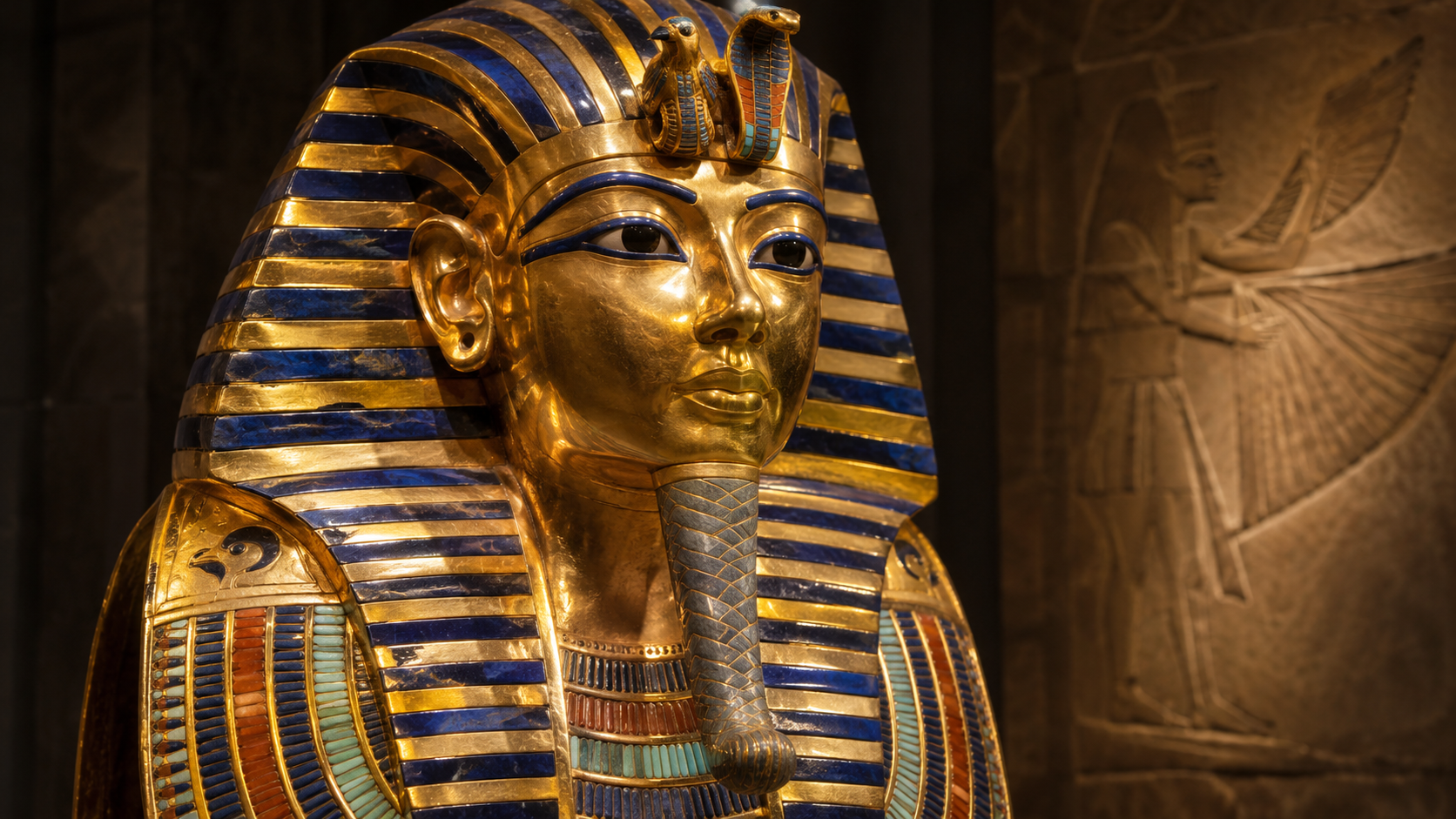
Its serene expression, brilliant gold surface, deep-blue headdress and carefully arranged gemstone inlays have fascinated generations of visitors, historians and archaeologists.
Yet the mask was never intended simply to be admired.
For the ancient Egyptians, death was not necessarily the end of existence. It was a transition into another realm, where the deceased hoped to achieve renewal, divine protection and everlasting life.
The golden mask of Tutankhamun belonged to this sacred vision of existence.
It was placed over the head and shoulders of the mummified king, forming part of an elaborate burial designed to preserve his identity and assist his transformation in the afterlife.
Its gold represented more than royal wealth.
Its blue materials recalled the divine and celestial world.
Its protective symbols invoked powerful goddesses.
Its inscriptions connected the king’s body with the gods themselves.
The gemstones, colours and sacred imagery were therefore part of a sophisticated religious composition.
To understand the mask fully, we must look beyond its beauty and enter the spiritual world of ancient Egypt.
1. Tutankhamun: The Young Pharaoh and His Extraordinary Legacy
Tutankhamun ruled during the Eighteenth Dynasty of Egypt’s New Kingdom, in the fourteenth century BCE.
He became king while still a child and died in his late teens.
His reign followed a period of profound religious change associated with Akhenaten, whose policies had elevated the worship of the Aten.
Under Tutankhamun, traditional cults and religious institutions regained prominence.
His name, meaning approximately “Living Image of Amun,” reflects the restored importance of Amun in royal religion.
The discovery of the tomb
In November 1922, Howard Carter and his Egyptian excavation workforce discovered Tutankhamun’s tomb, KV62, in the Valley of the Kings.
The discovery was remarkable because the tomb retained an extraordinary quantity of funerary equipment.
Although it had been entered in antiquity, much of its contents survived.
The burial included furniture, jewellery, ceremonial objects, shrines, coffins and numerous objects intended for the king’s continued existence.
The famous golden mask was not first revealed when the tomb entrance was discovered in 1922.
It was uncovered on the mummy during the investigation of the nested coffins in 1925.
Why the mask became so important
The mask combined artistic mastery with an exceptionally rich religious message.
Its idealised facial features presented the king in a perfected form.
Its materials evoked divine permanence.
Its inscriptions offered protection.
Its royal symbols affirmed that Tutankhamun remained a king even after death.
It was, in effect, a sacred face prepared for eternity.
2. The Egyptian Understanding of Death and Eternal Life
Ancient Egyptian religion included a complex understanding of the human person and existence after death.
Concepts such as the ka, ba and akh described different dimensions of life, identity and transformed existence.
These concepts cannot be reduced to a simple modern definition of the soul.
The ka
The ka was associated with a person’s vital identity and continued existence.
Funerary offerings helped sustain the deceased within the religious framework of the afterlife.
The ba
The ba represented an aspect of personal identity capable of movement between different realms.
It is frequently depicted as a human-headed bird.
The preservation and recognition of the deceased remained important within funerary belief.
The akh
The akh represented a transformed and effective state of existence achieved through appropriate funerary processes.
Becoming an akh was connected with successful transition into the divine world.
The importance of the body
Mummification preserved the physical remains of the deceased.
Tombs, coffins, statues and funerary masks contributed to maintaining identity and supporting the hoped-for transformation.
Tutankhamun’s mask therefore served a purpose far beyond covering the face.
It helped present the deceased king as an enduring, divinely protected being.
3. The Golden Mask and the God Osiris
Osiris was among the most important deities associated with death, resurrection and the afterlife.
In Egyptian mythology, Osiris was killed and subsequently restored through divine action associated particularly with Isis.
His story became a central expression of regeneration and continued existence after death.
Tutankhamun as Osiris
The funerary mask presents Tutankhamun in a divine and idealised form closely associated with Osiris.
The king’s ceremonial beard, perfected facial appearance and sacred inscriptions contribute to this transformation.
In the royal funerary tradition, the deceased king could be identified with Osiris.
This identification expressed the hope that the king would overcome death and participate in eternal existence.
The theological meaning
The mask was not merely a portrait of a deceased ruler.
It represented the king as he was intended to exist in the afterlife.
The human face and divine attributes were united.
This was one of the fundamental purposes of Egyptian funerary art: to make religious transformation visible through material form.
4. Gold: The Divine Flesh of the Gods
Gold is the most visually dominant material in Tutankhamun’s mask.
Its importance cannot be understood through wealth alone.
In ancient Egyptian religious symbolism, gold was associated with the gods and with enduring, incorruptible existence.
Its brilliance evoked sunlight and divine radiance.
Its resistance to ordinary corrosion made it particularly appropriate for objects intended to endure.
The flesh of the gods
Egyptian religious imagery could describe the flesh of the gods as golden.
The golden surface of Tutankhamun’s mask therefore helped express his transformation from mortal ruler into a divinely associated being.
Gold and the sun god Re
Re, also written Ra, was the great solar deity.
The sun’s daily movement across the sky and its return after darkness became a powerful model for renewal.
Gold’s radiant appearance created a natural visual connection with solar divinity.
Gold and eternal kingship
The mask also communicated royal permanence.
Tutankhamun’s earthly reign had ended, but the funerary image presented his kingship as continuing within the sacred order of the afterlife.
Gold made this theological message visible.
5. Lapis Lazuli: The Deep Blue of the Divine World
Among the most recognisable features of the mask are its deep-blue elements.
Lapis lazuli appears in the eyebrows, eye surrounds and decorative inlays.
The material was highly valued in ancient Egypt.
Its intense blue colour could evoke the heavens, divine mystery and the celestial realm.
The hair of the gods
Ancient Egyptian descriptions of divine bodies could associate the gods’ hair with lapis lazuli.
This makes the combination of gold and blue especially significant.
Gold evoked divine flesh.
Lapis lazuli evoked divine hair and celestial identity.
Together, they helped transform the king’s appearance into something beyond ordinary humanity.
A gemstone from distant lands
Lapis lazuli was not an ordinary local Egyptian stone.
Important ancient sources were located far to the east, particularly in the region of present-day Afghanistan.
Its presence in Egyptian royal objects reflects long-distance exchange networks and the considerable value placed upon the material.
Spiritual meaning
Dark blue was associated with the protective night sky and the divine realm.
Within funerary symbolism, lapis lazuli could therefore evoke celestial protection and the enduring presence of the gods.
On Tutankhamun’s mask, the material contributed to the sacred visual identity of the transformed king.
6. The Eyes of the Pharaoh: Quartz, Obsidian and Divine Vision
The eyes are among the mask’s most extraordinary details.
Their carefully constructed appearance gives the golden face a remarkable sense of presence.
The eyes incorporate light-coloured material described as quartz in museum documentation, while the dark pupils are formed from obsidian.
The eyebrows and surrounding outlines include lapis lazuli.
Why were the eyes important?
In Egyptian religious thought, sight was more than a physical ability.
Vision could be associated with awareness, recognition, protection and divine power.
The funerary mask helped preserve the identity of the king.
Its lifelike eyes contributed to the impression that Tutankhamun remained capable of perceiving the world beyond death.
The solar boats of Re
The protective inscription on the mask identifies the king’s eyes with the day and night boats of the sun god Re.
This is an especially powerful theological statement.
The sun’s journey across the sky and through the night represented a cycle of disappearance and renewal.
By connecting the king’s eyes with the solar boats, the inscription placed his transformed existence within the eternal movement of the sun.
The meaning of quartz and obsidian
Quartz provided the light appearance of the eyes, while obsidian created dark pupils.
Their contrast achieved remarkable visual realism.
It is tempting to assign separate mystical functions to every mineral, but the strongest documented religious meaning comes from the mask’s complete iconography and its protective inscription.
The material craftsmanship and the theology worked together.
7. Carnelian: The Red Colour of Life, Blood and Solar Power
Carnelian was an important gemstone in ancient Egyptian jewellery and amulets.
Its colours range from orange to reddish brown.
The warm red appearance made it particularly suitable for religious symbolism.
Red in Egyptian belief
Red could represent life-sustaining blood, vitality, solar power and strength.
However, Egyptian colour symbolism was complex.
Red could also be associated with danger, disorder or destructive forces.
Its meaning depended on context.
Carnelian in Tutankhamun’s mask
Carnelian is included in the official material identification of the mask.
The original excavation documentation also describes carnelian inlays and the use of quartz backed with red pigment to imitate its appearance.
This is an important detail.
Not every red decorative element should automatically be identified as natural carnelian.
Spiritual significance
Within the wider Egyptian funerary tradition, red gemstones could evoke vitality, protection and the continuing force of life.
Such symbolism was especially appropriate for objects associated with rebirth.
However, we should distinguish the general religious meaning of red stones from a specific, unrecorded magical function assigned to every individual inlay.
8. Amazonite: Green Stone and the Promise of Renewal
Amazonite is a green to blue-green variety of microcline feldspar.
It was among the green materials used in ancient Egyptian jewellery and funerary objects.
Early descriptions of Tutankhamun’s mask record green feldspar in the broad collar.
The spiritual importance of green
Green was a particularly meaningful colour in Egyptian religion.
It could represent vegetation, fertility, joy, regeneration and the renewed life of the deceased.
The natural return of plant growth offered a powerful image of rebirth.
Osiris and regeneration
Osiris was sometimes represented with green skin.
This colour symbolised regeneration and the restoration of life.
Green gemstones therefore belonged to a wider religious language of renewal.
Amazonite and divine protection
Modern interpretations sometimes connect amazonite with Hathor, goddess of love, music, joy and important aspects of protection.
Hathor was indeed associated with turquoise and the mining regions of Sinai.
However, the presence of green feldspar in Tutankhamun’s mask does not by itself establish that every amazonite element was a specific invocation of Hathor.
Its strongest historical interpretation is through the broader Egyptian symbolism of green, regeneration and the afterlife.
9. Turquoise: Protection, Joy and the Goddess Hathor
Turquoise held a distinguished place in ancient Egyptian culture.
Its blue-green colour was admired in jewellery, ceremonial objects and amulets.
Egyptians obtained turquoise from mining regions in the Sinai Peninsula.
Hathor, Lady of Turquoise
Hathor was associated with several aspects of divine life, including love, music, joy and maternal protection.
She also had a significant connection with mining regions.
At Serabit el-Khadim in Sinai, Hathor was worshipped as the Lady of Turquoise.
This is a historically documented religious association.
Turquoise and sacred colour
The blue-green colour of turquoise could evoke the sky, water, fertility and renewal.
Such associations made it especially appropriate for jewellery and protective objects.
Turquoise in the mask
Turquoise appears in some published material descriptions of the mask.
The original excavation records also identify turquoise-coloured glass in certain decorative elements.
This distinction matters because Egyptian craftsmen frequently combined natural stones with artificial materials that reproduced desirable colours.
The theological effect could depend on colour and appearance as well as the natural identity of the material.
10. Wadjet and Nekhbet: The Two Protective Goddesses
On the forehead of Tutankhamun’s mask appear two extraordinary royal emblems.
One is a rearing cobra.
The other is a vulture.
They represent the goddesses Wadjet and Nekhbet.
Wadjet: Protector of Lower Egypt
Wadjet was associated with the cobra and the protection of kingship.
The upright cobra, known as the uraeus, was a powerful royal symbol.
It represented divine authority and the capacity to defend the king.
Nekhbet: Protector of Upper Egypt
Nekhbet was represented by a vulture.
She was associated with Upper Egypt and royal protection.
The union of the Two Lands
Together, Wadjet and Nekhbet symbolised the unity of Upper and Lower Egypt.
Their presence on the mask affirmed Tutankhamun’s royal authority.
More importantly, they extended that protection into the afterlife.
The king was not portrayed as an isolated deceased individual.
He remained surrounded by divine guardians.
11. The Protective Spell: Giving the Mask Divine Power
One of the most important features of the mask is not visible from the front.
The back and shoulders carry an inscription associated with Chapter 151 of the ancient Egyptian Book of the Dead.
This text is essential to understanding the mask’s religious purpose.
The Book of the Dead
The Book of the Dead was not a single book in the modern sense.
It was a collection of funerary compositions used in different combinations over many centuries.
These texts were intended to assist the deceased in navigating the afterlife.
They included invocations, protective formulas and descriptions of divine transformations.
The mask as a sacred instrument
The inscription on Tutankhamun’s mask identifies parts of the king’s body and face with divine beings.
His forehead is associated with Anubis.
His eyes are connected with the solar boats.
His eyebrows are placed within the company of the gods.
Other parts of the mask are similarly integrated into the divine world.
Why the inscription mattered
The words were not merely decorative.
Within ancient Egyptian belief, sacred speech and properly performed rituals could contribute to the effectiveness of funerary objects.
The mask therefore combined material craftsmanship with religious language.
Its protective function depended upon the complete ritual and theological framework.
A transformed divine body
By identifying the king’s physical features with gods, the inscription helped express his transformation.
The mortal body was symbolically incorporated into a divine order.
The mask became a sacred interface between the preserved mummy and the hoped-for eternal existence.
12. Anubis: Guardian of Mummification and the Dead
Anubis was one of the most important deities associated with embalming and funerary protection.
He was commonly represented as a jackal or a jackal-headed figure.
Protection of the body
Anubis was closely connected with the preparation and preservation of the deceased.
His religious role made him especially relevant to royal burials.
Anubis and Tutankhamun’s mask
The protective inscription identifies the king’s forehead with Anubis.
This association reflects the god’s role in safeguarding the deceased and the funerary transformation.
The wider burial
Tutankhamun’s tomb contained other objects associated with Anubis, including a striking shrine bearing a recumbent jackal figure.
The mask therefore belonged to a much larger religious environment in which divine protection surrounded the deceased king.
13. Re and the Eternal Journey of the Sun
The sun god Re occupied a central position in Egyptian religion.
The sun’s daily journey across the sky was understood through a rich mythological framework.
At night, the solar deity travelled through the underworld.
At dawn, the sun emerged again.
Death and rebirth
The solar cycle provided an important model for regeneration.
The sun disappeared into darkness and returned with renewed light.
This pattern offered a powerful religious analogy for the deceased king’s hoped-for resurrection.
Tutankhamun’s golden face
The gold of the mask evoked divine radiance.
The solar associations of the eyes connected the king to Re’s continuing journey.
Together, these features presented Tutankhamun as participating in the cosmic cycle of renewal.
The mask was therefore not simply a representation of royal splendour.
It was an image of everlasting transformation.
14. Gemstones, Amulets and Magical Protection in Ancient Egypt
Gemstones were widely used in ancient Egyptian amulets and funerary jewellery.
Their religious meanings could derive from colour, shape, material, inscription or ritual use.
The protective function of amulets
Amulets could be worn during life or placed among the wrappings of the deceased.
They were intended to provide protection, regeneration or assistance in the afterlife.
Colour as a sacred language
Certain colours carried recurring associations.
Red could represent blood, vitality and powerful protective forces.
Green could symbolise vegetation, fertility and rebirth.
Dark blue could evoke the protective night sky.
Light blue could suggest the daytime sky or primordial waters.
These associations were not rigid rules.
Their meanings could change according to the object and religious context.
Natural gemstones and artificial materials
Ancient Egyptian craftsmen also used faience and coloured glass.
These materials could reproduce the colours of valued natural stones.
Their use demonstrates that visual symbolism was not always dependent upon the mineral’s natural origin.
The appearance and religious context of an object could be as important as its composition.
15. The Broad Collar: A Sacred Arrangement of Colour
The broad collar extending across Tutankhamun’s chest is among the most elaborate decorative features of the mask.
It contains carefully arranged rows of coloured materials.
The original excavation records describe combinations of lapis lazuli, quartz, green feldspar and coloured glass.
The visual rhythm of the collar
The arrangement alternates dark blue, light and green elements.
This creates a striking pattern that complements the gold surface.
More than decoration
In the context of Egyptian royal funerary art, such an arrangement could communicate divine splendour, protection and renewal.
The colours echoed religious themes found throughout Egyptian jewellery.
Falcon-head terminals
The collar ends in decorative falcon-head elements.
Falcon imagery was closely associated with Horus, a deity of kingship and royal protection.
The collar therefore participated in the wider symbolic language of the king’s divine identity.
16. The Mask as a Masterpiece of Sacred Craftsmanship
The mask was created by highly skilled Egyptian artisans.
Its construction required expertise in goldworking, gemstone preparation, inlay and surface finishing.
Goldworking
Gold sheets were shaped, joined and finished to create the mask’s idealised face and ceremonial features.
Gemstone inlay
Natural stones and coloured artificial materials were fitted into prepared settings.
The craftsmen exploited differences in colour, transparency and surface appearance.
The illusion of divine permanence
The result was a face that appeared calm, youthful and untouched by death.
This artistic perfection was directly connected with the religious purpose of the object.
Tutankhamun was presented not as a decaying mortal body but as a king prepared for eternal life.
17. A Brief Scientific Comparison of the Mask’s Materials
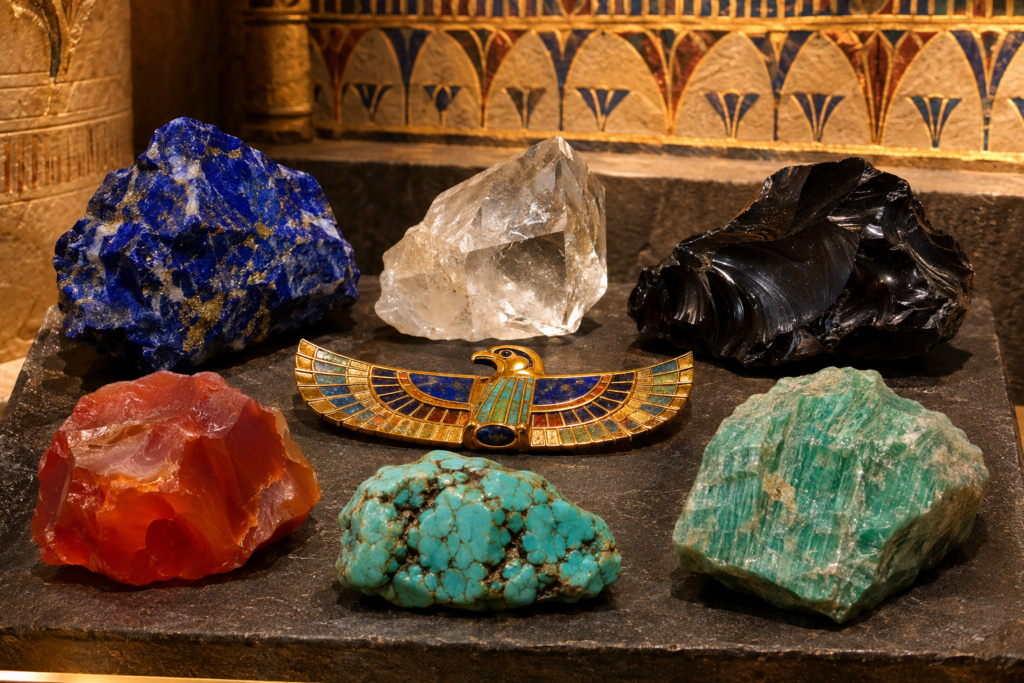
The mask’s materials possess distinct mineralogical and physical properties.
| Material | Scientific identity | Role or appearance |
|---|---|---|
| Gold | Metallic element, Au | Principal structural and decorative material |
| Lapis lazuli | Rock composed mainly of lazurite and associated minerals | Deep-blue eyebrows, eye surrounds and decorative inlays |
| Quartz | Silicon dioxide, SiO₂ | Light-coloured eye elements and decorative inlays |
| Obsidian | Natural volcanic glass | Dark pupils |
| Carnelian | Orange-to-red chalcedony | Red decorative inlays |
| Green feldspar / amazonite | Feldspar-group mineral material | Green elements of the broad collar |
| Turquoise | Hydrated copper aluminium phosphate | Blue-green gemstone material in published identifications |
| Coloured glass | Artificial silicate glass | Inlays imitating or complementing natural gemstones |
| Faience | Glazed siliceous ceramic material | Decorative blue-green material |
Why identification matters
Not every coloured inlay is necessarily a natural gemstone.
Some materials were manufactured to imitate precious stones.
The original excavation records distinguish natural carnelian from quartz coloured to resemble it, and natural stones from coloured glass.
This is important for both archaeological accuracy and modern gemmology.
What science can establish
Mineralogical examination can identify materials, manufacturing techniques and certain aspects of provenance.
Archaeological research can reconstruct the object’s historical and religious context.
However, scientific measurements cannot demonstrate that the materials literally granted immortality or transmitted supernatural protection.
Those functions belonged to the theological beliefs of ancient Egypt.
18. Where Egyptian Theology and Modern Science Meet
The mask of Tutankhamun can be understood through two complementary fields of study.
The religious interpretation
For ancient Egyptians, the mask participated in a sacred process intended to protect the king and assist his transformation into eternal life.
Gold, gemstones, divine imagery and protective inscriptions formed a coherent religious composition.
The scientific interpretation
For archaeologists and gemmologists, the mask is evidence of advanced craftsmanship, material knowledge, long-distance exchange and funerary practice.
Its gold, stones and glass can be studied through physical and chemical methods.
Respecting both perspectives
The spiritual meaning of the mask should not be dismissed merely because its supernatural functions cannot be demonstrated scientifically.
At the same time, historical beliefs should not be presented as experimentally verified physical effects.
The mask’s importance lies in its extraordinary combination of religious imagination, artistic skill and material sophistication.
19. The Enduring Legacy of Tutankhamun’s Golden Mask
More than three thousand years after its creation, Tutankhamun’s mask remains one of the most recognisable objects from ancient Egypt.
Its extraordinary appearance continues to inspire interest in archaeology, ancient religion, jewellery and gemstone symbolism.
The mask also reveals the sophistication of Egyptian religious thought.
Its materials were not chosen merely to create a beautiful object.
They contributed to an image of divine kingship, protection and rebirth.
The blue of lapis lazuli, the brilliance of gold, the carefully constructed eyes and the protective symbols all formed part of a sacred vision of existence beyond death.
A face that survived millennia
Tutankhamun’s earthly reign was relatively brief.
Yet the funerary image created for him has endured for more than thirty centuries.
The mask achieved an extraordinary form of historical permanence, even though the religious promise of eternal life belongs to the beliefs of the civilisation that produced it.
20. Conclusion: The Sacred Beauty of Eternal Life
The golden mask of Tutankhamun is much more than a masterpiece of ancient jewellery.
It is a remarkable expression of Egyptian theology.
Its gold evokes the divine body.
Its lapis lazuli recalls the celestial world.
Its red and green materials participate in a language of vitality and regeneration.
Its cobra and vulture invoke the protection of Wadjet and Nekhbet.
Its inscriptions unite the king with Osiris, Re, Anubis and other divine powers.
Every aspect contributes to the central religious purpose of the object: the preservation and transformation of the deceased king.
The mask was created not simply to remember Tutankhamun, but to help him exist forever.
Today, it allows us to explore the extraordinary relationship between precious materials, religious belief and artistic achievement in ancient Egypt.
Through its gemstones and sacred symbols, the mask preserves a vision of a civilisation in which beauty, divine protection and the hope of eternal life were inseparable.
Natural Gems Belgium – Our Perspective
At Natural Gems Belgium, we believe that gemstones deserve to be understood through both their natural properties and their cultural histories.
The golden mask of Tutankhamun demonstrates how precious materials could acquire profound religious significance.
Our Learning Center explores these traditions with respect for the people and civilisations that created them.
We distinguish historical beliefs from scientific conclusions while recognising the enduring cultural importance of gemstone symbolism.
Through gemmology, archaeology and historical research, we can better appreciate how natural stones became part of humanity’s most remarkable artistic and spiritual achievements.
References & Further Reading
The following references are institutional, archaeological and academic resources. They provide historical documentation, museum descriptions and scientific information without directing readers to competing gemstone retail pages.
1. Grand Egyptian Museum – The Golden Burial Mask of Tutankhamun
Official museum description of the mask, its religious significance, materials and protective inscription.
https://gem.eg/en/collection/artefacts/the-golden-burial-mask-of-tutankhamun
2. University of Oxford – Tutankhamun Spatial Archive: Gold Mask Object Card
Original excavation documentation by Alfred Lucas, including detailed descriptions of gemstone inlays, coloured glass and the collar.
https://tutankhamun.griffith.ox.ac.uk/object-cards/taa-i1256a3
3. University of Oxford – Re-creating Tutankhamun’s Mask in 3D
Research project using Harry Burton’s excavation photographs to reconstruct the mask and document its physical features.
4. Global Egyptian Museum – The Gold Mask of Tutankhamun
Museum database entry describing the funerary function, materials and protective symbolism of the mask.
https://globalegyptianmuseum.org/detail.aspx?id=15062
5. The Metropolitan Museum of Art – Turquoise in Ancient Egypt
Scholarly discussion of turquoise, ancient Egyptian gemstone colours and the use of carnelian, lapis lazuli and blue-green materials.
https://www.metmuseum.org/essays/turquoise-in-ancient-egypt
6. The Metropolitan Museum of Art – Ancient Egyptian Amulets
Educational study of amulets, protective beliefs, colour symbolism and the materials used in Egyptian funerary traditions.
https://www.metmuseum.org/essays/egyptian-amulets
7. UCLA Encyclopedia of Egyptology – Gemstones
Academic reference by James A. Harrell covering gemstone materials, Egyptian colour symbolism, archaeological evidence and religious uses.
https://escholarship.org/content/qt57f2d2sk/qt57f2d2sk.pdf
8. Smarthistory – Tutankhamun’s Tomb: Innermost Coffin and Death Mask
Art-historical discussion of Tutankhamun’s burial, funerary equipment and golden mask.
https://smarthistory.org/tutankhamuns-tomb-innermost-coffin-and-death-mask
9. University of Oxford – Tutankhamun Spatial Archive
Research archive containing excavation records, photographs and object documentation.
https://tutankhamun.griffith.ox.ac.uk
Historical note: Religious meanings are presented within the context of ancient Egyptian beliefs. Where specific gemstone-to-deity associations are uncertain, broader documented colour symbolism is distinguished from interpretation.
Scientific note: Ancient claims of supernatural protection, divine transformation and eternal life are historical religious beliefs, not scientifically demonstrated gemstone effects.
© Natural Gems Belgium — NGB 2.0 Learning Center