

Some gemstones become associated with a particular emotion.
Others acquire meanings connected with protection, prosperity or personal transformation.
But certain stones occupy a much deeper place within the religious imagination.
Their colours become part of sacred imagery.
Their appearance inspires descriptions of spiritual worlds.
And their symbolism becomes intertwined with ideas about human suffering, compassion and the possibility of liberation.
Lapis Lazuli offers one of the most fascinating examples.
Its intense blue appearance has made it a highly valued material in many historical cultures. Within Buddhist traditions, lapis-like blue imagery acquired a particularly important spiritual significance through its association with the Medicine Buddha, known in Sanskrit as Bhaiṣajyaguru.
In Buddhist religious literature and art, the Medicine Buddha is associated with the alleviation of suffering and the aspiration to help living beings.
His appearance is frequently described through the imagery of a brilliant blue precious substance, often translated or interpreted as Lapis Lazuli.
His Pure Land is similarly associated with a luminous blue realm.
These descriptions belong to Buddhist religious traditions.
They are not scientific claims about the physical healing abilities of Lapis Lazuli.
Nevertheless, they provide a remarkable example of how the symbolism of a gemstone can become connected with a profound spiritual principle:
compassion.
Today, this historical connection can inspire a contemporary contemplative practice.
Not a reconstruction of Buddhist religious ceremony.
Not an attempt to reproduce traditional mantras or sacred visualisations.
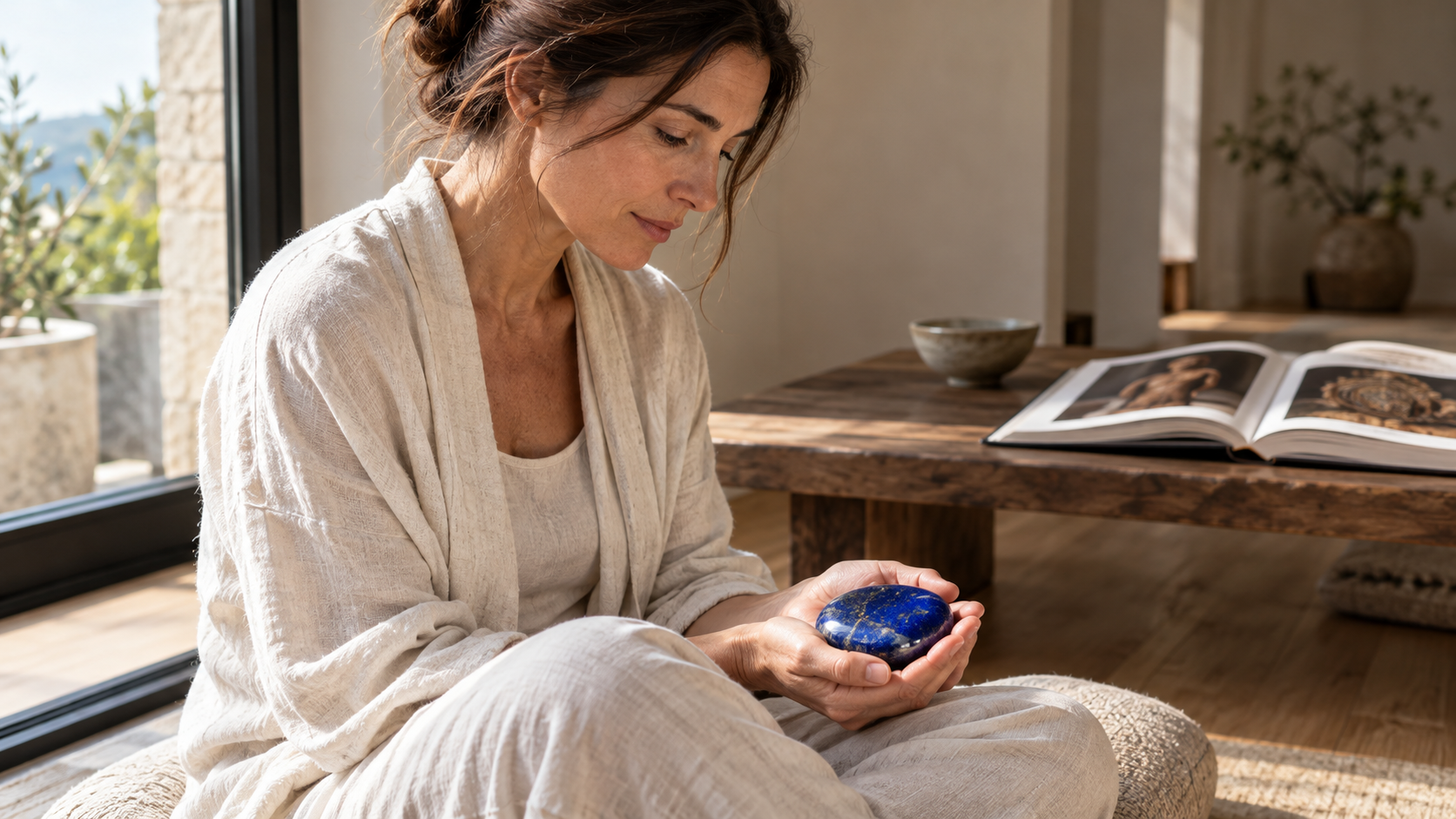
Instead, a simple meditation in which a Lapis Lazuli stone becomes a reminder to recognise suffering, respond with kindness and extend concern beyond ourselves.
Table of Contents
Why Lapis Lazuli?
Blue occupies a distinctive place in human visual experience.
We encounter it in the sky.
In distant mountains.
In deep water.
And in the changing colours of the natural world.
Within religious art, blue has also been used to express qualities that extend beyond ordinary physical appearance.
Depending on the tradition, it may suggest transcendence, sacred presence, wisdom or spiritual vastness.
Lapis Lazuli has been especially important because its striking blue colour made it a desirable material for artistic and religious expression.
The Smithsonian’s National Museum of Asian Art documents the significance of lapis-like blue imagery within Buddhist representations of the Medicine Buddha.
The museum explains that Buddhist texts describe this figure through an extraordinary blue appearance associated with the precious material.
The connection is not simply decorative.
It belongs to a religious framework in which the Medicine Buddha represents an aspiration to relieve suffering.
For a contemporary spiritual reader, this offers an interesting perspective.
A gemstone’s meaning does not always originate in modern crystal-healing interpretations.
Sometimes it emerges from centuries of religious storytelling, sacred art and philosophical reflection.
Who Is the Medicine Buddha?
The Medicine Buddha, or Bhaiṣajyaguru, is an important figure within several Buddhist traditions.
His name is commonly translated as Master of Healing.
The Smithsonian’s National Museum of Asian Art explains that devotion to the Medicine Buddha developed within Buddhist traditions originating in India and subsequently spread across several regions of Asia.
He became particularly significant within Mahayana and Vajrayana Buddhism.
Representations and devotional practices associated with him can be found in traditions connected with Tibet, China, Korea, Japan and other parts of Asia.
Within Buddhist religious narratives, the Medicine Buddha is associated with vows made for the benefit of living beings.
These vows express the aspiration to alleviate suffering and help beings overcome various forms of difficulty.
The Medicine Buddha is therefore more than a figure associated with physical illness.
His religious significance also concerns compassion, spiritual development and the wider Buddhist aspiration to reduce suffering.
It is important to understand these beliefs within their religious context.
Traditional claims concerning supernatural healing belong to Buddhist faith and practice.
They should not be interpreted as evidence that religious images, prayers or gemstones can replace medical treatment.
The Pure Land of Lapis Lazuli
One of the most remarkable aspects of Medicine Buddha symbolism is the description of his spiritual realm.
According to Buddhist religious literature discussed by the Smithsonian, the Medicine Buddha is associated with an eastern Pure Land described through the imagery of a precious blue substance.
This realm is frequently called the Pure Lapis Lazuli Land.
Within Buddhist thought, Pure Lands are sacred realms associated with particular Buddhas.
They are not simply physical landscapes comparable to ordinary geographical locations.
Their descriptions express religious and spiritual ideas.
The imagery of a luminous blue realm therefore belongs to a much larger symbolic world.
The colour, preciousness and radiance of the material contribute to the representation of a purified spiritual environment.
For readers interested in gemstone traditions, this is particularly fascinating.
The stone is not merely assigned a spiritual property.
Its appearance becomes part of the description of an entire sacred realm.
A Note on Historical Terminology
An important distinction is necessary when discussing the historical relationship between Lapis Lazuli and Buddhist literature.
Ancient Sanskrit and Tibetan terms for precious blue or blue-green materials do not always correspond precisely with modern gemstone names.
The Sanskrit term vaiḍūrya, for example, has frequently been translated as Lapis Lazuli.
However, scholarly translation notes published by 84000: Translating the Words of the Buddha explain that the term can also refer to materials identified differently in modern mineral terminology.
Consequently, historical references to a luminous blue precious substance should not automatically be interpreted as descriptions of one precisely identified modern gemstone.
The Smithsonian uses the familiar Lapis Lazuli interpretation when explaining the Medicine Buddha’s blue symbolism.
For the purposes of this article, Lapis Lazuli is therefore discussed as a recognised visual and cultural association, rather than as an exclusive identification of every historical reference.
This distinction allows the spiritual symbolism to be appreciated without oversimplifying the historical evidence.
Lapis Lazuli in Buddhist Art
The connection between Lapis Lazuli and Buddhism extends beyond literary descriptions.
The Metropolitan Museum of Art preserves an extraordinary fourth-century object from the ancient region of Gandhara, in present-day Pakistan.
It is a small Lapis Lazuli seal depicting the footprints of the Buddha.
Known as a Buddhapada representation, the footprints form part of a wider tradition of Buddhist symbolic imagery.
The object demonstrates that Lapis Lazuli could also be used directly in Buddhist artistic and devotional contexts.
Another object preserved by the Metropolitan Museum is an eighteenth-century Chinese figure of the Buddha carved from Lapis Lazuli.
These objects come from different periods and cultural settings.
They should not be interpreted as evidence of one continuous, universal gemstone-healing tradition.
Rather, they demonstrate how a precious blue material could acquire religious and artistic importance in different Buddhist environments.
The distinction matters.
Historical religious objects possess meanings shaped by their own traditions.
Modern crystal practices may draw inspiration from them, but they should not claim to reproduce those traditions automatically.
From Sacred Blue to Compassion
The most meaningful element of the Medicine Buddha’s symbolism is not simply the colour blue.
It is the religious aspiration associated with the figure.
The alleviation of suffering.
Within Buddhist traditions, compassion involves concern for beings who experience suffering and the wish that suffering might be relieved.
This idea extends beyond sympathy.
Sympathy may involve recognising that another person is experiencing difficulty.
Compassion includes a desire to respond with care.
The University of California, Berkeley’s Greater Good Science Center similarly describes compassion in terms of concern for suffering and the motivation to alleviate it.
This creates an interesting meeting point between historical religious symbolism and contemporary contemplative practice.
A Lapis Lazuli stone can become a symbolic reminder of compassion.
Not because it produces compassion through a scientifically measurable energy.
But because its historical associations provide a meaningful subject for reflection.
Compassion Is Different From Pity
Before beginning a meditation, it is useful to distinguish compassion from pity.
Pity can create distance.
One person observes another person’s suffering from a position of separation.
Compassion encourages a different perspective.
It recognises that difficulty and vulnerability are part of human experience.
Everyone encounters uncertainty.
Everyone experiences disappointment.
Everyone faces situations they cannot completely control.
This recognition does not mean that everyone’s circumstances are identical.
Nor does it mean that suffering should be minimised.
Instead, it encourages a basic awareness:
Other people experience difficulties that matter to them, just as our own difficulties matter to us.
That awareness provides the foundation for the contemporary meditation described below.
Choosing a Lapis Lazuli Stone for Meditation
The practice does not require a particular crystal shape.
A small polished Lapis Lazuli stone is sufficient.
You might choose:
- A smooth Lapis Lazuli palm stone.
- A small polished pocket stone.
- A rounded Lapis Lazuli cabochon.
- A simple Lapis Lazuli pendant.
- A small natural specimen.
A palm stone is particularly suitable for seated meditation because it can rest comfortably in the hand.
A pendant may be useful for someone who prefers to carry a symbolic reminder throughout the day.
The stone does not need to be unusually large or visually perfect.
Choose one that feels comfortable to handle.
The purpose is not to evaluate the quality of the gemstone.
It is to establish a personal contemplative relationship with the object.
Creating a Quiet Space
Choose a comfortable place where you can sit without interruption for approximately ten minutes.
You do not need a dedicated meditation room.
A chair beside a window is sufficient.
A cushion in a quiet corner can work equally well.
Place the Lapis Lazuli in front of you.
Keep the surrounding space relatively simple.
There is no need to recreate a Buddhist shrine or introduce religious objects that do not belong to your own practice.
The meditation described here is contemporary and non-devotional.
It draws inspiration from the symbolism of compassion while respecting the distinction between personal reflection and formal Buddhist religious practice.
Sit comfortably.
Allow your shoulders to relax.
Then pick up the stone.
A Ten-Minute Lapis Lazuli Compassion Meditation
This exercise is inspired by the symbolic association between Lapis Lazuli and the Medicine Buddha, together with contemporary compassion-meditation principles.
It is not a traditional Medicine Buddha ritual.
It does not involve sacred mantras, ritual initiation or claims of supernatural healing.
Its purpose is simple:
to practise recognising the needs of others with greater kindness and awareness.
Minute One — Observe the Stone
Hold the Lapis Lazuli in your open palm.
Look at its surface.
Notice the blue colour.
Observe how the light changes across the stone.
Do not attempt to interpret what you see.
Simply observe.
Then close your hand gently around the stone.
Allow your attention to move from the visual appearance to the physical sensation of holding it.
The stone has weight.
It occupies space.
It is present.
Use that physical presence as the beginning of the meditation.
Minute Two — Remember the Symbolism
Bring to mind the historical association between Lapis Lazuli and the Medicine Buddha.
Remember that the religious imagery connects the precious blue material with an aspiration to alleviate suffering.
Do not imagine that the gemstone possesses healing powers.
Instead, consider the human value represented by the symbolism.
Compassion.
Ask yourself:
What does compassion mean in my everyday life?
You do not need an immediate answer.
Allow the question to remain present.
Minutes Three and Four — Begin With Someone You Care About
Think of someone toward whom you naturally feel affection.
A family member.
A friend.
A partner.
Or another person whose wellbeing matters to you.
Imagine that person as they ordinarily appear.
Now remember that they, too, experience difficulties.
Some may be visible.
Others may remain private.
Without attempting to solve anything, silently offer a simple wish:
May you experience kindness and support.
Pause.
Allow the intention to remain present.
There is no need to produce a particular emotion.
The act of deliberately extending goodwill is the focus of the exercise.
Minutes Five and Six — Extend Compassion Beyond Familiar Relationships
Now think of someone you encounter occasionally but do not know particularly well.
Perhaps a neighbour.
A colleague.
Someone who works in a nearby shop.
Or a person you regularly pass during ordinary activities.
You may know very little about their life.
That is precisely the point.
It is easy to recognise suffering when we know someone’s circumstances.
It is more difficult when their experiences remain invisible.
Consider that this person also has responsibilities, uncertainties and concerns.
Then silently offer the same intention:
May you experience kindness and support.
Notice whether extending compassion to someone less familiar feels different.
There is no correct emotional response.
Simply observe.
The Importance of Common Humanity
Contemporary compassion research often emphasises the importance of recognising shared human experiences.
The Greater Good Science Center at the University of California, Berkeley provides a dedicated Common Humanity Meditation designed around this principle.
The exercise encourages practitioners to recognise similarities between themselves and others.
This does not mean ignoring differences in culture, circumstances or personal experience.
Instead, it means recognising that human vulnerability is not limited to ourselves or the people closest to us.
For the Lapis Lazuli practice, this idea provides a useful bridge between spiritual symbolism and everyday relationships.
The stone becomes a reminder to look beyond immediate personal concerns.
Not toward an imaginary world.
But toward the real people who share our ordinary environment.
Minutes Seven and Eight — Include Yourself
Compassion should not exclude the person practising it.
Now direct your attention toward your own experience.
Consider one difficulty you are currently facing.
It does not need to be dramatic.
Perhaps you are tired.
Uncertain about a decision.
Concerned about someone.
Or simply managing too many responsibilities.
Recognise that your own difficulties also deserve thoughtful attention.
Then silently repeat:
May I approach my difficulties with patience and kindness.
Notice whether this feels easier or more difficult than extending compassion toward another person.
Some people find it natural to care for others but uncomfortable to direct the same kindness inward.
Others experience the opposite.
Neither response is a failure.
The purpose is awareness.

Minute Nine — Choose One Small Act of Kindness
Now consider how the meditation might influence the remainder of your day.
Compassion becomes particularly meaningful when it affects behaviour.
Ask:
What small action could make someone’s day a little easier?
Perhaps you could listen without interrupting.
Offer practical assistance.
Express appreciation.
Check on someone who has been having a difficult time.
Or simply respond more patiently during an ordinary conversation.
Choose one realistic action.
Do not turn the meditation into a demanding personal obligation.
The action should be something you can reasonably accomplish.
Minute Ten — Close the Meditation
Open your eyes if they were closed.
Look once more at the Lapis Lazuli.
Remember the symbolic connection with compassion.
Then place the stone down.
Take one natural breath.
The meditation is complete.
You do not need to experience an extraordinary sensation.
You do not need to feel transformed.
The practice has served its purpose if it has encouraged even a brief moment of deliberate concern for others.
Why Compassion Meditation Is Worth Exploring
Compassion meditation has attracted considerable interest within contemporary psychological research.
The University of California, Berkeley’s Greater Good Science Center provides a research-informed compassion meditation that involves directing concern toward people experiencing difficulties.
The centre also discusses research examining how compassion training may influence prosocial behaviour.
One study published in Psychological Science in 2013 examined the effects of compassion training on altruistic behaviour and neural responses to suffering.
Participants who completed the compassion-training programme demonstrated greater generosity in an experimental task than participants in a comparison condition.
The findings concern the meditation training itself.
They do not establish that Lapis Lazuli enhances compassion or produces therapeutic effects.
This distinction is essential.
The contemplative practice is the activity being investigated.
The gemstone is an optional symbolic object.
Combining them may be personally meaningful, but any additional benefit from the stone itself remains unproven.
A Lapis Lazuli Pocket Stone for Everyday Compassion
The meditation does not need to remain confined to a quiet room.
A smaller Lapis Lazuli can be carried as a pocket stone.
Rather than treating it as a source of supernatural protection or healing, use it as a reminder of the intention established during meditation.
For example, imagine a difficult conversation.
You feel impatient.
Perhaps someone is explaining a problem you do not immediately understand.
Before responding, you notice the Lapis Lazuli in your pocket.
That moment can become a cue.
Pause.
Listen.
Ask a question.
Consider whether the other person needs advice, practical help or simply attention.
The stone has not changed the situation.
It has reminded you of the kind of response you wanted to practise.
This is a practical way to integrate spiritual symbolism into ordinary life.
Compassion Does Not Mean Accepting Everything
There is an important misunderstanding that sometimes appears in spiritual discussions.
Compassion is not the same as agreeing with everyone.
It does not require accepting harmful behaviour.
It does not mean abandoning personal boundaries.
And it does not oblige someone to solve every problem they encounter.
Compassion can exist alongside disagreement.
It can coexist with a firm boundary.
It may even require recognising that professional assistance is needed.
A compassionate response can be:
I understand that this is difficult, but I cannot take responsibility for solving it.
Or:
I care about your wellbeing, but I need to protect my own boundaries.
The purpose of compassion practice is not to become endlessly accommodating.
It is to respond with greater awareness of suffering while remaining thoughtful about what action is appropriate.
The Difference Between Compassion and Healing Claims
The Medicine Buddha’s religious significance includes traditional beliefs about healing and the relief of suffering.
Some contemporary crystal-healing sources extend these associations to Lapis Lazuli itself.
They may describe the gemstone as possessing healing vibrations or the ability to influence physical and emotional conditions.
Such claims belong to metaphysical belief systems.
They are not established medical facts.
A Lapis Lazuli stone should not be presented as a treatment for illness.
Nor should a contemporary compassion meditation be described as a replacement for professional medical or psychological care.
It is possible to respect Buddhist religious symbolism without treating traditional supernatural claims as scientifically verified.
It is equally possible to appreciate Lapis Lazuli as a meaningful spiritual object without assigning it unsupported therapeutic powers.
This distinction preserves both cultural respect and factual responsibility.
Lapis Lazuli and the Meaning of Spiritual Generosity
There is another way to interpret the symbolism of compassion.
Generosity does not always involve money or material gifts.
Sometimes generosity means giving someone time.
Attention.
Patience.
Understanding.
Or the opportunity to speak without immediately being judged.
A Lapis Lazuli compassion practice can therefore focus on something less visible than charitable giving.
The generosity of attention.
Consider how often conversations become exchanges of competing concerns.
One person speaks.
The other prepares an answer.
Both may leave feeling unheard.
Now imagine a different approach.
You listen.
You allow the other person to finish.
You ask what they need.
You recognise that their experience matters even when it differs from your own.
That is a practical expression of compassion.
The Lapis Lazuli becomes a reminder of the intention.
The meaningful part remains the human interaction.
A Contemporary Spiritual Practice, Not an Ancient Ceremony
When drawing inspiration from religious history, cultural distinctions matter.
The Medicine Buddha belongs to established Buddhist traditions with their own scriptures, teachings, devotional practices and ritual frameworks.
These traditions are not interchangeable with modern crystal-healing systems.
Holding Lapis Lazuli while contemplating compassion does not automatically constitute a traditional Medicine Buddha practice.
Nor does it reproduce the religious significance of sacred Buddhist visualisations or mantras.
The exercise presented here is a contemporary, non-devotional meditation inspired by a documented historical association.
Readers who wish to understand the traditional religious practices more deeply should consult reliable Buddhist educational institutions, translated scriptures and museum scholarship.
Respecting the difference between historical religion and modern personal spirituality makes the subject more meaningful, not less.
Creating a Personal Compassion Tradition
A personal ritual does not need to be complicated.
You might practise the full meditation once a week.
Or hold your Lapis Lazuli for two minutes before beginning a demanding day.
Perhaps the stone remains on a small table beside your favourite reading chair.
Perhaps it travels in a pocket.
Perhaps it is worn as a pendant.
The physical form is less important than the consistency of the intention.
Over time, the stone may become associated with particular questions:
Am I listening carefully?
Am I recognising another person’s difficulties?
Can I respond with kindness without abandoning my own boundaries?
Is there one practical way I can help?
These questions transform the stone from a passive decorative object into a personal symbol of conduct.
The symbolism does not guarantee a particular outcome.
It simply invites reflection.
When Compassion Becomes Action
At the end of a meditation, it is tempting to consider the practice complete.
But compassion has another dimension.
It can influence what happens afterwards.
A kind message.
A thoughtful conversation.
A small practical favour.
A moment of patience.
A decision to seek appropriate help for someone who needs it.
These actions may seem ordinary.
That is precisely what makes them important.
Spiritual reflection does not need to remain separate from everyday life.
The values contemplated during meditation can become part of ordinary behaviour.
A Lapis Lazuli stone can accompany that transition.
From symbolic reflection.
To conscious intention.
To action.
The Deeper Meaning of Sacred Blue
The connection between Lapis Lazuli and the Medicine Buddha illustrates how a gemstone can become part of a much larger spiritual narrative.
In Buddhist religious imagery, the brilliant blue material helps express the sacred qualities associated with the Medicine Buddha.
The imagery belongs to traditions concerned with suffering, spiritual development and the aspiration to benefit living beings.
For contemporary crystal practitioners, the historical connection offers something different from the familiar lists of gemstone properties.
It provides a subject for meaningful contemplation.
Not simply:
What can this stone do for me?
But:
What can this stone remind me to offer others?
That is a significant change in perspective.
The focus moves away from acquiring a personal benefit.
It moves toward developing a quality of attention.
A willingness to notice.
To listen.
To care.
And, when appropriate, to help.
A Blue Stone, a Human Intention
Lapis Lazuli has inspired artists, religious imagery and spiritual interpretations across different periods of history.
Its association with the Medicine Buddha provides one particularly profound example of gemstone symbolism.
The brilliant blue imagery represents much more than visual beauty.
Within its Buddhist religious context, it participates in a tradition concerned with the relief of suffering.
A contemporary practitioner does not need to claim supernatural powers to find meaning in that association.
One small Lapis Lazuli stone can become a reminder of compassion.
A meditation can create time to reflect on the difficulties of others.
A simple intention can encourage a more thoughtful response.
And a small action can carry that intention into everyday life.
The stone does not need to heal.
It does not need to transform invisible energies.
It does not need to guarantee spiritual progress.
Its role can be much simpler.
To remind us that compassion is not only something we feel.
It is something we can choose to practise.
References & Further Reading
1. Smithsonian National Museum of Asian Art — Medicine Buddha Bhaishajyaguru: Master of Healing
An authoritative museum resource examining the Medicine Buddha’s origins, religious significance, symbolism and development across Asian Buddhist traditions.
Particularly relevant are its explanations of the Medicine Buddha’s luminous blue appearance, his association with Lapis Lazuli and the religious symbolism of his eastern Pure Land.
2. 84000: Translating the Words of the Buddha — Aśokadattā’s Prophecy
A scholarly translation and reference resource from the nonprofit Buddhist translation initiative 84000.
Its terminology notes provide important context for understanding the Sanskrit term vaiḍūrya and why historical references to precious blue materials should not always be equated with one modern gemstone identification.
https://84000.co/translation/toh76
3. Metropolitan Museum of Art — Intaglio Seal with Footprints of the Buddha
An official museum collection record documenting a fourth-century Lapis Lazuli seal from the ancient region of Gandhara.
The object demonstrates the historical use of Lapis Lazuli in Buddhist artistic and symbolic contexts.
https://www.metmuseum.org/art/collection/search/37541
4. Metropolitan Museum of Art — Figure of Buddha
An official collection record documenting an eighteenth-century Chinese Buddha figure carved from Lapis Lazuli.
This object provides another historical example of the material’s presence within Buddhist artistic traditions.
https://www.metmuseum.org/art/collection/search/61987
5. University of California, Berkeley — Compassion Meditation
Greater Good in Action, Greater Good Science Center.
A research-informed educational guide explaining a contemporary compassion meditation involving awareness of suffering, goodwill and concern for others.
The resource also discusses relevant psychological research, including the relationship between compassion training and altruistic behaviour.
https://ggia.berkeley.edu/practice/compassion_meditation
6. University of California, Berkeley — Common Humanity Meditation
Greater Good in Action, Greater Good Science Center.
An educational meditation exercise focused on recognising shared human experiences and cultivating compassion through awareness of similarities between ourselves and others.
This resource provides additional context for the contemporary practice described in the article.
https://ggia.berkeley.edu/practice/common_humanity_meditation
7. Weng et al. (2013) — Compassion Training Alters Altruism and Neural Responses to Suffering
Psychological Science, 24(7), 1171–1180.
A peer-reviewed study examining the relationship between compassion training, altruistic behaviour and neural responses to suffering.
The study supports discussion of compassion meditation as a psychological practice. It does not investigate Lapis Lazuli or establish therapeutic properties of gemstones.
https://doi.org/10.1177/0956797612469537
The religious symbolism discussed in this article reflects historically documented Buddhist traditions. Traditional beliefs concerning the Medicine Buddha, sacred realms and supernatural healing are presented as religious beliefs rather than scientifically established medical effects.
The Lapis Lazuli meditation described here is a contemporary contemplative exercise inspired by the symbolism of compassion. It is not presented as an authentic traditional Medicine Buddha ritual.
Scientific research concerning compassion meditation does not establish that Lapis Lazuli possesses healing properties or produces additional psychological benefits. Gemstones and spiritual practices should not replace appropriate professional healthcare or evidence-based treatment.
[…] contemporary crystal spirituality, Lapis Lazuli is often associated with wisdom, insight, truth and the search for deeper […]