Introduction: A Civilisation That Understood the Power of Colour
More than four thousand years ago, Egyptian craftsmen were already transforming natural minerals into extraordinarily sophisticated jewellery.
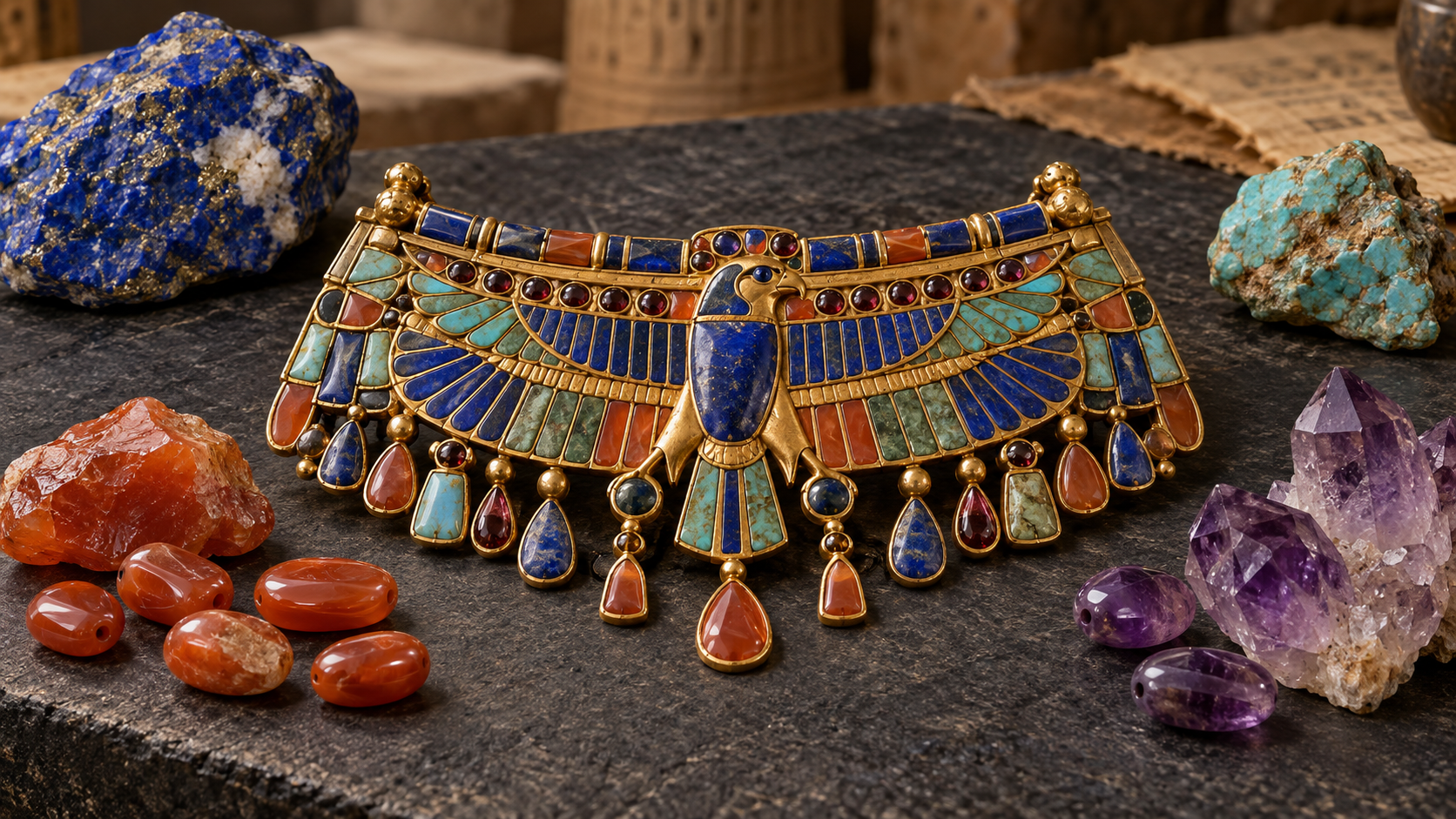
They worked with deep-blue lapis lazuli, reddish-orange carnelian, pale blue-green turquoise, purple amethyst and numerous other decorative stones.
These materials appeared in necklaces, bracelets, rings, ceremonial ornaments, amulets and elaborate royal jewellery.
Some were obtained from the deserts surrounding the Nile Valley.
Others travelled enormous distances through ancient exchange networks before reaching Egyptian workshops.
Yet the significance of these materials extended beyond their visual beauty.
Colour carried religious, cultural and political associations.
The selection of a particular stone could contribute to the symbolic meaning of an object.
A blue inlay might represent more than a decorative element. A red bead could have associations extending beyond its natural colour. Green materials were frequently connected with ideas of vegetation, renewal and life.
However, ancient Egyptian jewellery also reveals something equally important:
A sophisticated understanding of natural materials and the practical skills required to transform them into durable objects.
Modern archaeology allows us to investigate this relationship between geology, craftsmanship and cultural meaning.
By studying surviving artefacts, ancient mining sites, inscriptions and the mineral composition of jewellery, researchers can reconstruct aspects of an industry that developed thousands of years before modern gemmology.
This article explores the gemstones of ancient Egypt from a scientific and historical perspective.
Table of Contents
1. What Did the Ancient Egyptians Consider a Precious Stone?
The modern gemstone market frequently distinguishes between precious and semiprecious stones.
These categories do not adequately describe the value systems of ancient Egypt.
Today, diamonds, rubies, sapphires and emeralds dominate many discussions of valuable gemstones.
Ancient Egyptian jewellery followed different traditions.
The materials most frequently encountered in surviving ornaments include:
- Carnelian
- Lapis lazuli
- Turquoise
- Amethyst
- Feldspar
- Jasper
- Garnet
- Quartz
- Other coloured minerals and decorative stones
Gold was also exceptionally important.
However, the value of a material depended on more than its mineralogical identity.
Factors could include its colour, availability, difficulty of acquisition, suitability for carving and symbolic associations.
A carefully selected piece of turquoise or lapis lazuli could be highly desirable because it contributed to a specific visual and cultural composition.
Many surviving Egyptian ornaments also combine natural stones with manufactured materials.
This is an important distinction.
Not every blue or green element in ancient Egyptian jewellery is a natural gemstone.
Some are glass, glazed steatite or Egyptian faience.
Modern scientific examination has demonstrated that even historical museum identifications sometimes confused these materials.
Understanding ancient Egyptian jewellery therefore requires distinguishing between mineral identification, visual appearance and cultural interpretation.
2. Egypt’s Geological Advantage
Ancient Egypt occupied a geographically remarkable position.
The Nile Valley was bordered by extensive desert regions containing numerous mineral resources.
To the east lay the Eastern Desert, with its complex geological formations and mineral deposits.
To the northeast lay the Sinai Peninsula, an important source of turquoise and copper.
Farther south, Egypt maintained economic and political relationships with Nubia, a region particularly significant for gold.
These landscapes provided access to a wide variety of materials.
The Egyptians exploited geological resources for:
- Jewellery
- Sculpture
- Architecture
- Tools
- Pigments
- Decorative objects
- Religious and funerary equipment
Gemstone extraction formed part of a much broader tradition of mining and quarrying.
However, the presence of a mineral deposit did not automatically make its material easy to obtain.
Desert expeditions required water, food, transport, tools and organised labour.
Mining could involve significant logistical challenges.
The archaeological remains of these operations reveal that gemstone acquisition was sometimes a substantial administrative undertaking.
3. Turquoise: The Blue-Green Stone of Sinai
Few gemstones are as strongly associated with ancient Egypt as turquoise.
Turquoise is a hydrated copper-aluminium phosphate mineral.
Its chemical composition is commonly represented by:
CuAl₆(PO₄)₄(OH)₈·4H₂O
Its characteristic colours range from blue to green, with variations influenced by chemical composition and geological conditions.
Turquoise was especially valued for its distinctive blue-green appearance.
The most important ancient Egyptian sources were located in southwestern Sinai.
Two particularly significant mining districts were:
Wadi Maghara
and
Serabit el-Khadim.
Archaeological evidence from these areas includes mining remains, tools, habitation sites and inscriptions documenting Egyptian activity.
Royal expeditions were sent into Sinai during different periods of Egyptian history.
The region was also exploited for copper ores.
The turquoise obtained there was used for beads, amulets and decorative inlays.
However, modern museum research has established an important fact.
Despite its strong association with Egyptian culture, genuine turquoise was relatively scarce.
Its rarity contributed to the importance of materials that could reproduce a similar blue-green appearance.
4. Serabit el-Khadim and the Goddess Hathor
The mining district of Serabit el-Khadim provides a particularly interesting connection between geology and religion.
During the Middle Kingdom, a temple was established there in honour of the goddess Hathor.
Hathor was associated with several aspects of Egyptian religious life, including music, fertility, motherhood and protection.
At Serabit el-Khadim, she was also associated specifically with turquoise.
Ancient inscriptions refer to her as a mistress or lady of turquoise.
This association reflects the importance of the mineral within the cultural landscape of the mining district.
The presence of a temple near the mining operations also demonstrates that resource extraction could have a religious dimension.
Mining expeditions were not simply economic activities.
They could be accompanied by offerings, inscriptions and acts of devotion.
For archaeologists, the combination of mining remains and religious inscriptions provides valuable evidence about the organisation and cultural significance of ancient resource extraction.
5. Amethyst: Purple Quartz from the Eastern Desert
Amethyst was another important gemstone in ancient Egypt.
Mineralogically, amethyst is the purple variety of quartz.
Its chemical formula is:
SiO₂
Quartz crystallises in the trigonal crystal system.
Amethyst owes its purple coloration to iron-related colour centres within the quartz structure.
Its colour can range from pale lavender to deeper violet.
Ancient Egyptian craftsmen used amethyst in beads, jewellery and amulets.
Surviving Middle Kingdom ornaments demonstrate that the material was valued and worked with considerable skill.
Unlike lapis lazuli, which reached Egypt through long-distance exchange networks, important amethyst deposits were available within Egypt’s Eastern Desert.
One of the most significant archaeological locations is:
Wadi el-Hudi.
6. Wadi el-Hudi: An Ancient Amethyst Mining Industry
Wadi el-Hudi lies in the Eastern Desert southeast of Aswan.
Archaeological investigations have identified numerous ancient mining sites and associated settlements in the region.
The area is particularly important for understanding Egyptian amethyst extraction during the Middle Kingdom.
Modern research by the Wadi el-Hudi Expedition has documented mines, settlements, inscriptions and other archaeological remains.
The evidence demonstrates that amethyst extraction could involve substantial state-sponsored expeditions.
Some operations employed hundreds or more than a thousand workers, supported by administrators and security personnel.
These expeditions required extensive organisation.
Workers needed shelter, provisions, tools and transport.
Officials supervised operations and recorded activities.
Inscriptions sometimes identified the ruling pharaoh or the year of an expedition.
This information provides archaeologists with valuable chronological evidence.
The remains at Wadi el-Hudi also demonstrate that gemstone mining was connected to broader systems of labour organisation, political authority and economic administration.
An amethyst bead worn by an Egyptian elite individual could represent the final product of a complex operation involving miners, transport workers, administrators and specialist craftsmen.
The gemstone itself was only one stage in a much larger process.
7. Carnelian: The Importance of Red and Orange
Carnelian was one of the most widely used decorative stones in ancient Egyptian jewellery.
It is a reddish-orange to reddish-brown variety of chalcedony.
Chalcedony consists predominantly of microcrystalline quartz.
Carnelian’s characteristic colour is associated with iron-bearing constituents.
The material was suitable for producing:
- Beads
- Pendants
- Small amulets
- Decorative inlays
- Other carved ornaments
Its colours ranged from orange to deep reddish brown.
Carnelian also provided an important visual contrast with blue and green materials.
A particularly characteristic Egyptian jewellery palette combined:
Red carnelian
Blue-green turquoise
Deep-blue lapis lazuli
This combination appears in several surviving Middle Kingdom ornaments.
The resulting contrast was both visually striking and culturally meaningful.
Carnelian also demonstrates an important difference between ancient and modern gemstone preferences.
Its value in Egyptian jewellery did not depend on producing brilliant faceted stones.
Instead, colour, shape, polish and suitability for decorative arrangements were central considerations.
8. Lapis Lazuli: The Blue Stone That Travelled from Afar
Lapis lazuli occupies a special position in ancient gemstone history.
Its intense blue colour made it particularly desirable for jewellery and decorative objects.
However, lapis lazuli is not a single mineral species.
It is a rock composed of several minerals.
The most important contributor to its blue colour is generally:
Lazurite.
Other constituents may include calcite and pyrite.
Small metallic-looking pyrite grains can produce the familiar golden speckling seen in some lapis lazuli.
The most historically important source of lapis lazuli was located in the Badakhshan region of present-day Afghanistan.
The mineral deposits of this mountainous region supplied material to ancient exchange networks extending across substantial distances.
Archaeological research demonstrates that lapis lazuli travelled westward through networks connecting Central Asia, Mesopotamia, the Levant and Egypt.
This does not mean that every Egyptian lapis lazuli object can be assigned confidently to one particular mine.
Individual provenance requires appropriate evidence.
Nevertheless, Afghanistan’s Badakhshan deposits are central to the historical explanation of lapis lazuli distribution in the ancient Near East.
For Egyptian craftsmen, lapis lazuli represented access to a material that could not simply be collected from the nearby desert.
Its presence in jewellery therefore provides evidence of connections extending beyond the Nile Valley.
9. Why Blue Was So Important
Blue held important associations within ancient Egyptian visual culture.
Its use could evoke the sky, water and aspects of the divine world.
However, blue was not represented by one material alone.
Egyptian craftsmen could obtain blue or blue-green appearances using:
- Lapis lazuli
- Turquoise
- Certain feldspars
- Egyptian faience
- Glass
- Other manufactured pigments and decorative materials
This variety is important.
Two objects may have similar colours while being made from entirely different substances.
One may contain natural lapis lazuli.
Another may contain a manufactured blue material.
Their visual effect can be similar, but their geological and technological histories are different.
The selection of a material could reflect availability, cost, manufacturing requirements and the intended function of the object.
Modern gemmological analysis helps distinguish these possibilities.
10. Green Feldspar and the Problem of Gemstone Identification
Green feldspar was another important decorative material.
Some historical publications identify certain green feldspars as amazonite.
However, mineral identification requires care.
Amazonite is generally associated with green to blue-green microcline feldspar, but historical labels have not always been based on modern analytical confirmation.
The Metropolitan Museum of Art has documented cases in which ancient Egyptian blue-green stones were incorrectly identified.
Scientific examination revealed that some objects previously catalogued as beryl were actually turquoise or feldspar.
This is particularly important because visual appearance alone cannot reliably distinguish all blue-green materials.
Turquoise, feldspar, faience and certain other substances can resemble one another.
Modern identification may involve:
- Microscopic examination
- Elemental analysis
- Structural analysis
- Other appropriate non-destructive methods
For museum objects, destructive testing is often undesirable.
Researchers must therefore balance analytical certainty with conservation requirements.
The identification of ancient gemstone materials is not always straightforward.
Even when an object has been known for more than a century, new scientific techniques can change our understanding of its composition.
11. Egyptian Faience: An Artificial Material with Gemstone-Like Beauty
One of the most remarkable achievements of ancient Egyptian materials technology was the development and refinement of faience.
Egyptian faience was not a natural gemstone.
It was a manufactured material.
Its body consisted predominantly of silica-rich material, commonly based on finely divided quartz.
Other ingredients included alkaline substances, lime and colour-producing compounds.
The material was formed into objects and fired to produce a glazed surface.
Copper compounds were particularly important in creating characteristic blue-green colours.
The result could resemble turquoise.
Faience was used for:
- Beads
- Amulets
- Scarabs
- Small sculptures
- Decorative tiles
- Vessels
- Jewellery elements
The Metropolitan Museum of Art describes Egyptian faience as a silica-based ceramic material with a distinctive glazed surface.
It is not equivalent to modern tin-glazed earthenware, despite sharing the term faience.
The development of this material demonstrates that Egyptian craftsmen did more than work with naturally occurring minerals.
They also transformed mineral raw materials through controlled manufacturing processes.
This represents an important chapter in the history of materials science.
12. Why Faience Was More Than a Cheap Substitute
It would be misleading to describe all Egyptian faience simply as an inexpensive imitation of turquoise.
Although it could reproduce colours associated with desirable natural stones, faience developed its own important artistic and religious roles.
Its bright glazed surface was visually distinctive.
Blue-green faience objects were associated with concepts such as life, renewal and regeneration.
The material was used in objects intended for both everyday and ritual contexts.
Its manufacture also required technical knowledge.
Craftsmen had to understand how raw materials behaved during forming, drying and firing.
The production process could involve chemical reactions between silica, alkaline substances and colour-producing compounds.
The result was a material with properties different from those of the original ingredients.
Faience therefore demonstrates the relationship between natural mineral resources and early chemical technology.
The ancient Egyptians were not merely selecting attractive stones; they were also engineering materials to achieve desired visual and functional results.
13. Jasper, Garnet and Other Decorative Stones
Although turquoise, lapis lazuli, carnelian and amethyst receive considerable attention, Egyptian jewellery employed a broader range of materials.
Jasper occurs in several colours and was used for small decorative objects and amulets.
Garnet also appears in archaeological jewellery assemblages.
The garnet group includes several mineral species with different chemical compositions.
Ancient craftsmen did not classify these minerals according to modern gemmological species definitions.
Their choices were primarily informed by appearance, workability and cultural traditions.
Quartz and chalcedony were also important.
Some surviving necklaces combine several materials.
For example, a Middle Kingdom necklace in the Metropolitan Museum of Art’s collection contains carnelian, amethyst, garnet and hematite.
Such objects illustrate the diversity of materials available to Egyptian craftsmen.
They also demonstrate that jewellery frequently combined stones with different colours, textures and physical properties.
14. Gold and Gemstones: A Carefully Designed Relationship
Gold played an exceptionally important role in ancient Egyptian jewellery.
Egypt and neighbouring regions provided access to significant gold resources.
Gold could be shaped into:
- Beads
- Sheets
- Wire
- Rings
- Pendants
- Decorative settings
- Elaborate jewellery structures
Its workability made it particularly suitable for complex ornaments.
Gold also provided a striking visual contrast with coloured stones.
Deep-blue lapis lazuli, reddish carnelian and blue-green turquoise could be arranged within gold settings to create highly structured designs.
These combinations were not accidental.
Egyptian jewellery frequently incorporated religious imagery, royal names and symbolic motifs.
The gold framework supported the stones while also contributing to the meaning of the object.
The relationship between metal and gemstone was therefore both technical and artistic.
15. The Pectoral of Princess Sithathoryunet
One of the finest surviving examples of Middle Kingdom jewellery is the pectoral associated with Princess Sithathoryunet.
The object dates to the reign of Senwosret II, approximately 1887–1878 BCE.
It was discovered in her tomb at Lahun.
Today, it forms part of the collection of the Metropolitan Museum of Art.
The pectoral incorporates gold and numerous coloured stone inlays.
Materials include:
- Carnelian
- Lapis lazuli
- Turquoise
- Garnet
The associated necklace also includes green feldspar.
The pectoral contains approximately 375 small stone inlays arranged within a complex gold framework.
Its design incorporates royal and religious imagery.
Two falcons frame the central composition.
The name of Senwosret II appears within the design.
Additional figures and hieroglyphic elements express ideas associated with royal power, life and enduring rule.
The object demonstrates several important aspects of ancient Egyptian craftsmanship.
First, the individual stone elements had to be shaped with considerable precision.
Second, the coloured materials had to be selected and arranged to produce the intended visual composition.
Third, the gold framework had to accommodate numerous small inlays.
Finally, the finished object had to communicate a complex symbolic message.
This was not simply a collection of valuable stones.
It was a carefully engineered and culturally meaningful work of jewellery.
16. Ancient Egyptian Lapidary Techniques
The word lapidary refers to the working of gemstones and decorative stones.
Ancient Egyptian lapidary techniques differed substantially from modern precision faceting.
Egyptian craftsmen produced beads, cabochon-like forms, carvings, polished surfaces and shaped inlays.
The creation of these objects required several practical operations.
These could include:
Selecting suitable rough material
Reducing larger pieces to manageable sizes
Grinding and shaping
Drilling holes
Polishing surfaces
Fitting stones into jewellery settings
The exact techniques varied according to material and period.
Hard minerals required suitable abrasives and considerable labour.
Metal tools alone were not always sufficient to cut hard stone efficiently.
Abrasive particles could perform much of the actual material removal.
The use of abrasives was therefore central to ancient hard-stone working.
17. Evidence from the Tomb of Rekhmire
An especially valuable historical source is a workshop scene from the tomb of Rekhmire.
Rekhmire was a high official during Egypt’s Eighteenth Dynasty.
A surviving painted scene depicts craftsmen engaged in bead production.
A facsimile of this scene, produced by Nina de Garis Davies, is preserved by the Metropolitan Museum of Art.
One craftsman is shown stringing beads.
Another uses a bow drill to produce holes in stone disks.
This is particularly important evidence.
It provides a visual representation of ancient manufacturing techniques rather than relying entirely on modern reconstruction.
The scene also demonstrates that different craft activities could occur within the same workshop environment.
For historians of jewellery, such representations help connect surviving finished objects with the processes used to manufacture them.
They also reveal the importance of specialised labour.
A finished bead may appear simple.
However, producing a regular shape, drilling a central hole and polishing the surface required skill and appropriate tools.
18. Why Ancient Egyptian Gemstones Were Usually Not Faceted Like Modern Gems
Modern gemstone jewellery often emphasises brilliant cuts, step cuts and complex facet arrangements.
These designs depend on carefully controlled geometry and optical principles.
Ancient Egyptian jewellery generally followed different aesthetic priorities.
Polished beads, carved amulets and precisely shaped inlays were more characteristic.
This does not mean Egyptian craftsmen lacked technical sophistication.
Their achievements were simply directed toward different objectives.
For example, an inlaid pectoral required exceptional precision in the dimensions and placement of many small coloured elements.
A carved amulet required accurate representation of a recognised symbol.
A bead necklace required consistent drilling, shaping and arrangement.
These tasks could be technically demanding.
The absence of modern brilliant-cut faceting should therefore not be confused with an absence of advanced craftsmanship.
Ancient Egyptian lapidary expertise was highly developed within the technological and artistic traditions of its time.
19. Gemstones, Amulets and Religious Belief
Many Egyptian ornaments served functions extending beyond decoration.
Amulets were especially important.
They could represent:
- Deities
- Animals
- Religious symbols
- Protective signs
- Objects associated with life and regeneration
The wedjat eye, associated with the god Horus, is one of the best-known examples.
In Egyptian religious tradition, the eye represented restoration and protection.
Amulets could be worn by living individuals or placed with the dead.
The material and colour of an amulet could contribute to its symbolic meaning.
However, an important distinction must be maintained.
These associations describe ancient Egyptian beliefs and cultural practices.
They do not establish that a gemstone possesses scientifically demonstrable supernatural or medical properties.
For historical gemmology, the objective is to understand what people believed and how those beliefs influenced the selection and use of materials.
20. The Cultural Meaning of Red, Blue and Green
Colour was an important element of ancient Egyptian symbolic communication.
However, colour meanings were not necessarily fixed or identical in every context.
Red
Red could be associated with powerful or dangerous forces.
It could also possess protective significance.
This apparent contradiction reflects the complexity of Egyptian religious symbolism.
Carnelian provided an important natural red-orange material for jewellery and amulets.
Blue
Blue could evoke the sky, water and aspects of divine existence.
Lapis lazuli and manufactured blue materials contributed to this visual tradition.
Green
Green was associated with vegetation, life and renewal.
Turquoise, green feldspar and blue-green faience could express aspects of this colour symbolism.
These associations help explain why particular combinations of materials were repeatedly used.
However, archaeologists must interpret each object within its specific context.
A blue stone in a necklace does not automatically possess one universal symbolic meaning.
Its interpretation depends on the object’s form, date, imagery, archaeological context and associated evidence.
21. Mining and Trade Were Different Sources of Gemstones
Ancient Egyptian gemstone acquisition involved both local extraction and long-distance exchange.
This distinction is important.
Turquoise was obtained from Sinai.
Amethyst was mined in the Eastern Desert.
Other stones were available from Egyptian or neighbouring geological regions.
Lapis lazuli, by contrast, was associated with distant sources in Central Asia.
Its presence in Egypt demonstrates participation in wider exchange networks.
However, a finished Egyptian object does not necessarily reveal every stage of the material’s journey.
A stone may have passed through several intermediaries.
It may have been traded as rough material, a partly worked object or a finished ornament.
The archaeological evidence rarely allows every transaction to be reconstructed.
Therefore, the existence of imported gemstones demonstrates long-distance connections, but it should not automatically be interpreted as proof of direct contact between Egyptian miners and the original source.
This is an important distinction between archaeological evidence and historical speculation.
22. Gemstone Mining as an Organised Economic Activity
The evidence from Sinai and Wadi el-Hudi demonstrates that gemstone mining could involve considerable organisation.
Expeditions required planning.
Workers needed equipment and supplies.
Transport routes had to connect remote mining areas with settlements and workshops.
Officials supervised operations.
Inscriptions sometimes recorded the names of rulers and expedition leaders.
The mining process was therefore embedded within larger economic and administrative systems.
This is particularly significant for understanding luxury materials.
A gemstone worn by a member of the royal household represented more than an attractive natural object.
It could also reflect access to labour, transport infrastructure, specialised knowledge and political authority.
In this sense, jewellery provides evidence about the organisation of ancient society.
23. The Problem of Identifying Ancient Gemstones by Colour Alone
Modern gemmology has revealed an important limitation in historical gemstone terminology.
Colour is not sufficient for reliable mineral identification.
A blue-green object might be:
- Turquoise
- Feldspar
- Faience
- Glass
- Another natural or manufactured material
Likewise, a dark-blue object might be lapis lazuli or a manufactured substitute.
Historical museum catalogues sometimes relied on visual examination.
Later analytical work has corrected several identifications.
The Metropolitan Museum of Art’s research into Egyptian turquoise provides a particularly clear example.
Researchers used non-destructive X-ray fluorescence analysis to investigate the elemental composition of ancient objects.
This work helped distinguish turquoise from other blue-green materials and provided evidence relevant to geological provenance.
The research demonstrates that museum collections can continue to yield new scientific information long after their excavation.
It also illustrates why historical gemmology benefits from modern analytical techniques.
24. Can Modern Science Determine Where an Ancient Gemstone Came From?
Sometimes.
However, geographic origin determination is not always possible.
Researchers may compare the chemical or physical characteristics of archaeological material with reference samples from known geological deposits.
Potential approaches include:
- Elemental analysis
- Trace-element comparison
- Mineralogical examination
- Isotopic analysis
- Structural analysis
The appropriate technique depends on the material and the conservation requirements of the object.
For example, research on turquoise has demonstrated that differences in elemental composition can help distinguish material from different geological regions.
However, the strength of an origin conclusion depends on the quality and completeness of the reference data.
Not every deposit possesses a unique chemical signature.
Different sources may overlap in composition.
Some analytical techniques also require sampling that would be unacceptable for a valuable museum object.
Therefore, a scientifically responsible conclusion may be:
Consistent with a particular source
rather than:
Definitively mined at one specific location.
This distinction is fundamental to responsible provenance research.
25. A Common Historical Misconception: Emeralds and Ancient Egypt
Emeralds are frequently associated with ancient Egypt, particularly in popular accounts involving Cleopatra.
However, the chronology requires care.
Emerald is the green variety of beryl.
Its chemical formula is:
Be₃Al₂Si₆O₁₈
Egypt’s Eastern Desert contains historically important emerald deposits.
One of the best-known mining areas is Wadi Sikait.
However, the earliest known exploitation of this mining district is associated with the late Ptolemaic Period.
This is much later than the Middle Kingdom jewellery discussed earlier.
The distinction matters because popular descriptions sometimes project the gemstone preferences of later Egyptian history backward into much earlier periods.
An emerald associated with Ptolemaic or Roman Egypt should not automatically be treated as representative of Old Kingdom or Middle Kingdom jewellery.
Ancient Egypt existed over an exceptionally long period.
Its gemstone resources, trade connections and artistic traditions changed over time.
26. What Archaeological Jewellery Can Tell Us About Society
Surviving gemstone jewellery provides several types of historical information.
Access to resources
Imported materials can reveal connections with distant regions.
Craft specialisation
Complex inlays and precisely drilled beads demonstrate skilled manufacturing.
Social distinction
Certain elaborate ornaments were associated with elite or royal contexts.
Religious practices
Amulets and symbolic motifs provide evidence about cultural beliefs.
Technological development
Faience and sophisticated goldworking demonstrate knowledge of material behaviour.
Economic organisation
Mining settlements and inscriptions reveal aspects of labour administration and resource extraction.
However, archaeological interpretation requires caution.
A gemstone found in a tomb does not necessarily indicate that the individual wore it regularly during life.
Some objects were created specifically for burial.
Others may have been inherited, reused or modified.
The context of discovery is therefore essential.
27. A Gemmological Overview of Major Ancient Egyptian Materials
| Material | Mineralogical classification | Characteristic colour | Documented Egyptian use |
|---|---|---|---|
| Carnelian | Chalcedony, predominantly microcrystalline quartz | Orange to reddish brown | Beads, amulets, inlays |
| Amethyst | Purple quartz | Lavender to violet | Beads, jewellery, amulets |
| Turquoise | Hydrated copper-aluminium phosphate | Blue to green | Beads, inlays, amulets |
| Lapis lazuli | Rock containing lazurite and other minerals | Deep blue | Jewellery, inlays, decorative objects |
| Green feldspar | Feldspar-group mineral | Green to blue-green | Beads and inlays |
| Jasper | Opaque silica-rich material, commonly chalcedonic | Red, yellow, brown, green and other colours | Amulets and decorative objects |
| Garnet | Group of related silicate minerals | Variable, including red | Beads and jewellery |
| Hematite | Iron oxide mineral | Dark grey to metallic grey | Beads and small objects |
| Egyptian faience | Manufactured silica-rich glazed material | Commonly blue-green | Beads, amulets, figures, inlays |
Important: Egyptian faience is included for historical comparison. It is not a natural gemstone.
The table summarises documented material categories rather than claiming that every variety was used equally throughout all periods of Egyptian history.
28. What Makes Ancient Egyptian Jewellery Scientifically Important?
Ancient Egyptian jewellery is valuable not only because of its age or artistic beauty.
It also preserves evidence about the history of materials technology.
A single object may contain several different categories of information.
The stones can reveal mineralogical composition.
Their colours can provide evidence about material selection.
The metalwork can demonstrate manufacturing techniques.
The arrangement of the components can reveal artistic conventions.
The archaeological context can help establish chronology.
Inscriptions and imagery may explain cultural significance.
Modern analytical methods can add information unavailable to the original excavators.
Consequently, historical gemstone research benefits from cooperation between several disciplines:
Archaeology
Egyptology
Mineralogy
Gemmology
Materials Science
Conservation Science
Art History
No single discipline can explain every aspect of an ancient gemstone object.
29. The Difference Between Historical Belief and Scientific Evidence
When studying gemstones in ancient civilisations, it is important to separate three different types of information.
Mineralogical facts
These concern the material’s physical and chemical properties.
For example, amethyst is a variety of quartz.
Turquoise is a copper-aluminium phosphate mineral.
Lapis lazuli is a rock rather than a single mineral species.
Archaeological evidence
This concerns what has been found, where it was discovered and how it was used.
For example, amethyst mining remains exist at Wadi el-Hudi.
Turquoise mining occurred in Sinai.
Carnelian and lapis lazuli occur together in surviving Egyptian jewellery.
Cultural interpretation
This concerns the meanings ancient people associated with particular materials, colours and objects.
For example, green could be associated with renewal.
Red could possess protective significance.
Amulets could be intended to protect the wearer.
These beliefs are historically important.
However, they should not be presented as scientifically established effects of the minerals themselves.
Maintaining this distinction allows historical gemstone research to remain both respectful of ancient cultures and scientifically accurate.
30. What Modern Gemstone Collectors Can Learn from Ancient Egypt
The study of Egyptian jewellery offers several lessons relevant to modern gemstone appreciation.
First, gemstone beauty does not depend exclusively on modern faceting.
A polished bead or carefully carved inlay can possess extraordinary aesthetic and historical value.
Second, accurate material identification matters.
Two stones with similar colours may belong to entirely different mineralogical categories.
Third, provenance is an important part of gemstone history.
A stone may reveal information about ancient mining, exchange networks and economic organisation.
Fourth, craftsmanship contributes significantly to the value and meaning of a finished object.
The selection, shaping and arrangement of materials can be as important as the stones themselves.
Finally, the history of gemstones extends far beyond their modern commercial classifications.
A mineral that is relatively affordable today may have occupied an important position in an ancient society because of its colour, rarity, accessibility or symbolic associations.
31. The Natural Gems Belgium Perspective
At Natural Gems Belgium, natural gemstones are approached as geological materials with individual characteristics.
Modern gemmological evaluation considers properties such as:
- Mineral species and variety
- Colour
- Transparency
- Clarity
- Cut and workmanship
- Optical performance
- Natural characteristics
- Treatment status
Historical gemstone research adds another dimension.
It demonstrates how different societies selected and valued materials according to the knowledge, technology and cultural traditions available to them.
An ancient Egyptian carnelian bead and a modern faceted carnelian gemstone may contain essentially the same mineral material.
Yet their cutting styles, intended functions and cultural meanings can be very different.
Understanding both perspectives provides a more complete appreciation of gemstones.
The geological identity of a mineral remains fundamental.
But the history of its human use is equally fascinating.
Conclusion: The Stones That Connected Geology, Craftsmanship and Civilisation
The gemstones of ancient Egypt reveal an extraordinary relationship between natural resources and human ingenuity.
Turquoise was extracted from the mining districts of Sinai.
Amethyst was obtained from the Eastern Desert.
Carnelian, jasper, garnet and other decorative stones were transformed into beads, amulets and inlays.
Lapis lazuli travelled through long-distance exchange networks before reaching Egyptian workshops.
Craftsmen developed sophisticated techniques for shaping, drilling and polishing hard materials.
They also manufactured faience, demonstrating an advanced understanding of how mineral raw materials could be transformed through controlled processes.
These materials were then incorporated into jewellery that communicated beauty, status, religious meaning and political authority.
The surviving pectoral of Sithathoryunet demonstrates the extraordinary precision of Middle Kingdom jewellery production.
The mines of Wadi el-Hudi reveal the organisation required to obtain amethyst.
The turquoise deposits of Sinai demonstrate the connection between mineral extraction, royal expeditions and religious institutions.
Modern scientific research continues to deepen our understanding of these achievements.
Chemical analysis can correct historical mineral identifications.
Archaeological surveys can reveal previously undocumented mining settlements.
Museum collections can provide new evidence about ancient materials and manufacturing techniques.
Perhaps the most important lesson is that gemstones have never been merely attractive objects.
They are geological materials that acquire additional meaning through human activity.
In ancient Egypt, a small polished stone could connect distant landscapes, mining expeditions, skilled craftsmen and complex cultural traditions.
Nature supplied the minerals.
Human knowledge transformed them.
And thousands of years later, those objects continue to reveal how one of history’s most remarkable civilisations understood and valued the materials of the Earth.
References & Further Reading
The following sources are museum publications, archaeological research projects and documented collection records. They contain educational and scientific information rather than commercial gemstone product listings.
1. Schorsch, Deborah — Turquoise in Ancient Egypt
The Metropolitan Museum of Art, Heilbrunn Timeline of Art History, April 2018.
A major reference examining turquoise mining in Sinai, Egyptian jewellery, the symbolic significance of blue-green materials and modern scientific identification of ancient turquoise.
Particularly important for understanding the distinction between turquoise, feldspar and manufactured substitutes.
Read the Metropolitan Museum research
2. American Research Center in Egypt — Wadi el-Hudi Expedition
An archaeological research project documenting the amethyst mines, settlements and inscriptions of Egypt’s Eastern Desert.
Provides information about Middle Kingdom mining expeditions, labour organisation and archaeological conservation.
Wadi el-Hudi Expedition research
3. Liszka, Kate & Kraemer, Bryan — Conserving and Recording Stelae from the Amethyst Mines of Wadi el-Hudi
American Research Center in Egypt.
Documents inscriptions associated with ancient amethyst mining expeditions and explains their importance for reconstructing Egyptian administration and resource extraction.
Read the archaeological conservation report
4. The Metropolitan Museum of Art — Afghanistan
An exhibition resource explaining the importance of Afghanistan’s mineral resources and the role of Badakhshan lapis lazuli in ancient long-distance exchange networks.
Useful for understanding the geographic origins and historical distribution of lapis lazuli.
Explore the Afghanistan exhibition research
5. The Metropolitan Museum of Art — Pectoral and Necklace of Sithathoryunet with the Name of Senwosret II
Middle Kingdom, approximately 1887–1878 BCE.
Museum collection record for one of the most important surviving examples of Egyptian gemstone inlay jewellery.
Documents the object’s archaeological context, materials, craftsmanship and symbolic imagery.
Examine the Sithathoryunet pectoral
6. Riccardelli, Carolyn — Egyptian Faience: Technology and Production
The Metropolitan Museum of Art, Heilbrunn Timeline of Art History, December 2017.
A detailed scientific and historical explanation of Egyptian faience, including its silica-rich composition, glazing chemistry, manufacturing techniques and cultural significance.
Essential for distinguishing manufactured faience from natural gemstones.
Read Egyptian Faience: Technology and Production
7. The Metropolitan Museum of Art — Ancient Egyptian Amulets
An educational reference explaining the forms, materials, religious associations and historical development of Egyptian amulets.
Discusses colour symbolism and the use of natural stones, faience and precious metals.
8. The Metropolitan Museum of Art — Stringing and Drilling Beads, Tomb of Rekhmire
New Kingdom, original scene approximately 1479–1396 BCE.
A documented facsimile of an Egyptian workshop scene showing bead stringing and bow-drilling techniques.
Provides valuable visual evidence of ancient lapidary craftsmanship.
Examine the Rekhmire workshop scene
9. The Metropolitan Museum of Art — String of Amethyst Ball Beads
Middle Kingdom–Early New Kingdom.
A documented archaeological example of Egyptian amethyst bead production and use.
Useful for studying ancient gemstone forms and the archaeological occurrence of amethyst jewellery.
View the amethyst bead collection record
10. The Metropolitan Museum of Art — String of Wedjat Amulets
Middle Kingdom, Dynasties 12–13.
A collection record documenting amulets made from gold, carnelian, lapis lazuli, amethyst and beryl.
Provides evidence of the combination of different natural gemstone materials in Egyptian religious jewellery.
11. The Metropolitan Museum of Art — Gold in Ancient Egypt
An educational study of Egyptian gold resources, mining and goldworking.
Explains the importance of the Eastern Desert and Nubia as sources of gold and provides context for the use of precious metals in ancient jewellery.
12. Shaw, Ian & Jameson, Robert — Amethyst Mining in the Eastern Desert: A Preliminary Survey at Wadi el-Hudi
The Journal of Egyptian Archaeology, Volume 79, 1993, pages 81–97.
An archaeological research paper examining the mining remains and settlements associated with ancient amethyst extraction at Wadi el-Hudi.
Provides a scholarly foundation for the historical interpretation of the mining district.