
Introduction
Long before a painter opened a tube of synthetic blue paint, obtaining an intense permanent blue could require a journey of thousands of kilometres.
The starting material was not a pigment factory.
It was a rock.
Lapis lazuli.
For more than six millennia, this extraordinary blue material has moved between mountains, mines, workshops, temples, palaces, graves, manuscripts and paintings.
Ancient craftspeople fashioned it into beads, seals, inlays and jewellery.
Merchants carried it across vast trading networks.
Artists eventually learned to separate and purify its blue component to create one of history’s most celebrated pigments:
natural ultramarine.
Yet lapis lazuli is also frequently misunderstood.
It is not a single mineral.
It is not sapphire.
The glittering gold-coloured particles found in many specimens are not gold.
And the extraordinary historical value of lapis did not arise from mystical properties.
Its importance came from a remarkable combination of:
- geological rarity;
- saturated blue colour;
- difficult extraction;
- long-distance trade;
- skilled craftsmanship;
- cultural meaning;
- and, eventually, its ability to produce an exceptional artistic pigment.
To understand lapis lazuli properly, we therefore need to follow two histories at once.
One begins deep inside a mountain.
The other begins when humans discovered that this intensely blue material was worth carrying across continents.
Table of Contents
1. Lapis Lazuli Is a Rock, Not a Single Mineral
Unlike sapphire, quartz or diamond, lapis lazuli is not one mineral species.
It is a rock composed of several minerals.
The principal constituents commonly include:
- blue sodalite-group minerals traditionally described in gemmology as lazurite;
- calcite;
- pyrite.
Other minerals can include:
- diopside;
- amphibole;
- feldspar;
- mica;
- wollastonite;
- other associated phases depending on the deposit.
This mixture explains why two pieces of lapis can look dramatically different even when they come from the same general region.
One may be almost uniformly royal blue.
Another may contain white calcite.
Another may glitter with abundant pyrite.
The visual identity of lapis is the result of a mineral assemblage.
2. What Makes Lapis Blue?
The blue component of lapis belongs to the sodalite-group mineral system.
Traditional gemmological descriptions identify lazurite as the principal blue mineral.
The detailed mineralogy is more complicated.
Modern research has shown that sodalite-group minerals in lapis can vary chemically, and some material historically described simply as lazurite may contain substantial or dominant haüyne-related components.
This is an important scientific refinement.
“Lazurite makes lapis blue” remains a useful introductory explanation, but the actual mineralogical system is more complex than the traditional label suggests.
What is clear is that sulfur-bearing species within the sodalite-group crystal structure are central to the extraordinary blue colour.
3. The Gold-Coloured Flecks Are Usually Pyrite
Perhaps the most recognisable feature of lapis lazuli is the presence of metallic gold-coloured specks.
They are usually:
pyrite — FeS₂
not gold.
Fine scattered pyrite can create an attractive contrast against the deep blue rock.
Large quantities, however, can make the material appear duller or greener and may reduce commercial desirability.
White areas are commonly associated with:
calcite — CaCO₃
High-quality lapis is generally valued for a strong, uniform blue with little visible calcite.
Small attractively distributed pyrite flecks may be accepted or appreciated.
4. A Material Born Through Metamorphism
Fine lapis lazuli forms under specialised geological conditions.
The famous Afghan deposits occur where carbonate-rich rocks such as limestone were subjected to:
- elevated temperature;
- pressure;
- chemical interaction with fluids.
This combination produced metamorphic and metasomatic reactions that created the characteristic mineral assemblage.
At Sar-e-Sang in Afghanistan, lapis occurs in veins associated with calcite and dolomite together with minerals including diopside, scapolite and forsterite.
Sulfur is essential to the formation of the blue sodalite-group minerals.
The brilliant colour admired by ancient civilisations therefore began with complex geological reactions deep within mountain rocks.
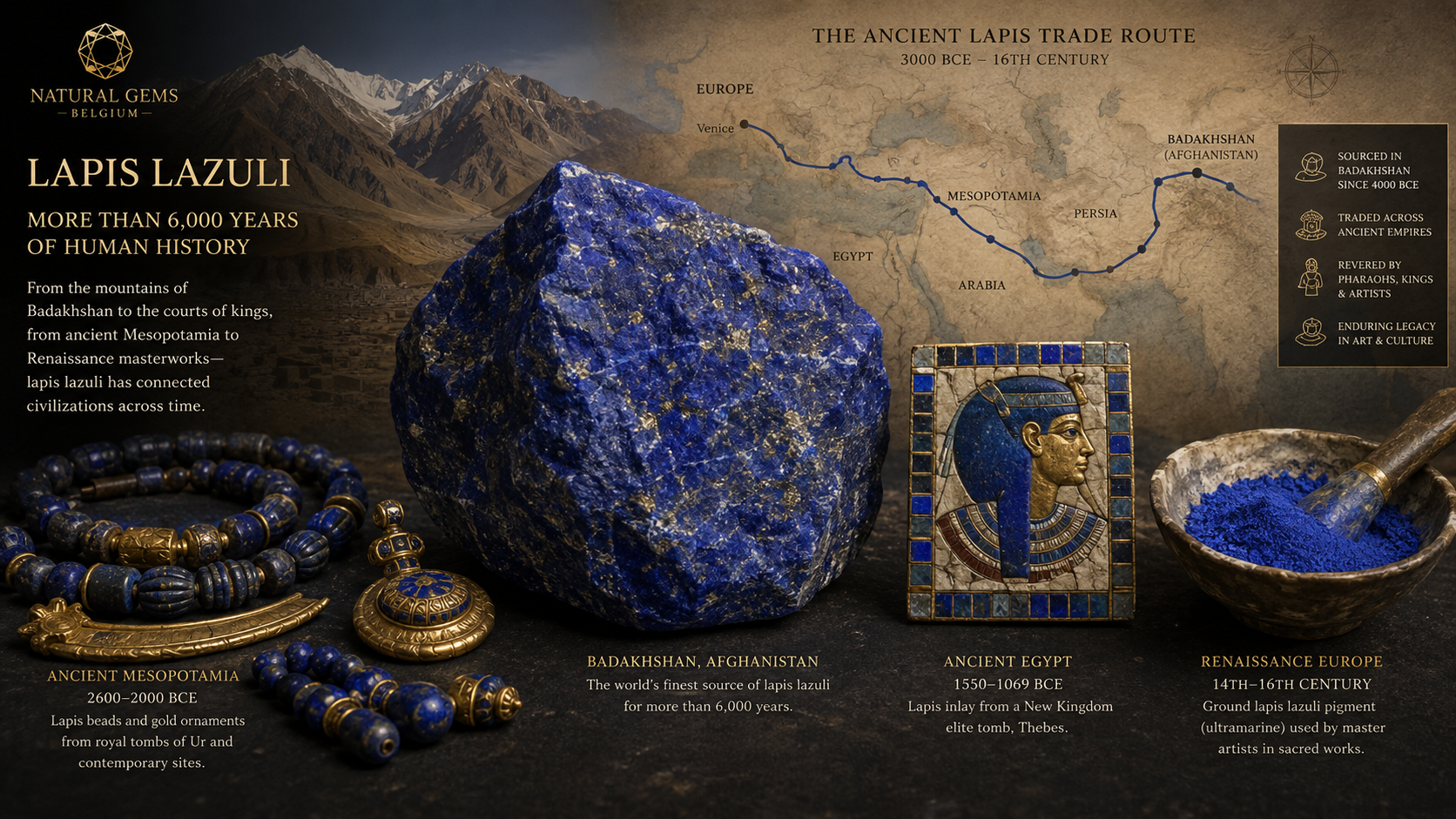
5. Sar-e-Sang: The Great Historical Source
The most famous historical source of fine lapis lazuli lies in:
Badakhshan, northeastern Afghanistan.
The Sar-e-Sang deposits occur in the Hindu Kush mountains.
The terrain is remote and difficult.
Gemological research describes mining conditions that historically restricted access to only part of the year because of altitude and climate.
Yet this remote source produced material that travelled astonishing distances.
Lapis from Badakhshan reached ancient societies thousands of kilometres away.
That fact alone tells us something extraordinary about prehistoric and ancient trade.
6. Six Thousand Years of Human Use
Lapis lazuli belongs among humanity’s oldest luxury gem materials.
Archaeological evidence documents its use more than six thousand years ago.
GIA notes lapis beads dating to roughly 6,500 years ago from a cemetery in southern Mesopotamia.
By the fourth and third millennia BCE, lapis was already circulating through societies far removed from the Afghan source.
This means organised exchange networks existed long before:
- Roman roads;
- medieval caravan systems;
- the maritime empires of the early modern world.
Lapis is therefore not merely an ancient ornament.
It is evidence for some of humanity’s earliest long-distance luxury trade.
7. Distance Made Lapis Remarkable
Consider the geography.
Badakhshan lies deep within Central Asia.
Ancient Mesopotamia lies far to the west.
Between them were:
- mountain ranges;
- deserts;
- river systems;
- political territories;
- numerous communities.
A piece of lapis arriving in Mesopotamia had already completed an extraordinary journey.
It may have passed through many hands:
miner → local trader → regional merchant → caravan network → urban market → craftsman → elite owner
No single person needed to travel the entire distance.
Trade connected communities that might never otherwise meet.
8. Lapis and the Rise of Early Cities
The flourishing of urban societies in Mesopotamia created demand for rare materials.
Cities required networks capable of supplying resources unavailable locally.
Lapis lazuli was one such material.
It had several advantages as a prestige commodity.
It was:
- visually distinctive;
- relatively durable;
- portable;
- workable;
- rare;
- obtainable only through long-distance exchange.
A small quantity could therefore carry substantial social value.
The stone became part of the material vocabulary of early elites.
9. Lapis at Ancient Ur
Some of the most famous archaeological uses of lapis come from the ancient Sumerian city of Ur, in present-day Iraq.
Objects recovered from the Royal Cemetery at Ur include extensive use of:
- lapis lazuli;
- gold;
- carnelian;
- shell.
The Metropolitan Museum of Art preserves Sumerian necklace beads dated approximately:
2600–2500 BCE
made from gold and lapis lazuli.
The museum identifies Badakhshan in Afghanistan as the source region for the lapis.
The object therefore physically connects two very distant ancient worlds.
10. A Necklace as Evidence of International Trade
A gold-and-lapis necklace is beautiful.
Archaeologically, however, it is also data.
Mesopotamia did not possess local deposits capable of supplying the lapis.
The material had to arrive through exchange.
Gold likewise entered Mesopotamia from external sources.
One object can therefore reveal:
- access to international materials;
- specialised craftsmanship;
- economic organisation;
- social hierarchy;
- long-distance commercial relationships.
Jewellery can function as historical evidence just as effectively as written records.
11. Lapis, Carnelian and the Ancient Trade Network
Lapis was not travelling alone.
Ancient luxury networks also moved materials such as:
- carnelian;
- gold;
- shell;
- metals;
- timber;
- textiles.
Different materials came from different regions.
Their appearance together in elite objects demonstrates how widely connected early societies could be.
This matters because the phrase “ancient trade route” can sound abstract.
A lapis bead makes the network tangible.
Someone mined it.
Someone transported it.
Someone purchased it.
Someone drilled and polished it.
Someone wore it.
12. Lapis and Ancient Mesopotamian Prestige
Lapis became deeply embedded in Mesopotamian elite culture.
It was used in:
- jewellery;
- beads;
- cylinder seals;
- inlays;
- decorative objects;
- ritual contexts.
Its saturated blue was visually unlike many common local materials.
That contrast amplified its prestige.
The value of lapis was therefore not simply intrinsic.
It was socially constructed through:
rarity + distance + colour + craftsmanship + cultural meaning.
This formula appears repeatedly in gemstone history.
13. Lapis in Ancient Egypt
Ancient Egypt also valued lapis lazuli.
The material was used for:
- jewellery;
- beads;
- amulets;
- inlays;
- decorative objects.
Egypt had access to many important mineral resources, but high-quality lapis was not a major indigenous Egyptian gemstone.
It had to reach Egypt through international exchange.
Its presence in Egyptian objects therefore provides further evidence of extensive ancient trade.
14. Why Blue Was Difficult
Part of lapis lazuli’s importance came from a fundamental material problem:
strong permanent blue is relatively difficult to obtain from nature.
Earth provides abundant:
- browns;
- reds;
- yellows;
- blacks;
- whites.
Intense stable blue minerals suitable for decoration and pigment are much less common.
Lapis offered an unusually rich blue that could be:
- polished as stone;
- carved;
- inlaid;
- eventually processed into pigment.
Its colour alone made it exceptional.
15. Lapis and the History of “Sapphire”
The previous NGB Learning Center article examined an important historical problem.
Ancient Greek sappheiros and Latin sapphirus did not always describe modern corundum sapphire.
Ancient descriptions mention a blue material with gold-coloured specks.
That description fits lapis lazuli remarkably well.
The blue body corresponds to its sodalite-group minerals.
The “gold” corresponds to pyrite.
This does not mean every historical use of sapphire-related terminology meant lapis.
It means ancient gemstone names were broader and less mineralogically precise than modern terminology.
16. The Ancient Observer Saw Appearance, Not Chemistry
A modern gemmologist distinguishes sapphire and lapis immediately.
Sapphire is:
- corundum;
- Al₂O₃;
- hardness 9;
- crystalline;
- commonly transparent to translucent.
Lapis is:
- a rock;
- a mineral aggregate;
- much softer;
- typically opaque to semitranslucent.
Ancient observers did not have:
- refractometers;
- Raman spectroscopy;
- X-ray diffraction;
- modern chemical analysis.
Colour and visual character carried much greater classificatory weight.
A brilliant blue stone could therefore belong to a naming tradition very different from modern mineral taxonomy.
17. Lapis Continued to Travel West
As Mediterranean societies developed, lapis continued to circulate.
Greek and Roman writers knew blue stone materials associated with eastern trade.
The material was valued in the Classical world and later remained important through Byzantine and Islamic cultural networks.
Again, it is misleading to imagine one continuous road.
Lapis could move through overlapping systems involving:
- Central Asian routes;
- Persian markets;
- Mesopotamian cities;
- maritime networks;
- Mediterranean ports.
Trade changed with political geography.
The stone continued moving.
18. Marco Polo and the Medieval Mines
By the later medieval period, European travellers were recording information about Central Asian mineral resources.
GIA notes that Marco Polo, whose travels began in the 13th century, described lapis mines associated with ancient Bactria.
Such accounts helped connect European knowledge of luxury materials with distant Asian landscapes.
But Europeans had already been consuming eastern gemstones and pigments long before individual European travellers described their sources directly.
Trade often precedes geographical understanding.
19. From Gem Material to Pigment
At some point, lapis lazuli acquired another extraordinary use.
It could be transformed into a blue pigment.
Simply grinding ordinary lapis does not automatically produce the finest artistic blue.
The rock contains:
- blue mineral phases;
- white calcite;
- metallic pyrite;
- other associated minerals.
Producing a highly saturated blue pigment therefore required separation and purification.
The resulting premium pigment became known in Europe as:
ultramarine.
20. What Does “Ultramarine” Mean?
The word derives from terminology meaning approximately:
beyond the sea
or
from beyond the sea.
For medieval and Renaissance Europeans, the name reflected the pigment’s distant eastern origin.
The word therefore preserves geography.
Every time an art historian says natural ultramarine, the name carries a memory of international trade.
The blue did not originate in the European painter’s workshop.
It arrived from far beyond the Mediterranean world.
21. Making Natural Ultramarine Was Difficult
High-quality natural ultramarine required more than crushing lapis into powder.
The objective was to isolate the intensely blue component while reducing contamination from:
- calcite;
- pyrite;
- colourless minerals.
Historical pigment preparation developed sophisticated separation processes.
The exact procedures varied.
One famous method involved incorporating powdered lapis into a prepared mixture containing waxes and resins and then extracting the blue particles.
Multiple extractions could produce different pigment grades.
The first fractions were generally the finest and most intensely coloured.
22. A Gemstone Became Paint
This transformation is remarkable.
The same geological material could exist as:
rough rock → polished ornament → carved object → powdered pigment → painted surface
Few gem materials have played such diverse roles.
Once converted into ultramarine, lapis no longer looked like stone.
Its geological identity became embedded in paint.
A blue robe in a medieval manuscript could therefore contain microscopic mineral material originally mined in Afghanistan.
The mountain had become an image.
23. Ultramarine Was Exceptionally Valuable
Natural ultramarine became one of the most prestigious pigments available to European artists.
Its value resulted from several accumulated costs:
- remote mining;
- long-distance transport;
- high-quality raw material;
- labour-intensive purification;
- limited yield.
GIA describes natural ultramarine as the most desired and expensive blue pigment of the European medieval period.
Its use could therefore signal the importance of a painting or manuscript.
Material economics became part of artistic meaning.
24. Expensive Colour Was Used Strategically
When a pigment is costly, artists and patrons do not necessarily use it everywhere.
Premium materials can be reserved for visually or symbolically important areas.
Natural ultramarine became famously associated with prestigious medieval and Renaissance painting.
Its expense meant that its use could reflect:
- patron wealth;
- contractual requirements;
- religious significance;
- artistic hierarchy.
Colour was therefore not merely aesthetic.
It had an economic dimension.
25. Blue and the Virgin Mary
One of the most familiar associations in European art is the blue mantle of the Virgin Mary.
Natural ultramarine was frequently used in prestigious representations.
This created a powerful relationship between:
- rare material;
- expensive pigment;
- sacred subject;
- saturated blue.
However, it would be incorrect to assume that every historical blue Marian robe contains lapis-derived ultramarine.
Artists had access to other blue pigments, and materials vary between works.
Scientific pigment analysis is required for object-specific identification.
26. A Painting Can Contain Gemological Material
The boundary between gemmology and art conservation becomes unusually thin with lapis.
A gemmologist studies lapis as a decorative stone.
A conservation scientist may encounter essentially the same mineral material as pigment particles in paint.
Analytical methods can include:
- Raman spectroscopy;
- microscopy;
- X-ray techniques;
- elemental analysis.
A tiny blue grain on a centuries-old painting can therefore become a mineralogical specimen.
27. Why Pigment Analysis Matters
Historical documents may describe a pigment as ultramarine.
But terminology can be ambiguous.
Scientific analysis helps determine what is actually present.
This is particularly important because different blue pigments can include:
- natural ultramarine;
- azurite;
- smalt;
- indigo;
- later synthetic pigments.
Identifying the material can reveal:
- workshop practice;
- restoration history;
- trade;
- chronology;
- artistic technique.
Once again, mineral identification contributes directly to historical interpretation.
28. Synthetic Ultramarine Changed the Market
Natural ultramarine’s extraordinary cost created a powerful incentive to reproduce its colour artificially.
During the early 19th century, researchers developed successful methods for manufacturing synthetic ultramarine.
GIA notes successful artificial production in the 1820s.
This changed the economics of blue pigment.
A colour once dependent on remote Afghan rock could now be manufactured at far lower cost.
Natural ultramarine consequently lost much of its practical dominance in painting.
29. The Colour Survived the Material
Synthetic ultramarine presents an interesting historical transition.
Artists could obtain a comparable family of intense blue colour without requiring natural lapis.
The cultural identity of ultramarine survived.
But the supply chain changed radically.
Before:
Afghan geology → mining → long-distance trade → purification → artist
After industrial synthesis:
raw industrial materials → chemical manufacturing → artist
A technological innovation effectively shortened a trade route that had existed for millennia.
30. Lapis Remained a Gem and Ornamental Material
The development of synthetic pigment did not end lapis lazuli’s importance.
It continued to be fashioned into:
- cabochons;
- beads;
- tablets;
- carvings;
- inlays;
- decorative objects;
- jewellery.
Large pieces of rough allow lapis to be used at scales impossible for many transparent gemstones.
Its saturated blue remains its dominant attraction.
The stone’s ornamental history therefore continued even as its pigment role changed.
31. Afghanistan Remains the Classic Source
The mountains of Afghanistan remain the traditional benchmark for fine lapis.
GIA identifies Afghanistan as the world’s major source and the traditional source of the finest colour.
Other important deposits occur elsewhere, including:
- Chile;
- Russia;
- Pakistan;
- additional smaller localities.
But historical association with Badakhshan is exceptionally strong.
Few gem materials have been connected to one source region for such a long period.
32. Chilean Lapis Lazuli
Chile contains another significant lapis deposit in the Coquimbo Region of the Andes.
The material occurs at high elevation in contact-metamorphosed limestone.
GIA research describes an assemblage including:
- blue lazurite;
- wollastonite;
- calcite;
- haüyne;
- diopside;
- pyrite.
Some Chilean material can approach fine quality.
Much is nevertheless visually distinguishable in trade by tendencies toward:
- lighter colour;
- visible calcite;
- sometimes greener appearance.
These are tendencies, not absolute geographic tests.
33. Trade Names Do Not Prove Origin
Modern lapis trade terminology sometimes uses geographic adjectives.
Examples include descriptions such as:
- Afghan;
- Persian;
- Siberian;
- Chilean.
These terms can describe an appearance or commercial grade, not necessarily proven geographic origin.
GIA specifically cautions that a geographic adjective applied to lapis does not automatically establish that the material actually comes from that location.
This principle extends throughout gemmology:
A trade name is not the same thing as scientific provenance.
34. What Makes Fine Lapis Valuable?
Unlike a transparent faceted gemstone, lapis is not evaluated primarily through brilliance.
Its principal quality factor is:
colour.
Fine material typically displays:
- strong saturation;
- medium-dark to dark blue;
- relatively uniform appearance;
- minimal visible white calcite.
Pyrite requires more nuanced evaluation.
Fine, evenly scattered pyrite can be attractive.
Heavy pyrite can overwhelm the blue and lower appeal.
The balance matters.
35. Calcite and Quality
Calcite usually appears as:
- white spots;
- streaks;
- patches.
Large visible calcite areas break the continuity of the blue body colour.
For that reason, heavily calcite-rich lapis generally commands less value than intense uniform blue material.
However, aesthetic preference remains relevant.
Some buyers enjoy the natural patterning created by white calcite and gold-coloured pyrite.
Commercial grading and personal taste are not always identical.
36. Pyrite: Beautiful but Misunderstood
The presence of pyrite generates two common misconceptions.
“The gold flecks are real gold.”
Usually incorrect.
They are typically pyrite.
“Any pyrite makes lapis lower quality.”
Also incorrect.
Small attractively distributed flecks may contribute positively to visual character.
The highest-value material is generally judged primarily on the quality and uniformity of its blue colour.
Pyrite is evaluated in context.
37. Lapis Is Much Softer Than Sapphire
The historical confusion between sapphire terminology and lapis becomes particularly striking when their physical properties are compared.
Sapphire
Mohs hardness:
9
Lapis Lazuli
Approximately:
5–6, depending on composition.
This difference has practical consequences.
Lapis is much more vulnerable to:
- scratching;
- abrasion;
- surface damage.
It requires different jewellery care from corundum sapphire.
Historical names should therefore never determine modern handling instructions.
Mineralogy should.
38. Lapis Requires Thoughtful Care
Because lapis is an aggregate of several minerals, its response to cleaning can be less predictable than that of a single durable mineral such as sapphire.
Avoid unnecessarily aggressive cleaning.
A conservative approach uses:
- mild soap;
- lukewarm water;
- soft cloth;
- gentle handling.
Avoid:
- harsh chemicals;
- abrasive cleaning;
- prolonged chemical exposure.
Jewellery should also be protected from scratching by harder gemstones.
Historical durability does not mean indestructibility.
39. Dyeing and Modern Treatment
Lower-quality lapis can sometimes be enhanced.
One possible treatment is:
dyeing
to strengthen or homogenise blue colour.
Surface treatments may also be used to improve appearance or polish.
Responsible sellers should disclose material treatments where relevant.
A naturally intense blue stone and a dyed pale material do not have the same treatment history.
Historical prestige should never be used to obscure modern enhancement.
40. Imitations
The desirability of lapis has encouraged imitation.
Materials used to imitate its appearance can include:
- dyed stones;
- glass;
- manufactured composites;
- synthetic materials.
Some imitations deliberately reproduce the blue-and-gold appearance by adding metallic particles.
Visual similarity is not mineral identity.
Professional identification may use:
- magnification;
- physical properties;
- spectroscopy;
- other analytical methods.
41. Why Lapis Became a Symbol of Prestige
Across its long history, lapis accumulated prestige through several reinforcing mechanisms.
Geological rarity
Fine material occurs only under unusual conditions.
Geographic distance
Major ancient consumers lived far from the principal source.
Colour rarity
Strong stable natural blue was uncommon.
Labour
Mining, transport and craftsmanship required effort.
Cultural reinforcement
Elite use increased social desirability.
Artistic importance
Its conversion into ultramarine created another luxury market.
Prestige was therefore not produced by one mysterious property.
It emerged from an entire material system.
42. A Stone Can Have Several Histories Simultaneously
Lapis has at least four overlapping histories.
Geological history
How the rock formed.
Commercial history
How it moved between societies.
Cultural history
What people believed and communicated through it.
Technological history
How craftspeople transformed it into jewellery, carvings and pigment.
A complete Learning Center treatment should preserve all four.
Reducing lapis to either “a blue crystal” or “an ancient sacred stone” misses most of what makes it important.
43. The Material Connects Archaeology and Gemmology
An archaeologist may encounter a lapis bead in a grave.
A gemmologist may evaluate a modern lapis cabochon.
A geologist may study a Badakhshan deposit.
A conservation scientist may identify ultramarine in a painting.
They are studying different stages of the same material story.
This interdisciplinary connection is one of lapis lazuli’s greatest educational strengths.
44. Scientific Provenance Research
Modern researchers can investigate the geological provenance of archaeological lapis.
This is challenging because lapis is a heterogeneous rock rather than a single chemically uniform mineral.
Potential analytical approaches examine:
- mineral assemblages;
- trace elements;
- spectroscopy;
- isotopic characteristics;
- microscopic features.
The objective is to compare archaeological material with known geological sources.
Such work may help reconstruct ancient trade networks more precisely.
45. Provenance Claims Need Caution
Because Badakhshan was an extraordinarily important historical source, there is a temptation to attribute every ancient lapis object automatically to Afghanistan.
That conclusion may often be plausible.
But object-specific provenance should still be distinguished from general historical probability.
A responsible statement is:
Badakhshan was a major and extremely ancient source of lapis traded across the ancient Near East.
A stronger statement:
This particular artefact came from one specific Afghan mine
requires appropriate analytical or archaeological evidence.
This distinction mirrors modern gemstone-origin practice.
46. Lapis and the Meaning of Luxury
Today, luxury is often associated with:
- branding;
- price;
- exclusivity.
Ancient luxury operated differently.
For lapis, luxury was physically embedded in geography.
Owning it meant possessing a material that had crossed enormous distances.
Its rarity was not manufactured.
It arose from geology and access.
The blue object in a Mesopotamian grave was therefore also evidence of the owner’s connection to an economic world extending far beyond the city.
47. From Mine to Museum
A piece of ancient lapis may have experienced a remarkable sequence:
metamorphic formation → mining → ancient trade → carving → ownership → burial → archaeological excavation → conservation → museum display
The object visible today represents only the latest stage.
Its history began hundreds of millions of years before human craftsmanship and continued thousands of years after its first owner disappeared.
Gemstone history therefore operates on radically different timescales simultaneously.
48. Evidence Classification
| Statement | Classification |
|---|---|
| Lapis lazuli is a rock composed of several minerals | Established mineralogical fact |
| Sodalite-group blue minerals provide its characteristic blue colour | Established mineralogical fact, with detailed phase nomenclature still scientifically nuanced |
| Gold-coloured flecks are commonly pyrite | Established mineralogical fact |
| White areas commonly contain calcite | Established mineralogical fact |
| Badakhshan, Afghanistan is an ancient and historically major source | Established geological and historical evidence |
| Lapis was used more than 6,000 years ago | Established archaeological evidence |
| Lapis from Badakhshan reached ancient Mesopotamia | Strong archaeological and historical evidence |
| Lapis was transformed into natural ultramarine pigment | Established art-technological fact |
| Natural ultramarine was an exceptionally valuable medieval European pigment | Established art-historical evidence |
| Synthetic ultramarine was successfully developed in the 1820s | Established technological history |
| Ancient sappheiros/sapphirus always meant corundum sapphire | Incorrect |
| Every ancient lapis object can automatically be assigned to one Afghan mine | Too absolute without object-specific evidence |
| Pyrite in lapis is gold | Incorrect |
| Every geographic lapis trade name proves actual origin | Incorrect |
| Historical spiritual or medicinal claims are demonstrated physical properties of lapis | Not established by modern gemmological science |
49. Common Misconceptions About Lapis Lazuli
Myth 1 — “Lapis lazuli is a mineral.”
Incorrect.
It is a rock composed of several minerals.
Myth 2 — “The gold flecks are gold.”
Usually incorrect.
They are commonly pyrite.
Myth 3 — “Lapis is a type of sapphire.”
Incorrect.
Sapphire is corundum. Lapis is a completely different material.
Myth 4 — “All lapis comes from Afghanistan.”
Incorrect.
Afghanistan is the classic and historically most important source, but deposits occur elsewhere.
Myth 5 — “All pyrite lowers lapis quality.”
Incorrect.
Fine scattered pyrite can be attractive.
Myth 6 — “Ultramarine was always synthetic paint.”
Incorrect.
Natural ultramarine was historically produced from lapis lazuli. Synthetic ultramarine appeared much later.
Myth 7 — “Ancient use proves every traditional healing claim.”
Incorrect.
Archaeological evidence demonstrates historical use, not modern medical efficacy.
50. How to Read a Piece of Lapis
A useful way to examine lapis is to ask several questions.
How saturated is the blue?
Strong uniform blue generally contributes positively to quality.
How much calcite is visible?
Large white areas commonly reduce commercial value.
How is pyrite distributed?
Fine attractive flecks can enhance character; excessive pyrite may overwhelm the colour.
Is the colour natural?
Very uniform intense colour in low-quality-looking material can justify investigation for dye.
What is the object?
A cabochon, bead, carving and pigment specimen each require different evaluation.
Is geographic origin actually documented?
Do not confuse appearance-based trade terminology with proven provenance.
Is a historical claim supported?
Separate archaeological evidence from later folklore.
This framework keeps material evaluation grounded in evidence.
Conclusion
Lapis lazuli is one of the great travelling materials of human history.
Its story began in unusual geological environments where heat, pressure, carbonate rocks, sulfur-bearing fluids and complex mineral reactions produced an intensely blue rock.
Humans then gave that geological rarity a second life.
More than six thousand years ago, lapis was already moving far beyond its source.
From the mountains of Badakhshan it entered long-distance trade networks.
It reached Mesopotamia.
It appeared in elite jewellery at Ur.
It travelled into Egypt and across the ancient Mediterranean world.
Its colour was so distinctive that ancient terminology for precious blue stones became entangled with the later history of sapphire.
Centuries later, craftspeople discovered another extraordinary possibility.
Lapis could be broken apart, processed and purified until its blue component became natural ultramarine.
A gemstone material became paint.
That pigment crossed another boundary—from jewellery and ornament into manuscripts and some of the most prestigious works of European art.
Its expense reflected an entire chain:
geology → mining → transport → trade → purification → craftsmanship.
The invention of synthetic ultramarine in the 19th century finally broke that ancient dependency.
Artists could reproduce the colour without importing Afghan rock.
Yet lapis itself remained.
It is still carved.
Still polished.
Still worn.
Still collected.
And the finest material from Afghanistan continues a geological and commercial tradition extending back to the beginnings of urban civilisation.
That longevity is what makes lapis lazuli exceptional.
It is not merely an ancient blue stone.
It is physical evidence of how human societies learned to connect distant landscapes through trade—and how one rare geological material could move from mountain to necklace, from necklace to pigment, and from pigment into cultural memory.
References & Further Reading
Gemological Institute of America — “Lapis Lazuli Description.”
Authoritative gemmological overview of lapis as a rock composed principally of lazurite/sodalite-group blue minerals, calcite and pyrite, including hardness, appearance, sources and the visual effects of its different constituents.
https://www.gia.edu/UK-EN/lapis-lazuli-description-v1
Wyart, J., Bariand, P. & Filippi, J. — “Lapis-Lazuli from Sar-E-Sang, Badakhshan, Afghanistan.” Gems & Gemology, Winter 1981, Gemological Institute of America.
Foundational geological study of the historic Sar-e-Sang deposits, their remote Hindu Kush setting, associated minerals and the long history of Afghan lapis as raw material for objects made by early civilisations.
https://www.gia.edu/gems-gemology/winter-1981-lapis-afghanistan-wyart
The Metropolitan Museum of Art — “Necklace Beads,” Sumerian, Early Dynastic IIIa, ca. 2600–2500 BCE.
Important archaeological object from Ur combining gold and lapis lazuli. The museum identifies Badakhshan, Afghanistan as the origin of the lapis and uses the object to document long-distance material exchange in ancient Mesopotamia.
https://www.metmuseum.org/art/collection/search/322910
Gemological Institute of America — “Lapis Lazuli.”
Overview of lapis mineralogy, history, sources, quality factors and historical use. GIA records lapis as treasured by ancient Mesopotamian, Egyptian, Chinese, Greek and Roman civilisations.
https://my.gia.edu/lapis-lazuli
Gemological Institute of America — “Lapis Lazuli Quality Factors.”
Detailed guidance on colour, calcite, pyrite, cutting styles and modern trade terminology, including the important warning that geographic adjectives used as lapis trade grades do not necessarily prove geographic origin.
https://www.gia.edu/lapis-lazuli-quality-factors
LeCroy, B. — “Gems on Canvas: Pigments Historically Sourced from Gem Materials.” Gems & Gemology, Fall 2022, Gemological Institute of America.
Scientific and art-historical overview of gemstones used as pigments, including the mineralogical complexity of lapis and its transformation into natural ultramarine. Particularly useful for the connection between gemmology, pigment science and conservation.
https://origin.prod.gia.edu/gems-gemology/fall-2022-gems-on-canvas
Shigley, J. E. — “Historical Reading List: Lazurite (Lapis Lazuli) from Afghanistan and its Artistic Use as a Blue Pigment (Ultramarine).” Gemological Institute of America.
A research-oriented historical overview of Afghan lapis, ancient long-distance trade, natural ultramarine, its exceptional value in medieval European art and the development of synthetic ultramarine during the 1820s.
https://www.gia.edu/articles/lazurite-afghanistan-reading-list
Coenraads, R. R. & Canut de Bon, C. — “Lapis Lazuli from the Coquimbo Region, Chile.” Gems & Gemology, Spring 2000, Gemological Institute of America.
Detailed geological and gemmological investigation of an important non-Afghan source, useful for comparing deposit geology and mineral assemblages and for avoiding the misconception that all lapis originates in Afghanistan.
https://origin.prod.gia.edu/gems-gemology/spring-2000-lapis-lazuli-chile-coenraads