
Introduction
Sapphire is far more than a blue gemstone.
Sapphire gemology examines the mineralogical properties, chemical composition and diagnostic characteristics that distinguish natural sapphire and its many varieties.
Gemologically, sapphire belongs to the mineral species corundum, crystalline aluminium oxide, Al₂O₃. Pure corundum is essentially colourless. The extraordinary range of colours encountered in natural sapphire develops primarily because trace elements and structural defects alter the way the crystal absorbs visible light.
Blue, yellow, green, pink, violet and orange sapphires can therefore belong to the same mineral species while displaying dramatically different appearances.
Red gem-quality corundum is conventionally called ruby; gem-quality corundum of other colours is classified as sapphire.
This apparently simple mineral system becomes considerably more complex once gem identification begins. Natural sapphires may be heated, diffusion treated, fracture filled or otherwise modified. Laboratory-grown sapphire can possess essentially the same fundamental chemical and physical properties as natural corundum.
Geographic origin determination introduces another level of difficulty because sapphires from different deposits can overlap in chemistry, inclusions and gemological properties.
Correct sapphire identification is therefore not based on colour alone. It is an exercise in combining optical properties, crystallography, microscopy, spectroscopy, trace-element chemistry and geological evidence.
Table of Contents
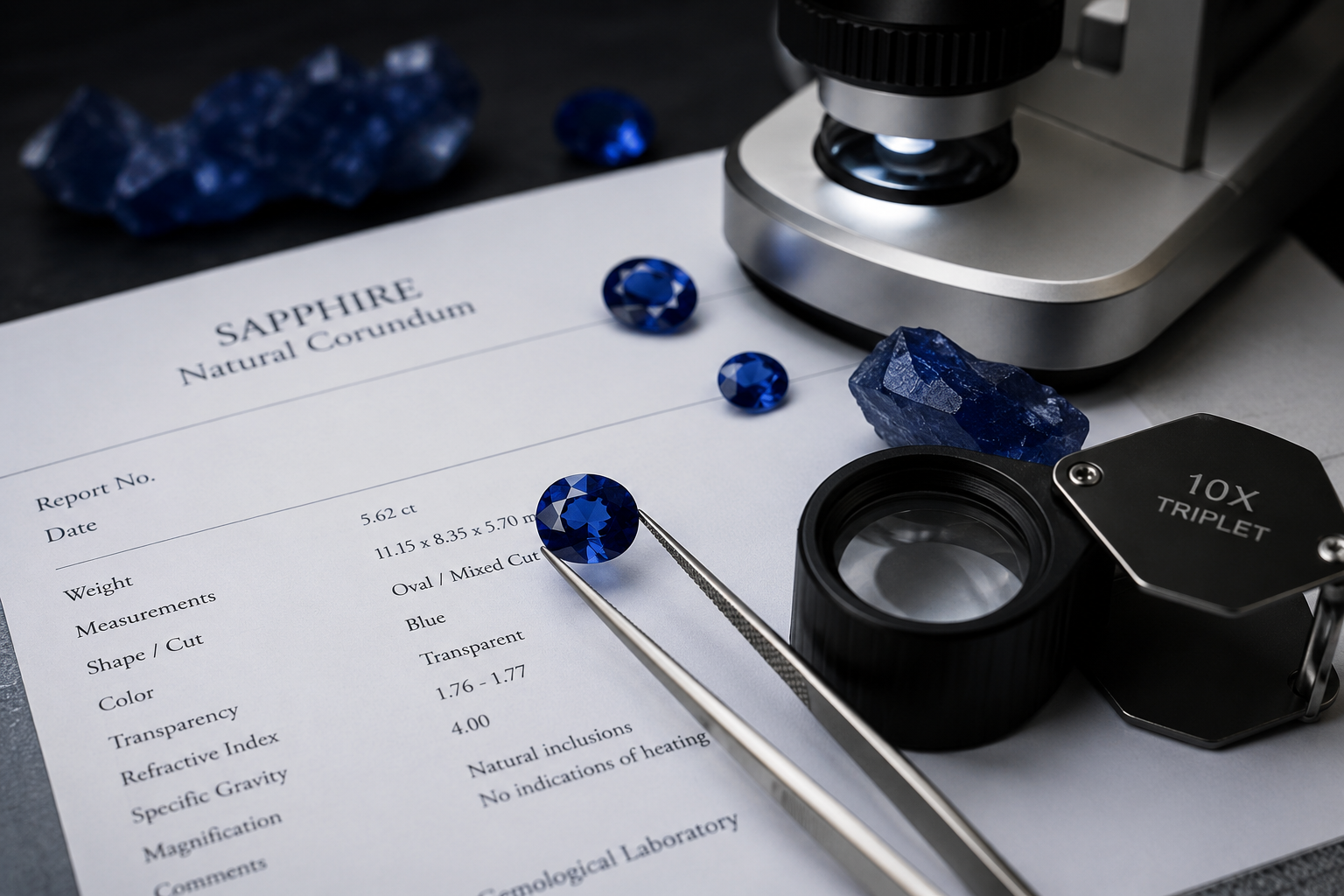
Sapphire at a Glance
| Mineral species | Corundum |
| Chemical composition | Al₂O₃ |
| Crystal system | Trigonal |
| Typical gem colours | Blue, pink, yellow, orange, green, violet, colourless and combinations thereof Red corundum | Classified as ruby |
| Mohs hardness | 9 |
| Refractive index | Approximately 1.762–1.770 |
| Birefringence | Approximately 0.008–0.010 |
| Specific gravity | Approximately 4.00 |
| Optical behaviour | Doubly refractive, uniaxial |
| Common natural inclusions | Rutile silk, mineral crystals, healed fractures, negative crystals, growth zoning |
| Common treatments | Heat; lattice diffusion; less commonly filling, coating and other modifications |
| Synthetic counterparts | Flame-fusion, flux-grown, hydrothermal and other laboratory-grown corundum |
Natural material can show minor variation in measured properties, particularly where abundant inclusions influence measurements.
1. Sapphire Is Corundum
Corundum consists primarily of aluminium and oxygen arranged in a highly ordered crystalline structure.
Its nominal formula, Al₂O₃, disguises one of sapphire’s most important gemological characteristics: very small quantities of foreign elements can profoundly alter its colour.
These impurities occur at concentrations far below those of aluminium and oxygen, but some can substitute for aluminium within the crystal lattice.
Elements of particular gemological importance include chromium, iron, titanium, vanadium, magnesium and gallium.
Their concentrations and interactions provide information not only about colour but sometimes about geological environment, treatment and geographic origin.
Evidence Classification
Established scientific fact: Sapphire is corundum, predominantly Al₂O₃.
Interpretive gemology: Determining why a particular sapphire has its precise colour, whether it has been treated, and where it formed may require multiple analytical observations rather than a single diagnostic measurement.
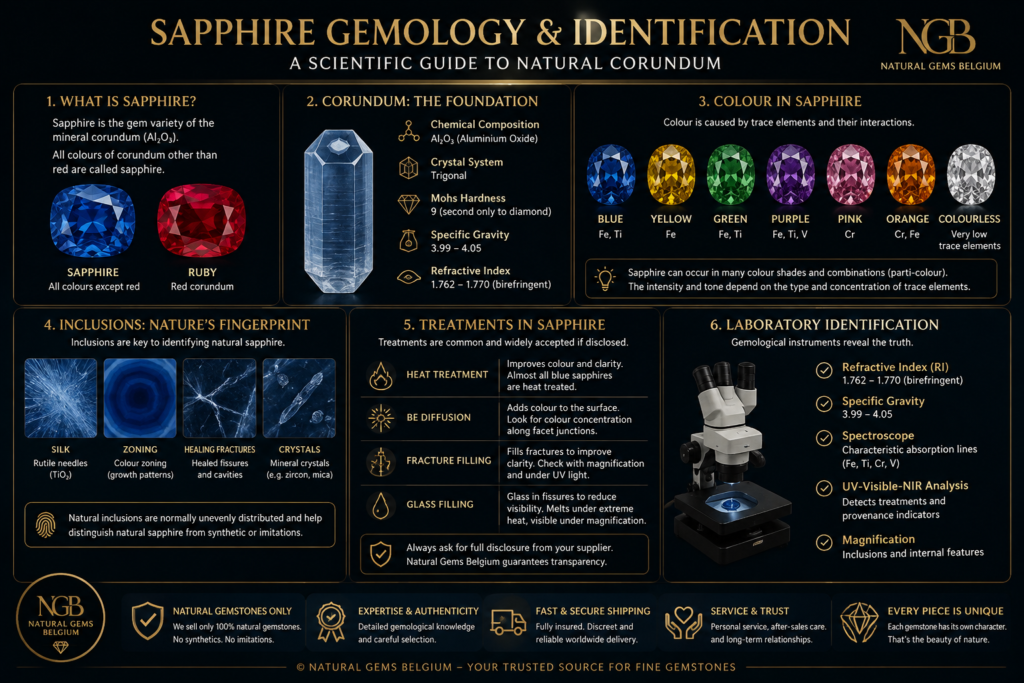
2. Why Sapphire Has So Many Colours
Blue Sapphire
The classic blue of sapphire is strongly associated with interactions between Fe²⁺ and Ti⁴⁺ ions.
Intervalence charge transfer between iron and titanium produces absorption that removes portions of the visible spectrum, leaving the characteristic blue appearance.
Modern research shows that sapphire colour chemistry is more complex than simply assigning one trace element to each colour.
Charge compensation, oxidation state, lattice defects and interactions among trace elements all matter.
Pink Sapphire
Chromium in the trivalent state, Cr³⁺, is an important chromophore in corundum.
Increasing chromium-related absorption can produce colours ranging from pink toward red.
The transition between what the trade calls pink sapphire and what it calls ruby is therefore not a mineralogical boundary: both are corundum.
The nomenclature reflects colour classification rather than a change of mineral species.
Yellow and Orange Sapphire
Yellow sapphire can arise through several colour mechanisms involving iron and defect-related processes.
Treatment can complicate the picture further. Modern gemological research distinguishes naturally coloured yellow sapphire from heated, beryllium-diffused and synthetic material using increasingly sophisticated spectroscopic and chemical methods.
Green, Violet and Other Fancy Sapphires
Other sapphire colours result from different combinations of chromophores and absorption mechanisms.
Because several mechanisms may operate simultaneously, apparently similar colours do not necessarily share identical chemistry.
That is one reason colour itself cannot establish natural origin, treatment status or geographic provenance.
3. Refractive Index: One of the First Identification Tests
Sapphire has a refractive index around 1.762–1.770, with birefringence generally around 0.008–0.010.
These values are characteristic of corundum and provide a powerful initial identification criterion.
Because corundum is anisotropic, light travelling through it behaves differently according to crystallographic direction.
A refractometer can therefore reveal two principal refractive-index readings in appropriately cut transparent stones.
This helps distinguish sapphire from many visually similar gems.
However, refractive-index testing primarily answers:
What mineral might this be?
It does not automatically answer:
Is it natural?
or:
Has it been treated?
Natural and synthetic sapphire are both corundum and can consequently possess overlapping refractive indices.
4. Specific Gravity
Sapphire has a characteristic specific gravity close to 4.00.
Studies of natural sapphire populations frequently produce measurements around 3.98–4.01.
Inclusion-rich specimens can deviate slightly because inclusions themselves contribute to the measured density.
Specific gravity is particularly useful when combined with refractive-index and optical testing.
A stone displaying approximately:
- RI 1.76–1.77
- SG around 4.00
- Doubly refractive behaviour
provides strong evidence for identification as corundum.
It still does not establish whether that corundum is natural or synthetic.
5. Hardness and Durability
Corundum has a Mohs hardness of 9, surpassed among major natural gem materials by diamond.
Hardness refers specifically to resistance to scratching.
It should not be confused with toughness, which describes resistance to breaking or chipping.
Sapphire’s combination of hardness and generally good durability explains its long-standing importance in jewellery, particularly rings and other pieces exposed to regular wear.
Treatments can nevertheless alter practical care requirements.
Filled or otherwise composite-treated material may require considerably greater caution than untreated or conventionally heated sapphire.
6. Pleochroism and Optical Character
Because sapphire is anisotropic, coloured specimens may display pleochroism: different colours or colour intensities when viewed along different crystallographic directions.
In blue sapphire, this can manifest as different blue, blue-green or related components depending upon orientation and composition.
Pleochroism has practical consequences for cutting.
A lapidary must consider crystal orientation because orientation can strongly influence the face-up colour of the finished gemstone.
It can also contribute to identification, although pleochroism alone is never proof that a stone is a natural sapphire.
7. Sapphire Inclusions: A Microscopic Geological Record
One of the most informative tools in sapphire gemology remains the gemological microscope.
Natural sapphires can contain:
- Rutile needles or “silk”
- Zircon crystals
- Other mineral crystals
- Healed fractures
- Negative crystals
- Fluid-related inclusions
- Particulate clouds
- Straight or angular colour zoning
- Growth structures
Microscopy is one of the principal methods used to distinguish natural, treated and synthetic sapphires.
Rutile Silk
Fine rutile needles are among the best-known inclusions in corundum.
When sufficiently abundant and appropriately oriented, needle-like inclusions can interact with light to create asterism — the star effect observed in star sapphire.
Modern microscopic and structural research continues to refine our understanding of the nanoscale structures responsible for such optical phenomena.
Rutile silk can also preserve evidence relevant to heat treatment.
High-temperature heating may partially or substantially dissolve rutile.
Titanium released from rutile can enter the surrounding corundum lattice and participate with iron in generating blue colour.
Microscopic internal diffusion around residual silk can therefore provide evidence of thermal treatment.
Zircon and Other Mineral Inclusions
Zircon is another important inclusion encountered in sapphire.
Its condition can be informative because heating may alter zircon crystals and their surrounding features.
However, the presence of one particular mineral inclusion should rarely be treated as an automatic geographic fingerprint.
Many sapphire deposits share inclusion types.
8. Natural Growth Zoning
Natural corundum frequently displays colour or growth zoning related to changing chemical conditions during crystal formation.
These structures are generally crystallographically controlled and can form straight or angular patterns.
This becomes especially useful when comparing natural sapphire with certain synthetics.
Flame-fusion synthetic corundum, for example, commonly develops curved growth or colour banding.
This curved banding can be a highly useful indicator of Verneuil-grown synthetic sapphire, contrasting with the angular zoning expected in natural corundum.
Gemological caution remains essential.
The absence of curved striae does not prove that a sapphire is natural because synthetic sapphire can be manufactured by several different growth methods.
9. Heat Treatment of Sapphire
Heat treatment is one of the most important subjects in sapphire identification.
Heating can be used to modify:
- Colour
- Colour uniformity
- Apparent clarity
- Visibility of certain inclusions
Conventional heat treatment has been used extensively in the sapphire trade and is fundamentally different from assuming that every heated stone is “fake.”
The gemstone remains corundum.
What changes is its treatment status, which is important for disclosure and potentially for value.
Confirmation that a fine sapphire shows no evidence of heat can contribute to rarity and commercial value.
Microscopic Evidence of Heating
Possible evidence includes:
- Altered or partially dissolved rutile silk
- Recrystallised inclusions
- Altered mineral crystals
- Stress fractures around inclusions
- Modified fingerprint structures
- Internal diffusion of colour around dissolved titanium-bearing inclusions
The precise interpretation requires experience because not every heated sapphire displays every feature.
10. Why Spectroscopy Matters
Microscopy is powerful, but modern sapphire identification increasingly relies on spectroscopy.
Techniques can include:
- UV-Vis-NIR absorption spectroscopy
- Fourier-transform infrared spectroscopy (FTIR)
- Raman spectroscopy
- Photoluminescence spectroscopy
FTIR is particularly important in corundum treatment research.
Certain infrared absorption features associated with OH-related defects can provide evidence relevant to heat treatment.
However, interpretation is not as simple as finding or failing to find a single peak.
Particular FTIR features can support heat-treatment identification, but their absence is not necessarily conclusive.
This leads to an important principle of professional gemology:
Absence of diagnostic evidence is not automatically evidence of absence.
11. Diffusion Treatment
Diffusion treatment uses high temperature and introduced chemical elements to modify sapphire colour.
The process can produce colour concentrated near the surface or, depending upon treatment chemistry and conditions, penetrate considerably deeper into the stone.
Older forms of diffusion treatment often produced diagnostic features such as:
- Colour concentrations at facet junctions
- Shallow colour layers
- Patchy surface-related coloration
- Characteristic features visible in immersion
Beryllium Diffusion
The introduction of beryllium significantly changed sapphire treatment detection.
Beryllium can penetrate relatively deeply into corundum during high-temperature treatment and can dramatically alter colour even at very low concentrations.
Because beryllium is a light element occurring at very low concentrations, conventional gemological testing may not be sufficient.
Detection may require sophisticated analytical techniques such as:
- SIMS — Secondary Ion Mass Spectrometry
- LA-ICP-MS — Laser Ablation Inductively Coupled Plasma Mass Spectrometry
- LIBS — Laser-Induced Breakdown Spectroscopy
This is a clear example of where visual gemstone identification reaches its limit.
12. Synthetic Sapphire
Synthetic sapphire is real corundum in the mineralogical sense, but it is not a naturally formed gemstone.
Its crystal structure and fundamental chemical and physical properties can closely reproduce natural sapphire.
The decisive distinction is geological origin.
Natural sapphire: Formed through natural geological processes.
Synthetic sapphire: Crystallised through human-controlled laboratory or industrial processes.
Synthetic sapphire has been produced for more than a century using several methods, including flame fusion, flux growth and hydrothermal techniques.
Flame-Fusion Sapphire
The Verneuil or flame-fusion process produces some of the most widely encountered synthetic corundum.
Potential identifying characteristics include:
- Curved growth striae
- Curved colour banding
- Gas bubbles
- Characteristic fluorescence behaviour in some materials
- Plato lines under suitable observation conditions
Curved banding is particularly significant because natural corundum growth zoning is generally angular rather than curved.
Flux-Grown Sapphire
Flux-grown synthetic sapphire can be considerably more challenging.
Flux residues and characteristic synthetic growth structures can provide important evidence, but experienced microscopy is required.
Documented flux-grown synthetic sapphires can contain wispy flux residues, flux-filled cavities and distinctive colour zoning that provide evidence for laboratory growth.
13. Why “Eye Clean” Does Not Mean Synthetic — or Natural
Clarity cannot establish natural origin.
A natural sapphire can be exceptionally clean.
A synthetic sapphire can contain inclusions.
A treated sapphire may retain natural inclusions.
A flux-grown synthetic may contain inclusions that superficially resemble natural fingerprints.
The nature, morphology, orientation and geological context of inclusions matter more than merely whether inclusions are present.
Statements such as “it has inclusions, therefore it is natural” are scientifically unreliable.
14. Sapphire Simulants
A simulant resembles sapphire visually but has a different identity.
Possible blue sapphire simulants can include other natural gemstones and manufactured materials.
Depending on colour and appearance, examples may include:
- Blue spinel
- Blue glass
- Synthetic materials of unrelated composition
- Other blue gem species
Basic gemological measurements often separate them efficiently.
Sapphire’s combination of refractive index, specific gravity and doubly refractive optical character differs from many visually similar materials.
The lesson is fundamental:
Appearance suggests. Measurement identifies.
15. Fluorescence: Useful but Rarely Sufficient Alone
Ultraviolet fluorescence can provide useful supporting evidence in corundum identification.
Its behaviour varies considerably with:
- Trace-element chemistry
- Colour
- Geological origin
- Treatment
- Synthetic growth method
Consequently, fluorescence should be interpreted as part of a larger evidence set.
Recent laboratory observations continue to document unusual optical responses in both natural and synthetic corundum, demonstrating that sapphire research remains an evolving area of gemology.
16. Geographic Origin: Why It Is Difficult
Statements such as “this inclusion proves Kashmir” or “this colour proves Sri Lanka” should be treated with considerable caution.
Professional geographic-origin determination typically combines:
- Microscopic inclusions
- Growth structures
- Trace-element chemistry
- Spectroscopic characteristics
- Comparison with extensive reference collections of known-origin material
Even then, geological overlap can make origin determination difficult.
Similar geological environments can produce gemstones with overlapping characteristics.
For blue sapphire specifically, inclusions strongly associated with one locality may also occur elsewhere.
Long rutile silk and certain fingerprint structures, for example, can be suggestive of Sri Lankan origin without automatically constituting proof.
This distinction is crucial:
Observation: A particular inclusion is present.
Interpretation: The inclusion is consistent with sapphires from a particular geological environment.
Origin conclusion: Requires evaluation of the complete evidence.
17. A Practical Sapphire Identification Workflow
A professional investigation may progress approximately as follows.
Step 1 — Visual Observation
Assess:
- Hue
- Tone
- Saturation
- Colour distribution
- Transparency
- Zoning
- Apparent inclusions
This generates hypotheses, not conclusions.
Step 2 — Standard Gemological Testing
Where appropriate:
- Refractive index
- Birefringence
- Polariscope response
- Specific gravity
- Dichroscope / pleochroism
- UV fluorescence
- Handheld spectroscopy
These tests can establish whether the stone’s properties are consistent with corundum.
Step 3 — Microscopy
Investigate:
- Growth structures
- Rutile silk
- Mineral inclusions
- Healed fractures
- Colour zoning
- Treatment-related alteration
- Synthetic growth indicators
Step 4 — Spectroscopic Analysis
Depending on the question:
- FTIR
- UV-Vis-NIR
- Raman
- Photoluminescence
Step 5 — Chemical Analysis
Trace-element analysis may be necessary for difficult treatment, synthetic or geographic-origin questions.
LA-ICP-MS and related analytical methods can detect trace elements at concentrations far below what ordinary gemological instruments can resolve.
Step 6 — Integrated Interpretation
No individual result should be considered in isolation when evidence is ambiguous.
The final conclusion must reconcile the gemstone’s:
Physical + optical + microscopic + spectroscopic + chemical evidence.
18. The Limits of Visual Sapphire Identification
A photograph can sometimes suggest that a stone resembles sapphire.
It cannot reliably establish:
- Natural versus synthetic origin
- Heat-treatment status
- Diffusion treatment
- Geographic origin
- Detailed trace-element chemistry
Even physical examination without advanced instrumentation can reach a limit.
This distinction matters increasingly because sophisticated synthetic growth and treatment technologies can produce materials that appear entirely convincing to the unaided eye.
Professional gemology is therefore not simply the ability to recognise gemstones visually.
It is the disciplined process of deciding which conclusions the available evidence actually permits.
19. What a Laboratory Report Can — and Cannot — Tell You
Depending on the laboratory and service requested, a professional report may address:
- Gemstone identity
- Natural or laboratory-grown origin
- Detectable treatments
- Geographic origin where determinable
Not every question can always be answered conclusively.
Origin determination in particular is probabilistic and comparative: laboratories evaluate a gemstone against reference data accumulated from known deposits.
A responsible conclusion may therefore sometimes be inconclusive.
That is not a failure of gemology.
It is an appropriate scientific response when the available evidence does not justify greater certainty.
20. Why Sapphire Is a Model Gemstone for Modern Gemology
Sapphire encapsulates many of the central challenges of gemstone science.
One mineral species can display numerous colours.
Trace elements measured in minute concentrations can radically alter appearance.
Natural geological environments can overlap.
Heating can modify colour while leaving the underlying mineral species unchanged.
Diffusion treatments can introduce colour-causing elements.
Synthetic sapphire can reproduce the fundamental properties of natural corundum.
Microscopy can reveal geological history, yet some questions require instrumentation capable of measuring chemistry at parts-per-million levels.
Sapphire therefore teaches perhaps the most important principle in gem identification:
A gemstone should be identified from converging evidence, not from a single attractive characteristic.
Evidence Classification for This Article
| Statement | Classification |
|---|---|
| Sapphire is corundum, Al₂O₃ | Established scientific fact |
| RI, birefringence, SG and hardness ranges | Established gemological data |
| Fe-Ti interactions contribute to blue sapphire colour | Established scientific evidence |
| Chromium contributes to pink/red corundum colour | Established scientific evidence |
| Microscopic features can reveal natural growth or treatment | Established gemological evidence requiring interpretation |
| Particular inclusions may suggest geographic origin | Gemological interpretation, not automatic proof |
| Geographic origin can be determined from appearance alone | Not scientifically reliable |
| Inclusions automatically prove natural origin | Incorrect |
| Visual inspection alone proves treatment status | Incorrect |
No metaphysical, religious or traditional claims are required for this article because its scope is deliberately scientific and gemological.
References & Further Reading
- GIA — Sapphire Gemstone Information — Baseline reference for sapphire identity, physical properties, treatments, synthetics and gemological characteristics.
- GIA, Gems & Gemology — A Quantitative Description of the Causes of Color in Corundum — Detailed research on chromium, Fe-Ti interactions and other chromophores responsible for corundum colour.
- GIA, Gems & Gemology — Inclusions in Natural, Synthetic, and Treated Sapphire — Microscopic reference for natural inclusions, treatment features and synthetic sapphire characteristics.
- GIA, Gems & Gemology — Geology of Corundum and Emerald Gem Deposits: A Review — Scientific review of corundum formation and geological deposit environments.
- GIA, Gems & Gemology — Geographic Origin Determination of Blue Sapphire — Detailed discussion of microscopy, trace-element chemistry and spectroscopy in sapphire origin determination.
- GIA, Gems & Gemology — Infrared Spectroscopy and Its Use in Gemology — Modern reference on FTIR and its application to natural/laboratory-grown identification and treatment detection, including corundum.
- GIA, Gems & Gemology — Yellow Sapphire: Natural, Heat-Treated, Beryllium-Diffused, and Synthetic — Advanced treatment of yellow sapphire colour mechanisms and the identification of natural, treated and synthetic material.
- GIA — Sapphire Research Archive — Continuing GIA research covering sapphire inclusions, treatments, origins and analytical gemology.