
Introduction
Few subjects in the gemstone world generate as much misunderstanding as sapphire heat treatment.
A heated sapphire is still natural sapphire.
Its corundum crystal formed naturally in the Earth. What has changed is part of its appearance through a deliberate post-mining treatment.
Sapphire heat treatment can improve or modify:
- colour;
- colour uniformity;
- transparency;
- the visibility of rutile silk;
- and, in some circumstances, the overall visual quality of the gemstone.
The process is not new. Heating corundum has a history extending back many centuries, and modern heat treatment is one of the most established enhancement practices in the coloured-stone trade.
But the science behind it is considerably more sophisticated than the common explanation that sapphires are simply “put into an oven to make them blue.”
Temperature is only one variable.
The final result can depend on:
- starting trace-element chemistry;
- oxidation states;
- hydrogen and other lattice defects;
- rutile and other microscopic inclusions;
- furnace atmosphere;
- temperature;
- duration;
- heating and cooling conditions.
Different sapphires can react very differently to the same thermal environment.
Equally important, the ability to detect heating depends on what treatment was performed.
High-temperature heating can substantially modify microscopic inclusions and may leave strong evidence.
Low-temperature heating can produce useful colour changes while leaving many inclusions almost untouched.
Modern treatment identification therefore requires a combination of classical microscopy and advanced analytical techniques.
Understanding that distinction is essential before interpreting the commercially important words:
heated
and
unheated.
Table of Contents
1. What Does “Heated Sapphire” Actually Mean?
A heated sapphire is a natural corundum gemstone that has been deliberately subjected to elevated temperature after recovery from its geological environment.
The objective is generally to modify its appearance.
Heating does not convert another mineral into sapphire.
Nor does ordinary heat treatment make a synthetic crystal natural.
The sapphire already existed as natural corundum before treatment.
The correct distinction is therefore:
Natural, unheated sapphire
Natural corundum without detected artificial heat treatment.
Natural, heated sapphire
Natural corundum that has subsequently undergone artificial heat treatment.
Synthetic sapphire
Laboratory-grown corundum.
These categories describe different aspects of a gemstone’s history and should never be treated as interchangeable.
2. Why Is Sapphire Heated?
Natural sapphire frequently emerges from the Earth with characteristics that can be modified advantageously by heating.
Treatment may be used to:
- develop stronger blue colour;
- reduce unwanted blue components in pink sapphire;
- alter yellow coloration;
- lighten overly dark material;
- reduce visible rutile silk;
- improve apparent transparency;
- modify colour zoning;
- create a more commercially desirable overall appearance.
Not every sapphire improves when heated.
Treatment outcome depends strongly on the chemistry and inclusions already present in the stone.
A furnace cannot create any desired colour from arbitrary sapphire rough.
The starting material determines what transformations are chemically possible.
3. Heat Treatment Works Through Crystal Chemistry
The most useful way to understand sapphire heating is not as a surface process but as a change occurring within the corundum crystal.
Sapphire contains trace elements and microscopic defects within its Al₂O₃ lattice.
These may include:
- iron;
- titanium;
- chromium;
- magnesium;
- silicon;
- hydrogen;
- vacancies and charge-compensating defects.
Heating supplies thermal energy.
That energy can allow atoms, ions and defects to:
- change configuration;
- diffuse;
- change oxidation state;
- interact differently;
- enter or leave microscopic mineral phases.
The result can change which wavelengths of visible light the sapphire absorbs.
Its colour consequently changes.
4. Heating Blue Sapphire: The Role of Iron and Titanium
One of the principal causes of blue colour in sapphire is Fe²⁺–Ti⁴⁺ intervalence charge transfer.
Iron and titanium ions positioned appropriately in the corundum structure create an electronic interaction that strongly absorbs portions of visible light, leaving blue as the dominant perceived colour.
In some natural sapphire, titanium is not entirely available within the corundum lattice.
It may instead occur in microscopic rutile crystals:
TiO₂
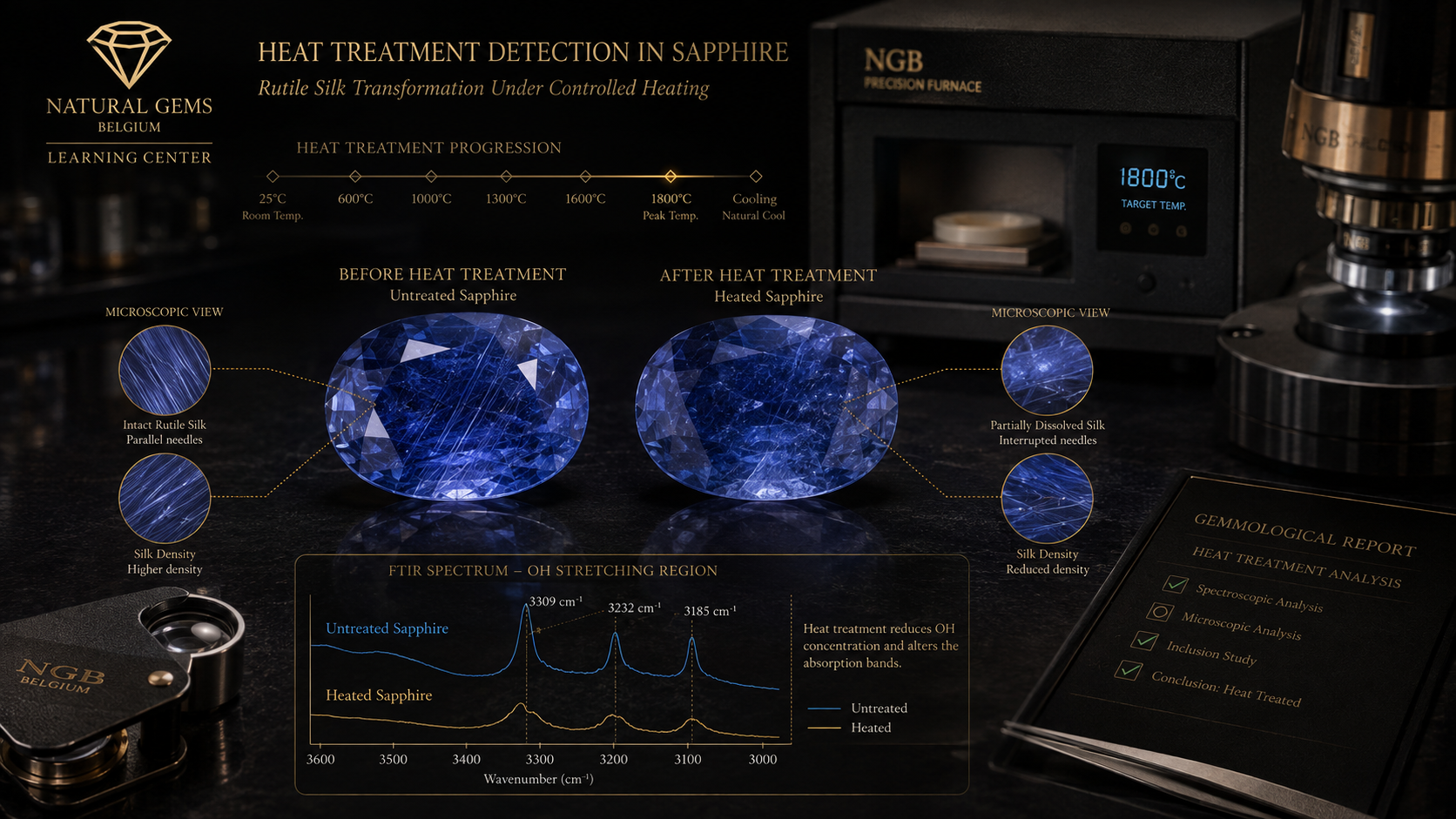
When sapphire is heated to sufficiently high temperatures, rutile can begin to dissolve.
Titanium is then released into the surrounding corundum lattice.
Under suitable chemical conditions, this can increase the number of Fe²⁺–Ti⁴⁺ colour-producing pairs.
The sapphire can become more strongly blue.
This is one of the central mechanisms behind conventional high-temperature blue-sapphire treatment.
5. Rutile Silk Is Central to Sapphire Heat Treatment
Natural sapphire commonly contains extremely fine rutile needles.
When numerous and appropriately oriented, these needles are known as silk.
Silk can influence:
- transparency;
- visual softness;
- light scattering;
- asterism in star sapphire.
Rutile is also highly important for heat-treatment detection.
At sufficiently high temperatures, rutile needles may:
- partially dissolve;
- become interrupted;
- develop altered surfaces;
- disappear substantially.
The resulting titanium can diffuse into the surrounding corundum.
A gemmologist examining altered silk under magnification may therefore find evidence that the sapphire has experienced high-temperature treatment.
6. Low-Temperature and High-Temperature Heating
Not all heat treatment should be treated as one process.
A useful scientific distinction concerns whether the temperature becomes high enough to dissolve secondary microscopic mineral phases such as rutile.
Research commonly places the approximate transition between low- and high-temperature corundum treatment in the region of:
about 1200–1350°C
because rutile silk begins to dissolve substantially within this general range.
This is not a rigid universal boundary.
Actual reactions depend on:
- treatment duration;
- atmosphere;
- inclusion size;
- sapphire chemistry;
- heating history.
But it provides a useful conceptual division.
Lower-Temperature Heating
May occur below roughly 1200°C and sometimes at temperatures below 700–900°C.
Potential effects include:
- modification of certain colour centres;
- reduction of unwanted blue components;
- changes involving hydrogen;
- subtle changes to some inclusions.
Higher-Temperature Heating
Often involves temperatures sufficient to modify or dissolve rutile and other inclusions.
Potential effects include:
- stronger colour modification;
- rutile dissolution;
- recrystallisation;
- substantial inclusion alteration;
- greater diffusion of some species.
Detection methods must therefore account for the treatment temperature.
7. Heating Does Not Always Make Sapphire Bluer
A particularly persistent misconception is:
“Sapphire is heated to make it blue.”
That is only one possible result.
Experimental work on metamorphic blue sapphire from Madagascar demonstrates that heating in air at approximately 800–1100°C can actually make blue sapphire lighter.
At higher temperatures, where rutile begins dissolving, the stones can develop deeper and more saturated blue colour.
The same material can therefore respond in opposite ways at different temperatures.
The outcome depends on which chemical and structural processes dominate at each stage.
8. Furnace Atmosphere Matters
Temperature alone does not control treatment.
The chemical environment inside the furnace is also important.
Heating can occur under:
- oxidising conditions;
- reducing conditions;
- controlled atmospheres.
These conditions affect the oxidation states of trace elements.
Iron is particularly important because Fe²⁺ and Fe³⁺ participate differently in sapphire colour chemistry.
Changing the balance between oxidation states can therefore alter the absorption spectrum and visible colour.
A statement such as:
“This sapphire was heated to 1500°C”
does not by itself completely describe the treatment.
Atmosphere and duration also matter.
9. Time Matters Too
Thermal reactions require time.
Diffusion distances increase with:
- temperature;
- treatment duration.
A short treatment and a prolonged treatment at the same temperature may therefore produce different results.
Likewise, high temperature can accelerate reactions that would occur much more slowly at lower temperatures.
Professional corundum treatment is consequently a controlled combination of:
temperature + atmosphere + time + starting material
rather than a single temperature setting.
10. Pink Sapphire Can Be Heated to Remove Blue
Low-temperature heating provides an excellent example of why treatment is not simply about intensifying colour.
Some pink sapphires from Madagascar contain an undesirable subtle blue component.
GIA experiments heated such material in air at approximately 800°C for 160 minutes.
After heating, the blue component was reduced and the stones appeared purer pink.
Importantly, many of their inclusions showed little obvious change.
Needles, particles, etch tubes, mica and zircon could remain largely unaffected under these conditions.
That creates a major identification challenge.
A sapphire can have experienced intentional heat treatment without displaying the dramatic melted or damaged inclusions associated with high-temperature treatment.
11. Low-Temperature Heating Is a Modern Detection Challenge
Traditional heat-treatment detection often relies heavily on microscopic evidence.
That approach works well when heating substantially alters inclusions.
Low-temperature treatment complicates the situation.
At lower temperatures:
- rutile silk may remain intact;
- zircon may remain visually unchanged;
- many mineral inclusions may show little damage;
- conventional visual indicators may be absent.
The sapphire may therefore look microscopically similar to an unheated stone.
This is where analytical spectroscopy becomes especially important.
12. Microscopy Remains the First Major Tool
Despite advances in laboratory instrumentation, microscopy remains fundamental to corundum treatment detection.
A trained gemmologist searches for features whose appearance may have been modified by heating.
These can include:
- altered rutile silk;
- damaged crystal inclusions;
- tension fractures;
- discoid fractures;
- recrystallised material;
- modified fissure residues;
- altered mineral surfaces.
No single feature should automatically be interpreted without context.
Different inclusions respond to heat at different temperatures.
13. Altered Rutile Silk
Rutile is among the best-known microscopic indicators.
Unheated rutile silk may appear as:
- fine intact needles;
- intersecting oriented needle systems;
- continuous delicate lines.
High-temperature heating can cause needles to become:
- broken;
- dotted;
- partially dissolved;
- irregular;
- substantially absent.
The interpretation must be made carefully.
Rutile morphology varies naturally, and the absence of silk does not prove heating.
A sapphire may simply never have contained visible rutile.
14. Heat-Damaged Crystal Inclusions
Mineral inclusions trapped inside sapphire can respond dramatically to heating.
Different minerals have different thermal stability.
Heating can produce:
- expansion;
- phase transformation;
- partial melting;
- recrystallisation;
- stress around the inclusion.
The surrounding sapphire and included mineral may also expand differently as temperature changes.
That mismatch can create stress.
One possible result is a fracture halo around the inclusion.
15. Discoid Fractures
A commonly recognised heat-related feature in corundum is the discoid fracture.
These are disc-like fractures that can develop around solid inclusions when heating creates internal stress.
They can provide strong evidence of treatment in appropriate circumstances.
But caution is necessary.
Natural geological processes can also create tension fractures around inclusions.
A gemmologist therefore interprets:
- fracture morphology;
- the included mineral;
- surrounding features;
- other evidence within the sapphire.
Treatment determination is rarely based on one isolated visual feature.
16. Surface-Reaching Residues Can Change During Heating
Surface-reaching fractures may contain naturally occurring iron-bearing residues.
Research has shown that yellow-brown limonitic material can convert to reddish hematite during heating.
Because this reaction occurs at relatively low temperatures, the colour change can provide a useful visual clue that a corundum has been heated.
This is a good example of classical gemmology remaining useful even in an era of advanced spectroscopy.
A microscope can sometimes reveal evidence created by straightforward mineral chemistry.
17. Why “Intact Inclusions” Do Not Prove a Sapphire Is Unheated
This is one of the most important practical lessons.
A sapphire containing apparently intact rutile or zircon cannot automatically be declared unheated.
Low-temperature treatment may leave many inclusions largely unchanged.
Experiments on Madagascan pink sapphire have demonstrated that treatment around 800°C can produce a useful colour modification while leaving many common inclusions visually unaffected.
Therefore:
Absence of obvious heat damage is not automatically proof of absence of heat treatment.
Professional laboratories must sometimes search for evidence outside the visible microscope scene.
18. FTIR Spectroscopy
One of the most important advanced tools for detecting certain forms of sapphire heat treatment is:
Fourier-transform infrared spectroscopy — FTIR
FTIR measures the absorption of infrared radiation by the gemstone.
It can detect vibrational features associated with:
- hydrogen;
- hydroxyl-related defects;
- other molecular or lattice-related species.
Hydrogen concentrations in natural corundum can be extremely small.
Yet the way hydrogen is incorporated into the crystal can contain valuable information about treatment history.
19. The 3309 cm⁻¹ Region
A particularly important region in corundum FTIR spectroscopy occurs around:
3309 cm⁻¹
A single absorption peak near 3309 cm⁻¹ can occur in natural corundum.
Its presence alone therefore does not automatically prove heating.
The interpretation becomes more significant when a characteristic series of peaks develops.
This is known as the:
3309 cm⁻¹ series
and principally contains peaks near:
- 3309 cm⁻¹;
- 3232 cm⁻¹;
- 3185 cm⁻¹.
Weaker associated features can also occur.
20. Why the 3309 Series Matters
The complete or partial 3309 series represents a particular form of hydrogen incorporation in corundum.
For certain ruby and sapphire populations, its presence provides diagnostic evidence of artificial post-growth heat treatment.
This has become especially valuable for detecting low-temperature heating.
A stone may show virtually no visible inclusion damage.
Yet its infrared spectrum can preserve evidence that heating changed the configuration of hydrogen-related defects within the crystal lattice.
This is a powerful example of modern analytical gemmology.
The treatment history is recorded at an atomic scale even when it is not obvious microscopically.
21. New Research Has Refined Interpretation of the 3309 Series
Research published in Gems & Gemology in 2025 refined how the 3309 cm⁻¹ series should be identified.
The study showed that the precise positions of the principal peaks can shift slightly depending on iron and chromium concentrations.
This matters because other unrelated hydrogen-related peaks can occur in the same spectral region.
Laboratories must therefore distinguish:
a genuine 3309-series pattern
from
an isolated absorption feature that happens to lie nearby.
The 2025 research demonstrated relationships between peak positions and trace-element concentrations, improving the reliability of this diagnostic tool.
It also reinforces a central principle:
Treatment detection requires interpretation, not merely spotting a peak on a spectrum.
22. The 3232 cm⁻¹ Peak and Pink Sapphire
Experiments on Madagascan pink sapphire provide a particularly useful example.
Before heating, studied sapphires displayed a single 3309 cm⁻¹ feature.
After heating around 800°C, many developed an additional peak near:
3232 cm⁻¹
GIA researchers examined hundreds of additional unheated pink sapphires from Madagascar and found that this 3232 feature was absent in their unheated reference samples.
For appropriate material, its development can therefore provide important evidence of low-temperature treatment.
But again, this criterion cannot automatically be transferred to every sapphire from every geological environment.
23. Orientation and Stone Size Affect FTIR Detection
FTIR interpretation is not as simple as placing a sapphire in an instrument and reading a yes-or-no result.
Some hydrogen-related absorption features are orientation-dependent.
Their strength can change according to the direction in which infrared radiation travels through the crystal.
Optical path length also matters.
A very small gemstone may not provide enough path length for a weak absorption feature to become clearly detectable.
Laboratories may therefore:
- collect spectra in multiple directions;
- orient the sapphire appropriately;
- use specialised accessories;
- combine FTIR with other evidence.
A spectrum showing no diagnostic heat feature does not necessarily prove that heating never occurred.
24. UV Fluorescence Can Provide Additional Evidence
Ultraviolet fluorescence is another useful investigative tool.
Some heated sapphires display changes in their short-wave UV reaction.
Heating can modify defects and trace-element configurations that influence fluorescence.
Certain heated sapphire populations may develop:
- chalky fluorescence;
- zoned fluorescence patterns;
- reactions different from comparable unheated material.
Experimental studies on Madagascar sapphire have shown that short-wave UV imaging can contribute useful evidence for treatment detection.
But fluorescence is not universal proof.
Its interpretation depends on sapphire type and chemistry.
25. UV-Vis-NIR Spectroscopy
Visible colour itself is caused by selective absorption.
UV-Vis-NIR spectroscopy records that absorption across ultraviolet, visible and near-infrared wavelengths.
Heating can alter absorption features by changing:
- oxidation states;
- defect configurations;
- Fe–Ti interactions;
- hydrogen-related chemistry.
Comparing spectral features with established reference data can therefore contribute to treatment interpretation.
However, spectral features must be interpreted carefully.
26. Why One Spectrum Can Be Misleading
Experimental heating of metamorphic Madagascar sapphire produced an important warning.
After treatment, some stones developed a strong absorption feature near approximately:
880 nm
That feature had often been associated with basalt-related sapphire.
The experiment demonstrated that heating could create similar spectral behaviour in metamorphic material.
Therefore, a laboratory should not automatically conclude geological type or treatment history from one absorption feature.
This illustrates the central method of professional gemmology:
multiple independent observations should converge on the same interpretation.
27. Raman Spectroscopy and Inclusion Analysis
Raman spectroscopy identifies minerals through their characteristic vibrational spectra.
This makes it particularly useful for identifying inclusions inside sapphire.
Once the inclusion is identified, researchers can examine whether its Raman spectrum indicates:
- structural change;
- recrystallisation;
- phase transformation;
- radiation damage;
- heat-induced modification.
Experimental studies have shown that minerals such as monazite and zircon can respond differently to heating.
Raman analysis can therefore provide complementary evidence when microscopic appearance alone is ambiguous.
28. Inclusion Reactions Depend on the Mineral
There is no universal temperature at which every inclusion inside sapphire suddenly becomes “heat damaged.”
Different minerals respond differently.
Even inclusions of the same mineral can behave differently depending on:
- size;
- depth below the surface;
- surrounding fractures;
- orientation;
- thermal history.
For example:
- rutile may remain intact at lower treatment temperatures;
- some mica inclusions can react relatively early;
- zircon may remain visually stable under conditions that alter other minerals;
- monazite can show measurable changes.
This is why laboratory research heats well-documented reference stones experimentally.
Treatment-detection criteria must be based on observed reactions, not assumptions.
29. High-Temperature Heating Is Often Easier to Detect
As treatment temperature increases, the likelihood of significant inclusion modification generally increases.
High-temperature corundum may show combinations of:
- dissolved rutile;
- altered crystal inclusions;
- recrystallised surfaces;
- tension fractures;
- changed fluorescence;
- modified spectra.
When several independent features agree, a gemmologist may have strong evidence of heating.
Low-temperature treatment is more challenging precisely because fewer obvious changes may occur.
30. “No Indications of Heating” Is Carefully Chosen Laboratory Language
Professional laboratory wording is important.
A laboratory may report:
No indications of heating
rather than making the absolute statement:
This sapphire has never experienced elevated temperature after mining.
Why?
Because scientific conclusions are limited by:
- current analytical methods;
- detection thresholds;
- stone size;
- available optical path;
- sapphire chemistry;
- treatment conditions.
Extremely subtle treatment may not always leave detectable evidence.
The laboratory is reporting what its examination supports.
This is scientifically more defensible than making an unlimited claim about every event in the stone’s history.
31. Unheated Does Not Mean “Better Gemmologically”
Treatment status and gemstone quality are different concepts.
An unheated sapphire can have:
- poor colour;
- severe zoning;
- fractures;
- low transparency;
- poor cut.
A heated sapphire can have:
- beautiful colour;
- excellent transparency;
- exceptional cut;
- strong durability.
Gem quality must be evaluated separately from treatment status.
However, treatment status can have substantial commercial importance because fine unheated sapphires with naturally attractive colour are comparatively scarce.
The market may therefore assign a premium to exceptional unheated stones.
That is a question of rarity and market preference — not a different mineralogical species.
32. Heating and Disclosure
Treatment disclosure is fundamental to responsible gemstone commerce.
A buyer should be able to distinguish between:
- natural unheated sapphire;
- natural heated sapphire;
- sapphire subjected to diffusion treatment;
- fracture-filled or otherwise treated corundum;
- synthetic sapphire.
These treatments do not all have the same gemmological or commercial significance.
The word natural should never be used in a way that conceals a material treatment.
Transparent disclosure supports:
- consumer trust;
- correct valuation;
- appropriate care;
- responsible resale documentation.
33. Ordinary Heat Treatment and Diffusion Treatment Are Not the Same
This distinction is particularly important.
Conventional Heat Treatment
Uses temperature to modify characteristics already present within the sapphire’s existing chemistry and inclusions.
Lattice Diffusion Treatment
Uses high-temperature treatment in the presence of an external chemical source so that elements diffuse into the corundum lattice and alter colour.
Historically important examples include:
- titanium diffusion;
- beryllium diffusion.
These are not merely different temperatures of ordinary heating.
They involve deliberate introduction of chemical species from outside the gemstone.
34. Beryllium Diffusion
Beryllium diffusion became a major gemmological issue in the early 2000s.
Corundum was treated at very high temperatures — above approximately 1800°C — in the presence of beryllium-bearing material.
Be²⁺ can diffuse into the corundum lattice.
Its introduction changes charge-compensation chemistry and can create or modify colour centres.
The treatment can produce or modify:
- orange;
- yellow;
- pink-orange;
- blue;
- other corundum colours.
Because beryllium is a very light element, its detection may require advanced chemical analysis such as mass spectrometry.
The development of this treatment significantly changed coloured-stone laboratory practice.
35. Surface Diffusion Versus Deep Diffusion
Not all diffusion treatments penetrate to the same depth.
Some older titanium diffusion treatments produced colour concentrated relatively close to the surface.
Repolishing or recutting could therefore remove or alter the treated colour layer.
Beryllium can diffuse considerably deeper under high-temperature conditions because of its small atomic size.
Treatment identification must consequently consider:
- colour concentration;
- facet-junction appearance;
- immersion observations;
- trace-element analysis.
The generic word heated is not sufficiently descriptive for a diffusion-treated sapphire.
36. Why Laboratory Reports Matter More for Valuable Sapphire
For lower-value commercial material, full advanced laboratory testing may not always be economically justified.
But as sapphire value rises, treatment status can become a major component of commercial evaluation.
A recognised laboratory can investigate:
- natural versus synthetic origin;
- indications of heating;
- diffusion treatment;
- geographic origin where requested and scientifically supportable.
For significant stones, laboratory documentation reduces reliance on:
- seller assumptions;
- visual appearance;
- incomplete provenance;
- historical trade descriptions.
A gemstone’s appearance can be beautiful.
Its treatment history requires evidence.
37. What a Gemmologist Actually Does
Professional sapphire treatment determination is a process of evidence integration.
A simplified workflow may include:
Step 1 — Standard Gemmological Examination
Confirm properties consistent with corundum.
Step 2 — Microscopy
Search for:
- natural inclusions;
- altered silk;
- heat-damaged crystals;
- fractures;
- residues;
- growth structures.
Step 3 — Fluorescence Examination
Observe reactions under long-wave and short-wave ultraviolet radiation.
Step 4 — FTIR Spectroscopy
Investigate hydrogen-related defects and diagnostic treatment features.
Step 5 — UV-Vis-NIR Spectroscopy
Analyse colour-producing absorption and other relevant spectral behaviour.
Step 6 — Raman Analysis
Identify inclusions and investigate possible structural modification where appropriate.
Step 7 — Chemical Analysis
Use trace-element techniques when required, especially for certain diffusion treatments or difficult identification problems.
Step 8 — Reference Comparison
Compare observations against documented natural, heated and experimentally treated reference material.
The final conclusion is based on the combined evidence.
38. What Consumers Cannot Reliably Determine at Home
Some treatment features are visible under professional microscopy.
Others are not.
A consumer cannot reliably determine heating simply from:
- colour;
- price;
- photographs;
- a loupe;
- the country where the stone was purchased;
- a seller’s statement that inclusions look “natural.”
Likewise, natural inclusions prove neither absence of treatment nor geographic origin.
A heated sapphire remains capable of containing natural inclusions because the sapphire itself is natural.
For commercially important treatment determinations, laboratory evidence is preferable.
39. Common Myths About Sapphire Heat Treatment
Myth 1 — “A Heated Sapphire Is Synthetic”
Incorrect.
A naturally formed sapphire remains natural after heat treatment.
Myth 2 — “Heating Just Makes Sapphire Darker Blue”
Incorrect.
Heating can deepen, lighten, remove or alter colour components depending on chemistry and treatment conditions.
Myth 3 — “Intact Rutile Proves a Sapphire Is Unheated”
Incorrect.
Low-temperature treatment may leave rutile largely unchanged.
Myth 4 — “If the Microscope Shows No Heat Damage, the Stone Is Definitely Unheated”
Incorrect.
Some low-temperature treatments require spectroscopic investigation.
Myth 5 — “All Heated Sapphires Receive the Same Treatment”
Incorrect.
Temperature, duration, atmosphere and starting material vary substantially.
Myth 6 — “Heat Treatment and Diffusion Treatment Are the Same”
Incorrect.
Diffusion introduces chemical species from an external source into the corundum lattice.
Myth 7 — “Unheated Automatically Means High Quality”
Incorrect.
Treatment status and gemstone quality are separate variables.
40. Evidence Classification
| Statement | Classification |
|---|---|
| Heat treatment is widely used to modify sapphire colour and/or clarity | Established gemmological fact |
| Heating can alter trace-element and defect chemistry in corundum | Established scientific fact |
| High-temperature treatment can dissolve rutile silk | Established experimental observation |
| Dissolved titanium can contribute to increased Fe²⁺–Ti⁴⁺ blue chromophores under suitable conditions | Established crystal-chemical mechanism |
| Low-temperature treatment may leave many inclusions visually unchanged | Established experimental observation |
| FTIR can detect certain hydrogen-related signatures associated with heating | Established analytical method |
| The 3309 cm⁻¹ series can be diagnostic of heating for certain corundum populations | Established laboratory criterion with material-specific limitations |
| A single 3309 cm⁻¹ peak automatically proves heating | Incorrect |
| Intact rutile automatically proves absence of heating | Incorrect |
| All sapphires react identically to the same furnace conditions | Incorrect |
| A sapphire can always be proven absolutely unheated | Too absolute; laboratories report according to detectable evidence |
| Diffusion treatment is equivalent to conventional heat treatment | Incorrect |
| Unheated sapphire is automatically higher quality than heated sapphire | Incorrect |
41. Why This Matters When Buying Sapphire
The treatment description tells you something important about the gemstone’s history.
It does not tell you everything about its quality.
When evaluating sapphire, consider treatment alongside:
- colour;
- clarity;
- cut;
- carat weight;
- durability;
- geographic origin where relevant;
- laboratory documentation;
- rarity.
For high-value material, the difference between heated and unheated status can have substantial market consequences.
For everyday jewellery, a properly disclosed conventionally heated natural sapphire can still be an excellent gemstone.
The essential requirement is that the description accurately reflects what is known.
Conclusion
Sapphire heat treatment is not simply the application of high temperature to make a gemstone look better.
It is controlled manipulation of crystal chemistry.
Heating can change oxidation states.
It can rearrange hydrogen-related defects.
It can dissolve rutile and release titanium into the corundum lattice.
It can strengthen or weaken particular colour-producing mechanisms.
It can remove an unwanted blue component from pink sapphire or develop deeper blue in other material.
At sufficiently high temperatures, it can visibly alter inclusions.
At lower temperatures, however, treatment may leave surprisingly little microscopic evidence.
That is why modern gemmology combines two worlds.
The first is classical observation:
microscope, inclusions, fluorescence and mineralogical knowledge.
The second is analytical science:
FTIR, UV-Vis-NIR spectroscopy, Raman spectroscopy and trace-element analysis.
Neither should be interpreted mechanically.
A single intact inclusion does not prove a sapphire is unheated.
A single spectral peak should not be taken out of context.
A beautiful blue colour does not reveal treatment history.
Reliable determination comes from multiple pieces of evidence interpreted against well-documented reference stones and controlled heating experiments.
That distinction is fundamental to responsible gemstone education.
A heated natural sapphire remains a natural sapphire.
An unheated sapphire records a different post-formation history.
And understanding the difference requires not assumptions, but gemmological evidence.
References & Further Reading
Soonthorntantikul, W. & Palke, A. C. — “The 3309 cm⁻¹ Series in Sapphire and Ruby: A Focus on FTIR Peak Position Variation.” Gems & Gemology, Spring 2025, Gemological Institute of America.
Current detailed research refining interpretation of the 3309, 3232 and 3185 cm⁻¹ FTIR series used as evidence of heat treatment in certain ruby and sapphire populations. Particularly important for low-temperature treatment detection.
https://www.gia.edu/gems-gemology/spring-2025-ftir-3309-series-corundum
Saeseaw, S., Khowpong, C. & Vertriest, W. — “Low-Temperature Heat Treatment of Pink Sapphires from Ilakaka, Madagascar.” Gems & Gemology, Winter 2020, Gemological Institute of America.
Controlled heating experiments demonstrating removal of blue colour components at approximately 800°C, limited alteration of many inclusions and the usefulness of FTIR in detecting low-temperature treatment.
https://origin.prod.gia.edu/gems-gemology/winter-2020-ilakaka-pink-sapphires-heat-treatment
Hughes, E. B. & Perkins, R. — “Madagascar Sapphire: Low-Temperature Heat Treatment Experiments.” Gems & Gemology, Summer 2019, Gemological Institute of America.
Experimental investigation showing how metamorphic blue sapphire responds across increasing temperatures and how microscopy, UV fluorescence and infrared spectroscopy can contribute to treatment detection.
https://hongkong.gia.edu/gems-gemology/summer-2019-madagascar-sapphire-heat-treatment-experiments
Saeseaw, S. & Khowpong, C. — “The Effect of Low-Temperature Heat Treatment on Pink Sapphire.” Gems & Gemology, Summer 2019, Gemological Institute of America.
Preliminary experimental work documenting reduction of blue colour components and development of the 3232 cm⁻¹ FTIR feature after low-temperature treatment.
https://hongkong.gia.edu/gems-gemology/summer-2019-gemnews-effect-low-temperature-heat-pink-sapphire
Koivula, J. I. — “Useful Visual Clue Indicating Corundum Heat Treatment.” Gems & Gemology, Fall 2013, Gemological Institute of America.
Practical microscopy reference describing the heat-induced conversion of limonitic residues to hematite in surface-reaching inclusions as a visual treatment clue.
https://www.gia.edu/gems-gemology/fa13-koivula-corundum-heat-treatment
Palke, A. C. et al. — “A Canary in the Ruby Mine: Low-Temperature Heat Treatment Experiments on Burmese Ruby.” Gems & Gemology, Winter 2022, Gemological Institute of America.
Detailed experimental research on inclusion reactions during low-temperature heating, demonstrating why different mineral inclusions respond differently and how Raman spectroscopy can complement microscopy.
https://www.gia.edu/gems-gemology/winter-2022-burmese-ruby
Atikarnsakul, U. & Emmett, J. L. — “Heat Treatment Effects on the Behavior of the 3161 cm⁻¹ Feature in Low-Iron Metamorphic Yellow Sapphire.” Gems & Gemology, Fall 2021, Gemological Institute of America.
Useful research into hydrogen diffusion and FTIR behaviour during staged heating of yellow sapphire.
https://www.gia.edu/gems-gemology/fall-2021-gemnews-heat-treatment-effects-low-iron-yellow-sapphire
Emmett, J. L., Scarratt, K., McClure, S. F., Moses, T., Douthit, T. R., Hughes, R., Novak, S., Shigley, J. E., Wang, W., Bordelon, O. & Kane, R. E. — “Beryllium Diffusion of Ruby and Sapphire.” Gems & Gemology, Summer 2003, Gemological Institute of America.
Foundational scientific study of beryllium diffusion treatment, colour modification, corundum crystal chemistry and the analytical challenges involved in detecting externally introduced beryllium.
https://www.gia.edu/gems-gemology/summer-2003-beryllium-diffusion-ruby-sapphire-emmett