
Introduction
Corundum geology helps explain why ruby and sapphire, although strikingly different in appearance, belong mineralogically to the same species: corundum, crystalline aluminium oxide with the ideal formula Al₂O₃.
Their existence as transparent, gem-quality crystals is geologically exceptional.
Aluminium is abundant in Earth’s crust, yet gem corundum is comparatively rare. The reason is not simply that aluminium must be present. The surrounding rock, temperature, pressure, chemical environment, fluid activity and availability of other elements must combine in ways that permit aluminium oxide to crystallise as corundum rather than being incorporated into far more common silicate minerals.
Ruby and sapphire can consequently form through more than one geological pathway.
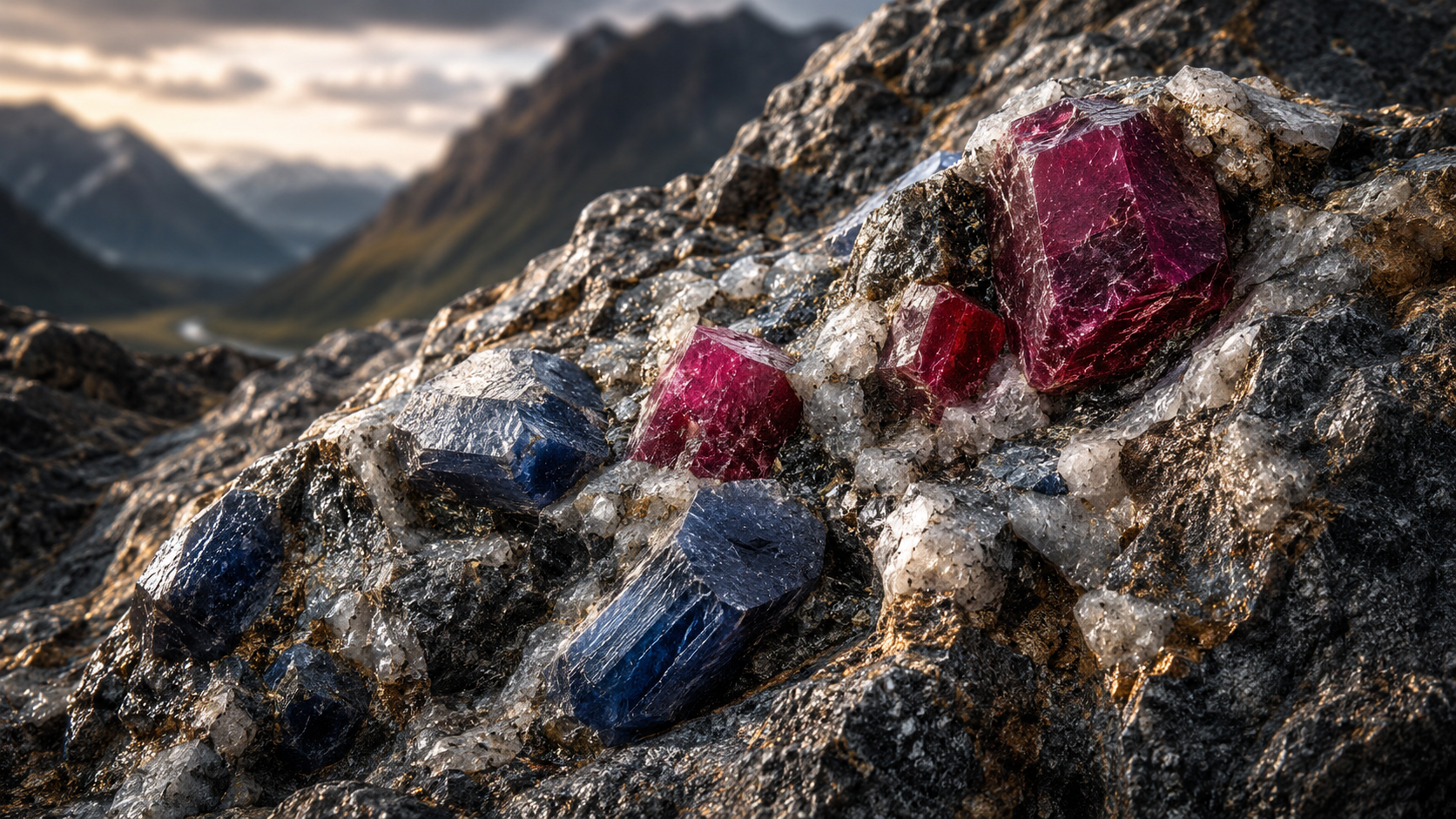
Modern classifications divide primary gem-corundum deposits broadly into magmatic and metamorphic types. Metamorphic occurrences include both rocks transformed largely through metamorphism and environments in which substantial fluid-rock interaction — metasomatism — played an important role. After their formation, ruby and sapphire may be released from their original host rocks by weathering and concentrated in secondary deposits such as river gravels.
Understanding those geological environments explains far more than where gemstones are mined. It helps explain their trace-element chemistry, inclusions, colour and why gemmological laboratories can sometimes extract clues about geographic origin from the stones themselves.
Table of Contents
1. Corundum: A Simple Formula with Difficult Geological Requirements
Corundum has the ideal chemical formula:
Al₂O₃
Its crystal structure consists essentially of oxygen atoms with aluminium occupying sites within that structure. Pure corundum is colourless. Trace elements incorporated during crystal growth can produce ruby and the many colours of sapphire. Chromium is particularly important in ruby, while iron and titanium play major roles in blue sapphire.
This is one of the central problems in corundum geology: aluminium is abundant, yet the geological conditions required for gem-quality corundum are comparatively rare.
Silicon and oxygen dominate much of Earth’s crust. Aluminium commonly combines with silicon and other elements to form abundant silicate minerals such as feldspars, micas and clay minerals.
For corundum to become stable and crystallise in significant amounts, geological conditions generally need to favour high aluminium availability relative to silica.
That does not mean every corundum deposit is literally devoid of silica. Rather, the local mineral-forming system must permit aluminium to be incorporated into Al₂O₃ instead of being consumed predominantly by aluminium-bearing silicates.
This chemical constraint is one reason gem-quality corundum deposits are unusual.
2. Ruby and Sapphire Are Geological Variations of the Same Mineral
Mineralogically, ruby and sapphire are not separate mineral species.
Both are corundum.
The distinction is primarily colour nomenclature:
- Ruby — red gem-quality corundum, with chromium an important chromophore.
- Sapphire — gem corundum of colours other than red, including blue, yellow, green, pink, violet and colourless varieties.
- Fancy sapphire — a gemmological and trade expression commonly used for sapphire colours other than conventional blue.
The geology behind those colours is important because the rocks and fluids surrounding a growing corundum crystal determine which trace elements are available for incorporation.
A corundum-forming environment therefore does more than produce the crystal.
It influences the gemstone’s eventual chemical fingerprint.
3. The Major Geological Environments of Gem Corundum
Modern geological classification separates corundum deposits first into primary and secondary occurrences.
A primary deposit preserves corundum in the rock where it crystallised or in rock that transported crystals upward from their deeper formation environment.
Primary deposits are broadly classified as:
- Magmatic
- Metamorphic
The metamorphic group can be divided further into:
- metamorphic deposits sensu stricto;
- metamorphic-metasomatic deposits involving substantial fluid-rock interaction.
Secondary deposits develop later, after erosion removes corundum from its host rock and transports or concentrates it elsewhere.
| Geological setting | Basic process | Typical geological association | Gem examples |
|---|---|---|---|
| Metamorphic | Existing rocks transformed by heat, pressure and recrystallisation | Marble, mafic-ultramafic rocks, gneiss, metapelites | Ruby and sapphire |
| Metamorphic-metasomatic | Metamorphism plus chemically active fluid-rock interaction | Desilicated pegmatites, plumasites, skarns, shear zones | Important sapphire and ruby deposits |
| Magmatic | Corundum related to igneous systems | Alkali basalt-associated systems, lamprophyres, syenites | Many blue, green and yellow sapphires |
| Secondary placer | Weathering, erosion, transport and concentration | Alluvial, colluvial and related sediments | Major sapphire and ruby mining deposits |
The classification describes geological processes, not gemstone quality. Exceptional stones can occur in more than one geological environment.
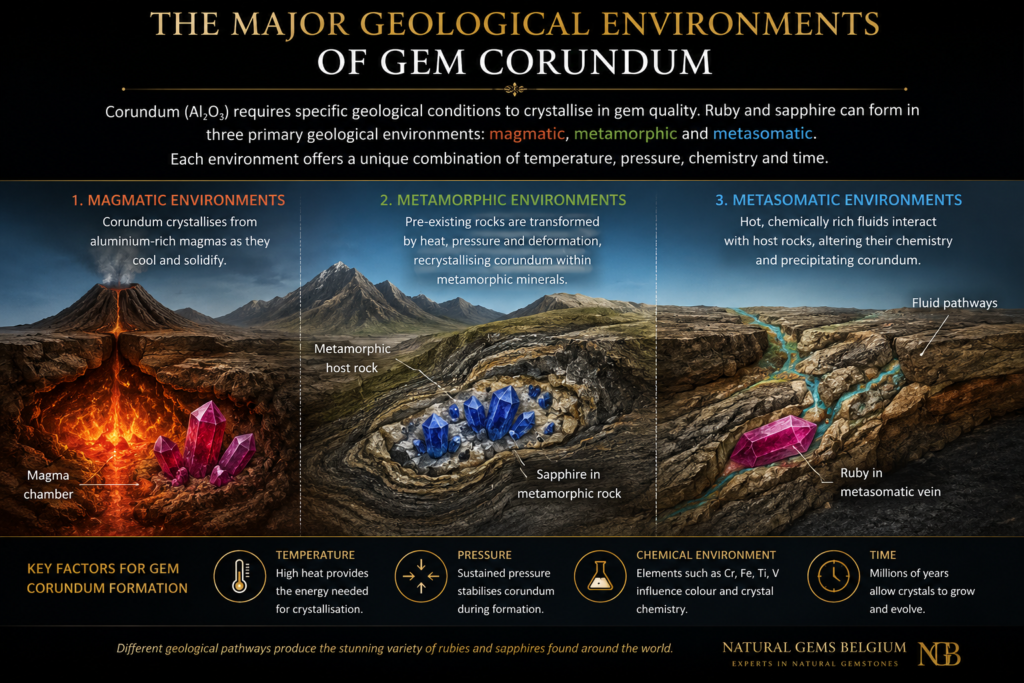
4. Metamorphism: Transforming Rocks into Gem-Producing Environments
Metamorphism occurs when pre-existing rocks are altered by changes in temperature, pressure, deformation and fluid activity without wholesale melting of the rock.
Minerals that were stable under the original conditions can break down, react and recrystallise into new mineral assemblages.
Corundum is a high-temperature mineral in many metamorphic settings. Important metamorphic gem-corundum deposits occur in rocks that reached amphibolite- to granulite-facies conditions, with temperatures commonly in the approximate range of 500–800°C.
Relevant host environments include:
- marble;
- mafic and ultramafic rocks;
- gneiss;
- metapelite complexes;
- amphibolite;
- rocks affected by regional or contact metamorphism.
But temperature alone does not produce ruby or sapphire.
The chemical composition of the protolith — the original rock before metamorphism — and the behaviour of fluids are equally important.
5. Ruby in Marble: One of the Classic Corundum Environments
Some of the world’s celebrated ruby deposits occur in metamorphosed carbonate rocks.
These marble-hosted ruby deposits are especially important across Central and Southeast Asia.
The host rocks originated as carbonate-rich sediments that were subsequently subjected to metamorphism. Ruby mineralisation occurs only in particular chemically suitable horizons rather than throughout every marble body.
Important associated minerals can include:
- calcite;
- phlogopite;
- muscovite;
- scapolite;
- margarite;
- spinel;
- titanite;
- graphite;
- pyrite.
Research into these deposits indicates that the precursor carbonate rocks could contain aluminium-bearing clay material and evaporitic components. Metamorphism and chemical exchange then created conditions under which corundum could crystallise.
Why Chromium Matters
Producing colourless corundum requires aluminium and oxygen.
Producing ruby additionally requires sufficient chromium to enter the corundum structure.
This creates an unusual geological requirement: the environment must supply both the aluminium needed to make corundum and the chromium needed to colour it, while still maintaining conditions favourable to corundum crystallisation.
That convergence is one reason fine natural ruby is rare.
6. Metasomatism: When Fluids Change the Chemistry of Rocks
One of the most important concepts in gemstone geology is metasomatism.
Metamorphism can reorganise minerals already present in a rock. Metasomatism goes further: chemically active fluids move through rocks and cause significant transfer of chemical components.
A rock can therefore gain some elements and lose others.
This process is highly relevant to gem corundum.
Where chemically contrasting rocks meet — for example, an aluminium-rich pegmatite interacting with mafic, ultramafic or carbonate rocks — fluid movement can profoundly alter the mineral assemblage.
One particularly important process is desilication.
Silica can be removed from an originally silica-rich intrusive rock during interaction with neighbouring rocks. The resulting silica-depleted, aluminium-rich environment can become favourable for corundum crystallisation.
7. Plumasites and Desilicated Pegmatites
A plumasite is a corundum-bearing metasomatic rock associated with desilication.
These environments are particularly important in sapphire geology.
Research describes major sapphire occurrences associated with desilicated pegmatites at localities including:
- Kashmir;
- Umba, Tanzania;
- southern Kenya;
- the Polar Urals.
At Kashmir, pegmatitic rocks interacted with surrounding metamorphic rocks, producing desilicated zones in which sapphire occurs.
This is a valuable correction to the oversimplified statement that sapphires merely “form in pegmatites.”
The important process is often not ordinary pegmatite crystallisation alone.
It is chemical interaction between the pegmatitic body and its surrounding rocks, frequently mediated by fluids and accompanied by silica removal.
8. Kashmir Sapphire: Geology Behind a Famous Gemstone
Kashmir sapphire provides an excellent example of metamorphic-metasomatic gem formation.
The classic deposit occurs in a complex metamorphic setting containing marble, amphibolite and gneiss intruded by pegmatites.
Sapphire-bearing desilicated pegmatites occur near contacts involving metamorphic rocks. Associated minerals include plagioclase, mica and tourmaline, with surrounding alteration assemblages involving talc, biotite, carbonate and other minerals.
Fluid-inclusion research indicates that sapphire growth there occurred under changing conditions. Some studies have estimated fluid-trapping conditions reaching roughly 680–700°C and 3.7–5.6 kbar in parts of the crystals, followed by lower-temperature conditions toward their margins.
These figures should not be treated as a universal recipe for sapphire.
They are estimates for a particular geological system.
That distinction matters because sapphire forms in multiple geological environments.
9. Magmatic Corundum
Not all gem corundum is metamorphic.
Important sapphire deposits are associated with magmatic environments, including:
- alkali basalt-related systems;
- lamprophyres;
- syenitic rocks.
Blue, green and yellow sapphires are especially common among basalt-associated corundum populations.
The geology is more complicated than the phrase “sapphire crystallised in basalt” implies.
In many basalt-related occurrences, sapphire is found as a xenocryst.
10. What Is a Xenocryst?
A xenocryst is a crystal carried by magma but not necessarily crystallised directly from the magma that ultimately transported it to the surface.
As alkali-basalt magma rises rapidly through the crust, it can entrain crystals or fragments of deeper rocks.
Sapphire may therefore be transported upward by basaltic volcanism even though the corundum crystal began forming deeper in the Earth under different conditions.
Melt inclusions in some basalt-associated corundum populations support a deep magmatic origin for the crystals, while the alkali basalt may subsequently have acted as the transporting magma.
This distinction is important:
Transport rock does not necessarily equal formation rock.
That principle recurs throughout gemstone geology.
11. Why the Origin of Some Basalt-Associated Sapphire Is Still Debated
Science does not require every geological question to have a final answer.
Corundum is an oxide mineral without silica in its formula, whereas basaltic magmas contain abundant silicate components.
Exactly how silica-poor corundum crystallisation environments develop in association with some basaltic systems has therefore been the subject of continuing geological research.
Several genetic models have been proposed for different basalt-associated sapphire populations, and not all questions regarding their precise deep formation environments are completely resolved.
This requires an important evidence distinction.
Established evidence: Many sapphires are geologically associated with alkali-basalt volcanic provinces and were transported toward the surface by magmatic activity.
Scientific interpretation: Several genetic models seek to explain exactly where and how those crystals originally formed at depth.
Unresolved component: No single simplified formation mechanism should be presented as universally established for all basalt-associated sapphire.
12. The Role of Plate Tectonics
Gemstone formation does not occur independently of large-scale Earth processes.
Some of the world’s major metamorphic corundum provinces are associated with enormous episodes of continental collision and mountain building.
Two geological episodes are particularly important.
Pan-African Orogeny
Major metamorphic gem deposits in East Africa, Madagascar and Sri Lanka are connected to tectonic events associated with the assembly of Gondwana hundreds of millions of years ago.
Important metamorphic gem-corundum formation occurred during the broader Pan-African orogenic interval, approximately 750–450 million years ago.
These ancient tectonic events contributed to sapphire-bearing terrains in regions that today include Sri Lanka, Madagascar and Tanzania, as well as important ruby-bearing terrains in East Africa and Madagascar.
Himalayan Orogeny
A much younger geological system developed as the Indian plate collided with Eurasia.
The resulting Himalayan and related tectonic belts created conditions associated with important ruby and sapphire deposits across parts of Central and Southeast Asia.
Important corundum-forming events within this geological belt occurred during the Cenozoic, with some ruby-forming episodes dated broadly between approximately 40 and 5 million years ago.
Gemstones can therefore preserve evidence of geological events on a continental scale.
13. From Primary Rock to Secondary Gem Deposit
Formation of a sapphire crystal is only the first stage of its geological story.
Corundum is exceptionally hard — approximately 9 on the Mohs scale — and is resistant to many weathering processes.
Its host rock may decompose far more readily.
Over immense periods:
- the primary host rock becomes exposed;
- chemical and physical weathering breaks it down;
- resistant corundum crystals are liberated;
- gravity and water move the crystals;
- hydraulic processes sort sediment;
- dense, durable gemstones become concentrated in suitable locations.
This produces secondary deposits.
14. Eluvial, Colluvial and Alluvial Corundum Deposits
Secondary gem deposits are not all identical.
Eluvial Deposits
Material accumulates close to its source through in-place weathering, with limited transport.
Colluvial Deposits
Gem-bearing material moves downslope primarily through gravity, slope processes and surface wash.
Alluvial Deposits
Streams and rivers transport and redeposit mineral grains, sometimes concentrating dense and resistant gemstones in gravel layers.
These placer environments are economically important because nature has already performed part of the extraction process.
Instead of removing gemstones from intact hard rock, miners may recover crystals from unconsolidated gravels.
A large proportion of gem-corundum production has historically come from secondary placer deposits related to several different types of primary geological environment, including alkali-basalt, plumasite, marble and amphibolite-associated deposits.
15. Sri Lanka: A Classic Secondary Sapphire Province
Sri Lanka provides one of the clearest examples of why a gemstone’s mining location is not necessarily its crystallisation location.
Much Sri Lankan gem corundum is recovered from secondary sedimentary deposits.
The sapphire originally crystallised in older metamorphic geological environments. Weathering subsequently released resistant crystals, and erosion transported and concentrated them into gem-bearing gravels.
The miners therefore recover the gemstone from sediment even though the sapphire itself did not crystallise in that sediment.
This distinction is fundamental:
Primary geological environment: where the mineral formed.
Secondary deposit: where geological processes later concentrated it.
Confusing these two concepts leads to inaccurate descriptions of gemstone formation.
16. Why Corundum Survives Transport
Several physical properties help ruby and sapphire survive the journey from primary rock into placer deposits.
Corundum combines:
- very high hardness;
- substantial chemical resistance;
- relatively high density;
- generally good durability.
A softer or less chemically resistant mineral may be destroyed during prolonged weathering and transport.
Corundum can persist.
River transport can nevertheless modify crystals. Edges may become worn and surfaces rounded, meaning an alluvial sapphire can retain geological evidence of both its original growth and its later transport history.
17. Trace Elements Link Geology to Gemmology
The geological environment surrounding a growing crystal controls the reservoir of trace elements available to it.
Corundum can incorporate minute concentrations of:
- Fe — iron;
- Ti — titanium;
- Cr — chromium;
- V — vanadium;
- Ga — gallium;
- Mg — magnesium;
among others.
These elements matter gemmologically because they can influence:
- colour;
- absorption spectra;
- fluorescence;
- treatment behaviour;
- geographic-origin interpretation.
Researchers use combinations of trace-element concentrations and elemental ratios to investigate whether sapphire populations are more consistent with metamorphic, metasomatic or magmatic geological environments.
However, compositional fields can overlap.
Trace-element diagrams are therefore evidence, not infallible geographic labels.
18. Inclusions Are Pieces of Geological History
A gemstone inclusion is not simply a flaw.
In scientific gemmology, inclusions can preserve evidence of the environment in which a crystal grew.
Sapphire may contain:
- mineral crystals;
- fluid inclusions;
- melt-related inclusions;
- rutile needles;
- healed fractures;
- particulate clouds;
- other microscopic growth features.
These can help researchers reconstruct:
- associated minerals;
- fluid chemistry;
- growth conditions;
- temperature-pressure history;
- geological environment.
In some cases, inclusions can support geographic-origin determination.
But they must be interpreted carefully.
Inclusion-cloud morphology, for example, can vary between sapphire localities. Some forms may be more characteristic of particular sources, but they are rarely restricted absolutely to one locality.
They can therefore support an origin interpretation without necessarily proving it independently.
19. Geology and Geographic Origin Are Related — But Not Identical
If Kashmir, Sri Lanka, Madagascar and Myanmar have different geology, it might seem that identifying geographic origin should be straightforward.
It is not.
Similar geological environments can develop in geographically distant regions.
Consequently, sapphires from different countries may overlap in:
- inclusions;
- trace-element chemistry;
- spectroscopy;
- colour;
- growth features.
Conversely, gemstones from different geological zones within one country may differ significantly.
Professional origin determination therefore requires comparison against large reference collections of stones whose mining provenance is known.
Geological overlap is one of the central difficulties of geographic-origin determination.
Geology narrows possibilities.
It does not automatically provide a postal address.
20. Formation Environment Does Not Determine Quality
A frequent misconception is that one geological deposit type inherently produces “better” sapphire or ruby.
Gem quality depends on many variables, including:
- colour;
- transparency;
- inclusions;
- crystal size;
- fracturing;
- colour zoning;
- orientation;
- treatment status;
- cut potential.
Exceptional gems occur in multiple geological settings.
Likewise, a famous geological locality produces far more than exceptional stones.
The geological origin of a gemstone is scientifically important, and certain origins can carry strong historical or market associations, but geological environment should not be confused with an automatic quality grade.
21. Corundum Formation and Geological Time
Gem formation is episodic rather than continuous.
The geological circumstances capable of producing important concentrations of gem-quality corundum occurred during particular tectonic episodes.
Some corundum deposits therefore record geological processes hundreds of millions of years old.
Others are much younger.
Basalt-related corundum provinces are associated in many areas with Cenozoic volcanism, whereas important metamorphic corundum provinces in East Africa, Madagascar and Sri Lanka trace their histories to much older tectonic events.
There is consequently no scientifically meaningful single answer to:
“How old is sapphire?”
The correct answer depends on the geological deposit.
22. A Simplified Corundum Geological Cycle
The natural history of a gem sapphire or ruby can be represented as:
Suitable aluminium-rich geological system
↓
Metamorphism, metasomatism or magmatic processes
↓
Corundum nucleation and crystal growth
↓
Incorporation of trace elements and inclusions
↓
Tectonic uplift and exposure
↓
Weathering of host rock
↓
Liberation of resistant corundum
↓
Transport by gravity and/or water
↓
Concentration in secondary placer deposit
↓
Mining and recovery
Not every corundum follows every stage.
A hard-rock ruby mine may exploit a primary deposit directly, while an alluvial sapphire operation may recover material after millions of years of erosion and transport.
23. What Geologists Can Learn from Ruby and Sapphire
Gemstones are not merely decorative geological products.
They can function as scientific archives.
Researchers can study corundum using:
- mineral inclusions;
- fluid inclusions;
- trace-element chemistry;
- oxygen isotopes;
- radiometric dating of associated minerals or inclusions;
- host-rock relationships;
- regional structural geology.
These approaches can reconstruct geological conditions and link gemstone formation to tectonic events.
The study of corundum consequently connects gemmology with:
mineralogy + petrology + geochemistry + tectonics + geochronology
That interdisciplinary character is precisely why geological knowledge becomes so valuable in advanced gemmology.
24. Established Facts, Interpretations and Open Questions
| Statement | Evidence classification |
|---|---|
| Ruby and sapphire are gem varieties of corundum, Al₂O₃ | Established scientific fact |
| Important primary gem-corundum deposits occur in metamorphic and magmatic geological environments | Established geological evidence |
| Metasomatic fluid-rock interaction is important in several major corundum deposits | Established geological evidence |
| Corundum’s durability permits concentration in secondary placer deposits | Established geological evidence |
| Many Sri Lankan sapphires are recovered from secondary deposits after formation in older metamorphic terrains | Established geological interpretation supported by field evidence |
| Kashmir sapphire is associated with metamorphic-metasomatic and desilicated pegmatitic environments | Established geological evidence |
| All basalt-associated sapphire crystallised directly from the basalt carrying it to the surface | Incorrect oversimplification |
| Every sapphire from one country has a single geological origin | Incorrect |
| A single inclusion automatically proves geographic origin | Not scientifically justified |
| The precise genesis of every basalt-associated sapphire population is completely resolved | No — aspects remain scientifically debated |
| One geological environment automatically produces higher-quality sapphire than another | Not scientifically justified |
No historical, religious or metaphysical assertions are necessary for this article. Its conclusions are based on geological and gemmological evidence.
25. Why This Geology Matters to the Gemstone Buyer
Most buyers will never need to identify amphibolite facies or interpret a trace-element diagram.
But understanding basic gemstone geology makes several commercial expressions easier to evaluate critically.
“Natural”
A natural sapphire formed through geological processes rather than laboratory crystal growth.
“Origin”
A country-of-origin opinion is an interpretation based on geological and gemmological evidence, not simply appearance.
“Alluvial”
An alluvial sapphire was recovered from sediment deposited by water. The term describes its secondary deposit, not necessarily the environment in which the sapphire originally crystallised.
“Basalt-Related”
This describes a geological association and transport history. It should not automatically be interpreted as a simple statement that the sapphire crystallised directly from the final basaltic lava.
“Unheated”
This is a gemmological treatment designation.
It does not describe geological formation.
Keeping these concepts separate allows consumers, collectors and professionals to interpret gemstone descriptions far more accurately.
Conclusion
Ruby and sapphire are products of unusually specific geological circumstances.
Their parent mineral, corundum, has a deceptively simple formula — Al₂O₃ — yet producing transparent, coloured crystals of gem quality requires a rare convergence of rock chemistry, temperature, pressure, fluids, trace elements and geological time.
Some corundum forms during high-grade metamorphism.
Some develops where chemically active fluids transform rocks through metasomatism.
Some is associated with deep magmatic systems and carried upward by alkali-basalt volcanism.
And much of the ruby and sapphire ultimately recovered by miners has travelled still further: weathered from its original rock, transported by erosion and concentrated into secondary gravels.
The gemstone in a piece of jewellery is therefore the final surviving fragment of a geological history that may have involved continental collision, deep crustal metamorphism, fluid-rock reaction, volcanism, uplift, erosion and river transport.
Understanding that history provides the bridge between geology and gemmology.
It explains why trace elements matter.
Why inclusions matter.
Why geographic origin can sometimes be investigated.
And why a natural sapphire or ruby is not simply a coloured crystal, but a record of the geological environment in which it grew.
References & Further Reading
Giuliani, G. & Groat, L. A. — “Geology of Corundum and Emerald Gem Deposits: A Review.” Gems & Gemology, Winter 2019, Gemological Institute of America.
Comprehensive scientific review of the geology, classification and genesis of ruby and sapphire deposits.
https://origin.prod.author.gia.edu/gia-website/gems-gemology/winter-2019-geology-of-corundum-and-emerald-gem-deposits
Palke, A. C. & Shigley, J. E. — “Gems Formed in Magmatic Rocks.” Gems & Gemology, Winter 2022, Gemological Institute of America.
Authoritative overview of magmatic gemstone formation, xenocrysts, basalt-associated corundum and secondary concentration.
https://www.gia.edu/gems-gemology/winter-2022-colored-stones-unearthed
Gemological Institute of America — “Gems Formed in Metamorphic Rocks.” Gems & Gemology, Summer 2023.
Detailed overview of metamorphic ruby and sapphire formation, metamorphic facies, metasomatism and the Pan-African and Himalayan tectonic events.
https://www.gia.edu/gems-gemology/summer-2023-colored-stones-unearthed0
Shigley, J. E., Bassoo, R. & Palke, A. C. — “Gems Recovered from Sedimentary Rocks.” Gems & Gemology, Winter 2023, Gemological Institute of America.
Authoritative discussion of secondary deposits, placer formation, weathering, transport and alluvial gemstone recovery.
https://www.gia.edu/gems-gemology/winter-2023-colored-stones-unearthed
Groat, L. A., Giuliani, G., Stone-Sundberg, J., Sun, Z., Renfro, N. D. & Palke, A. C. — “A Review of Analytical Methods Used in Geographic Origin Determination of Gemstones.” Gems & Gemology, Winter 2019.
Technical overview of the relationship between geological environment, trace-element chemistry, inclusions and modern geographic-origin determination.
https://origin.prod.gia.edu/gems-gemology/winter-2019-analytical-methods-geographic-origin-determination-gemstones
Gemological Institute of America — GIA Colored Stone Research.
Institutional research portal covering field gemmology, coloured-stone geology, treatment detection, inclusions and origin research.
https://www.gia.edu/gia-website/colored-stone-research
Tanawansombat, T. — “Uniquely Patterned Clouds in Sri Lankan Sapphire.” Gems & Gemology, Spring 2026, Gemological Institute of America.
A recent example illustrating how inclusion morphology may support geographic-origin interpretation while requiring caution against over-attribution.
https://www.gia.edu/gems-gemology/spring-2026-microworld-uniquely-patterned-clouds-in-sapphire