
Introduction
Blue is so strongly associated with sapphire that the two words can seem almost inseparable.
Yet pure sapphire is not blue.
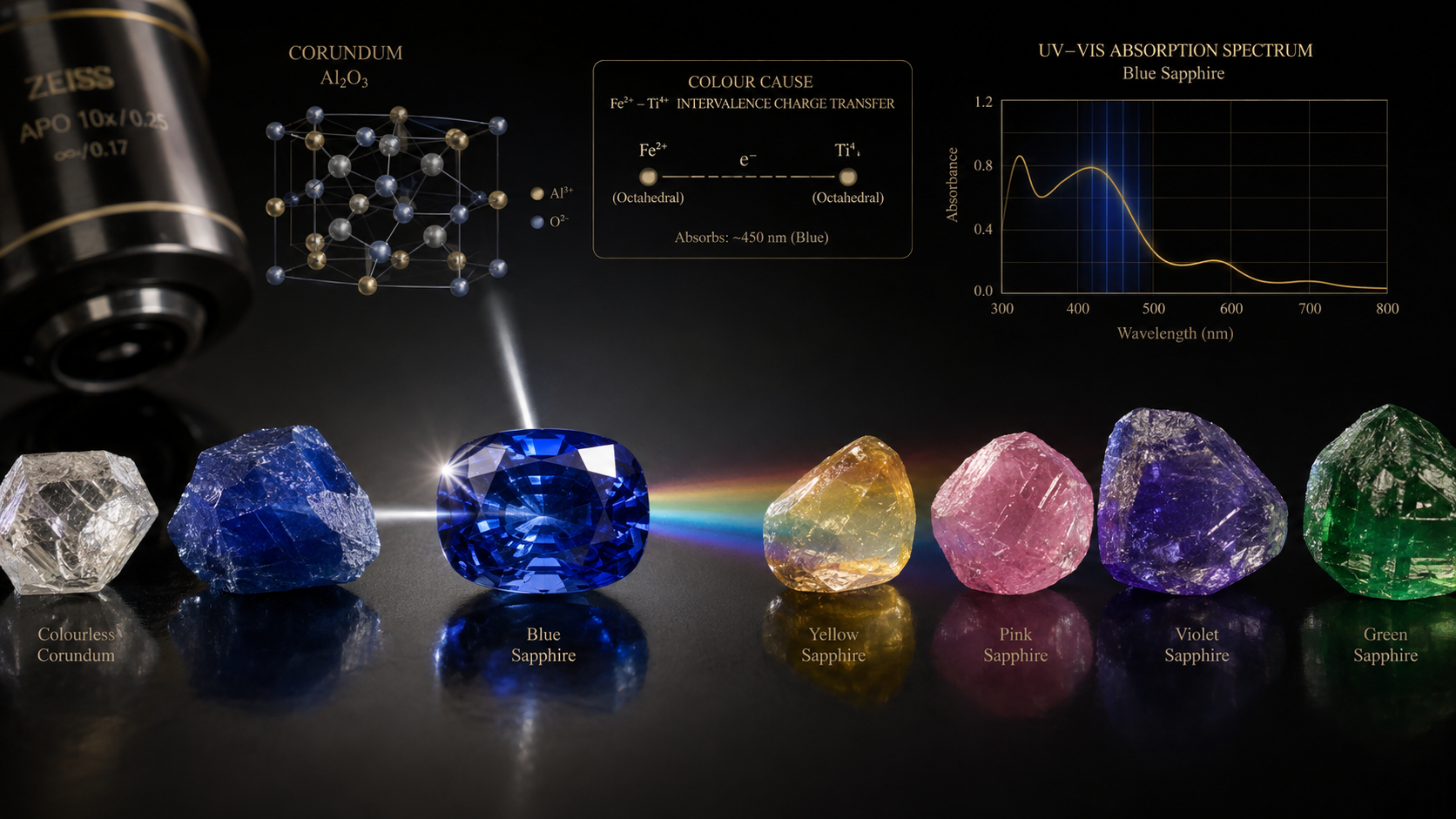
In fact, chemically pure corundum — aluminium oxide, Al₂O₃ — is colourless. The extraordinary range of colours seen in natural corundum arises because tiny quantities of foreign elements and atomic-scale defects alter the way the crystal absorbs visible light.
Blue sapphire is therefore an excellent example of an allochromatic gemstone: a mineral whose ideal chemical composition is colourless but which acquires colour through impurities or defects.
The familiar explanation that “iron and titanium make sapphire blue” is broadly useful, but scientifically incomplete.
Modern research has identified several major colour-producing centres, or chromophores, in natural corundum. Some involve a single transition-metal ion. Others involve interactions between neighbouring ions. Still others involve atomic-scale defects in the crystal lattice.
The resulting colour depends not only on which elements are present, but also on:
- their oxidation states;
- their positions within the crystal structure;
- interactions between neighbouring ions;
- charge-compensating defects;
- concentration;
- crystallographic orientation;
- optical path length;
- heat-treatment history;
- and even the illumination under which the sapphire is observed.
Understanding sapphire colour therefore requires us to move beyond the simple question:
“Which element causes this colour?”
The more accurate question is:
“Which light-absorbing mechanism is operating inside this corundum crystal?”
Table of Contents
1. Pure Corundum Is Colourless
Corundum has the ideal chemical formula:
Al₂O₃
Its crystal structure consists primarily of aluminium and oxygen.
When extremely pure, corundum is essentially colourless through the visible spectrum.
This is why colourless sapphire exists.
Natural corundum, however, is rarely chemically perfect. During crystal growth, trace quantities of other elements can substitute for aluminium or become involved in defects within the crystal lattice.
Important trace elements found in natural corundum include:
- chromium (Cr);
- iron (Fe);
- titanium (Ti);
- vanadium (V);
- magnesium (Mg);
- silicon (Si);
- gallium (Ga).
Only tiny concentrations may be required to influence colour.
But the presence of an element alone does not always tell us what colour it will produce.
Its oxidation state and interaction with neighbouring atoms can be equally important.
2. What Is a Chromophore?
A chromophore is an atomic or electronic centre responsible for selective absorption of visible light.
White light contains wavelengths across the visible spectrum.
When light enters a sapphire, some wavelengths are absorbed more strongly than others. The wavelengths that remain and return to the observer determine the perceived colour.
If a crystal strongly absorbs yellow and red wavelengths while transmitting or returning more blue light, the gemstone appears blue.
This is the fundamental principle behind sapphire colour.
In modern corundum research, six major chromophores have been identified as particularly important:
| Chromophore | Principal colour contribution in corundum |
|---|---|
| Cr³⁺ | Pink to red |
| h•–Cr³⁺ | Orange |
| Fe³⁺ | Yellow |
| h•–Fe³⁺ | Yellow to golden yellow |
| Fe²⁺–Ti⁴⁺ | Blue |
| V³⁺ | Blue, green or purple depending on conditions and orientation |
The symbol h• represents a trapped positive hole associated with charge compensation in the crystal lattice.
Natural sapphire frequently contains more than one chromophore.
Its final colour can therefore represent the combined absorption of several colour-producing mechanisms.
3. Why Blue Sapphire Is Blue
The classic blue colour of sapphire is principally associated with an interaction between Fe²⁺ and Ti⁴⁺ ions.
This is not simply “iron colour plus titanium colour.”
Instead, the neighbouring ions form an electronic interaction known as intervalence charge transfer, usually abbreviated IVCT.
An electron can transfer between the iron and titanium sites when the crystal absorbs light of suitable energy.
This interaction produces a broad absorption extending through parts of the visible spectrum, particularly removing substantial yellow-to-red light.
The remaining transmitted light is dominated by blue wavelengths.
The sapphire therefore appears blue.
The process is commonly represented conceptually as an interaction involving:
Fe²⁺ ↔ Ti⁴⁺
within the corundum lattice.
This Fe²⁺–Ti⁴⁺ chromophore is an extremely effective absorber compared with some individual transition-metal ions.
Consequently, relatively small concentrations of appropriately configured iron and titanium can create strong blue colour.
4. Iron Alone Does Not Explain Most Fine Blue Sapphire
Iron is common in natural corundum.
But simply detecting iron does not mean that a sapphire must be blue.
Iron can occur in different oxidation states and participate in several different electronic configurations.
Fe³⁺, for example, produces absorption behaviour quite different from the Fe²⁺–Ti⁴⁺ pair.
Fe³⁺ alone is primarily associated with yellow coloration in corundum, although it is a relatively weak chromophore and substantial concentrations may be required for intense colour.
Iron can also participate in Fe²⁺–Fe³⁺ intervalence charge-transfer processes.
These mechanisms can influence the appearance of iron-rich sapphire, particularly material associated with basaltic geological environments.
The important lesson is:
The concentration of an element is not the same thing as the concentration of a colour-producing chromophore.
Two sapphires containing similar total amounts of iron can therefore have substantially different colours.
5. Titanium Alone Is Not the Blue Chromophore Either
Titanium is also frequently simplified in popular descriptions.
Ti⁴⁺ substituting into corundum is not, by itself, the classic blue colour centre.
The important blue mechanism requires an appropriate relationship between titanium and iron.
This means that laboratory analysis showing titanium in a sapphire cannot by itself establish how much blue colour that titanium produces.
The chemical environment determines whether the required Fe²⁺–Ti⁴⁺ pairs can form.
Other trace elements — particularly those involved in charge balance — can influence how much titanium is actually available to participate in blue-producing pairs.
This is one reason modern sapphire colour chemistry is more sophisticated than simply measuring Fe and Ti concentrations.
6. Magnesium and Silicon Can Influence Sapphire Colour Indirectly
Magnesium and silicon illustrate an important concept:
An element does not need to absorb visible light strongly itself to influence gemstone colour.
When trace elements substitute for aluminium in the corundum lattice, differences in electrical charge must be compensated.
Aluminium normally occurs as Al³⁺.
If Mg²⁺ substitutes for Al³⁺, it introduces a charge imbalance.
If Si⁴⁺ or Ti⁴⁺ substitutes for Al³⁺, it introduces a different imbalance.
The crystal must maintain overall electrical neutrality.
Interactions among magnesium, silicon, titanium, hydrogen and other defects can therefore influence which colour-producing centres are able to form.
Research using highly sensitive analytical methods such as secondary ion mass spectrometry (SIMS) has demonstrated that silicon can play an important indirect role in the colour chemistry of natural corundum.
This is a crucial distinction:
Trace-element chemistry controls colour through a network of interactions, not merely through a list of independently acting impurities.
7. Chromium: From Pink Sapphire to Ruby
Chromium provides one of the clearest examples of direct transition-metal coloration in corundum.
Cr³⁺ can substitute for Al³⁺ in the crystal structure.
Its electronic transitions absorb portions of visible light in a way that produces:
- pink;
- intense pink;
- red.
At sufficiently red colour, gem corundum is classified as ruby rather than sapphire.
Mineralogically, however, the host mineral remains corundum.
There is no mineralogical transformation from sapphire into a different species.
The difference between pink sapphire and ruby is fundamentally a colour nomenclature boundary within gem-quality corundum.
Exactly where the commercial or laboratory boundary between strongly pink sapphire and ruby lies can involve professional colour assessment and may not be expressed by one universal chromium-concentration threshold.
This is why it is misleading to say:
“Above X amount of chromium, sapphire becomes ruby.”
Colour appearance, not a single elemental concentration, determines the nomenclature.
8. Chromium Also Explains Ruby Fluorescence
Chromium does more than produce red colour.
Cr³⁺ can also cause red fluorescence in corundum.
When suitable higher-energy radiation excites chromium ions, some of that absorbed energy can subsequently be emitted as visible red light.
This fluorescence can intensify the visual impression of some rubies and pink sapphires under appropriate lighting.
But fluorescence strength is affected by the broader chemistry of the stone.
Iron can suppress chromium-related fluorescence.
Consequently, two chromium-bearing corundum samples may respond very differently to ultraviolet radiation depending on their iron content and other factors.
Fluorescence is therefore useful gemmological evidence, but it should never be interpreted from chromium content alone.
9. Vanadium: A Less Familiar Corundum Chromophore
Vanadium is less widely discussed than chromium, iron and titanium, but modern quantitative research has demonstrated its importance.
V³⁺ can produce:
- blue;
- green;
- purple;
depending on concentration, orientation and interaction with other chromophores.
Vanadium is a weaker absorber than chromium in corundum, but its optical behaviour is strongly orientation-dependent.
This illustrates another central principle:
The same trace element can contribute differently to observed colour depending on how light travels through the crystal.
Natural corundum normally contains combinations of chromophores, so vanadium’s contribution may be superimposed on iron-, titanium- or chromium-related absorption.
10. Why Yellow Sapphire Is More Complicated Than “Iron Makes It Yellow”
Yellow sapphire has historically been described primarily in terms of Fe³⁺.
That explanation is incomplete.
Fe³⁺ can indeed produce yellow coloration, but quantitative studies show that it is a relatively weak chromophore.
Very high iron concentrations can generate strong yellow.
However, another important mechanism involves a trapped hole associated with Fe³⁺, written:
h•–Fe³⁺
This chromophore is dramatically stronger.
It can therefore produce substantial yellow or golden-yellow colour at far lower concentrations than Fe³⁺ alone.
The existence and strength of this chromophore help explain why older models of yellow sapphire colour were insufficient.
Yellow sapphire may consequently involve several mechanisms whose relative importance depends on the chemistry and history of the individual crystal.
11. Orange Corundum and Trapped-Hole Colour Centres
A related trapped-hole mechanism can operate with chromium.
The h•–Cr³⁺ chromophore produces orange coloration.
This becomes particularly important when studying pink-orange and orange corundum.
The presence of these defect-related colour centres demonstrates why gemstone colour cannot always be predicted simply by measuring transition-metal concentration.
A defect involving oxygen and charge compensation may radically alter the optical result.
This chemistry also becomes important when considering certain treatment processes and colour stability.
12. Padparadscha Sapphire Shows Why Colour Categories Become Complex
Padparadscha is the name applied to a restricted range of pink-orange to orange-pink sapphire.
Its colour may involve combinations of chromium-related pink/red absorption and orange/yellow-producing mechanisms.
The resulting colour is therefore not necessarily generated by one simple impurity.
This matters because some sapphires can also contain unstable colour centres.
Exposure to ultraviolet-containing light can alter the population of these centres and temporarily change the visible colour.
Professional laboratories consequently perform colour-stability testing on sapphires considered for padparadscha nomenclature.
A temporarily induced orange component should not automatically determine permanent colour classification.
This is a sophisticated example of why gemmological colour assessment involves both observation and an understanding of crystal chemistry.
13. Colour Can Be Stable — or Metastable
Most consumers reasonably assume that a gemstone’s colour is a permanent material property.
Often it is effectively stable under normal conditions.
But certain sapphires demonstrate photochromic or tenebrescent behaviour, meaning their colour can change in response to light exposure and subsequently reverse.
Some unstable sapphires can gain an orange or yellow component after exposure to ultraviolet-containing light.
That component may fade:
- in darkness;
- under intense visible illumination without UV;
- or with heating.
The colour can subsequently return after renewed UV exposure.
This does not mean that all yellow, orange or padparadscha sapphires are unstable.
It means that colour stability is a real gemmological property that laboratories may need to investigate in particular stones.
14. Why Sapphire Is Pleochroic
Corundum crystallises in the trigonal crystal system and is optically anisotropic.
Light travelling through the crystal in different crystallographic directions therefore experiences different absorption behaviour.
The result in coloured corundum can be pleochroism.
Blue sapphire commonly displays two different colour impressions depending on viewing direction, often described broadly as:
- violetish or deeper blue;
- greenish or lighter blue.
These colours arise because the absorption associated with its chromophores differs relative to the crystallographic c-axis.
This is not a surface effect.
It originates in the interaction between light and the oriented crystal structure.
15. Pleochroism Connects Crystal Chemistry to Faceting
Pleochroism has immediate practical consequences.
A faceter must decide which crystallographic direction should dominate the face-up colour of the finished gemstone.
If the rough is oriented poorly, a sapphire with excellent intrinsic chemistry may show too much:
- green;
- grey;
- darkness;
- or an otherwise less desirable secondary hue.
If oriented well, the same rough may display a much more attractive blue.
This is why rough evaluation and colour science cannot be separated.
The chemistry creates the potential colour.
Cut orientation determines how the observer experiences it.
16. Colour Zoning Records Crystal Growth
Natural sapphire commonly contains colour zoning.
A crystal may include:
- deep-blue zones;
- pale-blue zones;
- colourless regions;
- yellow zones;
- pink zones;
- or combinations of several colours.
These zones form because the chemical environment around the growing crystal changes through time.
The availability of trace elements and the conditions controlling their incorporation may fluctuate as successive layers of corundum grow.
Colour zoning is therefore more than a cutting problem.
It is part of the crystal’s geological growth record.
Angular zoning can be particularly characteristic because new growth follows the crystallographic geometry of the sapphire.
17. One Sapphire Can Contain More Than One Colour Mechanism
Natural corundum rarely behaves like a laboratory sample containing only one perfectly isolated chromophore.
Several colour centres may coexist.
A sapphire might simultaneously contain contributions from:
- Fe³⁺;
- Fe²⁺–Ti⁴⁺;
- Cr³⁺;
- V³⁺;
- trapped-hole chromophores.
Its final appearance is the combined result of their absorption.
This can generate complex colours such as:
- violet-blue;
- greenish blue;
- purple;
- pink-orange;
- yellow-green;
- teal.
The observed colour is therefore not necessarily attributable to a single element.
18. Why Teal and Green Sapphire Are Scientifically Interesting
Green and teal sapphires are particularly useful examples of overlapping colour mechanisms.
Natural corundum does not normally produce the intensely saturated emerald green familiar from chromium-bearing beryl.
But olive, blue-green and teal corundum occurs naturally.
Such colours can result from overlapping absorption contributions that leave a transmission window in the green-to-blue region.
Iron-rich basalt-related sapphires commonly produce these kinds of colour combinations.
Vanadium can also contribute green coloration in certain corundum.
Thus the statement:
“Green sapphire is coloured by element X”
is generally too simplistic.
Different stones can reach broadly similar visual colours through different combinations of chromophores.
19. Why Purple Sapphire Is Not Simply “Blue Plus Red”
Visually, purple can be described as a mixture of red and blue.
At the crystal-chemistry level, however, the situation is more complex.
Purple corundum can involve overlapping contributions from chromium, vanadium and blue-producing mechanisms.
A stone containing both chromium-related red/pink absorption behaviour and Fe²⁺–Ti⁴⁺ blue-producing absorption can produce purple or violet appearances.
Vanadium may also contribute.
The exact colour depends on:
- concentrations;
- orientation;
- optical path length;
- other trace elements;
- illumination.
This is another reason chemical analysis must be interpreted alongside spectroscopy rather than translated mechanically into a colour name.
20. Optical Path Length Changes the Colour You See
A fundamental principle of absorption spectroscopy is that the amount of light absorbed depends partly on how far that light travels through the material.
In simple terms:
longer path → more absorption
for a given concentration of an absorber.
This has direct relevance to gemstones.
A thin piece of sapphire may appear relatively pale.
A thicker region of chemically similar material can appear much darker or more saturated because light travels through more colour-producing material.
Modern quantitative studies of corundum explicitly model colour using both chromophore concentration and optical path length.
This explains why colour cannot be predicted from chemical concentration alone.
It also explains part of the relationship between cutting proportions and apparent colour.
21. A Large Sapphire Can Look Different from a Small Sapphire of Similar Chemistry
Suppose two pieces of corundum contain essentially the same chromophore concentration.
If one provides a much longer path for light through the crystal, its colour can appear substantially deeper.
This means that size and cut geometry can alter apparent saturation without changing the underlying chemistry.
For cutters, this creates an important optimisation problem.
A deeply saturated sapphire may become excessively dark if cut too deep.
A pale sapphire may benefit from a design that increases effective optical path length.
The science of colour therefore connects directly to practical faceting decisions.
22. Illumination Also Changes Sapphire Appearance
A gemstone does not generate its own ordinary bodycolour.
It selectively absorbs wavelengths from the light illuminating it.
Therefore, the spectrum of the light source matters.
Daylight-equivalent illumination and warm incandescent illumination contain different distributions of visible wavelengths.
A sapphire may consequently show a subtle change in:
- hue;
- saturation;
- apparent brightness.
This does not necessarily make it a true colour-change sapphire.
Some variation is simply the normal consequence of observing a selective absorber under different spectral illumination.
For scientific colour comparison, illumination must therefore be controlled.
23. Spectroscopy Lets Gemmologists See the Physics Behind Colour
The human eye sees the resulting colour.
A spectrometer provides a much deeper view.
UV-Vis-NIR spectroscopy measures how strongly a gemstone absorbs ultraviolet, visible and near-infrared wavelengths.
Different chromophores produce characteristic absorption features.
For example, blue sapphire may display:
- Fe³⁺-related absorptions;
- broad Fe²⁺–Ti⁴⁺ charge-transfer absorption;
- additional iron-related features depending on geological type and treatment.
The spectrum acts as a physical record of electronic interactions inside the crystal.
This is why spectroscopy is such a powerful gemmological tool.
It moves colour analysis from:
“This stone looks blue.”
toward:
“These absorption mechanisms contribute to why this stone looks blue.”
24. Chemical Analysis and Spectroscopy Answer Different Questions
Modern laboratories can analyse trace elements using techniques such as:
- LA-ICP-MS — laser ablation inductively coupled plasma mass spectrometry;
- SIMS — secondary ion mass spectrometry.
These methods can detect extremely low concentrations of trace elements.
But chemical analysis and spectroscopy are complementary.
Chemical Analysis
Answers:
Which elements are present, and approximately how much?
Spectroscopy
Answers:
How is the crystal interacting with electromagnetic radiation?
Neither should automatically be treated as a complete substitute for the other.
Knowing that Fe and Ti are present does not alone prove the exact concentration of Fe²⁺–Ti⁴⁺ pairs.
The optical spectrum helps reveal the active colour mechanism.
25. Trace Elements Can Also Help Investigate Geological Origin
Trace-element chemistry has another important use.
Different geological environments can produce different patterns of:
- Fe;
- Ti;
- Mg;
- Ga;
- Cr;
- V;
- other minor elements.
Laboratories can compare these chemical signatures with reference collections from known deposits.
Combined with:
- inclusions;
- spectroscopy;
- growth structures;
- geological knowledge;
trace-element data can support geographic-origin determination.
But colour itself does not establish geographic origin.
Two sapphires from completely different countries can show similar blue colours because similar chromophores operate in both.
26. Why Basalt-Related Sapphire Often Looks Different
Sapphires associated with basaltic geological provinces are often relatively iron-rich.
They can show:
- dark blue;
- greenish blue;
- teal;
- yellow;
- green;
depending on their detailed chemistry.
Iron-related absorption can become particularly significant.
Some basalt-related blue sapphires also show a broad absorption feature around the near-infrared region associated with iron-related intervalence charge transfer.
Such spectral behaviour can provide useful evidence when laboratories investigate geological type.
However, no single absorption feature should automatically be treated as an infallible country-of-origin marker.
27. Heat Treatment Can Change Sapphire Colour Because It Changes Defect Chemistry
Heating does not need to add blue pigment to make sapphire bluer.
Instead, high temperature can alter the internal chemical and defect structure of the corundum.
For example, heating may dissolve microscopic rutile particles.
Titanium that was previously locked inside rutile can become available within the corundum lattice.
Under suitable chemical conditions, this can increase the formation of Fe²⁺–Ti⁴⁺ chromophores.
The result can be stronger blue colour.
Heating can also:
- modify trapped-hole colour centres;
- change oxidation states;
- alter defect populations;
- modify inclusions;
- redistribute certain elements over microscopic distances.
This is why sapphire heat treatment is fundamentally a crystal-chemistry process, not merely “baking a stone to improve its colour.”
28. Heat Treatment Does Not Have One Universal Effect
A common oversimplification is:
“Heating makes sapphire blue.”
That is incorrect.
The outcome depends on the starting material.
Heating can be used to:
- develop blue;
- lighten overly dark blue;
- modify yellow;
- reduce undesirable colour components;
- improve apparent clarity by altering rutile silk;
- produce other colour changes depending on chemistry and atmosphere.
Temperature, duration and oxidation-reduction conditions matter.
Different sapphire populations respond differently because they begin with different trace-element and defect chemistry.
A future dedicated Learning Center article will examine these treatment mechanisms and their detection in detail.
29. Beryllium Diffusion Demonstrates the Importance of Charge Compensation
Beryllium diffusion became an important development in corundum treatment because it showed just how strongly defect chemistry can affect colour.
Beryllium itself is not simply an orange “dye.”
When Be²⁺ substitutes into sites normally occupied by Al³⁺, the crystal must compensate for the charge difference.
That process can generate trapped-hole colour centres.
These centres can create powerful yellow or orange colour effects depending on the other elements present.
The important scientific lesson extends beyond treatment:
Colour can arise from the way an impurity changes the electrical balance of a crystal rather than from the impurity directly absorbing visible light.
30. Why Visual Colour Cannot Prove Treatment
An unheated sapphire and a heated sapphire can show essentially the same visible colour.
Likewise, similar colours can result from different chromophore combinations.
Therefore:
Colour alone cannot reliably determine treatment history.
Professional treatment determination may require examination of:
- inclusions;
- altered rutile;
- healed fractures;
- UV-Vis-NIR spectra;
- FTIR spectra;
- trace-element chemistry;
- other microscopic or analytical evidence.
A beautiful blue colour is an observation.
It is not a treatment diagnosis.
31. Why Visual Colour Cannot Prove Natural Origin Either
Synthetic sapphire is also corundum.
Its crystal lattice can contain the same types of colour-producing transition metals.
A synthetic blue sapphire can therefore reproduce a blue colour broadly similar to natural sapphire.
This means:
Blue colour does not prove natural geological origin.
Natural-versus-synthetic identification depends on evidence such as:
- growth structures;
- inclusions;
- trace-element chemistry;
- spectroscopy;
- production-related features.
Colour is only one part of the evidence.
32. Colour, Cause of Colour and Trade Colour Are Different Concepts
These three ideas should be separated.
Observed Colour
What the stone visually looks like:
blue
Cause of Colour
The physical mechanism producing the absorption:
predominantly Fe²⁺–Ti⁴⁺ intervalence charge transfer
Commercial Colour Description
The terminology used to describe appearance in the gemstone market:
royal blue, cornflower blue, vivid blue, deep blue, and similar terms.
Commercial descriptions are not chemical mechanisms.
A stone does not contain a “royal blue element.”
Scientific communication becomes much clearer when these categories remain separate.
33. A Scientific Summary of Major Corundum Colours
| Observed colour | Important chromophore(s) or mechanism(s) | Important caution |
|---|---|---|
| Colourless | Very low visible-light absorption | Trace elements may still be measurable |
| Blue | Fe²⁺–Ti⁴⁺; V³⁺ in some circumstances | Iron and titanium concentrations alone do not fully predict colour |
| Pink | Cr³⁺ | Boundary with ruby depends on colour appearance |
| Red / Ruby | Cr³⁺ | Iron can influence fluorescence and appearance |
| Yellow | Fe³⁺ and/or h•–Fe³⁺ | Multiple yellow mechanisms exist |
| Orange | h•–Cr³⁺ and combinations | Treatment and colour stability can matter |
| Purple/Violet | Combined chromophores; V³⁺ can contribute | Often chemically complex |
| Green/Teal | Overlapping chromophores, often iron-related; V³⁺ may contribute | No single mechanism explains all green sapphire |
| Pink-orange | Combination of colour centres | Padparadscha nomenclature requires more than simple chemistry |
The table deliberately uses the phrase important chromophores rather than claiming that every stone of a given colour has one identical chemical mechanism.
Natural corundum is more complex than that.
34. Evidence Classification
| Statement | Classification |
|---|---|
| Chemically pure corundum is colourless | Established scientific fact |
| Natural corundum is allochromatic | Established mineralogical fact |
| Fe²⁺–Ti⁴⁺ intervalence charge transfer is a principal cause of blue sapphire colour | Established scientific fact |
| Cr³⁺ produces pink-to-red colour in corundum | Established scientific fact |
| Fe³⁺ and h•–Fe³⁺ can produce yellow colour | Established scientific fact |
| V³⁺ can contribute blue, green and purple colour | Established scientific fact |
| Natural corundum can contain several chromophores simultaneously | Established scientific fact |
| Colour depends partly on optical path length and crystallographic orientation | Established physical principle |
| Some sapphire colour centres can be unstable under changing illumination | Established gemmological observation |
| Heat treatment can change sapphire colour through changes in defect and trace-element chemistry | Established gemmological fact |
| All blue sapphires contain identical concentrations of iron and titanium | Incorrect |
| Detecting iron and titanium chemically proves that they are producing all of the observed blue | Incorrect oversimplification |
| Blue colour proves a sapphire is natural | Incorrect |
| Colour alone can determine whether sapphire has been heated | Incorrect |
| A trade term such as “royal blue” represents a specific chemical composition | Incorrect |
35. Why Colour Science Matters to Gemstone Buyers, Collectors and Faceters
Understanding the origin of sapphire colour changes how several common gemstone statements should be interpreted.
“Natural Colour”
This should refer to colour produced by the stone’s natural geological and crystal-chemical history rather than colour introduced or substantially modified by treatment.
It does not mean the colour was produced by one simple impurity.
“Unheated”
This is a treatment-status statement.
An unheated sapphire may still possess complex natural defect chemistry and several chromophores.
“Deep Blue”
This describes appearance.
It does not identify the precise chromophore concentration or geological origin.
“Colour Zoning”
This is not automatically a defect.
It records variations during crystal growth and can sometimes be used strategically by a skilled faceter.
“Pleochroism”
This is not artificial colour change.
It is an intrinsic optical consequence of anisotropic crystal structure.
“Origin”
Colour chemistry can contribute evidence toward geological and geographic interpretation, but colour itself does not prove a locality.
Conclusion
Sapphire is blue because its crystal lattice interacts selectively with light.
But behind that simple statement lies one of gemmology’s most elegant examples of solid-state chemistry.
Pure corundum is colourless.
Introduce chromium, and pink or red may emerge.
Create the appropriate interaction between Fe²⁺ and Ti⁴⁺, and blue can appear.
Iron in other configurations can contribute yellow or modify blue.
Vanadium can generate blue, green or purple components.
Atomic-scale charge compensation can create trapped-hole chromophores capable of producing powerful yellow and orange colours.
And when several of these mechanisms operate together, natural sapphire can display an extraordinary range of hues.
Even this chemistry does not act alone.
The colour ultimately perceived by the observer also depends on crystallographic orientation, optical path length, colour zoning, faceting and illumination.
Heating can modify the internal chemical equilibrium and alter colour without adding conventional pigment.
Synthetic corundum can reproduce similar colour mechanisms.
And advanced spectroscopy can reveal absorption processes that the human eye can only experience as colour.
This is why the scientific answer to “Why is sapphire blue?” is much more interesting than “because it contains iron and titanium.”
A sapphire’s colour is the visible consequence of interactions occurring at the atomic scale inside a crystal that may have formed hundreds of millions of years ago.
In that sense, colour is not merely one of sapphire’s aesthetic properties.
It is information — a visible expression of crystal chemistry, geological history and the physics of light.
References & Further Reading
Dubinsky, E. V., Stone-Sundberg, J. & Emmett, J. L. — “A Quantitative Description of the Causes of Color in Corundum.” Gems & Gemology, Spring 2020, Gemological Institute of America.
The principal scientific reference for this article. It quantitatively examines the six major chromophores responsible for colour in natural corundum and explains their absorption behaviour, relative strength, concentration dependence, orientation and optical-path effects.
https://www.gia.edu/gems-gemology/spring-2020-corundum-chromophores
Emmett, J. L., Stone-Sundberg, J., Guan, Y. & Sun, Z. — “The Role of Silicon in the Color of Gem Corundum.” Gems & Gemology, Spring 2017, Gemological Institute of America.
Important research into the interactions among silicon, titanium, magnesium and other trace constituents in corundum and their indirect role in determining colour-producing chemistry.
https://hongkong.gia.edu/gems-gemology/spring-2017-role-silicon-color-gem-corundum
Gemological Institute of America — “Yellow Sapphire: Natural, Heat-Treated, Beryllium-Diffused, and Synthetic.” Gems & Gemology, Fall 2023.
Detailed modern treatment of Fe³⁺, trapped-hole chromophores, charge compensation and the complex colour mechanisms operating in yellow sapphire.
https://www.gia.edu/gems-gemology/fall-2023-yellow-sapphire-chromophores
Palke, A. C., McClure, S. F. & Renfro, N. — “An Update on Sapphires with Unstable Color.” Gemological Institute of America, December 2022.
Authoritative discussion of unstable colour centres, colour-stability testing, UV-induced colour changes and their importance in padparadscha and other sapphires.
https://www.gia.edu/gia-news-research/unstable-color-sapphires
Hughes, E. B. — “Yellow Sapphires with Unstable Color.” Gems & Gemology, Summer 2022, Gemological Institute of America.
Laboratory observations of unstable yellow and orange components in sapphire and the role of fade testing.
https://www.gia.edu/gems-gemology/summer-2022-gemnews-yellow-sapphires-unstable-color
Gemological Institute of America — Sapphire Quality Factors.
Useful institutional reference for sapphire colour, pleochroism, colour zoning, crystal orientation and the relationship between rough orientation and face-up appearance.
https://dev.gia.edu/cn/sapphire-quality-factor
Gemological Institute of America — “U-Pb Ages of Zircon Inclusions in Sapphires from Ratnapura and Balangoda (Sri Lanka) and Implications for Geographic Origin.” Gems & Gemology, Spring 2019.
Includes spectroscopic documentation of Fe³⁺ and the broad Fe²⁺–Ti⁴⁺ intervalence charge-transfer absorption responsible for blue colour in studied Sri Lankan sapphire.
https://www.gia.edu/gems-gemology/spring-2019-u-pb-ages-of-zircon-inclusions-in-sapphires-from-ratnapura-and-balangoda
Gemological Institute of America — “Gemological Characterization of Sapphires from Yogo Gulch, Montana.” Gems & Gemology, Summer 2018.
Detailed study combining inclusions, spectroscopy and LA-ICP-MS trace-element chemistry, illustrating how colour chemistry also contributes to geological and geographic interpretation.
https://www.gia.edu/gems-gemology/summer-2018-gemological-characterization-of-sapphires-from-yogo-gulch-montana
Gemological Institute of America — “Gemological Characterization of Montana Sapphire from the Secondary Deposits at Rock Creek, Missouri River, and Dry Cottonwood Creek.” Gems & Gemology, Spring 2023.
Documents the development of blue colour during experimental heating through rutile dissolution and increased formation of Fe²⁺–Ti⁴⁺ chromophores.
https://www.gia.edu/gems-gemology/spring-2023-characterization-montana-sapphire
Fritsch, E. & Rossman, G. R. — “An Update on Color in Gems. Part 2: Colors Involving Multiple Atoms and Color Centers.” Gems & Gemology, Spring 1988.
A foundational review explaining intervalence charge-transfer mechanisms and colour centres in gemstones, including the Fe²⁺–Ti⁴⁺ interaction responsible for blue sapphire.
https://www.gia.edu/doc/SP88A1.pdf