
Introduction
Few gemstones carry a name with a history as complicated as sapphire.
Today the word has a precise gemmological meaning.
Sapphire is gem-quality corundum — aluminium oxide, Al₂O₃ — in colours other than the red material conventionally called ruby.
For an ancient Greek, Roman or medieval reader, however, the word translated as sapphire did not necessarily identify the same mineral.
That distinction changes sapphire history dramatically.
Ancient authors described a blue stone called sappheiros in Greek and sapphirus in Latin. Some descriptions mention golden specks within the blue material.
Modern blue corundum does not normally look like that.
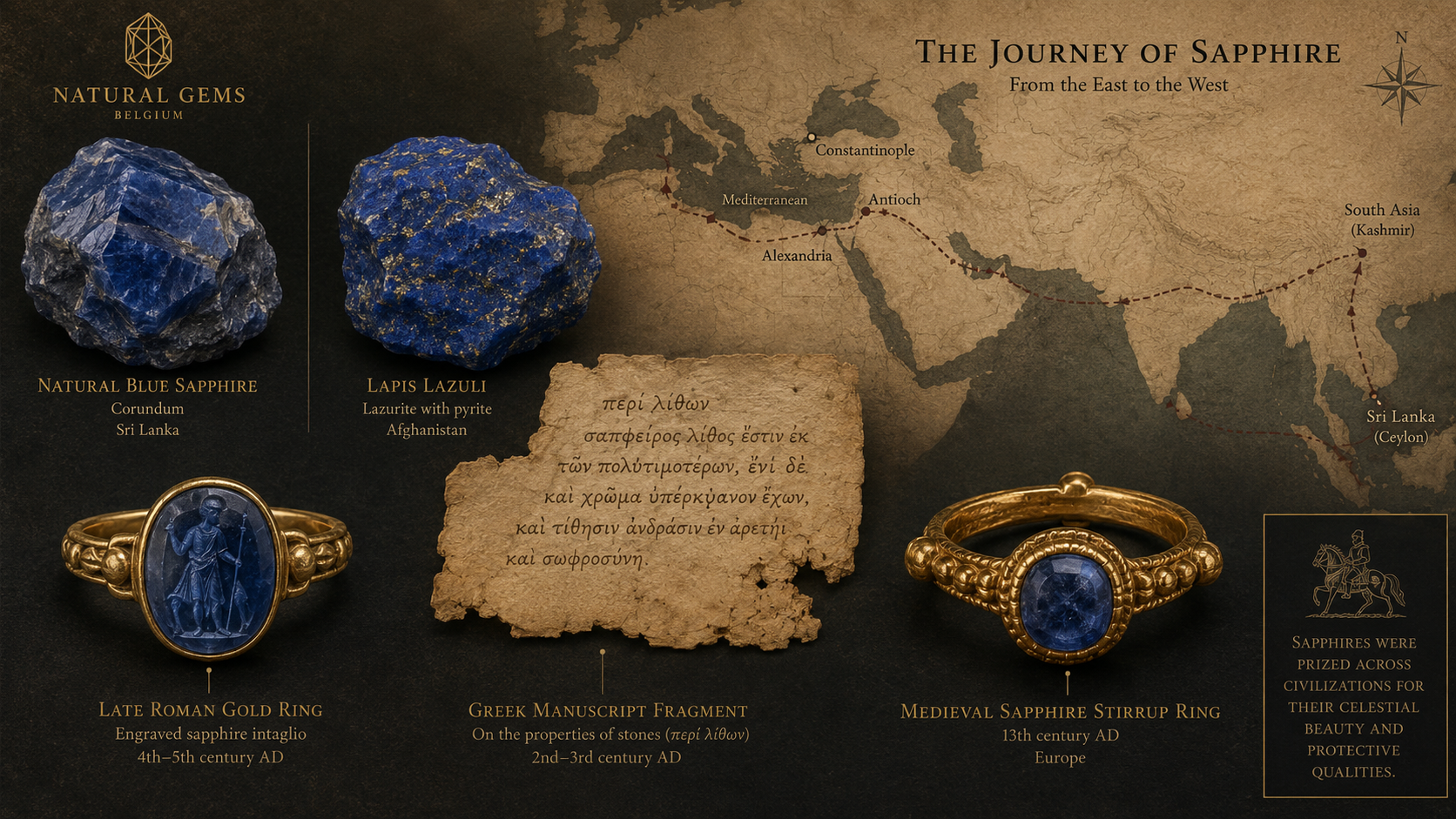
Lapis lazuli does.
Its deep blue body commonly contains brass-gold pyrite particles.
Consequently, many ancient references traditionally translated as “sapphire” are now understood, or strongly suspected, to describe lapis lazuli or another blue material rather than the corundum gemstone we call sapphire today.
Yet true sapphire was certainly known in later antiquity. Surviving Roman jewellery includes engraved corundum sapphire, and by the High Middle Ages sapphire had become an important gemstone in European rings and other jewellery.
Its history therefore cannot be told accurately as one uninterrupted story beginning with every ancient use of the word sapphire.
Instead, we must separate three things:
the history of a word;
the history of a blue colour and its symbolism;
and
the documented history of corundum sapphire as a gemstone.
Once those are separated, sapphire’s real history becomes considerably more interesting.
Table of Contents
1. Modern Sapphire Is a Mineralogical Definition
Modern gemmology identifies sapphire as corundum.
Corundum has the ideal chemical formula:
Al₂O₃
Ruby and sapphire are therefore not separate mineral species.
Both are corundum.
Red gem corundum is conventionally called ruby, while gem corundum of other colours is classified as sapphire.
Blue is the colour most strongly associated with sapphire, but natural sapphire can also be:
- yellow;
- pink;
- orange;
- green;
- purple;
- colourless;
- parti-coloured;
- and combinations of these.
This mineralogical precision is comparatively modern.
Ancient and medieval writers classified stones primarily by observable properties such as:
- colour;
- transparency;
- origin;
- hardness;
- perceived medicinal or symbolic properties.
They did not possess modern mineral chemistry, refractive-index measurement, spectroscopy or crystallography.
Historical gemstone names therefore cannot safely be translated directly into modern mineral species.
2. The Name “Sapphire” Is Older Than the Modern Definition
The English word sapphire came through earlier European languages from Latin sapphirus and Greek sappheiros.
Related terminology also appears in ancient Near Eastern linguistic traditions.
The continuity of the name can create a misleading impression:
same word = same mineral
That assumption is unsafe.
Gemstone terminology has changed repeatedly through history.
Names could migrate from one material to another when stones shared:
- similar colours;
- similar visual characteristics;
- similar symbolic associations.
The history of sapphire therefore begins with a linguistic problem.
3. The Ancient “Sappheiros” Problem
The Greek philosopher and naturalist Theophrastus, writing in the fourth century BCE, discussed a stone called sappheiros.
Ancient descriptions associated the material with blue colour and gold-like specks.
Later, the Roman author Pliny the Elder also described sapphirus as containing gold-coloured spots.
That description presents an immediate mineralogical problem.
Blue corundum sapphire does not characteristically contain abundant metallic-looking golden specks.
Lapis lazuli often does.
The gold-like particles in lapis are usually pyrite.
A deep-blue stone sprinkled with apparently golden material therefore fits lapis lazuli much better than transparent blue corundum.
For this reason, historians of minerals have long recognised that at least some ancient uses of sappheiros and sapphirus refer to lapis lazuli.
4. Lapis Lazuli and Sapphire Are Completely Different Materials
The historical confusion is linguistic, not mineralogical.
Sapphire
Mineral: Corundum
Ideal composition: Al₂O₃
Hardness: 9 on the Mohs scale
Structure: Crystalline mineral
Typical blue colour mechanism: Primarily Fe²⁺–Ti⁴⁺ intervalence charge transfer
Lapis Lazuli
Material: A rock composed principally of lazurite with other minerals
Common components: Lazurite, calcite and pyrite
Hardness: Much lower than corundum
Typical appearance: Intense blue, often with white calcite and gold-coloured pyrite
To a modern gemmologist they are unmistakably different.
To an ancient observer classifying precious blue materials by appearance, the nomenclature could be much less precise.
5. Why This Matters for Biblical “Sapphire”
Translations of ancient religious texts frequently use modern gemstone names.
That does not establish the mineral identity of the original stone.
The Hebrew term traditionally rendered as sapphire in passages of the Hebrew Bible has often been interpreted as lapis lazuli rather than corundum sapphire.
This interpretation is consistent with the broader ancient Mediterranean and Near Eastern use of sapphire-related terminology for an intensely blue, sometimes gold-speckled material.
Therefore statements such as:
“Sapphire is mentioned in the Bible, proving blue corundum had this symbolic meaning at that date”
should be treated cautiously.
The text may preserve the history of a blue precious stone and its symbolism, without necessarily documenting modern sapphire.
This distinction is especially important in responsible gemstone education.
6. Historical Texts Need Mineralogical Translation
Suppose an ancient manuscript uses a word translated as:
sapphire
A responsible historical analysis should ask:
- What was the original-language term?
- What physical properties did the author describe?
- Was the material transparent or opaque?
- Were inclusions or colour patterns described?
- What materials were available through contemporary trade?
- How did later writers reuse the terminology?
- Does the description match modern corundum?
Only then should a modern mineral identity be proposed.
This method prevents a common error in popular gemstone histories:
projecting modern mineral names backwards into periods when those names meant something different.
7. True Corundum Sapphire Was Known in the Roman World
The ancient naming problem does not mean that Roman people never encountered true sapphire.
Archaeological objects demonstrate otherwise.
The British Museum preserves a Late Roman gold finger-ring dated to the 3rd–4th century CE containing a sapphire engraved in intaglio with a dove holding a branch.
The object is particularly important because it provides physical evidence rather than relying on interpretation of a historical gemstone name.
Whatever terminology an ancient writer might have used, actual corundum sapphire was being worked and set in Roman-period jewellery.
That moves the history from literary ambiguity to material evidence.
8. Engraved Sapphire Reveals More Than Ownership
The Late Roman sapphire is engraved.
That is significant because corundum has a Mohs hardness of 9.
Engraving sapphire therefore requires:
- suitable abrasive technology;
- considerable skill;
- deliberate lapidary work.
The object demonstrates that sapphire was not merely transported into the Roman world as an exotic pebble.
At least some stones entered sophisticated gemstone-working traditions.
The engraved dove also shows that the stone could carry imagery and meaning in addition to colour and material value.
9. Long-Distance Trade Was Essential
Europe contains no historically important primary source capable of explaining the sapphire used in Roman and medieval jewellery.
The stones had to travel.
South and Central Asia contain several historically important corundum regions, while Sri Lanka became one of the great long-term sources of gem sapphire.
The Metropolitan Museum of Art notes that sapphire reached the West through trade and identifies Ceylon — modern Sri Lanka — among historical sources.
This means that every medieval European sapphire also tells a story about movement.
Before becoming part of a ring in England, France or Italy, a sapphire could already have travelled thousands of kilometres.
Gemstones were among the most portable forms of high-value material in premodern trade.
10. Sri Lanka’s Importance to the Sapphire Story
Sri Lanka occupies an exceptional position in sapphire history.
Its gem-bearing gravels have yielded corundum in a wide range of colours, alongside many other gemstone minerals.
Sri Lankan sapphire could enter long-distance commercial networks connecting the Indian Ocean with:
- South Asia;
- the Persian Gulf;
- the Red Sea;
- the eastern Mediterranean;
- and ultimately European markets.
Historical trade routes were not one fixed road.
Goods could move through multiple combinations of:
- maritime shipping;
- caravan networks;
- merchant intermediaries;
- major trading cities.
By the time a sapphire appeared in a medieval European goldsmith’s workshop, its earlier commercial history might already have involved several cultures and languages.
11. “Silk Road” Is Useful—but Can Be Too Simple
Popular histories often say that gemstones travelled to Europe “along the Silk Road.”
That phrase is convenient, but it can create the impression of one continuous highway.
Premodern Eurasian trade was actually a network.
A gemstone might travel:
- overland for one stage;
- by sea for another;
- through multiple merchant communities;
- via several political territories.
Mediterranean centres such as Venice and Genoa later became important redistribution points for luxury goods arriving from the East.
The historical sapphire trade should therefore be imagined as a network of exchange, not a single route from mine to European buyer.
12. The Early Medieval Transition
After the western Roman Empire fragmented, long-distance luxury trade did not simply disappear.
Political structures changed, but precious materials continued to circulate through Byzantine, Islamic, Mediterranean and European networks.
Gemstones were particularly suited to this environment.
They were:
- small;
- durable;
- valuable;
- transportable.
By the medieval period, sapphires were incorporated into jewellery and objects associated with:
- religious institutions;
- aristocratic status;
- personal devotion;
- love and loyalty.
Surviving objects allow this history to be studied directly.
13. Sapphire in Medieval Europe
By the High Middle Ages, sapphire appears repeatedly in European jewellery.
The Metropolitan Museum of Art preserves a British gold and sapphire stirrup ring dated to the late 13th or early 14th century.
The museum notes that this ring form was fashionable from the 12th through the 14th centuries and was commonly set with sapphire.
Such rings were worn by both:
- clergy;
- laypeople.
That evidence is important.
Sapphire had strong religious associations, but it was not exclusively an ecclesiastical gemstone.
14. What Is a Stirrup Ring?
The term stirrup ring describes a medieval ring whose raised bezel resembles a stirrup—or, according to another visual interpretation, the pointed forms of Gothic architecture.
The sapphire is commonly set at the summit of the raised bezel.
Compared with modern jewellery, the gemstone may appear:
- irregular;
- minimally shaped;
- cabochon-like;
- much less brilliant.
This reflects historical lapidary technology and aesthetic priorities.
The purpose was not to maximise modern-style scintillation.
The colour, rarity, material identity and symbolic meaning of the stone could be more important than precision faceting.
15. Medieval Sapphires Were Often Cabochons
Modern consumers frequently associate sapphire with highly symmetrical faceted gemstones.
Many medieval sapphires look very different.
Surviving rings often contain:
- cabochons;
- irregular polished stones;
- minimally trimmed gems;
- engraved stones.
The British Museum, for example, records a 13th–14th-century gold ring whose bezel shape follows an untrimmed cabochon sapphire.
This is valuable evidence of changing gemstone aesthetics.
A medieval sapphire should not be judged according to modern cutting expectations.
Its form belongs to a different technological and cultural environment.
16. Sapphire and Medieval Christianity
Blue carried powerful visual associations in medieval Christian culture.
Sapphire became linked in medieval lapidary traditions with ideas such as:
- purity;
- chastity;
- heaven;
- spiritual contemplation;
- divine favour.
These were historical beliefs, not gemmological properties.
The distinction matters.
Modern science can explain sapphire’s:
- mineral composition;
- colour mechanisms;
- inclusions;
- optical properties.
It cannot verify medieval claims that a sapphire could produce spiritual or medical effects.
Those claims belong to the history of belief.
17. The Bishop’s Sapphire Ring
Sapphire became particularly associated with high-ranking clergy.
Surviving medieval episcopal rings and archaeological finds document the use of sapphire in ecclesiastical contexts.
The association likely drew strength from several factors:
- the gemstone’s rarity;
- its blue colour;
- theological symbolism;
- lapidary traditions concerning purity and virtue.
Large rings could be worn by bishops over liturgical gloves.
Sapphire consequently became part of the visual language of ecclesiastical office.
But it is important not to reverse the evidence:
not every medieval sapphire ring was a bishop’s ring.
18. Museum Evidence Corrects the Simplification
The Metropolitan Museum’s late-13th/early-14th-century sapphire stirrup ring is considered more likely to have belonged to a layperson because it is lighter than examples recovered from clerical tombs.
The British Museum also preserves a 13th-century gold sapphire ring whose clasped-hand motif and inscription identify it as a love token rather than an ecclesiastical object.
This demonstrates the breadth of sapphire’s medieval social meaning.
The same gemstone could participate in:
- religion;
- rank;
- affection;
- loyalty;
- personal identity.
Historical symbolism was contextual, not fixed.
19. A Medieval Sapphire Love Token
One particularly revealing British Museum ring was found at Hatfield Forest in England.
Dating to the 13th century, it is made of gold and sapphire.
Its hoop includes clasped hands—an established symbol of trust and affection.
The medieval inscription identifies the ring as a love token and asks that it not be given away.
Here sapphire is not functioning principally as a bishop’s emblem.
It is part of an intimate personal object.
The ring demonstrates that gemstone history is also the history of human relationships.
20. Sapphire and the Medieval “Ave Maria” Ring
Another 13th-century English ring in the British Museum combines gold, sapphire and a devotional inscription derived from the Ave Maria.
Its cabochon sapphire sits in a raised bezel supported by animal-head decoration.
This object shows how jewellery could combine:
- precious material;
- Christian language;
- personal adornment;
- craftsmanship.
The sapphire’s role cannot be reduced to one factor.
It simultaneously carried material value, visual colour and religious context.
21. Sapphire Was Used Beyond Finger Rings
Medieval sapphire also appears in other forms of jewellery.
The Metropolitan Museum preserves a British or French gold ring brooch dated 1250–1300 containing sapphire and garnet.
The British Museum preserves a 13th-century gold annular brooch set alternately with rubies and sapphires.
The reverse bears a love inscription.
These surviving objects show that sapphire participated in a broader jewellery vocabulary.
It was not confined to one religious ring type.
22. Gemstones as Language
Medieval jewellery could communicate through several systems simultaneously.
Material
Gold indicated value and status.
Gemstone
Sapphire contributed colour, rarity and inherited symbolic associations.
Form
Hands, animals, Gothic-like bezels and other shapes carried visual meaning.
Inscription
Religious phrases, love messages and personal statements added written meaning.
A medieval jewel should therefore be read almost like a text.
The gemstone is one part of a larger communication system.
23. Medieval Lapidaries
To understand why gemstones accumulated so many meanings, we need to understand the lapidary.
A medieval lapidary was a text describing stones and their supposed properties.
These works combined material drawn from:
- Classical authors;
- religious interpretation;
- natural philosophy;
- medicine;
- folklore.
One influential medieval author was Marbode of Rennes, whose Liber Lapidum or Book of Stones circulated widely.
Lapidaries attributed various virtues to stones, including sapphire.
These texts shaped how educated medieval readers understood gemstones.
24. Medieval “Powers” Were Part of a Different Intellectual World
It is tempting either to repeat medieval gemstone claims as fact or dismiss them as simple superstition.
Both approaches lose historical context.
Medieval natural philosophy did not divide the world into the same intellectual categories used by modern experimental science.
A stone’s perceived hidden properties could be understood as part of nature itself.
Lapidary traditions therefore tell us something important about:
- medieval medicine;
- theology;
- natural philosophy;
- cultural inheritance.
But they do not constitute modern evidence that sapphire has medical or metaphysical effects.
A Learning Center should preserve the history without confusing it with contemporary science.
25. The Problem Returns: What Did a Medieval Author Mean by “Sapphire”?
Even medieval texts require caution.
Authors copied and adapted much older sources.
If an earlier Greek or Roman author used sapphirus for lapis lazuli, a medieval writer could inherit descriptions associated with that older material even when true corundum sapphire was also circulating in medieval Europe.
Historical gemstone traditions can therefore contain layers.
A medieval description may combine:
- Classical terminology;
- biblical symbolism;
- contemporary corundum sapphire;
- inherited lapidary beliefs.
The word had accumulated history.
This makes textual gemstone identification especially difficult.
26. Archaeological Objects Are Therefore Crucial
Texts tell us what people wrote.
Objects tell us what they actually used.
A surviving medieval ring containing mineralogically identifiable corundum provides direct evidence that sapphire in the modern sense was present.
Museum collections can therefore anchor historical interpretation.
The strongest gemstone history combines:
texts + archaeology + mineral identification + art history + trade history
rather than relying on later legends.
27. Reused Ancient Gems
Medieval Europe also reused gemstones from antiquity.
An engraved stone could survive for centuries before being mounted in a newer piece of jewellery.
The Metropolitan Museum notes examples of older engraved gemstones being incorporated into later rings and discusses sapphire arriving west through long-distance trade.
This creates fascinating layered objects.
A single jewel may contain:
- an ancient gemstone;
- a medieval setting;
- a later ownership history.
The age of the gemstone’s carving and the age of the jewellery object are therefore not always the same.
28. Why Gemstones Were Ideal Heirlooms
Sapphire is exceptionally durable.
With Mohs hardness 9, corundum resists scratching better than almost every natural gemstone except diamond.
A sapphire can therefore outlive:
- its first owner;
- its original setting;
- political dynasties;
- even the cultural meaning originally attached to it.
Gold can be melted and remade.
A valuable sapphire can be removed and reset.
This physical durability helps explain why gemstone histories can cross several periods.
29. Medieval Trade and the Value of Distance
A sapphire arriving in northern Europe carried another kind of prestige:
distance.
Before modern transportation, obtaining a gemstone from South Asia required long chains of trade.
Every stage added:
- risk;
- scarcity;
- commercial cost;
- exotic association.
A sapphire’s value was therefore shaped not only by beauty but by the difficulty of obtaining it.
The gemstone was physical evidence of international exchange.
30. Merchants Connected Worlds That Never Met Directly
A medieval English goldsmith did not need to travel to a Sri Lankan gem deposit.
Trade networks connected people who would never meet.
A sapphire could pass through the hands of:
- miners;
- local traders;
- regional merchants;
- maritime traders;
- caravan merchants;
- Mediterranean wholesalers;
- European goldsmiths.
Each participant operated within part of the chain.
The final ring condensed this enormous network into an object small enough to wear on one finger.
31. The Colmar Treasure: Sapphire in a Medieval Jewish Context
The Colmar Treasure provides an important reminder that medieval gemstone culture was not exclusively Christian or aristocratic.
Hidden in 14th-century Colmar, in modern France, the treasure contained jewellery and more than 300 coins.
The Metropolitan Museum records sapphire among its gemstone rings.
The cache is associated with Colmar’s medieval Jewish community and was probably concealed during the catastrophic persecutions surrounding the Black Death in 1348–49.
The treasure gives sapphire history a deeply human context.
Jewellery could represent:
- wealth;
- family property;
- personal identity;
- portable security.
And under conditions of persecution, such objects could be hidden in the hope of later recovery.
32. Jewellery Can Survive When Its Owners Do Not
The Colmar Treasure demonstrates one of the most sobering aspects of material history.
Precious objects can survive historical violence that their owners did not.
A sapphire ring in a museum is therefore not merely evidence of medieval taste.
It can also be evidence of:
- migration;
- insecurity;
- persecution;
- loss.
Responsible gemstone history should not isolate beautiful objects from the human events that preserved them.
33. Sapphire Between Sacred and Secular Life
By the 13th and 14th centuries, surviving European objects place sapphire in many settings.
It appears in:
- ecclesiastical rings;
- lay rings;
- love tokens;
- devotional jewellery;
- brooches;
- high-status personal possessions.
This diversity is historically important.
There was no single universal “meaning of sapphire.”
Meaning depended on:
- owner;
- object;
- inscription;
- social setting;
- religious context.
Modern lists claiming that sapphire “has always symbolised” one particular concept flatten this complexity.
34. Colour Still Mattered
Despite the complexity of historical nomenclature, sapphire’s blue colour became one of its strongest cultural characteristics.
Blue could evoke:
- the sky;
- heaven;
- purity;
- fidelity;
- elite status.
But colour symbolism itself changed between places and periods.
The modern assumption that blue has one timeless universal meaning should therefore be avoided.
Historical symbolism must be tied to evidence from a specific cultural context.
35. Why Medieval Sapphires Often Look Dark Today
Museum sapphires can appear much darker than modern jewellery-store stones.
Several factors can contribute:
- naturally dark material;
- cabochon or irregular cutting;
- closed-back settings;
- limited light entering the stone;
- surface wear;
- photographic conditions.
Modern precision cutting is designed to manage light in ways unavailable to medieval lapidaries.
Comparing a medieval cabochon directly with a modern precision-cut sapphire therefore tells us as much about cutting technology as about gemstone quality.
36. The Setting Changes the Appearance
Many medieval gemstones were mounted in settings that restricted light from entering through the back.
A modern faceted sapphire is usually evaluated under conditions where light enters and returns through carefully designed facets.
A medieval stone in a closed or deep gold setting behaves differently.
Its appearance may depend heavily on:
- surface reflection;
- body colour;
- polish;
- surrounding gold.
Historical jewellery must therefore be evaluated as a complete object.
The gemstone and setting were designed to function together.
37. From Cabochon to More Sophisticated Faceting
European lapidary technology evolved substantially through the later medieval and Renaissance periods.
Greater control over:
- sawing;
- grinding;
- polishing;
- facet geometry
gradually expanded the visual possibilities of transparent gemstones.
This did not happen overnight.
The transition from irregular polished gems and cabochons toward increasingly sophisticated faceting reflects technological development as well as changing taste.
Sapphire’s appearance in jewellery changed with the tools used to shape it.
38. Renaissance Collecting and Engraved Gems
By the Renaissance, elite European collectors developed intense interest in:
- Classical antiquity;
- engraved gems;
- cameos;
- intaglios.
Ancient gems were collected, remounted and sometimes imitated.
Sapphire could participate in this culture of engraving and connoisseurship.
The gemstone was no longer simply a coloured precious material.
It could also be valued as:
- an antiquity;
- a carved image;
- a scholarly object;
- a symbol of continuity with the Classical world.
39. The History of Sapphire Is Also the History of Identification
For most of this history, people could not chemically prove what a blue stone was.
Identification depended on experience and observable properties.
Modern gemmology transformed this.
Today sapphire can be investigated using:
- refractive index;
- specific gravity;
- microscopy;
- spectroscopy;
- Raman analysis;
- trace-element chemistry.
This allows researchers to return to historical objects and ask questions that their original owners could not answer scientifically.
Is the stone actually corundum?
Has it been heated?
Where might it have formed?
Historical jewellery can therefore become new scientific evidence centuries after it was made.
40. Archaeometry: When History Meets Gemmology
The scientific analysis of cultural objects is often called archaeometry or archaeological science.
For gemstone jewellery, non-destructive or minimally invasive techniques can include:
- Raman spectroscopy;
- X-ray fluorescence;
- optical microscopy;
- spectroscopic analysis.
These methods can help identify materials without damaging irreplaceable objects.
A medieval “sapphire” recorded in an old inventory can therefore sometimes be tested against modern mineralogical definitions.
This is one of the most exciting meeting points between gemmology and history.
41. Historical Names Should Never Override Analytical Evidence
Imagine a museum inventory from 1700 describing a blue gemstone as sapphire.
If modern Raman spectroscopy identifies it as another mineral, the historical label does not make it corundum.
Both pieces of information remain valuable:
Historical evidence: people called the stone sapphire.
Mineralogical evidence: the material is something else.
The apparent contradiction is itself historically informative.
It reveals how gemstone classification changed.
42. What We Can Say with Confidence
Several historical conclusions are strongly supported.
Ancient sapphire terminology was broader than modern terminology.
Greek and Roman descriptions of gold-speckled sappheiros/sapphirus are much more consistent with lapis lazuli than blue corundum.
True corundum sapphire nevertheless reached the Roman world.
Surviving Late Roman jewellery includes sapphire.
Long-distance trade was essential.
European sapphire depended on connections with gemstone-producing regions far to the east and south.
Sapphire was well established in High Medieval European jewellery.
Surviving 13th- and 14th-century rings and brooches provide direct evidence.
Medieval sapphire had both religious and secular uses.
It appears in clerical contexts, devotional jewellery and love objects.
Historical beliefs about gemstone powers are cultural evidence, not scientific evidence.
They should be studied historically rather than repeated as modern gemmological claims.
43. Claims That Require Caution
Several popular statements are much less secure.
“The sapphire in every biblical passage was corundum.”
Unsupported and probably incorrect in many cases.
Ancient terminology frequently points instead toward lapis lazuli.
“Sapphire has always represented exactly the same virtues.”
Incorrect.
Symbolism varies by period and cultural context.
“All medieval sapphire rings belonged to bishops.”
Incorrect.
Museum collections document secular examples.
“All medieval European sapphires came from one mine or country.”
Too absolute.
Sri Lanka was a major historical source, but historical supply chains and geological attribution require evidence.
“A museum object called sapphire must necessarily contain corundum.”
Not always.
Historical terminology may differ from modern mineral identification.
44. Evidence Classification
| Historical statement | Classification |
|---|---|
| Modern sapphire is corundum | Established mineralogical fact |
| Ancient sappheiros/sapphirus could refer to lapis lazuli | Strongly supported historical-mineralogical interpretation |
| Gold-speckled descriptions fit pyrite-bearing lapis better than corundum | Strong mineralogical evidence |
| True sapphire was used in Late Roman jewellery | Established archaeological evidence |
| Sapphire was used in 13th–14th-century European rings | Established museum evidence |
| Medieval sapphire occurred in both clerical and secular jewellery | Established material evidence |
| Medieval lapidaries attributed non-physical powers to sapphire | Established historical evidence of belief |
| Those medieval powers are scientifically demonstrated properties of corundum | Not supported by modern gemmological science |
| Every biblical reference translated “sapphire” identifies corundum | Unsupported / historically problematic |
| Every medieval sapphire came from Sri Lanka | Too absolute without object-specific evidence |
| Sapphire has always had one universal symbolic meaning | Incorrect oversimplification |
45. Why This History Matters Today
Historical accuracy matters for more than academic reasons.
Gemstone marketing frequently borrows authority from antiquity.
Phrases such as:
- “revered for thousands of years”;
- “the stone of ancient kings”;
- “mentioned in the Bible”;
- “always symbolised wisdom”
can sound compelling.
But without historical qualification, they may combine different minerals, cultures and periods into one invented tradition.
Natural gemstones do not need fabricated history to be fascinating.
The documented history is richer.
Sapphire connects:
- ancient terminology;
- Roman lapidary skill;
- Indian Ocean trade;
- medieval religious culture;
- secular love jewellery;
- manuscript traditions;
- modern mineralogical science.
Accuracy strengthens that story rather than diminishing it.
46. A Better Way to Read Historical Gemstone Claims
Whenever encountering a historical claim about sapphire, ask:
What is the date?
A Roman source and a 14th-century source belong to very different gemstone worlds.
What is the original word?
A modern translation may conceal historical ambiguity.
Is the evidence textual or physical?
A manuscript and an analysed gemstone provide different kinds of evidence.
Has the object been scientifically identified?
Historical labels are not always mineralogical identifications.
Is the statement describing belief or physical property?
“Medieval people believed sapphire protected its wearer” is a historical claim.
“Sapphire protects its wearer” is a completely different claim.
Is geographic origin actually demonstrated?
A plausible trade route is not the same as laboratory origin determination.
This framework protects both scientific accuracy and historical integrity.
Conclusion
Sapphire’s history begins with a paradox.
The name is older than the gemstone definition we use today.
Ancient Greek and Roman writers described sappheiros or sapphirus, yet their references to blue stones with golden specks frequently fit lapis lazuli better than corundum.
This means that some of the oldest “sapphire” traditions are actually part of the history of another blue material.
But true sapphire also entered the ancient Mediterranean world.
A surviving Late Roman gold ring with an engraved sapphire demonstrates that corundum was being worked and worn by the 3rd–4th centuries CE.
By the High Middle Ages, the evidence becomes abundant.
Sapphire appears in gold stirrup rings, devotional rings, brooches, love tokens and treasures.
It was worn by clergy.
It was also worn by laypeople.
It could signify religious devotion in one object and personal affection in another.
Its journey into Europe depended on long-distance trade connecting gemstone-producing regions of Asia with Mediterranean and European markets.
Medieval lapidaries surrounded sapphire with beliefs about purity, protection, medicine and divine favour.
Those beliefs are historically important.
They tell us how medieval people understood the natural world.
They should not, however, be confused with scientifically demonstrated properties of corundum.
Modern gemmology gives us something earlier generations did not possess: the ability to distinguish mineral species and investigate historic gemstones analytically.
Raman spectroscopy, microscopy and chemical analysis can now test old labels against physical evidence.
As a result, sapphire history is no longer merely a collection of legends.
It can be reconstructed from the intersection of:
texts, objects, archaeology, trade, mineralogy and gemmological science.
And that produces a more compelling conclusion than the usual mythology.
The history of sapphire is not the story of one stone carrying one meaning unchanged for thousands of years.
It is the story of how materials, names, beliefs and people travelled across cultures—and how modern science allows us to separate them again.
References & Further Reading
The Metropolitan Museum of Art — “Stirrup Ring,” British, late 13th or early 14th century.
Museum record for a surviving medieval gold and sapphire stirrup ring. The Met notes that stirrup rings were fashionable from the 12th through 14th centuries, were commonly set with sapphire and were worn by both clergy and laypeople.
https://www.metmuseum.org/art/collection/search/684497
British Museum — “Finger-ring,” Museum No. 1862,0729.3, Late Roman, 3rd–4th century.
Important physical evidence for true sapphire in Late Roman jewellery: a gold ring containing a sapphire engraved in intaglio with a dove holding a branch.
https://www.britishmuseum.org/collection/object/H_1862-0729-3
British Museum — “Finger-ring,” Museum No. 1980,1202.1, 13th century.
Gold and sapphire medieval ring with clasped hands and a love-token inscription. Particularly useful evidence that sapphire jewellery was not exclusively ecclesiastical.
https://www.britishmuseum.org/collection/object/H_1980-1202-1
British Museum — “Finger-ring,” Museum No. 1925,0113.1, England, 13th century.
A gold ring with cabochon sapphire and an Ave Maria inscription, illustrating the integration of sapphire, personal jewellery and Christian devotional language.
https://www.britishmuseum.org/collection/object/H_1925-0113-1
British Museum — “Finger-ring,” Museum No. AF.1867, 13th–14th century.
A medieval gold ring whose projecting bezel follows the irregular shape of an untrimmed cabochon sapphire, providing useful material evidence for medieval cutting and setting practice.
https://www.britishmuseum.org/collection/object/H_AF-1867
British Museum — “Annular Brooch,” Museum No. AF.2683, 13th century.
Gold medieval brooch set with rubies and sapphires and carrying a love inscription, demonstrating sapphire’s role in secular jewellery and personal expression.
https://www.britishmuseum.org/collection/object/H_AF-2683
The Metropolitan Museum of Art — “Ring Brooch,” British or French, 1250–1300.
Museum example of a finely worked medieval gold brooch set with sapphire and garnet, illustrating sapphire use beyond finger rings.
https://www.metmuseum.org/art/collection/search/479780
The Metropolitan Museum of Art — “Binding Together Past and Present.”
Curatorial discussion of historical rings, reused engraved gemstones, long-distance sapphire trade and the association of sapphire with chastity and purity in medieval lapidary traditions.
https://www.metmuseum.org/perspectives/binding-together-past-and-present
The Metropolitan Museum of Art — “The Colmar Treasure: A Medieval Jewish Legacy.”
Historical and museum context for the 14th-century Colmar Treasure, which includes sapphire jewellery and documents the material culture and tragic historical circumstances of a medieval Jewish community.
https://www.metmuseum.org/exhibitions/listings/2019/colmar-treasure-medieval-jewish-legacy/story-of-the-colmar-treasure
Encyclopaedia Britannica, 11th Edition — “Lapis Lazuli.”
Historical mineralogical discussion explaining why the gold-speckled sapphirus described by Theophrastus and Pliny is much more consistent with lapis lazuli than modern corundum sapphire. Useful as a historical reference for the long-recognised nomenclature problem.
https://en.wikisource.org/wiki/1911_Encyclop%C3%A6dia_Britannica/Lapis_lazuli
Atkinson, D. & Kothavala, R. Z. — “Kashmir Sapphire.” Gems & Gemology, Summer 1983, Gemological Institute of America.
A scientific and historical study of the famous Kashmir sapphire deposits. Although later than the medieval period covered here, it provides an important bridge toward the future history of sapphire mining, geographic origin and the rise of famous modern sapphire localities.
https://www.gia.edu/gems-gemology/summer-1983-sapphire-atkinson