

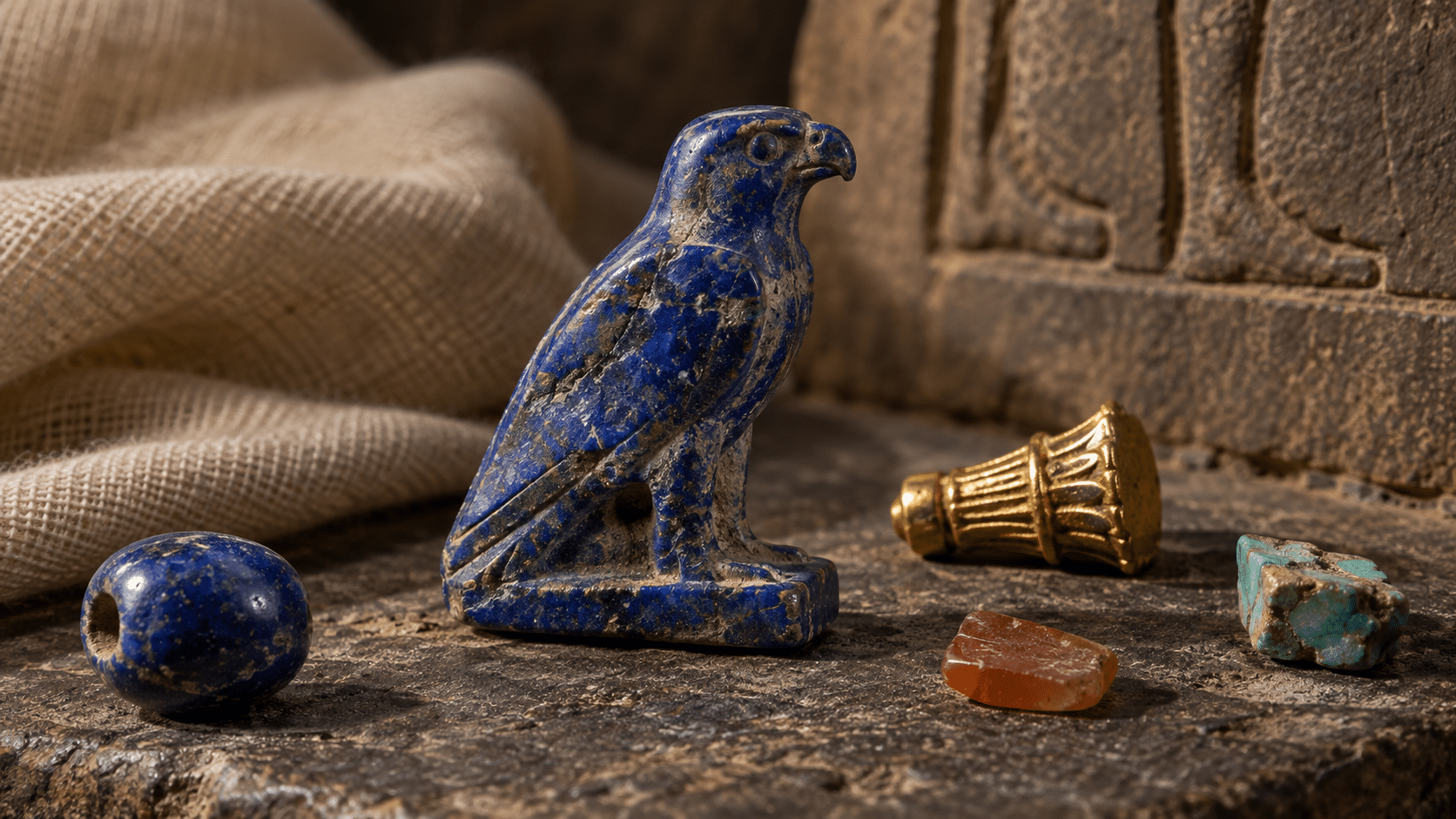
Few gemstones seem as naturally suited to the visual world of Ancient Egypt as lapis lazuli.
Its intense blue can resemble a deep night sky, while tiny metallic pyrite inclusions sometimes appear like distant points of gold. Combined with gold itself, lapis created one of the most striking colour contrasts in ancient jewellery.
Yet reducing its Egyptian story to beauty alone misses something important.
Surviving jewellery, amulets and archaeological objects show that lapis lazuli was incorporated into contexts involving divine imagery, protection, fertility, regeneration, royal adornment and beliefs surrounding death and the afterlife.
Some of those associations are supported directly by archaeological evidence. Others have been expanded considerably by modern crystal spirituality.
Understanding the difference allows us to appreciate lapis lazuli without projecting twenty-first-century beliefs backwards onto people who lived thousands of years ago.
At Natural Gems Belgium, that distinction is fundamental: first establish what the historical and gemmological evidence tells us, then explore what later traditions have made of it.
Table of Contents
What Is Lapis Lazuli?
Despite often being called a gemstone, lapis lazuli is technically a rock composed of several minerals, rather than a single mineral species.
Its principal components are typically:
- lazurite
- calcite
- pyrite
Other minerals can also occur.
Lazurite is primarily responsible for the celebrated blue colour. Calcite may appear as whitish areas or veins, while pyrite can produce metallic golden-looking flecks.
Fine lapis may display an intensely saturated royal to violetish blue.
That colour was already prized thousands of years ago.
But there is another remarkable aspect of Egyptian lapis lazuli:
Egypt did not possess the famous ancient deposits from which the finest material was obtained.
A Stone That Travelled an Extraordinary Distance
One of the most fascinating aspects of lapis lazuli in antiquity is geography.
The celebrated deposits at Sar-e-Sang in Badakhshan, present-day Afghanistan, have supplied lapis since the earliest civilisations. GIA’s detailed study of the deposit describes lapis occurring there in mineralised zones containing calcite, dolomite and various silicates, with lazurite providing the blue colour.
The Metropolitan Museum of Art likewise identifies Afghanistan’s Kokcha River region as the principal ancient source of prized lapis lazuli.
For Egyptians to acquire this material, therefore, lapis had to move across an enormous network connecting Central Asia with regions farther west.
We should be cautious about imagining a single merchant travelling directly from an Afghan mine to an Egyptian workshop.
Ancient luxury materials commonly moved through multiple communities and exchange networks.
What matters is the distance.
A piece of lapis reaching the Nile Valley represented a material whose geological origin lay thousands of kilometres away.
Long before modern global commerce, a brilliant blue rock from the mountains of Central Asia had become part of Egyptian jewellery and religious material culture.
That alone helps explain why lapis could carry exceptional prestige.
The Egyptian Language of Colour
To understand the symbolic importance of lapis lazuli, colour matters.
Ancient Egyptian material culture was highly attentive to colour, and colours could carry meanings extending far beyond decoration.
The Metropolitan Museum documents a particularly characteristic Egyptian lapidary palette consisting of:
red — carnelian
light blue-green — turquoise
dark blue — lapis lazuli
These materials were frequently combined in sophisticated jewellery and inlay.
Blue and blue-green materials could participate in symbolism concerning life, water, vegetation and regeneration.
Importantly, Egyptians did not restrict these visual ideas to natural gemstones.
They also became extraordinarily skilled at manufacturing materials that reproduced desirable colours.
Faience, glass and glazed materials could imitate or complement precious stones.
A revealing example survives in the Metropolitan Museum: a New Kingdom glass bead dating to approximately 1550–1300 BCE was deliberately coloured opaque dark blue to imitate lapis lazuli.
The imitation itself tells us something.
People imitate materials that matter.
Lapis Lazuli and Gold
One of the most visually powerful combinations in Egyptian jewellery was deep blue lapis with gold.
A remarkable New Kingdom girdle in the Metropolitan Museum, dating to the reign of Thutmose III around 1479–1425 BCE, combines gold with lapis lazuli beads.
The larger elements are interpreted as stylised cowrie shells, a form associated with fertility.
Other surviving jewellery combines lapis with gold and carnelian.
These combinations should not automatically be interpreted using modern crystal correspondences. Their significance came from an Egyptian visual, religious and social system very different from contemporary metaphysical practice.
Nevertheless, archaeological context makes one point unmistakable:
lapis lazuli could participate in objects carrying meanings far beyond simple ornament.
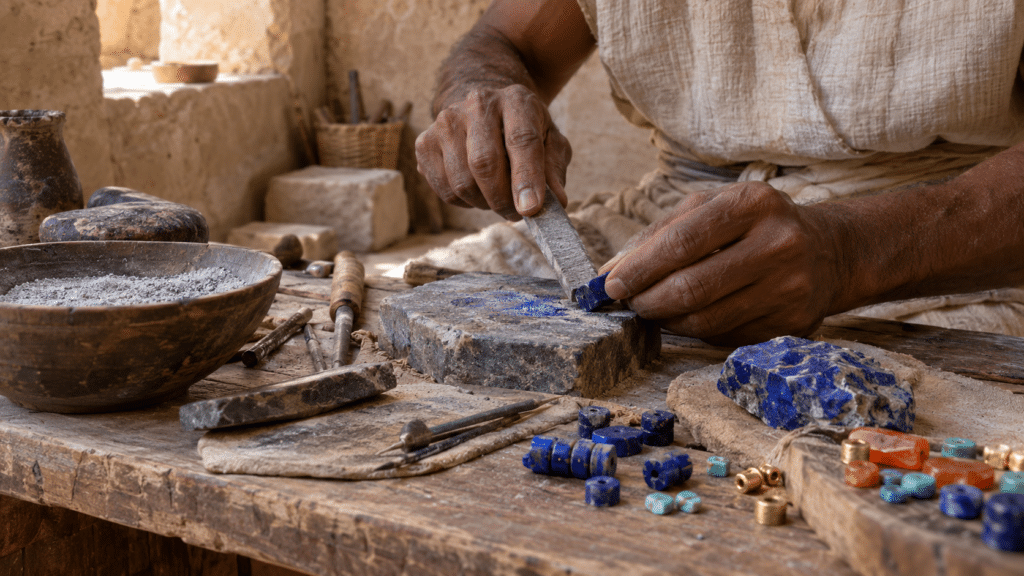
Gemstones as More Than Decoration
The modern distinction between jewellery and a spiritual object can become misleading when examining Ancient Egypt.
An object could be beautiful, valuable, socially meaningful and religiously potent at the same time.
Amulets provide particularly strong evidence.
The Metropolitan Museum explains that Egyptian amulets were understood as possessing powers that could derive from factors including their shape, material, colour and words or recitations associated with them.
This is a crucial distinction from modern crystal healing.
Ancient Egyptian amuletic practice was not simply based on a generic belief that every stone emitted an invisible vibration.
Meaning depended upon a complex interaction of material, image, colour, deity, ritual and religious worldview.
And lapis lazuli appears repeatedly within this world.
Lapis Lazuli Amulets: Archaeological Evidence
Museum collections preserve numerous Egyptian amulets carved from genuine lapis lazuli.
They are extraordinarily valuable evidence because they allow us to move beyond vague statements about what Egyptians supposedly believed.
Horus
The Metropolitan Museum holds a small Horus amulet carved from lapis lazuli, dated to Egypt’s Late Period, approximately 664–332 BCE.
Horus was one of the most important deities in Egyptian religion and was represented in multiple forms and contexts.
The existence of a genuine lapis Horus amulet establishes a direct material connection between the blue stone and divine representation.
Taweret
Another extraordinary surviving object is a lapis lazuli and gold amulet of Taweret, dating from approximately 664–30 BCE.
Taweret, whose composite form includes hippopotamus characteristics, was closely connected with protection surrounding pregnancy and childbirth.
Again, this provides something much stronger than a modern claim that lapis was simply a “protective crystal.”
We have an actual Egyptian protective deity represented in lapis.
The Uraeus
The Metropolitan Museum also preserves a Late Period uraeus amulet made from lapis lazuli.
The upright cobra was an immensely important Egyptian symbol associated particularly with divine and royal authority and protective power.
A related archaeological object documented by the British Museum’s Naukratis project takes the form of a cat-headed cobra, probably connected with Bastet.
Here material, divine imagery and protective symbolism intersect.
Ptah-Sokar
Lapis also appears in an amulet identified as possibly representing Ptah-Sokar, found at Abydos and dated to approximately 1850–1775 BCE.
Ptah-Sokar combined important aspects of Egyptian divine and funerary traditions.
Its archaeological context demonstrates that lapis was already being incorporated into amuletic material culture during the Middle Kingdom.
Lion Amulets
A tiny lapis lazuli lion amulet from approximately 1850–1700 BCE survives in the Metropolitan Museum collection.
Only about one centimetre long, it reminds us that spiritual significance was not dependent upon monumental scale.
Small objects could carry substantial symbolic meaning.
Lapis Lazuli and Egyptian Deities
Lapis appears in representations of several different divine figures rather than belonging exclusively to one god or goddess.
The British Museum, for example, documents lapis amulets representing or associated with figures including Horus or Haroeris, Harpocrates and Banebdjedet.
The Metropolitan Museum preserves a particularly refined lapis figure of a child deity, possibly Harpokrates, from the Late to Ptolemaic Period.
The museum explains that child gods became increasingly prominent from the Third Intermediate Period onwards and could embody ideas surrounding prosperity and abundance.
This diversity matters.
It would be misleading to claim simply:
“Lapis was the stone of Horus.”
The archaeological record reveals something richer.
Lapis could serve as a prestigious and symbolically resonant material within multiple religious contexts.
Protection — But Not in the Modern Crystal-Healing Sense
Modern crystal literature frequently describes lapis lazuli as a “stone of protection.”
Ancient Egyptian evidence does support a relationship between lapis and protective objects, but the mechanism imagined by Egyptians was culturally specific.
A Taweret amulet could be protective because Taweret was protective.
A uraeus could express protection and authority because of what the cobra represented within Egyptian religious thought.
An amulet’s material and colour could contribute additional significance.
This differs substantially from the modern metaphysical idea that lapis itself continuously broadcasts a universal protective energy.
The first claim can be investigated historically.
The second is a modern spiritual belief that has not been scientifically demonstrated.
Keeping those concepts separate actually makes Egyptian belief more interesting rather than less.
Lapis Lazuli, Death and Regeneration
Egyptian religion placed extraordinary emphasis on continuity after death, transformation and regeneration.
Amulets accompanied both the living and the dead, and their placement, form and colour could be highly significant.
A lapis lazuli heart amulet dated to Egypt’s Late Period survives in the Metropolitan Museum collection.
The heart occupied an exceptionally important position within Egyptian conceptions of the person and the afterlife.
Lapis objects have also been recovered from funerary settings.
This does not mean every lapis object represented resurrection, nor that lapis itself was thought universally to cause rebirth.
Instead, the evidence demonstrates that lapis could participate materially in the sophisticated symbolic systems surrounding death and continued existence.
Blue, Life and Regeneration
One reason blue materials were so compelling in Egypt may lie in the symbolic possibilities of colour.
The Metropolitan Museum notes that blue and green shades used for amulets could allude to water and vegetation, carrying associations with life and regeneration in Egypt’s desert environment.
This gives us a more historically grounded way of thinking about lapis spirituality.
Rather than assigning it a modern chakra or vibration, we can ask what intense blue meant to a civilisation whose existence depended upon the Nile.
Colour itself could become part of a religious vocabulary.
Was Lapis Lazuli Considered Sacred?
The word sacred requires some care.
There is no need to assume that every lapis bead was a sacred object.
Lapis was used in jewellery and decorative contexts as well as explicitly amuletic ones.
Yet archaeological evidence unquestionably demonstrates its presence in objects connected with deities, protection, funerary belief and ritual symbolism.
It is therefore reasonable to say that lapis lazuli could function within sacred and religious contexts in Ancient Egypt.
That is more precise than declaring that Egyptians universally regarded the material itself as inherently sacred.
Prestige, Distance and Spiritual Value
The physical journey of lapis may also have contributed to its prestige.
Imagine the material from an ancient Egyptian perspective.
It was intensely coloured.
It could be polished.
It combined spectacularly with gold.
And it arrived from unimaginably distant lands through extensive exchange networks.
Its rarity made it economically valuable.
Its colour made it visually extraordinary.
Its incorporation into divine and amuletic imagery gave it religious significance.
Material value and spiritual value need not have been separate categories.
Ancient Belief Versus Modern Crystal Spirituality
Today lapis lazuli is frequently associated with:
- wisdom
- truth
- intuition
- communication
- spiritual awareness
- the Third Eye Chakra
- the Throat Chakra
These ideas belong primarily to modern crystal spirituality and should not automatically be attributed to Ancient Egypt.
There is no archaeological justification for claiming that Egyptians used lapis to “open the Third Eye Chakra,” for example.
The chakra traditions originated in South Asian religious and philosophical contexts, while today’s colour-coded crystal-chakra system represents a considerably later development.
Combining the two and calling it an “Ancient Egyptian belief” creates a history that never existed.
Lapis does not need that invented history.
Its genuine story is already remarkable.
Can Lapis Lazuli Have Spiritual Meaning Today?
Historical accuracy does not prevent a modern person from giving lapis personal spiritual significance.
Someone may choose the stone as a symbol of:
reflection — because its long history encourages contemplation.
continuity — because humans have valued lapis for thousands of years.
distance and connection — because ancient lapis crossed enormous geographical networks.
the night sky — because its blue and pyrite can inspire that visual association.
personal spirituality — because an individual chooses to incorporate it into meditation or ritual.
Those are contemporary interpretations.
The important point is simply to identify them as such.
A Historically Inspired Lapis Meditation
A modern meditation can take inspiration from lapis lazuli’s history without pretending to reconstruct an ancient Egyptian ritual.
Place a piece of natural lapis in front of you.
Observe its colour before considering any symbolic meaning.
Look for variations in blue.
Notice any white calcite.
Look for metallic pyrite.
Then consider its geological history.
The material formed through natural processes long before human civilisation existed.
Now consider its human journey.
For thousands of years, people have extracted, traded, shaped, carved, worn and valued this extraordinary blue rock.
An ancient piece could travel vast distances before reaching its final owner.
Rather than asking the stone to provide an answer, use it to formulate a question:
What do I value enough to carry with me through change?
The practice is modern.
The inspiration is historical.
Why Historical Accuracy Matters in Crystal Spirituality
Gemstones occupy an unusual position between nature and culture.
Their physical properties belong to geology.
Their value belongs partly to economics.
Their meanings belong to human history.
Confusing those categories can easily produce exaggerated claims.
But separating them produces a richer story.
Lapis lazuli does not need to possess scientifically unverified healing frequencies to be extraordinary.
Nor do we need to invent Egyptian chakra practices to make it spiritual.
Real Egyptians carved genuine lapis into representations of their gods.
They incorporated it into amulets.
They buried precious objects with their dead.
They combined its intense blue with gold, carnelian and turquoise.
And the raw material itself could have travelled thousands of kilometres before reaching Egypt.
That history is far more compelling than a modern myth disguised as an ancient one.
Conclusion
Lapis lazuli in Ancient Egypt represents a remarkable meeting point between geology, trade, craftsmanship, religion and symbolism.
Scientifically, lapis is a rock composed primarily of minerals including lazurite, calcite and pyrite.
Historically, its finest ancient sources lay far beyond Egypt, particularly in the mountains of present-day Afghanistan.
Archaeologically, its importance is tangible.
Surviving lapis objects include jewellery and amulets representing Horus, Taweret, uraei, lions, child deities and other religious forms. Such objects demonstrate that lapis could participate directly in Egyptian ideas surrounding divine power, protection, fertility, life, death and regeneration.
Modern crystal spirituality has subsequently given lapis additional associations with intuition, truth, chakras and personal awareness.
Those modern beliefs should not be mistaken for ancient Egyptian doctrine.
We can appreciate both — provided we know where one ends and the other begins.
At Natural Gems Belgium, we believe this is one of the most rewarding ways to explore spiritual gemstone traditions:
understand the stone scientifically, reconstruct its historical meaning from evidence, and allow personal symbolism to remain personal.
Lapis lazuli needs very little mythology added to it.
Its real journey — from a remote mountain deposit to the workshops, jewellery and sacred imagery of one of history’s most extraordinary civilisations — is remarkable enough.
References & Further Reading
Gemmology & Mineralogy
Gemological Institute of America (GIA) — Lapis Lazuli Description
Authoritative gemmological introduction to lapis lazuli as a rock composed principally of lazurite, calcite and pyrite, including colour, structure and sources.
https://www.gia.edu/UK-EN/lapis-lazuli-description-v1
GIA, Gems & Gemology — Lapis-Lazuli from Sar-E-Sang, Badakhshan, Afghanistan
Detailed gemmological study by Jean Wyart, Pierre Bariand and Jean Filippi of the historically important Afghan lapis deposit.
https://www.gia.edu/gems-gemology/winter-1981-lapis-afghanistan-wyart
Archaeology, Art & Egyptian Material Culture
The Metropolitan Museum of Art — Girdle with Gold and Lapis Wallet-Shaped Beads
New Kingdom jewellery from the reign of Thutmose III demonstrating the combination of lapis, gold and fertility-related cowrie symbolism.
https://www.metmuseum.org/art/collection/search/547635
The Metropolitan Museum of Art — Horus Amulet
Late Period Egyptian amulet carved from lapis lazuli.
https://www.metmuseum.org/art/collection/search/565435
The Metropolitan Museum of Art — Taweret Amulet
Lapis lazuli and gold representation of the protective Egyptian deity Taweret, dated to the Late Period–Ptolemaic Period.
https://www.metmuseum.org/art/collection/search/570356
The Metropolitan Museum of Art — Uraeus Amulet
Late Period lapis lazuli cobra amulet illustrating the stone’s presence within Egyptian protective and royal symbolism.
https://www.metmuseum.org/art/collection/search/560759
The Metropolitan Museum of Art — Ptah-Sokar (?) Amulet
Middle Kingdom lapis lazuli and faience amulet excavated at Abydos.
https://www.metmuseum.org/art/collection/search/558519
The Metropolitan Museum of Art — Lion Amulet
A tiny lapis lazuli lion from the Late Middle Kingdom, demonstrating the use of lapis in small-scale amuletic objects.
https://www.metmuseum.org/art/collection/search/546824
The Metropolitan Museum of Art — Heart Amulet
Late Period lapis lazuli heart amulet providing material evidence for lapis within Egyptian funerary and amuletic traditions.
https://www.metmuseum.org/art/collection/search/555255
The Metropolitan Museum of Art — Djed Pillar Amulet
Museum explanation of how Egyptian amuletic power could be connected with shape, material, colour and ritual recitation, with discussion of blue and green symbolism in relation to life and regeneration.
https://www.metmuseum.org/art/collection/search/573701
British Museum — Lapis Lazuli Haroeris Amulet
Archaeological object from Tell Dafana representing the falcon-headed deity Haroeris.
https://www.britishmuseum.org/collection/object/Y_EA20654
British Museum — Lapis Lazuli Banebdjedet Amulet
Late Period amulet representing Banebdjedet as a four-headed ram.
https://www.britishmuseum.org/collection/object/Y_EA57889
Colour & Material Culture
The Metropolitan Museum of Art — Turquoise in Ancient Egypt
Scholarly discussion of the Egyptian lapidary colour palette, including the characteristic combination of carnelian, turquoise and dark-blue lapis lazuli.
https://www.metmuseum.org/essays/turquoise-in-ancient-egypt
The Metropolitan Museum of Art — Chroma: Ancient Sculpture in Color, Pigment Glossary
Museum resource discussing lapis lazuli, lazurite, ancient sources and the exceptional value of blue materials.
https://www.metmuseum.org/exhibitions/chroma/glossary
[…] is no reliable evidence that Lapis Lazuli enhances intuition through supernatural energy, communicates information from celestial objects or […]