Table of Contents
When a Small Stone Carried the Image of a God
Imagine a merchant in ancient Babylon, approximately 3,800 years ago.
A commercial agreement has been prepared.
The participants gather around a clay tablet.
One individual removes a small, dark cylindrical stone suspended from a cord.
The surface appears almost black, with a subtle metallic sheen.
Yet it is covered with extraordinarily intricate carvings.
Divine figures.
Animals.
Sacred symbols.
And perhaps an inscription identifying its owner.
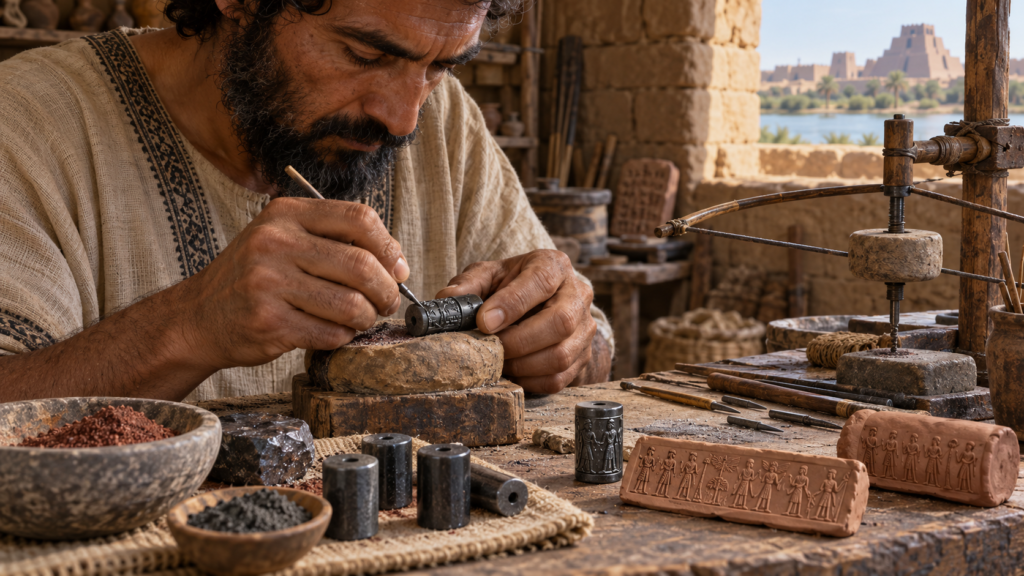
The cylinder is pressed into the soft clay and carefully rolled across its surface.
As it turns, the engraved design produces a continuous impression.
A miniature religious scene emerges.
The object has now performed an important administrative function.
It has identified an individual and authenticated an action.
But the engraved stone may also have possessed another meaning.
In ancient Mesopotamia, cylinder seals could function as personal amulets, and some were believed to offer protection through their materials, inscriptions or divine imagery.
One of the minerals frequently selected for such objects during the Old Babylonian period was hematite.
Hematite in ancient Babylon was a significant material utilized for its mystical properties and protective qualities.
The hematite cylinder seals of ancient Babylon reveal a remarkable intersection between mineralogy, religious belief, personal identity and the practical administration of society.
Their history demonstrates how gemstones could participate in spiritual traditions without their supernatural properties being scientifically established.
Ancient Babylon: Religion and Everyday Life
Babylon developed in southern Mesopotamia, in the region corresponding principally to present-day Iraq.
The city became an important political and cultural centre during the early second millennium BCE.
One of its most famous rulers was Hammurabi, who reigned during the eighteenth century BCE.
The period associated with his dynasty belongs to what historians call the Old Babylonian period.
Mesopotamian society possessed sophisticated systems of administration, commerce, law and religious practice.
Temples played important economic and social roles.
Religious beliefs were deeply integrated into political authority and everyday activities.
Deities were associated with different aspects of the world.
These included the sun, moon, fertility, warfare, justice, healing and the natural environment.
The religious traditions were neither static nor completely uniform.
Different cities maintained particular cults, and the identities and relationships of deities evolved over time.
This complexity is important when interpreting gemstones used in religiously decorated objects.
A cylinder seal depicting a deity does not necessarily communicate the same message as every other seal featuring that deity.
Its meaning depends on the period, owner, inscription and artistic context.
What Was a Mesopotamian Cylinder Seal?
A cylinder seal was a small object, usually made from stone, engraved around its curved exterior.
Most examples were only a few centimetres long.
A hole was commonly drilled through the centre.
This allowed the seal to be suspended from a cord or otherwise carried.
The surface was decorated using intaglio engraving.
In this technique, the design is cut into the material.
When the cylinder is rolled across soft clay, the recessed areas create a raised impression.
The result is a continuous image.
Cylinder seals originated in Mesopotamia during the fourth millennium BCE, long before the Old Babylonian period.
They subsequently became important across several ancient Near Eastern societies.
Their designs changed over time.
Some featured animals.
Others depicted mythological creatures.
Many included religious scenes.
Some carried inscriptions identifying their owners.
The surviving objects provide archaeologists with an exceptional record of ancient artistic and religious imagery.
A Personal Signature Made from Stone
Cylinder seals performed important practical functions.
They could identify the person responsible for a transaction.
They could authenticate documents.
They could mark ownership.
They could also be impressed into clay used to secure containers, doors or storage facilities.
In this respect, the seal functioned somewhat like a personal signature.
However, the comparison has limitations.
A cylinder seal was a physical object that could be worn, displayed, transferred or inherited.
Its imagery might also communicate social identity, religious devotion or political allegiance.
It therefore combined several functions within one object.
This combination makes cylinder seals particularly interesting for the study of gemstone beliefs.
They were simultaneously administrative instruments and potential carriers of symbolic or protective meaning.
Why Did Babylonians Use Hematite?
Hematite became a characteristic material for cylinder seals during the Old Babylonian period.
The Metropolitan Museum of Art identifies its use as a notable feature of seal production during this era.
Several physical characteristics made the mineral suitable for engraving.
Hematite can occur as a compact, relatively hard material.
It can take a smooth polish.
Its dark surface provides a distinctive appearance.
When properly worked, it can preserve intricate engraved details.
The mineral’s density also gives small objects a noticeably substantial weight.
These properties help explain its suitability for seal production.
However, the surviving evidence does not establish that every Babylonian hematite seal was selected primarily for supernatural reasons.
Practical craftsmanship, availability, fashion, personal preference and religious associations could all have influenced material selection.
What Is Hematite?
Hematite is a naturally occurring iron oxide mineral.
Its chemical formula is:
Fe₂O₃
It belongs to the oxide mineral class.
Hematite crystallises in the trigonal crystal system.
Its Mohs hardness is generally approximately 5–6, although reported ranges vary with material characteristics.
Its specific gravity is approximately 5.3.
This makes it relatively dense compared with many common silicate minerals.
Hematite can display several different appearances.
Some specimens are reddish-brown.
Others are steel-grey.
Compact polished material may appear almost black.
Certain crystalline varieties display a strong metallic lustre.
Despite these variations, hematite possesses one particularly important identifying characteristic.
Its streak is red to reddish-brown.
This is the colour of the mineral in powdered form.
Even a polished black specimen may produce a reddish streak.
The distinction between surface appearance and powdered colour is fundamental to identifying natural hematite.
Why Is Hematite Associated with Blood?
The modern name hematite derives from Greek terminology associated with blood.
The connection reflects the mineral’s characteristic red colour in powdered or earthy forms.
However, this etymology must be interpreted carefully.
The Greek-derived name belongs to a different linguistic and historical context from Old Babylonian Mesopotamia.
It would be incorrect to assume that Babylonian seal owners necessarily associated hematite with blood because of its modern name.
A mineral can acquire different names and meanings across cultures.
The red streak is a scientifically observable property.
The interpretation of that colour as spiritually significant requires independent historical evidence.
Hematite and the Art of Miniature Engraving
The technical achievement represented by Babylonian cylinder seals is extraordinary.
A typical seal might measure only two or three centimetres in height.
Yet its curved surface could contain several figures.
A deity might stand before a worshipper.
An animal could appear beneath a divine symbol.
A second figure might raise its hands in supplication.
Small inscriptions could identify the owner.
The engraver had to work on a curved surface.
The finished image also had to function correctly when transferred into clay.
This required considerable planning.
The carved design would appear reversed in the resulting impression.
The artist therefore needed to understand how the finished image would be reproduced.
The seal was both a miniature sculpture and a printing instrument.
The Religious Imagery of Old Babylonian Seals
Religious scenes were common on Old Babylonian cylinder seals.
Some depicted worshippers approaching seated deities.
Others showed gods standing on animals.
Certain compositions incorporated symbols associated with particular divine figures.
These images were not merely random decorations.
They belonged to a recognisable visual language.
Horned headdresses frequently identified divine beings.
Particular weapons or animals could help distinguish individual deities.
The arrangement of figures could communicate relationships between humans and the divine world.
However, not every image can be interpreted with certainty.
Some symbols remain disputed.
Others may have carried meanings that have not survived in written sources.
Responsible interpretation requires acknowledging those limits.
Ishtar: Divine Power and the Warrior Goddess
One remarkable hematite cylinder seal in the Metropolitan Museum of Art dates to approximately the eighteenth or seventeenth century BCE.
Its imagery includes the goddess Ishtar.
Ishtar occupied an important position in Mesopotamian religion.
She was associated with love, sexuality and warfare, among other aspects of divine power.
Her character was complex.
She could embody attraction and fertility while also appearing as a formidable warrior.
On the Metropolitan Museum’s hematite seal, Ishtar is represented with weapons.
She holds a mace and a curved sword.
Additional weapons emerge from her shoulders.
She stands upon a composite creature described by the museum as a lion-headed eagle.
The imagery emphasises her martial character.
It provides a clear example of how religious concepts could be expressed through miniature gemstone engraving.
Did an Image of Ishtar Offer Protection?
Ancient Mesopotamian seals could possess protective associations.
The Metropolitan Museum explains that protective properties may have been attributed to both the engraved imagery and the material itself.
However, the presence of Ishtar on a particular seal does not automatically establish its exact protective purpose.
The image could express religious devotion.
It could communicate identity.
It might invoke divine favour.
It could also reflect the owner’s position within a particular cultural environment.
Without an inscription or additional contextual evidence, the precise intention may remain uncertain.
This distinction is essential.
A deity’s image is historically documented.
The specific supernatural effect expected by an individual seal owner may not be recoverable.
Shamash: The Sun God and Divine Justice
Another important Mesopotamian deity represented on cylinder seals was Shamash.
Shamash was associated with the sun and justice.
His divine role connected the illumination of the world with the ability to perceive truth and wrongdoing.
One Old Babylonian hematite seal preserved by the Metropolitan Museum depicts a worshipper presenting an animal before a deity.
The deity carries a distinctive saw-like implement.
The museum identifies the figure as Shamash.
In Mesopotamian religious imagery, the saw was associated with the sun god’s movement through the eastern mountains.
The seal also contains several animals and mythological figures.
Its miniature composition brings together human worship, divine identity and symbolic imagery.
The Saw of Shamash
The saw carried by Shamash is particularly interesting.
To a modern viewer, it may appear to be an ordinary tool.
Within Mesopotamian religious iconography, however, it could function as a divine attribute.
The Metropolitan Museum explains its association with the sun god’s passage through the eastern mountains.
This illustrates an important principle of historical symbolism.
An object’s meaning depends on its cultural context.
A saw is not inherently supernatural.
But within a specific religious image, it can identify a deity and communicate a theological narrative.
The same principle applies to the hematite cylinder itself.
The stone’s physical properties and its cultural significance must be studied separately.
Amurru: A Deity Associated with Identity and Protection
One of the most revealing examples of protective gemstone symbolism comes from another hematite seal in the Metropolitan Museum’s collection.
The object dates to approximately the eighteenth through sixteenth centuries BCE.
It depicts two divine figures.
One is seated.
The other stands with a foot resting on a horned animal.
The standing figure may represent Amurru.
Amurru was associated with the Amorite peoples.
His iconography could include a crooked staff, horned animals and distinctive clothing or headgear.
The museum suggests that the deity’s appearance on the seal may have expressed Amorite identity.
It also proposes that the image may have served a protective function.
Amurru became associated with exorcism and healing in Mesopotamian religious traditions.
This is a particularly valuable example because the museum explicitly discusses the possible protective significance of the engraved image.
Protection Through Religious Representation
The Amurru seal demonstrates that protective beliefs could be communicated through religious imagery.
The owner may have valued the object because of the deity represented upon it.
The seal’s significance therefore extended beyond its material composition.
It was not simply a piece of hematite.
It was a carefully engraved object participating in a particular religious and social environment.
The image could express identity and a desired relationship with divine power.
However, the museum presents the protective interpretation as a possibility rather than a certainty.
We should preserve that distinction.
The historical evidence supports the existence of protective associations.
It does not establish the exact intentions of every individual owner.
What Does Apotropaic Mean?
The term apotropaic is frequently used in archaeology and religious studies.
It refers to objects, images or practices intended to avert harm or misfortune.
An apotropaic object may be worn.
It may be placed within a building.
It may carry a religious inscription.
Or it may depict a protective supernatural figure.
Mesopotamian cylinder seals could possess apotropaic functions.
The Metropolitan Museum specifically documents this possibility.
But an apotropaic object is not scientifically proven to prevent supernatural harm.
The term describes its intended or believed function within a cultural tradition.
This distinction allows the historical belief to be studied without presenting its supernatural mechanism as established fact.
The Difference Between an Amulet and a Seal
An amulet is generally understood as an object worn or carried because of its believed protective or beneficial properties.
A seal is an instrument used to create an identifying impression.
Mesopotamian cylinder seals could combine these functions.
A person might carry the same object for administrative use and personal protection.
The seal could therefore possess practical, social and religious significance simultaneously.
This makes it difficult to divide ancient objects into completely separate categories of jewellery, tools and spiritual objects.
Their functions frequently overlapped.
Were All Hematite Seals Sacred?
No such conclusion can be established.
Cylinder seals were used in a wide range of administrative and personal contexts.
Some contained explicitly religious imagery.
Others included animals, inscriptions or scenes whose meanings remain uncertain.
Even when a seal depicted a deity, its primary documented function might have been identification or authentication.
The existence of protective beliefs does not demonstrate that every hematite seal was regarded as a powerful amulet.
Nor does it prove that hematite was universally considered sacred throughout Mesopotamia.
The evidence supports a more nuanced interpretation.
Certain engraved stones participated in religious beliefs and practices.
Their precise significance varied.
The Relationship Between the Material and the Image
This distinction is central to understanding ancient gemstone spirituality.
Consider a polished hematite cylinder engraved with a deity.
Its physical material possesses measurable characteristics.
It is dense.
It is opaque.
It can take a polish.
It has a characteristic red streak.
The engraved image belongs to a symbolic system.
The deity has a particular identity.
The composition communicates religious ideas.
The owner may have believed that the object offered protection.
These different aspects interact.
But they are not interchangeable.
The physical mineral does not independently explain the religious meaning.
And the religious meaning does not change the mineral’s scientifically measurable properties.
Religious Scenes and Human Relationships with the Gods
Many Old Babylonian cylinder seals depict scenes of presentation or supplication.
A human figure approaches a deity.
Sometimes an intermediary goddess accompanies the worshipper.
The figures may stand before an enthroned divine being.
The imagery can communicate a relationship between humanity and the supernatural world.
It may express devotion, authority or the desire for divine favour.
Such scenes also provide evidence of how Mesopotamian society visualised religious hierarchy.
The gods occupy recognisable positions.
Human figures appear in gestures of respect or petition.
The miniature seal becomes a compact representation of a larger religious worldview.
Why Did These Images Matter in Everyday Life?
Religious imagery on a personal object could accompany its owner through daily activities.
A seal might be used during a commercial transaction.
It might identify an administrative official.
It could be carried on the body.
Its imagery remained physically associated with the individual.
This creates an interesting relationship between public and private identity.
The impression established authority in a practical context.
The engraved image could also communicate religious or cultural affiliation.
The same small stone participated in both worlds.
This dual function is one of the most distinctive aspects of Mesopotamian cylinder seals.
The Importance of Personal Identity
Cylinder seals were often associated with particular individuals.
Some carried inscriptions identifying their owners.
The seal could therefore represent a person’s position within society.
Its imagery might communicate status, profession or religious associations.
The Metropolitan Museum preserves an Akkadian cylinder seal belonging to an official identified as Balu-ili.
Although that particular seal is made from chert rather than hematite, it demonstrates the broader relationship between seal imagery, inscriptions and personal identity.
The object identifies its owner as a cupbearer.
It also contains an elaborate hunting scene.
This example illustrates why the interpretation of a cylinder seal must consider both its text and its imagery.
Hematite and the Physical Experience of a Gemstone
Hematite has an unusual tactile character.
Its density gives it considerable weight relative to its size.
Its polished surface can feel smooth and cool.
Its metallic appearance can resemble darkened metal rather than a conventional transparent gemstone.
These qualities may contribute to its aesthetic appeal.
However, we should not assume that ancient Babylonians interpreted them in exactly the same way as modern crystal enthusiasts.
The surviving evidence does not allow us to reconstruct every sensory or emotional association experienced by individual seal owners.
What we can establish is that hematite was used for carefully engraved objects that combined practical and potentially religious functions.
Hematite Is Not the Same as Magnetite
Modern gemstone discussions sometimes confuse hematite with magnetite.
Both are iron-bearing minerals.
Both can appear dark.
However, their chemical compositions and magnetic properties differ.
Hematite has the formula Fe₂O₃.
Magnetite has the formula Fe₃O₄.
Magnetite is strongly magnetic.
Ordinary natural hematite is not strongly attracted to a simple magnet, although magnetic impurities can influence the behaviour of particular specimens.
Some modern products marketed as magnetic hematite are manufactured materials rather than natural hematite.
This distinction matters for accurate gemmological identification.
It also demonstrates why modern commercial gemstone terminology should not be projected onto ancient artefacts.
Modern Hematite and Grounding Beliefs
Contemporary crystal spirituality frequently associates hematite with grounding.
Some practitioners describe it as a stone of stability, concentration or protection.
Others connect it with the Root Chakra.
Hematite may be carried during meditation or worn as a symbolic reminder of personal strength.
These practices belong to modern metaphysical traditions.
They should not automatically be attributed to ancient Babylonian religion.
Mesopotamian cylinder seals and contemporary chakra practices developed within different cultural systems.
Although both may involve beliefs concerning protection, their historical meanings are not equivalent.
Did Ancient Babylonians Believe Hematite Had Healing Powers?
This question requires particular caution.
The Metropolitan Museum documents that protective qualities could be attributed to cylinder seals and their imagery.
It also discusses a possible relationship between Amurru imagery and traditions of exorcism and healing.
However, this does not establish that hematite itself was universally regarded as a medical treatment.
Nor does it demonstrate that Babylonian practitioners believed polished hematite could balance chakras or regulate modern concepts of energy.
Such claims would require specific textual or archaeological evidence.
The surviving objects support a more limited but historically meaningful conclusion.
Certain hematite seals could participate in religious systems concerned with protection and divine favour.
What Does Modern Science Establish?
Hematite is an iron oxide mineral.
Its chemical composition, density, crystal structure and optical characteristics can be studied scientifically.
Its magnetic behaviour can be measured.
Its surface can be examined microscopically.
Its chemical composition can be investigated using analytical techniques.
These are established physical properties.
There is no reliable scientific evidence that wearing hematite independently treats disease, balances chakras or creates a supernatural protective field.
A person may experience calm, concentration or personal reassurance while holding a meaningful object.
Such experiences can be psychologically significant.
But they do not demonstrate that the mineral emits a special healing energy.
Archaeology and the Limits of Interpretation
One of the greatest challenges in studying ancient gemstone beliefs is the incomplete nature of the evidence.
An engraved seal may survive for thousands of years.
Its original owner may remain unknown.
The circumstances in which it was worn may be uncertain.
Its inscription may be damaged.
Some symbols may have meanings that scholars cannot reconstruct conclusively.
Museum catalogues therefore frequently use cautious language.
A figure may represent a particular deity.
An image may have served a protective function.
A composition may express religious identity.
These qualifications are not weaknesses.
They reflect responsible historical scholarship.
The Importance of Museum Collections
Cylinder seals are particularly valuable because they preserve miniature images that might otherwise have disappeared.
Large wall paintings and other decorative materials have often been lost.
But small engraved stones can survive for millennia.
The Metropolitan Museum of Art and the British Museum preserve extensive collections of Mesopotamian cylinder seals.
These collections allow researchers to compare materials, artistic styles, inscriptions and iconographic traditions.
Individual objects can be examined within broader chronological frameworks.
The comparison of many examples helps distinguish established patterns from isolated interpretations.
A Stone That Connected Administration and Religion
The most fascinating aspect of Babylonian hematite seals may be their combination of functions.
The same object could authenticate a transaction and display a divine image.
It could identify an owner while communicating religious affiliation.
It could serve a practical purpose and possess an amuletic association.
This overlap challenges modern assumptions that religion and everyday administration must occupy separate worlds.
In ancient Mesopotamia, they frequently intersected.
The cylinder seal offers a particularly tangible example.
Why Hematite Was More Than a Decorative Stone
A polished hematite cylinder seal was not simply an ornament.
It was a carefully manufactured instrument.
Its engraved surface could reproduce a complex image.
Its inscription could identify an individual.
Its religious imagery could communicate relationships with the divine world.
Its material could contribute to its durability and visual character.
The object therefore acquired significance through several interconnected processes.
Geological formation produced the mineral.
Craftsmanship transformed it into a seal.
Social institutions gave it an administrative function.
Religious traditions supplied symbolic meanings.
Its importance emerged from the interaction of all four.
What Can We Establish with Confidence?
The historical and scientific evidence supports several important conclusions.
Cylinder seals originated in Mesopotamia during the fourth millennium BCE.
They were used to identify individuals and authenticate transactions.
Hematite became a characteristic material for cylinder seals during the Old Babylonian period.
The mineral is an iron oxide with the formula Fe₂O₃.
It can occur as a dense, dark material suitable for detailed engraving.
Old Babylonian hematite seals frequently depict religious figures and mythological scenes.
Examples preserved by the Metropolitan Museum represent Ishtar, Shamash and possibly Amurru.
Cylinder seals could possess amuletic or protective associations.
The precise meaning of individual designs is not always recoverable.
The presence of religious imagery does not prove that every seal was regarded as supernatural.
Modern chakra and crystal-healing interpretations should not be attributed to ancient Babylon without historical evidence.
There is no established scientific evidence that hematite independently produces supernatural healing or protection.
A Contemporary Reflection on Hematite
For modern gemstone enthusiasts, the history of Babylonian hematite offers an interesting perspective.
A small polished stone can become meaningful through its relationship with a person.
An ancient seal represented identity.
Its engraved image could communicate belief.
Its impression could establish authority.
Its physical presence connected the owner with a wider social and religious world.
Today, a person may similarly associate a gemstone with a personal intention or symbolic reminder.
But such a modern interpretation should be identified as contemporary.
It is not necessarily a continuation of ancient Babylonian religious practice.
Understanding the difference preserves the historical identity of both traditions.
Conclusion: A Dark Stone Between the Human and Divine Worlds
Nearly four thousand years ago, Mesopotamian artisans transformed hematite into objects of remarkable sophistication.
Their cylinder seals were small enough to carry.
Yet they could contain elaborate religious compositions.
They identified individuals.
They authenticated transactions.
They communicated cultural and religious imagery.
And in certain contexts, they may have served as protective amulets.
The gods represented upon these stones belonged to a complex religious world.
Ishtar embodied powerful and sometimes contrasting divine attributes.
Shamash was associated with the sun and justice.
Amurru could communicate cultural identity and protective associations.
Through miniature engraving, these religious figures became part of objects used in everyday life.
The significance of Babylonian hematite did not depend solely on the mineral itself. It emerged from the relationship between natural material, artistic craftsmanship, personal identity and religious belief.
For Natural Gems Belgium, this history illustrates an essential principle.
Gemstones are not only geological specimens.
They can also preserve evidence of human thought.
Their surfaces may carry inscriptions.
Their shapes may reflect specialised craftsmanship.
Their use may reveal social relationships.
And their imagery may communicate religious ideas that remain fascinating thousands of years later.
The hematite cylinder seals of ancient Babylon provide an exceptional example.
They remind us that the history of gemstone spirituality is most rewarding when cultural tradition and scientific evidence are examined together.
References & Further Reading
The following references are selected from authoritative museum collections, archaeological scholarship and mineralogical resources. All links lead directly to informational pages rather than gemstone product listings.
1. The Metropolitan Museum of Art – Old Babylonian Hematite Cylinder Seal Depicting Amurru
https://www.metmuseum.org/art/collection/search/328761
Source description: Official collection record for a hematite cylinder seal dating to approximately the eighteenth through sixteenth centuries BCE.
Discusses the possible identification of Amurru, the relationship between divine imagery and cultural identity, and the potential protective function of the seal.
This is one of the most important sources for the article’s discussion of historically documented protective gemstone beliefs.
2. The Metropolitan Museum of Art – Hematite Cylinder Seal Depicting Ishtar
https://www.metmuseum.org/art/collection/search/327283
Source description: Detailed museum catalogue for an Old Babylonian hematite seal dating to approximately the eighteenth or seventeenth century BCE.
Documents the representation of Ishtar, her weapons and associated figures.
Also explains the administrative and potentially protective functions of ancient cylinder seals.
3. The Metropolitan Museum of Art – Hematite Cylinder Seal Depicting Shamash
Source description: Official collection record for an eighteenth-century BCE hematite cylinder seal depicting a worshipper approaching Shamash.
Explains the sun god’s distinctive saw-like attribute and the additional mythological imagery included in the composition.
4. The British Museum – Old Babylonian Hematite Cylinder Seal with Weather God
https://www.britishmuseum.org/collection/object/W_1841-0726-113
Source description: Official archaeological catalogue for a hematite cylinder seal featuring divine figures, a weather god, a bull and a royal offering scene.
Provides detailed documentation of the material, iconography, dimensions and historical classification.
5. The Metropolitan Museum of Art – Hematite Cylinder Seal with Heroes and Humbaba
https://www.metmuseum.org/art/collection/search/327620
Source description: Museum record for an Old Babylonian hematite seal dating to approximately 2000–1600 BCE.
Describes combat scenes involving heroic figures, mythological creatures and a probable representation of the demon Humbaba.
Demonstrates the complexity of religious and mythological imagery preserved through gemstone engraving.
6. The Metropolitan Museum of Art – Cylinder Seal with Suppliant Goddesses and Worshippers
https://www.metmuseum.org/art/collection/search/327775
Source description: Official collection record for an early second-millennium BCE hematite cylinder seal.
Documents the presentation of worshippers and divine figures, illustrating the importance of religious supplication in Old Babylonian seal imagery.
7. The Metropolitan Museum of Art – Cylinder Seal and Modern Impression: Hunting Scene
https://www.metmuseum.org/art/collection/search/329090
Source description: Detailed archaeological and educational resource concerning an Akkadian cylinder seal.
Although the particular object is made from chert rather than hematite, its museum documentation provides valuable explanations of seal production, ownership inscriptions, administrative functions and apotropaic associations.
8. The Metropolitan Museum of Art – Cylinder Seals: Tiny Treasures That Leave a Big Impression
https://www.metmuseum.org/perspectives/cylinder-seals-tiny-treasures-that-leave-a-big-impression
Source description: Educational museum article by Yelena Rakic, published in 2018.
Explains the operation of cylinder seals, the relationship between engraved designs and their impressions, and the historical importance of these miniature objects.
Provides an accessible introduction to the craftsmanship discussed throughout the article.
9. University of Minnesota – Hematite Mineral Properties
https://commonminerals.esci.umn.edu/minerals-g-m/hematite
Source description: University mineralogical reference documenting hematite’s chemical composition, hardness, density, lustre and characteristic red streak.
Provides the scientific foundation for the article’s explanation of the mineral’s physical properties.
10. Mindat – Hematite Mineral Information
https://www.mindat.org/min-1856.html
Source description: Specialist mineralogical database entry for hematite.
Documents its chemical formula, trigonal crystal system, physical properties, crystal habits and geological occurrence.
Useful for professional mineralogical verification.
11. The Metropolitan Museum of Art – Kassite Cylinder Seal Dedicated to Gula
https://www.metmuseum.org/art/collection/search/327207
Source description: Official museum catalogue for a Kassite-period cylinder seal dedicated to Gula, the Mesopotamian goddess of healing.
Although this particular seal is made from jasper rather than hematite, its inscription provides valuable comparative evidence that cylinder seals could carry explicitly religious and protective meanings.
Historical Evidence, Religious Tradition and Scientific Facts
Scientifically established: Hematite is an iron oxide mineral with the chemical formula Fe₂O₃.
Scientifically established: Hematite crystallises in the trigonal crystal system.
Scientifically established: Its characteristic streak is red to reddish-brown, even when the polished mineral appears black or metallic grey.
Scientifically established: Hematite is relatively dense and can be polished and engraved.
Historically documented: Cylinder seals originated in Mesopotamia during the fourth millennium BCE.
Historically documented: Cylinder seals were used for identification, ownership and the authentication of transactions.
Historically documented: Hematite was a characteristic material for Old Babylonian cylinder seals.
Historically documented: Religious imagery frequently appeared on Mesopotamian seals.
Historically documented: Surviving hematite examples depict deities including Ishtar and Shamash.
Historically supported interpretation: Some seals depicting Amurru may have communicated cultural identity or protective religious associations.
Historically documented belief: Cylinder seals could possess apotropaic functions within ancient Mesopotamian traditions.
Historically uncertain: The precise religious meaning of every individual seal cannot be reconstructed.
Historically unsupported: There is insufficient evidence to claim that all Babylonian hematite seals were used specifically for supernatural protection.
Modern metaphysical belief: Contemporary crystal traditions may associate hematite with grounding, stability, concentration and the Root Chakra.
Scientific limitation: There is no established scientific evidence that hematite emits supernatural healing energy, balances chakras or independently prevents illness.
Gemmological consideration: Natural hematite should not be confused with magnetite or manufactured products marketed as magnetic hematite.
The hematite cylinder seals of ancient Babylon provide a particularly valuable example of the relationship between gemstones and documented spiritual beliefs.
Their religious imagery is historically preserved.
Their administrative functions are archaeologically established.
Their mineralogical properties are scientifically measurable.
Their proposed supernatural efficacy remains a matter of historical belief rather than scientific demonstration.
Understanding these distinctions allows the remarkable objects to be appreciated without confusing ancient religious tradition with modern metaphysical claims.