Long before modern mirrors became ordinary household objects, reflective surfaces occupied a remarkable position in human culture.
A reflection could reveal the familiar.
A face.
A movement.
A passing expression.
Yet mirrors also invited questions about things that could not be seen directly.
What lies beyond appearances?
The practice of the Obsidian mirror ritual has captivated many who seek to explore the depths of their consciousness.
Can the future be known?
Does a reflection reveal something about the person looking into it?
Across different cultures, reflective objects acquired meanings extending far beyond their practical function.
Among the most fascinating examples are the polished obsidian mirrors associated with ancient Mesoamerica.
These dark reflective objects formed part of complex religious and symbolic traditions.
Centuries later, some travelled to Europe, where they entered very different intellectual and spiritual environments.
One particularly famous example became associated with the English Renaissance scholar John Dee.
Today, obsidian remains popular within contemporary crystal spirituality, where it is frequently connected with protection, introspection and confronting uncomfortable personal truths.
These modern associations should not be confused with the historical religious meanings of ancient obsidian mirrors.
Nor should they be presented as scientifically established energetic properties.
This ancient practice connects deeply with modern interpretations, emphasizing the significance of the Obsidian mirror ritual in personal reflection.
Nevertheless, the history of obsidian mirrors offers an extraordinary opportunity to explore how human beings have used meaningful objects to contemplate the unknown.
And how a small, dark stone can become the centre of a modern personal reflection practice.
The Fascination of a Dark Reflection
Most modern mirrors are designed to produce a clear image.
We expect to see ourselves accurately.
We use mirrors to examine our appearance, prepare for the day or observe details that would otherwise remain difficult to see.
A polished obsidian mirror creates a different visual experience.
Its dark surface reflects light, but the image may appear subdued.
The surrounding environment can seem quieter within the reflection.
Bright details remain visible.
Darker areas become less distinct.
This unusual appearance helps explain why obsidian mirrors have fascinated collectors, historians and people interested in spiritual traditions.
But their historical importance cannot be understood through appearance alone.
In ancient Mesoamerica, mirrors were connected with religious ideas, social authority and ceremonial practices.
Their meaning depended on the cultural world in which they were created and used.
A modern observer may see an intriguing reflective stone.
An ancient religious practitioner may have understood the object through an entirely different system of beliefs.
Recognising that difference is essential.
Obsidian Mirrors in Ancient Mesoamerica
Mesoamerica was home to numerous sophisticated societies whose religious and artistic traditions developed over many centuries.
These included the Maya, the inhabitants of Teotihuacan and, later, the Mexica, often referred to as the Aztecs.
Mirrors and reflective objects appeared in different forms within these cultures.
They were not always made from the same materials.
Nor did they necessarily have identical meanings.
Some were associated with elite status.
Others appeared in religious contexts.
Certain reflective objects were connected with divination, ritual authority and representations of supernatural beings.
The Metropolitan Museum of Art preserves a pre-sixteenth-century Mexican obsidian mirror in its collection.
The British Museum also holds polished obsidian mirrors attributed to the Aztec period.
These surviving objects demonstrate that such mirrors were real elements of Mesoamerican material culture.
They were not inventions of modern crystal spirituality.
However, their existence does not mean that every contemporary interpretation of obsidian can be traced directly to an ancient tradition.
Historical evidence must be distinguished from later spiritual adaptation.

Tezcatlipoca: The Smoking Mirror
One of the most important religious associations of mirrors in Mexica culture concerns the deity Tezcatlipoca.
His name is commonly translated from Nahuatl as Smoking Mirror.
Tezcatlipoca occupied a significant position within the Mexica religious world.
He was associated with several interconnected domains, including rulership, conflict, destiny, sorcery and divination.
His religious significance cannot be reduced to a single modern concept such as protection or personal transformation.
Representations of Tezcatlipoca frequently include mirror imagery.
In some depictions, a mirror appears in his headdress.
In others, it is associated with his body, including the position of a missing foot.
These visual features formed part of a sophisticated religious iconography.
The Dumbarton Oaks museum collection contains a representation of Tezcatlipoca dating to the early sixteenth century.
Its scholarly description discusses the deity’s relationship with mirrors, divination and political authority.
The object provides valuable evidence for understanding how mirror symbolism functioned within Mexica religious thought.
For modern readers, the central lesson is that these objects belonged to a cultural and religious system considerably more complex than the simplified gemstone meanings found in many contemporary spiritual guides.
Mirrors, Divination and the Unknown
Divination refers broadly to practices intended to obtain knowledge through supernatural, religious or symbolic means.
Historically, divination has taken many forms.
Some traditions interpret patterns.
Others examine natural events.
Certain practices involve meaningful objects or specialised ritual procedures.
In Mesoamerican contexts, mirrors could be associated with divinatory activity.
The reflective surface was not necessarily understood as an ordinary representation of visible reality.
It could possess religious significance connected with the ability to perceive what was otherwise hidden.
Within the Mexica religious world, such associations were connected with particular deities, institutions and understandings of supernatural authority.
This is important because modern descriptions sometimes present obsidian mirrors as universal tools for accessing spiritual truth.
Historical evidence supports a more specific conclusion.
Obsidian mirrors held important symbolic and religious meanings in particular Mesoamerican traditions.
It does not establish that they could reveal future events or communicate with supernatural beings.
The distinction between historical belief and demonstrated effect remains essential.
The Mirror That Travelled to Europe
One of the most remarkable surviving obsidian mirrors is associated with the English scholar John Dee.
Dee lived during the sixteenth and early seventeenth centuries.
He was involved in mathematics, astronomy, navigation, astrology and other intellectual pursuits characteristic of the Renaissance.
He also developed a strong interest in occult philosophy and attempts to communicate with supernatural beings.
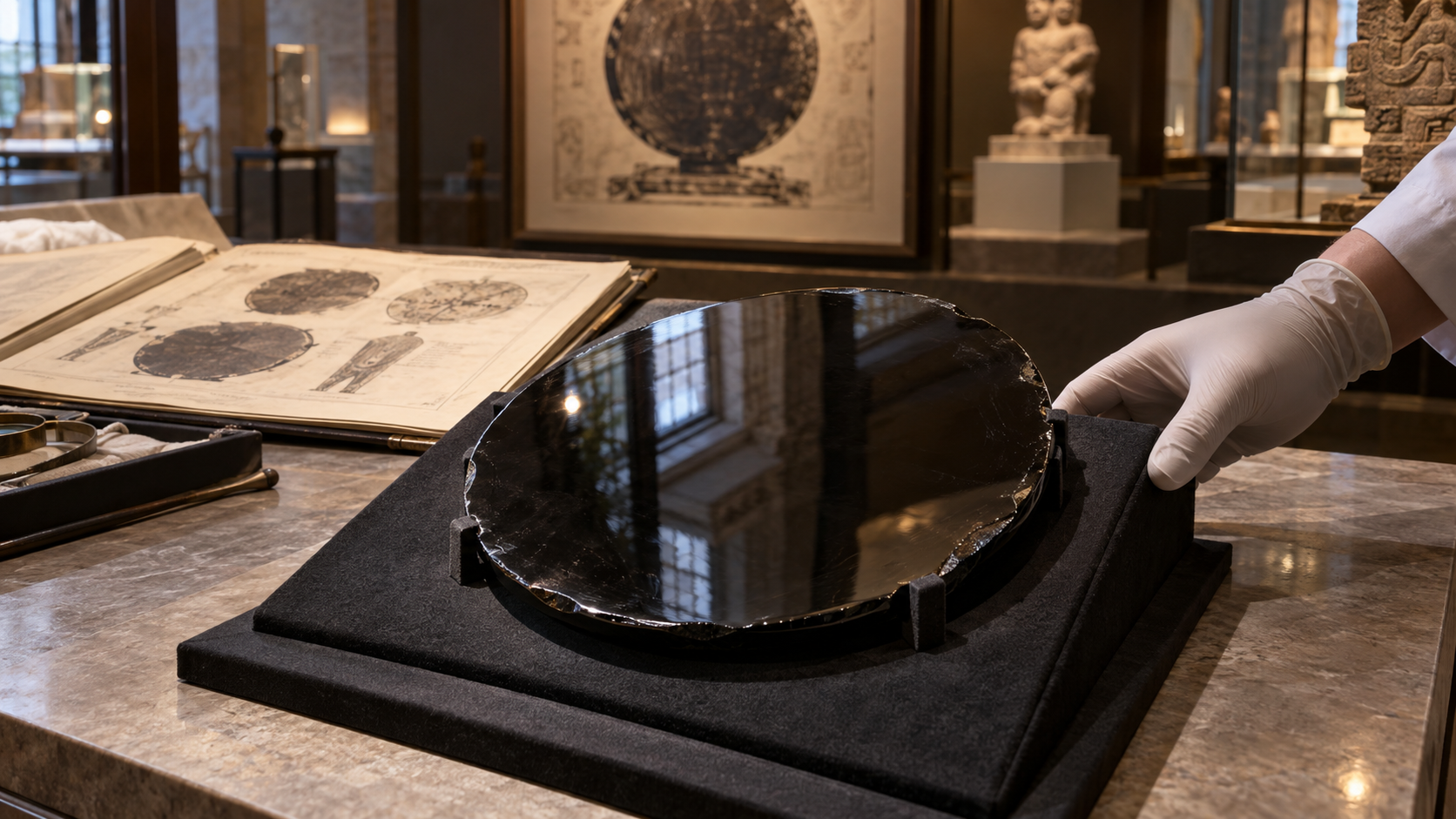
A circular obsidian mirror traditionally associated with Dee is preserved in the British Museum.
For many years, researchers suspected that the mirror had originated in Mexico.
But its precise history remained uncertain.
This changed when researchers examined the object alongside other obsidian artefacts in the museum’s collection.
Their findings were published in 2021 in the peer-reviewed archaeological journal Antiquity.
The research confirmed that the obsidian used to create Dee’s mirror originated in Mexico.
More specifically, it was traced to the Pachuca region.
This finding provided important evidence connecting the object with the Aztec world.
The mirror’s subsequent history demonstrates how an object can acquire different meanings as it moves between cultures.
John Dee and the Renaissance Search for Hidden Knowledge
John Dee belonged to an intellectual environment in which boundaries between science, philosophy, religion and magic were considerably different from those recognised today.
Renaissance scholars sometimes investigated natural phenomena while also pursuing astrology, alchemy or occult philosophy.
Dee was particularly interested in the possibility of communicating with angels and other supernatural beings.
His practices involved mediums, sometimes called scryers, who attempted to receive messages through reflective objects or crystals.
The obsidian mirror associated with Dee became part of this broader history.
However, the exact circumstances through which he acquired the mirror remain uncertain.
The archaeological research does not establish every detail of the object’s journey from Mexico to Europe.
Nor does it prove every later claim about how Dee used it.
What the research demonstrates is that the mirror was made from Mexican obsidian and later became associated with European occult practices.
This is a fascinating example of cultural transformation.
An object connected with one religious world entered another.
Its appearance remained recognisable.
But its interpretation changed.
The Colonial History Behind the Mirror
The movement of Mesoamerican objects into European collections cannot be separated from the history of Spanish colonisation.
Following the conquest of the Mexica Empire in the early sixteenth century, numerous objects from the Americas entered European collections.
Some were acquired through exchange.
Others were collected under circumstances involving conquest, coercion, tribute or unequal power.
The precise route by which John Dee’s mirror reached Europe is not known.
It would therefore be misleading to describe its individual history with certainty.
Nevertheless, the broader colonial context matters.
An obsidian mirror was not simply an exotic curiosity discovered by European intellectuals.
It originated within a sophisticated Indigenous cultural environment.
Its subsequent European history represents another chapter in the object’s biography.
Modern appreciation should acknowledge both.
The original cultural significance.
And the historical circumstances through which the object acquired new meanings.
What Makes a Historical Object Spiritually Meaningful?
A meaningful object can carry several different kinds of significance.
It may possess religious importance within a particular community.
It may be associated with an important historical event.
It may serve as a personal reminder of an experience.
Or it may inspire contemplation through its appearance.
These forms of meaning are not interchangeable.
An ancient religious object does not automatically become a universal spiritual instrument simply because modern observers find it fascinating.
Likewise, a contemporary personal ritual does not become historically authentic because it uses a material associated with an ancient culture.
For this reason, the modern reflection exercise described later in this article is deliberately separate from Mexica divination.
It does not attempt to reconstruct an ancient ceremony.
It does not invoke Tezcatlipoca.
And it does not claim access to supernatural knowledge.
Instead, it uses the symbolic idea of reflection as a starting point for personal contemplation.
Obsidian in Contemporary Crystal Spirituality
Within modern crystal spirituality, black obsidian is frequently associated with protection, grounding and introspection.
Some practitioners believe it absorbs negative energies.
Others describe it as a stone that encourages the recognition of hidden emotions or uncomfortable personal truths.
These interpretations are part of contemporary metaphysical belief systems.
They are not scientifically established properties.
There is no reliable evidence that obsidian absorbs harmful spiritual energy, removes emotional trauma or reveals information inaccessible through ordinary perception.
Nevertheless, the stone’s dark appearance may provide a compelling personal symbol.
For example, someone may associate its reflective surface with the idea of examining their assumptions.
Another person may use it as a reminder to approach difficult decisions thoughtfully.
These are symbolic uses.
Their meaning comes from the individual and the practice, not from demonstrated supernatural activity.
The Difference Between Scrying and Self-Reflection
The word scrying generally refers to attempts to obtain supernatural information by gazing into a reflective or otherwise visually suggestive surface.
Historically, people have used different objects for such practices.
Mirrors.
Water.
Crystals.
And other reflective materials.
The intended purpose was often divinatory.
A modern reflective exercise can look superficially similar while having a fundamentally different objective.
Instead of attempting to predict the future, the participant considers their own thoughts.
Instead of searching for supernatural messages, they examine ordinary experiences.
Instead of interpreting visual distortions as revelations, they distinguish observation from imagination.
This distinction is central to the Natural Gems Belgium approach.
The historical practice can be studied with respect.
The contemporary exercise can be explored for personal meaning.
Neither requires presenting supernatural claims as established facts.
Why Reflections Can Appear Mysterious
Human visual perception is remarkably sophisticated.
But it is not a perfect recording system.
What we perceive depends on lighting, attention, expectations and the interpretation of sensory information.
Research has demonstrated that unusual visual experiences can occur during prolonged mirror-gazing under particular conditions.
In 2010, psychologist Giovanni B. Caputo published research investigating perceptual changes reported by people looking at their reflected faces under low illumination.
Participants sometimes reported distorted or unfamiliar facial appearances.
These observations concern visual perception.
They do not demonstrate communication with spirits or supernatural entities.
The research also does not mean that every reflective surface produces the same effects.
Nevertheless, it illustrates an important principle.
An unusual visual experience is not, by itself, evidence of a supernatural event.
For contemporary contemplative practice, prolonged mirror-gazing in darkness is unnecessary.
A short period of ordinary observation under comfortable lighting is sufficient.
A Modern Obsidian Reflection Ritual
The following exercise is an original contemporary contemplative practice.
It is inspired by the broad symbolism of reflection, not by an attempt to reproduce Mexica religious ceremonies or Renaissance occult procedures.
Its purpose is simple.
To create a moment in which we examine our own assumptions, decisions and intentions.
You do not need an authentic obsidian mirror.
In fact, historical artefacts should remain within appropriate conservation and cultural contexts.
A small polished black obsidian stone is sufficient.
A palm stone, cabochon or stable polished specimen can serve as the central object.
The ritual does not require candles, incense, darkness or ceremonial equipment.
It can be performed in an ordinary comfortable room.
Preparing the Reflection Space
Choose a quiet location.
A reading corner.
A small table.
A comfortable chair beside a window.
Or another place where you can sit without unnecessary interruption.
Place the obsidian on a stable surface.
Keep a notebook nearby.
Allow natural daylight or comfortable indoor lighting to illuminate the space.
Avoid creating an artificially dark environment.
The objective is contemplation, not visual disorientation.
You may wish to begin with a specific question.
Perhaps you are reconsidering a decision.
Reflecting on a recent experience.
Or attempting to understand why a particular situation has remained on your mind.
Choose something manageable.
The exercise should not become an attempt to force answers to emotionally overwhelming problems.
Step One: Observe Without Interpreting
Sit comfortably.
Look at the obsidian for approximately thirty seconds.
Notice its surface.
Observe how it reflects the surrounding light.
Recognise the difference between what you can actually see and what your imagination might suggest.
For example:
Observation: The polished surface reflects part of the window.
Interpretation: The dark reflection reminds me of uncertainty.
Both statements can be meaningful.
But they describe different experiences.
The first concerns visible reality.
The second concerns personal symbolism.
Learning to distinguish them is a useful foundation for thoughtful reflection.
Step Two: Choose One Question
Place the stone in front of you.
Open your notebook.
Write one question.
Avoid questions that require supernatural knowledge.
Instead of asking:
What will happen to me next month?
Consider:
What information do I need before making this decision?
Instead of:
What is another person secretly thinking?
Ask:
What assumptions am I making about their intentions?
Instead of:
What message is the stone trying to reveal?
Ask:
What concern have I been avoiding?
The difference is important.
The questions encourage ordinary reasoning and personal awareness.
They do not imply that the stone possesses hidden information.
Step Three: Separate Facts From Assumptions
Divide a notebook page into two sections.
Label the first:
What I know.
Label the second:
What I assume.
Now consider your chosen situation.
Perhaps a friend has not replied to a message.
What do you know?
You sent a message.
You have not received a reply.
What might you assume?
The person is upset.
They are deliberately avoiding you.
They no longer value the relationship.
These interpretations may feel convincing.
But they are not necessarily supported by the available information.
The reflection exercise encourages a distinction between evidence and interpretation.
This is particularly relevant when emotions influence how we understand uncertain situations.
The obsidian serves as a symbolic reminder to examine what is actually visible.
And what remains unknown.
Step Four: Consider Another Perspective
Now ask:
Is there another reasonable explanation?
Perhaps the person is busy.
Perhaps they have not seen the message.
Perhaps they need time to respond.
You do not need to decide which explanation is correct.
The purpose is to recognise that uncertainty can accommodate more than one interpretation.
The University of California, Berkeley’s Greater Good Science Center provides a research-informed exercise called Gaining Perspective on Negative Events.
It explores how adopting a more distanced perspective may help people examine difficult experiences without becoming entirely absorbed in their immediate emotional response.
Our obsidian practice is not the same intervention.
But the general principle of examining an experience from another perspective provides a useful educational connection.
The gemstone itself is not responsible for any psychological effect.
Step Five: Identify What You Can Influence
Return your attention to the original question.
Ask:
Which part of this situation is within my control?
You may not be able to determine another person’s feelings.
You may not know how a future event will unfold.
You may not be able to change something that has already happened.
But you may be able to choose your next action.
Ask a respectful question.
Gather more information.
Set a reasonable boundary.
Delay a decision until you know more.
Or accept that some uncertainty remains.
Write down one practical action.
Keep it small enough to be realistic.
The reflection ritual should conclude with greater clarity about your available choices, not with an expectation of supernatural certainty.
Step Six: Close the Ritual
Look once more at the obsidian.
Consider the distinction between the object and the reflection it inspired.
The stone has not answered your question.
You have examined it.
The stone has not revealed the future.
You have considered possible outcomes.
The stone has not removed uncertainty.
You have recognised where uncertainty remains.
Close the notebook.
Return the obsidian to its usual place.
The ritual is complete.
There is no need to perform energetic cleansing or ceremonial protection.
If you wish, you may end with a simple personal statement:
I can reflect carefully without needing to know everything.
A Shorter Practice With an Obsidian Pocket Stone
Not every reflective moment requires a notebook.
A small polished obsidian can serve as a personal pocket reminder.
For example, before making a decision, hold the stone briefly.
Ask yourself three questions.
What do I know?
What am I assuming?
What should I verify?
Then put the stone away.
The exercise may take less than a minute.
It can be performed without the stone whenever necessary.
The objective is to develop a useful habit of reflection rather than dependence on a particular object.
The Symbolism of Facing the Unknown
Modern spiritual literature sometimes describes black obsidian as a stone that reveals hidden truths.
This idea can be interpreted symbolically.
Human beings often encounter situations in which information is incomplete.
We make decisions without knowing every outcome.
We form impressions of people based on limited experiences.
We attempt to understand events whose causes remain uncertain.
A dark reflective stone can represent this incomplete knowledge.
It reminds us that not everything is immediately visible.
But the appropriate response to uncertainty is not necessarily to search for supernatural explanations.
Sometimes it is to investigate.
Sometimes it is to ask.
Sometimes it is to wait.
And sometimes it is to acknowledge that a definitive answer is unavailable.
This is a thoughtful contemporary interpretation of obsidian symbolism.
It is not a claim about the stone’s energetic properties.
When Reflection Becomes Rumination
Self-reflection can be meaningful.
But repeatedly examining the same distressing thoughts is not always helpful.
There is a difference between constructive reflection and rumination.
Constructive reflection may involve identifying relevant facts, considering alternatives and deciding on an appropriate next step.
Rumination can involve repeatedly returning to upsetting questions without reaching a useful conclusion.
A contemplative ritual should not encourage endless analysis.
For this reason, the obsidian exercise is deliberately brief.
If a question remains unresolved, it is acceptable to stop.
You can return to the subject when additional information becomes available.
If reflection repeatedly increases distress, discontinue the practice.
Professional support may be appropriate when persistent thoughts or emotional difficulties interfere with daily life.
A gemstone ritual should never be presented as a substitute for evidence-based psychological care.
Why Historical Context Matters
The history of obsidian mirrors provides a useful example of how spiritual objects can acquire new meanings.
In the Mexica world, mirrors were connected with religious symbolism and cultural authority.
In Renaissance Europe, an obsidian mirror could become associated with attempts to communicate with supernatural beings.
In contemporary crystal spirituality, obsidian may represent protection, grounding or introspection.
These interpretations developed in different circumstances.
They should not be treated as interchangeable.
Nor should they be combined into an invented universal tradition.
A modern person may find the symbolism of obsidian personally meaningful.
But that does not grant authority to speak on behalf of historical Mexica religious practitioners.
Respectful appreciation begins with recognising the difference between studying a tradition and claiming to reproduce it.
Cultural Appreciation Without Inventing Ancient Rituals
Contemporary spiritual practices frequently draw inspiration from historical cultures.
This can encourage curiosity and learning.
But it can also create misleading claims.
For example, a modern ritual may be described as an ancient Aztec ceremony even when no reliable historical evidence supports that description.
Such claims can distort the original culture.
They may also obscure the complexity of Indigenous religious traditions.
The reflection exercise presented here is therefore explicitly modern.
It uses an ordinary polished obsidian stone.
It involves personal journaling.
It does not claim to reproduce ceremonial practices associated with Tezcatlipoca.
And it does not present contemporary gemstone meanings as direct continuations of Mexica religion.
Readers interested in the historical tradition are encouraged to consult museum collections and archaeological scholarship.
The surviving objects deserve to be understood within their own cultural contexts.
The Importance of Provenance
The history of John Dee’s mirror also raises an important question.
Where did an object come from, and how did it reach its present location?
The 2021 archaeological study provides a particularly valuable example of how research can clarify an object’s history.
The investigators examined the mirror’s material and compared it with known sources.
Their findings strengthened the connection between the object and ancient Mexico.
But identifying a material’s origin does not automatically establish every stage of an artefact’s ownership history.
Questions about acquisition, transfer and cultural context may remain unresolved.
This distinction matters for museums, collectors and anyone interested in historical objects.
An object can be visually impressive while still having an incomplete history.
Responsible appreciation includes recognising what is known and what remains uncertain.
Should Historical Obsidian Mirrors Be Collected?
Authentic archaeological objects require particular care.
Their significance extends beyond their appearance.
They may contain information about historical craftsmanship, religious practices, cultural relationships and the circumstances of their discovery.
Removing archaeological objects from their original context can destroy valuable information.
Their acquisition and movement may also be subject to cultural-property laws and ethical considerations.
For a contemporary reflection practice, there is no reason to seek an ancient artefact.
A modern polished obsidian stone is sufficient.
The purpose is personal contemplation.
Not ownership of an object connected with a historical religious tradition.
This approach allows the practitioner to appreciate obsidian symbolism while respecting the cultural importance of surviving archaeological material.
The Role of Mindfulness
The contemporary reflection ritual includes elements of deliberate attention.
Mindfulness practices commonly involve noticing present experiences without immediately judging or reacting to them.
The US National Center for Complementary and Integrative Health provides evidence-based information about meditation and mindfulness.
Its educational resources discuss possible benefits, limitations and potential negative experiences.
The research concerns specific contemplative practices.
It does not establish that gemstones provide additional therapeutic effects.
For our obsidian exercise, mindfulness offers a modest principle.
Notice what is present.
Recognise thoughts as thoughts.
Avoid assuming that every interpretation is a fact.
Then decide whether action is necessary.
The obsidian can serve as a symbolic object within this process.
It is not the source of a scientifically demonstrated healing effect.
The Difference Between a Symbol and a Prediction
Symbols can help people express ideas that are difficult to describe directly.
A closed door may represent an ending.
A sunrise may suggest a beginning.
A path may symbolise a decision.
A mirror may represent reflection or self-examination.
These meanings are interpretive.
They do not establish that the objects can predict future events.
An obsidian mirror may symbolise the unknown.
But it does not provide reliable access to future knowledge.
A dark reflection may inspire questions.
But it does not demonstrate communication with supernatural beings.
This distinction allows contemporary spiritual symbolism to remain meaningful without being confused with factual claims.
A Monthly Obsidian Reflection Practice
Readers who enjoy the exercise may wish to revisit it occasionally.
A monthly practice can be sufficient.
Choose one question that deserves thoughtful consideration.
Use the same obsidian stone.
Write down the facts.
Identify assumptions.
Consider alternative interpretations.
Then choose an appropriate next step.
At the following session, review what happened.
Did new information become available?
Were your original assumptions accurate?
Did your understanding change?
The purpose is not to measure the stone’s power.
It is to observe your own reasoning over time.
A familiar object can provide continuity.
But the learning comes from the reflection itself.
Obsidian and the Meaning of Protection
Contemporary crystal spirituality frequently associates black obsidian with protection.
Some practitioners describe it as a barrier against negative energies or harmful influences.
These are metaphysical beliefs rather than established physical effects.
There is no reliable scientific evidence that carrying obsidian prevents misfortune, blocks harmful intentions or creates a protective energy field.
However, protection can also be considered symbolically.
A person may choose to associate a stone with the intention to establish appropriate boundaries.
To examine a situation carefully.
To avoid unnecessary risks.
Or to seek help when circumstances require it.
These actions have practical meaning.
The stone does not provide protection independently.
It may simply remind the person of choices they wish to make.
When the Mirror Becomes a Question
The historical obsidian mirror offers an intriguing metaphor.
A mirror appears to show us something.
But it also depends on the observer.
The angle.
The lighting.
The surrounding environment.
The expectations brought to the experience.
Our interpretations of ordinary events can be similarly influenced by perspective.
We may see one explanation immediately.
Another person may recognise something different.
Additional information may change our understanding.
The contemporary reflection ritual invites us to approach these differences with curiosity.
Instead of demanding certainty, we can ask better questions.
Instead of treating every thought as a revelation, we can examine its foundation.
And instead of assuming that the unknown must contain a hidden message, we can recognise uncertainty as part of ordinary human experience.
From Sacred Object to Personal Symbol
The story of obsidian mirrors spans remarkably different worlds.
Ancient Mesoamerican religious traditions.
The political and ceremonial significance of Mexica deities.
The movement of objects during European colonisation.
Renaissance investigations of supernatural knowledge.
Modern archaeological research.
And contemporary personal spirituality.
Each context adds another dimension to the history.
But the distinctions between them remain important.
The Mexica religious meaning of a mirror cannot be reduced to modern self-help.
John Dee’s occult interests should not be confused with archaeological evidence of supernatural activity.
And a contemporary reflection exercise should not be presented as an authentic ancient ceremony.
These boundaries make the subject more interesting, not less.
They allow history, spirituality and modern contemplation to be explored without collapsing them into one unsupported narrative.
The Deeper Meaning of an Obsidian Reflection Ritual
A dark reflective stone can invite a simple but valuable question.
Am I seeing the situation clearly, or am I seeing only my interpretation of it?
This question does not require supernatural belief.
It requires curiosity.
A willingness to examine assumptions.
An acceptance that some information remains unavailable.
And the patience to distinguish what is known from what is imagined.
The obsidian becomes a symbol of this process.
Not a source of hidden knowledge.
Not a device for predicting the future.
And not an instrument of medical or psychological healing.
Its role is contemplative.
A physical reminder that reflection can involve more than looking.
It can involve reconsidering.
Questioning.
Learning.
And occasionally recognising that our first interpretation was incomplete.
Looking Into the Mirror Without Losing Sight of History
The historical significance of obsidian mirrors deserves careful attention.
Their connection with Mexica religion reveals a complex world of symbolism, ritual and political authority.
Their movement into Europe illustrates the changing meanings of objects across cultures.
The research into John Dee’s mirror demonstrates how modern scholarship can recover important aspects of that history.
And their continued fascination shows how reflective objects remain powerful symbols in human imagination.
For contemporary crystal practitioners, obsidian can become part of a modest personal ritual.
A moment of observation.
A thoughtful question.
A written reflection.
A practical decision.
Nothing more is required.
The stone does not need to reveal the future.
Its historical meaning does not need to be rewritten.
And its contemporary symbolism does not need to be presented as scientific fact.
Perhaps the most meaningful use of a reflective stone is not to search for something supernatural within its surface.
But to remember that understanding often begins with a willingness to question what we think we already know.
The mirror reflects what is before it.
Reflection invites us to consider what lies behind our assumptions.
And sometimes, that is where a more thoughtful understanding begins.
References & Further Reading
1. Campbell, Healey, Kuzmin & Glascock (2021) – The Mirror, the Magus and More: Reflections on John Dee’s Obsidian Mirror
Publication: Antiquity, Volume 95, Issue 384, pages 1547–1564
Publisher: Cambridge University Press
Published: 7 October 2021
A peer-reviewed archaeological study investigating the history and provenance of the obsidian mirror associated with John Dee.
The researchers established the Mexican origin of the mirror and examined its changing cultural significance from the Aztec world to Renaissance Europe.
This is the principal scholarly source for the historical sections of this article.
Read the open-access research article
2. British Museum – Dr Dee’s Magical Mirror
Institution: British Museum, London
Collection number: 1966,1001.1
The official museum collection record for the obsidian mirror associated with John Dee.
The record documents the object’s physical characteristics, historical attribution, Mexican origin and research history.
It provides direct institutional evidence for the existence and identification of this important artefact.
Explore the British Museum collection record
3. Dumbarton Oaks — Tezcatlipoca
Institution: Dumbarton Oaks Museum, Washington, D.C.
Collection: Pre-Columbian Art
Date of object: 1502–1520
An authoritative museum catalogue entry discussing a representation of Tezcatlipoca.
The scholarly description explains the deity’s association with mirrors, divination, political authority and religious symbolism.
It provides important cultural context for understanding the historical significance of mirrors in Mexica religion.
Explore the Dumbarton Oaks museum record
4. Metropolitan Museum of Art – Mirror, Mexican, Before the Sixteenth Century
Institution: The Metropolitan Museum of Art, New York
Collection number: 1994.35.562
The official museum record for a pre-sixteenth-century Mexican obsidian mirror.
The collection provides direct evidence of historical mirror production and preservation within Mesoamerican material culture.
It is particularly useful for readers interested in seeing an authentic surviving example.
View the Metropolitan Museum’s obsidian mirror
5. British Museum – Tezcatlipoca, Smoking Mirror
Institution: British Museum, London
Resource: Collections Online
An institutional reference identifying Tezcatlipoca as an important deity within the Aztec pantheon.
The resource explains the translation of his name as Smoking Mirror and describes aspects of his religious associations.
It supports the article’s discussion of historical symbolism without relying on contemporary commercial crystal-healing interpretations.
Read the British Museum’s Tezcatlipoca reference
6. Caputo (2010) – Apparitional Experiences of New Faces and Dissociation of Self-Identity During Mirror Gazing
Author: Giovanni B. Caputo
Journal: Perceptual and Motor Skills
Volume: 110, pages 1125–1138
Published: 2010
A peer-reviewed psychological study investigating unusual visual experiences reported during prolonged mirror-gazing under low illumination.
The research provides scientific context for understanding why reflective surfaces can sometimes produce unexpected perceptual experiences.
The study does not support supernatural explanations or demonstrate that obsidian mirrors possess special powers.
Read the scientific abstract on PubMed
7. University of California, Berkeley – Gaining Perspective on Negative Events
Institution: Greater Good Science Center
Resource: Greater Good in Action
A research-informed educational exercise exploring psychological self-distancing.
The practice encourages people to examine difficult experiences from a broader perspective rather than remaining entirely absorbed in immediate emotional reactions.
It provides a useful educational foundation for the contemporary reflection exercise described in this article.
The research does not concern gemstones.
Explore the Greater Good Science Center practice
8. National Center for Complementary and Integrative Health – Eight Things to Know About Meditation and Mindfulness
Institution: US National Institutes of Health
An evidence-based educational overview of meditation and mindfulness research.
The resource discusses potential benefits, limitations and possible adverse experiences associated with contemplative practices.
It supports the article’s cautious distinction between ordinary reflective exercises and scientifically unverified gemstone-healing claims.
Read the NIH educational resource
The associations between black obsidian, spiritual protection, hidden truths and energetic cleansing are traditional or contemporary metaphysical interpretations. They are not scientifically established therapeutic or supernatural properties.
The historical discussion of Mesoamerican obsidian mirrors concerns documented cultural and religious beliefs. It does not establish the existence of supernatural divination or communication with spirits.
The modern obsidian reflection ritual described in this article is an original contemporary contemplative exercise. It is not presented as an authentic Mexica ceremony, a reconstruction of historical divination or a continuation of Indigenous religious practice.
Research concerning mindfulness, visual perception and psychological reflection does not demonstrate that obsidian provides additional medical or psychological benefits.
Gemstones and spiritual practices should not replace appropriate healthcare, psychological treatment or evidence-based support. Readers should discontinue contemplative exercises that cause discomfort or distress.