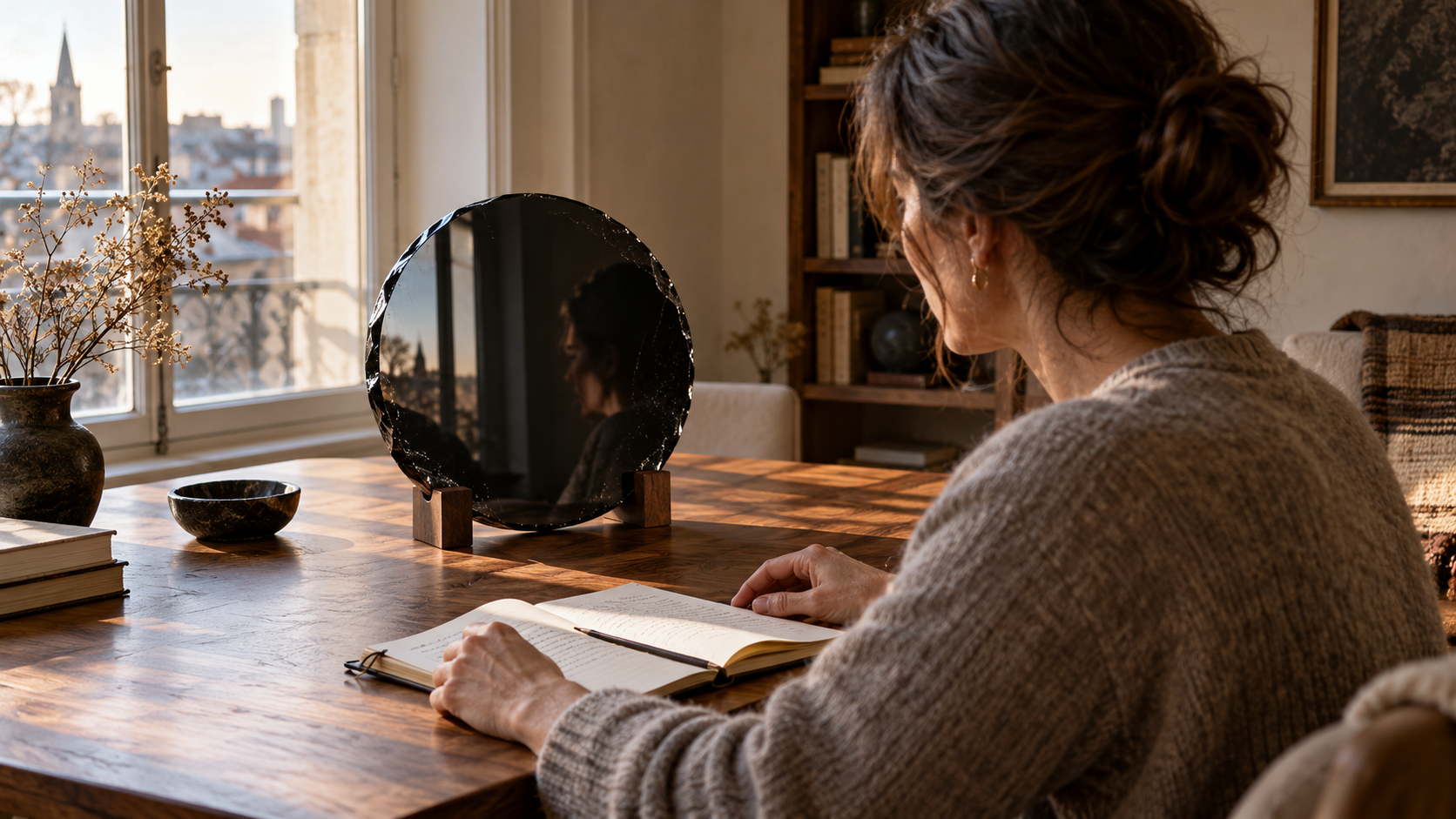
A mirror normally shows us what is directly in front of it.
A face.
A room.
The movement of light.
But throughout history, certain mirrors have been associated with something more mysterious: the possibility of seeing beyond ordinary appearances.
Among the most remarkable examples are mirrors made from polished Obsidian.
These dark reflective objects occupied important places in some Mesoamerican religious traditions and later attracted the attention of European scholars interested in divination, spiritual communication and the hidden dimensions of existence.
Today, obsidian mirrors continue to appear in contemporary spiritual practices.
Some practitioners associate them with introspection, hidden emotions, personal transformation and what is sometimes called shadow work.
Others simply find that a dark reflective surface creates an unusual focus for quiet contemplation.
The historical and modern interpretations are not identical.
Nor is there scientific evidence that an obsidian mirror can reveal supernatural information, predict future events or uncover hidden psychological truths.
Yet the symbolism of the mirror offers an interesting starting point for a personal ritual.
What happens when we stop looking outward and deliberately begin looking within?
That question forms the foundation of this practice.
Table of Contents
The Remarkable History of Obsidian Mirrors
Obsidian mirrors are not simply a modern invention of the crystal-healing movement.
Their history extends across different cultures and periods.
Polished stone mirrors were produced in ancient societies, and obsidian mirrors became particularly significant within parts of Mesoamerica.
In the religious world of the Mexica, often referred to as the Aztecs, mirrors were associated with powerful spiritual ideas.
They could represent vision, divination, supernatural knowledge and relationships between the visible and invisible worlds.
One of the most important deities associated with this symbolism was Tezcatlipoca.
His name is commonly translated from Nahuatl as Smoking Mirror.
Tezcatlipoca occupied an important position within Mexica religion, and mirrors were among his characteristic attributes.
The British Museum’s educational material and archaeological scholarship document the relationship between this deity, reflective objects and the wider religious symbolism of the period.
These objects belonged to specific cultural and religious contexts.
Their historical meanings should not be reduced to modern descriptions such as “protection crystal” or “healing stone.”
They were part of a much more complex spiritual world.
Tezcatlipoca and the Smoking Mirror
The association between obsidian mirrors and Tezcatlipoca is one of the most fascinating aspects of their history.
The deity was connected with numerous themes, including power, conflict, destiny, rulership and supernatural knowledge.
In surviving representations, mirrors may appear as important elements of his imagery.
The British Museum preserves a remarkable mosaic object believed to represent Tezcatlipoca, illustrating the significance of this deity within late pre-Hispanic Mexican religious culture.
The symbolism of the mirror was not simply decorative.
Reflective surfaces could be associated with seeing what was otherwise concealed.
In some historical contexts, mirrors were also connected with divination.
The idea was that an unusual reflective surface might provide access to information beyond ordinary human perception.
Such beliefs are historically documented.
They should not, however, be interpreted as evidence that the objects possessed supernatural capabilities.
For modern readers, the historical material is valuable because it demonstrates how deeply reflective objects could become embedded in spiritual thought.
The mirror was more than a household object.
It was a symbol of vision, knowledge and mystery.
An Obsidian Mirror Travels to Renaissance Europe
One of the most famous surviving obsidian mirrors is associated with John Dee, the sixteenth-century English mathematician, scholar and adviser to Queen Elizabeth I.
Dee was deeply interested in mathematics, astronomy, navigation and the intellectual developments of his period.
He was also involved in occult investigations and attempts at spiritual communication.
An obsidian mirror traditionally associated with Dee is now preserved in the British Museum.
For many years, the object’s geographical origin remained a subject of investigation.
In 2021, researchers published a detailed study in the archaeological journal Antiquity examining this mirror and several related objects.
Their research established that the obsidian used for the mirrors came from Mexican sources.
The mirror associated with Dee was traced to the Pachuca region of Mexico.
The findings strengthened its identification as a Mesoamerican object that had entered European collections following the Spanish conquest of Mexico.
The precise circumstances of its movement and acquisition remain uncertain.
This history is important because the mirror accumulated different meanings as it moved between cultural settings.
An object associated with religious practices in Mexico later became connected with the occult interests of Renaissance Europe.
Its material remained the same.
Its interpretation changed.
The Difference Between Historical Scrying and Modern Meditation
The term scrying generally refers to a form of divination involving the observation of a reflective or otherwise visually suggestive surface.
Historically, practitioners have used mirrors, water, crystals and other objects in attempts to obtain visions or information believed to come from supernatural sources.
The obsidian mirror associated with John Dee belongs to this wider history of divination.
Modern crystal practitioners sometimes use the same term when describing reflective meditation with a dark mirror.
But an important distinction is necessary.
Historical scrying sought information beyond ordinary perception.
Contemporary reflective meditation can use the mirror as an object for examining one’s own thoughts and feelings.
These are not the same activity.
The exercise described in this article does not attempt to predict the future, contact spirits or recreate Mexica religious ceremonies.
Instead, it uses the visual symbolism of an obsidian mirror within a contemporary personal reflection practice.
That distinction respects the historical context while allowing a different, modern application.
Why a Dark Mirror?
A conventional mirror presents a relatively clear image.
A dark mirror behaves differently.
Depending on the lighting and the position of the observer, the reflection may appear subdued, partial or difficult to distinguish.
The result can feel unfamiliar.
Instead of immediately seeing a detailed image, the observer may notice shadows, outlines and subtle changes in reflected light.
This visual ambiguity helps explain why dark mirrors have attracted symbolic and spiritual interpretations.
In a contemporary meditation, however, the ambiguity does not need to be treated as supernatural.
It can simply become a reason to slow down.
The observer must look more carefully.
Notice more deliberately.
And become comfortable with not immediately understanding everything that appears.
That experience provides a useful metaphor for introspection.
Not everything about ourselves is immediately clear.
Obsidian and Contemporary Shadow Work
Within modern spiritual communities, Obsidian is frequently associated with introspection and the exploration of uncomfortable or neglected aspects of personal experience.
This is sometimes described as shadow work.
The terminology is influenced by ideas associated with the psychologist Carl Gustav Jung and the development of analytical psychology.
In Jungian thought, the shadow refers broadly to aspects of personality that are not readily acknowledged within one’s conscious self-image.
Modern popular spirituality has adapted the term into a wide range of journaling exercises, meditation practices and self-exploration rituals.
These contemporary activities should not automatically be equated with formal Jungian psychotherapy.
Nor is there established clinical evidence that holding Obsidian reveals unconscious psychological material.
Nevertheless, the symbolism can provide a useful framework for ordinary self-reflection.
Instead of asking whether a crystal can expose hidden truths, we can ask a more practical question:
What am I reluctant to acknowledge about my own reactions?
That question does not require supernatural interpretation.
It requires curiosity.
Choosing an Obsidian Stone for Reflection
A traditional obsidian mirror is not necessary for the practice described here.
A small polished Obsidian palm stone can serve the same symbolic purpose.
You might choose:
- a polished black Obsidian palm stone
- a smooth Obsidian cabochon
- a small polished Obsidian disc
- an Obsidian sphere
- a purpose-made Obsidian mirror
A flat reflective surface creates the clearest connection with historical mirror symbolism.
However, a palm stone may be more comfortable for beginners.
The stone should be easy to handle and free from sharp or damaged edges.
Choose something that feels appropriate for quiet observation rather than an object selected purely for dramatic appearance.
The purpose is not to create an impressive spiritual display.
It is to establish a simple, repeatable practice.
Creating a Space for Obsidian Reflection
Choose a quiet location with comfortable lighting.
A small table beside a window can work well.
So can a desk, meditation corner or reading space.
Place the Obsidian on a soft natural surface.
Keep a journal and pen nearby.
Avoid completely dark surroundings.
Although dramatic darkness is sometimes associated with scrying imagery, it is unnecessary for this reflective practice.
Soft, indirect light is sufficient.
The goal is to observe the stone without straining your eyes or creating an unsettling atmosphere.
Sit comfortably.
Allow a few moments for your attention to settle.
Then begin.
A Ten-Minute Obsidian Reflection Ritual
This practice combines observation, personal questioning and journaling.
It is a contemporary contemplative exercise, not a reconstruction of an ancient ceremony.
Minute One — Arrive
Sit quietly with the Obsidian in front of you.
Notice the surface beneath your hands.
Feel the chair supporting your body.
Allow your breathing to continue naturally.
There is no need to force relaxation.
Simply recognise that you have chosen to spend a few minutes in reflection.
Minute Two — Observe the Surface
Look at the Obsidian.
Notice how the light interacts with its surface.
If the stone is polished, observe the reflections.
If the reflection is unclear, allow it to remain unclear.
Do not search for images, faces or hidden messages.
The purpose is ordinary observation.
Ask yourself:
What am I actually seeing?
This question introduces an important distinction between observation and interpretation.
Minute Three — Notice Your Expectations
Continue looking at the stone.
Now ask:
What did I expect this experience to feel like?
Perhaps you expected calm.
Perhaps something mysterious.
Perhaps nothing at all.
Notice the expectation without judging it.
Sometimes our expectations influence an experience before it has properly begun.
Recognising them creates space for a more open response.
Minutes Four and Five — Choose One Question
Now move your attention away from the physical appearance of the stone.
Choose one personal question.
For example:
What have I been avoiding?
Or:
What situation has been occupying more of my attention than I intended?
Or:
What am I finding difficult to accept?
Choose only one.
Do not attempt to analyse your entire life.
Allow the question to remain present for a short time.
If an answer appears, notice it.
If no answer appears, that is equally acceptable.
The purpose is not to force a revelation.
The Importance of Self-Compassion
Introspection can easily become self-criticism.
Someone begins by asking why a situation was difficult and ends by blaming themselves for everything that happened.
That is not the intention of this ritual.
Research and educational resources on self-compassion provide an important counterbalance.
The University of Rochester’s Mindful University Project explains self-compassion through three broad elements:
mindfulness,
recognition of shared human imperfection,
and kindness toward oneself.
These principles are particularly relevant when reflecting on uncomfortable experiences.
If you notice a mistake, acknowledge it without turning it into a judgement about your entire character.
If you recognise fear, allow yourself to recognise it without embarrassment.
If you discover that you avoided something, approach that observation with curiosity.
Self-reflection should create understanding, not punishment.
Minutes Six and Seven — Separate the Event From the Interpretation
Think about the situation you selected.
Now distinguish between two things.
What happened?
And:
What meaning did I give it?
For example:
What happened:
Someone disagreed with my idea.
What I interpreted:
They do not respect me.
The second statement may or may not be accurate.
It is an interpretation rather than a directly observed fact.
This distinction is useful because our reactions often depend partly on the meaning we assign to events.
The Obsidian becomes a symbolic reminder to examine the reflection carefully.
Not everything that appears obvious at first glance is necessarily the complete picture.
Minute Eight — Ask a Different Question
Now ask:
Is there another reasonable way to understand this situation?
Perhaps the disagreement reflected a different priority.
Perhaps the other person lacked information.
Perhaps you were already tired or frustrated.
Perhaps the situation remains genuinely unresolved.
You do not need to choose a more positive interpretation.
The goal is not forced optimism.
It is openness to complexity.
Minute Nine — Choose One Constructive Response
Reflection becomes more useful when it informs future behaviour.
Ask:
What could I do differently next time?
Keep the answer modest.
You might decide to ask one clarifying question.
Take more time before responding.
Express a boundary.
Request additional information.
Or acknowledge that a situation is outside your control.
The answer should be realistic.
One constructive response is enough.
Minute Ten — Close the Practice
Look once more at the Obsidian.
Then place it down.
Take one comfortable breath.
Remind yourself:
I do not need to understand everything today.
The ritual is complete.
You can now move to the journaling stage.
Writing After the Reflection
Writing provides a useful way to organise what emerged during meditation.
Research on expressive writing has examined how putting experiences into words may influence emotional processing and personal understanding.
James W. Pennebaker’s scholarly work helped establish expressive writing as an important subject within psychological research.
However, the evidence concerns writing practices themselves.
It does not establish that Obsidian adds a psychological or therapeutic effect.
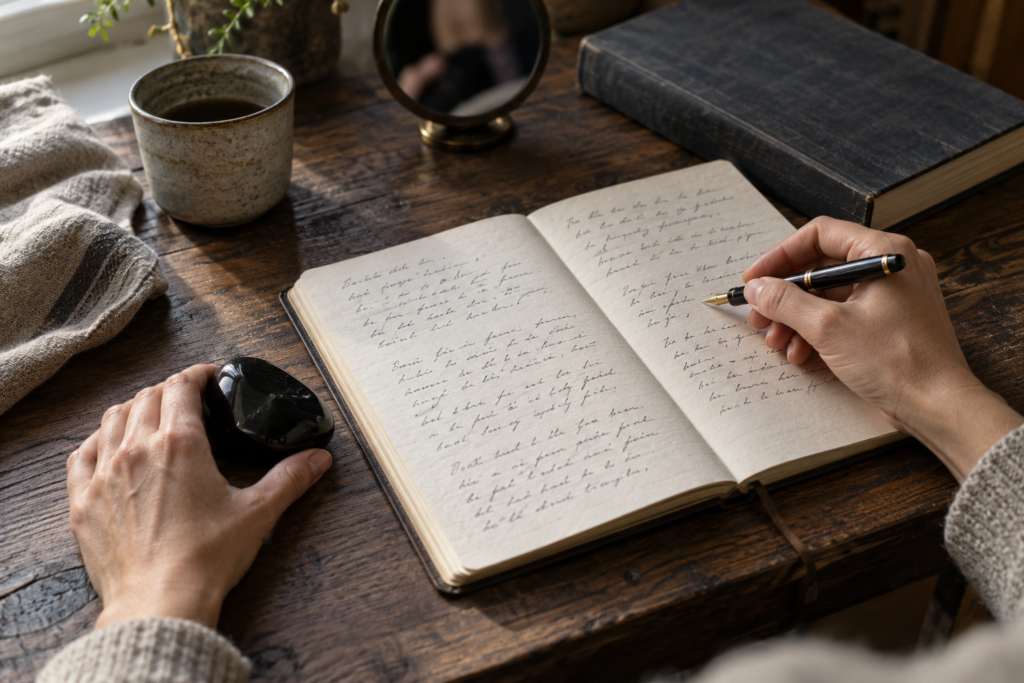
For this ritual, keep the writing exercise simple.
Open your journal.
Complete three sentences.
Today I noticed…
One interpretation I may need to reconsider is…
One constructive action I can take is…
Write naturally.
There is no need to produce beautiful prose.
The journal is not intended for publication.
It is simply a private record of reflection.
What if Nothing Happens?
This is an important question.
Many descriptions of spiritual practices create the expectation that something extraordinary should occur.
A sudden insight.
An emotional release.
A powerful vision.
A dramatic sense of transformation.
But ordinary reflection rarely follows such a predictable pattern.
Some sessions may feel meaningful.
Others may feel uneventful.
You might simply spend ten minutes observing a stone and considering one question.
That is sufficient.
Do not invent an interpretation because you believe the ritual should produce one.
And do not treat ordinary reflections, shadows or visual impressions as supernatural messages.
A meaningful practice does not require extraordinary experiences.
A Palm Stone Instead of a Mirror
Not everyone enjoys looking into a dark reflective surface.
Some people may prefer a more tactile approach.
A polished Obsidian palm stone provides an alternative.
Hold the stone in one hand.
Notice its weight and shape.
Then ask the same reflection questions.
The stone becomes a physical anchor rather than a visual one.
This approach may also be easier when travelling or when you do not have a dedicated meditation space.
A small Obsidian can be carried in a protective pouch and used whenever you want to create a deliberate moment of reflection.
The symbolism remains similar.
The method changes.
Obsidian as a Symbol of Honest Reflection
Contemporary crystal spirituality often associates Obsidian with protection, truth, transformation and the confrontation of uncomfortable emotions.
These associations are modern metaphysical interpretations.
They should not be confused with the historically specific religious meanings of obsidian mirrors in Mesoamerican societies.
Nor should they be presented as measurable properties of the material.
Within a personal practice, however, the symbolism of honest reflection can be valuable.
An Obsidian stone may represent a commitment to asking difficult questions without immediately avoiding the answers.
But honesty must be balanced with compassion.
A reflection ritual should never become an exercise in relentless self-criticism.
The purpose is to understand yourself more clearly.
Not to search endlessly for faults.
When to Avoid Deep Introspection
Not every moment is suitable for examining difficult emotions.
If you are already feeling overwhelmed, distressed or emotionally vulnerable, an intensive reflection exercise may be unhelpful.
Choose a simpler practice instead.
Hold the stone.
Notice its physical presence.
Look around the room.
Return your attention to ordinary surroundings.
You can leave deeper questions for another time.
If reflection brings up persistent distress, traumatic memories or difficulties that interfere with daily life, consider seeking support from a qualified mental health professional.
A crystal ritual is not a substitute for psychological treatment.
The University of Rochester’s educational resources similarly emphasise the value of professional support when people need individualised help with emotional regulation.
Personal spiritual practices should support wellbeing rather than create pressure to confront experiences before someone is ready.
How Often Should You Practise?
There is no prescribed frequency.
You might use an Obsidian reflection ritual once a week.
Perhaps after a challenging conversation.
Before making an important decision.
At the end of a particularly demanding period.
Or whenever you feel that a situation deserves more thoughtful consideration.
Unlike a daily pocket-stone ritual, this practice may benefit from being used selectively.
Deep reflection does not need to become a constant activity.
Sometimes the most appropriate response to a difficult day is simply to rest.
The Mirror as a Metaphor
There is something particularly compelling about the mirror as a spiritual symbol.
It appears to show us reality.
Yet it only shows what falls within its frame.
Change the angle and the reflection changes.
Change the light and different details become visible.
Move closer and the image becomes different again.
This makes the mirror a useful metaphor for self-understanding.
Our interpretation of an experience depends partly on where we stand.
What we notice.
What we remember.
And what we expect.
A reflective ritual invites us to examine those influences.
Not because the mirror contains hidden knowledge.
But because the act of looking can remind us to question what we think we already know.
Respecting the History Behind the Object
The history of obsidian mirrors deserves careful treatment.
Their significance within Mexica religious traditions cannot be reduced to a modern meditation technique.
Likewise, the later European fascination with obsidian mirrors emerged within a different intellectual and spiritual environment.
The story of John Dee’s mirror demonstrates how an object can acquire new meanings as it moves between cultures.
Its documented Mexican origin is an important part of that history.
So is the broader context of Spanish conquest and the movement of objects into European collections.
A contemporary Obsidian meditation should therefore be understood as a modern personal practice inspired by the symbolism of reflection.
It is not an authentic recreation of Mexica ceremony.
It is not a continuation of John Dee’s occult investigations.
And it does not claim to reproduce the spiritual knowledge of either tradition.
Respecting those distinctions makes the practice more thoughtful and historically responsible.
Looking Within Without Losing Perspective
The attraction of Obsidian within contemporary spirituality is understandable.
Its dark reflective appearance invites associations with mystery, depth and the unknown.
But perhaps its most useful modern symbolism is not mystery at all.
It is perspective.
The willingness to pause before accepting the first interpretation.
The courage to acknowledge an uncomfortable reaction.
The patience to consider another explanation.
And the kindness to recognise that self-understanding is rarely immediate.
An Obsidian mirror does not need to reveal the future.
A polished stone does not need to expose hidden energies.
A reflective ritual does not need to produce extraordinary experiences.
Sometimes the most meaningful question is also the simplest:
What am I seeing clearly, and what might I still be overlooking?
Hold the Obsidian.
Consider the question.
Write down what you discover.
Then return to ordinary life with a little more perspective.
The mirror does not provide the answers.
It reminds you to look.
References & Further Reading
1. British Museum — Dr Dee’s Magical Mirror
The British Museum’s official collection record documents the obsidian mirror traditionally associated with John Dee, including its historical attribution, Mexican origin and place within the museum’s collection.
https://www.britishmuseum.org/collection/object/H_1966-1001-1
2. Campbell et al. (2021) — The Mirror, the Magus and More: Reflections on John Dee’s Obsidian Mirror
A peer-reviewed archaeological study published in Antiquity, Volume 95, Issue 384, pages 1547–1564.
The researchers examine the historical significance of obsidian mirrors and establish the Mexican geological origins of several objects preserved in the British Museum.
This is the principal academic reference for the article’s historical discussion.
https://doi.org/10.15184/aqy.2021.132
3. Nature — A ‘Spirit Mirror’ Used in Elizabeth I’s Court Had Aztec Roots
A research highlight published on 6 October 2021 discussing the archaeological identification of the obsidian mirror associated with John Dee.
The article provides an accessible introduction to the findings reported in Antiquity.
https://www.nature.com/articles/d41586-021-02701-5
4. Smarthistory / British Museum — Mosaic Mask of Tezcatlipoca
An educational examination of the historical and religious significance of Tezcatlipoca, the Mexica deity associated with the Smoking Mirror.
This resource provides important cultural context for understanding mirror symbolism within pre-Hispanic Mexican religious traditions.
https://smarthistory.org/mosaic-mask-of-tezcatlipoca
5. University of Rochester — Self-Compassion
An educational resource from the university’s Mindful University Project discussing mindfulness, self-kindness and the importance of approaching difficult personal experiences without excessive self-criticism.
It supports the article’s emphasis on compassionate reflection rather than harsh self-judgement.
https://www.rochester.edu/mindful/self-compassion
6. Pennebaker (2018) — Expressive Writing in Psychological Science
A scholarly article published in Perspectives on Psychological Science examining the development of research into expressive writing and its possible psychological mechanisms.
This source provides academic background for the journaling component of the reflection ritual.
https://doi.org/10.1177/1745691617707315
7. University of Rochester — Emotion Regulation
An educational resource from the Mindful University Project discussing emotional awareness, regulation and reflective practices.
It provides additional context for the importance of approaching emotional experiences with awareness and appropriate personal support.
https://www.rochester.edu/mindful/emotion-regulation
Historical religious beliefs, divination practices and contemporary spiritual interpretations discussed in this article are presented as cultural traditions and personal symbolism rather than scientifically established supernatural effects.
The psychological research cited concerns mindfulness, self-compassion and expressive writing. It does not demonstrate that Obsidian possesses therapeutic properties or that using an Obsidian mirror produces additional psychological benefits.
The reflection ritual presented here is a contemporary contemplative exercise, not a reconstruction of historical Mexica ceremonies or Renaissance divination. It should not replace appropriate professional mental health support.