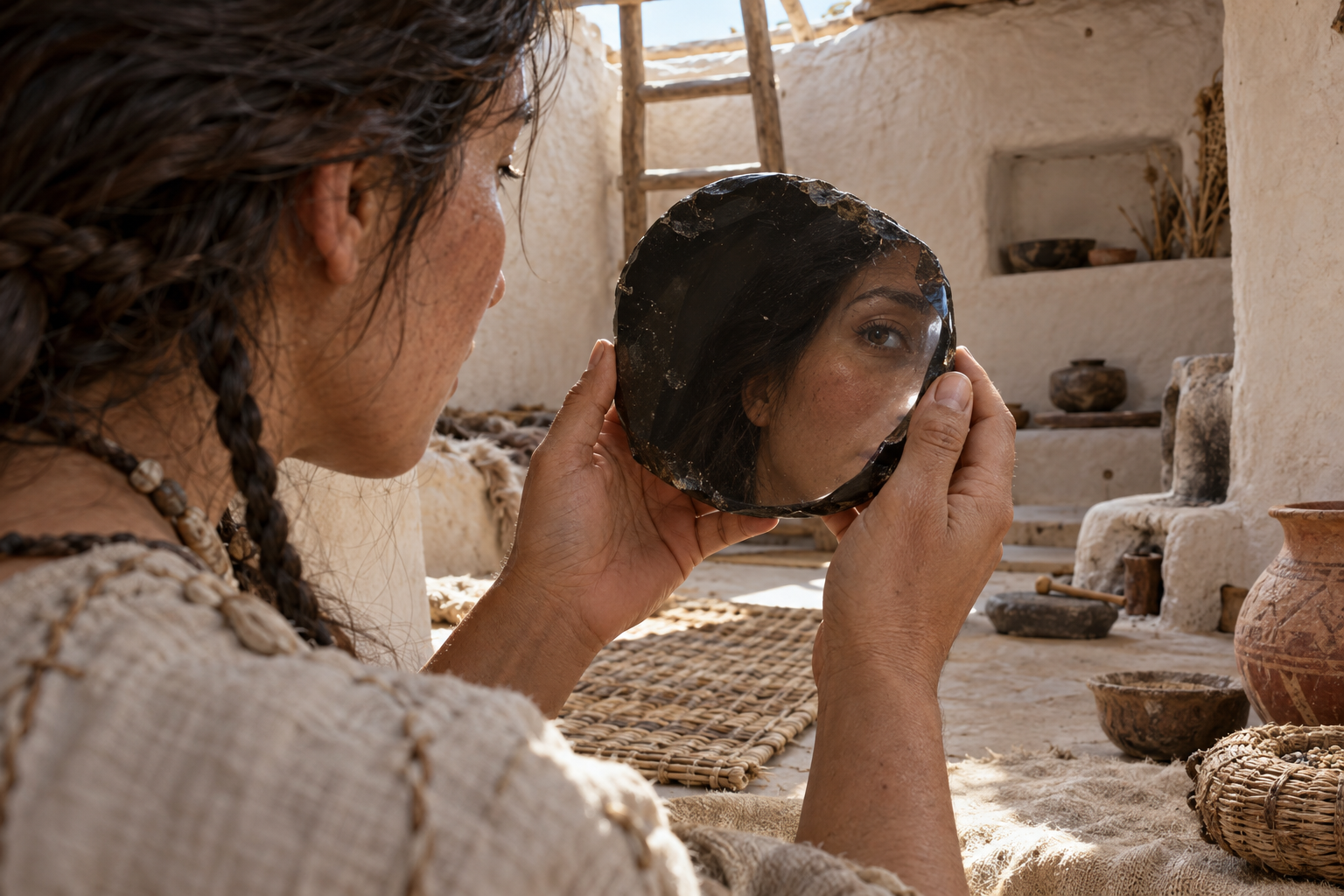
Imagine entering a small room approximately 8,000 years ago.
The walls are covered with pale plaster.
Daylight enters from an opening above.
The floor is carefully maintained.
Someone holds a dark, polished stone.
At first glance, it appears almost completely black.
Then the person turns it toward the light.
A face appears on its surface.
Not in water.
Not in metal.
But in volcanic glass.
This scene is an imaginative reconstruction, yet the objects that inspired it are real.
Archaeologists working at Çatalhöyük, an extraordinary Neolithic settlement in central Anatolia, discovered carefully polished obsidian objects capable of reflecting recognisable images.
Some are among the earliest known manufactured mirrors.
Their existence raises fascinating questions.
Why did prehistoric people invest considerable effort in transforming volcanic glass into reflective surfaces?
Were these objects used for personal appearance?
Did they possess special social significance?
Could reflection have played a role in ritual life?
And what can their history tell us about the relationship between natural materials and early human belief?
The answers are more complicated than many popular accounts suggest.
The archaeological evidence establishes that polished obsidian mirrors existed. It does not establish exactly what their makers believed those reflections meant.
That distinction makes Çatalhöyük one of the most interesting places to investigate the origins of gemstone symbolism.
Table of Contents
Çatalhöyük: A Remarkable Neolithic Settlement
Çatalhöyük lies on the Konya Plain in central Anatolia, within present-day Türkiye.
It is one of the most important archaeological sites for understanding the development of settled communities during the Neolithic period.
The settlement was occupied for many centuries.
According to UNESCO, the eastern mound contains eighteen levels of Neolithic occupation dating approximately from 7400 to 6200 BCE.
The western mound preserves later Chalcolithic occupation.
Çatalhöyük was not a city in the modern sense.
Nevertheless, its size, population and complex organisation make it an exceptionally important early settlement.
Its architecture was distinctive.
Houses stood close together.
There were no conventional streets separating many of the buildings.
People generally entered their homes through openings in the roofs.
Movement between buildings could take place across rooftop surfaces.
Inside the houses, archaeologists discovered evidence of domestic activities, elaborate wall decoration and burials beneath floors.
These discoveries reveal a society in which everyday life, memory and symbolic expression were closely connected.
A Settlement Without Written Explanations
One of the greatest challenges facing archaeologists is that the inhabitants of Çatalhöyük left no known written accounts explaining their beliefs.
There are no surviving local religious texts.
No written descriptions of ceremonies.
No inscriptions identifying particular deities.
No instructions explaining how an obsidian mirror should be used.
Archaeologists must reconstruct past behaviour through material evidence.
Buildings.
Burials.
Tools.
Objects.
Animal remains.
Wall paintings.
And the spatial relationships between them.
This makes interpretation both fascinating and difficult.
An unusual object may suggest a special purpose.
But unusual craftsmanship alone does not establish religious significance.
What Is Obsidian?
Obsidian is a naturally occurring volcanic glass.
It forms when silica-rich molten material cools sufficiently rapidly that extensive crystallisation cannot occur.
The result is a glassy volcanic rock.
Unlike quartz, which possesses an ordered crystalline structure, obsidian is predominantly amorphous.
Its atoms do not form the same long-range repeating arrangement characteristic of crystalline minerals.
This is an important gemmological distinction.
Although obsidian is frequently sold as a gemstone, it is not a mineral species in the strict crystallographic sense.
It is a natural glass.
Why Obsidian Is Usually Black
Many obsidian specimens appear black or extremely dark brown.
Their appearance depends on composition, microscopic inclusions and the interaction of light with the material.
Thin edges may transmit more light than thicker sections.
Some varieties display distinctive optical effects caused by microscopic structures or inclusions.
However, the obsidian used in prehistoric mirrors should not automatically be compared with every decorative variety marketed today.
Snowflake obsidian, rainbow obsidian and other named commercial varieties can possess very different appearances.
The Çatalhöyük mirrors are particularly significant because of their carefully prepared reflective surfaces.
Their importance lies in craftsmanship and archaeological context rather than modern gemstone marketing categories.
The Extraordinary Sharpness of Volcanic Glass
Obsidian possesses another important physical characteristic.
It fractures conchoidally.
This means it can break along smooth, curved surfaces.
Under suitable conditions, fracture produces extremely sharp edges.
The U.S. Geological Survey explains that this property made obsidian valuable for toolmaking over thousands of years.
Prehistoric communities used obsidian to manufacture blades, cutting implements and projectile points.
Its usefulness was practical and immediate.
But obsidian could also be transformed into objects that were not primarily cutting tools.
The polished mirrors from Çatalhöyük demonstrate this alternative application.
How Can Black Stone Become a Mirror?
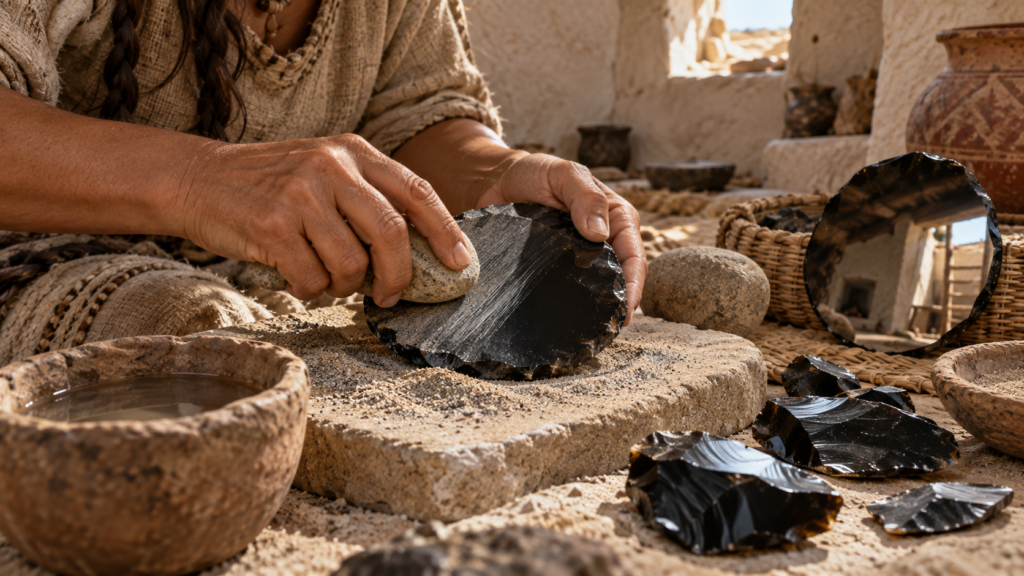
A reflective surface does not necessarily need to be silver-coloured.
What matters is how light interacts with the surface.
A sufficiently smooth, polished surface can produce specular reflection.
This occurs when incoming light is reflected in an organised direction rather than scattered randomly.
A rough obsidian surface may appear dull.
A freshly fractured surface can be glossy.
A carefully ground and polished surface can become reflective enough to produce a recognisable image.
The process requires considerable control.
The artisan must remove irregularities without introducing deep scratches.
The surface must be progressively refined.
The result can be astonishing.
A dark piece of volcanic glass becomes a mirror.
The Discovery of the Çatalhöyük Mirrors
The first major excavations at Çatalhöyük were conducted during the 1960s under archaeologist James Mellaart.
Among the discoveries were unusual polished obsidian objects.
Several possessed carefully prepared reflective surfaces.
They were interpreted as mirrors.
The objects subsequently entered archaeological collections, including those of the Archaeological Museum of Konya and the Museum of Anatolian Civilizations in Ankara.
Their existence attracted considerable interest because of their age and technical sophistication.
They demonstrated that Neolithic craftspeople could produce effective reflective surfaces without modern machinery.
How Many Mirrors Were Found?
The exact number requires careful explanation.
In a study published by Archaeology magazine in 2001, James F. Vedder described his examination of objects associated with the original excavations.
An inventory compiled by Naomi Hamilton identified eleven objects as mirrors or possible mirrors.
Vedder examined the evidence and concluded that eight were recognisable mirrors.
He rejected two proposed identifications.
A further object may have represented an unfinished mirror.
This distinction is important.
Archaeological objects are not always easy to classify.
A polished fragment may be a mirror.
It may be a partly worked object.
Or it may have served another purpose.
Responsible interpretation recognises these uncertainties.
The Mirrors Were Not Perfectly Flat
Modern mirrors usually employ carefully manufactured glass with a reflective metallic coating.
The Neolithic obsidian mirrors were different.
Vedder observed that some surviving examples possessed slightly convex surfaces.
A convex surface curves outward.
This can affect the reflected image.
It may introduce distortion.
Nevertheless, the objects were capable of producing recognisable reflections.
The craftsmanship remains remarkable.
The makers did not need to reproduce the optical precision of a modern bathroom mirror.
They needed to create a sufficiently smooth surface for light to form an image.
Could Neolithic People Really Polish Obsidian So Precisely?
Experimental archaeology helps answer this question.
James F. Vedder attempted to reproduce obsidian mirrors using relatively simple grinding and polishing methods.
He experimented with materials including:
Granite.
Sandstone.
Sand.
Quartzite.
Fine-grained stone.
And other abrasives.
His experiments demonstrated that obsidian could be polished sufficiently to produce clear reflections without modern industrial technology.
The resulting surfaces were not perfectly flat.
But they worked.
This finding is important because it replaces speculation about mysterious lost technologies with practical evidence.
The mirrors required knowledge, patience and skill.
They did not require supernatural intervention.
The Importance of Experimental Archaeology
Experimental archaeology investigates whether proposed ancient techniques can produce particular results.
Researchers may reproduce tools.
Test manufacturing methods.
Examine wear patterns.
Or compare experimentally produced objects with archaeological examples.
Such experiments can establish technical feasibility.
They can demonstrate that a prehistoric craftsperson could have produced a polished obsidian mirror using available materials.
However, they cannot automatically establish exactly how every original mirror was manufactured.
Several methods may produce similar results.
Experimental success demonstrates possibility.
It does not necessarily prove historical identity.
Where Did the Obsidian Come From?
The obsidian used at Çatalhöyük was not simply collected from the settlement’s immediate surroundings.
Archaeometric research has traced obsidian artefacts to volcanic sources in Cappadocia.
This region lies to the east of the Konya Plain.
Important sources include:
East Göllü Dağ.
Nenezi Dağ.
Acıgöl West.
These volcanic landscapes supplied obsidian that circulated through prehistoric communities.
The movement of material across considerable distances demonstrates the existence of regional connections long before written commercial records.
Scientific Evidence for Obsidian Provenance
In 2006, Tristan Carter and colleagues published a study examining 135 obsidian artefacts from Çatalhöyük.
The researchers used geochemical analytical methods, including inductively coupled plasma techniques and laser-ablation analysis.
They identified material from three Cappadocian sources.
The study also suggested changes in the relative importance of particular sources over time.
In 2007, Carter and Michael Steven Shackley published another investigation using energy-dispersive X-ray fluorescence.
This study examined 42 obsidian artefacts from a single Neolithic structure.
The chemical signatures matched East Göllü Dağ and Nenezi Dağ.
These findings demonstrate that modern science can investigate the geographical origins of prehistoric volcanic glass.
Obsidian as a Material of Connection
The movement of obsidian raises important social questions.
Who obtained it?
How was it transported?
Was it exchanged directly between neighbouring communities?
Did it pass through several intermediaries?
Were particular varieties preferred for particular purposes?
Did access to certain sources influence social relationships?
Archaeological evidence does not provide complete answers.
Nevertheless, the circulation of obsidian demonstrates that Neolithic communities were not necessarily isolated.
They participated in wider networks of material exchange.
A piece of volcanic glass could connect distant landscapes and human settlements.
Was Obsidian Considered Precious?
The word precious requires caution.
In modern gemmology, a material may be valued according to rarity, appearance, durability and market demand.
Neolithic societies did not necessarily apply the same categories.
Obsidian was useful because it could produce sharp cutting edges.
It could also be polished.
Some objects required considerably more labour than ordinary tools.
These differences suggest that obsidian could possess several forms of value.
Practical.
Technical.
Social.
And potentially symbolic.
However, not every obsidian artefact should automatically be described as sacred or prestigious.
Its significance depended upon context.
The Rare Mirrors Among Everyday Tools
Most obsidian recovered from Neolithic archaeological contexts consists of tools, manufacturing debris and related artefacts.
Polished mirrors are much less common.
This difference raises an important question.
Why invest considerable labour in producing a reflective surface when the same material could be used to make useful cutting implements?
Several explanations are possible.
The mirrors may have served practical purposes.
They may have been valued possessions.
They may have been used during particular social activities.
Or they may have participated in rituals.
The evidence does not establish one definitive answer.
Were the Mirrors Used for Personal Appearance?
James Mellaart proposed that the mirrors could have been used for personal grooming or the application of cosmetics.
This interpretation is plausible.
A reflective surface allows someone to examine their face.
It can assist with personal decoration.
It may be useful when applying pigments or arranging ornaments.
However, the presence of a mirror does not prove that it was used specifically for cosmetics.
A modern interpretation should not automatically project contemporary beauty practices onto a Neolithic society.
The possibility is reasonable.
The certainty is limited.
Reflection Before Modern Mirrors
Today, mirrors are ordinary objects.
They appear in bathrooms.
Bedrooms.
Vehicles.
Shops.
And electronic devices.
But prehistoric people encountered reflection through different materials.
Still water could reflect faces and surrounding landscapes.
Certain polished stones could also produce images.
A manufactured obsidian mirror offered something distinctive.
It was portable.
It did not require a pool of water.
Its surface could be deliberately positioned toward the light.
The user could control the angle.
This gave the object practical possibilities beyond those of a natural reflective pool.
Could Reflection Have Possessed Spiritual Meaning?
This is the central interpretive question.
Mirrors have acquired religious, ceremonial and symbolic significance in many historical societies.
They can be associated with identity.
Self-recognition.
Divination.
Transformation.
Or communication with supernatural realms.
However, these associations are not universal.
And they cannot automatically be transferred from one culture to another.
The fact that later societies used mirrors in spiritual practices does not prove that the inhabitants of Çatalhöyük did the same.
Archaeologists must distinguish comparative possibilities from direct evidence.
The Problem with Calling Every Ancient Mirror a Ritual Object
An unusual prehistoric object can easily attract dramatic explanations.
A polished black mirror seems mysterious.
It reflects faces.
It changes appearance with the light.
It may appear almost completely dark when held at the wrong angle.
These characteristics encourage imaginative interpretations.
But an object does not become a ritual instrument simply because modern observers find it mysterious.
To establish a ritual function, archaeologists look for contextual evidence.
Where was the object found?
Was it associated with a burial?
Was it deliberately deposited?
Was it accompanied by other unusual objects?
Does its location differ from ordinary domestic material?
Can patterns be identified across several contexts?
Even these questions may not produce definitive answers.
The Archaeological Context of Çatalhöyük
Çatalhöyük is especially interesting because its houses were not merely places of everyday activity.
UNESCO documents elaborate wall paintings, reliefs and sculptures.
Burials were also found beneath house floors.
The settlement therefore preserves evidence of relationships between domestic space, symbolic expression and treatment of the dead.
However, this does not mean that every object discovered inside a house possessed a religious function.
The same building could accommodate cooking, sleeping, craft production, social interaction and activities of symbolic importance.
Modern categories such as domestic and sacred may not correspond neatly with prehistoric practices.
Houses and the Dead
One of Çatalhöyük’s most remarkable features is the presence of burials beneath domestic floors.
The treatment of human remains suggests that relationships between the living and deceased formed an important part of community life.
Some houses were repeatedly modified and rebuilt.
Their histories accumulated over generations.
These patterns have encouraged archaeologists to investigate ancestry, memory and the social significance of buildings.
But it would be inaccurate to assume that every polished obsidian mirror was buried with the dead.
The precise archaeological contexts of individual mirrors must be evaluated separately.
Were the Mirrors Used in Funerary Rituals?
Some popular accounts describe Çatalhöyük obsidian mirrors as objects intended to guide the deceased into another world.
This is an evocative interpretation.
But it should not be presented as an established archaeological fact.
The surviving evidence does not demonstrate a universal belief that obsidian mirrors reflected souls or guided the dead.
Such claims require more than the presence of a reflective object within a settlement containing burials.
They require specific contextual support.
Without that evidence, funerary interpretations remain hypotheses.
Could Mirrors Have Been Used for Divination?
Divination involves attempts to obtain knowledge through practices understood as supernatural, symbolic or otherwise beyond ordinary observation.
Reflective surfaces have been used for divination in some documented historical traditions.
But there is no surviving written testimony establishing that the people of Çatalhöyük practised obsidian-mirror divination.
The suggestion is therefore speculative.
A polished mirror may have been capable of supporting such a practice.
Capability does not establish historical use.
This distinction is fundamental to responsible archaeological interpretation.
The Difference Between Possibility and Evidence
Consider three statements.
Statement one: Neolithic inhabitants of Çatalhöyük manufactured polished obsidian objects capable of reflecting images.
This is supported by archaeological evidence.
Statement two: The mirrors may have possessed social or symbolic significance.
This is a reasonable possibility, but the precise nature of that significance remains uncertain.
Statement three: The mirrors were used to communicate with ancestral spirits.
This is a specific claim that cannot presently be established from the available evidence.
These statements do not possess equal evidential status.
Professional historical writing should make that difference visible.
Obsidian Beyond the Mirror
The social significance of obsidian at Çatalhöyük was not restricted to polished mirrors.
Archaeologist Tristan Carter examined the material’s wider role in a substantial study published in Anatolian Studies.
The research considers obsidian procurement, technological change, gifting, storage, social identities and ritual behaviour.
It also investigates the role of projectile points in particular social and ceremonial contexts.
This broader perspective is important.
A material can participate in both ordinary activities and symbolically significant practices.
A cutting blade and a carefully deposited projectile point may be made from the same volcanic glass.
Their contexts can differ.
Obsidian and the End of a Building’s Life
One particularly interesting subject in Carter’s research concerns the relationship between obsidian artefacts and the ending of a building’s use.
At Çatalhöyük, buildings could undergo complex processes of modification, abandonment and replacement.
Certain deposits have been interpreted in relation to the termination of buildings or other socially meaningful transitions.
Obsidian could participate in such practices.
This provides stronger grounds for discussing the material’s potential ritual significance than simply assuming that black volcanic glass was considered magical.
The interpretation arises from archaeological context.
Not from colour alone.
Did Obsidian Have One Spiritual Meaning?
Almost certainly, this is the wrong question.
Obsidian existed in several forms.
Blades.
Projectile points.
Manufacturing fragments.
Polished objects.
And mirrors.
Different artefacts could participate in different activities.
Their meanings may also have changed over time.
The settlement existed for many centuries.
It would therefore be misleading to assign every obsidian object one universal spiritual function.
The material’s significance must be investigated through its particular archaeological context.
The Meaning of Black
Modern crystal literature frequently associates black stones with protection, grounding and the absorption of negative energy.
These associations are often applied to obsidian.
But blackness does not possess one universal spiritual meaning.
Colour symbolism differs among cultures and historical periods.
There is no established evidence that the inhabitants of Çatalhöyük interpreted obsidian through the modern concept of grounding.
Nor is there evidence that they associated black volcanic glass with the Root Chakra.
Those interpretations belong to different cultural frameworks.
Modern Obsidian and the Root Chakra
Contemporary crystal-healing systems often classify obsidian as a grounding stone.
It may be associated with the Root Chakra.
Some practitioners describe it as protective.
Others claim that it absorbs negative emotions or exposes hidden truths.
These are modern metaphysical interpretations.
They should not be presented as Neolithic Anatolian beliefs.
Chakra traditions developed within South Asian religious and philosophical contexts.
Modern Western crystal-to-chakra correspondences represent later interpretations.
They cannot be projected backward onto Çatalhöyük without historical evidence.
Does Obsidian Absorb Negative Energy?
Obsidian possesses measurable physical properties.
Its composition can be analysed.
Its refractive behaviour can be investigated.
Its fracture characteristics can be observed.
Its geological origin can sometimes be determined through trace-element analysis.
However, there is no established scientific evidence that obsidian absorbs negative emotions or produces a supernatural protective field.
Its black appearance does not demonstrate such properties.
Its reflective surface does not establish an ability to reveal spiritual truths.
A person may use obsidian as a meaningful object within a contemporary personal practice.
That experience should be distinguished from scientifically demonstrated physical effects.
Why the Mirrors Remain Extraordinary Without Supernatural Claims
The obsidian mirrors of Çatalhöyük do not require a mystical explanation to be remarkable.
They demonstrate an understanding of materials.
They required skilled manufacture.
They were produced within a complex prehistoric community.
Their raw material originated from volcanic landscapes beyond the settlement.
And their surfaces were capable of reflecting recognisable images thousands of years before modern industrial mirrors.
These achievements are extraordinary in their own right.
Adding unsupported claims about supernatural powers does not make them more impressive.
It obscures what archaeology can genuinely establish.
Reflection and Human Self-Awareness
The existence of a mirror raises a philosophical question.
What does it mean for a person to see their own reflection?
Humans can recognise themselves through visual feedback.
A reflective surface provides an unusual perspective on the body.
It allows someone to see features that would otherwise remain difficult to observe directly.
But we should not confuse this general human experience with a documented prehistoric doctrine.
A Neolithic person may have used a mirror to examine their appearance.
They may have found the reflection socially meaningful.
They may have associated it with practices we cannot reconstruct.
The object permits these possibilities.
It does not tell us which interpretation is correct.
A Mirror Is Not Necessarily a Symbol of the Soul
Many modern descriptions of ancient mirrors make a direct connection between reflection and the soul.
The argument seems intuitive.
A face appears in the dark surface.
The image resembles the person.
The image disappears when the mirror moves.
Therefore, the mirror must have represented a spiritual double.
But this reasoning is not sufficient.
Different societies can interpret the same physical phenomenon differently.
Some may connect reflection with supernatural ideas.
Others may understand it primarily through practical experience.
Without supporting evidence, we cannot assign one interpretation to prehistoric Anatolia.
The Importance of Archaeological Humility
Prehistoric archaeology frequently encounters the limits of available evidence.
An object survives.
Its maker does not.
Its material can be analysed.
Its function may remain uncertain.
Its craftsmanship can be reconstructed.
Its original meaning may be lost.
Recognising these limitations is not a weakness.
It is part of responsible scholarship.
The most accurate explanation is sometimes:
We know what the object could do, but we do not know exactly why it was made.
That statement preserves the distinction between knowledge and speculation.
A Gemmological Perspective on Ancient Obsidian
For gemmologists, obsidian offers an interesting contrast with crystalline gemstones.
It is a natural volcanic glass.
Its structure is predominantly amorphous.
Its appearance can range from nearly opaque black to more translucent material at thin edges.
Its fracture behaviour differs from that of many crystalline minerals.
It can develop a highly reflective polished surface.
And its trace-element composition can preserve information relevant to geological provenance.
These properties explain why obsidian could become both a practical cutting material and an attractive ornamental material.
The mirrors demonstrate one particularly sophisticated application.
Why Chemical Fingerprinting Matters
Obsidian sources often possess distinguishable geochemical signatures.
Researchers can compare archaeological artefacts with geological samples from known volcanic deposits.
Analytical methods may include X-ray fluorescence and various forms of elemental analysis.
These techniques can identify patterns in trace-element concentrations.
When an archaeological artefact matches a known geological source, researchers gain evidence about material movement.
At Çatalhöyük, this approach has connected obsidian artefacts with Cappadocian volcanic sources.
It allows archaeologists to investigate prehistoric exchange without relying on written trade records.
Can We Identify the Source of Every Mirror?
Not necessarily.
The geochemical studies discussed in this article examine assemblages of obsidian artefacts from Çatalhöyük.
Their findings establish important patterns in the site’s raw-material supply.
However, the identification of particular source regions for sampled artefacts should not automatically be extended to every individual mirror.
To establish the provenance of a specific mirror, that object would need appropriate analytical evidence.
This distinction prevents a common historical error.
Evidence concerning a wider collection is not always proof concerning every object within it.
Ancient Mirrors and Modern Crystal Mirrors
Polished obsidian mirrors are still produced today.
Some are used as decorative objects.
Others are incorporated into contemporary meditation or divination practices.
Their appearance may resemble ancient examples in certain respects.
But visual resemblance does not establish cultural continuity.
A modern obsidian mirror used for spiritual reflection is not necessarily a continuation of Neolithic practices at Çatalhöyük.
The modern user and the prehistoric maker belong to very different historical environments.
Their intentions should not be assumed to be identical.
A Historically Responsible Reflection with Obsidian
Someone interested in the symbolic possibilities of obsidian can explore its reflective qualities without claiming to reproduce ancient rituals.
Begin with a safely finished, polished obsidian object.
Observe its surface in natural light.
Notice how the reflection changes with the angle.
Consider the difference between the object’s physical appearance and the image it reflects.
Then investigate its geological origin.
Obsidian began as molten material.
It cooled into volcanic glass.
Its surface was subsequently shaped by human craftsmanship.
The object therefore brings together geological transformation and human intention.
This can provide a meaningful subject for personal contemplation.
But it should be described as a contemporary reflective exercise, not as an authenticated Neolithic spiritual ceremony.
The Difference Between Symbolism and Scientific Fact
A mirror can symbolise self-examination.
That symbolism may be personally meaningful.
But it does not demonstrate that the mirror possesses a measurable ability to reveal hidden truths.
Likewise, obsidian’s volcanic origin may inspire reflection on transformation.
That is a modern interpretation.
It does not prove that prehistoric communities understood obsidian as a stone of emotional transformation.
The distinction allows personal symbolism to coexist with scientific accuracy.
What Can We Say with Confidence?
The archaeological and scientific evidence supports several important conclusions.
Çatalhöyük was a major Neolithic settlement in central Anatolia.
Its eastern mound was occupied approximately between 7400 and 6200 BCE.
The settlement preserves extensive evidence of domestic life, symbolic expression and burial practices.
Obsidian was an important material used for tools and other artefacts.
Some exceptionally polished obsidian objects were manufactured as reflective surfaces.
Several surviving examples have been identified as mirrors.
Experimental archaeology demonstrates that effective obsidian mirrors can be produced through grinding and polishing without modern machinery.
Geochemical research has connected obsidian artefacts from Çatalhöyük with volcanic sources in Cappadocia.
The material participated in practical activities and, in certain archaeological contexts, socially or ritually significant practices.
However, the precise function of the polished mirrors remains uncertain.
There is no established evidence that they were universally used for divination, communicating with spirits or guiding the dead.
Modern claims concerning obsidian’s protective energy, chakra activation or emotional healing should not be presented as scientifically proven or as documented Neolithic beliefs.
Conclusion: The Mystery Is Not the Stone, but the People Who Made It
Approximately 8,000 years ago, someone at Çatalhöyük transformed volcanic glass into a mirror.
The process required skill.
The material had travelled from distant volcanic landscapes.
Its surface was carefully shaped.
Its imperfections were gradually removed.
And eventually, it reflected an image.
The object survives.
But the thoughts of its maker do not.
We can investigate the geology.
We can reproduce the polishing process.
We can analyse the material’s chemical composition.
We can study the settlement in which it was found.
Yet we cannot confidently reconstruct every meaning attached to the reflection.
Perhaps the mirror helped someone examine their appearance.
Perhaps it was a valued possession.
Perhaps it participated in an activity with symbolic importance.
The archaeological evidence does not allow us to choose one explanation with certainty.
And that uncertainty is precisely what makes the object so fascinating.
At Natural Gems Belgium, the obsidian mirrors of Çatalhöyük illustrate why the history of gemstone beliefs deserves careful investigation.
Natural materials can acquire significance through craftsmanship, exchange, social relationships and cultural interpretation.
But their historical meaning cannot always be recovered.
The obsidian mirrors remind us that the oldest mysteries surrounding gemstones are not necessarily supernatural.
Sometimes the greatest mystery is simply understanding what another human being, living thousands of years before us, saw when looking into a polished stone.
The reflection has survived.
The interpretation remains open.
And that is where responsible archaeology begins.
References & Further Reading
The following references were selected from archaeological institutions, academic research publications, UNESCO and geological authorities. They document the archaeological context of Çatalhöyük, the manufacture of obsidian mirrors, the geological characteristics of volcanic glass and the scientific investigation of prehistoric obsidian exchange.
1. UNESCO World Heritage Centre — Neolithic Site of Çatalhöyük
https://whc.unesco.org/en/list/1405
Source description: Official UNESCO documentation for the Neolithic settlement of Çatalhöyük. Provides the site’s chronology, archaeological significance, architectural characteristics, symbolic wall decoration and evidence of burial practices. Essential for establishing the historical and cultural environment in which the obsidian mirrors were discovered.
2. Archaeology Magazine — Grinding It Out: Making an Obsidian Mirror the Old-Fashioned Way
https://archive.archaeology.org/online/news/mirrors.html
Source description: Archaeological Institute of America publication by James F. Vedder, dated 2 April 2001. Documents experimental reconstruction of obsidian mirrors using grinding and polishing techniques. Also discusses the surviving Çatalhöyük mirrors, their physical characteristics, archaeological interpretation and uncertainty concerning their original functions.
This is the principal reference for the mirrors themselves.
3. Cambridge University Press — A True Gift of Mother Earth: The Use and Significance of Obsidian at Çatalhöyük
https://doi.org/10.1017/S0066154600008759
Source description: Peer-reviewed research by archaeologist Tristan Carter, published in Anatolian Studies. Reviews approximately fifty years of obsidian research at Çatalhöyük. Examines material procurement, technological change, social significance, gifting, storage, projectile points and ritual behaviour.
Particularly valuable for distinguishing documented archaeological practices from speculative claims about prehistoric spirituality.
4. Aberystwyth University — A New Programme of Obsidian Characterization at Çatalhöyük, Turkey
Source description: University research record for the peer-reviewed 2006 study by Tristan Carter, Gérard Poupeau, Céline Bressy and Nicholas J. G. Pearce, published in the Journal of Archaeological Science.
The researchers analysed 135 obsidian artefacts and identified material from East Göllü Dağ, Nenezi Dağ and Acıgöl West in Cappadocia.
Provides strong scientific evidence for prehistoric material exchange.
5. Wiley / Archaeometry — Sourcing Obsidian from Neolithic Çatalhöyük Using Energy-Dispersive X-Ray Fluorescence
https://onlinelibrary.wiley.com/doi/10.1111/j.1475-4754.2007.00313.x
Source description: Peer-reviewed study by Tristan Carter and Michael Steven Shackley, published in Archaeometry in 2007.
The research investigates 42 obsidian artefacts from a Neolithic structure at Çatalhöyük using energy-dispersive X-ray fluorescence.
The results connect the analysed materials with East Göllü Dağ and Nenezi Dağ.
Useful for understanding how geochemical analysis can identify archaeological raw-material sources.
6. United States Geological Survey — Yellowstone’s Tool-Making Lava Flows
https://www.usgs.gov/observatories/yvo/news/yellowstones-tool-making-lava-flows
Source description: Geological explanation of obsidian formation, silica-rich volcanic magma, rapid cooling, glassy structure and conchoidal fracture.
Although the article discusses Yellowstone rather than Anatolia, it provides authoritative scientific information about the physical characteristics that made obsidian valuable to prehistoric toolmakers.
7. Stony Brook University — The Çatalhöyük Flint and Obsidian Industry: Technology and Typology in Context
https://commons.library.stonybrook.edu/amar/539
Source description: Academic archaeological study by James Conolly, published in 1999 and preserved in the university’s Archive of Mesopotamian Archaeological Reports.
Examines the technological and typological characteristics of the flint and obsidian industries at Çatalhöyük.
Provides a broader archaeological context for understanding how obsidian was worked and used beyond the rare polished mirrors.
8. UNESCO World Heritage Centre — Çatalhöyük World Heritage Nomination Documentation
https://whc.unesco.org/uploads/nominations/1405.pdf
Source description: Extensive official World Heritage nomination dossier containing archaeological, historical and conservation information about Çatalhöyük.
The documentation discusses settlement organisation, architectural development, symbolic practices, burial evidence and changes between the Neolithic eastern mound and the later western mound.
Useful for readers seeking a more comprehensive archaeological understanding of the settlement.
Historical Interpretation, Modern Spiritual Belief and Scientific Evidence
The obsidian mirrors of Çatalhöyük provide an important case study in the distinction between archaeological evidence and spiritual interpretation.
Scientifically established: Obsidian is a naturally occurring volcanic glass produced through rapid cooling of suitable molten material.
Archaeologically documented: Prehistoric inhabitants of Çatalhöyük manufactured obsidian artefacts, including highly polished objects capable of functioning as mirrors.
Experimentally demonstrated: Reflective obsidian surfaces can be produced through grinding and polishing without modern industrial technology.
Geochemically established: Obsidian artefacts from Çatalhöyük originated from volcanic sources in Cappadocia.
Historically uncertain: The precise social, personal or ritual functions of the polished mirrors remain unresolved.
Speculative interpretation: Suggestions that the mirrors were used to communicate with spirits, examine souls or conduct divination are possibilities rather than established archaeological conclusions.
Modern metaphysical belief: Contemporary crystal traditions sometimes associate obsidian with grounding, protection, emotional transformation and the Root Chakra.
Scientific limitation: There is no established evidence that obsidian emits supernatural protective energy, absorbs negative emotions or possesses medically effective healing powers.
These distinctions do not diminish the cultural importance of the mirrors.
They reveal why the objects deserve serious study.
Their existence demonstrates exceptional prehistoric craftsmanship.
Their material connects Çatalhöyük with distant volcanic landscapes.
Their reflective surfaces raise important questions about early human experience.
And their uncertain functions remind us that archaeological interpretation must remain grounded in evidence.
The spiritual history of gemstones becomes more meaningful when documented practices, plausible interpretations and modern beliefs are clearly distinguished.
That approach allows us to appreciate the genuine achievements of prehistoric communities without inventing traditions that the archaeological record cannot support.