

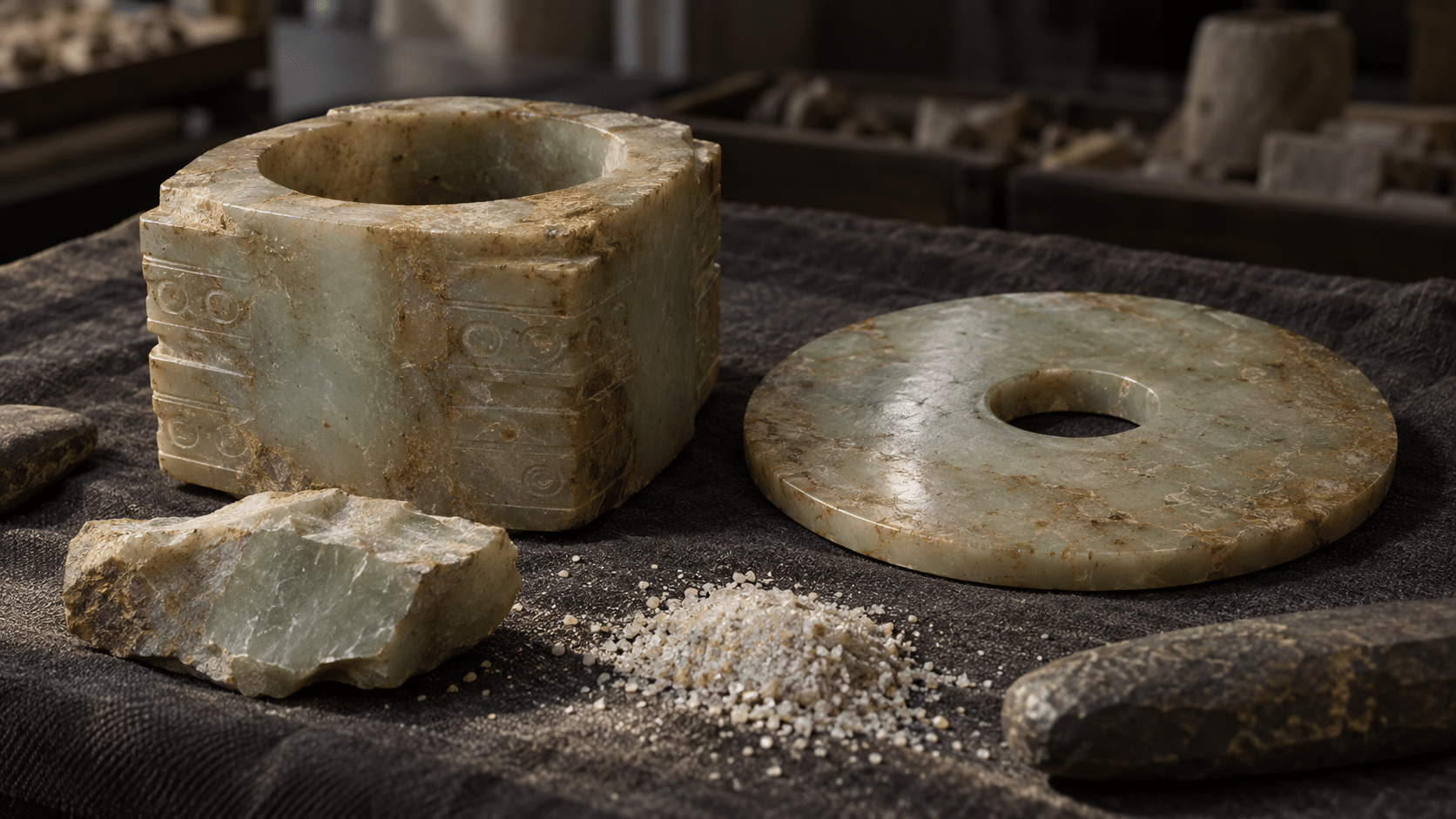
Long before diamonds became global symbols of luxury, craftspeople in prehistoric China were performing an extraordinary feat.
They were transforming one of nature’s toughest ornamental materials into perfectly polished discs, tubes, blades, pendants and enigmatic ritual objects.
That material was jade.
In China, jade eventually became associated with ideas as diverse as status, ritual authority, moral virtue, purity, protection, longevity and immortality. Some associations are securely documented in archaeological objects and historical texts. Others developed centuries or millennia after the earliest jade objects were created.
And some familiar interpretations have become so deeply embedded in popular culture that they are often presented as established archaeological facts even when the evidence is uncertain.
The history of jade in Ancient China therefore offers something especially valuable for the study of gemstone spirituality.
It shows us how a natural material can gradually accumulate meaning across thousands of years.
At Natural Gems Belgium, our approach is to separate those layers carefully: what the stone physically is, what archaeology demonstrates, what later texts say, and what modern spiritual traditions have subsequently added.
Table of Contents
First: What Is Jade?
The word jade does not describe one single mineral.
Gemologically, materials traditionally called jade principally belong to two distinct mineral families:
nephrite and jadeite.
Modern gemmological nomenclature can also recognise certain green omphacite material as jade under defined conditions.
This distinction is crucial when discussing Ancient China.
The jade worked during China’s Neolithic and early historic periods was overwhelmingly nephrite.
Jadeite—the material responsible for many intensely green, lavender and multicoloured Chinese carvings familiar today—entered China in significant quantities much later.
The Gemological Institute of America notes that jadeite from Burma, now Myanmar, reached China only around the late eighteenth century.
Consequently, imagining a brilliant emerald-green jadeite carving when reading about a Neolithic Chinese jade burial can create a completely false picture.
Ancient Chinese jade could be pale green, grey-green, creamy white, yellowish, brownish or altered in colour through burial.
The ancient material story is primarily a story of nephrite.
Why Was Nephrite So Extraordinary?
Nephrite possesses an unusual combination of toughness and beauty.
Its interlocking fibrous crystal structure makes it exceptionally resistant to breaking.
That toughness made jade useful long before it became an elite artistic material.
Across prehistoric societies, jade and jade-like materials could be fashioned into tools and weapons as well as ornaments.
But toughness also created an enormous challenge.
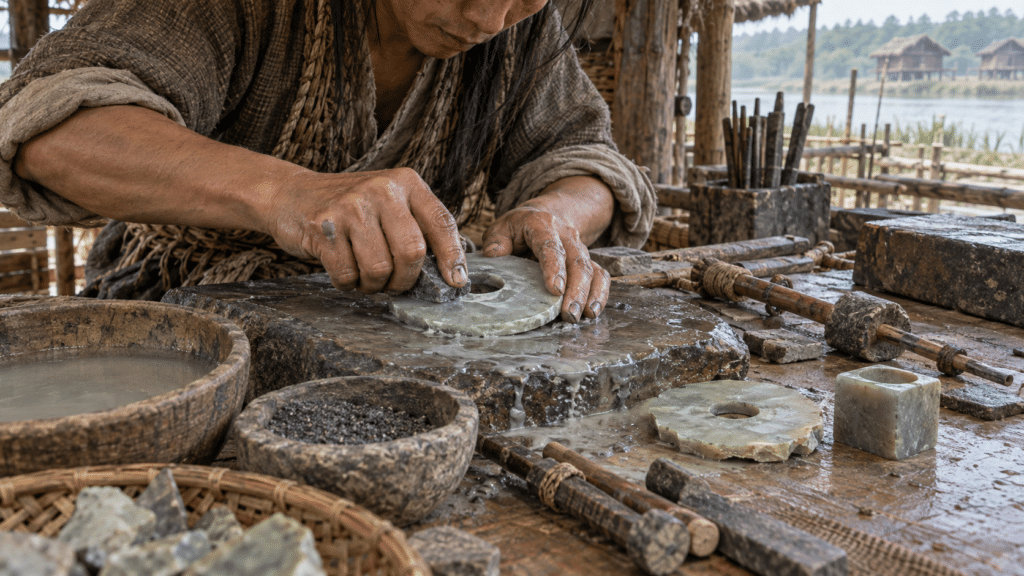
Ancient craftspeople could not simply carve nephrite with an ordinary metal blade.
Instead, jade had to be laboriously shaped through processes involving sawing, drilling, grinding and abrasion.
The Metropolitan Museum of Art notes that producing Neolithic jade objects required enormous labour using abrasives such as quartz and sand.
A perfectly smooth jade disc therefore represented more than access to an attractive stone.
It represented time.
Skill.
Specialised knowledge.
And substantial human effort.
These characteristics help explain why jade could become a material of prestige.
Before Imperial China: The Liangzhu Culture
Some of the most extraordinary evidence for early Chinese jade traditions comes from the Liangzhu culture, which flourished in the lower Yangtze region during the late Neolithic period, approximately 3300–2200 BCE.
Long before the Qin emperor unified China in 221 BCE, Liangzhu communities were already producing astonishingly sophisticated jade objects.
Excavated elite burials have contained substantial quantities of jade.
Two forms are particularly famous:
the bi
and the cong.
Their shapes are simple enough to describe.
Their original meanings are far more difficult to recover.
The Jade Bi Disc
A bi is essentially a flat circular jade disc with a central opening.
Some are remarkably plain.
Others vary in quality, dimensions and finish.
Liangzhu tombs could contain large numbers of these discs.
The British Museum records, for example, that one Liangzhu burial at Sidun yielded twenty-four discs, while another at Fanshan contained forty-two.
The Metropolitan Museum notes that bi could be positioned around elite burials—on the chest, above the head or surrounding the body.
This strongly suggests that the objects were more than ordinary decoration.
They participated in funerary behaviour associated with people of substantial status.
But what did the circle mean?
That question becomes more difficult.
Did the Bi Represent Heaven?
A familiar explanation says:
the round bi represented Heaven.
You will find this statement repeated throughout books, museum interpretation and modern discussions of Chinese jade.
Later Chinese traditions certainly associated the bi with Heaven.
GIA likewise records the traditional symbolism of the pierced jade disc as representing Heaven.
But caution is necessary when applying that interpretation directly to Neolithic Liangzhu society.
The people who created the earliest bi left no surviving explanatory text telling us what they believed the form represented.
Later interpretations may preserve older traditions.
But they may also reinterpret mysterious ancient objects according to later cosmological ideas.
This distinction is particularly important in archaeology:
an object’s later meaning is not automatically its original meaning.
The British Museum explicitly warns against overconfidence when interpreting early jade forms.
The archaeological evidence tells us that bi were important.
It tells us that they appeared in elite burials.
It tells us that enormous labour went into producing them.
It does not allow us to reconstruct every element of the belief system surrounding them with certainty.
The Mysterious Jade Cong
If the bi is visually simple, the cong is architecturally extraordinary.
A typical Liangzhu cong consists of a cylindrical interior passage surrounded by an approximately square exterior.
In other words:
round inside, square outside.
Some examples are short.
Others form tall columns.
Many have repeated designs concentrated around their corners, sometimes resembling stylised faces with circular eyes and bar-like features.
Their geometry has inspired generations of interpretation.
Did the Cong Represent Earth?
Later Chinese traditions paired the bi and cong cosmologically:
bi = Heaven
cong = Earth
The combination seems wonderfully logical.
Round heaven.
Square earth.
It also fits later Chinese cosmological ideas.
But there is a problem.
The British Museum explicitly states that there is no evidence supporting the assumption that Neolithic bi and cong originally represented Heaven and Earth respectively.
That is an exceptionally important archaeological caution.
The idea may have become meaningful later.
It should not automatically be presented as the belief of Liangzhu people living in the third millennium BCE.
We know the objects were important.
We know they were placed in burials.
We know their manufacture required extraordinary effort.
But their original ritual meaning remains partly mysterious.
Sometimes responsible history requires us to preserve uncertainty.
Faces in Stone
Many Liangzhu cong contain enigmatic face-like motifs.
Circular eyes stare outward from the corners.
Parallel bars and geometric forms create stylised features.
Some interpretations describe these as masks.
Others have proposed human, animal or supernatural imagery.
The temptation to identify them with a specific god or spirit is understandable.
But without explanatory texts, certainty is impossible.
What we can say is that the imagery was deliberate, repeated and associated with objects important enough to accompany high-status individuals into burial.
That makes the designs religiously or socially significant even if their exact meaning is lost.
There is something profound about that uncertainty.
We can still see the faces.
We simply no longer know whom—or what—they represented.
Jade, Death and the Afterlife
The concentration of jade in burials demonstrates that its significance extended beyond everyday ornament.
The Metropolitan Museum’s Liangzhu bi provides an excellent example.
The museum notes that the rarity of nephrite and extraordinary workmanship suggest that such objects may have functioned in rituals or as markers of wealth and high social status.
Its interpretive material also raises the possibility that bi played a symbolic or magical role connected with the deceased and the journey after death.
Here again, wording matters.
Archaeology can document placement.
It can document material.
It can document patterns of association.
Reconstructing invisible beliefs requires more caution.
It is therefore reasonable to say that jade participated in Liangzhu funerary ritual.
It is less responsible to claim that we know precisely what Liangzhu people expected the jade to do after death.
Jade as Social Power
Spiritual meaning and political power were not necessarily separate categories in early societies.
Jade was difficult to obtain.
Difficult to work.
And disproportionately concentrated in important burials.
These characteristics strongly connect it with elite identity.
A jade object could therefore communicate several things simultaneously:
wealth,
access to skilled labour,
social status,
ritual importance,
and perhaps relationships with ancestors or supernatural forces.
Modern categories such as “jewellery,” “religious object” and “status symbol” can become misleading when applied too rigidly to prehistoric material culture.
One object could potentially occupy all these worlds at once.
From Ritual Material to Moral Symbol
As Chinese civilisation developed, jade accumulated additional layers of meaning.
One of the most influential was moral virtue.
Later Chinese thinkers compared jade’s physical qualities with desirable human characteristics.
The Gemological Institute of America notes the famous tradition connecting jade with clarity of mind and purity of spirit, and records the Confucian comparison between jade and virtue.
This is an important transition.
The stone was no longer meaningful only because of what could be made from it or where it could be placed ritually.
Its physical qualities themselves became metaphors for human character.
Polish could evoke refinement.
Translucency could suggest purity.
Durability could evoke steadfastness.
The sound produced when jade was struck could carry additional symbolic value.
A mineral had become a language for ethics.
Confucius and the Virtues of Jade
The association between jade and virtue became deeply embedded in Chinese intellectual culture.
Texts connected with the Confucian tradition compare desirable human qualities with characteristics perceived in jade.
Rather than treating the stone as something that magically inserts virtue into a person, this tradition can be understood more subtly.
Jade becomes a material analogy for ethical cultivation.
A person should aspire toward virtue just as jade displays qualities admired by the culture interpreting it.
This differs considerably from many modern crystal-healing claims.
The stone is not necessarily acting upon the body through an invisible frequency.
Instead, it embodies qualities that humans are encouraged to contemplate and emulate.
That makes jade one of history’s most sophisticated examples of gemstone symbolism.
Jade, Purity and Spiritual Refinement
The association with purity became particularly enduring.
But “purity” in this context should not automatically be understood as physical cleanliness or modern ideas about detoxification.
It could refer to moral integrity, refinement, clarity and cultivated character.
This distinction matters because contemporary crystal language sometimes converts symbolic concepts into physiological claims.
A historical association between jade and purity does not demonstrate that jade removes toxins from the human body.
Symbolic purity and medical detoxification are entirely different concepts.
The former has a rich cultural history.
The latter requires scientific evidence.
Jade and Immortality
Another extraordinary layer in Chinese jade symbolism concerns longevity and immortality.
These ideas became especially important within later religious and philosophical traditions, including Daoist contexts.
Jade’s durability made it an intuitively powerful material through which to imagine permanence.
Unlike organic materials, polished jade can survive for millennia.
An object buried thousands of years ago can emerge recognisably intact.
That physical persistence lends itself naturally to symbolism concerning endurance and continuity.
Later Chinese art developed elaborate imagery around immortality, paradisiacal landscapes and supernatural beings.
The Metropolitan Museum preserves a spectacular eighteenth-century nephrite boulder carved with a Daoist paradise, complete with immortals, cranes, deer, pines and peaches of immortality.
By this period, jade’s connection with moral virtue and immortality was deeply developed.
But again, chronological precision matters.
An eighteenth-century Daoist jade cannot simply be used to explain what a Liangzhu community believed four thousand years earlier.
The material remained jade.
The cultural world around it changed enormously.
One Stone, Many Chinas
Talking about “Chinese jade belief” as though it were one unchanging tradition is therefore misleading.
Consider the timescale.
Liangzhu jade objects were being produced more than four thousand years ago.
The Shang dynasty came later.
Then Zhou.
Qin.
Han.
And successive imperial dynasties extending all the way to the Qing period.
Religious, philosophical and political ideas changed repeatedly.
Objects were rediscovered.
Ancient forms were copied.
Meanings were reinterpreted.
By the Qing dynasty, craftspeople and collectors deliberately produced archaistic jade objects inspired by ancient forms.
The British Museum documents examples in which ancient jade traditions were consciously reconstructed by later scholars and court culture.
This is not evidence of a static tradition.
It is evidence of an evolving conversation with the past.
When Later Generations Reinterpreted Ancient Jade
One fascinating consequence of jade’s longevity is that ancient objects survived long enough to become mysterious antiques within China itself.
Later scholars encountered forms such as bi and cong and attempted to understand them through historical texts and contemporary cosmology.
Some ancient forms were copied.
Others were incorporated into court ceremony.
This process could create entirely new meanings around very old shapes.
The British Museum even preserves a jade bi originally dating to the Shang period that later received an inscription from the Qianlong Emperor in 1790.
One physical object therefore bridges enormously different cultural moments.
It was ancient when the emperor encountered it.
He then added another historical layer.
This demonstrates something fundamental about gemstone symbolism:
meaning accumulates.
Jadeite Changes the Story
Another major transformation occurred when significant quantities of jadeite entered China from Myanmar during the Qing period.
This material could display an intense green very different from many traditional nephrites.
It became enormously desirable.
Today, Western audiences often imagine this brilliant green material whenever they hear the word “Chinese jade.”
But that association belongs largely to a later phase of jade history.
The Neolithic ritual jades of Liangzhu were predominantly nephrite.
Keeping nephrite and jadeite distinct is therefore essential for both gemmological and historical accuracy.
Does Ancient Chinese Jade Prove Crystal Healing?
No.
Archaeological evidence demonstrates that jade possessed enormous ritual, social and symbolic importance.
Historical traditions demonstrate associations with virtue, purity, protection, longevity and immortality.
None of this constitutes scientific evidence that jade emits a healing energy or medically changes the human body.
This distinction does not diminish the history.
Quite the opposite.
It allows us to appreciate what ancient and historical Chinese communities actually did with jade rather than replacing their traditions with modern crystal terminology.
Modern Jade Spirituality
Today, jade is commonly associated in crystal traditions with:
- harmony
- prosperity
- luck
- emotional balance
- protection
- wisdom
- longevity
- heart-centred spirituality
Some of these ideas overlap loosely with historical Chinese symbolism.
Others have been transformed through contemporary global crystal culture.
Modern practitioners may also connect green jade with the Heart Chakra.
That chakra correspondence should not be presented as an ancient Chinese tradition.
The chakra system originated in South Asian religious contexts, while the modern colour-coded association between green gemstones and a heart energy centre is much later.
Combining Chinese jade history and modern chakra practice can be personally meaningful.
But it is historically inaccurate to claim that ancient Chinese jade workers were balancing the Heart Chakra with nephrite.
A Historically Inspired Jade Reflection
Jade’s historical symbolism offers an unusually strong basis for modern contemplative practice.
Rather than asking a jade stone to transmit an invisible energy, consider using its physical characteristics as metaphors.
Hold a piece of nephrite or jadeite.
Notice its weight.
Observe its polish.
Consider its toughness.
Think about the enormous labour ancient craftspeople invested in transforming rough nephrite into smooth ritual objects.
Then consider a simple question:
Which quality in myself deserves the same patient refinement?
You might choose:
patience,
integrity,
clarity,
restraint,
compassion,
or resilience.
The stone does not create that quality.
It becomes a reminder of the work required to cultivate it.
This approach is surprisingly close to one of jade’s most profound historical roles: using a natural material as a metaphor for human character.
Why Jade Offers a Different Model of Gemstone Spirituality
Modern crystal culture frequently asks:
What can this stone do for me?
Ancient Chinese jade traditions suggest another possible question:
What can this stone teach me to value?
That difference is important.
A crystal does not need to possess scientifically unverified powers to participate in spiritual practice.
A natural material can inspire reflection through:
its history,
its physical qualities,
its cultural associations,
its craftsmanship,
and the ideas generations of humans have attached to it.
Jade demonstrates this exceptionally well.
Its spiritual significance did not depend upon one simple “healing property.”
It became intertwined with ritual, death, status, morality, continuity and ideas of transcendence.
The Mystery Should Remain
Perhaps the most important lesson from Neolithic Chinese jade is intellectual humility.
We know remarkable things about Liangzhu jade.
We know where objects were buried.
We know their shapes.
We know how difficult they were to manufacture.
We know that some tombs contained extraordinary quantities.
We can examine the enigmatic faces carved into cong today.
But we cannot interview the people who created them.
Their original explanations are gone.
The temptation is to fill that silence with confident stories.
The round bi must be Heaven.
The square cong must be Earth.
The faces must represent a particular deity.
The jade must have protected the soul.
Perhaps some of these ideas ultimately approach the truth.
But responsible archaeology distinguishes possibility from evidence.
Sometimes the most respectful statement we can make about an ancient spiritual tradition is:
we do not know.
Conclusion
The story of jade in Ancient China extends across thousands of years and cannot be reduced to a single spiritual meaning.
Scientifically, jade itself requires precision: the ancient Chinese material was primarily nephrite, while the jadeite so strongly associated with later Chinese jewellery entered the country in substantial quantities only much later.
Archaeologically, jade occupied an extraordinary position by the Neolithic period.
Liangzhu communities invested enormous labour in creating bi discs, cong, axes, pendants and other objects, many of which accompanied high-status individuals into burial.
Their precise original meanings remain partly unknown.
Later Chinese traditions added further layers.
Jade became associated with Heaven, moral virtue, purity, longevity and immortality. Philosophers used its physical characteristics as metaphors for human character. Imperial collectors studied and copied ancient jade forms. Daoist imagery eventually transformed jade into landscapes populated by immortals.
Modern crystal spirituality has added another chapter.
These layers should not be collapsed into one timeless belief system.
They are valuable precisely because they are different.
At Natural Gems Belgium, we believe jade provides one of the clearest examples of why the history of gemstone spirituality deserves serious study:
geology explains the material; archaeology reveals how it was used; texts preserve changing interpretations; and spirituality shows how humans repeatedly transform natural objects into carriers of meaning.
More than five thousand years after Liangzhu craftspeople began grinding nephrite into enigmatic ritual forms, jade continues to invite reflection.
Perhaps its deepest lesson is not that stones possess one permanent spiritual meaning.
It is that human beings have an extraordinary capacity to discover meaning in the enduring materials of the Earth.
References & Further Reading
Gemmology & Jade Identification
Gemological Institute of America (GIA) — Jade
Authoritative gemmological introduction explaining the materials covered by the term jade and providing background on nephrite, jadeite and the cultural importance of jade.
Gemological Institute of America (GIA) — Jade History and Lore
Overview of jade’s cultural history, including China’s long nephrite carving tradition, the later arrival of jadeite from Myanmar and historical associations with virtue and symbolism.
https://www.gia.edu/jade-history-lore
Liangzhu Jade & Neolithic Ritual Objects
British Museum — Chinese Jade Gallery
Museum overview of the history of Chinese jade, from Neolithic blades and ritual objects through later imperial carving traditions.
https://www.britishmuseum.org/collection/galleries/chinese-jade
British Museum — Liangzhu Jade Cong, Museum No. OA+.110
A jade cong dating to approximately 2500 BCE. The museum discusses Liangzhu burial contexts and explicitly notes that the exact purposes of these carvings remain unknown.
https://www.britishmuseum.org/collection/object/A_OA-110
British Museum — Liangzhu Nephrite Cong, Museum No. 1945,1017.157
A large green-black-grey nephrite cong from the Liangzhu culture, providing direct material evidence for the extraordinary workmanship and ritual jade traditions of Neolithic China.
https://www.britishmuseum.org/collection/object/A_1945-1017-157
British Museum — Liangzhu Jade Bi, Museum No. 1937,0416.142
A black-green jade bi dated to approximately 2500 BCE. The museum discusses the uncertain purpose of bi and cong and their frequent presence in Liangzhu burials.
https://www.britishmuseum.org/collection/object/A_1937-0416-142
British Museum — Liangzhu Jade Bi, Museum No. 1884,0405.1
Neolithic jade disc dated approximately 3300–2200 BCE, with curatorial discussion of Liangzhu burial practices and the ceremonial importance of bi.
https://www.britishmuseum.org/collection/object/A_1884-0405-1
The Metropolitan Museum of Art — Annular Disk (Bi), Liangzhu Culture
Mid-third-millennium BCE nephrite bi. The Met discusses its rarity, difficult manufacture, elite burial context and possible ritual significance.
https://www.metmuseum.org/art/collection/search/49371
The Metropolitan Museum of Art — Ritual Object (Cong), Liangzhu Culture
Nephrite cong dating to approximately 2400 BCE. The Met describes its complex square-and-cylindrical form, mask decoration and uncertain function.
https://www.metmuseum.org/art/collection/search/72376
Interpreting Heaven, Earth & Ancient Jade
British Museum — Jade Cong, Museum No. OA+.112
Particularly valuable for historical caution. The museum explains that later scholars paired cong with bi and interpreted them as Earth and Heaven respectively, while explicitly stating that there is no evidence supporting this interpretation for the original Neolithic objects.
https://www.britishmuseum.org/collection/object/A_OA-112
This distinction is essential when discussing ancient jade spirituality: a later traditional interpretation should not automatically be presented as the original belief of Liangzhu society.
Shang & Later Ritual Jade
The Metropolitan Museum of Art — Ritual Object (Cong), Shang Dynasty
Nephrite cong dating to the thirteenth–twelfth century BCE, illustrating the continuation and transformation of ancient jade forms after the Neolithic period.
https://www.metmuseum.org/art/collection/search/49369
Smithsonian Institution — Tube (Cong), Late Shang Dynasty
Nephrite ceremonial cong associated with Anyang and dated approximately 1250–1050 BCE, providing further evidence for the long continuation of cong forms.
https://www.si.edu/object/tube-cong-cong%3Afsg_S1987.466
Later Reinterpretation of Ancient Jade
British Museum — Shang Jade Bi with Qianlong Emperor Inscription
An especially revealing object: an ancient Shang-period jade disc that later received an inscription dated 1790 from the Qianlong Emperor. It demonstrates how later Chinese collectors actively reinterpreted and added meaning to ancient jade.
https://www.britishmuseum.org/collection/object/A_1937-0416-140
British Museum — Archaistic Ceremonial Jade Bi, Qing Dynasty
A later jade object deliberately based on ancient forms. The curatorial discussion explains how Qing scholars and craftspeople revived archaic jade shapes through study of ancient traditions.
https://www.britishmuseum.org/collection/object/A_1947-0712-495
Jade, Daoism & Immortality
The Metropolitan Museum of Art — Boulder with Daoist Paradise
Eighteenth-century nephrite sculpture depicting immortals, cranes, deer, pines and peaches of immortality within a mountainous Daoist paradise. The museum discusses jade’s later associations with moral virtue and immortality.
https://www.metmuseum.org/art/collection/search/42059
This much later object should not be used to reconstruct Neolithic Liangzhu religion, but it provides exceptional evidence for how jade’s spiritual symbolism continued to evolve within Chinese culture.
[…] The Human History of Meaningful Objects […]