


A small golden-looking stone rests on a table.
Beside it lies an ordinary notebook.
There are no banknotes arranged in ceremonial patterns, no promises of sudden wealth and no elaborate instructions for attracting money from the universe.
Instead, the first question is surprisingly simple.
What does it mean to have enough?
Within contemporary crystal spirituality, Pyrite is frequently associated with prosperity, abundance, confidence, opportunity and financial success.
Some practitioners place it near a workspace or financial documents. Others incorporate it into crystal grids, carry small specimens as symbolic reminders of ambition or use it during intention-setting rituals.
In certain modern metaphysical traditions, Pyrite is believed to attract wealth, strengthen personal determination or amplify the energy of abundance.
These are spiritual beliefs rather than scientifically established effects.
There is no reliable evidence that Pyrite attracts money, changes financial circumstances through supernatural energy or influences economic opportunities through crystal vibrations.
Nevertheless, symbolic objects can have personal meaning.
A gemstone may remind someone of a chosen value, a commitment or a practical intention.
And the idea of abundance offers an opportunity to examine a much broader question than simply acquiring more possessions.
This article introduces an original contemporary practice:
The Pyrite Abundance Ritual of Enough.
It combines one Pyrite stone with a short reflection on resources, gratitude and meaningful action.
The ritual does not promise financial gain.
It does not reproduce a documented ancient Pyrite ceremony.
And it does not suggest that gratitude can replace material security.
Instead, it explores a different understanding of prosperity.
This practice, the Pyrite Abundance Ritual, invites participants to reflect on their resources and cultivate gratitude.
Abundance is not always the presence of more. Sometimes, it is the recognition of what is valuable, what is necessary and what genuinely deserves our effort.
Table of Contents
Pyrite in Contemporary Crystal Spirituality
Pyrite occupies a prominent place in modern crystal practices concerned with prosperity and personal ambition.
It is commonly described by practitioners as a stone of abundance, motivation, confidence and financial opportunity.
Some believe it attracts favourable circumstances.
Others associate it with the ability to recognise possibilities, pursue goals or overcome feelings of scarcity.
Within certain crystal-grid traditions, Pyrite is positioned at the centre of arrangements intended to symbolise wealth or success.
It may also be placed on a desk, near a notebook or in a personal workspace.
These practices belong to contemporary metaphysical belief systems.
Their meanings are not uniform, and their claimed energetic effects have not been scientifically demonstrated.
The historical use of amulets and symbolic objects does not establish that every modern Pyrite prosperity ritual has ancient origins.
For the Ritual of Enough, Pyrite represents a deliberate question:
What resources do I already have, and how do I want to use them?
The gemstone does not answer the question.
Its role is symbolic.
The Human History of Meaningful Objects
Across many societies, people have assigned religious, protective or symbolic significance to physical objects.
Amulets are particularly important examples.
The Metropolitan Museum of Art documents ancient Egyptian amulets whose forms, colours and materials were believed to carry protective or regenerative significance.
One example is the djed-pillar amulet, associated with permanence and, in later periods, the god Osiris.
The museum explains that ancient Egyptians believed amulets could transfer protective or beneficial powers to their wearers.
This provides historical evidence of how objects could acquire spiritual significance within a particular religious culture.
However, it does not demonstrate that those believed powers operated as physical mechanisms.
Nor does it establish that ancient Egyptians performed modern Pyrite wealth-attraction rituals.
The distinction is essential.
Historical amulet traditions should be understood within their own religious and cultural settings.
The Pyrite Ritual of Enough is a contemporary symbolic exercise, not a reconstruction of an ancient Egyptian ceremony.
Prosperity Is More Than a Single Idea
The word prosperity can describe several different conditions.
For one person, prosperity may mean earning enough to meet essential expenses.
For another, it may mean having sufficient time to spend with family.
Someone else may associate it with independence, professional opportunity, stable housing or the freedom to make meaningful choices.
These interpretations are not interchangeable.
Financial resources matter.
A person facing difficulty paying for food, housing or essential services cannot necessarily resolve those difficulties by changing their attitude.
At the same time, material possessions are not the only things people value.
The Ritual of Enough distinguishes three broad forms of abundance.
Material sufficiency concerns the practical resources required for everyday life.
Personal resources may include time, skills, relationships, knowledge and opportunities.
Experienced appreciation concerns the ability to recognise something as valuable or meaningful.
These categories can overlap.
But none should be used to deny genuine financial hardship.
What Financial Wellbeing Actually Means
The US Consumer Financial Protection Bureau defines financial wellbeing in terms of security and freedom of choice.
Its educational framework identifies several important dimensions, including control over everyday finances, the capacity to absorb financial shocks, progress toward financial goals and freedom to make choices that support one’s life.
This is a useful contrast with supernatural prosperity claims.
Financial wellbeing depends on real circumstances.
Income.
Expenses.
Resources.
Obligations.
Available opportunities.
And the ability to make practical decisions.
A gemstone cannot substitute for these conditions.
Placing Pyrite beside a financial document does not change the figures on that document.
However, someone may choose to use the stone as a personal reminder to review their circumstances or make a considered decision.
In that case, the action belongs to the person.
Not to a supernatural force attributed to the gemstone.
The Difference Between Abundance and Materialism
Wanting financial stability is not the same as being excessively materialistic.
Money can provide security, opportunity and freedom.
It can help people meet essential needs and care for others.
The psychological concept of materialism generally concerns the importance assigned to possessions, acquisition and material success within a person’s broader value system.
A major 2014 meta-analysis published in the Journal of Personality and Social Psychology examined the relationship between materialistic orientation and personal wellbeing.
The researchers analysed 753 effect sizes from 259 independent samples.
Overall, the evidence indicated an association between stronger materialistic values and poorer personal wellbeing, although the strength and character of the relationship varied across measures and circumstances.
This does not mean that financial ambition is inherently harmful.
Nor does it mean that people should abandon material goals.
The distinction concerns the relative importance of acquisition compared with other sources of meaning.
The Pyrite Ritual of Enough uses this distinction as a starting point.
It asks whether a particular desire serves a meaningful need or whether the desire for more has become an end in itself.
Why Gratitude Belongs in a Prosperity Ritual
Gratitude is often associated with recognising something beneficial or valuable.
It may concern another person’s kindness.
A meaningful experience.
An opportunity.
Or an ordinary aspect of life that is easily overlooked.
The Greater Good Science Center at the University of California, Berkeley, provides a research-informed Gratitude Journal exercise.
Its guidance encourages participants to record specific experiences or things for which they feel grateful.
The practice emphasises thoughtful attention rather than simply producing a long list.
Research into gratitude interventions has reported potentially beneficial psychological outcomes in some settings.
A 2023 systematic review and meta-analysis examined 64 randomised clinical trials and reported improvements in several measures of gratitude and psychological wellbeing.
However, results vary across interventions and populations.
A separate 2020 systematic review found that evidence for physical-health outcomes remained limited and mixed.
These studies do not investigate Pyrite.
They do not establish supernatural crystal energy.
And they do not mean that everyone will benefit from gratitude exercises.
For the Ritual of Enough, gratitude is an optional reflective activity.
It is not a magical mechanism for obtaining wealth.
Gratitude Does Not Mean Ignoring Hardship
An important problem arises when gratitude is presented as an obligation.
Someone experiencing financial insecurity may be told that they should simply appreciate what they have.
A person dealing with serious difficulties may feel pressured to describe every experience positively.
This can become dismissive.
Gratitude should not be used to deny hardship.
Nor should someone be made to feel responsible for their difficulties because they supposedly failed to maintain a sufficiently positive mindset.
The Ritual of Enough therefore includes two equally legitimate statements:
Something in my life may be valuable.
Something in my life may still need to change.
Both can be true.
A person may appreciate supportive relationships while needing better employment.
They may value their home while struggling with housing expenses.
Or they may recognise an existing opportunity while pursuing a more secure future.
The ritual does not require choosing between appreciation and ambition.
Introducing the Pyrite Ritual of Enough
This is an original contemporary symbolic exercise designed for personal reflection.
It is not a historically documented ceremony.
It is not a clinical intervention.
And it does not require belief in supernatural gemstone energy.
The practice takes approximately fifteen to twenty minutes.
Choose a comfortable, quiet location where you can write without interruption.
You will need one Pyrite specimen, a notebook, a pen and a stable working surface.
A small rough specimen is suitable, provided it is clean, stable and safe to handle.
A polished decorative stone or another personally meaningful object may also be used.
No additional gemstones are necessary.
The ritual has three central themes:
What I have. What I need. What I choose.
Stage One – Creating the Space
Place the Pyrite on a small ceramic dish, slate coaster or stable wooden tray.
Set the notebook beside it.
Avoid arranging banknotes, credit cards or valuable personal documents around the stone.
There is no requirement to create an elaborate altar.
The setting should be practical.
The gemstone is a symbolic focal point.
It does not need to face a particular direction.
It does not require sunlight, moonlight, chanting or energetic activation.
Begin by considering one question:
When I think of abundance, what do I actually imagine?
Perhaps the answer involves money.
Perhaps it involves freedom.
Or perhaps it involves having enough time for important relationships and responsibilities.
Do not judge the answer immediately.
Simply notice it.
Stage Two – The First Page: What I Already Have
Open the notebook.
Write the heading:
What I Have
Identify three things that are genuinely valuable to you.
They do not need to be possessions.
One might be a useful skill.
Another might be a supportive person.
A third might be access to a resource that makes everyday life easier.
Be specific.
Instead of writing only “my work,” you might identify a particular skill developed through experience.
Instead of writing “my family,” you might recall a concrete act of support.
If nothing comes easily to mind, do not force a positive answer.
The exercise is optional.
Its purpose is to recognise value where it exists, not to manufacture gratitude.
The Pyrite remains on the table.
It does not create the appreciation.
Stage Three – The Second Page: What I Need
Turn to a fresh page.
Write:
What I Need
This stage is deliberately different.
Consider something that would meaningfully improve your circumstances.
Perhaps you need more predictable working hours.
A clearer financial plan.
More time for rest.
Additional professional training.
Or support with a practical responsibility.
Choose one need that feels relevant.
Avoid turning the exercise into a list of everything that is missing.
The question is not:
How can I become wealthy immediately?
It is:
What would make my circumstances more secure, manageable or meaningful?
There is no requirement to solve the problem during the ritual.
Recognising a need is already a distinct act from appreciating an existing resource.
Stage Four – The Third Page: What I Choose
On the next page, write:
What I Choose
Consider one realistic action connected to the need you identified.
For example, someone wishing to understand their finances better might choose to review a household expense.
Someone seeking professional development might identify a course to investigate.
A person wishing for more personal time might decide to reconsider a nonessential commitment.
The action should be specific and appropriate to your circumstances.
It does not need to be dramatic.
Nor must it involve spending money.
If the situation is outside your immediate control, the action may simply be to seek reliable information or appropriate support.
The Pyrite does not guarantee success.
It represents the intention to move from reflection toward practical agency.
Stage Five – The Question of Enough
Return your attention to the stone.
Consider the following question:
If I achieved the goal I have identified, what would become possible?
Perhaps the answer is greater security.
More independence.
A better ability to support others.
Or time for something important.
Then ask:
Would that outcome genuinely serve my values?
This question is not intended to discourage ambition.
A larger income, better home or successful business may be entirely reasonable goals.
The purpose is to distinguish the desired outcome from the assumption that acquiring more is automatically better.
Sometimes, the answer will confirm an existing ambition.
At other times, it may suggest a different priority.
Both are legitimate.
Stage Six – Closing the Ritual
Read the three headings once more.
What I Have.
What I Need.
What I Choose.
Notice how they differ.
The first concerns recognition.
The second concerns reality.
The third concerns possible action.
Return the Pyrite to its usual place.
Close the notebook.
There is no need to repeat a fixed affirmation or perform a closing ceremony.
If you wish, end with a simple personal statement:
I can appreciate what is valuable while working toward what is necessary.
The ritual is complete.
No financial or therapeutic result is promised.
Pyrite as a Pocket Stone for Intentional Spending
Some practitioners carry Pyrite as a prosperity talisman.
Within contemporary spiritual belief systems, the stone may be thought to attract opportunity or strengthen confidence.
A different, non-supernatural interpretation is possible.
A small Pyrite pocket stone can serve as a personal reminder to pause before an optional purchase.
The question might be:
Does this purchase serve a need, a meaningful preference or an impulse I may reconsider?
This is not a rule against buying things.
People are entitled to enjoy beautiful objects and personal interests.
Nor is every purchase required to meet an essential need.
The practice simply encourages deliberate choice.
The gemstone has no demonstrated ability to improve financial judgement.
Any benefit would arise from the person’s reflection and actions.
Pyrite on a Workspace or Desk
A Pyrite specimen can also be used as a symbolic object in a professional setting.
Some contemporary crystal practitioners associate it with ambition, motivation and successful opportunities.
They may place it near a desk, business notebook or creative workspace.
These are modern spiritual interpretations.
The stone does not increase productivity or attract clients through scientifically demonstrated energy.
However, a person may choose to associate it with a practical intention.
For example:
To complete one important task before beginning another.
To communicate clearly with a colleague.
Or to recognise progress that has already been made.
The symbolism is personal.
The outcome depends on ordinary circumstances, decisions and effort.
Pyrite and the Solar Plexus Chakra
In some contemporary seven-chakra systems, Pyrite is associated with the solar plexus chakra.
Modern practitioners frequently connect this chakra with confidence, personal power, motivation and self-direction.
Some believe that Pyrite strengthens this energetic centre or supports the ability to pursue goals.
These correspondences vary between spiritual communities.
They should not automatically be described as universal ancient teachings.
Historical South Asian chakra traditions developed in specific religious and philosophical contexts, and modern gemstone correspondence charts do not necessarily reproduce those systems.
There is no reliable biomedical evidence that Pyrite balances an anatomical solar plexus energy centre.
For the Ritual of Enough, the chakra association is optional.
The stone may simply represent deliberate choice and personal responsibility.
A Pyrite Centre Stone for a Symbolic Abundance Grid
Crystal grids are popular within contemporary gemstone spirituality.
Practitioners may arrange stones in geometric patterns and assign symbolic meanings to their positions.
A central Pyrite specimen is sometimes interpreted as the focal point for prosperity or success.
Some believe that surrounding stones amplify the central stone’s energetic influence.
These claims are not scientifically demonstrated.
A simplified arrangement can nevertheless serve as a visual reflection exercise.
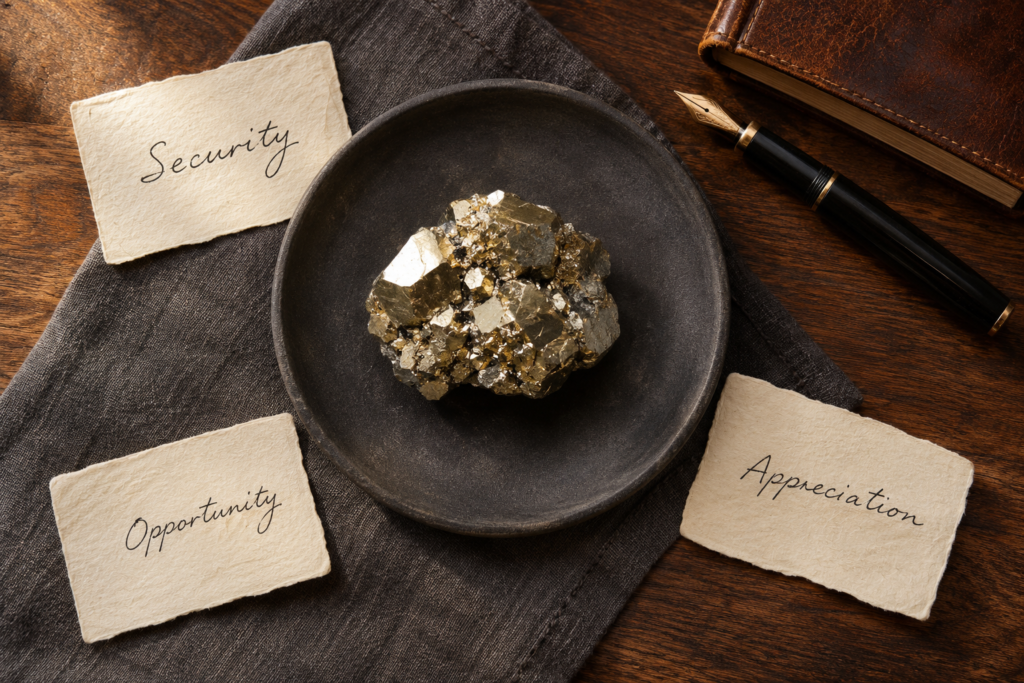
Place one Pyrite specimen in the centre of a small tray.
Around it, position three ordinary paper cards.
On the cards, write:
Security
Opportunity
Appreciation
The cards represent different dimensions of abundance.
The Pyrite represents the overall theme.
There is no need to add more gemstones.
The arrangement does not generate a measurable prosperity field.
It is a visual representation of personal values.
Why More Crystals Do Not Mean More Prosperity
Some modern crystal practices recommend collecting numerous stones to strengthen energetic intentions.
Different specimens may be assigned complementary roles.
One may represent wealth.
Another confidence.
Another protection.
And another opportunity.
These arrangements can be aesthetically meaningful to participants.
However, there is no reliable evidence that adding more gemstones increases financial success.
The Ritual of Enough deliberately challenges the assumption that spiritual practice requires continuous acquisition.
One stone is sufficient.
A stone already owned is entirely appropriate.
And no purchase is required to practise reflection, gratitude or intentional decision-making.
The symbolic value of the ritual does not depend on the quantity or cost of the objects involved.
Can Gratitude Make Someone Wealthier?
Research into gratitude does not establish that grateful people will automatically become wealthier.
Psychological studies may examine mood, subjective wellbeing, relationships or other outcomes.
Those findings should not be transformed into claims about guaranteed financial gain.
A gratitude journal does not create income.
It does not eliminate debt.
And it cannot replace appropriate financial planning.
The 2023 meta-analysis of gratitude interventions provides evidence of potential psychological benefits in the studied populations.
It does not demonstrate that gratitude attracts money through supernatural mechanisms.
The Pyrite Ritual of Enough therefore treats gratitude as a reflective practice rather than a financial strategy.
Someone may value the exercise without expecting it to change their bank balance.
The Problem With Guaranteed Prosperity Claims
A responsible spiritual practice should distinguish symbolism from promises.
Claims that a particular gemstone guarantees wealth, removes financial obstacles or attracts profitable opportunities are not supported by reliable scientific evidence.
Such promises may be especially problematic when directed toward people experiencing financial hardship.
They can create unrealistic expectations.
They may encourage unnecessary purchases.
And they may imply that someone is responsible for their financial difficulties because they have not performed a ritual correctly.
The Ritual of Enough rejects this interpretation.
There is no correct number of Pyrite stones required to achieve prosperity.
There is no special placement that guarantees success.
And there is no spiritual failure if a person’s financial circumstances remain difficult.
Practical problems require practical responses.
Symbolic reflection may accompany those responses, but it cannot replace them.
A Five-Minute Variation for Busy Days
The full ritual is not always necessary.
A shorter version can be completed with one stone and a single question.
Place the Pyrite on a stable surface.
Consider one resource you value.
Identify one genuine need.
Choose one manageable action, if an appropriate action is available.
Then return the stone to its usual place.
No notebook is required.
The exercise does not need to be performed every day.
It should remain voluntary rather than becoming another obligation.
Its purpose is to create a brief distinction between appreciation, need and action.
An Alternative Without a Gemstone
The same reflection can be completed without Pyrite.
A small wooden object.
A familiar photograph.
A plain ceramic token.
Or an empty space on the table may serve as the focal point.
The practical questions remain unchanged.
What do I have?
What do I need?
What do I choose?
This is important because the ritual’s reflective value does not depend on a scientifically demonstrated gemstone effect.
Pyrite is included because of its contemporary spiritual association with prosperity and abundance.
It is not a necessary therapeutic instrument.
Ethical Abundance and the Natural World
Abundance is sometimes presented as the unrestricted accumulation of material possessions.
However, acquiring objects involves resources.
Gemstones must be extracted, processed and transported.
These activities can have environmental and social consequences.
A ritual concerned with prosperity can therefore also ask what responsible consumption means.
Does a new purchase serve a genuine purpose?
Can an existing object continue to be used?
Is there reliable information about the material’s origin?
These questions do not make gemstone ownership inherently harmful.
Nor do they establish that avoiding purchases is always the correct decision.
They simply recognise that personal abundance exists within a wider material world.
The Pyrite Ritual of Enough requires no additional stones and no elaborate collection.
When the Ritual Is Not Appropriate
Some people may find reflection on money uncomfortable.
Financial difficulties can be complex and emotionally demanding.
A symbolic ritual should not pressure someone to feel grateful for circumstances that are genuinely difficult.
Nor should it be used as a substitute for financial advice, social support or professional assistance.
If the exercise becomes distressing, it can be stopped.
There is no requirement to complete every stage.
The participant may choose to focus on nonfinancial resources, such as time or practical skills.
Alternatively, they may decide that the ritual is not useful.
That decision is entirely legitimate.
What Science Supports – and What It Does Not
Several separate bodies of research are relevant to the ideas explored in this article.
Psychological studies have examined relationships between materialistic values and wellbeing.
Research into gratitude interventions has investigated possible effects on mood and psychological outcomes.
Financial education organisations have developed frameworks for understanding financial security and freedom of choice.
Historical museums document the cultural significance of amulets and symbolic objects.
However, these sources address different questions.
They do not establish that Pyrite attracts money.
They do not demonstrate that crystal grids create prosperity energy.
They do not prove that Pyrite balances chakra centres.
And they do not validate the Ritual of Enough as a clinical or financial intervention.
The exercise is an original symbolic practice.
Its meaning depends on the participant’s interpretation.
Final Reflection: The Meaning of Enough
Pyrite cannot guarantee prosperity through scientifically demonstrated crystal energy.
It cannot create financial security.
It cannot attract wealth through supernatural vibrations.
And it cannot replace practical decisions.
Yet within contemporary crystal spirituality, its association with abundance offers an interesting opportunity to reconsider what prosperity means.
For some people, the answer will involve financial stability.
For others, it may include meaningful work, independence, relationships or time.
Often, several of these dimensions matter together.
The Ritual of Enough does not suggest that ambition should disappear.
It does not ask anyone to stop pursuing a better future.
Instead, it introduces a distinction.
Appreciating what exists does not mean denying what is missing.
Recognising a need does not mean overlooking what is valuable.
And pursuing success does not require believing that more possessions will automatically create a more meaningful life.
The Pyrite remains a symbol.
The reflection belongs to the participant.
And the practical choices remain their own.
Abundance is not always about having everything.
Sometimes, it begins with understanding what matters, recognising what is needed and deciding what is truly worth pursuing.
References & Further Reading
The following sources provide historical, psychological and educational context for symbolic objects, gratitude, materialism, financial wellbeing and contemporary reflective practices.
All references lead to informative, non-commercial resources from museums, universities, peer-reviewed academic publications or government institutions.
None establishes supernatural wealth-attraction, healing or chakra-balancing properties of Pyrite.
1. The Metropolitan Museum of Art – Djed Pillar Amulet
Institution: The Metropolitan Museum of Art, New York
Historical period: Third Intermediate Period–Ptolemaic Period, approximately 1080–30 BCE
Type: Museum collection and religious-history education
This museum record explains how ancient Egyptian amulets were believed to carry protective or regenerative significance through their form, colour, material and associated religious practices.
The djed pillar was associated with permanence and later with Osiris.
The source illustrates the historical role of symbolic objects but does not document modern Pyrite prosperity rituals.
Direct source:
https://www.metmuseum.org/art/collection/search/574168
2. University of California, Berkeley – Gratitude Journal
Institution: Greater Good Science Center, University of California, Berkeley
Programme: Greater Good in Action
Type: University-based, research-informed wellbeing education
This educational resource describes a structured gratitude-journaling exercise.
It encourages participants to record specific people, experiences or circumstances they appreciate and explains the psychological research informing the practice.
It provides context for the gratitude component of the Ritual of Enough.
Direct source:
https://ggia.berkeley.edu/practice/gratitude_journal
3. Dittmar et al. – The Relationship Between Materialism and Personal Well-Being: A Meta-Analysis
Authors: Helga Dittmar, Rod Bond, Megan Hurst and Tim Kasser
Publication: Journal of Personality and Social Psychology
Volume: 107, Issue 5
Pages: 879–924
Published: November 2014
DOI: 10.1037/a0037409
Type: Peer-reviewed meta-analysis
This major review examined 753 effect sizes from 259 independent samples.
It investigated associations between materialistic values and personal wellbeing, providing a substantial research foundation for distinguishing material acquisition from broader life satisfaction.
The findings concern psychological associations, not gemstone spirituality.
Research abstract:
https://pubmed.ncbi.nlm.nih.gov/25347131
DOI:
https://doi.org/10.1037/a0037409
4. Consumer Financial Protection Bureau – Why Financial Well-Being?
Institution: US Consumer Financial Protection Bureau
Type: Government financial education
This resource defines financial wellbeing through security and freedom of choice.
It identifies control over everyday finances, resilience to financial shocks, progress toward goals and the ability to make meaningful choices as important dimensions.
It provides an evidence-informed alternative to supernatural claims about wealth attraction.
Direct source:
https://www.consumerfinance.gov/consumer-tools/financial-well-being/about
5. Diniz et al. – The Effects of Gratitude Interventions: A Systematic Review and Meta-Analysis
Authors: Geyze Diniz and colleagues
Publication: Einstein (São Paulo)
Published: 2023
DOI: 10.31744/einstein_journal/2023RW0371
Type: Peer-reviewed systematic review and meta-analysis
This review included 64 randomised clinical trials investigating gratitude interventions.
The authors reported improvements in several psychological outcomes across the included studies.
The research does not investigate Pyrite or supernatural prosperity practices.
Research abstract and open-access article access:
https://pubmed.ncbi.nlm.nih.gov/37585888
DOI:
https://doi.org/10.31744/einstein_journal/2023RW0371
6. Boggiss et al. – A Systematic Review of Gratitude Interventions: Effects on Physical Health and Health Behaviors
Authors: Anna L. Boggiss and colleagues
Publication: Journal of Psychosomatic Research
Volume: 135
Published: August 2020
DOI: 10.1016/j.jpsychores.2020.110165
Type: Peer-reviewed systematic review
This review examined randomised studies of gratitude interventions and physical-health outcomes.
The researchers identified some potentially promising findings but emphasised that the evidence remained limited, mixed and subject to methodological concerns.
The source helps prevent exaggerated health claims based on gratitude research.
Research abstract:
https://pubmed.ncbi.nlm.nih.gov/32590219
DOI:
https://doi.org/10.1016/j.jpsychores.2020.110165
7. Bauer et al. – Cuing Consumerism: Situational Materialism Undermines Personal and Social Well-Being
Authors: Monika A. Bauer, James E. B. Wilkie, Jung K. Kim and Galen V. Bodenhausen
Publication: Psychological Science
Volume: 23, Issue 5
Pages: 517–523
Published: 2012
DOI: 10.1177/0956797611429579
Type: Peer-reviewed experimental psychology research
Across four experiments, the researchers investigated how consumer-related cues influenced materialistic concerns, emotions and social behaviour under experimental conditions.
The findings offer additional context for reflecting on consumerism and personal values.
They do not establish that buying possessions is inherently harmful or that gemstones influence financial behaviour.
Research abstract:
https://pubmed.ncbi.nlm.nih.gov/22427388
DOI:
https://doi.org/10.1177/0956797611429579
Educational and Scientific Clarification
Pyrite’s associations with wealth, abundance, prosperity, motivation, personal power, financial opportunity and the solar plexus chakra belong to contemporary crystal spirituality.
These interpretations are not scientifically established therapeutic, economic or supernatural properties.
There is no reliable evidence that Pyrite attracts money, guarantees financial success, changes economic opportunities through crystal energy, increases personal confidence through supernatural mechanisms or balances anatomical chakra centres.
The Pyrite Ritual of Enough described in this article is an original contemporary symbolic exercise.
It is not a historically documented ancient ceremony.
It is not a clinically validated psychological intervention.
And it is not a financial-planning method.
Research into gratitude, materialism and financial wellbeing does not establish additional benefits from Pyrite.
The ritual should never be used to suggest that financial hardship results from insufficient gratitude, negative thinking or failure to perform spiritual practices.
Participation should remain voluntary and appropriate to individual circumstances.
Gemstones and symbolic rituals should never replace professional financial guidance, appropriate medical care or psychological support.
[…] Pyrite is iron disulfide, FeS₂. […]
[…] Pyrite is iron disulfide, FeS₂. […]