

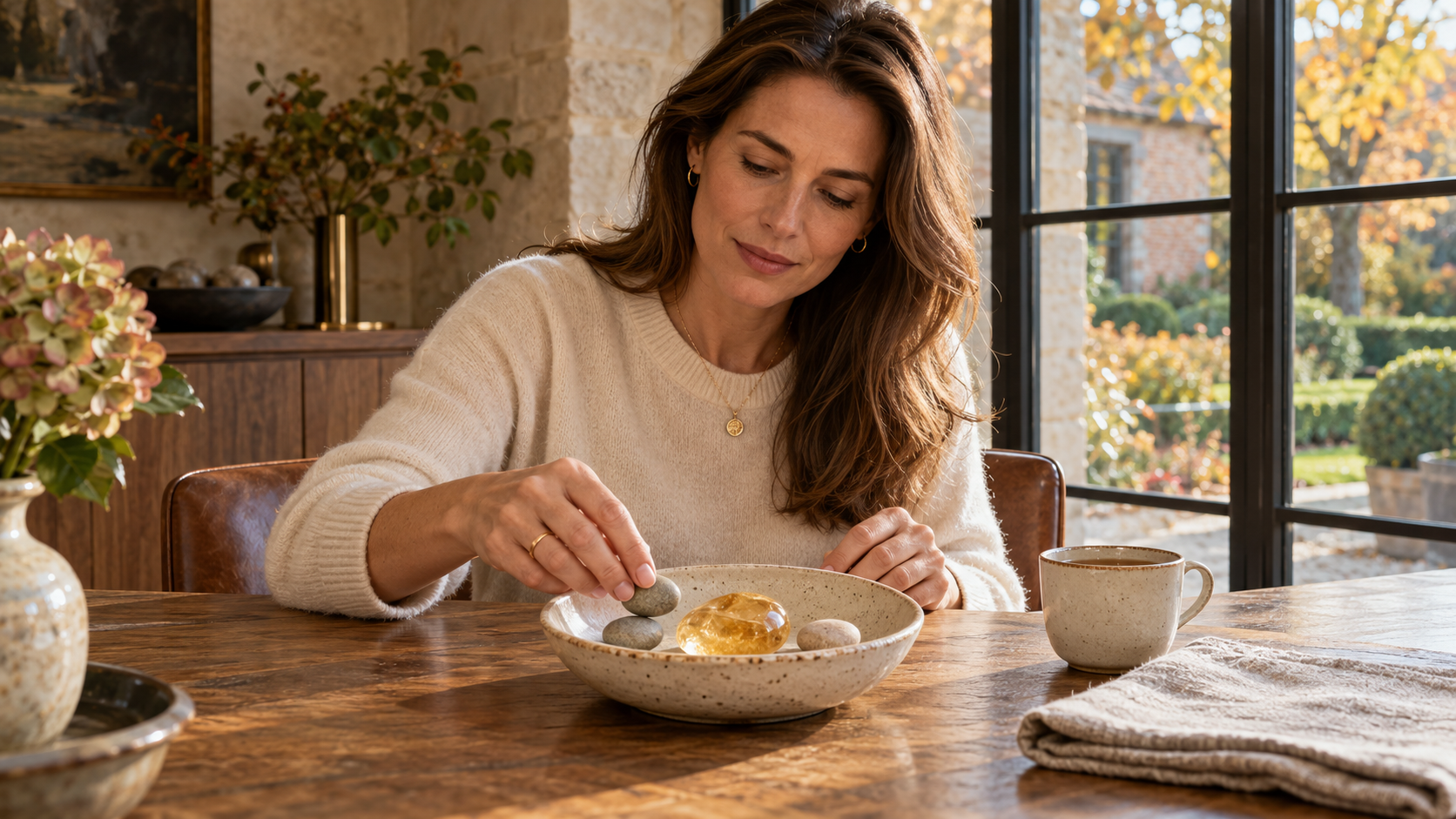
Abundance is a word that carries many meanings.
For some people, it suggests financial prosperity.
For others, it represents opportunity, personal achievement or the freedom to pursue meaningful experiences.
Within contemporary crystal spirituality, abundance is frequently associated with gemstones believed to attract success, prosperity and positive energy.
Citrine is among the best-known gemstones connected with these beliefs.
Often described in modern spiritual literature as a stone of abundance, optimism and personal confidence, Citrine has become a familiar presence in prosperity rituals, manifestation practices and intention-based crystal arrangements.
Some practitioners believe that Citrine attracts wealth.
Others associate it with confidence, creativity or the energetic qualities of the sun.
These interpretations belong to contemporary spiritual belief systems.
There is no reliable scientific evidence that Citrine attracts money, influences financial outcomes, transmits prosperity energy or changes external events through supernatural mechanisms.
Nevertheless, a gemstone can become a meaningful symbol without possessing such powers.
Its presence may remind someone of an intention.
Its colour may evoke a personal association.
And its placement within a deliberate practice may encourage reflection.
This article explores a different interpretation of abundance.
Rather than attempting to attract more possessions, opportunities or financial rewards, we consider the possibility of recognising what is already meaningful.
A supportive relationship.
An ordinary pleasure.
A moment of generosity.
An opportunity to learn.
Or a small experience that might otherwise pass unnoticed.
For this purpose, we introduce an original contemporary practice:
The Citrine Gratitude Ritual.
The exercise combines Citrine’s modern spiritual symbolism with reflection on appreciation, generosity and everyday experiences.
This ritual emphasizes the importance of gratitude in recognizing the abundance in our lives.
It does not promise wealth.
It does not claim to activate supernatural energy.
Instead, it invites a simple question:
What does abundance mean when we begin by noticing what is already present?
Table of Contents
Citrine in Contemporary Crystal Spirituality
Citrine is frequently associated with prosperity, optimism, confidence and personal achievement within contemporary gemstone spirituality.
Some practitioners refer to it as a merchant’s stone.
Others place it in prosperity bowls, intention arrangements or areas associated with financial activity.
Within modern metaphysical interpretations, Citrine is sometimes believed to encourage opportunities, attract success or support personal motivation.
These beliefs can have personal or cultural significance.
However, their historical origins should not be exaggerated.
Contemporary claims about Citrine attracting money should not automatically be presented as ancient teachings.
The widespread association between specific gemstones and modern manifestation practices belongs largely to contemporary spiritual culture.
Historical traditions involving meaningful stones certainly exist, but that does not establish a continuous ancient lineage for every modern gemstone ritual.
For the present exercise, Citrine serves as a symbol.
Its warm yellow appearance can evoke sunlight, warmth and the idea of appreciation.
This is a visual and personal association.
It is not evidence of a supernatural connection between Citrine and prosperity.
What Does Abundance Actually Mean?
Abundance is often understood as having more.
More money.
More opportunities.
More possessions.
More recognition.
Or more freedom.
These aspirations are not necessarily unreasonable.
Financial security, access to resources and stable living conditions can be important aspects of wellbeing.
However, abundance can also be considered from another perspective.
What do we already have that contributes meaningfully to our lives?
A reliable friendship may be valuable.
So may an enjoyable meal.
A comfortable place to rest.
A new skill.
Or the opportunity to spend time with someone important.
Recognising these experiences does not mean denying the importance of material needs.
Nor does it mean pretending that financial difficulties are unimportant.
Instead, it introduces a distinction between material prosperity and appreciation.
A person can recognise meaningful experiences while still working toward practical improvements in their circumstances.
The two approaches are not mutually exclusive.
Citrine and the Spiritual Idea of Prosperity
In contemporary crystal-healing traditions, Citrine is sometimes described as attracting prosperity energy.
Practitioners may place it near financial documents, carry it during business activities or incorporate it into manifestation rituals.
Some believe that the gemstone encourages confidence and opportunities.
Others associate it with the ability to receive abundance.
These interpretations should be understood as spiritual beliefs rather than established causal effects.
There is no reliable evidence that Citrine changes financial circumstances through an energetic mechanism.
A gemstone cannot guarantee business success.
It cannot influence investment returns.
And it cannot replace financial planning, professional advice or practical decision-making.
However, an individual may choose to associate Citrine with a personal value.
For example, the stone might represent responsible financial behaviour, generosity or appreciation for opportunities.
The symbolic meaning is personal.
The practical outcomes depend on actions and circumstances.
Gratitude: A Different Perspective on Abundance
Gratitude is an important subject within contemporary psychology.
Researchers commonly describe it as an appreciation of something beneficial that has been received or experienced.
This may involve recognising support from another person.
Appreciating a positive event.
Or acknowledging circumstances that have contributed to a meaningful experience.
The Greater Good Science Center at the University of California, Berkeley, describes gratitude as involving both the recognition of goodness and an awareness that some sources of that goodness exist outside ourselves.
This distinction is important.
Gratitude is not simply congratulating ourselves for personal achievements.
It may also involve recognising relationships, opportunities, shared experiences and contributions from others.
Within the Citrine Gratitude Bowl Ritual, this understanding becomes central.
The gemstone does not create abundance.
Instead, it symbolises the intention to notice and appreciate meaningful experiences.
What Scientific Research Says About Gratitude
One influential investigation into gratitude was published in 2003 by psychologists Robert Emmons and Michael McCullough.
Their study, Counting Blessings Versus Burdens, examined whether deliberately focusing on gratitude could influence subjective wellbeing.
Participants in different experimental conditions recorded experiences involving gratitude, difficulties or other events.
Across three studies, the researchers observed improvements in several wellbeing measures among participants assigned to gratitude-related conditions.
However, the effects were not identical across every outcome.
Positive emotional experience appeared to be among the more consistent findings.
The research suggested that deliberately attending to appreciated experiences may have psychological benefits.
It did not investigate gemstones.
Nor did it establish that spiritual manifestation practices influence external events.
The distinction matters.
Evidence supporting certain gratitude exercises does not establish that Citrine possesses healing or prosperity-attracting energy.
A Broader Scientific Perspective
Research into gratitude has continued beyond the early experimental studies.
A large meta-analysis published in the Proceedings of the National Academy of Sciences in 2025 examined gratitude interventions across different cultural settings.
The researchers analysed 145 papers, representing 163 samples and 24,804 participants from 28 countries.
They reported a small overall improvement in wellbeing associated with gratitude interventions.
The estimated overall effect size was Hedges’ g = 0.19.
This is an important finding.
It suggests that gratitude practices can have measurable benefits under certain conditions.
However, the average effect was small.
The researchers also identified differences between countries and study methods.
These findings do not mean that gratitude exercises work equally well for everyone.
Nor do they establish that gratitude produces happiness automatically.
The Citrine Gratitude Bowl Ritual has not itself been scientifically evaluated.
Its symbolic gemstone component should therefore not be presented as an evidence-based therapeutic intervention.
The Problem With Forced Positivity
Contemporary spiritual discussions sometimes suggest that maintaining positive thoughts is necessary to attract positive outcomes.
Within manifestation culture, people may be encouraged to avoid negative emotions because those emotions are believed to interfere with prosperity.
Such claims are not scientifically established.
They can also create unrealistic expectations.
A person experiencing financial difficulty does not necessarily need to become more grateful.
They may need practical assistance.
Someone experiencing grief does not have to identify positive aspects of their loss.
And a person facing unfair treatment should not be expected to replace legitimate concerns with optimism.
Gratitude should remain voluntary.
It is possible to appreciate certain aspects of life while acknowledging that other circumstances are difficult.
The Citrine Gratitude Bowl Ritual therefore does not require participants to deny unpleasant emotions.
It is not an exercise in pretending that everything is satisfactory.
Instead, it provides an optional opportunity to recognise meaningful experiences without dismissing genuine problems.
Gratitude Is Not the Same as Contentment With Everything
A person can feel grateful for a supportive friend while remaining dissatisfied with their employment situation.
They may appreciate their home while recognising that improvements are necessary.
They may value their health while seeking appropriate medical treatment.
Gratitude does not require abandoning ambition.
Nor does it mean accepting unfair circumstances.
A useful distinction is that gratitude concerns appreciation, while contentment concerns satisfaction.
The two may overlap.
But they are not identical.
The Citrine ritual encourages appreciation without insisting that participants should stop pursuing change.
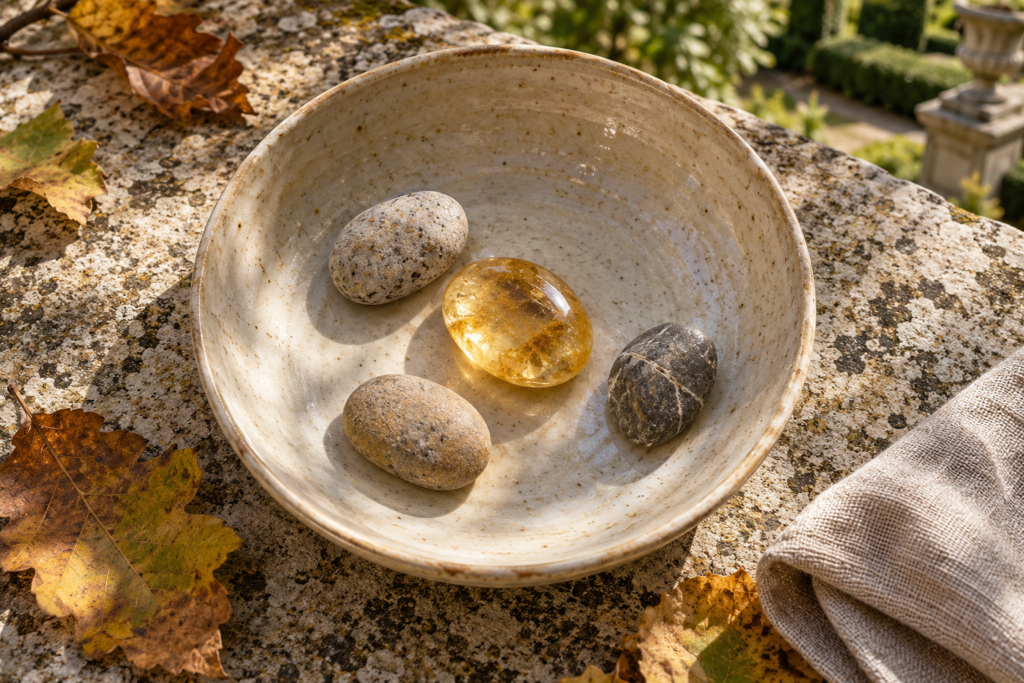
The Citrine Gratitude Bowl Ritual
The following practice is an original contemporary reflective exercise.
It combines Citrine’s modern spiritual symbolism with an appreciation-based activity.
It is not an ancient religious ceremony.
It is not a recognised clinical intervention.
And it does not require belief in supernatural energy.
The exercise can be completed in approximately ten to fifteen minutes.
You will need:
- One Citrine palm stone, tumbled stone or cabochon.
- One small ceramic or wooden bowl.
- Three small, clean pebbles or other simple symbolic tokens.
- A quiet, comfortable surface.
The bowl should be shallow enough that the objects remain visible.
A natural ceramic bowl in a neutral colour is suitable.
There is no need to purchase specialised ritual equipment.
The practice can be adapted using objects already available at home.
Stage One — Choosing the Centre Stone
Begin by placing the Citrine in the centre of the empty bowl.
Take a moment to observe it.
Notice its colour.
Its shape.
And the way it appears against the surface of the bowl.
Within contemporary crystal spirituality, Citrine is frequently associated with abundance and optimism.
For this exercise, the stone represents appreciation.
It does not radiate prosperity energy.
It does not attract money.
And it does not influence future events.
Its role is symbolic.
The central position simply indicates that appreciation is the theme of the exercise.
Stage Two — Recognising Something Received
Take the first small pebble.
Hold it briefly.
Consider something meaningful that you have received.
It does not need to be a physical object.
Perhaps someone offered useful advice.
A friend made time for a conversation.
A colleague helped with a difficult task.
Or a family member provided encouragement.
Choose something genuine.
There is no need to exaggerate its importance.
Place the pebble beside the Citrine.
Within the ritual, this first object represents something received.
You may silently acknowledge the experience.
There is no requirement to speak aloud.
The purpose is simply to recognise that meaningful experiences sometimes involve contributions from other people.
The Social Dimension of Gratitude
Gratitude often involves relationships.
The Greater Good Science Center describes gratitude as an emotion that can strengthen awareness of social support and connection.
Recognising another person’s contribution may encourage appreciation.
It may also influence how someone understands a relationship.
However, gratitude should not become an obligation.
Receiving help does not necessarily create unlimited personal debt.
Nor does appreciation require tolerating harmful behaviour.
A person may recognise a past kindness while maintaining appropriate boundaries.
The Citrine ritual does not require participants to contact anyone.
It is a private reflective practice.
Stage Three — Recognising Something Noticed
Take the second pebble.
This time, consider something pleasant that you noticed recently.
It might be a small sensory experience.
Morning sunlight entering a room.
The smell of fresh bread.
An interesting piece of music.
A quiet garden.
Or the appearance of autumn leaves.
The experience does not need to be extraordinary.
In fact, ordinary experiences may be particularly suitable.
Choose something that genuinely attracted your attention.
Place the second pebble beside the Citrine.
This object represents something noticed.
The Psychology of Savoring
Psychologists use the term savoring to describe the process of attending to and appreciating positive experiences.
Savoring may involve noticing an experience while it occurs.
Remembering something pleasant.
Or anticipating an enjoyable event.
The Greater Good in Action programme at the University of California, Berkeley, includes a practice called the Savoring Walk.
Participants are encouraged to pay deliberate attention to pleasant sights, sounds and other experiences during a walk.
The exercise aims to increase awareness of positive experiences that might otherwise pass unnoticed.
The Citrine ritual uses a related principle.
However, the gemstone arrangement itself has not been studied.
Any research supporting savoring practices should not be interpreted as evidence that Citrine produces additional psychological effects.
Stage Four — Recognising Something Shared
Take the third pebble.
Consider something that you have shared with another person.
Perhaps you offered assistance.
Shared useful information.
Prepared a meal.
Listened carefully.
Or contributed to a collective activity.
The experience does not need to involve money.
Generosity can take different forms.
Time.
Attention.
Knowledge.
Practical help.
Or a thoughtful gesture.
Place the third pebble beside the Citrine.
This object represents something shared.
The bowl now contains one central gemstone and three surrounding objects.
Together, they symbolise:
Something received.
Something noticed.
Something shared.
Why Generosity Belongs in an Abundance Ritual
Prosperity rituals often focus on attracting something toward the practitioner.
More money.
More opportunities.
More success.
The Citrine Gratitude Bowl Ritual introduces another possibility.
Abundance can also involve recognising what we are able to contribute.
This does not require financial generosity.
A person may have limited material resources while still sharing knowledge, encouragement or attention.
At the same time, generosity should remain voluntary and appropriate to personal circumstances.
No one should feel pressured to give away resources they need for their own wellbeing.
The ritual does not suggest that generosity will cause wealth to return through a supernatural mechanism.
Instead, it encourages reflection on the role of giving and receiving within ordinary human relationships.
Stage Five — Observing the Completed Bowl
Once all three pebbles have been placed, observe the arrangement.
The Citrine remains at the centre.
The surrounding objects represent three different forms of appreciation.
There is no requirement to arrange them according to sacred geometry.
No specific direction is necessary.
The bowl does not need to be activated.
And the objects do not generate a measurable field of abundance energy.
Their arrangement is symbolic.
Consider the three experiences you selected.
Do they reveal something about what matters to you?
Perhaps relationships are particularly important.
Perhaps ordinary sensory experiences deserve more attention.
Or perhaps you recognise that contributing to other people’s lives is meaningful.
There is no correct answer.
Stage Six — Completing the Ritual
The final stage is simple.
Leave the objects in the bowl for a few moments.
Then decide whether you wish to keep the arrangement.
You may place it on a shelf.
Return the objects to their usual locations.
Or repeat the practice another day.
There is no spiritual requirement to preserve the arrangement.
The Citrine does not become more powerful through repetition.
And the ritual does not guarantee improved wellbeing.
Its purpose is to provide an opportunity for reflection.
If the exercise feels useful, it may become part of a personal routine.
If not, there is no obligation to continue.
Why a Bowl?
Bowls are familiar objects across many cultures.
They may be used for food, water, storage, offerings or ceremonial purposes.
Their meanings depend on the specific cultural and religious context.
The Citrine Gratitude Bowl Ritual does not claim to reproduce a particular historical offering ceremony.
Instead, the bowl is used as a contemporary visual metaphor.
It holds several objects together.
Each object represents a different experience.
The arrangement makes an otherwise abstract idea visible.
In this context, abundance is not represented by the number of possessions in the bowl.
It is represented by the meaning assigned to the experiences.
Citrine as a Centre Stone
Contemporary crystal spirituality frequently uses centre stones in intention arrangements and crystal grids.
The central gemstone is often believed to establish the energetic theme of the arrangement.
Other stones may be placed around it according to particular symbolic systems.
These practices can be meaningful within an individual’s spiritual worldview.
However, there is no reliable evidence that placing Citrine at the centre of a geometric arrangement attracts prosperity or amplifies energy.
In the Gratitude Bowl Ritual, Citrine serves as a visual focal point.
The surrounding pebbles represent the participant’s reflections.
No additional gemstones are required.
A single Citrine is sufficient.
Its size, rarity or price does not determine the value of the exercise.
Citrine and the Solar Plexus Chakra
Within contemporary seven-chakra spirituality, Citrine is frequently associated with the solar plexus chakra.
Modern practitioners often connect this chakra with confidence, personal agency, motivation and self-esteem.
Some also associate Citrine with the sacral chakra, particularly in practices involving creativity or personal expression.
These gemstone correspondences are not universal.
Historical South Asian chakra traditions vary considerably in their number of chakras, symbolism and spiritual interpretations.
Modern systems that assign particular gemstones to specific chakras should not automatically be presented as ancient teachings.
The association between Citrine and the solar plexus chakra belongs primarily to contemporary crystal spirituality.
There is no reliable biomedical evidence that Citrine balances an anatomical energy centre.
For the Gratitude Bowl Ritual, chakra symbolism is optional.
A participant may appreciate the association with confidence or personal agency.
Another may prefer to focus entirely on gratitude.
Neither approach requires belief in gemstone healing.
Gratitude and Personal Confidence
Confidence is another theme frequently associated with Citrine.
Some contemporary practitioners believe the gemstone encourages courage, motivation or a more positive outlook.
These are spiritual interpretations.
There is no reliable evidence that Citrine directly increases confidence through an energetic mechanism.
However, the Gratitude Bowl Ritual may invite reflection on personal effort.
For example, the third pebble can represent something the participant contributed through their own actions.
This may include learning a skill.
Helping another person.
Completing a difficult task.
Or making progress toward a meaningful goal.
Recognising such experiences does not guarantee greater confidence.
But it can provide a more concrete basis for reflection than simply repeating that success will arrive.
The Difference Between Gratitude and Manifestation
Manifestation practices are common within contemporary spiritual culture.
Some practitioners believe that thoughts, emotions or intentions influence external events through universal energy.
Citrine is frequently included in these practices because of its association with prosperity.
However, there is no reliable scientific evidence that visualising wealth or placing a gemstone in a particular location causes money or opportunities to appear.
Positive expectations may sometimes influence behaviour.
For example, someone who feels motivated may be more willing to pursue a realistic opportunity.
But this is not evidence of supernatural manifestation.
The distinction is important.
An intention may guide action.
Action may influence outcomes.
Yet outcomes also depend on circumstances beyond individual control.
The Citrine Gratitude Bowl Ritual does not attempt to manifest financial rewards.
It focuses on recognising meaningful experiences.
Can Gratitude Become a Form of Pressure?
Although gratitude is often discussed positively, it can become unhelpful when imposed on others.
A person experiencing serious hardship may be told to focus on what they have rather than what they lack.
Such advice may overlook genuine difficulties.
Financial insecurity.
Illness.
Discrimination.
Loss.
Or unsafe living conditions.
Gratitude does not remove these problems.
Nor should it replace practical assistance or appropriate professional support.
A respectful gratitude practice allows people to acknowledge difficult circumstances.
The Citrine ritual should never be used to suggest that someone is responsible for their hardship because they have failed to think positively.
That would be an unsupported and potentially harmful interpretation.
What Research Does Not Establish
The scientific literature on gratitude provides useful insights.
However, the findings should be interpreted carefully.
A 2010 study involving a Spanish sample attempted to replicate aspects of the earlier gratitude research.
The researchers found some positive results when comparing gratitude participants with those recording difficulties.
However, the findings became less consistent when baseline and follow-up measurements were considered.
Some differences were no longer present at follow-up.
The researchers concluded that gratitude interventions may have benefits but that other methods should also be investigated.
This illustrates why scientific findings should not be reduced to simple promises.
Gratitude does not guarantee happiness.
And adding Citrine to a gratitude practice has not been demonstrated to improve its effectiveness.
A Citrine Pocket Stone for Everyday Appreciation
The full bowl ritual may not always be practical.
A small Citrine pocket stone can serve as a simpler symbolic reminder.
For example, someone might carry it during an ordinary day.
When they notice the stone, they may briefly consider something they appreciate.
A helpful conversation.
A pleasant environment.
An opportunity to learn.
Or a small act of kindness.
There is no need to repeat affirmations.
No special breathing pattern is required.
The stone does not transmit gratitude energy.
Its purpose is simply to represent an intention.
The same reminder could be created using another familiar object.
The gemstone is optional.
A Citrine Palm Stone Reflection
A palm stone may be preferred by readers who enjoy holding an object during quiet reflection.
Choose one Citrine palm stone.
Sit comfortably.
Hold it naturally.
Consider the question:
What meaningful experience have I overlooked recently?
Allow yourself a moment to reflect.
You might remember something pleasant.
You might recognise someone’s contribution.
Or you may discover that nothing particular comes to mind.
All of these responses are acceptable.
There is no requirement to produce a positive thought.
The stone does not determine the answer.
The exercise is simply an invitation to notice.
Raw Citrine in a Gratitude Arrangement
Some practitioners prefer raw gemstones for spiritual arrangements.
Others choose polished stones or cabochons.
Within contemporary crystal spirituality, these forms may be assigned different symbolic meanings.
Raw stones are sometimes associated with naturalness or an unaltered connection to the Earth.
Polished stones may be associated with refinement, calmness or tactile comfort.
These interpretations are subjective.
There is no reliable evidence that one form possesses stronger gratitude-related or prosperity-attracting energy.
For the Citrine Gratitude Bowl Ritual, choose a form that is comfortable and appropriate for the arrangement.
A small polished stone may be convenient.
A raw specimen may be visually appealing.
The spiritual significance does not depend on the form.
The Importance of Noticing Ordinary Experiences
People often remember major events.
A promotion.
A holiday.
A significant purchase.
Or an important celebration.
Smaller experiences may receive less attention.
Yet everyday life contains many ordinary moments that can be meaningful.
A pleasant conversation.
A familiar song.
A comfortable chair.
A meal prepared with care.
Or a moment of unexpected kindness.
Savoring practices encourage people to notice such experiences.
The Greater Good Science Center’s educational resources describe how deliberate attention to positive events may support appreciation.
However, this does not mean that every moment must be enjoyed.
Nor should people feel guilty when ordinary life is difficult.
The purpose is awareness.
Not compulsory happiness.
The Role of Repetition
Some spiritual practices recommend repeating rituals daily.
Others associate particular numbers of repetitions with energetic effectiveness.
There is no reliable scientific evidence that repeating the Citrine Gratitude Bowl Ritual a specific number of times activates supernatural prosperity.
However, repetition can be useful in establishing ordinary habits.
A person may choose to practise once a week.
Another may prefer an occasional reflection.
Someone else may find the exercise unnecessary.
The appropriate frequency depends on personal preference.
Research into gratitude interventions has used different schedules and durations.
Those studies do not establish an ideal frequency for this particular gemstone ritual.
The exercise should remain flexible.
A Seven-Day Citrine Appreciation Practice
Readers who wish to explore the ritual further may try a simple seven-day variation.
This is an original reflective exercise rather than a clinically validated intervention.
Each day, place the Citrine in the centre of the bowl.
Choose one experience to represent with a small pebble.
The subject changes throughout the week.
Day One — A Helpful Person
Recognise someone whose actions contributed positively to your life.
Day Two — An Ordinary Pleasure
Consider a small experience that you enjoyed.
Day Three — Something Learned
Reflect on knowledge or a skill that has become meaningful.
Day Four — An Opportunity
Recognise an opportunity that was available to you, whether or not it produced a major achievement.
Day Five — Something Shared
Consider a contribution you made to another person’s experience.
Day Six — A Meaningful Place
Reflect on a place associated with comfort, interest or belonging.
Day Seven — Your Own Definition of Abundance
Consider what abundance means to you beyond financial prosperity.
There is no requirement to complete every day.
The exercise may be discontinued whenever desired.
Its purpose is reflection.
Not the accumulation of spiritual energy.
Citrine, Generosity and the Idea of Enough
Modern prosperity culture often emphasises the pursuit of more.
More success.
More recognition.
More possessions.
And more opportunities.
The Citrine Gratitude Bowl Ritual offers a different question:
What is enough for this moment?
This question does not imply that people should stop pursuing financial security or personal development.
It simply encourages reflection on the difference between genuine needs and the continuous desire for additional rewards.
A person may recognise that certain aspects of life are already meaningful while still pursuing practical goals.
Generosity can also become part of this perspective.
Sharing time or knowledge may be valuable without requiring financial expenditure.
However, generosity should never be demanded from someone who lacks the resources to give.
The ritual is not a moral test.
The Cultural Limits of Modern Crystal Practices
Gemstones have held symbolic and spiritual significance in many societies.
However, the meanings assigned to particular stones have changed across time and place.
Modern crystal-healing systems frequently combine ideas from different religious, philosophical and metaphysical traditions.
These combinations may be meaningful to contemporary practitioners.
But they should not automatically be described as historically continuous traditions.
The Citrine Gratitude Bowl Ritual is a modern creation.
Its symbolism draws on contemporary associations between Citrine and abundance.
Its reflective elements are informed by psychological discussions of gratitude and savoring.
These components have different origins.
They can be considered together without claiming that scientific research validates supernatural gemstone properties.
A Spiritual Practice Without Supernatural Promises
For some readers, Citrine’s spiritual associations will be central to the experience.
They may interpret the gemstone as representing prosperity energy or personal empowerment.
Others may appreciate its appearance without accepting metaphysical explanations.
The Gratitude Bowl Ritual can accommodate both perspectives.
Its symbolic meaning does not require a scientifically measurable energy field.
Nor does its personal significance depend on proving supernatural effects.
The participant may simply use the gemstone as a reminder to appreciate meaningful experiences.
This approach respects spiritual interpretation while maintaining a clear distinction between belief and evidence.
When Gratitude Is Difficult
There may be periods when identifying positive experiences feels difficult.
Someone experiencing grief, exhaustion or serious hardship may not wish to participate in a gratitude exercise.
That is understandable.
The Citrine ritual should not become another obligation.
It should not be used to suppress sadness, anger or disappointment.
Nor should someone conclude that they are spiritually unsuccessful because they cannot identify something positive.
If the exercise feels uncomfortable or unhelpful, it can be postponed or abandoned.
There is no requirement to continue.
For significant or persistent psychological distress, appropriate professional support is more important than a symbolic gemstone practice.
What the Citrine Bowl Cannot Do
The Citrine Gratitude Bowl Ritual cannot guarantee financial prosperity.
It cannot attract employment opportunities through supernatural energy.
It cannot treat depression or anxiety.
It cannot eliminate difficult emotions.
And it cannot ensure that someone becomes happier.
Scientific research into gratitude does not establish these claims.
The exercise has not been clinically tested.
Its possible value lies in the opportunity for reflection and the personal meaning assigned to the arrangement.
This distinction should remain clear.
A symbolic practice may be personally meaningful without being medically or scientifically effective.
A More Thoughtful Interpretation of Abundance
Perhaps abundance is not always about obtaining more.
Sometimes, it may involve recognising something that already contributes meaningfully to life.
A relationship.
An experience.
A personal achievement.
An opportunity.
Or the ability to offer something useful to another person.
These experiences do not replace material needs.
Financial security and access to essential resources remain important.
But appreciation can coexist with practical ambition.
The Citrine Gratitude Bowl Ritual encourages this broader understanding.
The gemstone represents abundance.
The pebbles represent experiences.
And the participant decides what those experiences mean.
Final Reflection: The Meaning of an Abundant Life
Citrine cannot promise prosperity.
It cannot influence financial markets.
It cannot create opportunities through invisible energy.
And it cannot guarantee happiness.
Yet within contemporary crystal spirituality, its association with abundance provides an interesting symbolic starting point.
What do we value?
What have we received?
What have we noticed?
And what have we shared?
The Gratitude Bowl Ritual transforms these questions into a simple physical arrangement.
One Citrine.
Three small objects.
And a few moments of reflection.
There is no supernatural mechanism to activate.
No particular result to achieve.
And no requirement to feel grateful.
The practice simply invites us to reconsider what abundance might mean.
For some people, it will remain closely connected with financial prosperity.
For others, it may include relationships, experiences, opportunities and generosity.
Neither perspective needs to exclude the other.
The important distinction is between recognising meaning and expecting supernatural rewards.
Citrine does not create abundance through an invisible force.
It can, however, become a personal symbol of the intention to recognise what matters.
And sometimes, the most meaningful form of abundance begins not with acquiring something new, but with noticing something we already value.
References & Further Reading
The following references provide scientific and educational context for gratitude, appreciation, savoring and wellbeing. They are drawn from university resources and peer-reviewed academic research.
None of these sources establishes supernatural prosperity-attracting, healing or energetic properties of Citrine.
1. Greater Good Science Center – Gratitude Defined
Institution: University of California, Berkeley
Type: University-based psychological education
An educational explanation of gratitude and its relationship with appreciation, social connection and recognition of contributions from others.
The resource discusses psychologist Robert Emmons’ understanding of gratitude as involving both the recognition of goodness and awareness of its sources.
This provides a conceptual foundation for the Citrine Gratitude Bowl Ritual.
Direct source:
https://greatergood.berkeley.edu/gratitude/definition
2. Emmons & McCullough (2003) – Counting Blessings Versus Burdens: An Experimental Investigation of Gratitude and Subjective Well-Being in Daily Life
Authors: Robert A. Emmons and Michael E. McCullough
Publication: Journal of Personality and Social Psychology
Volume: 84, Issue 2
Pages: 377–389
Published: February 2003
DOI: 10.1037/0022-3514.84.2.377
Type: Peer-reviewed experimental research
This influential study investigated whether deliberately focusing on gratitude influenced subjective wellbeing.
Across three experiments, participants assigned to gratitude-related conditions demonstrated improvements in several wellbeing measures compared with participants in comparison conditions.
Positive affect was among the more consistent findings.
The study provides scientific background for gratitude exercises but does not investigate gemstones.
Direct source:
https://pubmed.ncbi.nlm.nih.gov/12585811
3. Choi et al. (2025) – A Meta-Analysis of the Effectiveness of Gratitude Interventions on Well-Being Across Cultures
Authors: Hyewon Choi, Youngjae Cha, Michael E. McCullough, Nicholas A. Coles and Shigehiro Oishi
Publication: Proceedings of the National Academy of Sciences
Published: July 2025
DOI: 10.1073/pnas.2425193122
Type: Peer-reviewed preregistered meta-analysis
This major analysis examined 145 papers, 163 samples, 727 effect sizes and 24,804 participants from 28 countries.
The researchers identified a small overall improvement in wellbeing associated with gratitude interventions.
The estimated effect size was Hedges’ g = 0.19.
The study also identified differences between countries and intervention methods.
This source provides an important contemporary scientific perspective on the potential benefits and limitations of gratitude practices.
https://pmc.ncbi.nlm.nih.gov/articles/PMC12280877
4. Greater Good in Action – Three Good Things
Institution: University of California, Berkeley
Programme: Greater Good in Action
Type: Research-informed wellbeing exercise
An educational practice encouraging participants to identify three positive experiences and consider why they occurred.
The exercise is associated with gratitude, optimism and appreciation.
It provides practical context for the three-part reflective structure used in the Citrine Gratitude Bowl Ritual.
The gemstone ritual is an independent contemporary adaptation and has not itself been scientifically evaluated.
Direct source:
https://ggia.berkeley.edu/practice/three-good-things
5. Greater Good in Action – Savoring Walk
Institution: University of California, Berkeley
Programme: Greater Good in Action
Type: Research-informed wellbeing exercise
An educational practice focused on noticing and appreciating pleasant experiences during an ordinary walk.
The resource discusses the psychological concept of savoring and the role of attention in appreciating positive experiences.
It provides background for the second stage of the Citrine ritual, which encourages recognition of an ordinary experience that might otherwise pass unnoticed.
Direct source:
https://ggia.berkeley.edu/practice/savoring_walk
6. Harvard Health Publishing – Giving Thanks Can Make You Happier
Institution: Harvard Medical School
Published: August 14, 2021
Type: University medical and psychological education
An accessible discussion of gratitude and its relationship with wellbeing.
The resource examines gratitude research and describes several practical methods for cultivating appreciation.
It also acknowledges that some studies have produced less positive findings.
This provides a balanced educational foundation for discussing gratitude without promising universal benefits.
Direct source:
https://www.health.harvard.edu/healthbeat/giving-thanks-can-make-you-happier
7. Martínez-Martí et al. (2010) – The Effects of Counting Blessings on Subjective Well-Being: A Gratitude Intervention in a Spanish Sample
Publication: The Spanish Journal of Psychology
Published: 2010
DOI: 10.1017/S1138741600002535
Type: Peer-reviewed experimental research
This study examined a gratitude intervention inspired by the earlier work of Emmons and McCullough.
Participants recorded gratitude-related experiences, difficulties or other events over a two-week period.
The researchers observed some positive findings, but the results were less consistent when baseline and follow-up measures were considered.
The study provides important context for understanding why gratitude practices should not be presented as universally effective.
Direct source:
https://pubmed.ncbi.nlm.nih.gov/20977036
8. The Effects of Gratitude Interventions: A Systematic Review and Meta-Analysis
Published: 2023
Type: Peer-reviewed systematic review and meta-analysis
This systematic review examined 64 randomised clinical trials investigating gratitude interventions.
The researchers reported improvements in several psychological outcomes, including gratitude, positive emotions and some mental-health measures.
However, the findings concern specific interventions and study populations.
They do not establish that every gratitude practice is effective or that gemstones produce additional benefits.
Direct source:
https://pubmed.ncbi.nlm.nih.gov/37585888
Educational and Scientific Clarification
Citrine’s associations with abundance, prosperity, optimism, confidence and the solar plexus chakra belong to contemporary crystal spirituality.
These interpretations are not scientifically established therapeutic, financial or supernatural properties.
There is no reliable evidence that Citrine attracts wealth, creates opportunities through invisible energy, balances anatomical energy centres or influences external events through manifestation.
The Citrine Gratitude Bowl Ritual described in this article is an original contemporary symbolic practice.
It is not a historically documented religious ceremony.
It is not a clinically validated psychological intervention.
And it is not a substitute for professional healthcare, financial planning or evidence-based treatment.
Scientific research into gratitude and savoring does not demonstrate additional benefits from Citrine.
Gratitude practices may have small psychological benefits for some individuals under certain conditions, but they do not guarantee happiness or improved wellbeing.
Participation should remain voluntary.
People experiencing hardship should never be pressured to express gratitude or encouraged to believe that their circumstances result from insufficient positive thinking.
Gemstones and spiritual practices should never replace appropriate medical, psychological, financial or practical assistance.


[…] contemporary crystal spirituality, Pyrite is frequently associated with prosperity, abundance, confidence, opportunity and financial […]