A small tear appears in a favourite piece of fabric.
Perhaps it is a linen napkin that has accompanied countless family meals.
A cotton pouch carried for years.
Or a piece of clothing that has become familiar through everyday use.
The damage may be minor.
A few stitches could make the object usable again.
Yet repairing it introduces an interesting question.
Must something look exactly as it did before in order to remain valuable?
Within contemporary crystal spirituality, Rhodonite is frequently associated with compassion, forgiveness, emotional balance and the symbolic repair of difficult experiences.
By integrating the rhodonite compassion ritual into our lives, we can foster emotional growth and understanding.
Some practitioners believe that Rhodonite helps release resentment, encourages reconciliation or restores harmony to the heart chakra.
Others carry it as a pocket stone, hold it during meditation or place it within arrangements intended to represent kindness and emotional understanding.
These interpretations belong to contemporary spiritual belief systems.
There is no reliable scientific evidence that Rhodonite heals emotional wounds, changes relationships through gemstone energy or balances anatomical energy centres.
Nevertheless, a gemstone can become a meaningful personal symbol.
And an ordinary practical activity can offer an opportunity for reflection.
This article introduces an original contemporary exercise:
This article explores the Rhodonite compassion ritual, connecting the concepts of care and emotional healing.
The Rhodonite Visible Mend Ritual: A Rhodonite compassion ritual.
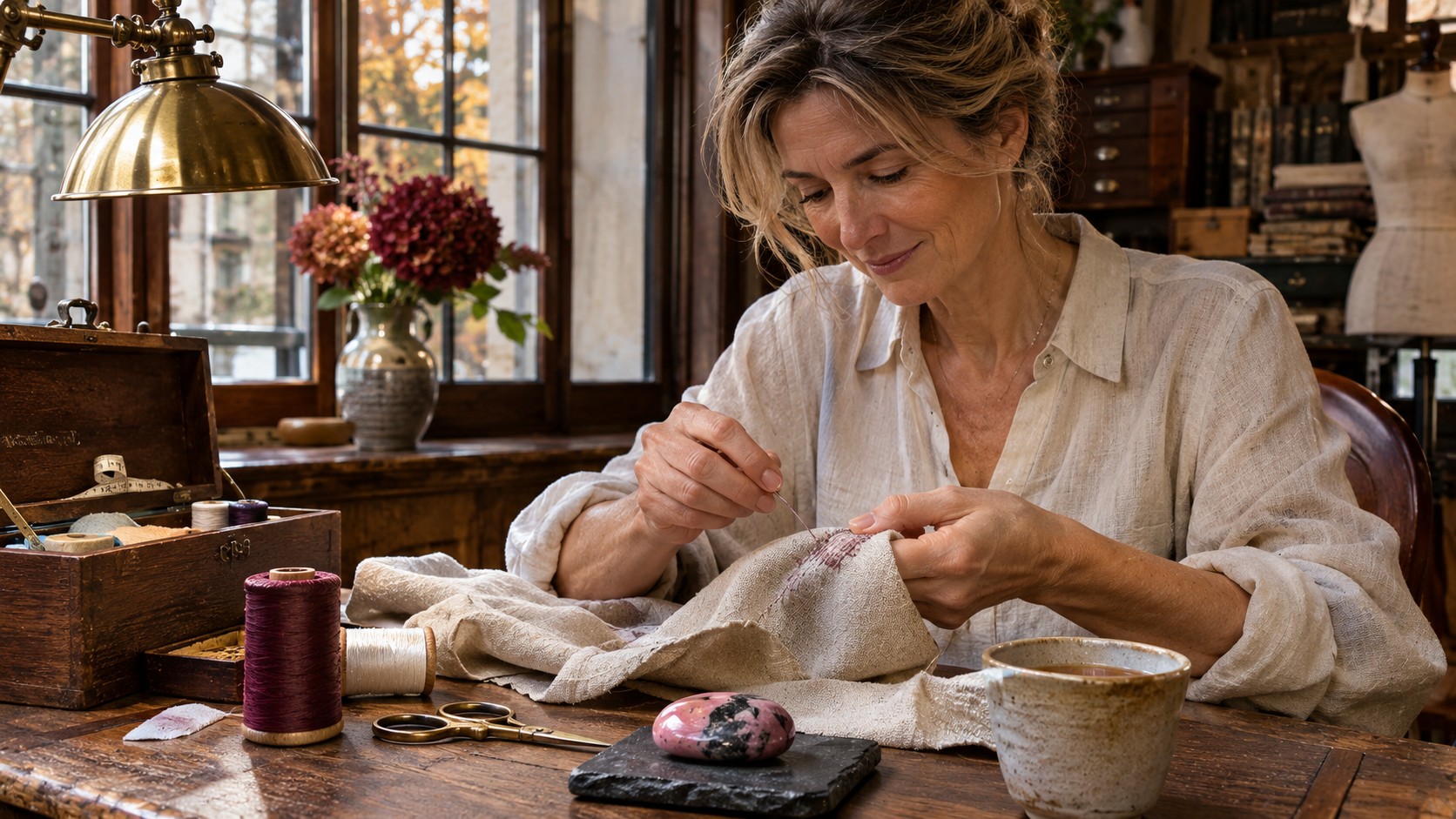
It combines one Rhodonite stone with the simple act of repairing a small piece of fabric.
The purpose is not to recreate an ancient gemstone ceremony.
Nor is it to suggest that people are damaged objects requiring repair.
Instead, the practice explores the relationship between care, imperfection and the freedom to decide what deserves our attention.
Its central principle is simple:
Compassion does not require pretending that nothing was ever damaged.
Table of Contents
Rhodonite in Contemporary Crystal Spirituality
Rhodonite occupies a distinctive place in modern crystal traditions concerned with compassion and emotional understanding.
Practitioners frequently associate it with kindness, forgiveness, patience and the ability to respond thoughtfully to difficult experiences.
Some describe it as a stone of emotional reconciliation.
Others connect it with self-acceptance or the symbolic process of moving beyond resentment.
These meanings vary between practitioners and spiritual systems.
They should not automatically be presented as ancient, universal teachings.
The historical use of a gemstone does not establish the historical origin of every contemporary metaphysical interpretation associated with it.
For the Visible Mend Ritual, Rhodonite represents a willingness to approach something with care.
It does not repair relationships.
It does not remove painful memories.
And it does not determine whether forgiveness is appropriate.
The gemstone serves as a symbolic companion to an ordinary activity.
Why Repair Can Become a Meaningful Symbol
Repair is a familiar human activity.
People mend clothing, restore furniture, preserve books and maintain objects that would otherwise deteriorate.
The reasons vary.
Sometimes repair is economical.
Sometimes it is environmentally responsible.
And sometimes an object holds memories that make it worth preserving.
A repaired item may retain evidence of its previous condition.
A patch may remain visible.
A seam may follow a slightly different line.
Or a replacement thread may contrast with the original fabric.
The object does not necessarily return to its earlier appearance.
Yet it may continue to be useful.
This provides a possible metaphor for compassion.
Care does not always mean restoring something to an imagined state of perfection.
Sometimes it means acknowledging what exists and responding appropriately.
However, the metaphor has limits.
People are not damaged garments.
Emotional experiences cannot necessarily be repaired through a simple sequence of actions.
And not every relationship should be preserved.
The Visible Mend Ritual uses textile repair as an invitation to reflect, not as a model that human relationships must follow.
The Cultural History of Mending
Repairing textiles has a long and varied history.
Before clothing became widely available as inexpensive, frequently replaced consumer goods, maintaining garments was an important household skill in many societies.
People darned socks.
Reinforced worn areas.
Replaced buttons.
And reused fabric from garments that could no longer serve their original purpose.
The Nederlands Openluchtmuseum in Arnhem documents these practices through its historical textile collections.
Its educational article Waardeer het, repareer het explores the repair and reuse of clothing.
The museum explains that repairs were often designed to be discreet, particularly on garments worn for formal occasions.
However, repaired everyday clothing also forms an important part of its historical collections.
These objects provide evidence of ordinary life, resourcefulness and changing attitudes toward material possessions.
The history of textile repair is not a history of Rhodonite spirituality.
There is no basis for claiming that the museum’s historical garments were repaired through gemstone rituals.
The connection made in this article is a modern symbolic interpretation.
Visible Mending and the Acceptance of Imperfection
Visible mending takes a different approach from attempting to conceal every repair.
Instead of matching the original fabric perfectly, a person may choose a contrasting thread or patch.
The repair remains apparent.
It becomes part of the object’s appearance.
This approach can be practical, decorative or personally expressive.
It does not necessarily represent a spiritual philosophy.
Nevertheless, contemporary practitioners sometimes appreciate visible mending as a metaphor for accepting imperfection.
A repaired garment may remain useful without appearing untouched.
Its history is not erased.
For the Rhodonite ritual, the visible stitch represents an act of care.
It does not represent the elimination of a problem.
The distinction matters.
Compassion is not the same as denial.
And accepting imperfection does not mean accepting harmful circumstances.
Repair as Cultural Heritage
Museums preserve evidence of textile-making and repair because these practices reveal important aspects of social history.
The London Museum holds a mending kit dating to the first half of the twentieth century.
Its collection record places the object within the history of work and clothing production.
Such objects remind us that repair was not merely decorative.
It involved labour, skill, available resources and social circumstances.
The Victoria and Albert Museum also maintains specialist conservation departments responsible for preserving textiles, dress and other historical objects.
Professional conservation involves careful examination and decisions about how an object should be stabilised or preserved.
Conservation is not identical to domestic visible mending.
A museum conservator may have different objectives from someone repairing an everyday garment.
Yet both demonstrate that continued care can be an intentional response to material deterioration.
The Rhodonite ritual does not reproduce museum conservation methods.
It uses a simple household activity as a symbolic exercise.
Why Rhodonite Is Associated With Compassion
Within contemporary crystal spirituality, Rhodonite is frequently described as a gemstone of emotional understanding.
Practitioners may associate it with forgiveness, patience and the desire to approach difficult situations with kindness.
Some believe it encourages the release of resentment.
Others interpret it as representing the possibility of restoring harmony after disagreement.
These beliefs are not scientifically established.
There is no reliable evidence that Rhodonite changes emotional states through supernatural energy.
Nor can it determine whether reconciliation is safe, desirable or appropriate.
For the Visible Mend Ritual, the gemstone represents a question rather than an answer:
What does a caring response look like in this situation?
Sometimes care may involve offering assistance.
Sometimes it may involve acknowledging a mistake.
And sometimes it may require establishing a boundary.
Compassion does not have to produce the same decision in every circumstance.
Compassion Is Not the Same as Reconciliation
Contemporary spiritual language sometimes treats forgiveness and reconciliation as though they are interchangeable.
They are not.
The American Psychological Association distinguishes forgiveness from reconciliation and from excusing harmful behaviour.
Forgiveness generally concerns a voluntary change in a person’s response toward someone who has caused harm.
Reconciliation concerns the restoration of a relationship.
The two processes are different.
A person may choose forgiveness without renewing contact.
Another person may decide that forgiveness is not appropriate or possible at a particular time.
And someone may maintain firm boundaries regardless of their emotional response.
The Rhodonite ritual does not require forgiveness.
It does not ask participants to reconnect with anyone.
Nor should gemstone spirituality be used to pressure someone into accepting mistreatment.
The practice concerns the broader idea of care.
That care may include protecting oneself.
Self-Compassion and Personal Boundaries
Compassion is sometimes imagined as a gentle response directed toward others.
However, contemporary psychological approaches to self-compassion also consider the importance of protecting oneself.
The Greater Good Science Center at the University of California, Berkeley, provides an educational exercise called the Fierce Self-Compassion Break.
The practice explores how kindness toward oneself can coexist with recognising harm, establishing boundaries and taking appropriate protective action.
This is an important distinction for the Rhodonite ritual.
Kindness does not always mean agreement.
Understanding another person’s circumstances does not remove their responsibility for harmful behaviour.
And choosing not to continue a relationship does not necessarily represent a lack of compassion.
The Visible Mend Ritual incorporates this distinction symbolically.
The participant decides what deserves care.
The gemstone does not make that decision.
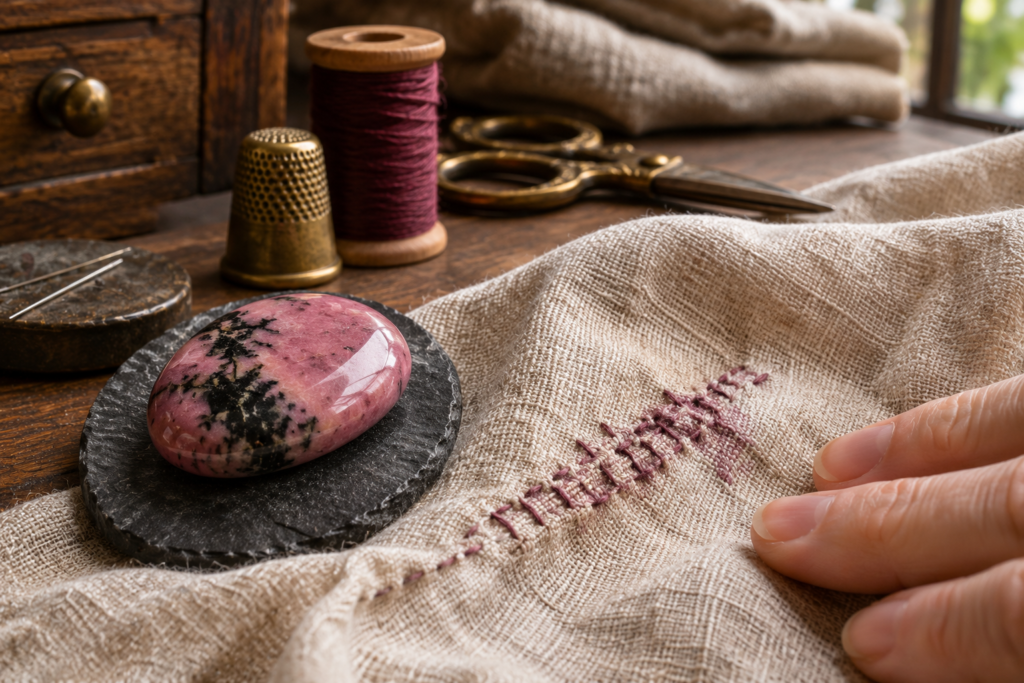
Introducing the Rhodonite Visible Mend Ritual
The following practice is an original contemporary symbolic exercise.
It is not an ancient Rhodonite ceremony.
It is not a clinically validated psychological intervention.
And it does not require belief in supernatural gemstone energy.
The activity involves repairing a small piece of ordinary fabric.
Choose something of modest practical or personal significance.
Avoid valuable antiques, delicate historic textiles or garments requiring specialist repair.
The exercise can take approximately fifteen to thirty minutes, depending on the chosen task and the participant’s experience.
You will need:
- One Rhodonite palm stone, cabochon or small polished stone.
- A piece of ordinary fabric with a small area suitable for repair.
- A needle and suitable thread, or a simple fabric patch.
- A safe, comfortable working surface.
- Good lighting.
If you are unfamiliar with sewing, practise on a scrap of fabric rather than a valued garment.
A pre-prepared patch or a simple decorative stitch may also be used.
The gemstone must remain separate from needles and sharp tools.
No additional crystals are required.
Stage One – Choosing Something Worth Caring For
Begin by selecting a suitable piece of fabric.
Perhaps a linen pouch has a loose seam.
A cotton cloth has developed a small tear.
Or a familiar garment has lost a button.
Choose an item that can be repaired safely with your existing skills.
The exercise does not require a meaningful family heirloom.
An ordinary household object is sufficient.
Place the Rhodonite beside the fabric.
Consider the following question:
Why have I chosen to care for this object?
Perhaps it is useful.
Perhaps it has sentimental value.
Or perhaps repairing it seems preferable to replacing it.
There is no correct answer.
The question simply acknowledges that care often begins with a choice.
Stage Two – Observing Without Immediate Judgement
Before beginning the repair, examine the fabric.
Notice the location of the damage.
Consider what kind of repair would be appropriate.
Do not begin by judging the object as ruined or worthless.
At the same time, do not pretend that the damage is absent.
The tear exists.
It may require attention.
And the repair may remain visible.
This stage introduces the symbolic theme of the exercise.
Recognition comes before action.
The Rhodonite does not provide insight through supernatural energy.
It represents the intention to approach the task thoughtfully.
Stage Three – Choosing a Visible Repair
Select a suitable thread or patch.
You may choose a colour that closely matches the fabric.
Alternatively, use a contrasting colour so that the repair remains visible.
For the symbolic version of this ritual, a visible repair is particularly appropriate.
It allows the finished object to show that care has taken place.
However, the choice is entirely personal.
A discreet repair is equally legitimate.
There is no spiritual requirement to make damage visible.
The purpose is to choose deliberately rather than follow an imagined rule.
Stage Four – The First Stitch: Recognition
Begin the repair carefully.
As you make the first stitch, consider:
Something needed attention, and I have chosen to respond.
This statement is not a magical affirmation.
It does not activate the Rhodonite.
It simply acknowledges the practical activity.
The fabric requires repair.
You are taking an appropriate action.
The first stitch represents recognition.
No emotional transformation is required.
Stage Five – Continuing Without Perfection
Continue the repair at a comfortable pace.
Some stitches may be uneven.
The thread may not follow a perfectly straight line.
The finished result may look different from the original fabric.
These are ordinary possibilities.
If a stitch needs correcting, correct it.
If the repair requires more skill than expected, stop and seek appropriate guidance.
The ritual does not require accepting unsafe or ineffective workmanship.
Instead, it distinguishes practical quality from an unrealistic demand for perfection.
An imperfect repair can still be useful.
And a careful effort does not lose its meaning because it requires adjustment.
Stage Six – The Second Question: Where Does Care End?
Pause at a safe point.
Place the needle down.
Look at the Rhodonite.
Consider another question:
Is there something I am trying to repair that is not mine to repair?
This question should be approached gently.
It does not require thinking about a painful relationship.
It may concern an ordinary responsibility.
Perhaps someone has taken on more tasks than they can reasonably manage.
Perhaps they feel responsible for another person’s decisions.
Or perhaps they are attempting to solve a problem beyond their control.
The question is optional.
If it does not feel relevant, return to the fabric.
The ritual does not require personal disclosure or emotional analysis.
Its purpose is to acknowledge that care has limits.
Stage Seven – Completing the Repair
Finish the practical work when appropriate.
Secure the thread.
Remove any loose needles or pins.
Inspect the fabric to ensure the repair is suitable for its intended use.
Then place the finished item beside the Rhodonite.
Notice what has changed.
The fabric may now be usable.
The repair may remain visible.
Or the object may require further attention later.
There is no requirement for the result to be beautiful.
The practical task is complete when the repair is satisfactory and safe.
The symbolic exercise can end there.
Why the Ritual Does Not Require Forgiveness
Some contemporary Rhodonite practices encourage participants to repeat affirmations about forgiveness.
Others suggest that the gemstone can dissolve resentment or restore emotional harmony.
These are spiritual beliefs rather than scientifically demonstrated effects.
The Visible Mend Ritual takes a different approach.
It does not require the participant to forgive anyone.
It does not ask them to excuse harmful behaviour.
And it does not treat reconciliation as an obligation.
The fabric is being repaired because the participant has chosen to repair it.
That choice does not establish a duty to repair every relationship.
In some circumstances, maintaining distance may be the appropriate response.
Compassion and boundaries can coexist.
The Difference Between Repairing an Object and Repairing a Relationship
The metaphor of mending can be appealing.
A torn seam is repaired.
A damaged object becomes usable again.
And a visible stitch records the work that has been done.
Human relationships, however, are more complicated.
They involve independent people.
Different experiences.
Responsibilities.
Trust.
And sometimes serious harm.
A relationship cannot necessarily be restored through one person’s effort.
An apology may be insufficient.
Trust may not return.
Or renewed contact may be unsafe.
The Rhodonite ritual should never be interpreted as a promise that relationships can be healed through symbolic action.
Its practical activity concerns fabric.
Its emotional meaning remains optional and personal.
What Research Says About Arts, Crafts and Wellbeing
Creative and craft activities have attracted increasing scientific interest.
A 2024 study published in Frontiers in Public Health examined associations between arts-and-crafts participation and subjective wellbeing.
The researchers analysed survey data from 7,182 adults in England.
Participation in creating arts and crafts was associated with higher reported life satisfaction, happiness and a stronger sense that life was worthwhile, after accounting for several demographic and health-related variables.
However, the study was observational.
It cannot establish that crafting caused those outcomes.
Nor did it specifically test Rhodonite rituals or visible-mending exercises.
People who engage in crafts may differ from non-participants in ways that are difficult to measure fully.
The research provides context for the possible personal value of creative activity.
It does not validate supernatural gemstone effects.
Why Making Something Can Feel Meaningful
A craft activity produces a tangible result.
A person begins with materials.
Makes decisions.
Performs practical actions.
And observes the outcome.
This can create a sense of participation in a process.
For some individuals, the experience may be satisfying.
Others may find it frustrating or tiring.
There is no guarantee that sewing will produce relaxation or emotional clarity.
The Visible Mend Ritual should therefore remain flexible.
The participant may enjoy the craft activity without attaching spiritual meaning to it.
Alternatively, they may appreciate the Rhodonite as a symbolic reminder of compassion.
Neither interpretation requires a claim of therapeutic effectiveness.
Rhodonite and the Heart Chakra
Within contemporary seven-chakra spirituality, Rhodonite is frequently associated with the heart chakra.
Modern practitioners often connect this chakra with love, compassion, emotional openness and relationships.
Some interpret Rhodonite as a stone that supports forgiveness or helps balance emotional energy.
These correspondences vary between spiritual systems.
They should not automatically be presented as universal ancient teachings.
Historical South Asian chakra traditions developed within diverse religious and philosophical contexts.
Modern gemstone correspondence charts do not necessarily reproduce those historical systems.
There is no reliable biomedical evidence that Rhodonite balances an anatomical heart-chakra energy centre.
For the Visible Mend Ritual, chakra symbolism is optional.
The gemstone may simply represent the human value of compassion.
A Rhodonite Pocket Stone for Everyday Kindness
The full mending exercise may not always be practical.
A small Rhodonite pocket stone can serve as a private symbolic reminder.
For example, someone may carry it before a difficult but ordinary conversation.
During a busy day involving several responsibilities.
Or while considering how to respond to a minor disagreement.
When noticing the stone, they might ask:
Can I respond with care without ignoring my own needs?
The question does not require a particular answer.
Sometimes a kind response may involve listening.
Sometimes it may involve saying no.
And sometimes it may involve taking time before making a decision.
The gemstone does not determine the outcome.
Its role is symbolic.
A Rhodonite Palm Stone for Seated Reflection
Readers who prefer a quiet practice without sewing may use a Rhodonite palm stone during a brief period of reflection.
Choose a comfortable chair.
Place the stone in your hand or on a nearby table.
Consider something ordinary that you have cared for recently.
It might be a household object.
A garden plant.
A pet.
Or a practical responsibility.
Notice what that care involved.
Time.
Attention.
Effort.
Perhaps patience.
There is no need to interpret the experience as evidence of spiritual energy.
The exercise simply invites reflection on care as an action.
If it becomes uncomfortable, discontinue it.
Rhodonite Cabochons and Symbolic Jewellery
Some contemporary practitioners prefer wearing Rhodonite rather than keeping a separate meditation stone.
A cabochon incorporated into jewellery may serve as a discreet personal symbol.
The wearer might associate it with kindness or the intention to maintain healthy boundaries.
There is no evidence that wearing Rhodonite close to the heart produces therapeutic effects.
Nor does the gemstone need to touch the skin to fulfil a symbolic role.
The meaning belongs to the person wearing it.
A small pocket stone, palm stone or cabochon can serve the same general symbolic purpose.
No particular size or form is required.
Rhodonite as a Centre Stone
Contemporary crystal-grid practices sometimes place Rhodonite at the centre of an arrangement intended to represent compassion or emotional harmony.
Practitioners may believe that surrounding stones amplify or direct spiritual energy.
These claims are not scientifically established.
For the Visible Mend Ritual, a single Rhodonite is sufficient.
It may be placed beside the fabric.
No geometric pattern is necessary.
No additional gemstones are required.
And no energetic activation is needed.
The arrangement represents the participant’s intention to approach the activity with care.
It does not create a measurable healing field.
A Simple Fabric-and-Stone Reflection Arrangement
Readers who enjoy visual symbolism may create a small arrangement after completing the repair.
Place the repaired fabric on a clean wooden surface.
Position the Rhodonite beside it.
Leave the visible stitches unobstructed.
The fabric represents practical care.
The gemstone represents the chosen theme of compassion.
The arrangement can remain in place briefly or be put away immediately.
There is no requirement to preserve it as an altar.
Nor must the repaired fabric become a permanent spiritual object.
It may simply return to ordinary use.
This is an important part of the practice.
The purpose of repair is not necessarily to create a display.
It may be to allow something useful to continue serving its purpose.
Compassion Without Self-Sacrifice
Spiritual discussions of compassion sometimes emphasise giving, understanding and forgiveness.
However, care directed toward others should not automatically require abandoning personal needs.
The Greater Good Science Center’s work on fierce self-compassion highlights the importance of combining kindness with protective action.
The Rhodonite ritual can reflect this distinction.
A person may care about someone while maintaining boundaries.
They may acknowledge another person’s difficulties without assuming responsibility for every consequence.
And they may decide that a relationship should not continue.
The gemstone does not provide moral authority for these decisions.
It simply represents an opportunity to consider what care means in a particular situation.
When the Repair Should Not Be Attempted
Not every object should be repaired through a simple household technique.
Delicate historic textiles may require professional conservation.
Certain garments may need specialised equipment.
And some damaged materials may no longer be safe or practical to use.
The Visible Mend Ritual should not encourage careless restoration.
If an object is valuable, fragile or historically important, consult an appropriate specialist.
The same principle applies to the metaphor.
Not every difficult situation can be resolved through individual effort.
Some problems require professional assistance.
Others require practical changes.
And some cannot be repaired at all.
The ritual does not promise otherwise.
A No-Sew Variation
Not everyone enjoys sewing.
Some people may have limited dexterity, visual difficulties or other reasons to avoid needles.
A no-sew variation is possible.
Choose a small piece of ordinary fabric.
Place it on a stable surface beside the Rhodonite.
Select a suitable decorative patch or ribbon.
Arrange it over the area you wish to cover.
You may simply explore the visual composition without permanently attaching anything.
Alternatively, use a safe fabric-repair method appropriate to the material and your abilities.
The symbolic meaning remains the same.
Care involves noticing, choosing and responding.
The exercise does not require manual precision.
The Value of Leaving a Repair Visible
A visible stitch can record an act of maintenance.
It shows that an object has been used.
That something changed.
And that someone decided to continue caring for it.
This can be appreciated without attaching a supernatural explanation.
However, the visible repair should not become a demand that people display their personal difficulties.
Privacy is also valuable.
Not every experience needs to be shared.
Not every emotional challenge requires a public narrative.
And not every act of care needs to be recognised by others.
The Rhodonite ritual is private unless the participant chooses otherwise.
Can Rhodonite Help With Forgiveness?
Contemporary crystal practitioners sometimes believe that Rhodonite encourages forgiveness.
They may use it during meditation or carry it while considering a difficult relationship.
These beliefs are not supported by reliable scientific evidence of gemstone energy.
Forgiveness is a complex psychological and personal process.
It cannot be guaranteed by holding a stone.
Nor should it be treated as a required outcome of spiritual practice.
The American Psychological Association distinguishes forgiveness from reconciliation and excusing wrongdoing.
This distinction matters.
A person may choose to forgive without restoring a relationship.
Another person may not be ready or willing to forgive.
The Visible Mend Ritual respects both possibilities.
Why the Practice Should Remain Optional
Symbolic rituals can be personally meaningful.
But they can also become burdensome if surrounded by rigid expectations.
The Rhodonite does not need to be placed in a precise direction.
The thread does not need to have a prescribed colour.
The repair does not need a particular number of stitches.
And the activity does not become spiritually ineffective if interrupted.
There is no scientifically established gemstone energy that can be lost through an imperfect procedure.
If the exercise feels frustrating, stop.
If the object is unsuitable, choose another.
And if the symbolic interpretation does not appeal to you, the fabric can simply be repaired without a ritual.
A Weekly Practice of Ordinary Care
Readers who appreciate the exercise may adapt its central idea into a weekly routine.
Choose one small, manageable act of maintenance.
Repair a loose button.
Care for a familiar household object.
Clean an item that has been neglected.
Or organise something that needs practical attention.
The Rhodonite may remain nearby as a symbolic reminder.
There is no requirement to complete a new craft project every week.
The purpose is not to increase productivity.
Nor is it to create another obligation.
It is simply to recognise that care can take practical forms.
The activity may be meaningful even when no spiritual interpretation is involved.
Sustainability and the Meaning of Repair
Repairing usable objects may also reduce the need for replacement.
However, the environmental consequences depend on the materials, methods and circumstances involved.
A repair is not automatically environmentally beneficial in every situation.
Nor does the spiritual association between Rhodonite and compassion establish that gemstone use is environmentally harmless.
Gemstones are physical materials obtained through extraction and processing.
Their sourcing can involve environmental and social considerations.
The Visible Mend Ritual requires only one stone.
There is no need to acquire additional gemstones or create elaborate arrangements.
A stone already owned is entirely suitable.
The practical focus remains on caring for an existing object.
What Scientific Research Does Not Establish
Research into arts and crafts provides useful educational context for creative activities.
Psychological resources also explain the distinction between forgiveness and reconciliation.
And university-based self-compassion exercises explore the relationship between kindness and personal boundaries.
However, these sources do not establish that Rhodonite possesses healing energy.
They do not demonstrate that a gemstone improves the psychological effects of crafting.
Nor do they validate the Visible Mend Ritual as a clinical intervention.
The exercise has not been experimentally evaluated.
Its meaning is symbolic and personal.
Any benefits associated with ordinary craft participation should not be attributed automatically to the gemstone.
Final Reflection: Care Does Not Erase History
A repaired piece of fabric may never look exactly as it did before.
The thread may be visible.
The colour may differ.
And the object may carry evidence of years of use.
Yet it may remain useful.
Perhaps even more personally meaningful.
Within contemporary crystal spirituality, Rhodonite’s association with compassion offers an interesting symbolic perspective on this ordinary act of repair.
But the gemstone does not heal emotional wounds through scientifically demonstrated energy.
It cannot restore trust.
It cannot guarantee forgiveness.
And it cannot determine which relationships deserve another opportunity.
The Visible Mend Ritual asks something simpler.
Can care be expressed through a deliberate action?
Can imperfection be acknowledged without immediately treating it as failure?
And can compassion coexist with the freedom to establish boundaries?
The Rhodonite remains a symbol.
The fabric receives the practical repair.
The meaning belongs to the participant.
Compassion does not require erasing what happened.
Sometimes, it means choosing carefully what deserves another stitch — and recognising that not everything is ours to mend.
References & Further Reading
The following sources provide historical, cultural, psychological and scientific context for textile repair, creative activities, self-compassion, personal boundaries and forgiveness.
They are drawn from museums, a professional psychological organisation, a university-based research centre, a peer-reviewed journal and a government health institution.
None establishes supernatural healing, emotional-balancing or chakra-related properties of Rhodonite.
1. Nederlands Openluchtmuseum – Waardeer het, repareer het
Institution: Nederlands Openluchtmuseum, Arnhem, Netherlands
Type: Museum historical and cultural education
Language: Dutch
This educational article explores the history of repairing, altering and reusing clothing.
It discusses the significance of repaired garments in museum collections and how attitudes toward visible and invisible repairs have changed.
The source provides historical context for textile mending, independently of gemstone spirituality.
Direct source:
https://www.openluchtmuseum.nl/nl/verdiep/waardeer-het-repareer-het
2. London Museum – Mending Kit
Institution: London Museum, United Kingdom
Collection: Social History, 1900–1950
Type: Museum collection record
This historical collection entry documents a mending kit dating from the first half of the twentieth century.
It provides material evidence of textile repair equipment and connects the object with the social history of clothing production and labour.
Direct source:
https://www.londonmuseum.org.uk/collections/v/object-499578/kit-mending-kit
3. Victoria and Albert Museum – Conservation
Institution: Victoria and Albert Museum, London
Type: Museum conservation and educational information
The museum explains its approach to preserving and conserving historical objects, including textiles and dress.
Its conservation work demonstrates the importance of specialist knowledge, material care and preservation.
Professional conservation should be distinguished from ordinary household mending.
Direct source:
https://www.vam.ac.uk/info/conservation
4. Keyes et al. – Creating Arts and Crafting Positively Predicts Subjective Wellbeing
Authors: Helen Keyes and colleagues
Publication: Frontiers in Public Health
Published: 2024
DOI: 10.3389/fpubh.2024.1417997
Type: Peer-reviewed observational research
This study analysed data from 7,182 adults in England.
Participation in arts and crafts was associated with higher reported life satisfaction, happiness and a sense that life was worthwhile after adjustment for several measured factors.
Because the study was observational, it does not establish causation.
It also did not investigate gemstone rituals.
Full open-access article:
https://www.frontiersin.org/journals/public-health/articles/10.3389/fpubh.2024.1417997/full
5. American Psychological Association – Forgiveness
Institution: American Psychological Association
Type: Professional psychological education
Published: 2024
This resource explains forgiveness and distinguishes it from reconciliation, excusing wrongdoing and simply accepting harmful behaviour.
It provides important psychological context for discussing Rhodonite’s contemporary spiritual associations with forgiveness.
Direct source:
https://www.apa.org/topics/forgiveness
6. University of California, Berkeley – Fierce Self-Compassion Break
Institution: Greater Good Science Center, University of California, Berkeley
Programme: Greater Good in Action
Type: University-based, research-informed contemplative practice
This educational exercise explores self-compassion in situations involving boundaries, unfair treatment and the need for personal protection.
It demonstrates that compassion can involve active self-protection rather than passive acceptance.
The practice does not investigate Rhodonite.
Direct source:
https://ggia.berkeley.edu/practice/fierce_self_compassion_break
7. National Center for Complementary and Integrative Health – Meditation and Mindfulness: Effectiveness and Safety
Institution: US National Institutes of Health
Type: Government evidence-based health education
This resource reviews research into meditation and mindfulness, including possible benefits, methodological limitations and potential adverse experiences.
It provides context for distinguishing optional reflective practices from established psychological or medical treatment.
Direct source:
https://www.nccih.nih.gov/health/meditation-and-mindfulness-effectiveness-and-safety
Educational and Scientific Clarification
Rhodonite’s associations with compassion, forgiveness, emotional healing, reconciliation, kindness and the heart chakra belong to contemporary crystal spirituality.
These interpretations are not scientifically established therapeutic or supernatural properties.
There is no reliable evidence that Rhodonite heals emotional wounds, removes resentment, restores relationships, balances anatomical energy centres or influences psychological processes through gemstone energy.
The Rhodonite Visible Mend Ritual described in this article is an original contemporary symbolic exercise.
It is not a historically documented gemstone ceremony.
It is not a clinically validated psychological intervention.
And it is not a substitute for professional healthcare, counselling or psychological treatment.
Research into creative activities, forgiveness and self-compassion does not establish additional benefits from Rhodonite.
The ritual should never be used to pressure individuals into forgiving harmful behaviour, restoring unsafe relationships or abandoning necessary personal boundaries.
Participation should remain voluntary, flexible and appropriate to the individual’s circumstances.
Gemstones and symbolic spiritual practices should never replace appropriate medical treatment, psychological support or professional assistance.