


Every beginning requires something.
Sometimes it is knowledge.
Sometimes preparation.
Sometimes encouragement.
And sometimes, despite having everything we need, we still hesitate.
A conversation remains unfinished.
A creative project never moves beyond the planning stage.
An important decision is repeatedly postponed.
Or a personal ambition remains an idea because the first step feels uncomfortable.
Throughout history, people have used meaningful objects to represent protection, determination and their hopes for the future.
Gemstones have frequently played a role in these traditions.
Among them, Carnelian has a particularly interesting cultural history.
Its warm orange-red appearance contributed to its use in ancient Egyptian amulets, where colour, material and symbolic form could carry religious significance.
Today, contemporary crystal spirituality frequently associates Carnelian with courage, vitality, motivation and personal initiative.
These modern energetic interpretations are spiritual beliefs rather than scientifically established gemstone properties.
There is no reliable evidence that Carnelian produces a special energy capable of increasing courage, removing fear or influencing future events.
Nevertheless, a small stone can become a meaningful personal reminder.
It can represent a decision.
Mark the beginning of a new undertaking.
Or encourage someone to remember an intention they have already chosen.
This article explores the historical symbolism of Carnelian and introduces a contemporary pocket stone ritual focused on one simple principle:
Courage does not always mean feeling ready. Sometimes it means taking a reasonable first step despite uncertainty.
Table of Contents
Carnelian: A Gemstone With a History of Symbolic Power
Carnelian has been valued as a decorative and symbolic material for thousands of years.
Its distinctive orange-red appearance made it particularly suitable for objects associated with colour symbolism.
Ancient Egypt provides well-documented examples.
The Metropolitan Museum of Art preserves numerous Egyptian Carnelian amulets, including small representations of hands, feet, protective symbols and divine figures.
These objects were not simply decorative accessories.
They belonged to a cultural and religious environment in which amulets could be understood as possessing protective or beneficial powers.
Their significance depended on several factors.
The material.
The colour.
The shape.
The religious imagery.
And sometimes inscriptions or accompanying ritual actions.
In ancient Egyptian belief, these elements could contribute to an amulet’s perceived effectiveness.
Modern scholarship studies these objects as evidence of historical religious practices.
Their existence demonstrates what people believed and how they expressed those beliefs.
It does not establish that the supernatural properties attributed to the amulets were physically real.
This distinction is essential when exploring the relationship between historical gemstone traditions and contemporary spirituality.
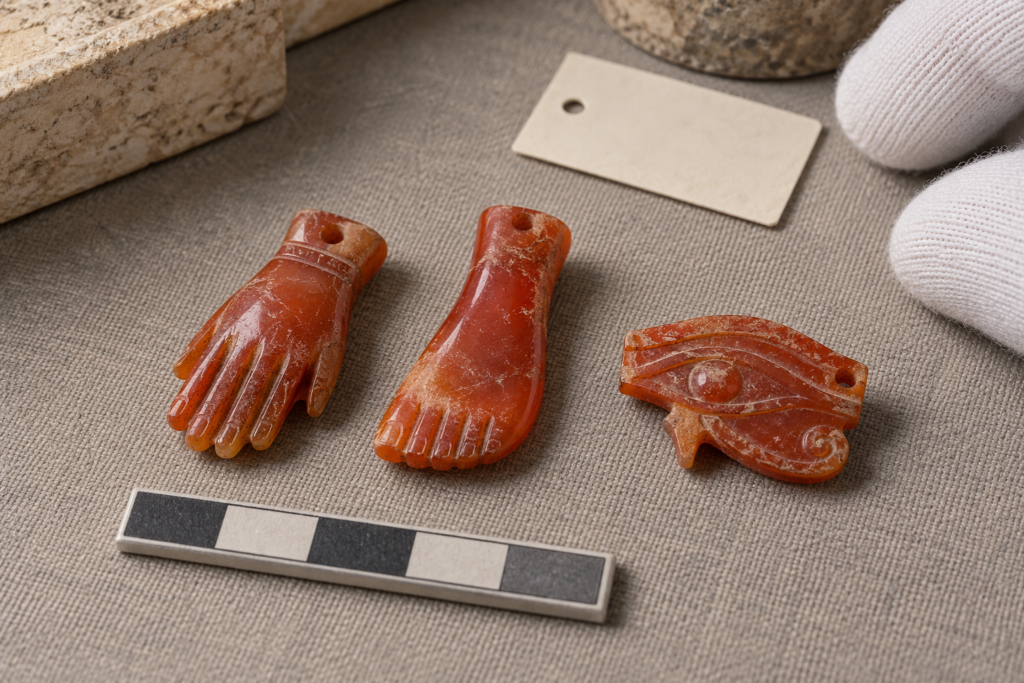
Ancient Egyptian Carnelian Amulets: Hands, Feet and Symbolic Protection
One particularly interesting example appears in the Metropolitan Museum of Art’s collection.
The museum preserves a pair of small Carnelian amulets representing a hand and a foot.
They date to approximately 2465–2100 BCE, spanning the Old Kingdom and First Intermediate Period.
According to the museum’s interpretation, small amulets representing hands and feet were commonly incorporated into bracelets and anklets during this period.
They were believed to protect the limbs and might also have been associated with abilities such as dexterity, creative potential or speed.
Carnelian was frequently used for these objects.
The museum explains that its orange-red colour, reminiscent of blood, contributed to its symbolic association with power and energy.
This is a historically documented interpretation of ancient Egyptian religious symbolism.
It should not be confused with modern claims that Carnelian emits measurable vitality-enhancing energy.
Nevertheless, the symbolism offers an interesting historical perspective.
The hand represents an instrument of action.
The foot represents movement.
Together, they suggest human activity and the ability to interact with the world.
For a contemporary reader, these objects may inspire reflection on the relationship between intention and action.
But the ritual developed later in this article is a modern interpretation.
It is not a reconstruction of an ancient Egyptian ceremony.
Why Colour Mattered in Ancient Egyptian Spirituality
Colour carried considerable symbolic significance in ancient Egyptian religious culture.
The Metropolitan Museum of Art’s educational essay Ancient Egyptian Amulets explains that the meaning of an amulet could depend partly on its colour and material.
Red was associated with dangerous forces but could also have protective significance.
This illustrates an important aspect of historical symbolism.
A colour did not necessarily possess one simple, universally positive meaning.
Its interpretation depended on context.
The orange-red appearance of Carnelian could contribute to its symbolic role within particular amulet traditions.
But it would be inaccurate to claim that all ancient Egyptians regarded Carnelian as a universal stone of courage or motivation.
Those broad descriptions are more characteristic of contemporary crystal spirituality.
The historical evidence supports specific uses and meanings.
It does not justify attributing every modern Carnelian belief to ancient Egypt.
From Ancient Amulets to Contemporary Pocket Stones
Today, Carnelian is commonly encountered in several forms.
A small tumbled pocket stone.
A cabochon.
Or a piece of natural rough material.
Within contemporary crystal spirituality, practitioners may associate these objects with determination, confidence, creativity or motivation.
Some believe Carnelian stimulates personal energy.
Others describe it as encouraging initiative or helping overcome hesitation.
These interpretations belong to modern spiritual practice.
They are not established medical or psychological effects.
The contemporary Carnelian pocket stone ritual takes a more practical approach.
Instead of assuming the gemstone changes the individual through invisible energy, the stone becomes a symbolic reminder of a consciously chosen intention.
The focus shifts from what the stone supposedly does to what the person decides to do.
The Spiritual Meaning of New Beginnings
New beginnings are frequently represented through symbolic objects and rituals.
A new calendar.
A written intention.
A meaningful piece of jewellery.
Or a small object kept close during an important transition.
Such objects can mark a personal decision.
They may remind someone of a commitment or represent a change in priorities.
In contemporary crystal spirituality, Carnelian is often associated with beginnings that require courage or initiative.
For example, someone might carry Carnelian when starting a creative project.
Preparing for an important conversation.
Learning a new skill.
Or entering an unfamiliar environment.
The stone does not guarantee success.
Nor does it eliminate uncertainty.
Its symbolic purpose is to remind the individual of the intention they have already established.
The beginning is not created by the gemstone. It is created by the person’s actions.
Courage Is Not the Absence of Fear
Courage is sometimes misunderstood as a complete absence of uncertainty.
But many meaningful decisions involve some degree of hesitation.
A person may feel nervous before speaking in public.
Uncertain about beginning a new project.
Or uncomfortable when approaching an unfamiliar responsibility.
These feelings do not automatically mean that the decision is wrong.
Nor do they mean that the individual lacks courage.
However, not every fear should be ignored.
Some concerns identify genuine risks.
A responsible approach distinguishes between manageable discomfort and situations that require additional preparation, assistance or caution.
The Carnelian ritual should never encourage reckless behaviour.
Its purpose is not to suppress fear.
Instead, it encourages a simple question:
What is one reasonable action I can take, given my circumstances and the information available?
This approach allows courage to coexist with careful judgment.
The Psychology of Turning Intentions Into Actions
Psychological research provides useful insights into why people sometimes struggle to act on their goals.
Having an intention does not automatically produce behaviour.
Someone may genuinely wish to begin a project but repeatedly postpone the first step.
The American Psychological Association discusses a planning technique known as an implementation intention.
This approach involves connecting a particular situation with a specific intended response.
It is often expressed through an if–then statement.
For example:
If I finish breakfast, then I will spend ten minutes working on my project.
Or:
If I arrive home from work, then I will prepare the materials I need for tomorrow.
The technique differs from a vague intention such as:
I want to become more productive.
An implementation intention identifies a recognisable situation and a concrete action.
Research suggests that this type of planning can support goal-directed behaviour in various circumstances.
A 2021 meta-analysis published in Frontiers in Psychology examined mental contrasting combined with implementation intentions.
The review included 21 empirical studies and 15,907 participants.
The findings suggested that the combined strategy could support goal attainment, although effects varied and the evidence had limitations.
These studies did not investigate gemstones.
They do not demonstrate that carrying Carnelian improves motivation.
However, they provide an educational foundation for the practical planning component of our contemporary ritual.
The Carnelian First-Step Pocket Ritual
The following exercise combines contemporary Carnelian symbolism with a simple intention-setting practice.
It is an original modern ritual.
It is not presented as an ancient Egyptian ceremony.
The ritual takes approximately five minutes.
Its purpose is to identify one meaningful action and create a practical plan for carrying it out.
Only one Carnelian stone is required.
A smooth pocket stone or small palm stone is particularly convenient.
A natural rough specimen may also be used if it is comfortable and safe to handle.
There is no requirement to use a particular shape.
No additional gemstones are necessary.
No candles, incense or ceremonial equipment are required.
Step One – Choose a Meaningful Beginning
Place your Carnelian on a clean, stable surface.
Sit comfortably.
Consider one area of your life in which you wish to begin something.
It may be a small creative project.
A personal learning goal.
An unfinished practical task.
Or a conversation you have been postponing.
Choose something realistic.
Avoid selecting several unrelated goals.
The purpose is to create clarity.
Ask yourself:
What would I like to begin, and why does it matter to me?
Take a moment to consider your answer.
The gemstone represents the intention.
It does not determine whether the goal is appropriate.
That judgment remains yours.
Step Two – Identify the Smallest Useful Action
Many goals appear overwhelming when considered as complete projects.
Writing a book.
Learning a language.
Reorganising a home.
Or developing a new skill.
Each involves multiple stages.
For this ritual, identify the smallest useful action that would represent genuine progress.
If your goal is writing, the action might be opening a document and drafting one paragraph.
If your goal is learning, it might be completing one short lesson.
If your goal is organising a workspace, it might be clearing one drawer.
The action should be specific enough that you can recognise when it has been completed.
It should also be manageable within your circumstances.
The aim is not to achieve everything immediately.
It is to make a beginning possible.
Step Three – Hold the Carnelian as a Symbol of Initiative
Take the Carnelian into your hand.
Observe its warm colour.
Notice its shape and surface.
For contemporary crystal practitioners, the stone may symbolise courage, determination or personal initiative.
You may choose to interpret this symbolically or spiritually.
There is no requirement to believe that the gemstone emits energy.
Hold the stone briefly while considering the action you have selected.
You may silently repeat:
I do not need to complete everything today.
I can begin with one reasonable step.
My actions will give meaning to this intention.
These statements are personal reflections.
They are not magical formulas.
They do not guarantee an outcome.
Their purpose is to express the decision in clear language.
Step Four – Create an If–Then Plan
Now turn the intention into a practical commitment.
Choose a specific situation in which you can perform the action.
For example:
If I sit at my desk after lunch, then I will work on my project for ten minutes.
Or:
If I finish my morning coffee, then I will review the first page of my study notes.
Avoid making the plan unnecessarily ambitious.
A manageable action is preferable to an unrealistic promise.
You may write the plan in a notebook.
Keep the wording simple.
The Carnelian remains beside the page as a symbolic reminder.
The psychological technique is the planning process.
The gemstone is an optional personal addition.
Step Five – Take the Stone With You
Place the Carnelian in a small pouch or secure pocket.
Carry it during the period when you intend to perform the action.
If you notice the stone, you may use that moment to remember your plan.
However, the physical presence of the gemstone is not essential.
You can complete the action without it.
The stone is a reminder rather than a source of motivation with scientifically established energetic properties.
Its meaning comes from the intention you have associated with it.
Step Six – Complete the First Action
When the planned opportunity arrives, attempt the action.
Begin with the manageable step you selected.
Do not wait for a dramatic feeling of confidence.
Do not expect the Carnelian to remove hesitation.
The action may still feel unfamiliar.
That is acceptable.
If circumstances change, adapt the plan.
The purpose is not rigid obedience to a ritual.
It is to support deliberate, reasonable behaviour.
Once the action is complete, acknowledge the progress.
You have moved from intention toward action.
What If You Do Not Complete the Plan?
A ritual should not become another source of unnecessary pressure.
Sometimes plans fail.
A schedule changes.
An unexpected responsibility appears.
Or a task turns out to be more complicated than anticipated.
These circumstances do not mean that the gemstone has failed.
Nor do they imply that you have insufficient spiritual energy.
Instead, reconsider the plan.
Was the action too large?
Was the chosen time unrealistic?
Was an important resource missing?
Could the task be divided into smaller stages?
Adjust the plan if necessary.
A useful intention-setting practice should support flexibility rather than self-criticism.
Carnelian as a Daily Pocket Stone
The complete ritual is not necessary every day.
A small Carnelian can also serve as an ordinary reminder of a chosen personal value.
For example, someone may associate the stone with initiative.
Another person may connect it with creativity.
A third may use it as a reminder to approach unfamiliar tasks thoughtfully.
The meaning is personal.
There is no requirement to follow a universal interpretation.
A pocket stone can be particularly convenient because it is small and portable.
However, carrying the gemstone is optional.
A written note, calendar reminder or another meaningful object may serve the same practical purpose.
The ritual should never create dependence on possessing a particular stone.
A Carnelian Ritual for Creative Beginnings
Carnelian is frequently associated with creativity in contemporary crystal spirituality.
Some practitioners believe it stimulates artistic inspiration or encourages creative expression.
These energetic claims are not scientifically established.
Nevertheless, the gemstone can represent a creative intention.
Consider someone who wishes to begin drawing.
They may have purchased materials but never started.
For a simple ritual, they could place a Carnelian beside their sketchbook.
Then identify one manageable action.
For example:
If I sit down after dinner, then I will spend five minutes drawing an ordinary object.
The stone symbolises the decision to begin.
The actual creative work comes from observation, practice and effort.
This distinction allows the gemstone to remain meaningful without attributing unsupported powers to it.
A Carnelian Ritual Before an Important Conversation
Another contemporary application involves preparing for a difficult but necessary conversation.
The individual may wish to express a concern.
Ask a question.
Or discuss a decision.
Carnelian can symbolise the intention to approach the conversation with courage and respect.
However, the stone cannot influence the other person’s response.
It does not guarantee agreement.
And it does not make an unsafe conversation appropriate.
The practical preparation should include considering what needs to be communicated, choosing a suitable time and respecting the other person’s autonomy.
A useful intention might be:
I will communicate my concern clearly and listen carefully to the response.
The ritual focuses on the individual’s own behaviour.
Not on controlling someone else.
The Difference Between Courage and Recklessness
Spiritual discussions about courage sometimes encourage people to overcome every obstacle through determination.
But this can become misleading.
Not every hesitation is irrational.
Some situations require additional information.
Others involve financial, physical or emotional risks.
The Carnelian ritual should never be used to justify ignoring these concerns.
Courage can involve seeking professional advice.
Waiting until circumstances are safer.
Or deciding not to proceed.
A meaningful intention-setting practice should support thoughtful decisions.
It should not replace them.
Carnelian and the Symbolism of Personal Energy
Modern crystal spirituality frequently describes Carnelian as an energising stone.
Practitioners may associate it with vitality, enthusiasm or the sacral chakra.
The sacral chakra is commonly connected with creativity and emotional expression in contemporary seven-chakra systems.
These associations are spiritual interpretations.
They do not establish that Carnelian alters human energy levels through a measurable physiological mechanism.
Nor do they demonstrate that the gemstone affects an anatomical energy centre.
For the present ritual, we use the broader symbolic idea of initiative.
The stone represents the decision to direct attention toward a meaningful task.
This avoids confusing spiritual symbolism with established medical knowledge.
The Ancient Amulet and the Modern Reminder
There is an important difference between an ancient Egyptian Carnelian amulet and a contemporary pocket stone.
Ancient Egyptian amulets belonged to specific religious and cultural systems.
Their forms and materials could carry meanings connected with protection, regeneration or divine power.
A modern polished Carnelian carried as a reminder of a personal goal belongs to a different context.
The two should not be treated as identical practices.
Nevertheless, historical amulets demonstrate that people have long attributed symbolic significance to small, portable objects.
The modern ritual explores that broader human tendency without claiming direct continuity with an ancient ceremony.
Respecting the distinction makes the historical comparison more meaningful.
A Seven-Day Carnelian First-Step Practice
For readers who enjoy structured reflection, the ritual can be extended across seven days.
This is an original contemporary exercise, not a scientifically validated seven-day programme.
Day One – Choose
Identify one meaningful goal.
Day Two – Simplify
Break the goal into smaller actions.
Day Three – Prepare
Gather the materials or information required.
Day Four – Begin
Complete one manageable action.
Day Five – Adjust
Review any obstacles and revise the plan if necessary.
Day Six – Continue
Repeat the action or complete the next reasonable step.
Day Seven – Reflect
Consider what you have learned and whether the goal remains appropriate.
The Carnelian may accompany the process as a symbolic reminder.
But the progress comes from planning, available resources and practical action.
There is no requirement to complete every stage perfectly.
Does Carnelian Actually Increase Confidence?
There is no reliable scientific evidence that Carnelian itself increases confidence through a special energetic property.
Historical accounts of amulet beliefs do not demonstrate modern psychological effectiveness.
Likewise, research into intention-setting cannot be used as proof of gemstone healing.
These are different subjects.
The research concerns human planning and behaviour.
The gemstone contributes a personally chosen symbol.
Someone may find the ritual meaningful.
Another person may prefer a notebook or ordinary reminder.
Neither experience establishes supernatural causation.
The appropriate conclusion is that Carnelian can be used symbolically within a personal practice.
Its effectiveness as an independent therapeutic or confidence-enhancing agent has not been established.
The Importance of Personal Responsibility
A meaningful ritual should strengthen personal agency rather than replace it.
If someone believes a gemstone will automatically create success, they may overlook the practical steps required.
A project still needs planning.
A conversation still requires communication.
A skill still requires learning.
And important decisions still demand appropriate information.
The Carnelian pocket stone ritual therefore places responsibility with the individual.
The gemstone does not choose the goal.
It does not create the plan.
It does not perform the action.
It represents a decision that the person has made.
This is the central distinction between symbolic spiritual practice and claims of supernatural intervention.
When a Small Beginning Matters Most
Not every meaningful beginning is dramatic.
Sometimes progress is almost invisible.
Opening a notebook.
Making an appointment.
Preparing a workspace.
Reading the first page.
Or asking a necessary question.
These actions may appear ordinary.
But they can represent a transition from thinking about something to engaging with it.
The Carnelian ritual invites attention toward this moment.
Not because the gemstone guarantees success.
But because it provides a simple symbol for the decision to begin.
The practice is deliberately modest.
It does not promise transformation.
It encourages a manageable action.
The Deeper Meaning of Carnelian
Ancient Egyptian Carnelian amulets demonstrate how colour, material and symbolic form could contribute to religious meaning.
The small hand and foot amulets preserved by the Metropolitan Museum of Art provide particularly interesting examples.
They belonged to a world in which protective powers and bodily abilities could be associated with miniature objects.
Contemporary Carnelian spirituality uses different language.
Courage.
Creativity.
Motivation.
Personal initiative.
These modern associations should not be presented as identical to ancient Egyptian beliefs.
But they offer an opportunity to explore how people continue to use meaningful objects to express hopes and intentions.
For the contemporary pocket stone ritual, the symbolism is straightforward.
The stone represents a beginning.
The plan identifies a direction.
And the action gives the intention practical meaning.
The Courage to Take the First Step
A gemstone cannot promise that a new beginning will be easy.
It cannot remove every obstacle.
It cannot guarantee that an idea will succeed.
And it cannot replace preparation, judgment or effort.
But a small stone can become a personal symbol.
Something familiar.
Something tangible.
Something associated with a decision that matters.
Carnelian’s warm colour and historical amulet traditions make it an interesting choice for this purpose.
The stone may remind us of ancient beliefs about protection and symbolic power.
It may also represent contemporary ideas of courage and initiative.
Yet the most important part of the ritual does not occur while holding the gemstone.
It happens afterward.
When the notebook is opened.
When the first sentence is written.
When the conversation begins.
Or when the first practical task is completed.
The Carnelian represents the intention.
The plan creates an opportunity.
The action makes the beginning real.
And perhaps that is the most meaningful lesson of this contemporary gemstone practice.
We do not need to wait for a stone to give us courage.
We can use its symbolism to remind ourselves that thoughtful action is already within our possibilities.
Sometimes, the most important step is simply the first one.
References & Further Reading
1. The Metropolitan Museum of Art – Ancient Egyptian Amulets
Author: Isabel Stünkel
Institution: The Metropolitan Museum of Art
Published: February 2019
Type: Museum research and historical education
A scholarly introduction to the role of amulets in ancient Egyptian religious and cultural life.
The article explains how shape, colour, material, decoration and inscriptions could influence the perceived significance of an amulet.
It also discusses protective symbolism, religious beliefs and the historical use of small portable objects.
This source provides the principal historical foundation for the article.
https://www.metmuseum.org/essays/egyptian-amulets
2. The Metropolitan Museum of Art – Hand and Foot Amulets
Institution: The Metropolitan Museum of Art
Department: Egyptian Art
Period: Old Kingdom–First Intermediate Period
Date: Approximately 2465–2100 BCE
Type: Museum collection record and object interpretation
A documented pair of ancient Egyptian Carnelian amulets representing a hand and a foot.
The museum explains their historical association with protection and possible abilities such as dexterity, creative potential and speed.
The record also discusses the symbolic significance of Carnelian’s orange-red colour.
This source directly supports the article’s discussion of historical Carnelian amulet symbolism.
https://www.metmuseum.org/art/collection/search/688030
3. The Metropolitan Museum of Art – Wedjat Eye Amulet
Institution: The Metropolitan Museum of Art
Department: Egyptian Art
Period: Late Middle Kingdom
Date: Approximately 1850–1700 BCE
Material: Carnelian
Type: Museum collection record
A historically documented Carnelian amulet representing the wedjat eye.
The museum explains the relationship between this protective symbol and the Egyptian mythological tradition concerning the eye of Horus.
The object demonstrates that Carnelian could be incorporated into religious symbols associated with protection and regeneration.
https://www.metmuseum.org/art/collection/search/546821
4. American Psychological Association – What You Need to Know About Willpower: The Psychological Science of Self-Control
Institution: American Psychological Association
Published: January 2012
Type: Psychological science educational resource
An extensive educational overview of self-control, motivation and goal-directed behaviour.
The resource discusses implementation intentions, including the use of specific if–then plans to connect situations with intended actions.
It provides an evidence-informed foundation for the planning component of the Carnelian pocket stone ritual.
The research concerns human behaviour, not gemstone energy.
https://www.apa.org/topics/personality/willpower
5. Wang, Wang & Gai (2021) – A Meta-Analysis of the Effects of Mental Contrasting With Implementation Intentions on Goal Attainment
Authors: Guoxia Wang, Yi Wang and Xiaosong Gai
Publication: Frontiers in Psychology
Published: May 2021
Type: Peer-reviewed systematic review and meta-analysis
A scientific review examining the effects of mental contrasting combined with implementation intentions on goal attainment.
The analysis included 21 empirical studies and 15,907 participants.
The findings suggest that structured planning strategies may support goal achievement under certain conditions.
The research does not investigate gemstones or spiritual rituals.
https://pubmed.ncbi.nlm.nih.gov/34054628
6. Webb & Sheeran (2008) – Mechanisms of Implementation Intention Effects
Authors: Thomas L. Webb and Paschal Sheeran
Publication: British Journal of Social Psychology
Published: 2008
Type: Peer-reviewed psychological research
A scientific investigation into how implementation intentions influence goal-directed behaviour.
The researchers examined the relationship between specific situational cues, intended responses and goal achievement.
Their findings provide context for understanding why concrete action plans may be more useful than vague intentions.
This research supports the practical planning principles discussed in the article.
https://pubmed.ncbi.nlm.nih.gov/18096108
Important Educational and Scientific Clarification
The associations between Carnelian, courage, creativity, vitality, motivation and personal initiative are contemporary spiritual interpretations.
They are not scientifically established energetic or therapeutic properties.
Ancient Egyptian Carnelian amulets are historically documented objects. Their existence demonstrates religious beliefs and cultural practices, not proof that the supernatural powers attributed to them were physically effective.
The Carnelian First-Step Pocket Ritual presented in this article is an original contemporary contemplative exercise. It is not an authentic reconstruction of an ancient Egyptian ceremony.
Research into implementation intentions and goal attainment does not establish that Carnelian provides additional psychological benefits.
Gemstones and spiritual rituals should not replace appropriate medical care, psychological support, professional advice or practical decision-making.
[…] In certain modern metaphysical traditions, Pyrite is believed to attract wealth, strengthen personal determination or amplify the energy of abundance. […]