Some of the most meaningful objects we possess are not necessarily the most valuable.
An old photograph.
A handwritten recipe.
A small piece of jewellery.
A letter that has been carefully preserved.
Or an ordinary object that once belonged to someone important.
These possessions may appear unremarkable to an outsider.
Yet for the person who understands their history, they can carry extraordinary meaning.
They remind us of people.
Places.
Experiences.
And stories that might otherwise gradually disappear.
Within contemporary gemstone spirituality, amber is sometimes associated with warmth, protection, continuity and ancestral connections.
Its golden appearance has inspired symbolic interpretations involving sunlight, vitality and the preservation of memories.
These associations are spiritual and cultural interpretations rather than scientifically established energetic properties.
Nevertheless, amber offers a particularly interesting starting point for a practice centred on remembrance.
Its historical use in amulets, personal ornaments and funerary contexts demonstrates that people have attributed profound significance to this material for thousands of years.
Today, a small piece of amber can become part of a different kind of ritual.
Not an attempt to communicate with ancestors through supernatural means.
Not a method of recovering forgotten memories through mysterious energies.
But a deliberate practice of preserving the stories, experiences and relationships that connect one generation with another.
An amber memory ritual.
A practice in which a meaningful stone becomes a reminder to remember, listen and preserve.
Table of Contents
Why Amber?
Amber occupies an interesting position within the world of gemstones and traditional spiritual objects.
Unlike crystalline minerals, amber is an organic gem material.
Its warm appearance and long cultural history have contributed to its symbolic appeal.
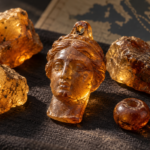
Throughout different historical periods, amber has been used in personal adornment, amulets and objects associated with religious or funerary practices.
Its significance was not identical across every culture.
Different communities attributed different meanings to the material.
In some contexts, amber was associated with protection.
In others, it appeared in offerings, personal ornaments or burial assemblages.
Contemporary spiritual practitioners sometimes describe amber as a material associated with ancestral wisdom, emotional warmth or the preservation of personal energy.
These are metaphysical interpretations.
There is no established scientific evidence that amber stores human memories, transmits ancestral knowledge or creates a protective spiritual field.
However, a meaningful object can serve as a reminder of something we wish to remember.
That distinction forms the foundation of our practice.
Amber does not preserve our memories through supernatural energy.
We preserve memories through the attention and meaning we give them.
Amber in the Ancient Mediterranean World
The historical significance of amber extends far beyond contemporary crystal spirituality.
Archaeological evidence demonstrates that amber was valued throughout the ancient Mediterranean and Near East.
The J. Paul Getty Museum’s scholarly publication Ancient Carved Ambers in the J. Paul Getty Museum examines its use in ornaments, amulets, religious offerings and funerary contexts.
During the Bronze Age, amber appeared among valuable objects associated with elite burials.
The famous Shaft Graves at Mycenae contained substantial quantities of amber beads.
These discoveries demonstrate the material’s importance within particular ancient societies.
Amber was also used to create decorative objects and religious offerings.
Its presence in archaeological contexts suggests that its value was not limited to appearance.
But interpretation requires care.
An amber bead found in a grave does not automatically reveal the precise beliefs of the person who owned it.
Archaeologists must consider the object’s context, associated materials, signs of use and relevant historical evidence.
The important conclusion is that amber participated in a complex world of personal, social and religious meanings.
Ancient Amber Amulets and Spiritual Protection
In antiquity, amber was sometimes believed to possess protective or medicinal properties.
The Getty Museum’s research discusses historical references to amber amulets, including accounts by the Roman author Pliny the Elder.
Pliny described beliefs concerning amber’s protective and medicinal value.
These accounts provide evidence of historical attitudes.
They do not establish that the supposed effects were real.
Amber objects were worn as ornaments and amulets.
Some were shaped into figures.
Others took the form of beads or pendants.
Their meanings could depend on their material, imagery, cultural context or the circumstances in which they were used.
In certain ancient Mediterranean settings, amber amulets were associated with protection during important stages of life.
They also appeared in funerary practices.
This historical relationship between personal objects, protection and remembrance is particularly relevant to our subject.
But the contemporary ritual described here is not a reconstruction of an ancient ceremony.
It is a modern practice inspired by the broader human tradition of giving meaningful objects a place in personal and family life.
Amber, Mourning and the Memory of the Dead
One of the most interesting aspects of ancient amber symbolism concerns its presence in burial contexts.
The Getty Museum’s research discusses amber ornaments and amulets associated with mourning and grave offerings.
Some archaeological examples show evidence of prolonged handling or wear before burial.
This raises an intriguing possibility.
Certain objects may have accompanied their owners through significant portions of their lives before eventually becoming part of funerary arrangements.
In some cases, objects may already have been old when they were buried.
They may have passed between individuals or generations.
However, researchers cannot always determine the precise personal history of an individual artefact.
An object showing signs of wear does not automatically prove that it was a family heirloom.
Nevertheless, the archaeological evidence illustrates something important.
Meaningful objects can have histories that extend beyond a single moment of use.
They may be worn.
Handled.
Preserved.
Transferred.
And eventually placed within new cultural or personal contexts.
This provides an interesting historical foundation for considering how ordinary objects can become associated with remembrance.
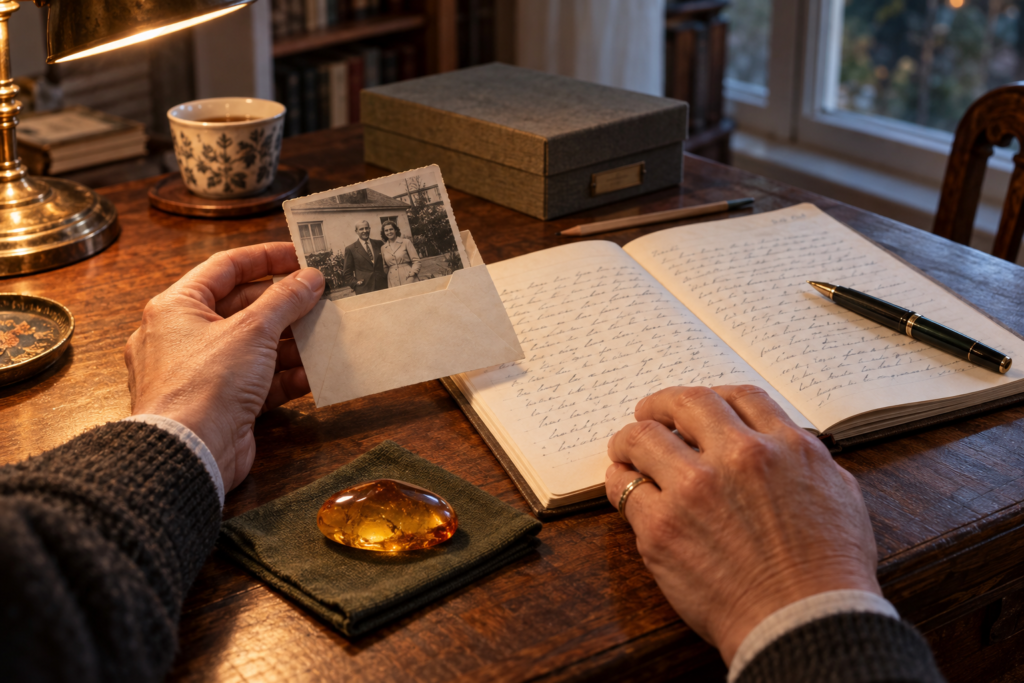
When an Object Becomes a Family Memory
Imagine a small pendant that belonged to a grandmother.
Perhaps it was worn regularly.
Perhaps it appeared in family photographs.
Perhaps it was kept in a familiar jewellery box.
Years later, another family member receives the pendant.
Its meaning has changed.
The object is no longer simply an ornament.
It has become connected with a person and a history.
The new owner may remember a particular occasion.
A conversation.
A family celebration.
Or the way the previous owner wore it.
The emotional significance does not depend on the material itself.
A similar experience could involve a watch, a book, a scarf or an old photograph.
The object becomes meaningful because of its associations.
For our amber ritual, the stone serves a comparable symbolic purpose.
It becomes a reminder that memories deserve attention.
And that stories can be preserved deliberately rather than left entirely to chance.
Ancestral Connection Without Supernatural Claims
Contemporary spiritual literature sometimes describes certain gemstones as instruments for communicating with ancestors.
Some practitioners believe that stones can transmit ancestral wisdom or strengthen connections with deceased relatives.
These interpretations belong to spiritual belief systems.
There is no reliable scientific evidence that amber can communicate with the dead, store ancestral consciousness or reveal information about previous generations.
Yet ancestral connection can have another meaning.
It can involve learning about the people whose lives preceded our own.
Understanding their experiences.
Preserving their stories.
Recognising the cultural traditions they followed.
And considering how their decisions influenced later generations.
This form of connection does not require supernatural assumptions.
It can be developed through conversation, historical research and the preservation of family records.
The amber memory ritual uses the stone as a symbolic reminder of that responsibility.
The Importance of Family Stories
Family history is often presented through names and dates.
Births.
Marriages.
Locations.
Occupations.
And relationships between generations.
These details are valuable.
But they do not necessarily reveal what everyday life felt like.
What did a childhood home look like?
Which meals were prepared for family celebrations?
What was school like?
How did someone meet their closest friend?
What traditions were important?
What did an ordinary working day involve?
These questions can reveal dimensions of family history that formal records may not preserve.
The Smithsonian Institution’s National Museum of African American History and Culture emphasises the importance of oral history in documenting personal experiences and preserving cultural memory.
Its educational guidance explains how recorded conversations can help future generations understand the lives of people who experienced historical events.
This principle applies to family storytelling more broadly.
An ordinary personal memory may become an important historical record when it is preserved.
The Amber Memory Ritual
The following practice is an original contemporary exercise developed around symbolic gemstone use and the preservation of personal stories.
It is not an ancient Mediterranean ceremony.
It is not presented as a traditional ancestral invocation.
And it does not claim to establish supernatural communication.
Its purpose is to create a meaningful moment in which a memory is recalled, documented and preserved.
You will need one small piece of amber.
A notebook or suitable recording method.
And, if available, a photograph or other meaningful personal object.
The practice can be completed individually.
It can also be adapted for a family gathering or a conversation with an older relative.
Step One – Choose Your Memory Stone
Select one small amber stone.
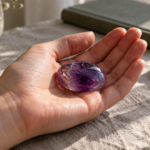
A polished amber palm stone may be suitable.
A small pendant or bead can also be used.
The exact form is not important.
You do not need a rare specimen.
You do not need an elaborate arrangement.
And you do not need an object that has been inherited.
A modern piece of amber can become meaningful through the personal associations you develop with it.
Place the stone on a stable surface.
Look at its warm colour.
Notice its appearance.
Then consider the purpose of the exercise.
Today, I will preserve one memory that matters to me.
The stone represents that intention.
Step Two – Choose One Person or Experience
Think of a person whose story you would like to preserve.
It might be a grandparent.
A parent.
A relative.
A close friend.
A teacher.
Or another person who played an important role in your life.
The person does not need to be deceased.
In fact, recording the experiences of living relatives can be particularly valuable.
You may also choose a personal experience rather than an individual.
A childhood celebration.
A family journey.
A meaningful home.
Or an important moment of change.
Avoid attempting to document an entire life in one session.
Choose one memory.
A specific subject is easier to explore carefully.
Step Three – Recall the Details
Hold the amber briefly.
Consider the memory.
Where did the experience take place?
Who was present?
What was happening?
Which details remain particularly clear?
Perhaps you remember the sound of someone’s voice.
The appearance of a room.
A familiar meal.
Or a phrase that was repeated during family gatherings.
Allow the memory to develop naturally.
Do not force missing details.
If something is uncertain, recognise that uncertainty.
Human memory is reconstructive rather than a perfect recording of past events.
A recollection may be meaningful without every detail being historically accurate.
The amber does not restore forgotten information.
It simply marks the intention to pay attention to what you remember.
Step Four – Write the Story
Open your notebook.
Begin with a simple sentence.
For example:
One of my earliest memories of my grandfather is…
Or:
Every winter, our family used to…
Or:
The first home I remember had…
Continue in your own words.
There is no need to produce a polished literary account.
The purpose is preservation.
Include details that future readers might find useful.
Names.
Places.
Approximate dates.
Relationships.
And explanations of customs that may no longer be familiar.
If you are uncertain about a detail, indicate that clearly.
For example:
I believe this happened around 1985, but I am not certain.
This is more useful than presenting an uncertain recollection as an established fact.
The Difference Between Memory and Historical Evidence
Personal memories are valuable.
But they are not identical to verified historical records.
Two people may remember the same event differently.
One may recall a particular conversation.
Another may remember a different sequence of events.
These differences do not automatically mean that someone is deliberately being dishonest.
Memory is influenced by perspective, attention and later experiences.
The Oral History Association recognises that oral histories preserve personal recollections shaped by individual and social contexts.
For a family memory project, this means that uncertainty should be acknowledged rather than concealed.
If two relatives remember an event differently, preserve both accounts where appropriate.
Do not silently combine them into a single supposedly definitive version.
The objective is to document experiences faithfully.
Not to manufacture a perfectly consistent family narrative.
Step Five – Give the Memory a Place
Once the story has been written, decide how it will be preserved.
You might create a dedicated memory notebook.
A family archive folder.
A collection of photographs with written explanations.
Or a digital document containing individual stories.
The amber can remain beside the notebook during the exercise.
Afterwards, return it to a safe place.
The stone does not need to be stored with the records.
Its symbolic purpose is to remind you to continue the practice.
The actual preservation depends on the written or recorded material.
Creating a Family Memory Corner
Some contemporary spiritual practitioners enjoy creating dedicated spaces for reflection and remembrance.
A simple memory corner can serve a similar purpose.
Choose a small shelf or table.
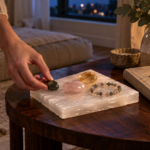
Place the amber on a stable stand or shallow tray.
Add one meaningful photograph.
Perhaps include a handwritten note or a copy of a family recipe.
Avoid creating an unnecessarily elaborate display.
The purpose is not to construct a universal ancestral altar.
Different religious and cultural traditions have their own established practices concerning remembrance and offerings.
Our memory corner is a contemporary personal arrangement.
It should not be described as an authentic ceremony borrowed from a particular culture.
Its function is straightforward.
It provides a visible reminder that family stories deserve to be preserved.
Recording the Stories of Living Relatives
One of the most valuable extensions of the amber ritual involves speaking with someone who can share their own experiences.
The Smithsonian Institution Archives provides detailed guidance on conducting oral history interviews.
Its recommendations include preparing questions, choosing a quiet location and allowing the interviewee to speak freely.
The guidance also emphasises consent.
A person should understand why an interview is being recorded and how the recording may be used.
They should be able to decline questions or stop the interview.
These principles are essential.
Family history should not be collected through pressure.
A person’s memories belong to their own experience.
Their willingness to share them must be respected.
A Simple Family Storytelling Session
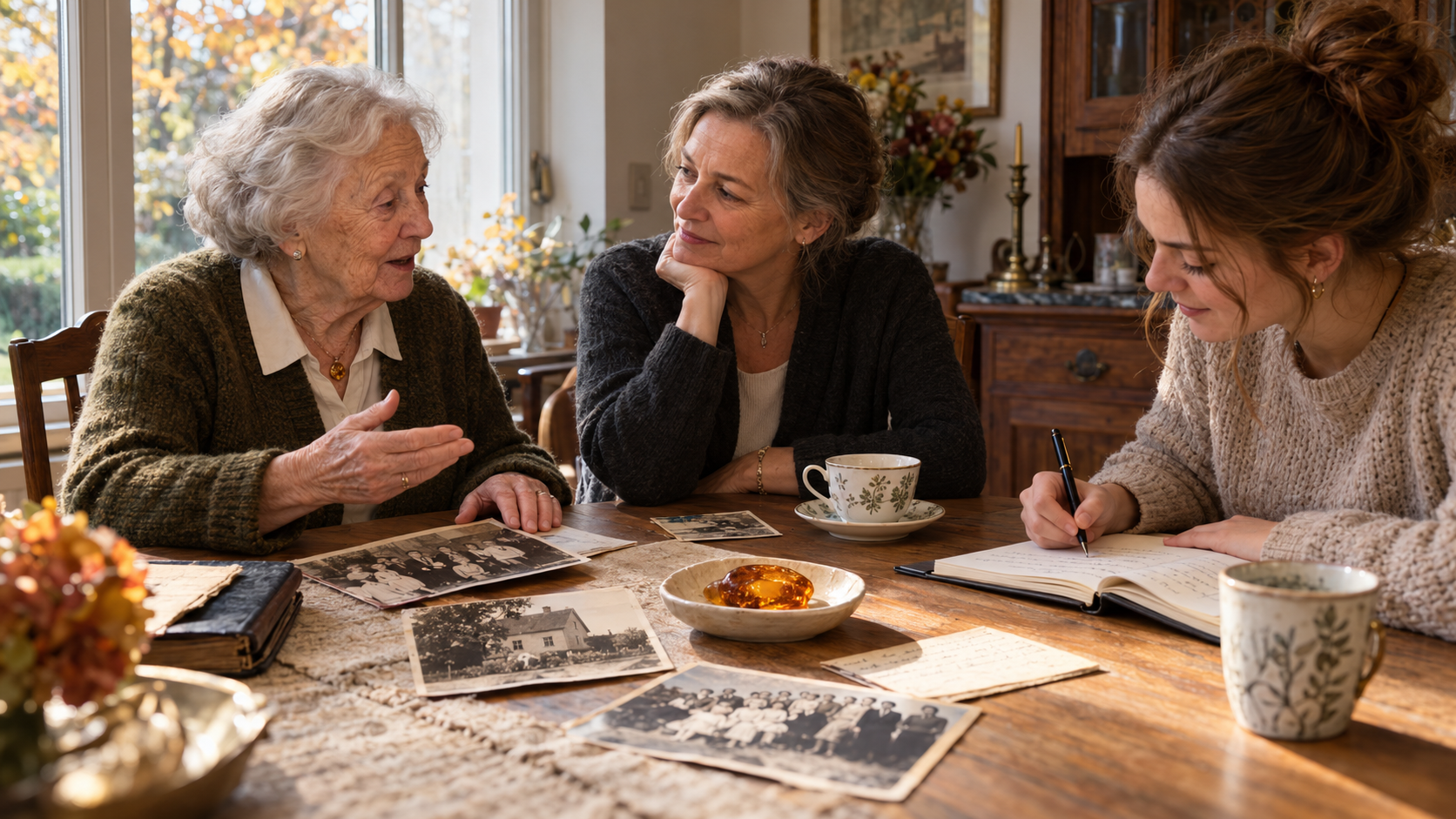
Arrange a comfortable meeting with a willing relative.
The amber may remain on a nearby table as a personal symbol.
It does not need to be part of the conversation itself.
Begin with ordinary questions.
What was your childhood home like?
What did you enjoy doing when you were young?
Which family traditions do you remember?
What was your first job?
How did your neighbourhood change over time?
Allow the conversation to develop naturally.
Avoid treating the meeting as an interrogation.
A small detail may lead to an unexpected story.
The Smithsonian’s oral history guidance encourages interviewers to remain flexible when a participant introduces a meaningful subject.
This is particularly important in family conversations.
The most valuable memory may not be the one you originally intended to record.
Preserving a Voice
Written memories are valuable.
But an audio recording can preserve additional details.
A person’s voice.
Their expressions.
The rhythm of their speech.
Their laughter.
And the way they tell a familiar story.
The Library of Congress provides educational guidance on preserving family stories.
It recommends recording basic contextual information, including the date, location and identities of the people involved.
For a private family recording, begin by confirming that everyone understands and agrees to the recording.
Then identify the date and participants.
Afterwards, store the file carefully.
Consider keeping a backup in a separate location.
Digital files can be lost through device failure, accidental deletion or changes in technology.
A meaningful memory deserves a practical preservation plan.
The Ethics of Family Remembrance
Not every family story should be shared publicly.
Some memories involve sensitive experiences.
Others concern people who have not agreed to have their private lives discussed.
A recording intended for one family member may not be appropriate for publication online.
The Oral History Association emphasises informed consent, respect for participants and clarity about how recorded material will be preserved and accessed.
These principles are useful even for informal family projects.
Before sharing a recording, photograph or written account, consider whether the people involved have agreed.
Respect requests for privacy.
Allow individuals to correct factual errors in their own accounts where appropriate.
And recognise that some stories may be meaningful precisely because they remain private.
Preservation does not require public exposure.
Amber and the Symbolism of Continuity
Within contemporary crystal spirituality, amber is sometimes associated with continuity between generations.
This interpretation can be understood symbolically.
A family story begins with one person.
It is shared with another.
Then perhaps repeated years later.
The story may change slightly.
New details may be added.
Other details may disappear.
But the act of sharing creates continuity.
The amber memory ritual uses a familiar object to mark this process.
The stone remains present as different stories are recorded.
Over time, it may become associated with the growing collection.
Not because it contains the memories.
But because it accompanies the deliberate work of preserving them.
A Ritual for Remembering Someone Who Has Died
For some people, remembrance concerns someone who is no longer alive.
A small personal ritual may provide an opportunity to acknowledge that relationship.
Choose a photograph or a meaningful memory.
Place the amber nearby.
Write down one story you would like to preserve.
It might concern a joyful experience.
An ordinary conversation.
A familiar habit.
Or something the person taught you.
There is no requirement to concentrate on the circumstances of their death.
The purpose is to remember an aspect of their life.
The ritual should remain voluntary.
If recalling the person causes significant distress, it is appropriate to stop.
Grief is highly individual.
A gemstone ritual is not a treatment for bereavement.
Continuing Bonds and the Psychology of Remembrance
Psychological research has examined how people maintain a sense of connection with someone who has died.
This area of study is often described as continuing bonds.
Continuing bonds may involve memories, meaningful objects, personal rituals or an ongoing sense of relationship with the deceased.
A systematic review published in Death Studies examined research concerning continuing bonds following bereavement.
The review included 79 studies.
Its findings suggest that maintaining connections through memories and meaning-making can sometimes provide comfort or support a continuing sense of identity.
However, the relationship between continuing bonds and adjustment to bereavement is complex.
Not every form of continuing connection is beneficial for every person.
Some experiences may be comforting.
Others may be distressing.
The research does not establish that everyone should maintain a particular type of bond.
Nor does it demonstrate any special effect from amber.
For our contemporary ritual, the relevant principle is modest.
Remembering someone can be personally meaningful, but the appropriate form of remembrance differs between individuals.
Remembrance Is Not the Same as Remaining in the Past
A memory ritual should not require someone to remain constantly focused on previous experiences.
Family history is meaningful partly because it helps us understand the present.
A story about a grandparent’s childhood may reveal how daily life has changed.
A recollection of migration may explain why a family settled in a particular region.
An old recipe may preserve a cultural tradition.
A photograph may reveal relationships that were never formally documented.
The purpose is not to idealise the past.
It is to understand it more carefully.
The amber becomes a reminder to preserve what is valuable without assuming that every earlier period was simpler or better.
What About Difficult Family Histories?
Not every family story is comforting.
Some involve conflict.
Separation.
Loss.
Migration under difficult circumstances.
Or experiences that remain painful.
A remembrance ritual should not require someone to reinterpret these experiences positively.
Nor should it encourage forgiveness where forgiveness is not freely chosen.
People may decide that certain memories are too difficult to explore.
Others may wish to document them carefully.
Both choices deserve respect.
For the amber memory ritual, choose subjects that feel manageable.
If a memory produces significant distress, discontinue the exercise.
Professional psychological support may be appropriate when traumatic memories interfere with daily life.
A gemstone cannot resolve trauma or replace appropriate care.
Family Traditions as Living Memory
Not every meaningful memory concerns a particular person.
Some involve traditions.
A meal prepared for a holiday.
A song sung during family gatherings.
A particular way of decorating a home.
A seasonal celebration.
Or a craft passed between generations.
These practices may carry cultural significance.
They can also change over time.
A family may adapt a recipe after moving to another country.
A celebration may incorporate new customs.
A language may gradually be spoken less frequently.
Recording these changes can be valuable.
Instead of assuming that traditions must remain completely unchanged, a family history project can document how they develop.
The amber ritual provides a symbolic occasion to preserve one such story.
Creating a Family Recipe Memory
Choose a recipe associated with someone important.
Write down the ingredients and preparation method.
Then record the story behind it.
Who usually prepared the dish?
When was it served?
Was it connected with a particular celebration?
Did the recipe change over time?
Perhaps someone remembers an ingredient that was difficult to obtain.
Or a particular kitchen where the meal was prepared.
These details transform an ordinary recipe into a personal historical record.
The amber may remain beside the notebook while the story is written.
Its role is symbolic.
The preserved knowledge is contained in the recipe and its accompanying history.
A Monthly Amber Storykeeping Practice
The ritual can become a recurring personal tradition.
Once a month, choose one memory to preserve.
The subject can change.
One month, record a childhood experience.
The next, document a family celebration.
Later, interview a relative.
Or identify the people in an old photograph.
Over time, these small contributions can form a substantial collection.
The practice does not need to become a demanding obligation.
Even a few carefully recorded stories may be valuable.
Consistency can help, but there is no spiritual requirement to follow a particular schedule.
The purpose is preservation, not ritual perfection.
An Amber Pocket Stone for Everyday Remembrance
A small amber stone can also be carried as a personal reminder.
Perhaps you are visiting a place connected with family history.
Meeting an older relative.
Or attending a family gathering.
The stone can symbolise your intention to remain attentive to the stories being shared.
There is no need to hold it constantly.
And there is no reason to believe that carrying it improves memory through supernatural means.
The meaningful action is ordinary.
Ask a question.
Listen carefully.
Record a detail.
Preserve a story.
The stone simply reminds you of that intention.
What About Amber’s Supposed Healing Properties?
Amber has been associated with protective and medicinal beliefs in several historical contexts.
Ancient writers described supposed benefits that reflected the medical and spiritual understandings of their time.
Contemporary crystal-healing traditions sometimes make similar claims.
However, historical use does not establish medical effectiveness.
There is no reliable scientific evidence that wearing amber jewellery relieves pain, treats illness or produces therapeutic effects through spiritual energy.
Particular caution is necessary concerning amber teething necklaces.
Medical and public-health authorities have warned that such jewellery can create choking and strangulation hazards for infants and young children.
Amber jewellery should not be used as a teething treatment.
For the memory ritual, amber is a symbolic object intended for appropriate adult handling or safe display.
It is not a medical device.
A Family Archive Without Expensive Equipment
Preserving memories does not require professional recording equipment.
A notebook can be sufficient.
A basic digital audio recording may also be useful when consent has been obtained.
Photographs can be scanned or carefully photographed.
Old letters can be transcribed.
Recipes can be documented.
The important elements are organisation and context.
Include names where known.
Record approximate dates.
Explain relationships.
Identify locations.
And preserve original wording when possible.
The Smithsonian and Library of Congress both provide educational resources for developing these practices.
The goal is not to create a perfect museum archive.
It is to prevent meaningful information from disappearing unnecessarily.
Why Ordinary Stories Matter
Family history often concentrates on extraordinary events.
War.
Migration.
Major achievements.
Historical turning points.
These experiences can be important.
But ordinary life also deserves attention.
How did people travel to work?
What did children do after school?
How were birthdays celebrated?
Which household tasks required the most effort?
What did a typical Sunday look like?
These details may seem too familiar to record.
Yet they can become fascinating to later generations.
Everyday life changes.
Objects disappear.
Customs evolve.
Language develops.
And familiar environments are transformed.
A story that seems ordinary today may become a valuable description of a world that no longer exists.
The Spiritual Meaning of Remembering
Within contemporary spirituality, remembrance can be understood as an expression of gratitude, continuity or respect.
Different people interpret these ideas differently.
Some understand ancestral connection through religious beliefs.
Others approach it through family history and cultural identity.
Still others find meaning in preserving personal experiences without adopting any supernatural interpretation.
The amber memory ritual can accommodate these different perspectives.
Its central action remains the same.
Choose something meaningful.
Give it attention.
Preserve it carefully.
The stone provides a symbolic focus.
The story provides the substance.
And the act of preservation gives the ritual its practical purpose.
A Stone Cannot Replace a Story
A meaningful object can remind us of someone.
But it cannot explain everything about their life.
A pendant may survive for generations while the story of its original owner disappears.
A photograph may remain in a family album after everyone who could identify the people pictured has died.
An old recipe may be preserved without anyone remembering who first prepared it.
This is why documentation matters.
The object and its history should remain connected whenever possible.
If an amber pendant has been inherited, record what is known about it.
Who owned it?
When was it acquired?
Why was it important?
Which details are certain?
Which are based on family recollection?
These questions may reveal a story worth preserving.
If the answers are unknown, acknowledge that honestly.
Uncertainty is preferable to an invented family history.
Passing the Ritual to Another Generation
The most meaningful outcome of the amber memory ritual may occur when another person becomes interested in the stories.
A child asks about an old photograph.
A younger relative discovers a family recipe.
Someone listens to a recording made years earlier.
Or a family member reads an account of an ancestor they never met.
At that moment, the memory moves beyond the person who originally preserved it.
It becomes part of a shared collection of knowledge.
The amber may remain associated with the project.
Perhaps it is displayed beside the family archive.
Perhaps it is passed to someone who wishes to continue recording stories.
But the most important inheritance is not the stone.
It is the knowledge that accompanies it.
The Difference Between Possession and Preservation
Owning a meaningful object does not automatically preserve its history.
A gemstone can remain in a collection for decades without anyone recording where it came from.
A piece of jewellery may be inherited without documentation.
A photograph can survive while the names of the people pictured are forgotten.
Preservation requires deliberate action.
A written note.
A recorded conversation.
A carefully maintained archive.
Or a simple explanation passed to another person.
The amber memory ritual encourages this transition.
From possession to understanding.
From remembering privately to documenting responsibly.
From admiring an object to preserving the story that gives it meaning.
Amber as a Symbol of Generational Continuity
Amber’s historical presence in ornaments, amulets and funerary objects demonstrates that people have valued it in many different ways.
Some ancient communities attributed protective powers to it.
Others incorporated it into objects associated with status, religious offerings or burial practices.
Contemporary practitioners may interpret amber as a symbol of warmth, memory or ancestral connection.
These meanings are not identical.
And the modern ritual described here should not be presented as an uninterrupted ancient tradition.
Instead, it represents a contemporary interpretation inspired by a broader human experience.
The desire to remember.
The wish to preserve meaningful relationships.
And the recognition that personal objects can become associated with stories extending beyond one lifetime.
The Deeper Meaning of an Amber Memory Ritual
A small piece of amber cannot tell us who our ancestors were.
It cannot reconstruct forgotten conversations.
It cannot reveal memories that were never recorded.
And it cannot communicate with previous generations through scientifically established supernatural means.
But it can become a personal reminder to ask questions while answers are still available.
To listen when someone shares an experience.
To preserve photographs before their subjects become unidentified.
To record recipes before their preparation is forgotten.
And to recognise the value of ordinary stories.
The ritual is simple.
One stone.
One memory.
One deliberate act of preservation.
Over time, these small actions can become something much larger.
A family archive.
A collection of experiences.
A record of changing traditions.
Or simply a meaningful reminder of someone whose life influenced our own.
What We Choose to Remember
Every generation inherits something from those who came before.
Sometimes it is a physical object.
Sometimes a tradition.
Sometimes a story.
And sometimes an understanding of the world shaped by experiences we did not personally witness.
Not everything can be preserved.
Not every question can be answered.
And not every family history is complete.
But we can choose to protect the knowledge that remains available.
Within contemporary crystal spirituality, amber may symbolise warmth, continuity and remembrance.
These associations remain matters of personal and cultural interpretation.
The meaningful value of the practice lies in what we do with that symbolism.
We listen.
We document.
We preserve.
And we share when sharing is appropriate.
The amber itself remains a small object.
But the stories connected with it can reach across generations.
A stone may remind us of the past.
A preserved story allows someone else to discover it.
And perhaps the most meaningful form of ancestral connection is not the search for hidden messages from those who came before us.
It is the careful preservation of the experiences they chose to share.
References & Further Reading
1. J. Paul Getty Museum — Amber Medicine, Amber Amulets
Institution: J. Paul Getty Museum
Publication: Ancient Carved Ambers in the J. Paul Getty Museum
Type: Scholarly museum publication
An extensive academic examination of the historical use of amber in amulets, religious practices, personal ornaments and funerary contexts.
The publication discusses ancient Mediterranean beliefs concerning amber’s protective and medicinal properties, while distinguishing archaeological evidence from historical interpretation.
It also examines objects that show signs of prolonged handling and possible use across generations.
This is the principal historical reference for the article.
https://www.getty.edu/publications/ambers/intro/13
2. J. Paul Getty Museum — The Bronze Age
Institution: J. Paul Getty Museum
Publication: Ancient Carved Ambers in the J. Paul Getty Museum
Type: Scholarly museum publication
An educational and archaeological overview of amber’s importance during the Bronze Age.
The resource discusses its presence in the ancient Mediterranean and Near East, including its use in ornaments, amulets, religious offerings and burial assemblages.
It provides historical context for understanding amber’s significance before later Mediterranean traditions developed.
https://www.getty.edu/publications/ambers/intro/14
3. Metropolitan Museum of Art — Amber from the Bow of a Fibula
Institution: The Metropolitan Museum of Art, New York
Culture: Etruscan
Date: Seventh–sixth century BCE
Collection number: 96.9.447
An official museum collection record documenting an Etruscan amber object.
The museum notes that the object may have been created for burial rather than ordinary use because of its substantial weight.
This example illustrates the importance of archaeological context when interpreting amber objects associated with funerary practices.
https://www.metmuseum.org/art/collection/search/246443
4. Smithsonian Institution — Capturing Your Family’s Oral History
Institution: National Museum of African American History and Culture
Type: Museum educational resource
An authoritative educational article explaining why personal memories and family stories are important historical records.
The resource discusses how oral histories preserve individual experiences and provide valuable context for understanding cultural and historical developments.
It also provides practical guidance for recording family stories.
https://nmaahc.si.edu/explore/stories/capturing-your-familys-oral-history
5. Smithsonian Institution Archives — How to Do Oral History
Institution: Smithsonian Institution Archives
Type: Archival education and methodology
A practical guide to conducting oral history interviews.
It explains how to prepare questions, choose a suitable recording environment, obtain consent, conduct respectful interviews and preserve recordings.
The resource directly supports the article’s recommendations for documenting the experiences of living relatives.
https://siarchives.si.edu/history/how-do-oral-history
6. Library of Congress — Preserving Family Stories
Institution: Library of Congress
Type: Educational family-history guide
A practical institutional resource explaining how to record, document and preserve family stories.
The guide includes recommendations for identifying interview participants, recording contextual information and reflecting on what has been learned.
It provides a useful foundation for creating a personal or family memory archive.
https://www.loc.gov/static/portals/families/documents/PreservingFamilyStories.pdf
7. Oral History Association — Oral History Best Practices
Institution: Oral History Association
Type: Professional methodology and ethical guidance
An authoritative guide covering preparation, interviewing, preservation and access.
The resource emphasises informed consent, respect for interview participants, accurate documentation, appropriate storage and ethical sharing.
It is particularly relevant to the article’s discussion of privacy and responsible preservation of family memories.
8. The Impact of Continuing Bonds Following Bereavement: A Systematic Review
Journal: Death Studies
Published: 2023
Type: Peer-reviewed systematic review
A scholarly review examining how people maintain connections with deceased individuals through memories, meaningful objects, personal experiences and continuing relationships.
The review included 79 studies and explored themes involving comfort, distress, identity, meaning and spirituality.
Its findings demonstrate that continuing bonds are complex and may be experienced differently by different individuals.
The research does not investigate gemstones or establish therapeutic effects from amber.
https://doi.org/10.1080/07481187.2023.2223593
9. American Academy of Pediatrics — FDA: Teething Necklaces Can Lead to Choking, Strangulation
Institution: American Academy of Pediatrics
Published: December 20, 2018
Type: Medical safety information
An institutional medical news report describing FDA warnings about the risks associated with amber teething necklaces and other teething jewellery.
The resource explains that these products can create choking and strangulation hazards.
It provides an important safety distinction between historical or contemporary spiritual beliefs about amber and evidence-based medical recommendations.
https://publications.aap.org/aapnews/news/9241/FDA-Teething-necklaces-can-lead-to-choking
The associations between amber, ancestral wisdom, spiritual protection, continuity and remembrance are historical or contemporary cultural and metaphysical interpretations. They are not scientifically established energetic or therapeutic properties.
The amber memory ritual described in this article is an original contemporary practice. It is not presented as an ancient Mediterranean ceremony or an authentic religious tradition.
Historical evidence concerning amber amulets and funerary objects demonstrates cultural beliefs and practices, not the existence of supernatural powers.
Research concerning oral history, memory preservation and continuing bonds does not establish that amber improves memory, treats grief or enables communication with deceased individuals.
Gemstones and spiritual practices should not replace professional healthcare, psychological treatment or appropriate bereavement support. Amber jewellery must not be used as a teething treatment for infants or young children. Personal remembrance exercises should remain voluntary, respectful and compatible with individual emotional wellbeing.