

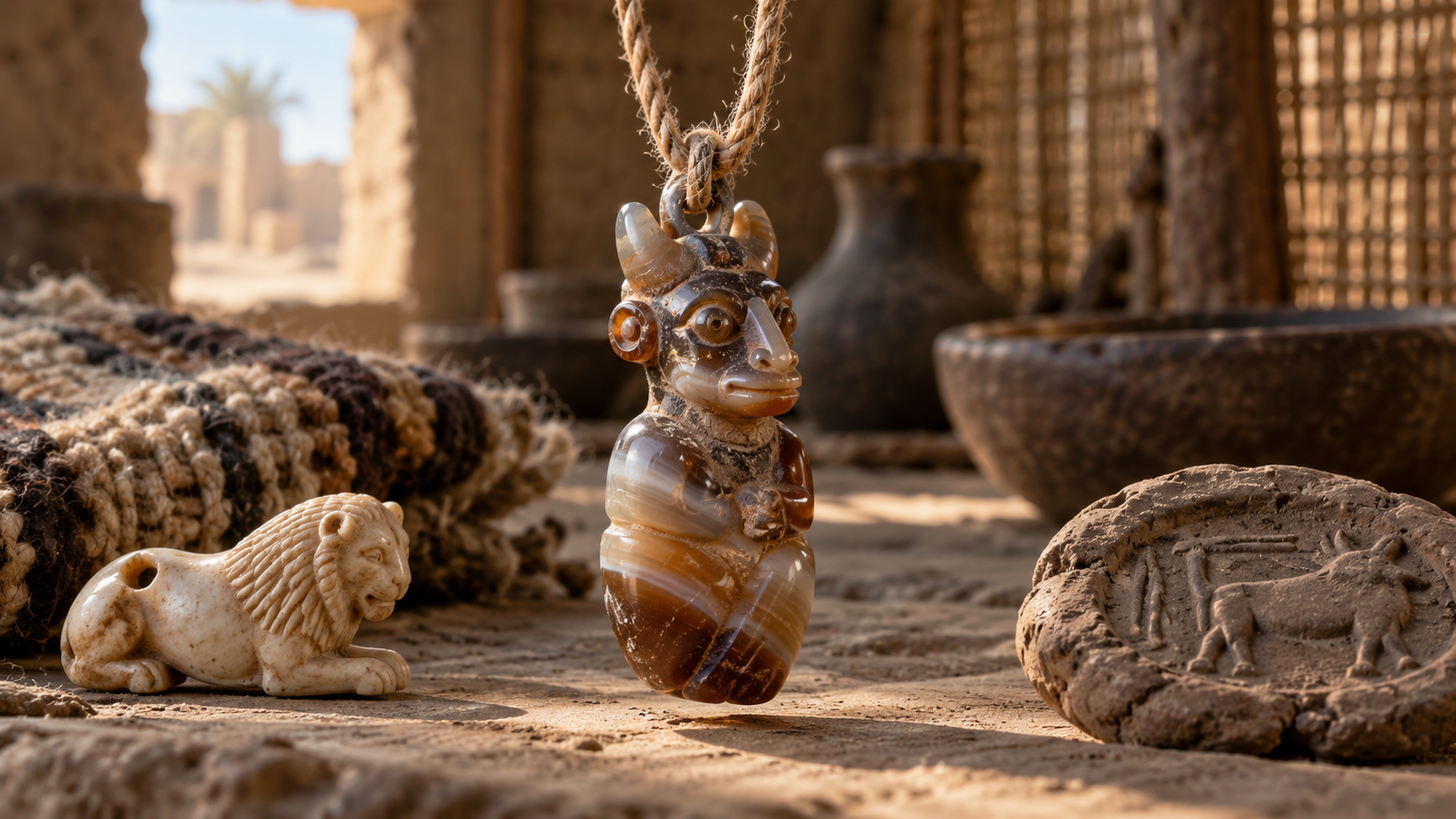
Nearly five thousand years ago, someone in Mesopotamia carved a tiny piece of agate into the head of a supernatural being.
The object is only about 1.9 centimetres high.
Today, it belongs to The Metropolitan Museum of Art.
The museum identifies it simply but provocatively:
Demon-headed amulet.
It dates to approximately 2900–2700 BCE, during the Sumerian Early Dynastic I period.
That makes it one of the oldest gemstone amulets through which we can explore a question that still appears in crystal culture today:
Can a stone protect its wearer?
The ancient Mesopotamian answer cannot be reduced to the modern expression “protective crystal.”
For people living in the cities of ancient Mesopotamia, illness, nightmares, dangerous childbirth, storms, bad fortune and unexplained suffering could exist within a cosmos populated by gods, spirits and hostile supernatural beings.
Protection could therefore involve prayer.
Incantation.
Divine images.
Ritual specialists.
Amulets.
Written formulas.
Plants.
Animal imagery.
And sometimes stone.
Agate participated in that world.
But the stone was only one element within a much larger system of belief.
Understanding that distinction reveals something considerably more interesting than a list of supposed crystal properties.
It reveals how one of the world’s earliest urban civilisations attempted to make invisible danger manageable.
Table of Contents
Mesopotamia: A World Between Rivers
The name Mesopotamia comes from Greek words referring to the land between rivers.
The region centred on the great river systems of the Tigris and Euphrates, largely within modern Iraq but extending into neighbouring territories.
Here, some of humanity’s earliest cities developed.
Uruk.
Ur.
Nippur.
Lagash.
Kish.
Later Babylon and Nineveh.
Writing developed here in the late fourth millennium BCE.
Temples dominated urban landscapes.
Administrative systems became increasingly sophisticated.
Kingship, trade and organised religion developed on extraordinary scales.
Yet the people who created these cities also lived within a universe they understood as intensely supernatural.
Gods Were Part of Reality
Modern readers sometimes separate “religion” from “ordinary life.”
That distinction fits ancient Mesopotamia poorly.
The gods were involved in kingship.
Agriculture.
Weather.
Fertility.
Justice.
War.
Health.
Cities themselves could possess patron deities.
Temples were not merely places where abstract beliefs were discussed.
They were institutions embedded within economic, political and social life.
The supernatural world was therefore not imagined as something separate from reality.
It formed part of reality as Mesopotamians understood it.
But Not Every Supernatural Being Was a God
Mesopotamian texts and images contain an extraordinary variety of beings.
Some were divine.
Some were protective.
Some were dangerous.
Some appear difficult to classify using modern categories.
The English word demon is convenient but imperfect.
It can suggest an automatically evil creature opposed to a benevolent deity.
Ancient Mesopotamian supernatural beings were more complicated.
Some threatening beings could themselves be used against other threats.
A terrifying appearance did not necessarily make an image harmful.
Sometimes frightening the danger was precisely the point.
The Tiny Agate Demon
The Metropolitan Museum’s Early Dynastic agate amulet is remarkable partly because of its age.
It was produced approximately 2900–2700 BCE.
The object is explicitly identified as Sumerian and made from agate.
Its small scale strongly separates it from monumental religious art.
This was an intimate object.
Something that could exist close to a human body.
Although its precise original use and the identity of the represented being are not securely known, its classification as an amulet places it within the material world of personal supernatural protection or benefit.
But what role did the agate itself play?
That question requires caution.
What Is Agate?
Agate is a variety of chalcedony, a microcrystalline form of quartz.
Its principal chemical composition is silicon dioxide:
SiO₂.
Unlike transparent macrocrystalline quartz, chalcedony consists of extremely fine intergrowths of silica minerals.
Agate is particularly known for banding and patterned colour.
Brown.
White.
Grey.
Red.
Orange.
Black.
And combinations of these can occur naturally.
The patterns arise through mineral deposition within cavities and fractures over geological time.
No two pieces need look exactly alike.
For an ancient craftsperson, this variability could make agate visually distinctive long before anyone understood its microscopic structure.
Hardness Made Agate Valuable
Agate has a hardness of approximately 7 on the Mohs scale.
That makes it significantly harder than many materials available to ancient craftspeople.
Hardness provides advantages.
The stone takes a fine polish.
It resists ordinary abrasion.
A carved object can survive for millennia.
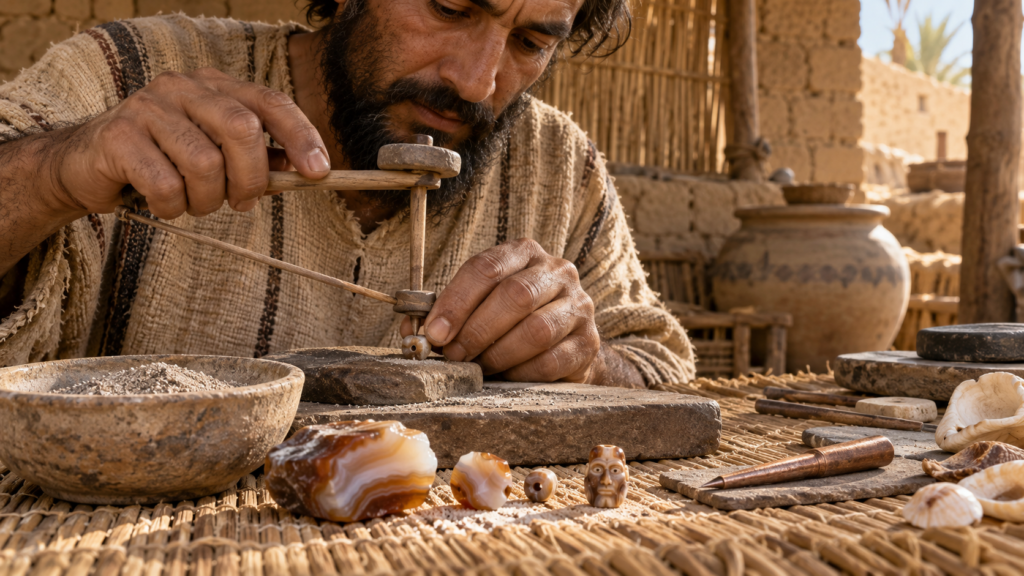
But hardness also makes working the material difficult.
Creating a tiny drilled or carved agate object required skill, abrasives, tools and time.
Its durability therefore contributed directly to its value.
A small stone amulet might represent considerably more labour than its size suggests.
Pattern Could Matter
Agate also differs from a uniformly coloured stone because its internal structure is visible.
Bands can resemble:
eyes,
waves,
clouds,
skin,
or layered landscapes.
Humans are extremely good at finding meaningful forms in natural patterns.
This has contributed to the cultural appeal of agate in many societies.
Yet we should be careful not to assume that every ancient patterned agate was selected for exactly the same symbolic reason.
Archaeology can demonstrate selection and use more easily than private interpretation.
Amulet Is a Functional Category
An amulet is generally understood as an object carried, worn or placed for protection or benefit.
The word describes a function, not a material.
An amulet can be made from:
stone,
metal,
shell,
bone,
clay,
textile,
wood,
or other substances.
This is important.
If ancient Mesopotamian people believed only in the inherent energy of particular minerals, we would expect protective objects to depend overwhelmingly on those minerals.
They do not.
Mesopotamian amulets survive in many different materials.
The meaning often depended on more than substance.
A Lion Can Become Protection
The Metropolitan Museum preserves another Early Dynastic amulet dating to approximately 2900–2700 BCE.
It is not agate.
It is carved from shell.
The object represents a reclining lion.
The Met suggests that it may have functioned as an amulet by harnessing the enormous power associated with this dangerous animal.
This provides a useful comparison with the agate demon head.
In one object, supernatural imagery may matter.
In another, animal strength may matter.
The protective logic lies partly in representation.
Material alone does not explain the object.
Why Wear Something Frightening?
This principle appears repeatedly across world cultures.
A dangerous image can protect.
A predator can guard.
A demon can repel another demon.
A terrifying face can frighten supernatural danger.
Modern viewers sometimes assume protective objects should look peaceful.
Ancient protective traditions frequently demonstrate the opposite.
Protection may require symbolic aggression.
The threatening object becomes an ally.
The Logic of Apotropaic Magic
Scholars often use the term apotropaic for practices intended to avert or turn away harm.
An apotropaic image does not necessarily heal after danger occurs.
Its purpose may be preventative.
Keep the threat away.
Repel it.
Confuse it.
Intimidate it.
Block its entry.
Mesopotamian houses, bodies and ritual spaces could all become locations requiring supernatural defence.
Amulets belonged to this wider protective landscape.
Magic and Religion Were Not Opposites
Modern European history has strongly influenced the tendency to separate:
religion
from
magic.
For ancient Mesopotamia, that binary can be misleading.
Incantations could invoke recognised gods.
Ritual specialists could operate within established religious traditions.
Protective ceremonies could use prayers, images and prescribed materials.
What modern observers call “magic” was not necessarily an illicit alternative to religion.
It could be part of authorised methods for dealing with danger.
Illness Could Have a Supernatural Dimension
Ancient Mesopotamians developed substantial empirical medical knowledge.
They observed symptoms.
Prepared remedies.
Used plants and other substances.
But illness could also be understood through supernatural causation.
A hostile being.
A divine offence.
A curse.
A malevolent force.
These explanations could coexist with physical treatments.
A person might receive a medicinal preparation and a ritual intervention.
The categories were not necessarily contradictory to the patient or practitioner.
Written Incantations Against Demons
The British Museum preserves a Neo-Assyrian clay tablet from the seventh century BCE containing bilingual Sumerian and Akkadian incantations against an evil asakku demon.
The text describes malevolent forces attacking the sufferer in the head.
This evidence comes thousands of years after the Early Dynastic agate demon amulet.
We should not treat the two as one unchanged tradition.
Mesopotamian religion evolved enormously.
But the tablet demonstrates the long historical importance of supernatural explanations for affliction and ritual methods for combating them.
Words themselves could protect.
Protection Could Be Spoken
This is one of the most important differences between historical amulets and simplistic modern “stone meaning” lists.
An object might work within a ritual that also required:
a spoken formula,
a written incantation,
a divine name,
a ritual specialist,
a prescribed time,
or a specific placement on the body.
The stone was not necessarily imagined as an independent spiritual battery.
It could be one component within a ritual technology.
Protection Could Be Written
Mesopotamian culture placed extraordinary importance on writing.
Cuneiform inscriptions recorded trade, administration, literature, law, ritual and prayer.
Words could also become physical objects.
A protective inscription could be written on clay.
Engraved on stone.
Placed in a building.
Carried.
Buried.
Or incorporated into ritual.
The boundary between text and object therefore becomes blurred.
A written spell is language.
But once written on clay or stone, it is also material culture.
Seals: Identity, Administration and Protection
One of Mesopotamia’s most distinctive technologies was the cylinder seal.
A small cylinder of stone was carved in reverse.
When rolled across wet clay, it produced a continuous image.
Seals could mark ownership and identity.
They secured containers and doors.
They authenticated documents.
They also carried elaborate religious and mythological imagery.
The Metropolitan Museum notes that protective properties may have been attributed both to the stone material and to the carved designs of ancient Near Eastern seals.
This is particularly important.
It suggests that material and image could both contribute to perceived efficacy.
Agate as a Seal Stone
Agate was well suited to this purpose.
It is hard.
Durable.
Capable of taking fine engraving.
Polishable.
And visually distinctive.
The British Museum preserves an Old Babylonian agate cylinder seal depicting a deity confronting a composite monster with a bird’s head, wings, talons and scorpion tail.
A star and crescent appear above.
The object therefore combines:
agate,
divine imagery,
monstrous imagery,
celestial symbols,
and personal identity technology.
Calling it simply a “healing stone” would miss almost everything important about it.
A Seal Could Touch Daily Life
Cylinder seals were often worn or carried because their owner needed them.
Imagine the consequences.
A stone carved with gods and supernatural creatures might repeatedly touch the owner’s body.
Then it would be pressed into clay.
Its image would appear on administrative objects.
The same engraved stone could therefore operate in personal, legal, economic and symbolic worlds.
Gemstones in ancient Mesopotamia were not isolated on decorative pedestals.
They moved through life.
Precious Stones Came from Elsewhere
Southern Mesopotamia possessed limited supplies of many raw materials valued by its urban societies.
Long-distance trade was therefore essential.
Stone.
Metals.
Timber.
Shell.
Precious materials.
These could arrive from distant regions.
The famous royal graves at Ur contain extraordinary quantities of imported material.
Gold.
Lapis lazuli.
Carnelian.
These substances demonstrate that early Mesopotamian elites participated in exchange networks extending far beyond southern Iraq.
A precious stone could therefore signify distance as well as beauty.
Material from Beyond the Horizon
The Metropolitan Museum notes that the lapis lazuli used at Ur originated ultimately in the Badakhshan region of what is now Afghanistan.
Other precious materials came through different networks.
This matters spiritually as well as economically.
An object arriving from beyond the familiar landscape could possess qualities of rarity and prestige impossible for an ordinary local material.
But rarity alone does not prove supernatural meaning.
Trade history and religious interpretation must remain separate unless evidence connects them.
Did Mesopotamians Believe Stones Had Magical Properties?
There is evidence from later Mesopotamian texts that particular stones could possess amuletic and magical associations.
The Metropolitan Museum explicitly notes, when discussing jewellery from the Royal Cemetery at Ur, that later textual traditions describe magical and amuletic properties for different materials.
But chronology matters.
The Royal Cemetery dates largely to the third millennium BCE.
Many surviving textual compilations concerning stone properties are later.
We cannot simply take a first-millennium text and assume every belief existed unchanged two thousand years earlier.
This is one of the central rules of responsible historical interpretation.
Archaeological Object Versus Later Text
The agate demon-headed amulet tells us something directly.
Someone around 2900–2700 BCE selected agate and carved it into a supernatural form classified archaeologically as an amulet.
That is evidence.
If a much later Mesopotamian text says a certain agate protects against a certain danger, that is also evidence.
But it is evidence for its own period.
Connecting the two requires argument.
Not assumption.
Historical gemstone writing becomes unreliable when centuries are collapsed together merely because the mineral name is the same.
The Demon Does Not Necessarily Represent Evil
Another caution concerns the tiny agate head itself.
Modern popular culture tends to interpret “demon” as synonymous with evil.
Ancient Mesopotamian supernatural beings could have much more complex roles.
Some beings were malevolent.
Others were protective.
Some could be dangerous in one context and useful in another.
Without an inscription securely identifying the Early Dynastic figure, we should not invent a biography for it.
Its ambiguity is part of its archaeological significance.
Lamashtu: A Later Threat
Later Mesopotamian religion provides a much better documented example.
Lamashtu was a dangerous female supernatural being associated particularly with threats to pregnant women and infants.
Protective rituals were developed against her.
The British Museum preserves both stone and metal amulets associated with Lamashtu.
These objects belong to much later periods than the Early Dynastic agate head.
They should therefore be treated as comparative evidence rather than direct explanations of it.
The Lamashtu Plaque
One British Museum object is a copper-alloy magical plaque designed for a sick person.
Its imagery includes a figure on a couch, supernatural beings and a demon that may represent Pazuzu.
The object is extraordinary because it makes visible a complex ritual confrontation.
The patient is not protected merely by carrying a naturally beautiful material.
The plaque constructs a supernatural drama.
Images oppose images.
Danger is personified.
Protection is personified.
The invisible becomes visible.
Pazuzu: Fighting Danger with Danger
Pazuzu is among the best-known Mesopotamian demonic beings today, partly because modern popular culture has removed him almost entirely from his ancient context.
Historically, Pazuzu was associated with destructive winds.
Yet his image could also be used protectively, particularly against Lamashtu.
This apparent contradiction makes sense within apotropaic logic.
A dangerous being can be recruited against another danger.
Power confronts power.
Fear becomes a weapon against fear.
Why This Matters for Gemstone Spirituality
The principle changes how we interpret an ancient demon carved into agate.
Modern crystal literature might ask:
“What protective frequency does agate emit?”
Ancient Mesopotamian material culture encourages different questions:
What is represented?
What threat is being addressed?
Who prepared the object?
Where was it worn or placed?
Were words spoken over it?
Did the material itself have a traditional association?
Was a deity invoked?
The object becomes meaningful through relationships.
Stone Was Not the Entire Ritual
This is perhaps the most important conclusion.
Ancient protective practice often worked through combinations.
Material.
Shape.
Image.
Inscription.
Gesture.
Speech.
Placement.
Divine authority.
Ritual expertise.
A modern commercial description such as:
“Agate: protection, grounding, courage”
compresses all of this into the mineral.
Ancient evidence frequently points in the opposite direction.
Meaning was distributed across the entire object and its use.
What Did Agate Itself Mean?
This is harder to answer than many popular websites suggest.
Agate was certainly used in Mesopotamia.
It was carved.
Polished.
Drilled.
Engraved.
Made into beads, seals and amulets.
Its hardness and attractive pattern made it an excellent material.
Later textual traditions indicate that stones could have specific magical associations.
But there is no justification for assuming that every agate object represented one universal meaning such as:
“grounding,”
“emotional stability,”
or “Root Chakra protection.”
Those formulations belong largely to modern metaphysical vocabulary.
The Root Chakra Is Not Sumerian
Modern crystal traditions frequently associate red, brown or black agates with the Root Chakra.
That system should not be projected onto Early Dynastic Mesopotamia.
Chakra traditions developed in South Asian religious contexts.
The familiar modern seven-chakra rainbow system is itself the result of substantial historical reinterpretation.
A Sumerian agate amulet from approximately 2900 BCE belongs to a completely different religious world.
Calling it a Root Chakra stone would erase rather than explain its context.
Modern Agate Beliefs
Contemporary metaphysical sources commonly associate agate with:
- grounding
- stability
- protection
- courage
- emotional balance
- concentration
- security
- calm
Different varieties receive additional meanings.
Blue lace agate.
Moss agate.
Botswana agate.
Fire agate.
Crazy lace agate.
These modern systems can be meaningful within contemporary spiritual practice.
They should simply be identified as modern metaphysical traditions, not presented as universal ancient knowledge.
Does Agate Emit Protective Energy?
There is no established scientific evidence that agate produces an invisible field capable of repelling demons, misfortune, hostile intentions or supernatural forces.
Agate’s scientifically measurable properties include:
chemical composition,
microcrystalline structure,
hardness,
density,
optical behaviour,
fracture characteristics,
and trace-element-related colour.
Those properties make agate beautiful and durable.
They do not establish the protective energy described in metaphysical literature.
But the Ancient Belief Was Real
Rejecting a supernatural mechanism does not make the historical belief meaningless.
The Mesopotamian person who wore an amulet inhabited a different explanatory world.
Supernatural danger could feel as real as physical danger.
A protective object could therefore provide reassurance.
It could connect the wearer with religious authority.
It could make an invisible threat tangible.
It could provide an action when circumstances otherwise felt uncontrollable.
Those functions deserve serious historical attention.
Fear Creates Material Culture
Humans make objects not only because we love beauty.
We make objects because we are afraid.
Locks.
Helmets.
Walls.
Weapons.
Medical equipment.
Religious medals.
Amulets.
The technologies differ enormously, as do their demonstrated effectiveness.
But they share an underlying human impulse:
reduce vulnerability.
Ancient Mesopotamian amulets are archaeological records of that impulse.
A Historically Inspired Agate Reflection
A modern spiritual practice can draw inspiration from this history without pretending to reproduce Sumerian ritual.
Take a natural piece of agate.
Observe its bands.
Its irregularity.
Its hardness.
Do not begin by asking what energy it supposedly emits.
Instead ask:
What am I trying to protect?
Then:
Is the threat physical, emotional, social, imagined or symbolic?
And finally:
What form of protection is actually appropriate?
Some dangers require practical action.
A lock.
A doctor.
A boundary.
A conversation.
A safety plan.
Others may involve anxiety, uncertainty or the desire for reassurance.
A symbolic object can serve as a reminder.
But symbol and physical protection should not be confused.
An Amulet as a Reminder
Suppose someone carries an agate today because it reminds them to remain calm under pressure.
The stone does not need to emit a scientifically undetected calming field for the practice to have personal meaning.
The user has created an association.
Touching the object may prompt a learned thought:
slow down.
focus.
remember what matters.
That is different from claiming the mineral chemically or energetically forces calm upon the nervous system.
Distinguishing the two allows spiritual practice and scientific accuracy to coexist.
Ancient Objects Were Personal
Museum display cases can make amulets appear remote.
Clean.
Labelled.
Motionless.
But an amulet was designed for proximity.
It could be worn against skin.
Suspended from clothing.
Handled.
Carried.
Placed beside a bed.
Buried with a person.
Installed within a building.
The tiny scale of many amulets reminds us that ancient religion was not confined to monumental temples.
It could fit into a hand.
The Body Was a Sacred Boundary
Protective objects worn on the body effectively created a boundary.
Inside: the person.
Outside: danger.
This boundary was not merely physical.
It could be supernatural.
An amulet hanging at the neck, wrist or torso occupied the interface between human vulnerability and the surrounding world.
That is one reason jewellery and spiritual protection so frequently overlap across cultures.
The body offers an obvious place for protective symbolism.
Gemstone Jewellery Still Does This
Modern jewellery can perform similar symbolic functions without requiring supernatural claims.
A wedding ring marks commitment.
A mourning jewel preserves memory.
A religious pendant expresses faith.
A family heirloom creates continuity.
A gemstone given during a difficult period may become associated with survival.
None of these meanings can be measured through refractive index.
Yet they are genuine human meanings.
Ancient amulets remind us that jewellery has almost never been only decoration.
When a Material Outlives a Belief
The Early Dynastic agate demon amulet has survived for almost five thousand years.
The person who owned it is gone.
The spoken words surrounding it—if there were any—are gone.
Its original cord is gone.
Its exact ritual context is gone.
Even the identity of the represented supernatural being is uncertain.
The agate remains.
This creates one of archaeology’s most striking asymmetries.
Materials often survive longer than explanations.
We possess the object but not the owner’s thoughts.
Responsible interpretation must respect that silence.
Why “Ancient Crystal Wisdom” Can Be Misleading
Modern crystal literature sometimes presents ancient societies as if they all shared one forgotten gemstone science.
Egyptians supposedly knew one set of crystal energies.
Sumerians another.
Greeks another.
Then these traditions are combined into a single timeless system.
Historical evidence shows something much more complex.
Different societies classified stones differently.
Religious systems changed.
Names changed.
Trade changed.
Rituals changed.
Even within one civilisation, beliefs could change dramatically across centuries.
There was no single universal ancient crystal manual.
Mesopotamia Lasted for Millennia
This is particularly important here.
“Ancient Mesopotamia” encompasses an enormous chronological span.
Sumerian Early Dynastic culture around 2900 BCE is not identical to:
Old Babylonian culture around 1800 BCE,
Neo-Assyrian culture around 700 BCE,
or Late Babylonian culture centuries later.
Using a Neo-Assyrian demon text to explain an Early Dynastic amulet directly would collapse more than two thousand years of history.
Imagine using a twenty-first-century European religious practice to explain an object from the Iron Age.
The chronological distance becomes obvious.
What Can We Say with Confidence?
Several conclusions are well supported.
Agate was used for amulets and engraved objects in ancient Mesopotamia.
The Metropolitan Museum preserves a Sumerian demon-headed agate amulet dating approximately 2900–2700 BCE.
Early Dynastic Mesopotamia also produced amulets in shell, stone and other materials, demonstrating that protective function was not restricted to one mineral.
Animal imagery could itself possess protective significance; the Met suggests that a contemporary shell lion amulet may have harnessed the symbolic power of the animal.
Mesopotamian cylinder seals combined precious or attractive stones with divine, supernatural and mythological imagery.
Later Mesopotamian texts explicitly document incantations against harmful supernatural beings.
Later amulets and plaques connected with Lamashtu and Pazuzu demonstrate sophisticated protective traditions involving image, supernatural identity and ritual.
Mesopotamian traditions also attributed magical or amuletic properties to stones.
What cannot be demonstrated is that all Mesopotamian agate objects shared one universal metaphysical meaning.
Nor is there scientific evidence that agate emits a protective force, repels demons, treats illness or automatically produces emotional stability.
Modern chakra and crystal-energy interpretations should not be projected onto Sumerian objects.
Conclusion
The tiny Sumerian agate demon head in New York is easy to overlook.
It is less than two centimetres high.
It is not covered with gold.
It does not contain a monumental inscription.
It does not depict a famous king.
Yet it opens an extraordinary window onto the human experience.
Almost five thousand years ago, someone selected a piece of agate.
A craftsperson shaped it.
A supernatural face emerged from the stone.
The object became an amulet.
Whatever precise danger it addressed has been lost.
But the desire behind it remains recognisable.
Human beings know that they are vulnerable.
Ancient Mesopotamians responded to vulnerability through systems involving gods, spirits, rituals, incantations and protective objects.
Agate could participate in those systems.
But it did not act alone.
The stone acquired meaning through what was carved into it, how it was used, what people believed and the ritual world surrounding it.
Modern crystal traditions may describe agate as grounding, balancing and protective.
Those contemporary beliefs can form part of modern spirituality.
They should not be mistaken for a direct translation of Sumerian religion.
At Natural Gems Belgium, preserving that distinction reveals a richer history.
The ancient question was probably not simply:
“What power is inside this stone?”
It was closer to:
“How can this object help place protection between me and what I fear?”
Five thousand years later, that question remains surprisingly human.
References & Further Reading
The Metropolitan Museum of Art — Demon-Headed Amulet, Sumerian, Early Dynastic I
The key archaeological object for this article: a 1.91 cm agate demon-headed amulet from Mesopotamia, dated approximately 2900–2700 BCE. The museum identifies the object as Sumerian and classifies it explicitly as an amulet.
https://www.metmuseum.org/art/collection/search/323774
The Metropolitan Museum of Art — Amulet in the Form of a Couchant Lion, Early Dynastic I
Contemporary comparison from southern Mesopotamia, approximately 2900–2700 BCE. Carved from shell rather than gemstone, the reclining lion may have functioned as an amulet that harnessed the symbolic power of a dangerous animal. It demonstrates why protective meaning cannot be reduced to mineral identity alone.
https://www.metmuseum.org/art/collection/search/324730
The Metropolitan Museum of Art — Pendant Amulet in the Form of a Bird, Sumerian Nippur
Early Dynastic Sumerian pendant from Nippur, approximately 2900–2350 BCE. Its shell construction provides further evidence for the diversity of materials used for small personal amuletic objects.
https://www.metmuseum.org/art/collection/search/324874
The Metropolitan Museum of Art — Cow Amulet, Sumerian Nippur
Early Dynastic amulet carved from lapis lazuli and found at Nippur. This small object provides useful comparative evidence for the use of valuable imported stones in Sumerian amuletic material culture.
https://www.metmuseum.org/art/collection/search/324875
The Metropolitan Museum of Art — Necklace Beads from the Royal Cemetery at Ur
Gold and lapis lazuli beads from the Great Death Pit at Ur, approximately 2600–2500 BCE. The Met discusses the distant origin of the materials and notes that later Mesopotamian texts describe magical and amuletic properties for particular substances. The page is especially valuable for distinguishing archaeological evidence from later textual traditions.
https://www.metmuseum.org/art/collection/search/322910
The Metropolitan Museum of Art — Beads from Ur: Gold, Lapis Lazuli and Carnelian
Additional jewellery from the Royal Cemetery at Ur, demonstrating the use of multiple precious materials within elite Sumerian adornment and funerary contexts.
https://www.metmuseum.org/art/collection/search/322911
British Museum — Old Babylonian Agate Cylinder Seal with Deity and Monster
An engraved agate cylinder seal depicting a deity confronting a composite winged monster with bird head, talons and scorpion tail, accompanied by celestial symbols. It illustrates how agate could carry sophisticated divine and supernatural imagery in Mesopotamian glyptic art.
https://www.britishmuseum.org/collection/object/W_2013-6001-2098
The Metropolitan Museum of Art — Cylinder Seal with Demon
Although this Neo-Elamite seal comes from southwestern Iran and is considerably later than the Early Dynastic Sumerian amulet, the Met’s discussion is valuable for understanding ancient Near Eastern cylinder seals. The museum notes that protective properties could be attributed both to a seal’s material and to its carved imagery.
https://www.metmuseum.org/art/collection/search/327258
British Museum — Incantation Tablet Against the Asakku Demon
Seventh-century BCE Neo-Assyrian tablet from the Library of Ashurbanipal containing bilingual Sumerian and Akkadian incantations against the malevolent asakku demon and other hostile forces attacking a sufferer. It provides direct textual evidence for later Mesopotamian ritual responses to supernatural causes of affliction.
https://www.britishmuseum.org/collection/object/W_K-3118
British Museum — Lamashtu Magical Plaque for the Sick
Copper-alloy Mesopotamian magical plaque showing a sick person on a couch and supernatural figures, including a possible representation of Pazuzu. The object demonstrates the complexity of later Mesopotamian protective practice: image, supernatural beings, illness and ritual were combined within a single artefact.
https://www.britishmuseum.org/collection/object/W_1914-0407-145
British Museum — Late Babylonian Lamashtu Amulet from Warka
Polished serpentine amulet dating approximately 800–550 BCE, incised with a representation of Lamashtu, another supernatural figure and an imitation inscription. It provides a useful later comparison for the continuing Mesopotamian tradition of material protection against supernatural danger.
https://www.britishmuseum.org/collection/object/W_1851-0101-18
Historical Belief Versus Modern Crystal Claims
The archaeological record demonstrates that stones could participate in protective practice in ancient Mesopotamia.
What we can document includes:
an Early Dynastic Sumerian demon-headed amulet carved from agate;
amulets made from several different materials rather than one supposedly universal protective mineral;
animal forms that may have symbolically harnessed the power of dangerous creatures;
precious and imported stones used in personal adornment;
engraved stone seals carrying gods, monsters and supernatural imagery;
later written incantations against harmful supernatural beings;
and later ritual objects specifically designed to confront supernatural causes of danger and illness.
These sources do not demonstrate that agate emits scientifically measurable protective energy.
They also do not justify assigning modern concepts such as “Root Chakra activation,” “vibrational grounding” or universal emotional healing to Early Dynastic Sumerian agate.
The historically strongest interpretation therefore distinguishes:
the measurable mineralogical properties of agate
from
archaeologically documented amuletic use
from
Mesopotamian religious and magical belief
from
modern metaphysical crystal traditions.
That distinction makes the ancient evidence more—not less—interesting.
The Sumerian amulet shows that gemstone spirituality can be historically real without requiring us to turn ancient belief into modern crystal science.
Related Products
-
18K Yellow Gold Rope Chain Bracelet · Adjustable 15 · 18 cm · Luxury NGB Jewelry
$251.21 -
Aventurine Bead Bracelet with Bridge · 8 mm · 19 cm · Unisex · Untreated · Good Polish
$39.10 -
Baltic Amber Chip Bracelet 10 mm · Natural Dark Honey Amber Bead Bracelet
$32.67 -
Bead Bracelet with bridge · Rose Quartz · 8mm · pink charm bracelet
$36.86