Table of Contents
Introduction: When Gemstones Were Studied Through Books Rather Than Laboratories
Imagine opening a manuscript written more than seven hundred years ago.
Its pages are made from carefully prepared parchment.
The text is written by hand, perhaps decorated with coloured initials, miniature illustrations or gold leaf.
Among the subjects discussed are precious stones.
These discussions about precious stones often reflect the understanding of gemstones in medieval manuscripts.
Rubies, sapphires, emeralds, diamonds and other materials appear alongside descriptions of their colours, origins and supposed properties.
Some passages contain observations that remain recognisable today.
Others describe powers that modern science does not recognise.
The manuscript may associate a gemstone with medicine, religious symbolism, astrology or the natural order of the universe.
To a modern reader, these descriptions can seem to belong to several completely different subjects.
Yet for many medieval scholars, they formed part of a connected attempt to understand nature.
Gemstones occupied a distinctive position within medieval intellectual culture.
They were admired for their beauty, valued as precious materials, collected as objects of status and investigated for their supposed natural properties.
Their rarity and sometimes distant geographic origins also encouraged the circulation of stories and inherited explanations.
The books that described these materials are particularly important to the history of gemmology.
Many belonged to a literary tradition known as the lapidary.
The knowledge preserved in these texts is crucial for studying gemstones in medieval manuscripts.
These works preserved and transmitted knowledge about stones long before the development of modern mineralogical classification.
Today, medieval lapidaries provide valuable evidence about the history of scientific ideas, terminology, medicine, commerce and cultural exchange.
However, interpreting them requires care.
A medieval gemstone name does not necessarily correspond to one modern mineral species.
A historical illustration cannot automatically establish the identity of the material represented.
And a description of a gemstone’s supposed medicinal powers is evidence of historical belief rather than proof of therapeutic effectiveness.
Understanding these distinctions allows us to appreciate medieval gemstone knowledge without confusing historical tradition with modern scientific evidence.
1. What Was a Medieval Lapidary?
The word lapidary derives from the Latin word lapis, meaning stone.
Today, lapidary work generally refers to the cutting, shaping and polishing of gemstones and other ornamental stones.
In medieval literature, however, a lapidary was a written work describing stones and their properties.
Such texts could contain information about colour, appearance, geographic occurrence and practical uses.
They might also discuss medicinal applications, religious significance, protective qualities or astrological associations.
Some lapidaries were relatively short.
Others formed part of extensive encyclopaedic compilations.
Their contents varied considerably according to author, language, period and intended audience.
A lapidary was not necessarily a practical guide to identifying gemstones.
Nor was it always a book written by someone who had personally examined every material described.
Many authors relied on earlier written authorities.
Descriptions could therefore be transmitted across generations, sometimes with modifications or misunderstandings.
This was a characteristic feature of medieval scholarship.
Knowledge was frequently preserved through copying, commentary, translation and compilation.
The importance of a text often depended partly on the reputation of its sources.
Consequently, medieval lapidaries provide evidence not only about gemstones but also about how knowledge itself was organised.
2. The Classical Foundations of Medieval Gemstone Knowledge
Medieval European authors inherited substantial information from Greek and Roman literature.
One particularly influential ancient author was Pliny the Elder.
His Naturalis Historia, written during the first century CE, included extensive discussions of minerals and precious stones.
Book 37 contains descriptions of numerous gemstone materials.
Pliny recorded their appearance, reported origins, commercial significance and properties attributed to them.
Some passages describe observable characteristics.
Others preserve traditional stories and claims that cannot be supported scientifically.
For medieval readers, however, Pliny represented an important source of ancient learning.
His work contributed to the broader body of information from which later gemstone descriptions developed.
Other classical and late-antique traditions also influenced medieval lapidaries.
These included works associated with Damigeron and Evax, as well as encyclopaedic material transmitted through authors such as Isidore of Seville.
The resulting literature combined several kinds of knowledge.
Descriptions of natural materials appeared alongside inherited medical and symbolic interpretations.
This mixture should not automatically be understood as an absence of intellectual curiosity.
Rather, it reflects a historical period in which the boundaries between natural philosophy, medicine, theology and symbolic interpretation differed substantially from those of modern science.
3. Isidore of Seville and the Organisation of Knowledge
Isidore of Seville lived during the late sixth and early seventh centuries.
His Etymologiae became one of the most influential encyclopaedic works of the European Middle Ages.
The work attempted to organise knowledge across numerous subjects.
These included language, geography, animals, plants, minerals and aspects of the natural world.
Gemstones appeared within this broader intellectual framework.
An important feature of Isidore’s approach was the explanation of words and names.
Etymology was treated as a means of understanding the nature of things.
From a modern scientific perspective, the historical derivation of a name does not necessarily reveal the physical properties of the material.
Nevertheless, the approach influenced how medieval scholars classified and discussed natural objects.
A stone’s name could become closely connected with its supposed origin, colour or characteristic properties.
This is one reason why historical gemstone terminology requires careful interpretation.
Names were not always based on the criteria that modern mineralogists use to distinguish mineral species.
4. Marbode of Rennes: One of the Most Influential Medieval Lapidaries
Among medieval European gemstone texts, the Liber lapidum of Marbode of Rennes occupies a particularly important position.
Marbode lived from approximately 1035 to 1123.
His work, also known as De lapidibus, was composed toward the end of the eleventh century.
Written in Latin verse, it described approximately sixty stones.
The text drew upon earlier traditions, including classical and late-antique sources.
Its influence extended far beyond the lifetime of its author.
The work circulated in manuscript copies and was adapted or translated into several languages.
Its popularity demonstrates the sustained interest in gemstone properties during the medieval period.
Marbode’s descriptions combined material characteristics with qualities traditionally attributed to stones.
Some entries discussed appearance or provenance.
Others described supposed protective or medicinal effects.
These claims belonged to the intellectual and medical traditions of the period.
They should not be interpreted as scientifically demonstrated properties.
The importance of Marbode’s work lies primarily in its historical influence.
It helped preserve and circulate a particular understanding of gemstones throughout medieval Europe.
5. What Surviving Manuscripts Tell Us About Marbode’s Influence
The historical significance of a medieval text can be investigated through surviving manuscript copies.
One important example is preserved in the British Library.
The manuscript is catalogued as:
Cotton MS Claudius A XII
It contains several different works.
Among them is Marbode’s De lapidibus, occupying folios 78v–83r.
The manuscript also contains historical and administrative material.
This combination is important.
Medieval manuscripts were not always organised according to the subject divisions familiar to modern readers.
A single volume could contain works on history, religion, medicine, natural philosophy or institutional administration.
The presence of a lapidary within such a manuscript illustrates how knowledge about stones circulated as part of a broader written culture.
The British Library catalogue provides detailed information about the manuscript’s contents and preservation.
It also makes the surviving material accessible through digitised manuscript resources.
Such records allow modern researchers to investigate not only what medieval authors wrote, but also how their texts were copied, preserved and transmitted.
6. Were Medieval Gemstone Manuscripts Illustrated?
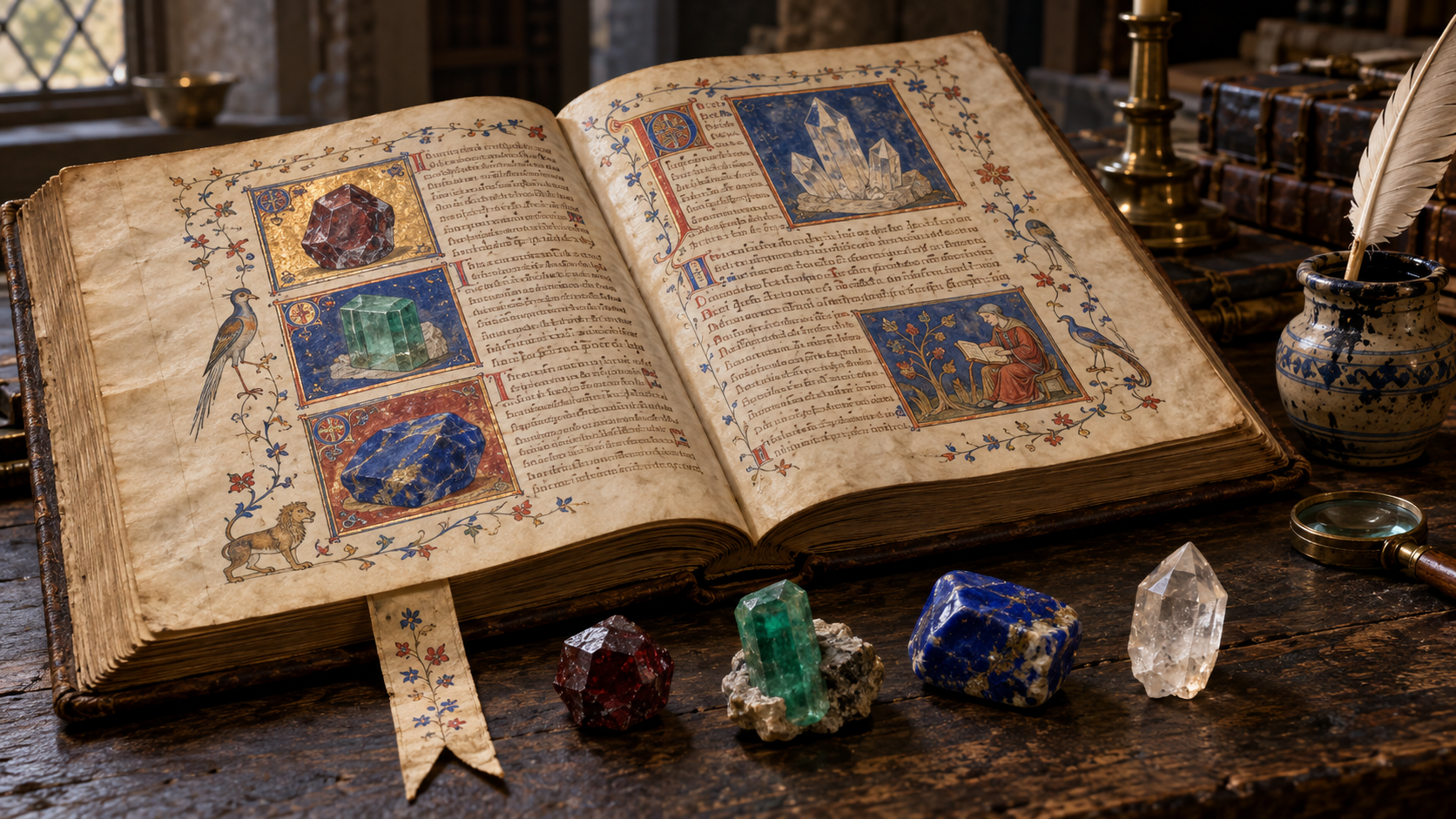
Some medieval manuscripts contained elaborate illustrations.
Others relied primarily on written descriptions.
The presence and quality of illustrations depended on the manuscript, its intended audience, the resources available to its makers and the traditions followed by the workshop.
Illustrations could serve several purposes.
They might help organise information.
They could represent a gemstone’s supposed appearance.
They might depict the circumstances in which a stone was found.
In other cases, illustrations expressed symbolic or astrological associations.
However, medieval gemstone illustrations should not automatically be treated as accurate mineralogical drawings.
Artists did not necessarily work from physical specimens.
They might follow established visual conventions.
The colours used in an illustration could also be influenced by available pigments, artistic traditions and decorative objectives.
A painted red stone does not necessarily establish that the author intended a modern mineralogical ruby.
Similarly, an illustration of a green gemstone cannot independently demonstrate whether the material was emerald, another green beryl variety or a different mineral altogether.
The illustration must be interpreted together with the accompanying text and historical context.
A medieval image is valuable historical evidence, but it is not automatically a reliable gemstone identification.
7. Alfonso X and the Extraordinary Lapidario of Medieval Castile
One of the most remarkable surviving examples of medieval gemstone literature is the Lapidario associated with Alfonso X of Castile.
Alfonso X ruled Castile and León during the thirteenth century.
His court supported substantial intellectual and translation activity.
The Lapidario is particularly important because it demonstrates the interaction of different scholarly traditions.
According to the catalogue of the Royal Library of the Monastery of San Lorenzo de El Escorial, the work originated through the translation of an Arabic text.
The project involved Yehuda ben Moses and Garcí Pérez.
The initial translation activity took place between approximately 1243 and 1250.
Further work continued afterward.
The surviving illuminated manuscript was copied around 1270–1275.
It is preserved under the shelfmark:
h-I-15
The manuscript contains four treatises dealing with stones, their characteristics and their supposed properties.
Its illustrations are particularly notable.
The first treatise includes representations associated with the discovery of stones and the constellations believed to influence them.
The work reflects a worldview in which mineral properties, medicine, astrology and divine order were understood as interconnected.
For modern historians, the manuscript is exceptionally valuable.
It documents the transmission of knowledge through Arabic and Castilian scholarly environments.
It also demonstrates the importance of translation in the development of medieval natural philosophy.
8. Why the Alfonso X Lapidario Is Important to the History of Science
The Lapidario of Alfonso X is not a modern mineralogical textbook.
Its explanations frequently depend on astrological principles.
The text attributes particular properties to stones according to relationships with celestial bodies.
Modern mineralogy does not recognise planetary or astrological influence as a demonstrated mechanism responsible for gemstone properties.
Nevertheless, the manuscript remains an important scientific-historical source.
It shows how medieval scholars attempted to organise information systematically.
It demonstrates the importance of written authorities and translation.
It also reveals how natural materials were classified within a larger understanding of the universe.
The manuscript’s significance is therefore not dependent on the scientific accuracy of every statement it contains.
Its value lies in documenting the development and transmission of knowledge.
This distinction is essential when studying the history of gemmology.
A historical theory can be scientifically incorrect while remaining extremely important to the history of scientific thought.
9. The Contribution of Arabic-Language Scholarship
Medieval gemstone knowledge did not develop exclusively within Latin Europe.
Arabic-language scholars produced important works on precious stones, minerals, medicine and natural philosophy.
These texts formed part of a wider intellectual tradition extending across regions of the Islamic world.
Gemstones were discussed in relation to their physical appearance, commercial value, geographic origins and cultural significance.
Some works also recorded medical or protective properties attributed to stones.
The exchange of knowledge between Greek, Arabic, Hebrew and Latin scholarly traditions was complex.
Texts were translated, adapted and interpreted in different intellectual environments.
The Lapidario associated with Alfonso X provides one example of this transmission.
Modern academic research also demonstrates the importance of gemstones in the medieval Arab world.
A study by Zohar Amar and Efraim Lev, published in the Journal of the Royal Asiatic Society, examines gemstone use and valuation through early Arabic sources.
Their research discusses materials including corundum, diamond, emerald and pearl.
It also examines more widely accessible stones such as carnelian, garnet, turquoise and quartz.
This research illustrates the economic and cultural importance of gemstones within medieval societies.
It also demonstrates why the history of gemstone knowledge must be studied across linguistic and geographic boundaries.
10. Albertus Magnus and the Study of Minerals
Albertus Magnus was a thirteenth-century scholar whose work contributed significantly to medieval natural philosophy.
His De mineralibus, commonly known in English as the Book of Minerals, addressed mineral materials and their properties.
The work belongs to a tradition in which scholars attempted to explain natural phenomena through philosophical reasoning, inherited authorities and observations.
Albertus discussed questions concerning the formation and characteristics of mineral substances.
His approach represents an important stage in the history of mineralogical thought.
However, it would be inaccurate to describe his work as modern experimental mineralogy.
Medieval natural philosophy operated within different conceptual frameworks.
Its explanations were influenced by Aristotelian ideas and other inherited theories.
Nevertheless, the attempt to organise information about minerals and explain their natural characteristics contributed to the longer intellectual development that eventually led to modern mineralogy.
The history of science is not a simple transition from ignorance to knowledge.
It is a complex process involving the preservation, criticism, modification and replacement of earlier explanations.
Albertus Magnus represents an important part of that process.
11. Gemstone Names: One of the Greatest Problems in Historical Gemmology
Modern mineralogy distinguishes mineral species using physical and chemical characteristics.
These include:
- Chemical composition
- Crystal structure
- Optical properties
- Physical properties
- Diagnostic analytical characteristics
Historical gemstone names were not always based on these criteria.
A name might refer primarily to colour.
It might describe appearance or geographic origin.
It could also represent a broad category containing several different minerals.
This creates a major difficulty for historians.
When a medieval manuscript describes a gemstone, the modern identity of that material may not be certain.
The problem is particularly important for red gemstones.
12. The Historical Meaning of Carbuncle
The word carbuncle appears frequently in historical gemstone literature.
It derives from a term associated with a small glowing coal.
The name reflects the visual impression of a brilliant red stone.
However, carbuncle was not a precise mineralogical species.
Historically, it could refer to different red gemstones.
These included materials that modern gemmologists identify as garnet, spinel or ruby.
The Gemological Institute of America documents the historical use of the term for red garnets and other red stones.
This distinction matters when interpreting medieval texts.
A manuscript that praises the beauty of a carbuncle does not necessarily describe a ruby.
Nor does it automatically identify a garnet.
The exact material may remain uncertain unless additional evidence is available.
Such evidence might include a surviving gemstone, reliable provenance or sufficiently diagnostic historical descriptions.
Without that evidence, assigning a modern mineral species would be speculative.
Historical gemstone terminology should not be translated into modern mineralogical terminology without considering its original context.
13. The Black Prince’s Ruby: A Famous Example of Historical Misidentification
One of the most famous examples of historical gemstone terminology concerns the Black Prince’s Ruby.
Despite its traditional name, the gemstone is a red spinel.
It forms part of the British Crown Jewels.
Its documented history extends back to the fourteenth century.
The stone was associated with medieval rulers before entering English royal possession.
The traditional name reflects the historical use of ruby terminology for certain red gemstones.
Modern gemmological identification distinguishes spinel from corundum.
Ruby is the red variety of corundum.
Spinel is a different mineral species.
The distinction can be established through mineralogical and gemmological properties.
The Black Prince’s Ruby demonstrates why historical names must not be interpreted as definitive scientific identifications.
It also shows how traditional gemstone names can survive long after the material’s true mineral identity becomes known.
For historians, this creates an interesting situation.
The traditional name remains part of the object’s cultural history.
The modern identification provides its mineralogical classification.
Both are relevant, but they answer different questions.
14. Sapphire and the Problem of Historical Blue Stones
Blue gemstones present similar interpretive difficulties.
Modern gemmology defines sapphire as corundum, excluding the red variety classified as ruby.
However, historical gemstone terminology did not always correspond to modern mineralogical categories.
Some historical descriptions of blue stones are difficult to associate confidently with one particular mineral.
Depending on the text and period, the terminology may reflect visual appearance rather than diagnostic mineral identity.
This is particularly relevant when comparing sapphire with other blue materials, including lapis lazuli.
Lapis lazuli is a rock composed principally of lazurite together with other minerals.
It is not the same material as blue corundum.
Nevertheless, both could be valued for their blue appearance.
A medieval description of a blue precious stone must therefore be interpreted cautiously.
Colour alone is insufficient to establish mineral identity.
This principle remains important in modern gemmology.
A blue transparent gemstone cannot be identified reliably from colour alone.
The same general limitation applies when interpreting historical descriptions.
15. Emerald, Beryl and Historical Green Gemstones
Emerald presents another interesting historical problem.
Modern gemmology classifies emerald as a green variety of beryl.
Its characteristic colour is associated principally with chromium and/or vanadium.
However, historical descriptions of green gemstones may not provide sufficient information for modern identification.
A green stone mentioned in a medieval manuscript could potentially represent several different materials.
The precise interpretation depends on the source.
Some historical descriptions may be consistent with emerald.
Others are too general to establish the mineral species.
This is particularly important because medieval authors frequently relied on colour, reputation and inherited descriptions.
Modern gemmologists can investigate a physical specimen through refractive index, spectroscopy, microscopy and chemical analysis.
Historians examining a manuscript usually do not have access to the original gemstone.
They must instead evaluate the available written and visual evidence.
The difference between these approaches explains why historical mineral identification can remain uncertain.
16. Medieval Medicine and the Supposed Powers of Gemstones
Many medieval lapidaries attributed medicinal properties to stones.
These claims were not limited to one particular gemstone.
Different materials were associated with different supposed effects.
The historical explanations often reflected wider medical and philosophical traditions.
Some writers believed that natural substances possessed hidden qualities.
Others associated their properties with colour, celestial influence or religious significance.
These ideas were part of medieval attempts to understand the relationship between the natural world and human health.
Modern historical research demonstrates that gemstone-related medical beliefs circulated widely.
However, their historical importance should not be confused with scientific validation.
There is no established medical basis for assuming that wearing a gemstone can cure disease merely because a medieval manuscript attributes such an effect to it.
Likewise, historical instructions involving powdered minerals should not be treated as safe medical advice.
Some mineral substances may present toxicological risks when ingested.
For modern readers, medieval medical claims are best understood as historical evidence.
They reveal how people interpreted natural materials within the medical knowledge and belief systems available to them.
17. Gemstones, Religion and Symbolic Meaning
Gemstones also occupied an important place within medieval religious culture.
Their colours, rarity and durability made them suitable materials for symbolic interpretation.
Precious stones appeared in religious texts, liturgical objects and artistic representations.
They could be associated with purity, authority, spiritual significance or particular virtues.
These associations varied between traditions and historical periods.
They should not be treated as one universal medieval belief system.
Religious symbolism also influenced the interpretation of gemstone descriptions.
A stone could be valued for its appearance and simultaneously understood as possessing symbolic meaning.
In some contexts, the material itself was believed to possess protective or beneficial qualities.
Research into medieval and Byzantine material culture demonstrates that such ideas were not restricted to one social class.
They circulated within broader intellectual and religious environments.
For historians, these beliefs provide information about cultural practices.
For gemmologists, however, symbolic associations remain separate from measurable mineral properties.
18. The Relationship Between Gemstones and Astrology
Astrology played an important role in some medieval lapidary traditions.
Certain texts associated stones with planets, constellations or celestial conditions.
The Lapidario of Alfonso X is a particularly important example.
Its structure includes relationships between stones and astrological influences.
Within the intellectual framework of the manuscript, celestial bodies were believed to influence the properties of terrestrial materials.
This reflected a broader historical understanding of the relationship between the heavens and the Earth.
Modern geology and mineralogy explain gemstone formation through physical and chemical processes.
These include crystallisation, metamorphism, fluid-rock interaction and other geological mechanisms.
Astrological associations are not accepted as scientifically demonstrated explanations for gemstone formation or physical properties.
Nevertheless, studying these historical ideas remains valuable.
They demonstrate how medieval scholars attempted to construct comprehensive explanations of nature.
They also reveal why gemstone literature often combined subjects that modern academic disciplines treat separately.
19. A Medieval Manuscript as a Record of Cultural Exchange
A surviving gemstone manuscript may contain evidence of several distinct historical processes.
The original author may have worked in one region.
The text may have drawn upon earlier works written in another language.
A translator may have adapted the material for a different audience.
A scribe may have copied the text decades or centuries later.
An illustrator may have added images based on local artistic conventions.
The resulting manuscript may therefore preserve several layers of intellectual history.
This is particularly evident in works associated with the translation movements of medieval Iberia.
The Lapidario of Alfonso X reflects the movement of information across Arabic and Castilian scholarly environments.
Similarly, Latin lapidaries frequently preserved ideas inherited from classical and late-antique authors.
Such manuscripts demonstrate that the history of gemstone knowledge was not confined to individual kingdoms or cultures.
It developed through contact, translation and reinterpretation.
20. How Historians Study Medieval Gemstone Manuscripts
Modern historians use several complementary methods when investigating medieval lapidaries.
Manuscript examination
Researchers investigate the physical manuscript.
They may study its parchment, handwriting, decoration, binding and later additions.
These characteristics can help establish when and where the manuscript was produced.
Textual comparison
Different manuscript copies may contain variations.
A passage might be omitted, expanded or altered.
Comparing versions can help reconstruct the transmission of a text.
Linguistic analysis
Historical gemstone names must be interpreted within their original language and period.
Translations may introduce additional uncertainty.
Source criticism
Researchers examine which earlier authors influenced a text.
They distinguish inherited claims from material that may represent new observations or interpretations.
Historical context
The manuscript is considered in relation to the intellectual, religious, medical and commercial environment in which it circulated.
Comparison with surviving objects
Where relevant objects survive, historians and scientists may investigate their material composition.
This can provide valuable evidence.
However, a surviving gemstone cannot automatically be associated with a particular manuscript description.
The relationship must be established through appropriate historical evidence.
21. Can Modern Gemmology Identify Stones Mentioned in Medieval Texts?
Sometimes modern mineralogical knowledge can help interpret historical descriptions.
For example, a text may describe a gemstone’s colour, transparency, geographic origin or unusual physical characteristics.
These observations may be consistent with a particular mineral.
However, consistency is not the same as proof.
Several gemstones may share similar visible characteristics.
Historical geographic names may also differ from modern place names.
Descriptions may have been copied from earlier sources rather than based on direct examination.
Therefore, identification should be expressed according to the strength of the evidence.
A responsible interpretation might state:
“The historical description is consistent with red garnet.”
This is different from claiming:
“The manuscript definitively describes almandine garnet.”
The second statement requires stronger evidence.
Modern gemmology provides tools for identifying physical specimens.
It does not automatically resolve every uncertainty in historical terminology.
22. Why Medieval Illustrations Cannot Be Treated as Gemstone Photographs
A modern gemstone photograph records light interacting with a physical specimen.
Although photographs have limitations, they can preserve substantial information about colour, shape and surface characteristics.
A medieval illustration was produced through a different process.
The artist selected pigments and applied them according to artistic conventions.
The image might represent a gemstone symbolically rather than reproduce its appearance accurately.
The artist may never have examined the material being depicted.
Even when a real specimen served as a model, the illustration could simplify or modify its characteristics.
Consequently, modern viewers should avoid interpreting illustrated gemstone shapes as precise crystallographic forms.
A painted green hexagonal object is not automatically evidence of emerald.
A red rounded stone does not establish whether the intended material was garnet, spinel or ruby.
Illustrations are particularly valuable for understanding how gemstones were represented.
They are less reliable as independent mineralogical evidence.
This distinction becomes especially important when digitised manuscripts are examined online.
High-resolution scans can reproduce the historical artwork in extraordinary detail.
However, greater digital resolution does not transform a symbolic illustration into a scientific specimen record.
23. From Medieval Descriptions to Modern Mineral Classification
Modern mineralogy developed through a long process of scientific investigation.
The classification of minerals gradually became increasingly dependent on observable and measurable characteristics.
Crystal geometry became particularly important.
Later developments in chemistry and crystallography transformed mineral identification.
Modern analytical methods now permit the investigation of crystal structure and chemical composition with extraordinary precision.
These methods provide a fundamentally different basis for classification from the one used in many medieval lapidaries.
Consider three red gemstones.
Ruby is the red variety of corundum.
Spinel is a different mineral species.
Garnet is a mineral group containing several species.
All three may display attractive red colours.
However, their crystal structures, chemical compositions and physical properties differ.
Modern gemmology distinguishes them through diagnostic evidence.
Historical terminology frequently grouped visually similar materials together.
This difference illustrates the development from appearance-based and tradition-based descriptions toward mineralogical classification.
The transition did not occur at one precise moment.
It developed over centuries through advances in observation, measurement and scientific theory.
24. What Medieval Gemstone Knowledge Got Right
It would be misleading to describe medieval gemstone literature as entirely inaccurate.
Many authors preserved observations about natural materials.
Descriptions of colour, appearance and certain physical characteristics could be useful.
Some works recorded geographic information or commercial distinctions.
Others recognised that different stones possessed different properties.
The difficulty lies in separating these observations from inherited explanations and unsupported claims.
A medieval text might correctly describe the appearance of a gemstone while attributing an imaginary medical power to it.
It might preserve valuable information about a material’s historical use while employing a name that modern mineralogists consider ambiguous.
These combinations are not unusual in historical scientific literature.
The development of scientific knowledge often involves retaining useful observations while replacing inadequate explanations.
For this reason, medieval lapidaries deserve careful study rather than simple dismissal.
25. What Medieval Gemstone Knowledge Could Not Establish
Medieval scholars lacked many of the analytical methods available to modern gemmologists.
They could not routinely determine crystal structures through X-ray diffraction.
They did not possess modern spectroscopic instruments.
They could not measure trace-element concentrations using contemporary analytical techniques.
Their chemical understanding differed substantially from modern chemistry.
Consequently, many distinctions now considered fundamental were difficult or impossible to establish reliably.
This is particularly important for gemstones that share similar colours.
A red spinel and a ruby may appear visually similar.
Without appropriate diagnostic methods, the distinction can be difficult.
The same applies to several other gemstone groups.
Historical authors therefore often classified materials using characteristics that were accessible to them.
The limitations of those methods explain many historical ambiguities.
26. The Difference Between Historical Knowledge and Modern Scientific Evidence
The study of medieval gemstone literature requires two different forms of evaluation.
The first concerns historical accuracy.
Did a particular author make a statement?
Does the surviving manuscript preserve that statement?
Was the description copied from an earlier source?
How was the information understood by its original audience?
The second concerns scientific accuracy.
Does the claim correspond to measurable physical properties?
Can it be tested?
Is it supported by reproducible evidence?
Does it agree with established mineralogical knowledge?
A statement may be historically authentic without being scientifically correct.
For example, a medieval manuscript may genuinely claim that a particular stone protects its wearer from illness.
The authenticity of that historical statement does not establish the claimed medical effect.
This distinction is fundamental to responsible historical gemmology.
27. Why Gemstone Manuscripts Remain Important Today
Medieval lapidaries remain valuable for several reasons.
They document historical gemstone terminology.
They preserve information about cultural values and commercial perceptions.
They demonstrate the transmission of knowledge between different linguistic traditions.
They reveal how natural philosophy, medicine and religion interacted.
They also provide evidence of the gradual development of mineralogical thought.
For collectors and gemmology enthusiasts, these manuscripts offer a different perspective on familiar gemstones.
A ruby can be studied as a variety of corundum.
It can also be investigated as a material with a long cultural history.
A garnet can be evaluated through its chemical composition and optical properties.
It can also be examined through historical descriptions of carbuncles and red precious stones.
These perspectives are complementary when their different purposes are clearly understood.
Modern science explains the physical material.
Historical scholarship explains how people interpreted and valued that material.
28. A Comparative Overview: Medieval and Modern Gemstone Knowledge
| Subject | Medieval lapidary traditions | Modern gemmology |
|---|---|---|
| Gemstone classification | Often based on appearance, names and inherited descriptions | Based on mineral species, chemistry, crystal structure and diagnostic properties |
| Colour | Frequently a principal descriptive characteristic | Analysed through optical behaviour, absorption and colour evaluation |
| Gemstone origin | Geographic traditions and inherited explanations | Geological evidence, analytical comparison and documented provenance |
| Medicinal properties | Frequently discussed within historical medical traditions | Claims require independent scientific and clinical evidence |
| Astrological associations | Important in certain lapidary traditions | Not accepted as demonstrated mechanisms of mineral formation or properties |
| Red gemstones | Several materials could share historical names | Ruby, spinel and garnet are distinguished mineralogically |
| Illustrations | Often symbolic or artistically conventional | Scientific images can document actual specimens |
| Identification methods | Primarily description, comparison and available physical observations | Microscopy, refractometry, spectroscopy, chemical analysis and other methods |
| Scientific authority | Frequently connected with respected earlier authors | Based on reproducible evidence and critical scientific evaluation |
This comparison describes broad differences rather than absolute historical divisions.
Medieval authors varied considerably in their methods, just as modern gemmological investigations vary according to their objectives.
29. The Natural Gems Belgium Perspective
At Natural Gems Belgium, gemstones are approached primarily through their natural mineralogical characteristics.
These include:
- Mineral species and variety
- Colour
- Transparency
- Clarity
- Crystal structure
- Optical properties
- Natural characteristics
- Treatment information
- Individual quality evaluation
These characteristics belong to modern gemmological assessment.
Historical gemstone traditions represent a different but equally interesting field of study.
They help explain how gemstone names developed.
They reveal why certain materials acquired cultural significance.
They also demonstrate how interpretations of natural stones changed over time.
However, historical beliefs should not be confused with scientific descriptions.
A gemstone’s mineral identity must be established through appropriate evidence.
Its quality must be evaluated according to relevant characteristics.
Its treatment status should be disclosed accurately.
Its historical symbolism may enrich our understanding of the material, but it does not replace gemmological information.
This separation between historical interpretation and scientific evaluation is essential to responsible gemstone education.
30. Why the History of Gemmology Is Still Developing
The history of gemstone knowledge is not a closed subject.
New manuscript research continues to improve our understanding of historical texts.
Digitisation makes previously difficult-to-access material available to scholars and the public.
Researchers can compare manuscript copies preserved in different collections.
Improved historical cataloguing can reveal relationships between texts.
Scientific examination of surviving historical objects can also provide additional information about the materials used.
These developments create opportunities for collaboration between historians, conservators, mineralogists and gemmologists.
The results can refine our understanding of historical gemstone terminology and material culture.
They may also reveal how knowledge moved between regions and intellectual traditions.
Nevertheless, many uncertainties remain.
Some historical gemstone names cannot be identified with confidence.
Some descriptions are too general.
Other texts preserve traditions whose original sources are difficult to reconstruct.
Responsible scholarship recognises these limitations rather than replacing them with unsupported certainty.
Conclusion: The Manuscripts That Preserved Gemstone Knowledge
Medieval gemstone manuscripts provide an extraordinary record of humanity’s attempts to understand precious stones.
They reveal a world in which natural observation, inherited authority, medicine, religion and symbolic interpretation frequently existed within the same intellectual framework.
The lapidaries of medieval Europe preserved ideas from earlier classical traditions.
Arabic-language scholarship contributed important knowledge and interpretations.
Translation projects, including those associated with Alfonso X of Castile, helped transmit material across linguistic and cultural boundaries.
Authors such as Marbode of Rennes and Albertus Magnus contributed to the continued discussion of stones and their properties.
These works were not modern mineralogical textbooks.
Their classifications were often different from those used today.
Their medical and astrological claims do not establish scientifically demonstrated effects.
Nevertheless, the manuscripts remain essential historical sources.
They show how gemstone knowledge was preserved, organised and transformed.
They also explain why certain historical names continue to appear in modern gemstone culture.
The story of the Black Prince’s Ruby demonstrates this particularly clearly.
A gemstone can retain a traditional name while modern science identifies it as a different mineral.
The cultural history and mineralogical identity are both real, but they belong to different forms of knowledge.
For modern gemmologists, medieval manuscripts provide an important reminder.
Scientific understanding develops through observation, questioning, comparison and the critical examination of evidence.
For collectors, they reveal another dimension of natural gemstones.
A gemstone is not only a mineral specimen or a beautiful object.
It may also belong to a history of human curiosity extending across many centuries.
The gemstone itself is a product of geological history.
The knowledge surrounding it is a product of human history.
Understanding both allows us to appreciate natural gemstones with greater scientific precision and historical depth.
References & Further Reading
The following references include original manuscript catalogues, academic publications, historical collections and authoritative gemmological research.
All sources are educational, academic or institutional. No gemstone product pages or commercial crystal-healing websites are included.
1. Royal Library of the Monastery of San Lorenzo de El Escorial — Lapidario of Alfonso X
Institution: Patrimonio Nacional, Spain
Manuscript: h-I-15
Date: Thirteenth century
The official catalogue record of the illuminated Lapidario associated with Alfonso X of Castile.
Includes historical information about its Arabic source, translation, manuscript production, astrological content and illustrations.
The catalogue provides access to the digitised manuscript.
https://rbme.patrimonionacional.es/s/rbme/item/13127
2. British Library — Cotton MS Claudius A XII
Institution: British Library
Collection: Cotton Manuscripts
Official manuscript catalogue containing Marbode of Rennes’ De lapidibus on folios 78v–83r.
An important primary-source record for the circulation of medieval lapidary literature.
The catalogue also provides access to digitised manuscript material.
https://searcharchives.bl.uk/catalog/040-001102462
3. Wellcome Collection — Marbode of Rennes’ De Lapidibus
Author of scholarly edition: John M. Riddle
Publication: 1977
Bibliographic record for a scholarly edition of Marbode’s De lapidibus, including Latin text, English translation and commentary.
Particularly valuable for investigating the historical medical interpretation of gemstones.
https://wellcomecollection.org/works/vjxqxrg4
4. Wellcome Collection — Bartholomaeus de Ripa Romea, De Lapidibus
Manuscript: MS.116
Date: Mid-fourteenth century
A digitised medieval manuscript containing a lapidary and other texts.
Provides direct evidence of medieval manuscript transmission and the relationship between stones, medicine and related intellectual traditions.
https://wellcomecollection.org/works/beww7rkb
5. Peter Kitson — Lapidary Traditions in Anglo-Saxon England
Journal: Anglo-Saxon England
Publisher: Cambridge University Press
Academic research examining the background of Anglo-Saxon gemstone literature and the cultural significance of stones.
Useful for understanding early medieval traditions and the development of lapidary texts.
6. Zohar Amar and Efraim Lev — Most-Cherished Gemstones in the Medieval Arab World
Journal: Journal of the Royal Asiatic Society
Volume: 27, Issue 3
Year: 2017
Pages: 377–401
Peer-reviewed research examining the production, trade, cultural significance and historical descriptions of gemstones in medieval Arabic sources.
Particularly relevant to diamond, corundum, emerald, pearl and other historically valued materials.
https://doi.org/10.1017/S1356186316000614
7. Cambridge University Press — The Materiality of Magic: The Ritual Lives of People and Things
Publication: Sacred Heritage
Academic discussion of medieval beliefs concerning stones, natural magic and religious practices.
Useful for distinguishing historical interpretations of gemstone properties from modern scientific evidence.
8. Metropolitan Museum of Art — Popular Religion: Magical Uses of Imagery in Byzantine Art
Institution: The Metropolitan Museum of Art
A scholarly museum essay discussing the relationship between gemstones, amulets, religious imagery and historical beliefs concerning protective or medicinal properties.
Provides valuable cultural context for the medieval interpretation of stones.
https://www.metmuseum.org/it/essays/popular-religion-magical-uses-of-imagery-in-byzantine-art
9. Gemological Institute of America — Spinel History and Lore
Institution: Gemological Institute of America
Educational information concerning the historical confusion between ruby and spinel.
Includes the Black Prince’s Ruby, an important example of the distinction between traditional gemstone names and modern mineralogical identification.
https://www.gia.edu/gia-website/spinel-history-lore
10. Gemological Institute of America — Garnet History and Lore
Institution: Gemological Institute of America
Explains the historical use of the term carbuncle for red garnets and other red stones.
Useful for understanding why historical gemstone names cannot always be assigned to one modern mineral species.
https://origin.prod.gia.edu/garnet-history-lore
11. Gemological Institute of America — Gems Formed in Magmatic Rocks
Publication: Gems & Gemology
Year: 2022
A scientific discussion of gemstone formation and mineral classification.
Includes information concerning spinel and historical terminology such as carbuncle and Balas ruby.
Provides a useful modern mineralogical comparison with historical gemstone descriptions.
https://www.gia.edu/gems-gemology/winter-2022-colored-stones-unearthed
12. Albertus Magnus — Book of Minerals
English translation: Dorothy Wyckoff
Publisher: Oxford University Press, Clarendon Press
Year: 1967
A scholarly English translation of Albertus Magnus’ medieval mineralogical work.
An important reference for the history of natural philosophy and mineral classification.
Bibliographic review published in the British Journal for the History of Science:
https://doi.org/10.1017/S0007087400010451
13. Archives de littérature du Moyen Âge — Liber Lapidum
Author: Marbode of Rennes
Resource: Arlima Medieval Literature Archive
A specialist bibliographic resource documenting the composition, manuscript transmission and translations of Marbode’s Liber lapidum.
Includes manuscript references and historical scholarship.
https://www.arlima.net/mp/marbode_de_rennes/liber_lapidum.html
14. Getty Research Institute — Getty Research Portal
Institution: J. Paul Getty Trust
An academic discovery platform providing access to digitised historical art publications, research literature and related scholarly material.
Useful for further research into medieval manuscript culture and the historical study of precious materials.
https://www.getty.edu/research-conservation/tools-databases/research-portal