Table of Contents
Introduction: When Gemstones Carried the Colours of Civilisation
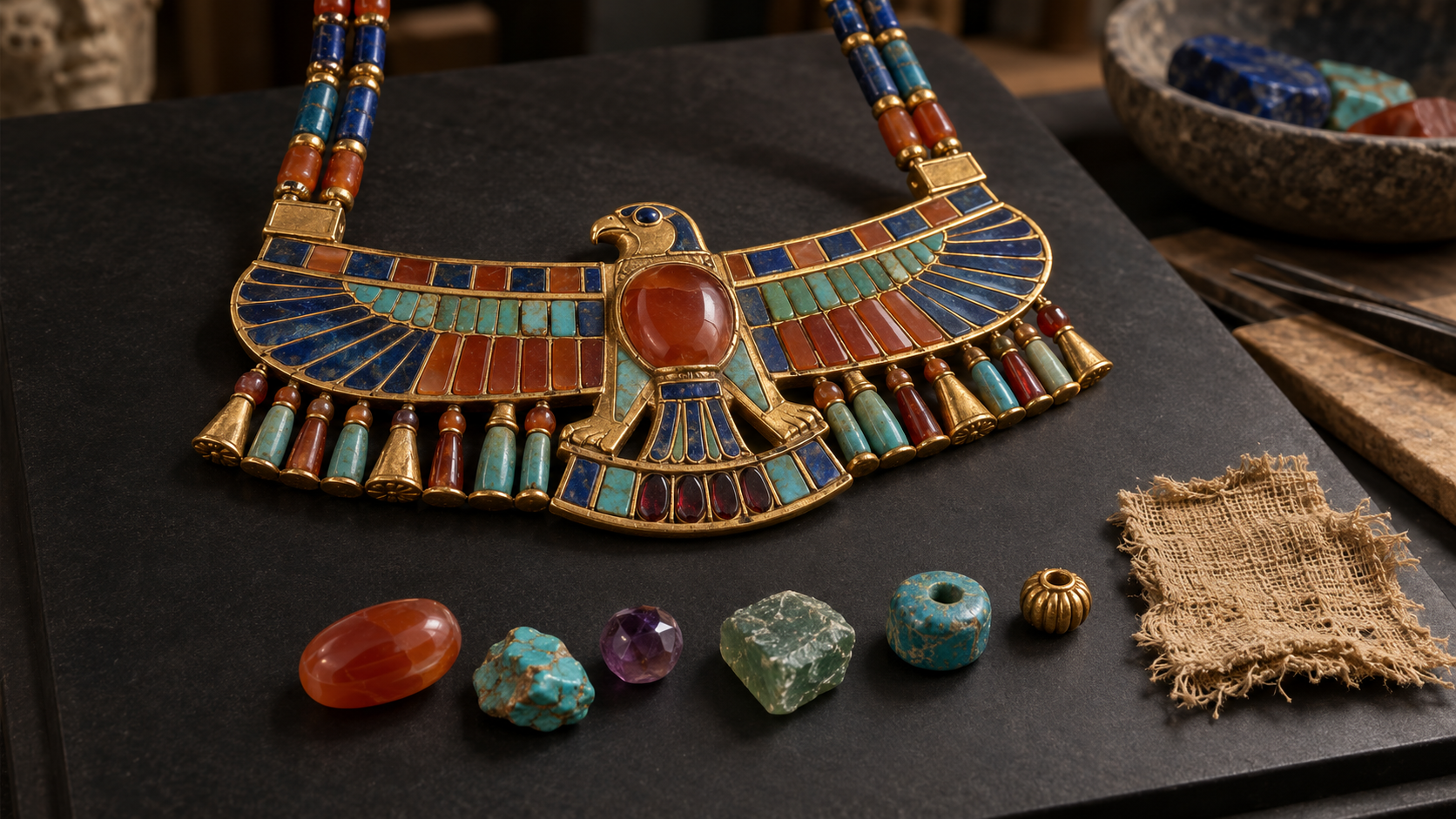
Imagine opening an ancient Egyptian jewellery box.
Inside, carefully arranged against a dark background, lie small pieces of polished red carnelian, pale blue-green turquoise, violet amethyst and deep blue lapis lazuli.
Some have been fashioned into beads.
Others form intricate inlays set into gold.
A few have been carved into miniature animals, scarabs or protective symbols.
At first glance, the objects appear to demonstrate an appreciation of beautiful natural materials.
Yet their significance extends considerably further.
In ancient Egypt, colour was rarely a purely decorative consideration.
The materials selected for jewellery, amulets and ceremonial objects could communicate ideas about life, renewal, protection, divine authority and the natural world.
Gold was associated with enduring brilliance.
Blue and green frequently evoked life, vegetation and regeneration.
Red could represent powerful and sometimes dangerous forces.
The selection of gemstones was therefore connected with a complex cultural system in which material, colour, image and ritual meaning interacted.
However, the physical origins of these colours tell a different story.
The reddish appearance of carnelian is associated with iron-bearing compounds.
The blue-green colour of turquoise reflects its copper-containing mineral chemistry.
The purple colour of amethyst results from defects associated with iron in the quartz crystal structure and natural irradiation.
The deep blue appearance of lapis lazuli originates principally from lazurite and its sulfur-related colour centres.
These are measurable mineralogical and physical characteristics.
The ancient symbolic meanings attributed to the materials belong to the history of religion and culture.
Both perspectives are important, but they answer different questions.
Perhaps most remarkably, ancient Egyptian craftspeople also learned to manufacture brilliant blue-green materials using powdered quartz, alkaline substances and copper-containing compounds.
The resulting substance, known today as Egyptian faience, became one of the civilisation’s most characteristic decorative materials.
The history of Egyptian gemstones is therefore not simply a history of beautiful stones. It is a history of geology, technology, trade, artistic craftsmanship and the human interpretation of colour.
1. Understanding Gemstones in Their Historical Context
Ancient Egyptian civilisation developed over several millennia.
Its jewellery traditions changed substantially during that time.
Materials favoured during the Predynastic Period were not necessarily used in the same ways during the Middle Kingdom or New Kingdom.
Mining activities expanded and contracted.
Trade relationships changed.
New manufacturing techniques appeared.
Religious imagery also developed.
Consequently, it would be misleading to describe ancient Egyptian gemstone use as a single, unchanging tradition.
Archaeologists reconstruct these practices by studying surviving objects, inscriptions, archaeological contexts and evidence of ancient production.
Modern scientific analysis provides additional information.
A gemstone preserved in a museum can reveal details about its mineral composition.
A manufactured bead may preserve evidence of firing techniques.
An inlay can sometimes provide information about ancient material selection and trade.
These investigations are particularly important because historical descriptions do not always correspond to modern mineralogical classifications.
The names used by ancient societies were not equivalent to the terminology employed by contemporary gemmologists.
An ancient description of a blue-green stone does not necessarily identify turquoise.
Likewise, a modern museum catalogue created before advanced analytical methods became widely available may contain material identifications that require revision.
The study of ancient gemstones therefore depends on combining archaeological evidence with modern mineralogical knowledge.
2. Natural Gemstones, Decorative Rocks and Manufactured Materials
Before examining individual Egyptian gemstones, an important distinction must be established.
Not every material used in ancient jewellery was a gemstone in the strict mineralogical sense.
Some were natural minerals.
Others were rocks containing several mineral components.
Still others were manufactured materials.
Turquoise is a recognised mineral species.
Amethyst is a purple variety of quartz.
Carnelian is a variety of chalcedony, a fine-grained silica material.
Garnet refers to a group of related mineral species.
Lapis lazuli, by contrast, is a rock composed of several minerals, including lazurite.
Egyptian faience is an artificially manufactured siliceous material.
These distinctions matter because visually similar objects can possess very different compositions and structures.
A blue-green faience bead may resemble turquoise.
A dark blue glass inlay may resemble lapis lazuli.
A reddish manufactured material may imitate the appearance of carnelian.
However, the materials are not mineralogically interchangeable.
For modern gemmology, accurate identification begins with understanding what the material actually is.
For archaeology, the material’s identity also provides information about production methods, resource availability and technological development.
3. Turquoise: A Precious Mineral from the Sinai
Turquoise is among the gemstones most strongly associated with ancient Egyptian culture.
Its characteristic blue-green colour made it particularly desirable for jewellery and decorative objects.
Mineralogically, turquoise is a hydrated copper-aluminium phosphate.
Its chemical composition is commonly expressed as:
CuAl₆(PO₄)₄(OH)₈·4H₂O
The mineral generally forms through geological processes involving copper-bearing solutions and suitable aluminium- and phosphate-containing materials.
Its colour ranges from blue to green.
Copper is particularly important in producing its characteristic blue coloration.
The gemstone usually occurs as opaque or semitranslucent material.
Its Mohs hardness is approximately 5–6.
Although turquoise has become almost synonymous with Egyptian jewellery in popular culture, archaeological research reveals a more complicated history.
According to the Metropolitan Museum of Art, turquoise was relatively scarce in ancient Egypt.
Important ancient sources were located in the southwestern Sinai Peninsula.
Two particularly significant mining areas were Wadi Maghara and Serabit el-Khadim.
Evidence from these regions includes ancient mining installations, tools, inscriptions and remains associated with mining expeditions.
The exploitation of turquoise deposits required organised activities beyond the Nile Valley.
Mining expeditions therefore formed part of the wider economic and political systems of ancient Egypt.
Turquoise was used for beads, amulets and decorative inlays.
It was particularly valued for its blue-green colour.
However, the relative scarcity of natural turquoise encouraged the use of other materials capable of producing similar visual effects.
This becomes important when examining Egyptian faience and green feldspar.
4. Turquoise, Hathor and the Symbolism of Blue-Green
The Sinai turquoise deposits were not important solely as mineral resources.
They also acquired religious significance.
At Serabit el-Khadim, a temple was dedicated to Hathor.
The goddess was associated with several aspects of Egyptian religious life, including music, fertility and protection.
Historical inscriptions identify Hathor with titles connecting her to turquoise.
This relationship illustrates how a valuable mineral resource could become integrated into religious geography.
The colour of turquoise was also important.
Blue-green tones were associated with vegetation, fertility and renewal.
Such associations were understandable within a civilisation whose agricultural life depended heavily on the Nile.
However, it is important to distinguish cultural symbolism from physical properties.
Turquoise possesses measurable mineralogical characteristics.
Its chemical composition, hardness, colour and structure can be investigated scientifically.
The belief that a turquoise amulet could provide protection or regeneration belongs to the religious traditions of ancient Egypt.
These beliefs are historically significant because they influenced the manufacture, selection and use of objects.
They do not establish that the mineral possesses scientifically demonstrated supernatural properties.
The same gemstone can therefore be understood through two complementary perspectives: its natural geological identity and the cultural meanings attributed to it.
5. Carnelian: The Red Stone of Egyptian Jewellery
Carnelian was another important material in ancient Egyptian jewellery.
Its colour ranges from orange-red to reddish-brown.
Carnelian belongs to the chalcedony family.
Chalcedony consists predominantly of fine-grained silica phases, principally quartz.
The chemical composition of its principal quartz component is SiO₂.
Carnelian’s characteristic reddish colour is associated with iron-bearing compounds, including iron oxides.
The precise appearance depends on the distribution and state of these colour-producing components.
Carnelian was particularly suitable for beads and small carved objects.
Its relatively fine-grained structure allows it to accept an attractive polish.
It also possesses the durability associated with quartz-rich materials.
Archaeological collections contain numerous examples of Egyptian carnelian jewellery.
These include necklaces, beads, amulets and decorative inlays.
Carnelian could be combined with turquoise and lapis lazuli to create contrasting colour arrangements.
The Metropolitan Museum of Art identifies red, light blue-green and dark blue as an especially important combination in Middle Kingdom jewellery.
Carnelian commonly supplied the red component.
Turquoise supplied the lighter blue-green colour.
Lapis lazuli provided the darker blue.
This combination demonstrates how different natural materials were selected to create a coordinated visual and symbolic composition.
6. The Meaning of Red in Ancient Egyptian Amulets
Red possessed several associations in ancient Egyptian culture.
It could evoke powerful or dangerous forces.
At the same time, red could be considered protective.
This apparent contradiction is important.
Historical colour symbolism does not always follow the simplified systems commonly presented in modern gemstone folklore.
The meaning of a colour could depend on context, imagery and religious purpose.
A red amulet might be associated with protection precisely because the colour represented powerful forces.
The Metropolitan Museum of Art’s research into Egyptian amulets confirms that red could carry both dangerous and protective associations.
Carnelian was therefore more than a convenient decorative material.
Its appearance could contribute to the intended meaning of an object.
However, the interpretation of an individual amulet should consider its form, inscription, archaeological context and date.
It would be inaccurate to assume that every carnelian object carried exactly the same symbolic meaning.
A simple bead, a royal inlay and a funerary amulet may have served different purposes.
7. Amethyst: Purple Quartz in Egyptian Jewellery
Amethyst is the purple variety of quartz.
Its chemical composition is SiO₂.
Unlike carnelian, which generally displays orange-red to reddish-brown tones, amethyst can range from pale lilac to deep violet.
The purple colour of natural amethyst is associated with iron-related defects in the quartz crystal structure and the effects of natural irradiation.
These processes create colour centres that influence the wavelengths of visible light absorbed by the crystal.
The result is the characteristic purple appearance.
Amethyst was used in ancient Egyptian jewellery, particularly during the Middle Kingdom.
Surviving objects include beads, pendants and amulets.
The Metropolitan Museum of Art preserves several examples.
One Middle Kingdom necklace belonging to the young girl Mayet includes turquoise, amethyst, carnelian, Egyptian blue and faience.
The combination demonstrates that natural gemstones and manufactured decorative materials could be used together within a single piece of jewellery.
Other surviving Egyptian objects combine amethyst with gold.
These examples establish the importance of purple quartz within Egyptian jewellery traditions.
However, the precise symbolic meaning of amethyst should not be generalised across all Egyptian periods.
Modern associations between amethyst and tranquillity, meditation or spiritual healing should not automatically be projected onto ancient Egyptian society.
Historical interpretation requires evidence from the relevant period.
8. Garnet: A Family of Minerals Rather Than One Stone
Garnet was also used in ancient Egyptian jewellery.
It is important to understand that garnet is not a single mineral species.
The term describes a group of related silicate minerals sharing a characteristic crystal structure.
Different garnet species possess different chemical compositions.
Their colours can vary considerably.
Red garnets are especially familiar in jewellery, but garnets also occur in green, orange, yellow and other colours.
Ancient Egyptian jewellery frequently incorporated reddish garnet beads and inlays.
A necklace preserved in the Metropolitan Museum of Art, dated to approximately 1580–1458 BCE, contains garnet, gold, carnelian and silver.
The object demonstrates the use of garnet during the transition from the Second Intermediate Period into the early New Kingdom.
Another Middle Kingdom bead assemblage includes garnet, carnelian, green feldspar, amethyst and jasper.
These examples illustrate the diversity of mineral materials available to Egyptian jewellery makers.
From a modern gemmological perspective, an important caution applies.
Identifying a historical object as garnet does not automatically establish its precise garnet species.
Distinguishing almandine, pyrope and other garnet compositions may require additional analysis.
Historical catalogue descriptions should therefore not be interpreted as more chemically specific than the available evidence supports.
9. Green Feldspar and the Problem of Historical Identification
One of the most interesting discoveries in modern Egyptian gemstone research concerns green feldspar.
Feldspar is a major group of rock-forming minerals.
Certain feldspar materials display attractive green or blue-green colours.
These can resemble turquoise.
In older archaeological literature, some Egyptian green feldspar objects were described as amazonite.
However, modern research has demonstrated that historical identifications based primarily on appearance can be unreliable.
The Metropolitan Museum of Art conducted analytical investigations of blue-green stones in its Egyptian collections.
The research revealed that several objects had previously been incorrectly identified.
A hippopotamus-head amulet once classified as another mineral was identified as feldspar.
Other objects historically described as beryl were subsequently reclassified.
These findings demonstrate an important principle.
Colour alone is not sufficient to establish mineral identity.
Turquoise, green feldspar, glass and faience can all produce visually similar blue-green appearances.
Their chemical compositions and structures are nevertheless different.
The distinction is particularly important when studying ancient objects because material identity can influence conclusions about mining, trade and manufacturing technology.
If a supposedly imported gemstone is actually a locally manufactured material, its historical interpretation may change substantially.
10. Lapis Lazuli: A Brief Look at Egypt’s Imported Deep Blue
Lapis lazuli deserves mention because it formed an important part of the Egyptian colour palette.
However, its wider geological and historical significance extends beyond the scope of this article.
Unlike turquoise or amethyst, lapis lazuli is a rock rather than a single mineral species.
Its characteristic blue colour originates principally from lazurite.
Other components may include calcite and pyrite.
The presence of white calcite and metallic-looking pyrite can produce the distinctive appearance familiar to gemstone collectors.
Ancient Egypt did not possess the major lapis lazuli deposits associated with the historic sources of Afghanistan.
The material reached Egypt through long-distance exchange networks.
The Metropolitan Museum of Art identifies Afghanistan as the source of the lapis lazuli used in important Egyptian objects.
This provides evidence of the extensive commercial and cultural connections linking ancient societies.
In Egyptian jewellery, lapis lazuli supplied an intense dark blue that contrasted effectively with carnelian and turquoise.
Its significance therefore involved both visual appearance and the prestige associated with an imported material.
The precise meaning of an individual lapis lazuli object depended on its context.
A bead, an inlay and a carved scarab were not necessarily equivalent in function.
11. Egyptian Faience: A Manufactured Material That Resembled Gemstones
Perhaps the most remarkable material in the Egyptian decorative tradition was not a natural gemstone at all.
It was Egyptian faience.
Faience was a manufactured material composed predominantly of silica-rich substances.
Its principal ingredients included powdered quartz or sand, alkaline salts, small quantities of lime and colour-producing compounds.
The finished material typically consisted of a siliceous body covered by a brightly coloured glaze.
Blue-green examples are particularly characteristic.
The colour was commonly produced using copper-containing compounds.
During manufacture, the ingredients were mixed, shaped and heated.
Chemical reactions during firing produced a glassy surface layer.
The resulting objects could display a brilliant appearance reminiscent of turquoise.
The Metropolitan Museum of Art explains that Egyptian faience may have developed partly in response to the desire for attractive blue-green materials.
However, it would be misleading to describe faience simply as a cheap imitation.
It became an important artistic and technological material in its own right.
Faience was used to produce beads, amulets, rings, vessels, figurines and architectural decoration.
Its manufacture required considerable knowledge of materials and firing conditions.
The production of faience therefore represents a major achievement in ancient materials technology.
12. The Science Behind Egyptian Faience
Egyptian faience provides an excellent example of how natural mineral resources can be transformed into manufactured decorative materials.
The principal silica source was usually powdered quartz or sand.
Alkaline substances acted as fluxes.
They helped promote reactions during firing.
Lime contributed to the composition and stability of the resulting glassy material.
Copper-containing compounds produced characteristic blue-green colours.
One important manufacturing technique is known as efflorescence glazing.
In this process, soluble salts within the prepared material migrate toward the surface during drying.
During firing, reactions involving the surface components produce a glaze.
Other manufacturing methods were also employed.
The finished object generally contained a relatively porous quartz-rich core beneath its glaze.
This structure differs fundamentally from that of natural turquoise.
Turquoise is a mineral with its own crystal structure and chemical composition.
Faience is a manufactured composite material.
Although both may appear blue-green, their physical origins are completely different.
Scientific analysis can reveal these differences.
Microscopic examination may identify the characteristic core and glaze structure of faience.
Chemical analysis can detect elements associated with the siliceous body and colouring compounds.
The Metropolitan Museum of Art’s conservation research on the famous faience hippopotamus known as William provides a particularly informative example.
Researchers examined its composition and manufacturing characteristics.
Their investigation documented copper-containing glaze, firing-related features and evidence of later restoration.
The study demonstrates how modern conservation science can reveal details of ancient manufacturing processes.
13. Egyptian Blue: Not the Same as Faience
Another important distinction concerns Egyptian blue.
Egyptian blue is a synthetic blue pigment developed in antiquity.
It should not be confused with natural lapis lazuli, turquoise or Egyptian faience.
The pigment was manufactured by heating a mixture containing silica, lime, an alkaline component and copper-bearing material.
The principal blue crystalline phase is commonly identified as calcium copper tetrasilicate, CaCuSi₄O₁₀.
This compound is associated with the mineral cuprorivaite.
Egyptian blue was used in painting and other decorative applications.
It could also be incorporated into manufactured objects.
However, the term does not describe every blue artificial material found in ancient Egypt.
Faience refers to a manufactured siliceous body with a glaze.
Egyptian blue refers principally to a synthetic pigment or related blue frit material.
Glass represents another category.
These distinctions are important because different technologies can produce similar colours.
A blue object may therefore require scientific examination before its material can be identified confidently.
The Metropolitan Museum of Art preserves a lump of Egyptian blue dated to the reign of Hatshepsut and Thutmose III.
This surviving material provides direct archaeological evidence of ancient synthetic pigment production.
14. The Pectoral of Sithathoryunet: A Masterpiece of Gemstone Inlay
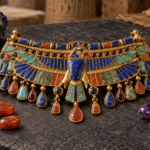
One of the finest surviving examples of Middle Kingdom jewellery is the pectoral associated with Princess Sithathoryunet.
The object is preserved in the Metropolitan Museum of Art.
It dates to approximately 1887–1878 BCE.
The pectoral was discovered among the princess’s jewellery in her tomb at Lahun.
Its construction demonstrates an extraordinary level of craftsmanship.
According to the museum, the pectoral contains 372 carefully shaped gemstone inlays.
These were arranged within a gold framework.
The materials include carnelian, lapis lazuli, turquoise and garnet.
The associated necklace also incorporates green feldspar.
The composition is not simply ornamental.
Its imagery includes falcons, cobras, solar symbols, hieroglyphs and representations associated with divine authority.
The design centres on the throne name of King Senwosret II.
The arrangement expresses concepts of royal power, life and enduring rule.
The gemstones contribute to this symbolic programme through their colours.
Red, blue and blue-green materials create a carefully coordinated composition.
The object’s significance therefore emerges from the interaction of several elements.
Its precious materials demonstrate wealth and access to valuable resources.
Its craftsmanship demonstrates advanced technical skill.
Its imagery communicates royal ideology.
Its archaeological context connects it with the Middle Kingdom elite.
This pectoral is an excellent example of why historical jewellery should be examined as a complete cultural object rather than merely as a collection of gemstones.
15. Gemstone Amulets: Shape, Colour and Religious Meaning
Amulets were important throughout ancient Egyptian history.
They were worn by the living and placed with the dead.
Their intended functions varied.
Some were associated with protection.
Others represented regeneration, divine assistance or the continuation of life after death.
The Metropolitan Museum of Art explains that the perceived power of an amulet could depend on several interacting characteristics.
These included its shape, material, colour, inscription and ritual use.
A gemstone’s identity was therefore only one part of its meaning.
For example, a scarab-shaped amulet could refer to concepts of renewal and transformation.
The wedjat eye was associated with restoration and protection.
Other forms represented deities, animals or religious symbols.
Amulets could be made from natural gemstones.
They could also be manufactured from faience, glass or other materials.
This demonstrates that religious significance did not depend exclusively on the rarity of the material.
A relatively inexpensive faience amulet could possess considerable cultural importance.
The symbolic function was connected with the object’s identity and intended use.
However, these historical beliefs should not be confused with scientifically established effects.
Modern mineralogical research can identify the physical characteristics of an amulet.
Archaeology can investigate its cultural meaning.
Neither discipline establishes that the object possessed supernatural powers.
16. The Scarab: From Natural Observation to Religious Symbol
The scarab beetle became one of the most recognisable symbols of ancient Egypt.
Its importance was connected with observations of dung beetles and their behaviour.
Certain beetles roll balls of dung across the ground.
Ancient Egyptians associated this movement with the apparent daily movement of the sun.
The scarab consequently became connected with ideas of renewal and rebirth.
Scarabs were produced from several materials.
These included natural gemstones and manufactured substances.
Some were incorporated into rings or necklaces.
Others functioned as seals.
Their undersides could contain inscriptions or decorative images.
The Metropolitan Museum of Art preserves a Middle Kingdom bracelet associated with Wah that includes a lapis lazuli scarab.
The object demonstrates how an imported blue stone could be transformed into a culturally meaningful form.
The significance of the scarab was therefore not determined by colour alone.
The carved shape was essential.
This provides another example of how ancient Egyptian jewellery combined material selection with symbolic design.
17. Did Every Egyptian Gemstone Have a Fixed Spiritual Meaning?
Modern publications sometimes present simplified lists assigning one specific spiritual property to every gemstone.
Such interpretations should be approached cautiously when applied to ancient Egypt.
Egyptian religious beliefs developed over thousands of years.
Different periods and regions employed different traditions.
The meaning of an object could depend on its colour, shape, inscription, material and ritual context.
Consequently, it is rarely appropriate to assume that every example of one gemstone variety carried an identical meaning.
A carnelian bead worn as ordinary jewellery may not have served the same purpose as a carnelian funerary amulet.
A turquoise inlay in a royal pectoral belonged to a different context from a simple turquoise bead.
An amethyst necklace may have been valued for its appearance, craftsmanship or social significance without necessarily representing a universal spiritual concept.
Historical interpretations should therefore be supported by archaeological evidence.
The distinction is important for both scientific and culturally respectful writing.
Traditional beliefs can be described accurately without presenting them as universal truths or measurable physical effects.
18. Were Emeralds and Peridot Common in Every Period of Ancient Egypt?
Popular accounts sometimes create the impression that emeralds and peridot were widely used throughout the entire history of pharaonic Egypt.
The archaeological evidence requires a more careful interpretation.
Emerald deposits are known from Egypt’s Eastern Desert.
However, the Metropolitan Museum of Art identifies the earliest known exploitation of the Wadi Sikait emerald mining area with the late Ptolemaic Period.
This is considerably later than the Middle Kingdom jewellery discussed earlier.
Consequently, the existence of Egyptian emerald deposits does not establish that emeralds were widely used during every earlier dynasty.
Peridot presents another interesting case.
The green gem variety of olivine is historically associated with the Red Sea island of Zabargad.
Ancient literary sources refer to valuable green stones associated with the region.
However, the relationship between those descriptions and specific surviving archaeological objects requires careful evaluation.
A 2026 historical research bibliography published by the Gemological Institute of America notes that the literary association between peridot and the Ptolemaic court is not supported by direct archaeological evidence for that particular period.
This does not mean that ancient Egyptians never encountered peridot.
It means that historical claims should be proportional to the evidence.
The presence of a mineral deposit, an ancient written description and a securely identified archaeological gemstone are three different types of evidence.
They should not be treated as interchangeable.
19. Ancient Gemstone Trade and the Geography of Materials
The distribution of gemstone resources influenced Egyptian economic and political activities.
Some materials were available within Egypt or nearby territories.
Others required long-distance exchange.
Turquoise was obtained from the Sinai.
Many quartz-rich materials could be sourced from Egyptian geological environments.
Lapis lazuli travelled through extensive exchange networks connecting regions far beyond the Nile Valley.
These differences affected the availability and cultural significance of materials.
Imported gemstones could communicate access to distant resources.
Locally manufactured faience provided another way to produce desirable colours.
The existence of these different material sources also demonstrates that Egyptian jewellery was not created through one simple supply system.
Mining, transport, trade, craftsmanship and royal patronage all contributed.
However, the geological origin of an individual ancient gemstone cannot always be established merely from its appearance.
Different deposits may produce visually similar material.
Historical trade routes can suggest possible sources, but they do not necessarily prove the origin of a particular object.
Modern scientific analysis can sometimes strengthen provenance investigations.
Such conclusions should remain tied to the analytical evidence available.
20. How Modern Science Identifies Ancient Egyptian Gemstones
Modern gemmological and archaeological research provides methods for distinguishing visually similar materials.
Several analytical approaches may be useful.
Microscopic examination
Microscopy can reveal surface structures, inclusions and manufacturing characteristics.
In faience, examination of the body and glaze may provide evidence of its manufactured structure.
X-ray fluorescence spectroscopy
X-ray fluorescence, commonly abbreviated XRF, can identify chemical elements present in a material.
It is particularly useful for investigating certain ancient gemstones and manufactured objects without removing substantial samples.
However, elemental composition alone does not always identify a specific mineral species.
Raman spectroscopy
Raman spectroscopy can provide information about molecular vibrations and crystal structures.
It may help distinguish minerals and manufactured materials when suitable reference data and analytical conditions are available.
X-ray diffraction
X-ray diffraction can identify crystalline phases.
This can be valuable when distinguishing minerals with similar appearances but different crystal structures.
Archaeological context
Scientific analysis should be combined with archaeological information.
An object recovered from a documented excavation provides a different level of historical evidence from an object with an unknown collection history.
The Metropolitan Museum of Art’s research into ancient Egyptian turquoise demonstrates the importance of this combined approach.
Its analytical programme revealed historical identification errors and provided information relevant to the geological sourcing of turquoise.
The central lesson is straightforward.
Modern gemmology can improve our understanding of ancient objects, but scientific measurements must be interpreted alongside archaeological evidence.
21. A Remarkable Authentication Example from the British Museum
The British Museum preserves an object that illustrates the importance of scientific material identification.
The object is a carved lapis lazuli head representing a jackal-like animal.
It was historically presented as an ancient Egyptian-style object.
However, its appearance raised questions.
The museum’s research identified stylistic inconsistencies.
Further investigation using X-ray diffraction revealed wollastonite within the stone.
According to the museum’s interpretation, this mineral association was inconsistent with the Afghan lapis lazuli source expected for the proposed ancient Egyptian context.
Instead, it was characteristic of material associated with the Lake Baikal region of Siberia.
The museum concluded that the object was almost certainly a modern creation.
This example is particularly instructive.
The material itself was natural lapis lazuli.
Yet that did not establish the historical authenticity of the carving.
The geological characteristics of the material contributed to a conclusion about the object’s probable manufacture.
The case demonstrates why natural gemstone identification and historical authentication must remain separate questions.
A natural mineral can be carved recently.
An ancient object can be manufactured from artificial materials.
Both possibilities must be considered when evaluating historical gemstone artefacts.
22. Why Egyptian Faience Was Not Simply a Counterfeit Gemstone
The distinction between natural gemstones and manufactured materials is essential.
However, describing every manufactured Egyptian object as an imitation or counterfeit would be historically misleading.
Faience developed into a recognised artistic medium.
Its production required specialised knowledge.
Its characteristic colours became culturally meaningful.
Faience objects were used in religious, decorative and funerary contexts.
Some were made in elaborate forms that would have been difficult to reproduce using natural gemstones.
The material therefore possessed qualities that extended beyond its ability to resemble turquoise.
In modern gemmology, an artificial material sold as natural turquoise without proper disclosure would represent a serious identification and disclosure problem.
Ancient Egyptian faience must be understood differently.
It was a historically established manufactured material with its own technological and cultural identity.
The appropriate description of an ancient object depends on its actual composition and historical context.
A faience amulet should be identified as faience.
A turquoise amulet should be identified as turquoise when that identification is supported.
Neither material should be misrepresented as the other.
23. What Egyptian Jewellery Teaches Modern Gemstone Collectors
Ancient Egyptian jewellery provides several lessons that remain relevant today.
The first concerns material identification.
Objects that appear similar may possess different compositions.
The second concerns colour.
The visual appearance of a gemstone depends on its mineralogical properties, while its cultural meaning depends on human interpretation.
The third concerns craftsmanship.
A relatively common material can become an exceptional artistic object through skilled workmanship.
The fourth concerns provenance.
Knowing where an object was discovered or how it entered a collection can be essential to understanding its historical significance.
The fifth concerns terminology.
Historical names do not always correspond to modern mineralogical classifications.
Finally, Egyptian jewellery demonstrates that the significance of a gemstone cannot always be reduced to its rarity or monetary value.
An ancient faience amulet may possess extraordinary archaeological importance.
A small carnelian bead may provide evidence of a particular historical period.
A complex royal pectoral may reveal information about religion, political authority and artistic technology.
These qualities extend beyond the physical properties of the materials alone.
24. Common Misconceptions About Gemstones in Ancient Egypt
Misconception 1: All blue-green Egyptian jewellery was made from turquoise.
Incorrect.
Green feldspar, faience, glass and other materials were also used.
Misconception 2: Egyptian faience was a natural gemstone.
Incorrect.
Faience is a manufactured siliceous material with a characteristic glaze.
Misconception 3: Lapis lazuli is a single mineral species.
Incorrect.
Lapis lazuli is a rock composed of several minerals, including lazurite.
Misconception 4: Every Egyptian gemstone had one fixed spiritual meaning.
Incorrect.
Interpretations depended on historical period, context, colour, form and religious tradition.
Misconception 5: Ancient Egyptian jewellery used only natural gemstones.
Incorrect.
Manufactured materials were important components of Egyptian decorative technology.
Misconception 6: Emeralds were widely used throughout every Egyptian dynasty.
Not supported by the available archaeological evidence.
The best-documented Egyptian emerald mining history belongs to considerably later periods.
Misconception 7: A museum’s historical gemstone identification can never change.
Incorrect.
Modern analytical research has led to revisions of earlier material identifications.
Misconception 8: A natural gemstone proves that an object is ancient.
Incorrect.
The geological origin of a mineral does not establish when it was carved or incorporated into jewellery.
Misconception 9: Manufactured materials were always considered inferior.
Incorrect.
Faience became a prestigious and culturally important artistic material.
Misconception 10: Ancient gemstone beliefs demonstrate scientifically measurable healing effects.
Incorrect.
Historical religious beliefs provide evidence about culture and interpretation, not proof of supernatural physical properties.
25. The Relationship Between Mineralogy and Egyptian Culture
The extraordinary diversity of ancient Egyptian jewellery becomes clearer when viewed through both scientific and historical perspectives.
Mineralogy explains the physical characteristics of the materials.
It identifies the chemical composition of turquoise.
It explains the iron-related colour mechanisms of amethyst and carnelian.
It distinguishes natural feldspar from manufactured faience.
It identifies the mineral components of lapis lazuli.
Archaeology explains how those materials were used.
It reveals the importance of mining expeditions.
It documents jewellery production and trade.
It identifies religious imagery.
It provides evidence of social status and cultural practices.
Art history examines the craftsmanship and visual organisation of objects.
Conservation science investigates manufacturing methods, alterations and material condition.
These disciplines are complementary.
A purely mineralogical description cannot fully explain the significance of a royal Egyptian pectoral.
A purely symbolic interpretation cannot establish the actual composition of its gemstones.
A comprehensive understanding requires both.
Conclusion: Natural Stones, Human Ingenuity and the Meaning of Colour
Ancient Egyptian jewellery demonstrates an extraordinary relationship between natural mineral resources and human creativity.
Turquoise supplied attractive blue-green colour from the Sinai.
Carnelian contributed warm reddish tones.
Amethyst provided purple quartz.
Garnet offered additional colour and decorative possibilities.
Green feldspar created effects that could resemble turquoise.
Imported lapis lazuli supplied intense blue.
Alongside these natural materials, Egyptian craftspeople developed sophisticated manufactured substances.
Faience allowed them to create brilliant blue-green objects through controlled processing of silica-rich materials.
Egyptian blue demonstrated another important achievement in ancient chemical technology.
The surviving jewellery reveals how these materials were combined.
Gold frameworks held carefully shaped gemstone inlays.
Beads formed necklaces and bracelets.
Carved amulets expressed religious ideas.
Royal ornaments communicated authority and cultural identity.
Modern scientific research adds another dimension.
It allows scholars to investigate material composition, manufacturing techniques and possible geological origins.
It can also correct historical misidentifications.
Perhaps the most important lesson is that gemstones possess several different kinds of significance.
Their physical properties belong to mineralogy.
Their geological origins belong to Earth science.
Their craftsmanship belongs to the history of technology and art.
Their symbolic meanings belong to the cultural traditions of the people who used them.
Understanding these dimensions together produces a richer and more accurate appreciation of ancient jewellery.
The gemstones of ancient Egypt were not simply decorative fragments of the natural world.
They became materials through which an entire civilisation expressed its knowledge, craftsmanship, beliefs and understanding of colour.
References & Further Reading
The following references have been selected from recognised museums, archaeological research institutions and professional gemmological publications.
They support the historical, mineralogical, technological and cultural information presented in this article.
All references lead to educational, scientific, archaeological or museum collection resources rather than commercial gemstone product pages.
1. Metropolitan Museum of Art – Turquoise in Ancient Egypt
Author: Deborah Schorsch
Published: April 2018
Institution: Metropolitan Museum of Art
A comprehensive research essay examining turquoise mining in the Sinai, Egyptian jewellery traditions, the cultural significance of blue-green materials and the scientific identification of historical turquoise objects.
The article is particularly valuable for understanding the distinction between turquoise, green feldspar and manufactured materials.
https://www.metmuseum.org/essays/turquoise-in-ancient-egypt
2. Metropolitan Museum of Art – Egyptian Faience: Technology and Production
Author: Carolyn Riccardelli
Published: December 2017
Institution: Metropolitan Museum of Art
A detailed scientific and archaeological explanation of Egyptian faience.
The publication discusses its chemical composition, manufacturing methods, glazing technology, colour-producing compounds and historical applications.
It provides essential evidence for distinguishing faience from natural gemstones.
https://www.metmuseum.org/essays/egyptian-faience-technology-and-production
3. Metropolitan Museum of Art – Ancient Egyptian Amulets
Author: Isabel Stünkel
Published: February 2019
Institution: Metropolitan Museum of Art
An authoritative examination of Egyptian amulets, their historical functions and the relationship between material, colour, imagery and religious meaning.
The publication explains the importance of scarabs, wedjat eyes and other protective symbols.
https://www.metmuseum.org/essays/egyptian-amulets
4. Metropolitan Museum of Art – Pectoral and Necklace of Sithathoryunet with the Name of Senwosret II
Institution: Metropolitan Museum of Art
Period: Middle Kingdom
Date: Approximately 1887–1878 BCE
Collection number: 16.1.3a, b
A documented royal jewellery masterpiece containing 372 carefully shaped gemstone inlays.
The museum’s collection record identifies the materials and explains the religious and political symbolism of the composition.
https://www.metmuseum.org/art/collection/search/544232
5. Metropolitan Museum of Art – A Necklace of Four Strands of Beads and Amulets
Institution: Metropolitan Museum of Art
Period: Middle Kingdom
Date: Approximately 2051–2030 BCE
Collection number: 22.3.324
An important archaeological example combining turquoise, amethyst, carnelian, Egyptian blue and faience.
The necklace demonstrates the simultaneous use of natural gemstones and manufactured decorative materials.
https://www.metmuseum.org/art/collection/search/544147
6. Metropolitan Museum of Art – String of Beads
Institution: Metropolitan Museum of Art
Period: Middle Kingdom
Date: Approximately 2030–1640 BCE
Collection number: 40.9.23
A documented bead assemblage containing carnelian, garnet, green feldspar, amethyst, green jasper and other materials.
The object provides direct evidence of the mineral diversity used in Egyptian jewellery.
https://www.metmuseum.org/art/collection/search/546089
7. Metropolitan Museum of Art – Scarab and Bead Bracelet
Institution: Metropolitan Museum of Art
Period: Middle Kingdom
Date: Approximately 1981–1975 BCE
Collection number: 40.3.14
A bracelet associated with Wah containing a lapis lazuli scarab and carnelian beads.
The museum explains the symbolic importance of the scarab and the imported origin of Egyptian lapis lazuli.
https://www.metmuseum.org/art/collection/search/545120
8. University College London – Egyptian Faience and Glazed Ware
Institution: University College London
Resource: Digital Egypt for Universities
An archaeological educational resource explaining the composition and technology of Egyptian faience.
The publication distinguishes faience from glazed stone and other manufactured materials.
https://www.ucl.ac.uk/museums-static/digitalegypt/faience/index.html
9. Gemological Institute of America – Turquoise
Institution: Gemological Institute of America
Resource: Gem Encyclopedia
A professional gemmological reference covering turquoise’s chemical composition, formation, colour, hardness, optical characteristics and historical importance.
The resource provides the scientific foundation for distinguishing natural turquoise from other blue-green materials.
10. Gemological Institute of America – Amethyst from Boudi, Morocco
Authors: Fabrizio Troilo, Abdelghani El Harfi, Salahaddine Mouaddib, Erica Bittarello and Emanuele Costa
Publication: Gems & Gemology
Published: Spring 2015
A scientific study of natural amethyst, including its geological occurrence, crystal characteristics, colour zoning and iron-related colour mechanisms.
Although the material studied originates from Morocco rather than ancient Egypt, the research provides relevant mineralogical evidence for understanding amethyst coloration.
https://www.gia.edu/gems-gemology/spring-2015-amethyst-from-boudi-morocco
11. Metropolitan Museum of Art – Lump of Blue Paste
Institution: Metropolitan Museum of Art
Period: New Kingdom
Date: Approximately 1473–1458 BCE
Collection number: 36.3.202
A documented example of Egyptian blue pigment production.
The museum explains the manufacture of the synthetic pigment using silica, lime, alkaline substances and copper-containing compounds.
https://www.metmuseum.org/art/collection/search/568012
12. British Museum – Lapis Lazuli Jackal-Head Figure
Institution: British Museum
Collection number: EA64075
An important case study demonstrating how scientific mineral identification can contribute to the authentication of historical objects.
The museum describes stylistic concerns and X-ray diffraction evidence that indicate a modern origin for an object formerly presented as ancient Egyptian.
https://www.britishmuseum.org/collection/object/Y_EA64075
13. Gemological Institute of America – Historical Reading List: Peridot from Egypt
Institution: Gemological Institute of America
Published: 26 June 2026
A historical research bibliography examining peridot from Egypt’s Red Sea region.
The resource discusses ancient literary references, the historical importance of Zabargad Island and the limitations of archaeological evidence for particular early gemstone-use claims.
https://www.gia.edu/gia-website/reading-list-peridot-from-egypt
Scientific and Historical Interpretation
The gemstone materials discussed in this article were used across different periods of ancient Egyptian history.
Their availability, cultural meanings and applications changed over time.
Consequently, no single symbolic interpretation should automatically be applied to every object or historical period.
Modern mineralogical terminology is used to describe the physical identity of the materials.
Historical religious beliefs are presented as cultural traditions rather than scientifically demonstrated supernatural effects.
Material identifications and geological provenance claims should be understood according to the evidence available for individual objects.
The presence of a natural gemstone does not establish the antiquity of its carving or setting.
Likewise, an ancient manufactured material such as Egyptian faience is not inherently fraudulent or inferior because it is not a natural mineral.
The most reliable interpretation combines archaeological context, historical research, material analysis and careful scientific terminology.