There is something remarkable about the moment before a journey begins.
The suitcase is closed.
The keys are in your hand.
The door is still open.
Behind you lies the familiar world.
Ahead is something different.
Perhaps a holiday.
An important meeting.
A new home.
An unfamiliar city.
Or simply a day that requires you to step outside your usual routine.
For centuries, people have associated journeys with uncertainty, opportunity and the desire for protection.
Small objects have often accompanied them.
Amulets.
Religious symbols.
Personal keepsakes.
Stones carried close to the body.
Within contemporary crystal spirituality, Turquoise is frequently associated with protection during travel, communication and safe passage.
These associations belong to spiritual belief systems and symbolic traditions. There is no scientific evidence that carrying Turquoise prevents accidents, changes external events or provides supernatural protection.
Yet the history of Turquoise offers a fascinating perspective on why a small stone might become meaningful during a journey.
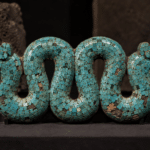
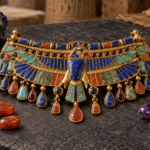
In ancient Egypt, Turquoise was associated with sacred objects, personal amulets and a goddess whose sanctuary stood within an important mining landscape.
That goddess was Hathor.
Her relationship with Turquoise provides an extraordinary starting point for exploring the symbolism of travel, uncertainty and the human desire to return safely.
And today, this history can inspire a simple personal ritual.
Not a reconstruction of an ancient Egyptian ceremony.
Not a claim of supernatural protection.
Instead, a contemporary practice in which a Turquoise pocket stone becomes a reminder to leave home with awareness, intention and practical care.
Table of Contents
Why Do People Carry Stones When Travelling?
Human beings frequently attach personal meaning to small objects.
A family photograph inside a wallet.
A necklace received from someone important.
A coin kept for good luck.
A familiar object carried during a difficult period.
The significance of these objects often extends beyond their appearance or material value.
They represent memories, relationships, commitments or hopes.
Within spiritual traditions, certain objects acquire an additional role.
They become talismans or amulets.
Although these terms are sometimes used interchangeably, their historical meanings vary across cultures.
An amulet is generally understood as an object believed to offer protection or beneficial influence.
A talisman may be associated with attracting a desired outcome or expressing a particular spiritual intention.
The Metropolitan Museum of Art’s educational essay Ancient Egyptian Amulets explains that such objects were widespread in ancient Egypt.
They could be worn on the body, incorporated into jewellery or attached to clothing.
Their believed effectiveness could depend on their shape, colour, material, inscriptions or associated ritual actions.
These beliefs were culturally significant.
They were not evidence of scientifically measurable supernatural effects.
But they reveal something important about the relationship between people and meaningful objects.
An object could accompany its owner while representing a hope that extended beyond the object itself.
That principle remains recognisable in many contemporary spiritual practices.
Turquoise in Ancient Egypt
Turquoise occupied a distinctive position within ancient Egyptian culture.
The Metropolitan Museum of Art’s research demonstrates that the material was strongly associated with Egyptian jewellery and decorative traditions, although genuine Turquoise was considerably rarer than its familiar appearance in modern representations might suggest.
Ancient Egyptian Turquoise was obtained principally from deposits in the Sinai Peninsula.
Two important mining regions were Wadi Maghara and Serabit el-Khadim.
Royal expeditions travelled into these areas during different periods of Egyptian history.
The journeys required organisation, labour and considerable effort.
Mining expeditions were not ordinary recreational journeys.
They involved travelling beyond the familiar Nile Valley into a demanding landscape to obtain valuable materials.
This setting gives the historical relationship between Turquoise and Hathor particular significance.
Hathor: The Mistress of Turquoise
Hathor was one of the major goddesses of ancient Egyptian religion.
Her religious roles were varied and developed across different periods and locations.
She was associated with themes including music, joy, motherhood, fertility and divine relationships.
In the Sinai, however, she acquired a particularly important local identity.
The Mistress of Turquoise.
The Metropolitan Museum of Art documents a Middle Kingdom temple dedicated to Hathor at Serabit el-Khadim.
Ancient inscriptions refer to the goddess using titles connecting her with Turquoise.
The sanctuary stood within the region where Egyptian expeditions sought the valued blue-green material.
This relationship was not accidental.
The religious significance of the goddess was closely connected with the activities taking place in the surrounding landscape.
The workers and officials involved in mining expeditions operated within a world where religious devotion and practical activity were deeply intertwined.
Success was not understood exclusively through human planning.
Divine favour also formed part of the religious interpretation of events.
Offerings Before an Uncertain Outcome
One particularly interesting archaeological discovery provides a glimpse into this relationship.
During excavations at Serabit el-Khadim in the early twentieth century, archaeologists recovered numerous objects associated with the Temple of Hathor.
Among them were fragments of votive offerings.
The Metropolitan Museum of Art preserves a fragment of a tile bearing the name of Seti II, a king of Egypt’s Nineteenth Dynasty.
The museum explains that votive objects found at the sanctuary included vessels, bracelets, figures, ritual instruments and decorated tiles.
These objects had been offered to Hathor by royal officials seeking success for their mining expeditions.
The historical meaning is important.
The offerings belonged to a specific religious environment.
They were not simply decorative souvenirs.
Nor were they equivalent to modern pocket stones.
They formed part of an established system of religious devotion associated with important expeditions.
Nevertheless, the broader human concern is recognisable.
People were preparing to undertake demanding activities with uncertain outcomes.
They sought reassurance and favourable circumstances through religious practice.
The objects expressed that relationship.
From Ancient Offerings to Modern Personal Symbolism
It would be historically inaccurate to claim that a modern Turquoise travel ritual directly continues the ceremonies performed at Serabit el-Khadim.
The ancient sanctuary belonged to a specific religious tradition.
Its rituals, offerings and divine relationships cannot be reconstructed simply by holding a gemstone.
The practice described in this article is therefore deliberately different.
It draws inspiration from the historical relationship between Turquoise, journeys and religious hopes for successful expeditions.
But its purpose is contemporary.
Rather than asking a stone to guarantee safety, we use it to remember three principles:
Prepare carefully.
Travel attentively.
Accept that not everything can be controlled.
These ideas transform the stone into a symbol of responsible movement through an uncertain world.
Turquoise and the Ancient Egyptian Amulet Tradition
Turquoise was also used in smaller personal objects.
The Metropolitan Museum of Art documents ancient Egyptian Turquoise beads, amulets, pendants and jewellery inlays.
One particularly interesting surviving object is a small fish-shaped pendant dating to the Middle Kingdom, approximately 1878–1749 BCE.
The pendant was made from Turquoise and gold.
Its suspension loop demonstrates that it was designed to hang vertically.
The object illustrates how Turquoise could become part of something small enough to be worn on the body.
Ancient Egyptian amulets were not limited to one material or meaning.
Their symbolism depended on multiple factors.
The shape could matter.
The colour could matter.
The represented animal or deity could matter.
The object’s religious and personal context could matter.
It would therefore be incorrect to assume that every ancient Egyptian Turquoise object was intended specifically for travel protection.
Nevertheless, the archaeological evidence clearly establishes that Turquoise participated in a wider tradition of meaningful personal objects.
The Symbolism of Blue-Green
Colour played an important role in ancient Egyptian visual and religious culture.
The Metropolitan Museum explains that light blue-green colours were associated with fertility and vegetation.
Turquoise was particularly valued for this appearance.
Other materials, including Egyptian faience, were also used to produce similar colours.
This distinction matters.
Many ancient Egyptian objects that appear turquoise-blue were not made from the gemstone Turquoise.
They could be manufactured from other materials selected for their colour and symbolic significance.
The visual effect itself was often important.
Blue-green could evoke ideas connected with life, growth and regeneration.
For a contemporary spiritual practice, these historical associations offer an alternative to the familiar modern claim that Turquoise simply provides protection.
The colour can symbolically represent:
continuity
renewal
movement into a new stage
the possibility of growth
These are contemporary interpretations inspired by documented historical symbolism, not fixed ancient Egyptian meanings assigned to every Turquoise object.
Why Travel Is an Interesting Spiritual Threshold
A journey changes our relationship with familiar surroundings.
At home, much of life is predictable.
We know where objects belong.
We recognise the streets.
We understand our usual routines.
Travel interrupts that familiarity.
Even a short journey introduces decisions.
Which direction should we take?
What have we forgotten?
How much time do we need?
What happens if plans change?
This makes travel an interesting subject for contemplative practice.
The moment of departure is a threshold.
A boundary between two situations.
Behind us is the familiar.
Ahead is the uncertain.
A small personal ritual can make that transition more deliberate.
The ritual does not control what happens during the journey.
Instead, it provides an opportunity to consider how we wish to approach it.
Choosing a Turquoise Travel Stone
A travel stone should be practical.
There is no need for a large specimen or elaborate arrangement.
A small polished Turquoise pocket stone works particularly well.
Other suitable forms include:
- A small Turquoise cabochon.
- A smooth Turquoise palm stone.
- A simple Turquoise pendant.
- A small Turquoise bead bracelet.
- A modest natural Turquoise specimen kept in a protective pouch.
The object should be comfortable to carry.
Avoid sharp edges or fragile settings.
If you use jewellery, make sure it is securely fastened.
If you use a pocket stone, choose a pouch that prevents it from becoming damaged or lost.
The purpose is to create a familiar symbolic object.
Not to introduce another practical concern during travel.
Creating a Departure Ritual
This contemporary ritual takes approximately five minutes.
It can be performed before leaving home for a holiday, business trip, important appointment or unfamiliar destination.
It requires only:
A Turquoise stone.
A quiet moment.
And a willingness to consider the journey ahead.
There is no need for candles, incense, sacred symbols or elaborate ceremonial arrangements.
The simplicity is intentional.
A departure ritual should fit naturally into everyday life.
Step One — Recognise the Threshold
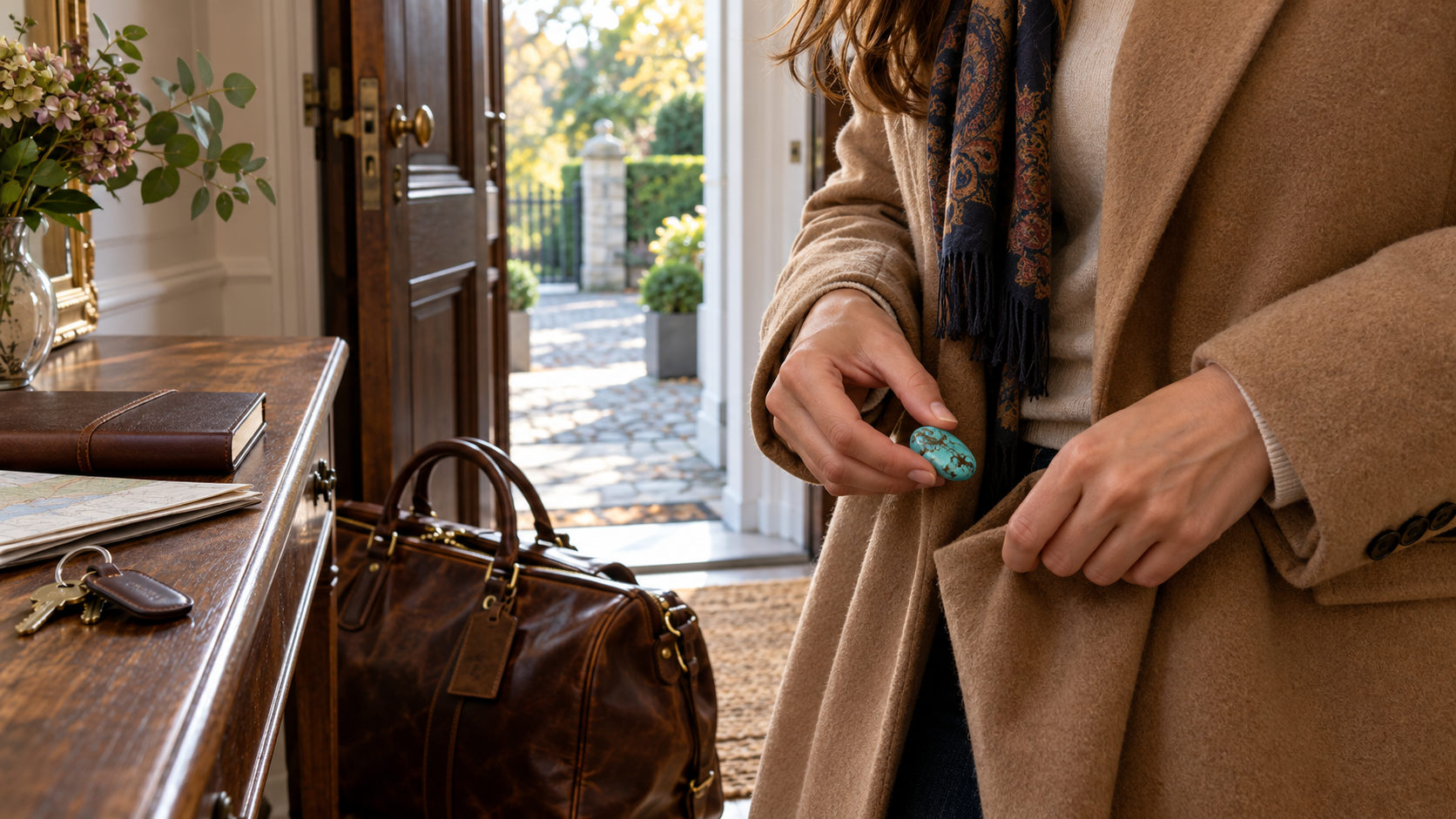
Before leaving, place your Turquoise stone on a small table near the door.
Do not immediately pick it up.
Stand quietly for a moment.
Look at the familiar surroundings.
The room.
The doorway.
The objects you are leaving behind.
Then consider:
I am about to move from the familiar into something different.
This may be a significant journey.
Or a relatively ordinary one.
Either way, the moment marks a transition.
Acknowledge it.
Step Two — Separate Preparation From Worry
Travel often produces two different kinds of mental activity.
The first is practical preparation.
Have I packed what I need?
Do I have my documents?
Is the route correct?
Have I allowed enough time?
The second is speculation.
What if everything goes wrong?
What if I forget something?
What if an unexpected problem occurs?
These thoughts can overlap.
A useful departure ritual distinguishes between them.
Ask yourself:
Is there something practical I still need to do?
If the answer is yes, do it.
Check the relevant document.
Confirm the address.
Review the departure time.
Make sure the necessary arrangements are complete.
The ritual should never replace ordinary preparation.
It should support it.
Step Three — Hold the Turquoise
Now pick up the stone.
Rest it comfortably in your palm.
Notice its physical presence.
Its shape.
Its surface.
Its weight.
You do not need to imagine energy moving through the stone.
Simply hold it.
Allow your attention to remain with the object for a few moments.
Then consider the historical symbolism.
Centuries ago, people associated Turquoise with religious devotion, meaningful objects and the activities surrounding important expeditions.
Your own journey belongs to a completely different world.
But the human experience of facing uncertainty remains familiar.
The stone becomes a reminder of that connection.
Step Four — Choose One Intention
An intention should describe how you wish to behave.
Not what you expect the universe to guarantee.
For example:
I will approach unfamiliar situations with patience.
Or:
I will remain attentive and make thoughtful decisions.
Or:
I will allow myself to experience something new without needing to control every detail.
Choose one.
Keep it simple.
The intention is not a prediction.
It is a personal commitment.
Step Five — Create a Practical Reminder
Psychological research offers an interesting way to make intentions more useful.
The American Psychological Association discusses a planning technique known as an implementation intention.
This involves connecting a particular situation with a chosen response.
The structure is simple:
If this happens, then I will do that.
For a journey, the intention might become:
If my plans change unexpectedly, then I will pause and review my options before reacting.
Or:
If I begin rushing, then I will check what actually needs to happen next.
Or:
If I feel overwhelmed by unfamiliar surroundings, then I will stop somewhere safe and orient myself.
The Turquoise can serve as a reminder of the plan.
The research concerns intentional planning and behaviour.
It does not demonstrate any psychological effect produced by the gemstone itself.
Step Six — Leave Deliberately
Place the Turquoise in its pouch or secure pocket.
Pick up your belongings.
Take one natural breath.
Then leave.
The ritual is complete.
There is no need to repeat a phrase a particular number of times.
No need to wait for a special sensation.
No need to interpret the appearance of the stone as a prediction.
The meaningful part is the transition.
You have prepared.
You have chosen an intention.
Now you begin.
Turquoise as a Pocket Stone During Travel
Once the journey begins, the stone does not require constant attention.
In fact, it is better to leave it safely stored during activities requiring concentration.
Driving, cycling and navigating busy environments require attention to the surroundings.
Do not handle a crystal while operating a vehicle.
Instead, use the stone during appropriate pauses.
Perhaps while seated safely before departure.
During a quiet break.
After arriving at your destination.
Or before an important conversation.
Take out the Turquoise.
Remember the intention.
Then put it away again.
The stone becomes a reminder rather than a distraction.
A Different Ritual for an Important Meeting
Not every journey involves travelling far.
Sometimes the most meaningful threshold is the doorway to an important meeting.
A job interview.
A difficult conversation.
A new workplace.
A first appointment.
A presentation.
These situations can feel unfamiliar even when the physical journey is short.
A Turquoise pocket-stone ritual can be adapted accordingly.
Before entering, find an appropriate quiet moment.
Hold the stone briefly.
Ask:
What quality do I want to bring into this situation?
Perhaps:
Patience.
Clarity.
Respect.
Confidence.
Curiosity.
Then choose one practical action that expresses that quality.
If your intention is clarity, perhaps you will ask questions when something is unclear.
If your intention is patience, perhaps you will allow the other person to finish speaking.
If your intention is confidence, perhaps you will express your position calmly.
The gemstone does not produce the quality.
It reminds you to practise it.
Travelling Into the Unknown
Some journeys carry more emotional significance than others.
Moving to a new city.
Beginning a different job.
Leaving a familiar environment.
Visiting a place connected with personal memories.
Returning somewhere after a long absence.
In these situations, travel becomes more than transportation.
It represents change.
A contemporary Turquoise ritual can acknowledge that change without pretending to control its outcome.
Hold the stone.
Ask:
What am I leaving behind?
Then:
What am I moving toward?
Finally:
What would help me approach this transition thoughtfully?
The answers may be practical.
They may be emotional.
They may remain incomplete.
That is acceptable.
Not every transition needs to be understood before it begins.
The Difference Between Protection and Preparedness
Contemporary crystal spirituality frequently describes Turquoise as a protective travel stone.
Some practitioners believe it helps shield travellers from harmful influences or misfortune.
These are spiritual beliefs.
They are not scientifically established effects.
A gemstone cannot replace appropriate safety measures.
For example, carrying Turquoise does not eliminate the need to:
- Follow traffic regulations.
- Check travel documents.
- Maintain suitable insurance.
- Monitor relevant safety information.
- Use appropriate protective equipment.
- Follow medical advice when travelling with health concerns.
The distinction is straightforward.
Spiritual protection is a matter of belief.
Practical safety depends on appropriate action.
The two should never be confused.
A meaningful personal ritual can coexist with careful preparation.
The Return Journey
Departure receives considerable attention in spiritual symbolism.
But returning home can be equally meaningful.
After a journey, we often move immediately into familiar routines.
The suitcase is opened.
Messages are checked.
Laundry begins.
Work resumes.
Yet the journey may have changed something.
Perhaps you learned something new.
Perhaps a situation was more difficult than expected.
Perhaps you encountered unexpected kindness.
Perhaps you discovered that an old concern mattered less than you imagined.
A short homecoming ritual creates an opportunity to acknowledge the experience before ordinary life resumes.
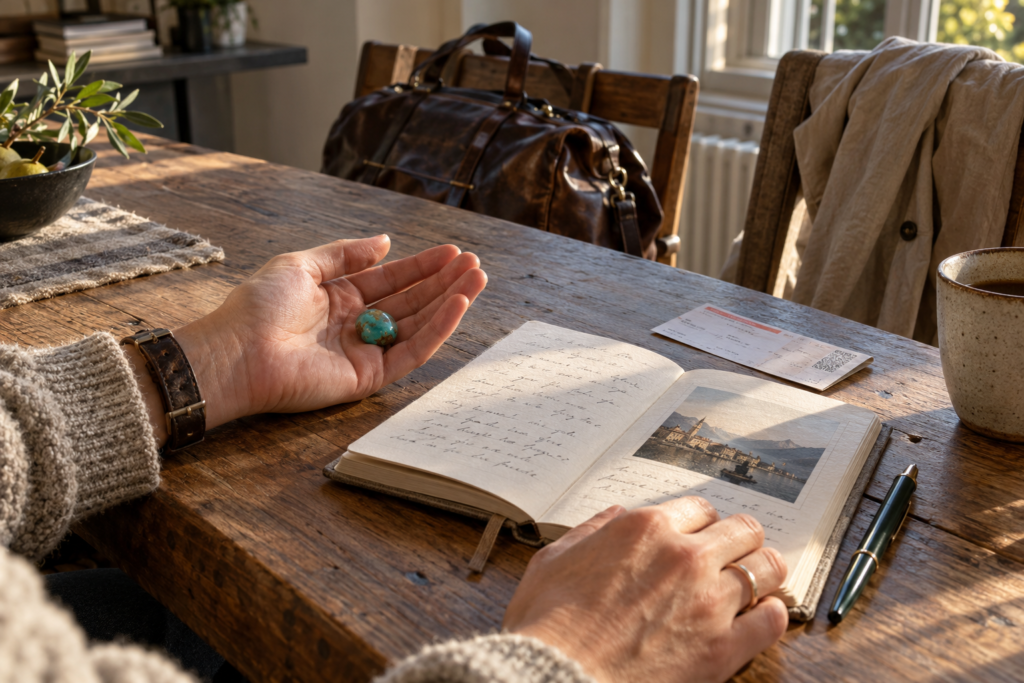
A Three-Minute Homecoming Ritual
When you return home, place your belongings down.
Choose a quiet moment.
Remove the Turquoise from its pouch.
Hold it briefly.
Then consider three questions.
What surprised me?
Recall one unexpected experience.
It does not need to be extraordinary.
Perhaps a place was different from what you imagined.
Perhaps someone helped you.
Perhaps you handled an unfamiliar situation more comfortably than expected.
What did I learn?
Choose one observation.
It might concern the destination.
Another person.
Or yourself.
Avoid turning the question into a formal evaluation of the entire journey.
One meaningful observation is enough.
What do I want to carry forward?
This is the most important question.
Perhaps you discovered that you enjoy exploring unfamiliar places.
Perhaps you recognised the importance of preparation.
Perhaps you appreciated returning home.
Choose one idea that deserves to remain with you.
Then place the Turquoise in its usual location.
The journey is complete.
Why the Return Matters
A travel talisman can become more meaningful through repeated personal experience.
Imagine carrying the same small Turquoise during several different journeys.
Over time, it becomes associated with particular memories.
A first visit to another country.
A successful professional meeting.
A difficult transition.
An unexpected opportunity.
The stone itself has not necessarily changed.
But your relationship with it has.
It has become connected with experiences that matter to you.
This is one reason meaningful objects can remain important long after their original purpose has passed.
Their significance is personal.
They become part of the story we tell about our lives.
A Turquoise Stone for Everyday Thresholds
The practice does not need to be limited to travel.
Everyday life contains smaller thresholds.
Beginning work.
Leaving the office.
Entering a classroom.
Starting a creative project.
Preparing for a difficult discussion.
Moving from activity into rest.
A Turquoise stone can symbolically mark these transitions.
For example, place the stone beside your workspace before beginning an important task.
Take a moment to identify your intention.
Then start.
When the work is finished, return the stone to its usual place.
This creates a visible beginning and ending.
The stone does not need to be understood as storing or releasing energy.
It can simply mark a boundary between activities.
The Role of Mindful Attention
The University of California, Berkeley’s Greater Good Science Center describes mindful breathing as a practice involving deliberate attention to the experience of breathing.
When attention wanders, the practitioner gently returns to the chosen focus.
This provides a useful principle for a contemporary travel ritual.
During the departure exercise, the stone can serve as an object of attention.
You notice it.
You recognise the present moment.
You return to what actually needs to be done.
The practice does not require elaborate visualisation.
Nor does it depend on experiencing a particular emotional state.
The purpose is simply to interrupt automatic behaviour long enough to make a deliberate choice.
The psychological research concerns mindfulness and attention.
It does not establish that Turquoise produces additional benefits.
Turquoise and the Symbolism of Safe Return
The historical relationship between Hathor, Turquoise and Egyptian mining expeditions invites reflection on another theme.
The hope of returning safely.
Ancient officials made votive offerings at the sanctuary of Hathor in connection with the success of expeditions.
These offerings belonged to a religious framework in which divine favour was believed to influence human affairs.
It would be inaccurate to treat that history as proof that Turquoise itself protected travellers.
Nevertheless, the broader symbolism is understandable.
A journey involves departure.
Uncertainty.
And the hope of a successful return.
Within a modern practice, these ideas can be expressed without supernatural claims.
We prepare carefully because safety matters.
We travel attentively because circumstances can change.
We return with appreciation for the experience.
The Turquoise becomes a personal symbol connecting those three stages.
Respecting the Original Cultural Tradition
The history of Hathor and Turquoise deserves careful treatment.
Ancient Egyptian religion was complex.
Its ceremonies, deities, temples and sacred objects belonged to particular historical communities.
A modern crystal practice should not claim to reproduce an ancient Egyptian ceremony merely because it uses the same gemstone.
The sanctuary at Serabit el-Khadim was not a modern meditation centre.
Its votive offerings were not generic crystal rituals.
They belonged to religious practices associated with mining expeditions, royal administration and devotion to Hathor.
The contemporary departure ritual presented here is therefore an original personal exercise inspired by documented historical symbolism.
It does not claim ancient authority.
Nor does it require adopting ancient Egyptian religious beliefs.
Its purpose is to appreciate the historical relationship while developing a distinct modern practice.
What if You Forget the Stone?
Nothing is lost.
This is an important principle.
A spiritual object should not become a source of additional anxiety.
If you leave the Turquoise at home, you can still perform the departure ritual.
Pause.
Check your preparation.
Choose an intention.
Continue your journey.
The ability to act thoughtfully does not depend on possessing a gemstone.
The stone supports the symbolism.
You remain responsible for your decisions.
A meaningful ritual should encourage personal agency rather than create dependence on an object.
A Small Object With a Long History
Turquoise offers a particularly interesting connection between ancient cultural traditions and contemporary spiritual practice.
In ancient Egypt, it appeared in jewellery, personal ornaments and amulets.
Its blue-green colour carried symbolic significance.
At Serabit el-Khadim, its extraction was connected with a sanctuary dedicated to Hathor, the Mistress of Turquoise.
Royal officials left votive offerings associated with the success of demanding expeditions.
These historical practices were not the same as modern crystal spirituality.
But they reveal a long-standing human desire to attach meaning to objects during uncertain activities.
Today, a small Turquoise stone can inspire a different kind of ritual.
One centred on awareness.
Preparation.
Intention.
And reflection.
Before the Door Opens
The most meaningful moment of a journey may occur before the first step.
Before the vehicle moves.
Before the train departs.
Before the unfamiliar place appears.
It is the moment when we recognise that we are about to leave what we know.
A Turquoise pocket stone can make that moment visible.
Hold it briefly.
Remember the intention.
Check what matters.
Then place it safely away.
The journey does not become predictable.
The world does not become free from uncertainty.
But your departure becomes deliberate.
And when you return, the same stone can invite one final question:
What has this journey taught me?
Perhaps that is the most meaningful role of a travel talisman.
Not to promise that nothing unexpected will happen.
But to remind us that every journey offers an opportunity to practise awareness, responsibility and openness to experience.
Prepare carefully.
Travel attentively.
Return with perspective.
One small stone can become a symbol of all three.
References & Further Reading
1. The Metropolitan Museum of Art — Turquoise in Ancient Egypt
Author: Deborah Schorsch
Published: April 2018
An authoritative museum research article examining the historical importance of Turquoise in ancient Egypt.
Particularly relevant are its discussions of the Sinai mining regions, the Temple of Hathor at Serabit el-Khadim, the goddess’s title as Mistress of Turquoise, and the use of Turquoise in ancient Egyptian jewellery and amulets.
The article also explains the symbolic importance of blue-green colours and distinguishes genuine Turquoise from other materials used to create similar appearances.
https://www.metmuseum.org/essays/turquoise-in-ancient-egypt
2. The Metropolitan Museum of Art — Ancient Egyptian Amulets
Author: Isabel Stünkel
Published: February 2019
A comprehensive educational article examining the role of amulets in ancient Egyptian religious and everyday life.
The museum explains how shape, material, colour, inscriptions and ritual actions could contribute to an amulet’s believed protective significance.
This source provides the principal historical foundation for understanding meaningful objects carried or worn close to the body.
https://www.metmuseum.org/essays/egyptian-amulets
3. The Metropolitan Museum of Art — Fragment of a Votive Tile with Cartouche of Seti II
Historical period: New Kingdom, Nineteenth Dynasty
Date: Approximately 1214–1208 BCE
An official museum collection record documenting an object recovered from the Temple of Hathor at Serabit el-Khadim.
The museum explains that votive offerings were placed within the sanctuary by royal officials seeking success for mining expeditions.
This archaeological evidence directly supports the article’s discussion of the relationship between Hathor, Turquoise and the religious hopes surrounding expeditions.
https://www.metmuseum.org/art/collection/search/550199
4. The Metropolitan Museum of Art — Fish Pendant
Historical period: Middle Kingdom
Date: Approximately 1878–1749 BCE
An official museum collection record documenting a small ancient Egyptian pendant made from Turquoise and gold.
The object illustrates the use of genuine Turquoise in a personal ornament designed to be suspended and worn.
It provides a concrete archaeological example of Turquoise used in a small, portable object.
https://www.metmuseum.org/art/collection/search/546742
5. American Psychological Association — What You Need to Know About Willpower
An educational article discussing psychological research into self-control, goal-directed behaviour and intentional planning.
Particularly relevant is its explanation of implementation intentions: practical if-then plans connecting anticipated situations with chosen responses.
This resource supports the contemporary departure ritual’s emphasis on deliberate preparation rather than supernatural protection.
https://www.apa.org/topics/personality/willpower
6. University of California, Berkeley — Mindful Breathing
Institution: Greater Good Science Center
A research-informed educational guide explaining how mindful attention to breathing can provide a focus during moments of distraction or stress.
The resource discusses returning attention to the present moment and describes research concerning mindfulness practices.
It supports the attention-based component of the contemporary Turquoise ritual, without suggesting that gemstones themselves produce psychological effects.
https://ggia.berkeley.edu/practice/mindful_breathing
7. Gollwitzer (1999) — Implementation Intentions: Strong Effects of Simple Plans
Author: Peter M. Gollwitzer
Journal: American Psychologist, 54(7), 493–503
A foundational peer-reviewed psychology article examining how specific if-then plans can support the translation of intentions into actions.
This research provides the theoretical background for connecting a travel situation with a deliberate behavioural response.
The research concerns planning and human behaviour, not the effects of gemstones.
https://doi.org/10.1037/0003-066X.54.7.493
The historical associations between Turquoise, Hathor, amulets and mining expeditions are presented as documented elements of ancient Egyptian culture and religion.
The departure and homecoming rituals described in this article are contemporary contemplative exercises inspired by that history. They are not reconstructions of ancient Egyptian religious ceremonies.
Traditional and contemporary beliefs concerning protective gemstones, spiritual energy and supernatural influence are not scientifically established effects. Turquoise does not replace practical travel precautions, appropriate safety measures, professional medical care or evidence-based psychological support.
Research concerning mindfulness and implementation intentions relates to the practices themselves and does not establish additional benefits from carrying Turquoise.