

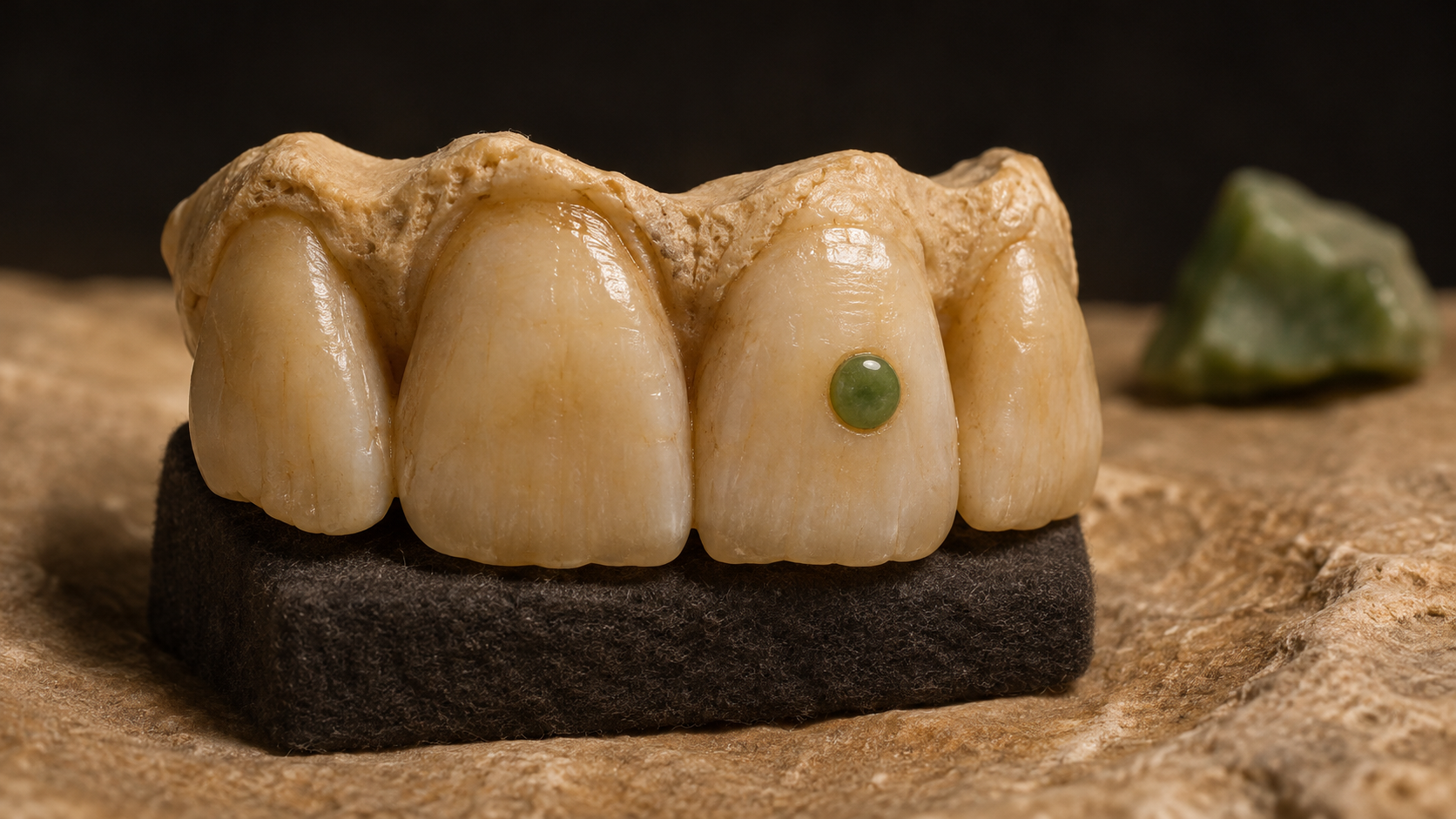
A small green stone set into a front tooth can tell a surprisingly large story. It brings together the skill of a stoneworker, the knowledge of a dental practitioner and the values of the person who wore it.
Among the ancient Maya, dental inlays formed part of a wider tradition of deliberately modifying the teeth. These surviving alterations offer evidence of craftsmanship and cultural expression, while their cements raise intriguing questions about ancient materials knowledge.
For gemstone enthusiasts, they also invite a different way of thinking about precious materials: stones were incorporated into the body itself.
Table of Contents
A Smile Shaped by Cultural Choices
Dental modification in ancient Mesoamerica included filing, cutting, engraving and inserting decorative materials. These practices occurred in different combinations across communities and periods.
A recent scholarly review places them within the study of the body and the life course: how people’s appearance changed through their lives, and how those changes related to culturally meaningful ways of being a person.
This perspective matters. Calling an inlay “fashion” can understate its significance, while describing every example as a religious procedure claims more than the evidence allows. Beauty, belonging and social identity are useful questions to investigate, rather than universal explanations that can be assigned to every modified tooth.
The physical alteration survives; an individual wearer’s precise intentions usually do not.
Why Jade Matters to This Story
Jade held exceptional importance in ancient Maya material culture. Museum scholarship connects its green colour and polished appearance with maize, agricultural fertility and sacred water.
A sixth- to ninth-century Maya jadeite pendant in the Metropolitan Museum of Art illustrates this wider relationship between material and meaning. Its interpretation connects blue-green stone with life-sustaining elements of the Maya world.
That context helps explain why a green dental ornament deserves attention beyond its decorative appearance. However, the symbolism documented for a pendant should not automatically be treated as a complete explanation for a particular dental inlay.
There is also an identification question. A green appearance alone cannot establish a stone’s mineral composition. When discussing an archaeological specimen, the material identification should follow the published analysis rather than an assumption based on colour.
How Were the Stones Positioned?
Archaeological research describes inlays placed into deliberately prepared cavities on the outward-facing surfaces of front teeth.
The stone had to fit the opening, while cement secured it against the tooth. This makes the object more complex than a jewel attached to an untouched surface: the preparation permanently altered the tooth.
The finished result depended on the relationship between three materials—the tooth, the shaped stone and the cement holding them together.
What Scientists Found in the Dental Cements
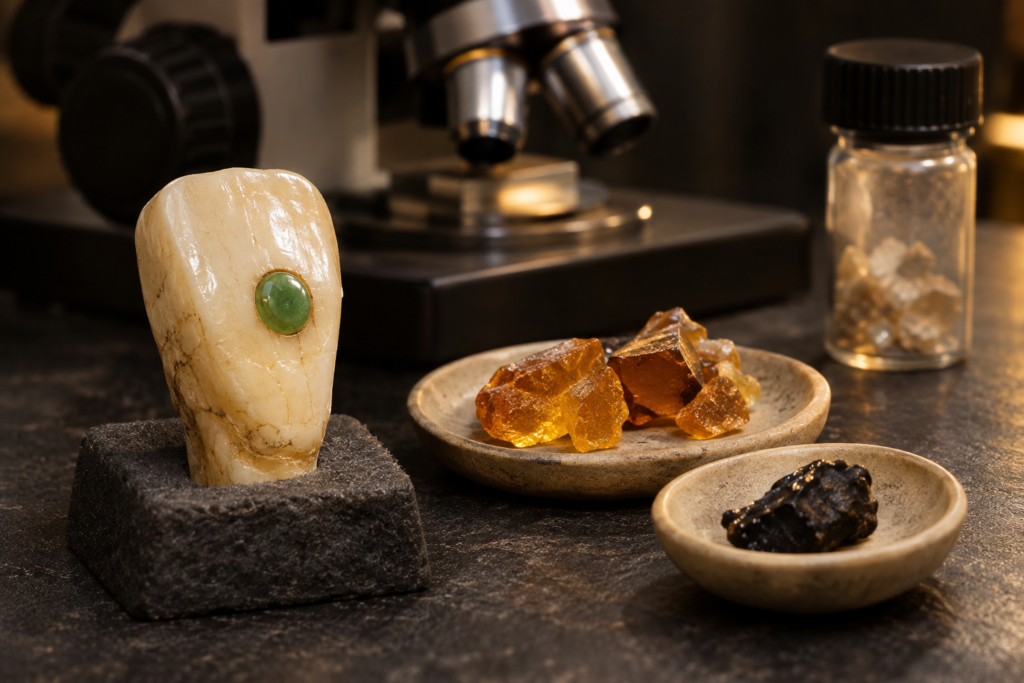
A 2022 study by Hernández-Bolio and colleagues examined eight dental specimens from Holmul in Guatemala, Baking Pot in Belize and the Copán Valley in Honduras.
Using infrared spectroscopy and gas chromatography–mass spectrometry, the researchers investigated the organic components of sealants and fillings. Their findings indicated varied mixtures, with possible ingredients including pine-family resins, a mint-family essential oil, an aster-family preparation and bitumen.
These are interpretations of chemical evidence, rather than surviving written recipes. The differences also caution against imagining one standard cement used everywhere.
Some identified components suggested possible antibacterial or anti-inflammatory properties. This creates an important research question about the mixtures’ functions, alongside their ability to bind and seal.
Yet finding a substance associated with biological activity does not establish how effectively an ancient preparation worked inside a living mouth.
Did Dental Inlays Protect Oral Health?
The teeth themselves provide an essential counterbalance to the chemistry.
A 2018 investigation compared 193 inlaid front teeth from 107 individuals with 211 untreated front teeth. The researchers assessed decay and several forms of internal or surrounding disease.
Inlaid teeth showed higher frequencies of the measured conditions than the untreated comparison teeth. Caries, for example, occurred in 18.5% of inlaid teeth, compared with 1.4% of controls.
The authors nevertheless considered the cements to have provided excellent sealing characteristics on average. Surviving inlays also demonstrate considerable durability.
These findings can coexist: a cement may seal effectively while the procedure still carries biological costs. Archaeological preservation demonstrates that some inlays endured; it does not prove that their wearers experienced no pain, infection or other complications.
What These Findings Allow Us to Say
The strongest account of Maya dental inlays brings cultural interpretation and physical evidence together without confusing them.
The practice belongs within a broader history of intentional body modification. Jade’s documented cultural importance offers valuable context. Chemical analysis reveals complex cement ingredients, while examination of the teeth records consequences that material analysis alone cannot establish.
Each approach answers a different question. None supplies the entire story.
A Remarkable Meeting of Stone and Human Skill
Maya dental inlays deserve recognition for the demanding relationship they created between craftsmanship, materials and the human body.
Their fascination does not depend on presenting ancient practitioners as infallible or describing their cements as proven medicines. The surviving evidence is compelling enough: carefully positioned ornaments, durable sealing materials and culturally meaningful transformations whose details continue to be investigated.
At Natural Gems Belgium, these objects remind us that the history of gemstones includes much more than jewellery. It also includes the ways people used materials to shape appearance, express identity and give physical form to what they valued.
References & Further Reading
Hernández-Bolio, G. I., et al. (2022). “Organic compositional analysis of ancient Maya tooth sealants and fillings.” Journal of Archaeological Science: Reports, 43, 103435.
Primary research into the organic ingredients of eight ancient Maya dental sealants and fillings.
https://doi.org/10.1016/j.jasrep.2022.103435
Ramírez-Salomón, M., Vega-Lizama, E., Quintana-Owen, P., Cucina, A., and Tiesler, V. (2018). “Pulp pathosis associated with ancient Maya dental inlays.” Archives of Oral Biology, 95, 202–208.
Primary research comparing pathological changes in inlaid and untreated teeth. An abstract is available through PubMed.
https://pubmed.ncbi.nlm.nih.gov/30144666/
https://doi.org/10.1016/j.archoralbio.2018.08.008
Tiesler, V. (2026; first published online in 2025). “Dental Modifications in Ancient Mesoamerica and Beyond.” Journal of Archaeological Research, 34, 13–61.
A scholarly review of dental modification, its archaeological study and cultural interpretation.
https://doi.org/10.1007/s10814-025-09207-y
The Metropolitan Museum of Art. “Head Pendant.” Maya, sixth–ninth century.
A museum collection record explaining Maya jadeite craftsmanship and associations with maize, fertility and sacred water.
https://www.metmuseum.org/art/collection/search/53939
The Metropolitan Museum of Art. “Golden Kingdoms: Exhibition Galleries — Forests of Jade.”
Museum background on the value, symbolism and circulation of jade and other greenstones in ancient Mesoamerica.
https://www.metmuseum.org/exhibitions/listings/2018/golden-kingdoms/exhibition-galleries

[…] the ancient Maya world, such ornaments could unite the work of skilled stone carvers with culturally meaningful ideas […]
[…] The colour was so striking that the deceased became popularly known as the Red Queen of Palenque. […]