A Royal Tomb Covered in Red
In 1994, archaeologists investigating Temple XIII at Palenque, in the Mexican state of Chiapas, uncovered one of the most remarkable royal burials of the ancient Maya world.
Inside a limestone sarcophagus lay the remains of an elite woman surrounded by precious ornaments.
Her body, jewellery and the interior of the burial container had been covered with an intensely red substance.
The colour was so striking that the deceased became popularly known as the Red Queen of Palenque.
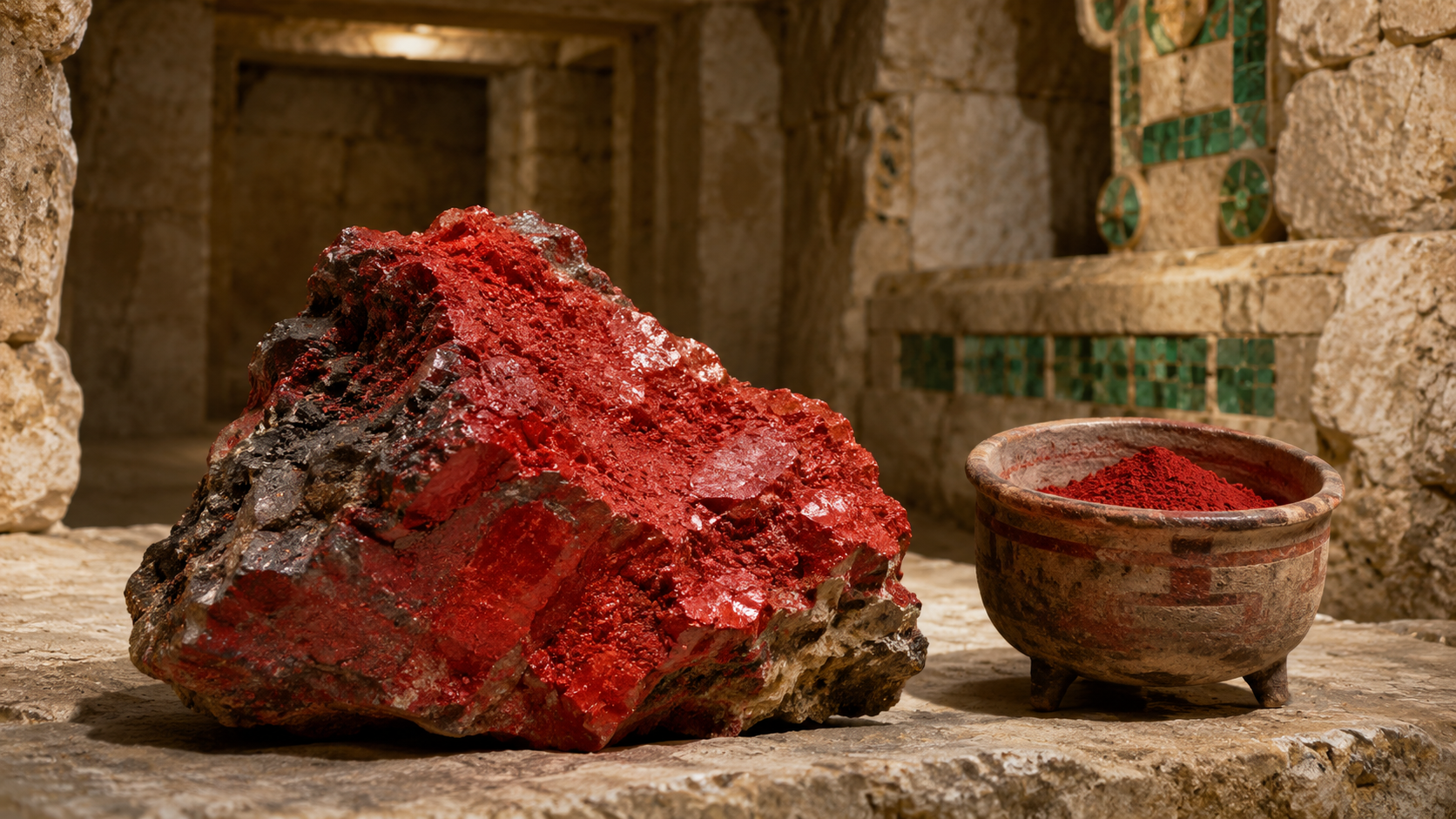
The material responsible for this extraordinary appearance was cinnabar, a naturally occurring mineral composed of mercury sulfide.
Unlike red ochre, which commonly derives its colour from iron oxides, cinnabar contains mercury and sulfur. Its brilliant scarlet colour, geological scarcity and unusual physical characteristics made it a distinctive material.
For the ancient Maya, red pigments could participate in complex ideas about blood, life, death, ancestry and renewal.
Yet these associations were not universal or identical across all Maya communities.
The Red Queen’s burial provides a particularly important example of how a natural mineral could become part of a royal funerary tradition.
Cinnabar in ancient Maya rituals highlights the mineral’s cultural significance in this context arose from its colour, material value and ritual use – not from scientifically demonstrated supernatural healing powers.
Its history offers an unusual opportunity to connect mineralogy, archaeology, religious symbolism and the study of ancient gemstone materials.
Table of Contents
What Is Cinnabar?
Cinnabar is the principal naturally occurring mineral form of mercury(II) sulfide, with the chemical formula HgS.
It belongs to the sulfide mineral class.
Its characteristic colour ranges from vivid scarlet red to darker reddish-brown.
Some specimens form well-developed crystals, while others occur as granular masses, veins or coatings.
Cinnabar is an important historical ore of mercury.
Its striking colour also made it valuable as a pigment.
The mineral is relatively soft, with a Mohs hardness of approximately 2–2.5, and has an unusually high density of around 8.0–8.2 g/cm³.
These properties distinguish it from most familiar red gemstones.
Ruby, for example, is a much harder aluminium oxide mineral.
Red garnets are silicates.
Cinnabar is a mercury sulfide.
Although attractive crystalline specimens exist, cinnabar is not generally suitable for conventional jewellery because of its softness, fragility and mercury-related safety considerations.
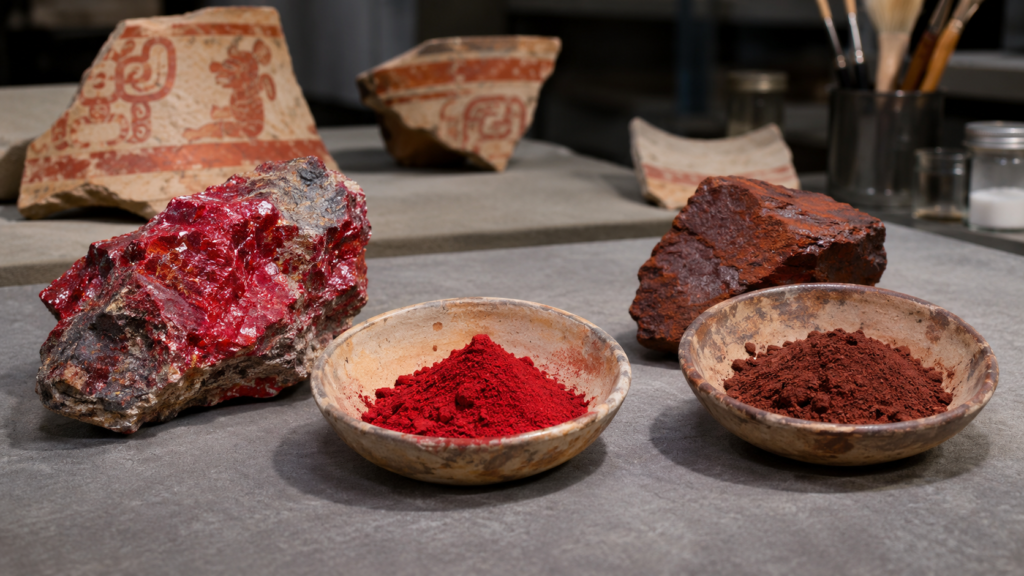
The Mineral Behind Vermilion
The words cinnabar and vermilion are closely connected.
Cinnabar generally refers to the natural mineral.
Vermilion refers to the brilliant red pigment historically prepared from mercury sulfide, whether obtained from natural cinnabar or manufactured.
The Metropolitan Museum of Art explains that cinnabar and vermilion have been used across numerous societies for thousands of years.
Their intense colour made them particularly desirable for painting, decoration and ritual purposes.
However, the appearance of a red pigment does not prove that it contains cinnabar.
Iron-rich hematite can also produce red pigments.
Organic colourants may produce similar visual effects.
Correct identification requires scientific examination.
This distinction is particularly important in archaeological research.
How Cinnabar Forms in Nature
Cinnabar commonly forms in hydrothermal geological environments.
Mercury-bearing fluids can circulate through fractures and porous rocks.
Under suitable chemical and temperature conditions, mercury sulfide precipitates.
Deposits may occur in association with volcanic regions, geothermal systems and certain sedimentary or structurally controlled hydrothermal environments.
The mineral may form veins, coatings or massive concentrations.
Some deposits contain attractive crystals.
Others consist mainly of fine-grained material suitable for pigment production.
Cinnabar’s formation is a natural geological process.
Its historical religious importance developed much later, when human communities encountered and selected the mineral for particular uses.
Why Its Colour Was So Important
The red colour of cinnabar is one of its most remarkable characteristics.
In the visible spectrum, its electronic structure produces strong absorption of certain wavelengths, leaving a vivid red appearance.
When finely ground, suitable material can produce a brilliant pigment.
The visual effect differs from the transparent red appearance of a ruby or garnet.
Cinnabar pigment is generally opaque.
Its power lies in the intensity of its surface colour.
For societies in which red could evoke blood, vitality or transformation, such a mineral offered striking visual possibilities.
However, the relationship between red colour and religious meaning must be established through cultural evidence.
Colour resemblance alone cannot prove a particular belief.
The Ancient Maya World
The Maya civilisation developed across regions of present-day southern Mexico, Guatemala, Belize, western Honduras and El Salvador.
Its history extends over many centuries.
The Classic period, conventionally dated approximately 250–900 CE, witnessed the flourishing of major cities, dynastic courts, monumental architecture and sophisticated artistic traditions.
Maya societies shared important cultural features but were not politically or religiously uniform.
Individual cities maintained distinct dynasties and local traditions.
Palenque, Copán, Tikal, Calakmul and other centres developed their own political histories.
Consequently, cinnabar’s use in one royal burial should not automatically be treated as evidence for identical practices throughout the entire Maya world.
Cinnabar in Maya Funerary Practices
Archaeological research demonstrates that cinnabar was used in certain Classic Maya funerary contexts.
The mineral could be applied to bodies, burial furnishings, ornaments and other objects.
Its vivid red colour made it especially conspicuous.
A study published in Archaeometry, titled Spectrochemical Characterization of Red Pigments Used in Classic Period Maya Funerary Practices, investigated the composition of red pigments associated with Maya burials.
The research distinguishes mercury-bearing cinnabar from other red materials and demonstrates the importance of scientific analysis.
It also places cinnabar within the wider context of elite funerary practice.
The evidence does not establish that every Maya burial contained cinnabar.
Rather, its documented use was selective and especially prominent in certain high-status contexts.
The Red Queen of Palenque
The burial of the Red Queen provides one of the clearest archaeological examples.
Palenque, known in ancient Maya history as Lakamha’, became a major dynastic centre during the seventh century CE.
The reign of K’inich Janaab’ Pakal I was particularly important.
His monumental burial was discovered within the Temple of the Inscriptions in the twentieth century.
Nearby, Temple XIII contained the tomb of an elite woman.
Her burial was uncovered in 1994.
The Metropolitan Museum identifies the woman as Lady Tz’akbu Ajaw, associated with Pakal’s royal household.
The tomb’s contents demonstrate extraordinary investment in funerary preparation.
The deceased was accompanied by elaborate ornaments, including a funerary mask made with green malachite elements.
But the most visually distinctive feature was the red cinnabar covering her remains and burial assemblage.
A Mineral Used to Transform the Appearance of Death
The Red Queen’s sarcophagus was coated with cinnabar pigment.
Her body and accompanying objects were also covered with the red material.
This created a striking contrast between the mineral pigment and the green stones used in her ornaments.
The Metropolitan Museum’s research interprets the red and green materials within a broader Maya symbolic framework involving blood, life and regeneration.
However, the complete intentions of those who prepared the burial cannot be reconstructed with certainty.
The evidence establishes deliberate use of cinnabar.
Its precise theological meaning requires interpretation.
This distinction is essential when studying ancient religious materials.
Blood, Life and the Colour Red
Blood held important symbolic and ritual significance in several ancient Maya traditions.
Dynastic rituals, sacrifice and relationships with ancestors formed part of the religious life of Maya courts.
Red pigments could evoke blood through visual resemblance.
Cinnabar’s intense colour made it particularly suitable for this association.
The Metropolitan Museum notes that red cinnabar was closely linked to blood in Maya funerary symbolism.
Yet the mineral was not literally blood.
It was a selected material whose appearance could communicate ideas connected with vitality and transformation.
The association belongs to the cultural interpretation of colour.
It is not evidence that cinnabar possessed a measurable life-giving energy.
Cinnabar and the Idea of Rebirth
One interpretation of cinnabar in elite Maya burials concerns regeneration after death.
In Maya religious thought, ancestors and supernatural beings could remain important participants in the lives of communities.
Royal funerary rituals could help establish the deceased ruler’s continuing significance.
The vivid red pigment may have participated in ideas of renewal, vitality and transformation.
In the Red Queen’s burial, the combination of red cinnabar and green mineral ornaments is particularly evocative.
Green stones were associated in certain Maya contexts with vegetation, growth, preciousness and life.
Red cinnabar could evoke blood.
Together, these materials created a powerful visual arrangement.
However, it would be inaccurate to claim that every Maya person believed cinnabar physically resurrected the dead.
The interpretation concerns religious symbolism rather than an observable supernatural effect.
The Relationship Between Cinnabar and Royal Authority
The use of cinnabar also reveals something about social hierarchy.
Cinnabar was not equally accessible everywhere.
Its geological sources were geographically restricted.
Transporting it to distant cities required exchange networks.
Processing it into pigment demanded labour.
Using substantial quantities in a burial therefore represented an investment in valuable material.
Such expenditure could help distinguish elite funerary ceremonies.
The Red Queen’s tomb illustrates how mineral resources could participate in the public and ritual expression of dynastic importance.
The material’s prestige was connected to its scarcity, colour and cultural significance.
Where Did Maya Cinnabar Come From?
Cinnabar deposits occur in parts of Mesoamerica, including mineralised regions of the southern Mexican and Central American highlands.
Archaeological research indicates that cinnabar could be transported from source regions into lowland Maya centres.
This required connections between communities occupying different geological and ecological environments.
The exact origin of an individual archaeological pigment cannot be established simply because it contains mercury sulfide.
Provenance investigations may require chemical analysis, geological comparison and archaeological evidence.
Even then, multiple deposits can sometimes share similar characteristics.
The movement of cinnabar nevertheless demonstrates that mineral resources were part of ancient Maya exchange networks.
How Archaeologists Identify Cinnabar
Modern scientific methods make it possible to distinguish cinnabar from other red pigments.
Raman spectroscopy can identify characteristic vibrational features of mercury sulfide.
X-ray diffraction can establish crystalline phases.
X-ray fluorescence and electron-based analytical methods can detect mercury and sulfur.
However, elemental detection alone may not always be sufficient to determine the exact mineral phase.
A sample containing mercury and sulfur should be interpreted alongside appropriate mineralogical evidence.
These techniques are particularly valuable because archaeological pigments may be altered, contaminated or mixed with other substances.
Scientific identification provides the foundation for responsible historical interpretation.
Cinnabar Versus Hematite
Cinnabar and hematite can both produce red pigments, but their compositions differ fundamentally.
Cinnabar is mercury sulfide, HgS.
Hematite is iron(III) oxide, Fe₂O₃.
Hematite is generally harder and less dense.
Its red pigment derives from iron oxide.
Cinnabar’s brilliant colour derives from mercury sulfide.
Ancient artists and ritual specialists could select different red materials for different purposes.
However, without scientific analysis, a surviving red deposit should not automatically be identified as cinnabar.
The distinction matters because the presence of mercury-bearing pigment can reveal different resource networks and material choices.
A Royal Ornament with Traces of Cinnabar
The Metropolitan Museum preserves a Maya ornament with traces of red pigment, probably cinnabar, in its crevices.
The museum discusses the relationship between red pigment and funerary contexts.
The object provides an important reminder that cinnabar was not restricted to coating entire bodies.
It could also be applied to precious ornaments.
Its presence on another valuable material could create a layered symbolic effect.
However, the museum’s identification is qualified.
Where pigment analysis is incomplete, the term likely cinnabar is more appropriate than an absolute identification.
This distinction reflects good archaeological practice.
The Material and the Meaning
An important question arises when interpreting ancient mineral use.
Did cinnabar possess religious importance because of its chemical composition, its colour, its rarity or its association with particular practices?
The answer may involve several factors.
Its red colour was visually striking.
Its acquisition could require specialised exchange.
Its application transformed the appearance of bodies and objects.
Its presence in elite burials participated in established ritual traditions.
Yet no surviving evidence allows every individual’s understanding of the mineral to be reconstructed.
The material’s meaning was produced within human relationships, ceremonies and belief systems.
It was not simply an inherent physical property.
Did the Maya Know Cinnabar Contained Mercury?
The ancient Maya clearly recognised cinnabar as a distinctive material.
They selected and processed it for specific purposes.
However, this does not mean they possessed the modern chemical understanding expressed by the formula HgS.
Modern chemistry distinguishes mercury, sulfur and their compounds through analytical methods unavailable in antiquity.
Historical communities could develop extensive practical knowledge of mineral properties without describing them in modern atomic terms.
The evidence for cinnabar use should therefore not be confused with evidence for knowledge of its molecular structure.
The Scientific Problem of Mercury Toxicity
Cinnabar contains mercury, a toxic element.
However, mercury toxicity depends upon chemical form, exposure pathway, concentration and duration.
Solid cinnabar is not chemically identical to elemental mercury or methylmercury.
Nevertheless, cinnabar-bearing dust can create occupational and environmental hazards, particularly during mining, grinding and processing.
Heating mercury sulfide can release hazardous mercury-containing emissions under suitable conditions.
Ancient use does not establish safety.
Modern collectors and conservators should avoid grinding, heating, inhaling dust from or ingesting cinnabar.
Historical ritual use must never be interpreted as a recommendation for contemporary healing practices.
Why Cinnabar Is Not a Suitable Healing Powder
Some modern alternative-healing traditions discuss mineral powders and preparations.
Cinnabar requires particular caution because of its mercury content.
There is no reliable scientific evidence that ingesting cinnabar provides supernatural healing benefits.
Exposure to mercury compounds can be harmful.
The historical application of cinnabar to bodies or objects does not demonstrate that the practice was medically beneficial.
The distinction between a culturally meaningful ritual and a scientifically established therapy is fundamental.
Cinnabar should be studied as a mineral and historical material, not promoted as an ingestible crystal remedy.
Cinnabar in Modern Crystal Beliefs
Contemporary metaphysical literature sometimes associates cinnabar with transformation, prosperity, vitality or personal empowerment.
These interpretations may have subjective significance for practitioners.
However, they should not be projected automatically onto ancient Maya religion.
Modern crystal-healing systems often combine ideas from different cultural and historical sources.
The result may differ considerably from the traditions documented in archaeological contexts.
The ancient Maya use of cinnabar in royal burials is historically established.
Modern claims about its ability to emit transformative energy are not scientifically demonstrated.
These are separate categories of knowledge.
Can Cinnabar Affect Human Energy?
Cinnabar possesses measurable physical and chemical properties.
Its crystal structure can be determined.
Its density can be measured.
Its optical behaviour can be investigated.
Its chemical composition can be analysed.
However, none of these properties demonstrates that cinnabar alters human emotions or spiritual states through an invisible healing field.
A person may experience a strong emotional response when viewing an ancient red mineral or learning about its historical symbolism.
That response can be meaningful.
It is not evidence of supernatural mineral energy.
The Importance of Respecting Maya Religious Traditions
Ancient Maya religious practices should not be reduced to generic modern crystal-healing terminology.
The communities of the Classic period developed sophisticated systems of kingship, ritual, writing, calendrical knowledge and relationships with ancestors.
Their use of cinnabar belonged to those cultural settings.
Modern Maya peoples also maintain diverse living traditions.
It would be inappropriate to assume that every modern Maya community shares the same beliefs about cinnabar as a seventh-century royal court at Palenque.
Historical specificity is essential.
The best approach is to identify the relevant site, period, archaeological evidence and interpretation.
Cinnabar as a Window into Ancient Trade
Cinnabar also contributes to the study of economic and political relationships.
A mineral found in a royal tomb may have originated far from the burial site.
Its movement required knowledge of deposits, procurement and transport.
Its preparation demanded technical skill.
Its use reflected cultural demand.
Scientific analysis can help reconstruct some of these relationships.
However, the identification of a mineral does not automatically reveal the complete route it travelled.
Trade networks must be reconstructed through multiple forms of evidence.
Why the Red Queen Remains Important
The Red Queen of Palenque is significant for several reasons.
Her tomb provides evidence for elite Maya funerary practice.
It preserves elaborate mineral and ornamental materials.
It demonstrates the deliberate use of cinnabar.
It contributes to the study of royal women in Classic Maya society.
It also reveals the importance of colour in the presentation of the dead.
The tomb’s extraordinary red appearance has become its most recognisable feature.
Yet the scientific value of the discovery extends far beyond its visual impact.
It allows researchers to investigate the relationship between material resources, political authority and religious expression.
What the Evidence Establishes
The available archaeological, museum and mineralogical evidence supports several conclusions.
Cinnabar is a naturally occurring mercury sulfide mineral.
It can produce a brilliant red pigment.
Ancient Maya communities used cinnabar in selected funerary and ceremonial contexts.
The Red Queen of Palenque was buried with substantial quantities of cinnabar.
The mineral was associated with elite material culture.
Red pigments could participate in symbolic ideas involving blood, vitality and renewal.
Scientific analysis can distinguish cinnabar from other red pigments.
The material’s distribution provides evidence for mineral procurement and exchange.
However, the precise religious meaning of every cinnabar deposit cannot be established.
There is no reliable evidence that cinnabar emits supernatural healing energy.
Its mercury content also creates genuine safety concerns.
Conclusion: The Mineral That Coloured Royal Eternity
Cinnabar occupies a distinctive place in the history of ancient Maya precious materials.
It was not a conventional faceted gemstone.
It was a naturally occurring mineral whose extraordinary colour made it valuable.
Its geological formation produced a brilliant red substance.
Human craftsmanship transformed it into pigment.
Maya ritual practices gave it significance within particular funerary contexts.
The Red Queen of Palenque demonstrates how cinnabar could become part of an elaborate royal burial.
Its colour evoked blood and vitality.
Its application transformed the appearance of the deceased.
Its presence reflected access to valuable resources.
Its use participated in religious understandings of death, ancestry and possible renewal.
The historical importance of cinnabar lies in its documented mineralogical properties and cultural role within ancient Maya funerary traditions – not in scientifically demonstrated supernatural healing powers.
For Natural Gems Belgium, this history illustrates the extraordinary range of ways in which minerals have been valued.
Cinnabar’s formation belongs to geology.
Its colour belongs to mineral physics.
Its processing belongs to materials technology.
Its distribution belongs to archaeological trade studies.
Its use in royal burials belongs to the history of Maya religion.
Its modern metaphysical associations remain matters of belief.
The red mineral of Palenque demonstrates that the cultural power of a natural substance can arise from its physical beauty, rarity and symbolic significance without requiring supernatural explanations.
References & Further Reading
1. Metropolitan Museum of Art – The Red Queen and Her Sisters: Women of Power in Golden Kingdoms
https://www.metmuseum.org/ko/perspectives/golden-kingdoms-red-queen-women-of-power
Source description: Scholarly museum essay examining the burial of Lady Tz’akbu Ajaw at Palenque, the discovery of her tomb in 1994, the extensive application of cinnabar and the extraordinary mineral ornaments associated with her burial.
2. Metropolitan Museum of Art – The Story of Cinnabar and Vermilion (HgS) at The Met
https://www.metmuseum.org/it/perspectives/cinnabar-vermilion
Source description: Museum research exploring the mineralogical identity, historical production and cultural uses of cinnabar and vermilion. Provides comparative evidence for red mineral pigments in funerary and ceremonial practices across different societies.
3. Metropolitan Museum of Art – Maya Ornament with Traces of Cinnabar
https://www.metmuseum.org/art/collection/search/314832
Source description: Official museum catalogue of a Maya ornament with traces of red pigment, probably cinnabar. Discusses the association of red pigment with funerary contexts and the symbolic relationship between cinnabar, blood and renewal.
4. Metropolitan Museum of Art – The Red Queen’s Funerary Assemblage
https://www.metmuseum.org/art/collection/search/760286
Source description: Detailed museum record of an object associated with the burial of the Red Queen of Palenque. Provides information on the burial date, royal identity, cinnabar covering and associated mineral ornaments.
5. Metropolitan Museum of Art – Maya Zoomorphic Ornament
https://www.metmuseum.org/art/collection/search/309987
Source description: Specialist museum catalogue discussing traces of cinnabar or hematite on a Maya ornament, the symbolic significance of red pigments and the importance of scientific caution when identifying archaeological materials.
6. Quintana, P., Tiesler, V., Conde, M., et al. – Spectrochemical Characterization of Red Pigments Used in Classic Period Maya Funerary Practices
https://doi.org/10.1111/arcm.12144
Source description: Peer-reviewed archaeological science study published in Archaeometry. Investigates the composition of red pigments used in Classic Maya funerary contexts, including cinnabar and other mineral materials, and examines their archaeological significance.
Historical, Cultural and Scientific Distinctions
Scientifically established: Cinnabar is mercury(II) sulfide, HgS, and belongs to the sulfide mineral class.
Scientifically established: Its brilliant red colour arises from its electronic and optical properties.
Scientifically established: Cinnabar is relatively soft, unusually dense and associated with mercury-related safety hazards.
Archaeologically documented: Cinnabar was used in selected ancient Maya funerary and ceremonial contexts.
Historically documented: The Red Queen of Palenque was buried with substantial quantities of cinnabar pigment.
Archaeological interpretation: Cinnabar’s red colour could participate in symbolic associations with blood, vitality and regeneration.
Historical qualification: The precise religious meaning of individual cinnabar deposits cannot always be reconstructed.
Scientific provenance evidence: Cinnabar deposits in Mesoamerica and archaeological pigment analysis provide evidence for mineral procurement and exchange.
Modern metaphysical belief: Contemporary crystal traditions sometimes associate cinnabar with transformation, prosperity or vitality.
Scientific limitation: There is no reliable evidence that cinnabar emits supernatural healing energy or provides therapeutic benefits.
Safety qualification: Cinnabar contains mercury and should not be ingested, heated, ground or used in practices that create inhalable dust.
Cinnabar demonstrates how a naturally occurring mineral could acquire profound cultural significance through its colour, rarity and role in religious practice.
Its formation belongs to geology.
Its colour belongs to mineral physics.
Its preparation belongs to materials technology.
Its archaeological distribution belongs to exchange studies.
Its funerary use belongs to Maya religious history.
Its alleged supernatural healing properties remain matters of belief rather than scientifically established facts.