
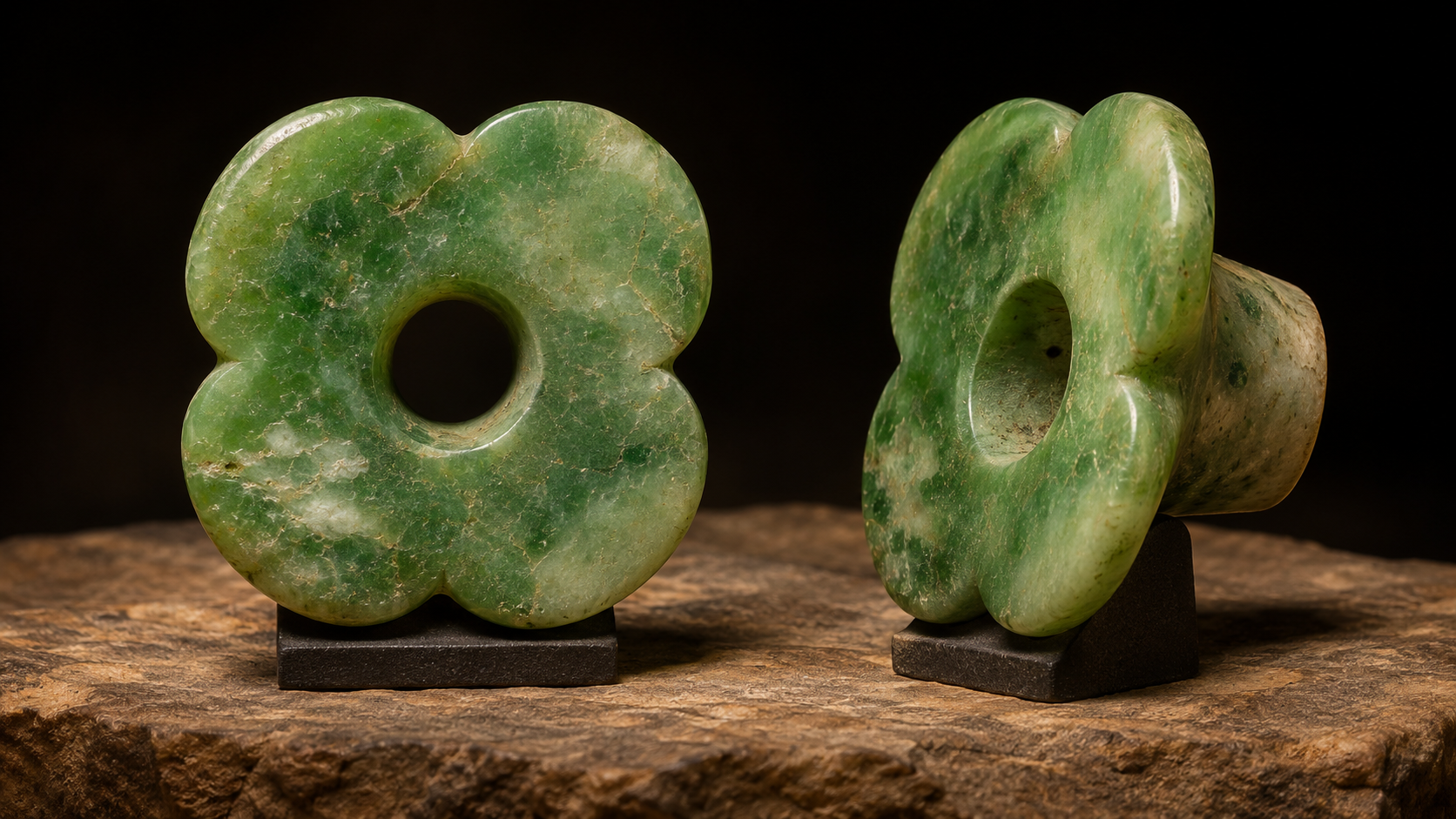
A polished green ear ornament can appear deceptively simple. Its surface catches the light, its central opening creates a striking silhouette, and its balanced form suggests an object designed with extraordinary care. The significance of these pieces, such as Maya jade ear ornaments, is often overlooked.
In the ancient Maya world, such ornaments could unite the work of skilled stone carvers with culturally meaningful ideas about the body, precious materials and the living world.
Maya jade ear ornaments hold a special place in the culture, symbolizing both artistry and societal status.
Understanding them requires more than admiring their colour. Their construction, archaeological context and imagery reveal different parts of their story.
Table of Contents
What Were Maya Earflares?
Among the various types of ear ornaments, Maya jade ear ornaments are particularly revered for their craftsmanship.
The terms “earflare” and “earspool” describe related forms of ear ornament, although archaeological terminology varies with shape and construction.
An earflare frontal could form the visible face of a larger assemblage worn through an enlarged opening in the earlobe. It was therefore not necessarily a complete ornament by itself.
The Metropolitan Museum of Art describes several possible attachment arrangements. Beads could be threaded through a central opening and secured with counterweights behind the ear. Alternatively, a plug inserted from behind could hold the frontal in position.
This distinction helps explain why isolated museum objects can be difficult to interpret. A surviving stone component may represent only part of an arrangement that originally included additional beads, cord or other materials.
Jade, Jadeite and Greenstone
“Jade” is a familiar name, but mineralogical identification requires greater precision. Jadeite and nephrite are distinct materials traditionally grouped under that name.
Jadeite has a Mohs hardness of approximately 6.5–7, while nephrite is generally around 6–6.5. Hardness describes resistance to scratching; toughness concerns resistance to breaking and chipping. These properties should not be confused.
Ancient Mesoamerican jade objects are commonly associated with jadeite, but a green archaeological ornament should not automatically be assigned that identification.
Museum terminology offers a useful reminder. LACMA catalogues one Maya pair of earspools as “greenstone.” Retaining that broader description respects the published record instead of replacing it with a more specific mineral name.
For gemstone readers, the principle is straightforward: colour is an observation, while mineral identification is a conclusion requiring evidence.
The Skill Behind the Polished Surface
Creating an ear ornament involved much more than giving a stone a pleasing outline. The maker had to control its proportions, prepare openings and shape surfaces that would be seen from different angles.
Museum accounts describe jade working through combinations of percussion and abrasion, including grinding, sawing, drilling and polishing. These methods required sustained labour and considerable practical skill.
Princeton University Art Museum explains that cord could be used for sawing, with hard particles and water providing the cutting action. The cord carried the abrasive rather than acting like a modern metal blade.
There is also archaeological evidence relevant to shaping earflares. A limestone tool from the Maya site of Cancuén bears impressions of different sizes that may have assisted their forming and polishing.
The finished surface can conceal this long sequence of work. Its apparent simplicity is part of the achievement.
When Stone Became a Flower
Some Maya ear ornaments were deliberately shaped to resemble flowers.
Princeton’s Early Classic floral ear ornaments illustrate this especially clearly. Their four-lobed forms would have been accompanied by central tubular beads. Together, the broad frontal and projecting centre could suggest petals surrounding a flower’s reproductive structures.
The museum connects these designs with Maya ideas about ik’: breath, wind and animating force. Floral imagery could make an otherwise invisible quality, such as fragrance, visually present.
This is a historical interpretation of imagery and belief. It does not mean that the stone physically emitted a special fragrance or possessed a measurable life force.
The distinction preserves both sides of the object’s significance: the ornament was a worked mineral material, and its form could express ideas extending beyond that material.
Four Directions and a Centre
Floral designs could also carry spatial meanings.
LACMA interprets its four-petalled greenstone earspools in relation to a Mesoamerican conception of the cosmos organised around four corners or sides and a centre.
The Metropolitan Museum similarly discusses the central opening and surrounding divisions of particular Maya earflares as references to centrality and the directions.
Such readings concern specific arrangements of form and imagery. They should not become a rule that every circular ornament carried precisely the same message.
Careful interpretation asks what is actually present: four lobes, an opening, a projecting bead, or other features that support the proposed meaning.
Why Green Was More Than a Colour
Museum scholarship connects precious green materials in Maya culture with breath, water, maize and vitality.
These associations help explain why a green ornament could matter beyond its visual beauty. Its colour, sheen and durability participated in a cultural understanding of preciousness.
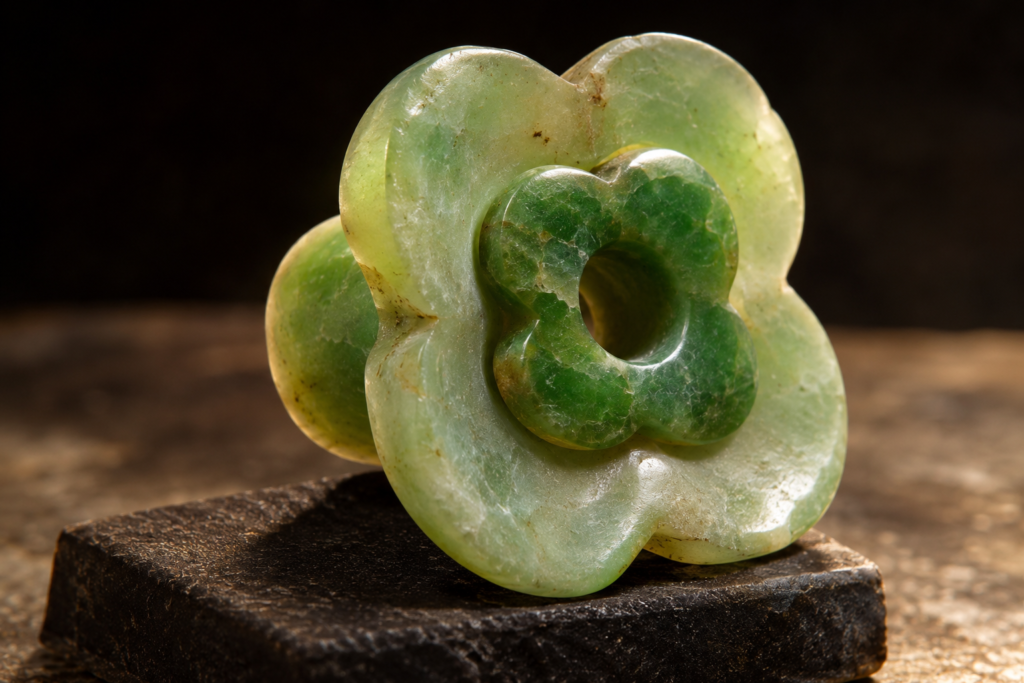
Yet there was considerable variety even within jade ornaments. One nested set at the Metropolitan Museum combines lighter and darker green components. Its unusually thin carving—approximately one to two millimetres in places—allows light to pass through the stone.
The museum notes that this translucency is distinctive: Maya carvers more commonly emphasised rich, saturated colour.
This example challenges the assumption that there was only one ideal appearance. Different makers could use colour, thickness and assembly to create different effects.
Were Ear Ornaments Only for Rulers?
Elaborate jade ornaments are strongly associated with elite display, but ear ornamentation itself should not be treated as exclusive to royalty.
Morgan Clark’s archaeological study of Tikal distinguishes the value of particular materials and forms from the broader practice of adorning the ears. Less costly materials also mattered, while durable jade is especially visible in surviving collections.
The study also cautions that Tikal had unusually abundant jade. Evidence from that major centre cannot automatically represent every Maya community.
This matters when reconstructing ancient appearance. A collection dominated by precious surviving objects can give an incomplete impression of what people commonly wore.
What Context Adds to Beauty
An ornament’s form can reveal how it was shaped. Its archaeological setting can help explain when and where it was used, and what accompanied it.
Clark notes that visually impressive museum objects may lack the detailed excavation context available for systematically recorded finds. Appearance alone cannot recover that missing information.
A responsible account therefore separates documented features from interpretation. “This ornament has four lobes” is a description. “Those lobes evoke a four-part cosmos” is an interpretation supported by comparative scholarship.
Both are valuable, provided the distinction remains clear.
A Different Way to Look at Precious Stone
Maya jade ear ornaments reward close attention because they operate at several levels at once. They are shaped materials, components of dress and objects interpreted through culturally specific ideas.
At Natural Gems Belgium, they offer a reminder that gemstone history includes the knowledge and choices of the people who worked and wore the material.
The green surface attracts the eye. The craftsmanship and context give us reasons to keep looking.
References & Further Reading
Clark, M. (2024). “The stuff of currency: Changing styles and uses of ear ornaments at Tikal.” Ancient Mesoamerica.
Peer-reviewed archaeological research examining changes in ear ornaments, their materials, contexts and value at Tikal.
https://doi.org/10.1017/S0956536124000063
The Metropolitan Museum of Art. “Pair of earflare frontals.” Maya, 200–600 CE.
Museum documentation explaining attachment arrangements, stoneworking and interpretations of floral and directional imagery.
https://www.metmuseum.org/art/collection/search/316299
The Metropolitan Museum of Art. “Earflare Set.” Maya.
A detailed discussion of nested ornaments, contrasting green colours and unusually thin jade carving.
https://www.metmuseum.org/art/collection/search/317430
Princeton University Art Museum. “Floral ear ornaments.” Maya, Early Classic Period, 250–600 CE.
University museum documentation discussing manufacture, assembly, floral imagery and the concept of ik’.
https://artmuseum.princeton.edu/art/collections/objects/20303
Los Angeles County Museum of Art. “Pair of Earspools.” Maya, 300–900 CE.
Museum documentation of greenstone ear ornaments and their interpretation in relation to flowers, cosmology and preciousness.
https://collections.lacma.org/object/169094
The Metropolitan Museum of Art. “Earflares.” Olmec, 900–400 BCE.
Comparative Mesoamerican background, including discussion of a possible earflare-shaping tool from the Maya site of Cancuén. The objects catalogued on this page are Olmec, not Maya.
https://www.metmuseum.org/art/collection/search/316286
Gemological Institute of America. “Jade Care and Cleaning Guide.”
Educational information explaining jadeite and nephrite hardness and the distinction between hardness and toughness.
https://origin.prod.gia.edu/jade-care-cleaning