

Table of Contents
The Red Gemstones of an Emerging Medieval World
Imagine opening a carefully furnished grave in northern Gaul, dating from the sixth century CE.
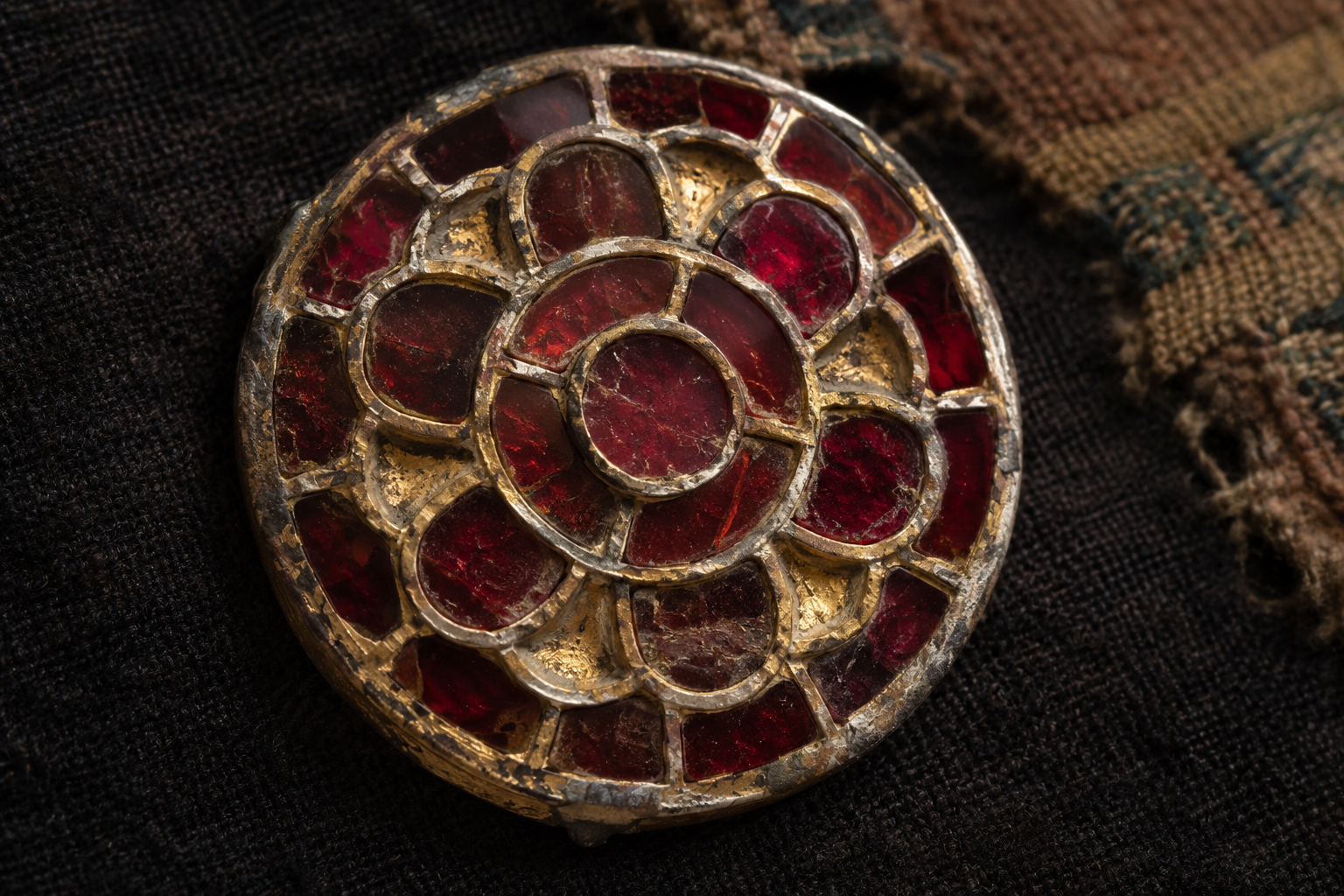
Among the surviving objects is a small circular brooch.
Its metal surface is divided into tiny geometric compartments. Each compartment contains a deep red gemstone, polished into a thin plate and fitted precisely within its setting.
Under the right light, the garnets appear almost luminous.
The effect is not supernatural. It is the result of sophisticated goldsmithing, translucent gemstones and carefully prepared reflective surfaces.
Yet the brooch communicates much more than technical skill.
It belongs to the world of the Merovingian Franks, whose political and cultural influence extended across substantial parts of western Europe between the fifth and eighth centuries.
During this period, garnets became particularly important in luxury jewellery.
They appeared in brooches, buckles, ornaments and other prestigious objects.
Some were deposited in graves. Others formed part of personal dress and the material culture of powerful families.
Their significance developed within a society experiencing profound changes in political authority, religious affiliation and artistic traditions.
Merovingian garnet jewellery reveals how a natural gemstone could become associated with prestige, identity and ceremonial display without requiring the assumption that its red colour possessed scientifically demonstrable magical powers.
The surviving objects also demonstrate remarkable connections between European craftsmanship and gemstone trade networks extending far beyond the Frankish kingdoms.
Who Were the Merovingian Franks?
The Merovingians were a ruling dynasty associated with the Frankish kingdoms of early medieval western Europe.
Their political history is conventionally traced from the fifth century into the eighth century CE.
The dynasty takes its name from Merovech, a figure associated with early Frankish royal tradition.
One of its most important rulers was Clovis I, who consolidated Frankish power around the end of the fifth century.
The period saw the development of new political structures in territories formerly governed by the Western Roman Empire.
It also witnessed the expansion and transformation of Christian institutions.
However, Merovingian society should not be imagined as culturally uniform.
Regional identities, burial customs, religious practices and artistic traditions varied considerably.
The jewellery produced and worn during this period reflects this diversity.
Why Garnets Became So Important
Garnets offered several qualities that made them attractive to early medieval goldsmiths.
Their rich red colour contrasted dramatically with gold and gilded silver.
Their transparency allowed light to interact with reflective material placed beneath them.
They could be cut into relatively thin plates.
Their hardness made them suitable for durable jewellery.
The Metropolitan Museum of Art documents numerous Frankish brooches decorated with garnets during the sixth century.
These objects demonstrate the importance of red gemstones in Merovingian luxury metalwork.
However, their popularity cannot be explained through one simple symbolic interpretation.
Garnets were visually impressive, technically useful and connected with systems of wealth and prestige.
Their religious or protective significance, where present, requires separate historical evidence.
What Is Garnet?
Garnet is not a single mineral species.
It is a group of related silicate minerals with similar crystal structures.
The principal gemmological species include almandine, pyrope, spessartine, grossular, andradite and uvarovite.
Their compositions differ.
Consequently, garnets occur in a wide range of colours.
Red garnets are particularly familiar, but the group also includes green, orange, yellow, purple and other varieties.
Garnets crystallise in the cubic crystal system.
Their Mohs hardness commonly falls between approximately 6.5 and 7.5, depending on species.
Many red garnets possess sufficient transparency to produce attractive optical effects when polished.
These physical properties help explain their historical use in jewellery.
They do not establish supernatural healing or protective abilities.
The Red Garnets of Frankish Jewellery
The garnets used in early medieval European jewellery were often red to purplish red.
Many archaeological examples have been identified as almandine-rich garnets, although composition varies among objects and deposits.
Almandine is an iron-aluminium garnet.
Its idealised chemical formula is Fe₃Al₂(SiO₄)₃.
Its colour is influenced by iron and its electronic interactions within the crystal structure.
However, not every ancient red garnet can be identified as almandine solely from its appearance.
Reliable identification requires appropriate analytical methods.
The distinction matters because modern gemstone names should not be assigned indiscriminately to archaeological objects.
A museum catalogue may identify a material simply as garnet when a more specific determination is unavailable.
Cloisonné: The Art of Setting Garnets into Gold
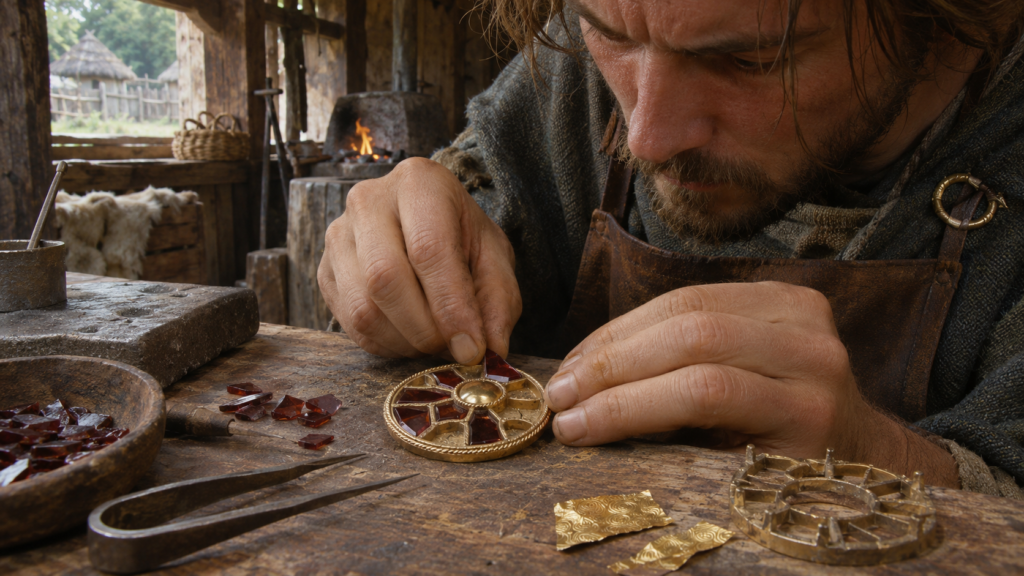
One of the most distinctive features of Merovingian jewellery is the cloisonné technique.
The word derives from the French cloison, meaning partition or compartment.
In gemstone cloisonné, small metal walls divide the surface into individual cells.
The goldsmith shapes these compartments into geometric or decorative arrangements.
Thin gemstone plates are then fitted into the cells.
The Metropolitan Museum explains that Frankish goldsmiths frequently placed patterned gold foil beneath translucent garnets.
The foil reflected light through the gemstones.
This intensified their colour and visual brilliance.
The technique required extraordinary precision.
A small circular brooch could contain numerous individually prepared garnet pieces.
Why the Gold Foil Matters
The reflective backing beneath a garnet is not merely decorative.
It plays an important optical role.
Light entering the translucent stone may reach the metal foil and be reflected towards the observer.
The patterned surface can influence the appearance of brightness and texture.
This creates the characteristic glowing red effect seen in many Merovingian ornaments.
The appearance is entirely consistent with the physical behaviour of light.
It does not require an explanation involving supernatural energy.
For gemstone enthusiasts, this is an important historical example of deliberate optical enhancement.
Ancient craftspeople understood, through practical experience, how gemstone thickness, colour and reflective surfaces could work together.
A Sixth-Century Frankish Rosette Brooch
The Metropolitan Museum of Art preserves a Frankish rosette brooch dating to the last quarter of the sixth century.
Its materials include gilded silver and garnets with patterned foil backings.
The object measures approximately three centimetres across.
Despite its modest size, the brooch demonstrates the sophistication of Merovingian jewellery production.
Its carefully arranged compartments create a controlled geometric design.
The garnets provide intense red colour.
The metalwork creates structure and contrast.
The object was intended to be viewed as a complete ornament rather than as a collection of individual gemstones.
Its cultural significance therefore emerges from the relationship between material, craftsmanship and use.
The Rosette as a Decorative Form
Rosette brooches were among the characteristic ornaments of the period.
Their circular or flower-like arrangements created visually balanced designs.
Some incorporated garnets around a central element.
Others combined red stones with pearls, glass or additional materials.
The Metropolitan Museum preserves examples dated between approximately 550 and 650 CE.
These objects reveal considerable variation within a recognisable artistic tradition.
However, the rosette shape should not automatically be interpreted as a solar amulet or sacred flower symbol.
A decorative resemblance does not establish a religious meaning.
Such interpretations require supporting archaeological or textual evidence.
Garnets and Personal Identity
Jewellery can communicate social identity.
A brooch may indicate wealth.
Its design may reflect regional fashion.
Its craftsmanship may demonstrate access to specialised workshops.
Its materials may reveal participation in long-distance exchange networks.
In Merovingian society, elaborate garnet jewellery could form part of prestigious personal dress.
However, the exact significance of a particular ornament depends upon its context.
A brooch found in a grave may provide information about burial customs.
A piece preserved without archaeological provenance may be more difficult to interpret.
The presence of garnets alone does not establish royal ownership.
Were Garnets Reserved for Royalty?
Garnets were associated with prestigious jewellery, but they were not exclusively royal gemstones.
The Metropolitan Museum preserves numerous Frankish ornaments containing garnets.
Their variety suggests that the material circulated through broader elite and affluent networks.
Some objects may have belonged to powerful individuals.
Others may have been worn by people whose precise social position is unknown.
It is therefore misleading to describe every Merovingian garnet brooch as a royal jewel.
The relationship between jewellery and rank must be reconstructed through archaeological evidence.
Garnet Jewellery in Burial Traditions
Burial assemblages are important sources for early medieval jewellery history.
Some Merovingian graves contain ornaments, weapons, dress accessories and other possessions.
Garnet brooches could form part of the deceased person’s clothing or burial presentation.
However, grave goods do not automatically establish beliefs about the afterlife.
An ornament may have been deposited because it belonged to the deceased.
It may have communicated family status.
It may have been part of customary funerary dress.
It may also have carried personal or religious significance.
These possibilities are not mutually exclusive.
But they should not be treated as proven without evidence.
The Relationship Between Jewellery and Death
The presence of gemstones in graves can encourage spiritual interpretations.
A red garnet might appear to symbolise blood, vitality or life.
Such associations are imaginable.
However, the archaeological presence of a red gemstone does not establish that its owner believed it could restore life or protect the soul.
Historical interpretation must distinguish between symbolic possibilities and documented beliefs.
The same caution applies to modern claims that garnets were universally worn as talismans against death.
The surviving evidence does not support such a broad statement.
Christianity and the Merovingian World
Christianity became increasingly important within the Frankish kingdoms.
The conversion of Clovis I is a major event in traditional accounts of Merovingian history.
Christian institutions developed alongside existing regional customs.
However, the process of Christianisation was gradual and varied.
Not every object from the Merovingian period was explicitly Christian.
A garnet brooch without religious imagery should not automatically be described as a Christian amulet.
Likewise, its deposition in a grave does not establish that it was intended to assist the deceased spiritually.
Religious meaning requires more specific evidence.
Did Red Garnets Symbolise the Blood of Christ?
Modern descriptions sometimes connect red gemstones with Christian ideas of sacrifice and redemption.
Such symbolism exists in various historical Christian contexts.
However, it would be misleading to claim that every Merovingian garnet represented the blood of Christ.
The surviving Frankish brooches documented by the Metropolitan Museum are often primarily geometric ornaments.
Their red colour is visually striking.
But colour alone does not establish a theological programme.
A specific Christian interpretation should be supported by inscriptions, iconography, textual references or archaeological context.
Without such evidence, the safest conclusion is that garnets were prized decorative materials that could participate in a Christianising society.
The Wider Artistic World of Migration-Period Europe
Merovingian garnet jewellery belongs to a larger artistic tradition often described as Migration Period art.
The Metropolitan Museum’s publication Migration Art, A.D. 300–800 examines the development of luxury metalwork across Europe.
It documents connections among Frankish, Gothic, Langobardic and other artistic traditions.
Garnet cloisonné was not exclusive to the Franks.
Related techniques appeared in several regions.
This demonstrates the importance of cultural exchange.
The development of Merovingian jewellery cannot be understood as an isolated invention.
It emerged within a network of artistic practices extending across Europe and beyond.
Garnets and Long-Distance Trade
The presence of garnets in European jewellery raises important questions about gemstone provenance.
Some garnets used in early medieval ornaments were imported over considerable distances.
Scientific research has investigated their chemical compositions and potential geological sources.
However, the origin of a particular garnet cannot be established simply because it appears in a Frankish object.
Different garnet deposits can produce stones with similar appearances.
Geochemical analysis is necessary for more reliable provenance studies.
Even then, geological source attribution may remain probabilistic.
The important historical point is that Merovingian jewellery reflects access to materials and technologies beyond local production.
Why Provenance Matters
A gemstone’s geological origin can reveal patterns of trade.
Its chemical composition may help distinguish among potential source regions.
Its presence in an archaeological object can contribute to reconstructing historical exchange networks.
However, provenance must be established through evidence.
It should not be inferred from modern commercial labels.
A red garnet in a sixth-century Frankish brooch is not automatically an Indian, Sri Lankan or Bohemian stone.
Such claims require appropriate analytical support.
This is particularly important for scientifically responsible gemstone education.
The Craftsmanship Behind Thin Garnet Plates
Cutting garnets into thin plates required technical skill.
The stones needed to fit within small metal compartments.
Their surfaces had to be prepared carefully.
The thickness of each plate influenced the appearance of colour and transmitted light.
The goldsmith also had to prepare the reflective backing.
The finished arrangement depended upon accurate relationships between stone, foil and metal partitions.
This is an important example of ancient and early medieval lapidary sophistication.
The beauty of the jewellery was not accidental.
It resulted from deliberate control of material and optical properties.
Garnet, Glass and Imitation Materials
Not every red inlay in early medieval jewellery is necessarily natural garnet.
Glass and other materials were also used in decorative metalwork.
The Metropolitan Museum documents objects containing combinations of garnet, glass and other substances.
This complicates identification.
A red compartment may resemble a gemstone in photographs.
However, visual appearance alone is insufficient for definitive material classification.
Scientific examination may be necessary to distinguish natural garnet from glass or other materials.
This is another reason to avoid assuming that every red ornament in a Merovingian object is a natural gemstone.
The Spiritual Interpretation of Red Gemstones
Red has acquired numerous symbolic associations across cultures.
It may evoke blood, vitality, warfare, passion or authority.
However, these meanings are not universal.
Their significance depends upon historical context.
In Merovingian jewellery, the use of red garnets certainly created a powerful visual effect.
But the exact symbolic intentions of individual owners are often unknown.
The stones may have communicated prestige and beauty.
They may also have acquired personal meanings.
However, there is insufficient evidence to assign one universal spiritual interpretation to every garnet ornament.
Were Merovingian Garnets Protective Amulets?
Early medieval Europe included religious and protective practices involving objects, prayers and symbols.
However, this does not establish that every garnet brooch was an amulet.
The Metropolitan Museum’s Frankish jewellery records primarily document materials, techniques and artistic forms.
They do not prove a general belief that garnets independently protected their wearers from danger.
A particular object might have possessed protective significance.
But such an interpretation requires supporting evidence.
The distinction between possible personal belief and documented historical practice is essential.
Modern Garnet Crystal Beliefs
Contemporary crystal-healing traditions often associate garnet with vitality, passion, grounding and emotional strength.
Some practitioners connect red garnet with the root chakra.
Others describe it as a protective stone.
These interpretations may hold personal meaning within modern spiritual practices.
However, they should not be projected directly onto Merovingian jewellery.
The historical evidence demonstrates the use of garnets in luxury ornaments.
It does not establish that Frankish goldsmiths or wearers believed the stones balanced chakras or emitted healing frequencies.
Modern metaphysical systems and early medieval European traditions are distinct historical contexts.
Does Garnet Possess Healing Energy?
There is no reliable scientific evidence that garnet emits supernatural healing energy.
Its physical properties are measurable.
Its crystal structure can be studied.
Its chemical composition can be analysed.
Its optical behaviour can be explained through mineral physics.
However, these properties do not establish that garnet cures illness or alters emotional states through an invisible energy field.
A person may find garnet jewellery meaningful or emotionally comforting.
That experience is different from a scientifically demonstrated medical effect.
The historical prestige of garnet does not establish therapeutic efficacy.
Garnet Jewellery as a Historical Expression of Power
The importance of Merovingian garnet jewellery lies partly in its association with social display.
The combination of gold, silver and carefully cut gemstones required resources and expertise.
Such ornaments could communicate access to wealth.
They could also participate in regional fashions and elite identities.
Their presence in graves provides evidence for the importance of personal adornment in funerary contexts.
However, the material alone does not identify a specific political rank.
A brooch must be interpreted through its complete archaeological and artistic setting.
Why the Garnets Appear to Glow
One of the most visually striking features of Merovingian cloisonné jewellery is the intense red appearance of its gemstones.
This effect results from the interaction of several physical factors.
The garnets transmit selected wavelengths of visible light.
Their colour arises from their chemical composition and electronic absorption characteristics.
The reflective gold foil beneath them redirects light towards the observer.
The surrounding metal partitions create contrast.
Together, these elements can produce remarkable brilliance.
The effect is optical rather than supernatural.
Understanding it makes the craftsmanship even more impressive.
What the Museum Evidence Establishes
The Metropolitan Museum of Art preserves numerous Frankish garnet ornaments from the sixth and early seventh centuries.
Its collection records establish the importance of garnet cloisonné in Merovingian luxury jewellery.
The museum documents the use of patterned gold foil beneath translucent stones.
Its examples include rosette brooches, disk brooches and other decorative forms.
The broader scholarly literature places these objects within Migration Period artistic traditions.
However, the evidence does not establish one universal spiritual meaning for garnets.
Nor does it demonstrate that their wearers believed the stones possessed medically effective supernatural powers.
Their cultural significance is best understood through material, craftsmanship, social context and historically documented religious traditions.
Conclusion: The Red Gemstones of Early Medieval Authority
Merovingian garnet jewellery represents one of the most sophisticated gemstone traditions of early medieval Europe.
Its beauty emerges from the relationship between natural minerals and skilled human craftsmanship.
The garnets provide rich colour.
The goldsmith creates the setting.
The reflective foil intensifies the optical effect.
The finished ornament becomes part of personal dress, social identity and, in some cases, burial traditions.
Its historical importance extends beyond decoration.
It reveals connections between political power, long-distance exchange and changing cultural traditions.
The significance of garnet in Merovingian jewellery lies in its documented role within prestige metalwork and early medieval society – not in scientifically demonstrated supernatural healing properties.
For Natural Gems Belgium, these objects offer an important lesson.
A gemstone can acquire powerful cultural associations without possessing magical abilities.
Its colour may contribute to symbolism.
Its rarity may contribute to prestige.
Its craftsmanship may communicate wealth.
Its historical context may reveal religious or social meaning.
But these dimensions should not be confused with physical evidence of healing energy.
Merovingian garnet jewellery demonstrates how natural gemstones can become extraordinary historical objects through the interaction of geology, artistry and human culture.
References & Further Reading
1. Metropolitan Museum of Art – Frankish Rosette Brooch, Late Sixth Century
https://www.metmuseum.org/art/collection/search/464834
Source description: Official museum catalogue documenting a late-sixth-century Frankish rosette brooch made from gilded silver and garnets with patterned foil backings. Explains the cloisonné technique and the optical role of reflective gold foil.
2. Metropolitan Museum of Art – Frankish Disk Brooch, Early Sixth Century
https://www.metmuseum.org/art/collection/search/465084
Source description: Museum record of an early-sixth-century Frankish disk brooch decorated with garnets and patterned foil. Provides direct material evidence for Merovingian gemstone craftsmanship.
3. Metropolitan Museum of Art – Frankish Rosette Brooch with Garnets, Glass and Pearl
https://www.metmuseum.org/art/collection/search/464847
Source description: Official catalogue of a sixth-century Frankish ornament combining garnets, green glass and pearl, demonstrating the use of multiple materials in early medieval luxury jewellery.
4. Metropolitan Museum of Art – Frankish Disk Brooch with Garnets and Emeralds
https://www.metmuseum.org/art/collection/search/464828
Source description: Museum documentation of a sixth-century Frankish brooch containing garnets with patterned foil backings and emeralds, illustrating the diversity of precious materials used in Merovingian metalwork.
5. Metropolitan Museum of Art – Frankish Rosette Brooch, 550–650 CE
https://www.metmuseum.org/art/collection/search/465385
Source description: Official collection record of a garnet and pearl rosette brooch dating to approximately 550–650 CE, providing comparative evidence for Merovingian jewellery forms.
6. Metropolitan Museum of Art – Frankish S-Shaped Brooch
https://www.metmuseum.org/art/collection/search/465246
Source description: Museum catalogue of a mid-sixth-century Frankish S-shaped brooch made from gilded silver and garnets, demonstrating variation in decorative forms.
7. Metropolitan Museum of Art – Frankish Whorl-Shaped Brooch
https://www.metmuseum.org/art/collection/search/465344
Source description: Official museum record of a whorl-shaped brooch dated approximately 550–650 CE, made from copper alloy, gilding, niello and garnet.
8. Metropolitan Museum of Art – Migration Art, A.D. 300–800
https://resources.metmuseum.org/resources/metpublications/pdf/Migration_Art_AD_300_800.pdf
Source description: Scholarly museum publication examining Migration Period metalwork, jewellery, gemstone inlays and artistic exchanges among early medieval European cultures.
Historical, Cultural and Scientific Distinctions
Scientifically established: Garnet is a group of silicate minerals with related crystal structures and varying chemical compositions.
Scientifically established: Many red garnets possess sufficient transparency to create striking optical effects when placed over reflective metal foil.
Historically documented: Garnet cloisonné was prominent in Frankish luxury jewellery during the sixth century.
Historically documented: Merovingian goldsmiths used thin garnet plates set into metal compartments, often with patterned gold foil beneath them.
Historically documented: Garnet ornaments appear in early medieval jewellery and burial contexts.
Historical interpretation: Elaborate garnet jewellery could communicate wealth, status and social identity.
Historical uncertainty: The exact religious or protective significance of individual garnet ornaments is not always recoverable.
Religious context: Merovingian society experienced important developments in Christianity, but not every garnet ornament was an explicitly Christian object.
Modern metaphysical belief: Contemporary crystal traditions sometimes associate garnet with vitality, grounding, passion or protection.
Scientific limitation: There is no reliable evidence that garnet emits supernatural healing energy or cures illness.
Merovingian garnet jewellery demonstrates how gemstone materials could acquire cultural significance through skilled craftsmanship, prestige and historical context.
Its mineral composition belongs to gemmology.
Its optical effects belong to physics.
Its craftsmanship belongs to early medieval art history.
Its social and religious interpretations require archaeological and historical evidence.
Its alleged supernatural healing properties remain matters of belief rather than scientifically established facts.

[…] building near St Paul’s Cathedral. Workmen breaking through the cellar floor encountered jewellery and gemstones in the soil beneath it. The finds subsequently reached George Fabian Lawrence, the […]
[…] century. Its existence reveals how medicine, religious institutions, precious materials and luxury craftsmanship intersected in the Portuguese colonial […]