A branch of red coral is one of nature’s strangest gem materials.
It resembles a plant.
It grows beneath the sea.
When polished, its surface can become remarkably smooth.
Its colour ranges from pale pink and salmon through orange-red to deep crimson.
And for centuries around the Mediterranean, those characteristics helped transform coral into something far more culturally complicated than jewellery.
Coral was worn by children.
It appeared in amulets.
It was incorporated into religious and secular jewellery.
It became associated with protection from the evil eye.
It appeared in portraits of infants and in objects intended to accompany vulnerable bodies.
Later European rattles combined coral with bells and precious metals, bringing together play, teething and supernatural protection in a single object.
Yet coral presents an especially interesting challenge for a modern gemstone Learning Center.
Modern metaphysical literature may describe red coral as energising, protective, grounding or connected with the Root Chakra.
Historical Mediterranean beliefs about coral protection Mediterranean are genuine and extensively documented.
But that does not mean ancient Romans or Renaissance Italians were practising modern crystal healing.
Nor does historical belief demonstrate that coral possesses a scientifically measurable ability to repel disease, envy or supernatural harm.
The real story is more interesting.
It concerns one of humanity’s oldest questions:
How do we protect ourselves—and especially our children—from dangers we cannot control?
Table of Contents
Coral Is Not a Mineral
Before exploring its symbolism, an important gemmological distinction is necessary.
Precious coral is not a crystalline mineral.
It is an organic gem material produced by marine animals.
Coral colonies consist of tiny organisms called polyps. In precious corals used for jewellery, the hard internal skeleton is principally composed of calcium carbonate.
Species belonging to the genus Corallium have historically supplied some of the most valued red and pink coral used in Mediterranean jewellery.
This immediately separates coral from gemstones such as garnet, sapphire or quartz.
Its origin is biological rather than geological.
For people who did not possess modern marine biology, however, coral’s nature was far more mysterious.
It seemed to occupy an ambiguous position between categories.
Was it a plant?
A stone?
Something alive?
Something that became stone?
That uncertainty contributed to its mythology.
A Material Between Sea and Stone
Coral’s appearance helped encourage extraordinary interpretations.
Underwater, coral appeared to grow like a branching plant.
Once removed from the sea, it was hard and stone-like.
To premodern observers, this transformation demanded explanation.
The Mediterranean supplied one of antiquity’s most famous mythological explanations through the story of Perseus and Medusa.
In the tradition preserved by the Roman poet Ovid, Perseus placed the severed head of Medusa upon sea plants. The supernatural power of her blood caused them to harden, while sea nymphs repeated the transformation.
Thus coral became linked mythologically with the blood of Medusa.
This story was not geology.
It was mythology attempting to explain an unusual natural substance.
But the association is revealing.
Coral’s redness, branching form and marine origin invited a story connecting blood, transformation, danger and supernatural power.
Medusa: A Protector Born from a Monster
The connection with Medusa becomes particularly intriguing because Medusa herself acquired an important protective role in Greek and Roman visual culture.
Her terrifying face—the Gorgoneion—could be displayed on shields, armour, buildings and personal objects.
The logic of such imagery was fundamentally apotropaic.
Something terrifying could frighten away other threats.
The monster became protection against monsters.
Coral’s mythical origin from Medusa’s blood therefore placed it within an already powerful symbolic environment.
But we should distinguish mythological association from universal practice.
Not every Roman coral bead was necessarily understood consciously as a fragment of transformed Medusa blood.
Cultural symbols can persist even when individual users interpret them differently.
What Does “Apotropaic” Mean?
The word apotropaic comes from a Greek concept of turning away or averting harm.
An apotropaic object is intended to repel danger.
That danger might be understood as:
- supernatural attack
- envy
- misfortune
- disease
- hostile magic
- demonic influence
- the evil eye
Different cultures defined those threats differently.
The important point is that protective objects did not necessarily function through one universal theory.
A written prayer might protect because of sacred words.
A saint’s image might protect through intercession.
An animal tooth might derive significance from the animal.
A red material might possess symbolic associations because of its colour.
An unusual natural substance might be valued because its very strangeness suggested power.
Coral could participate in several of these systems.
The Evil Eye
Few protective beliefs have travelled as widely as the evil eye.
Versions of the belief occur across the Mediterranean, Middle East, North Africa, South Asia and other regions.
But “belief in the evil eye” should not be treated as one completely uniform religion.
Practices vary dramatically by region, period, language and community.
At its broadest, the concept concerns harmful consequences associated with a hostile, envious or sometimes even involuntary gaze.
Beauty, prosperity, fertility and healthy children could attract dangerous attention precisely because they were desirable.
This created a paradox.
The things a family valued most could also be considered the most vulnerable.
Why Children?
Children occupy a particularly important place in the history of protective amulets.
Premodern childhood was medically precarious.
Infant and childhood mortality were high.
Modern medicine did not yet understand pathogens, immunity or many causes of disease.
Families nevertheless needed ways to understand and respond to vulnerability.
Religion offered prayer.
Medicine offered treatments based on contemporary knowledge.
Popular traditions offered amulets.
These systems frequently overlapped.
A parent could employ a physician, pray to a saint and attach a protective object to a child without perceiving those actions as mutually exclusive.
Coral became one such protective material.
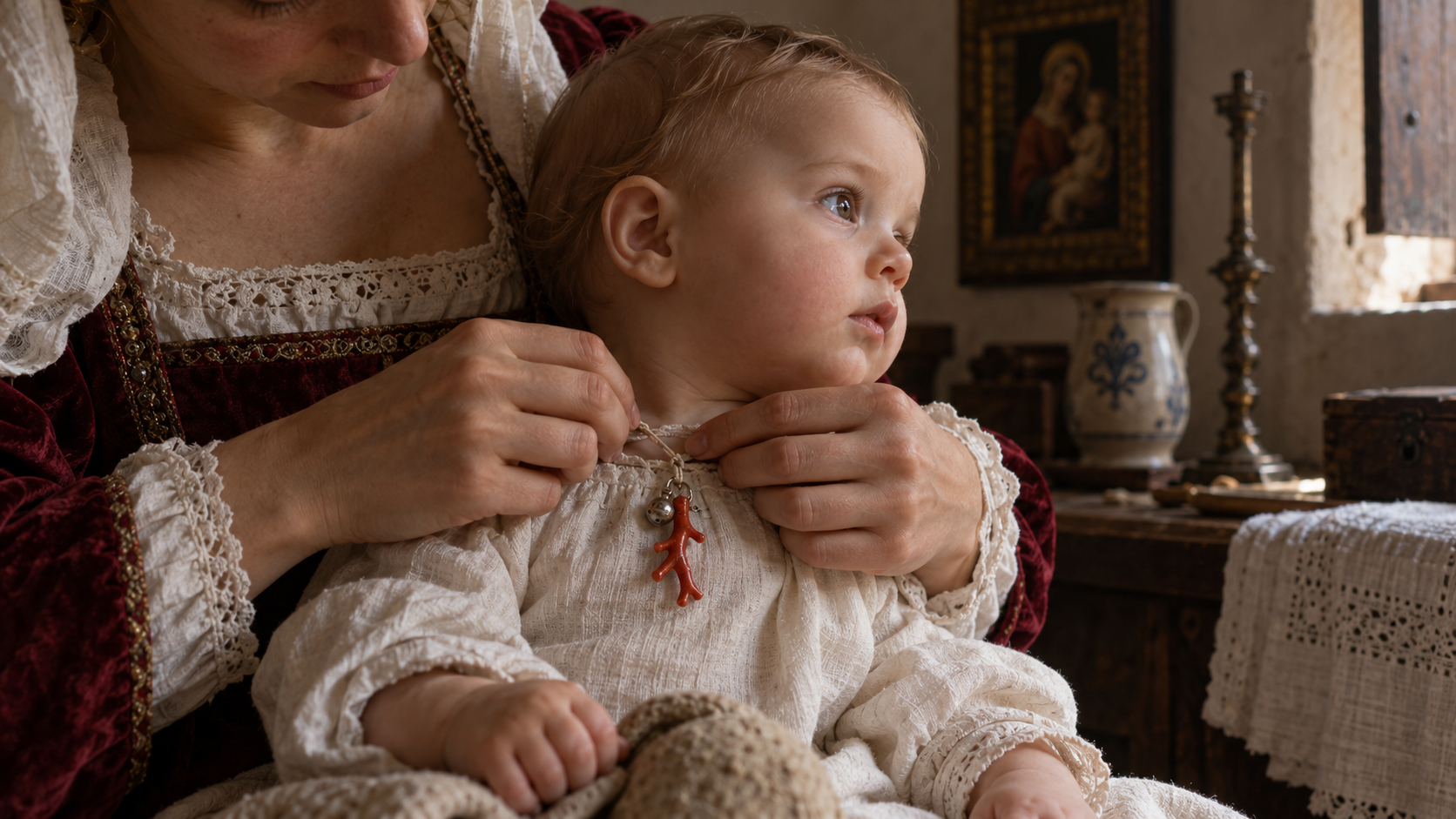
Coral Around a Child’s Neck
In Renaissance and early modern Europe, coral frequently appears in connection with children.
Branches could be suspended from necklaces.
Small coral objects could be attached to jewellery.
Later, coral became incorporated into elaborate rattles and teethers.
The cultural logic combined several ideas.
Coral was precious.
Its red colour was visually striking.
Its unusual natural origin carried accumulated folklore.
It was associated with protection.
And a smooth coral branch could physically be placed in a child’s mouth during teething.
The same object could therefore exist simultaneously as:
jewellery,
a teething implement,
a status object,
and an amulet.
Modern categories do not always separate historical objects cleanly.
Coral in Renaissance Images of Children
Northern Renaissance and later European portraits sometimes depict children holding or wearing coral.
These details should not automatically be dismissed as decorative accessories.
Coral could communicate protection and prosperity.
The Metropolitan Museum of Art specifically notes this protective symbolism when discussing surviving coral rattles and teethers.
A painted coral branch therefore could tell a viewer something about parental hopes.
The child was precious.
The child was vulnerable.
The child should be protected.
An object only a few centimetres long could communicate all three ideas.
Why Red?
Red has acquired protective significance in many societies, although its meanings are not universal.
It can evoke:
- blood
- vitality
- danger
- fire
- life
- sacrifice
- power
Coral offered a naturally occurring red material that could be polished and worn.
But we should resist turning this into a simplistic equation:
red = protection everywhere.
Colour symbolism changes across cultures.
The importance of coral emerged through the interaction of colour with its marine origin, mythology, rarity, physical form and inherited tradition.
The Coral Branch as a Protective Shape
Natural coral often forms branching structures.
When small branches were polished but retained their organic form, they could resemble fingers, horns or antlers.
Such forms fitted easily into Mediterranean traditions involving pointed or horn-like protective gestures and objects.
In later Italian contexts, the corno or horn-shaped amulet became particularly associated with protection against the evil eye.
Coral was an obvious material from which such objects could be made.
Yet the natural coral branch itself had already possessed a distinctive visual vocabulary long before modern souvenir versions of the Italian cornicello became familiar.
Coral in the Roman World
Coral circulated widely during Roman antiquity.
It was used for jewellery and personal ornament and also entered wider traditions of medicinal and protective belief.
Roman authors recorded beliefs concerning coral that modern science does not recognise as physical properties of the material.
This is valuable historical evidence.
It tells us what people thought.
It does not tell us that those beliefs were medically or physically correct.
That distinction is fundamental when studying ancient gemstone lore.
A historical source can demonstrate the existence of a belief without validating the mechanism proposed by that belief.
A Late Roman Coral Magical Gem
The British Museum preserves an especially unusual object demonstrating that coral could enter explicit magical practice.
The object is a small oval coral intaglio from the eastern Mediterranean, dating to the third century CE.
It was acquired in Alexandria.
A standing hawk is engraved on one side.
The reverse bears hieroglyphic inscription.
The British Museum classifies it as a magical gem.
This is unusually strong evidence.
We do not need to infer that the object was magical merely because modern viewers find coral mystical.
Its archaeological and scholarly classification places it directly within the late antique tradition of magical gems.
Magical Gems Were Complex Objects
Late antique magical gems should not be understood as simply ancient equivalents of modern healing crystals.
They could combine:
- deities
- sacred names
- magical words
- astrological imagery
- Egyptian religious motifs
- Greek inscriptions
- Jewish divine names
- medical intentions
- protective formulas
The eastern Mediterranean during the Roman period was culturally interconnected.
Egyptian, Greek, Roman and other religious traditions interacted.
A gemstone’s material could matter, but so could its engraved image, inscription and ritual use.
Again, the object functioned as a system.
Reducing it to “coral energy” would remove most of what made it historically meaningful.
Material, Image and Word
This principle is worth emphasising.
A coral magical gem engraved with a hawk and sacred signs is not merely a piece of coral.
Its perceived efficacy could depend on several components simultaneously:
the substance,
the image,
the inscription,
the ritual knowledge surrounding it,
and perhaps the person who prepared or wore it.
Modern crystal culture often places mineral identity at the centre:
“What does coral do?”
Historical amuletic traditions more often require a different question:
“What did this particular object mean within this particular system of belief?”
That is a far more precise approach.
From Antiquity into Christian Europe
The Christianisation of the Mediterranean did not instantly eliminate older amuletic practices.
Religious change is rarely so clean.
Christian authorities sometimes criticised magical or superstitious practices.
At the same time, Christians continued to use material objects associated with protection:
crosses,
relics,
medals,
written prayers,
blessed objects,
and other devotional items.
Popular practices could exist beside formal theology.
Older materials could acquire new interpretations.
Coral survived within this changing religious landscape.
Coral and the Christ Child
One of the most fascinating transformations appears in Renaissance Christian art.
Coral could appear with the infant Christ.
To a casual modern viewer, a red coral necklace may look like ordinary jewellery.
Within Renaissance visual culture, however, the material could operate on several levels.
Its established protective association made it appropriate for a child.
Its red colour could also invite Christian reflection on blood and the future Passion of Christ.
Thus a material inherited from older Mediterranean protective traditions could acquire specifically Christian resonances.
This is not necessarily evidence of one fixed doctrine.
It is evidence of symbolic layering.
Symbolism Can Accumulate Rather Than Replace
This is one of the most important lessons in the cultural history of gemstones.
New religions do not always erase older material traditions.
Instead, meanings can accumulate.
Coral could be:
a marine wonder,
a luxury material,
a protective amulet,
a child’s teething object,
a symbol connected with blood,
and an object interpreted through Christian imagery.
These meanings could overlap.
Cultural history often behaves less like replacing one page with another and more like writing repeatedly on the same manuscript.
The Child’s Coral Rattle
By the eighteenth and nineteenth centuries, coral appeared in elaborate European and American children’s rattles.
The Metropolitan Museum preserves several striking examples.
One American silver rattle made in New York around 1735–45 combines bells, a whistle and coral.
The Met identifies it simultaneously as:
a toy,
a whistle,
a teething device,
and an amulet.
The museum specifically records that coral was believed to ward off enchantment and disease.
This is an excellent example of how protective belief could survive into relatively recent European-derived culture.
A Physical Use and a Magical Use in the Same Object
The coral teether demonstrates something especially important.
Historical objects often combined practical and supernatural reasoning.
A child could bite the smooth coral during teething.
That is a physical action.
At the same time, adults might believe the coral protected against enchantment or illness.
That is a cultural belief.
The two interpretations did not need to compete.
For the historical user, they could coexist.
Modern analysis should therefore avoid forcing the object into only one category.
Did Coral Cure Teething Problems?
A child biting a hard, smooth object can experience mechanical pressure on the gums.
That does not validate historical claims that coral itself prevents disease.
Nor should antique coral teethers be used as models for modern childcare.
Historical objects were created under different medical and safety standards.
The important point is not whether the protective belief was medically effective.
The important point is that families believed material objects could participate in protecting vulnerable children.
Coral Beyond Christian Europe
Coral’s protective biography did not remain confined to European Christianity.
It travelled extensively through Mediterranean, Islamic, North African, Central Asian and African trade networks.
But these traditions should not be collapsed into a single universal “coral belief.”
A nineteenth-century amulet from Samarkand belongs to a different cultural system from a Renaissance Italian child’s coral.
The Metropolitan Museum preserves a pair of nineteenth-century amulet cases attributed to Samarkand in present-day Uzbekistan.
They are decorated with silver, coral, turquoise and glass.
The cases were intended to contain rolled pieces of paper inscribed with Qur’anic verses or other sacred words.
They were worn on the body for protection.
Here the most important protective component may not have been coral alone.
Sacred writing, container, placement on the body and ornament operated together.
Sacred Text and Gem Material
This provides an instructive comparison with modern crystal practice.
Suppose an amulet case contains Qur’anic text and is decorated with coral.
It would be historically misleading to describe the object simply as:
“a protective coral crystal.”
The sacred words matter enormously.
So does the Islamic cultural context.
So does the amulet form.
The coral participates in the object but does not necessarily explain its entire religious function.
This distinction respects the tradition rather than translating it into contemporary metaphysical vocabulary.
Coral in North African Jewellery
The Metropolitan Museum also preserves coral jewellery from North Africa.
A nineteenth- to early twentieth-century necklace attributed to Morocco combines coral and silver and incorporates a pendant related to the form of an amulet box.
The museum notes that the jewel likely possessed a protective function.
Another amulet case from the Kabylie region of Algeria combines silver, enamel and coral within a protective jewellery tradition.
Again, however, regional specificity matters.
“African coral spirituality” would be far too broad a category.
Moroccan Amazigh jewellery, Kabyle jewellery and other North African traditions have their own histories.
Coral and the Court of Benin
Coral also acquired extraordinary importance far beyond the Mediterranean at the royal court of the Kingdom of Benin, in present-day Nigeria.
Coral regalia became closely associated with the Oba and royal authority.
British Museum documentation describes coral mesh crowns as established components of royal dress by at least the sixteenth century.
The museum also records ritual dimensions associated with royal coral.
But this tradition should not simply be folded into a generic article about “coral protection.”
Benin court coral belongs to a distinct political, religious and historical system deserving treatment in its own right.
It also has a difficult colonial museum history: many Benin objects now held in European collections were taken during the British military expedition of 1897.
That provenance must not be ignored.
Trade Changes Symbolism
Coral is an excellent example of how trade can transform a natural material culturally.
Mediterranean coral could travel far from the sea in which it formed.
Once transported, it entered new societies.
Those societies did not necessarily preserve the exact beliefs of Mediterranean fishermen, Roman amulet users or Italian merchants.
Instead, imported material could acquire new meanings.
This is why gemstone symbolism should be studied as cultural biography, not as a universal list of properties.
Is Coral a Crystal?
In modern spiritual retail, coral is sometimes grouped loosely with “crystals.”
Gemmologically, that terminology is imprecise.
Precious coral is an organic gem material, not a mineral crystal.
That does not make it less important.
Pearl, amber, shell and coral all demonstrate that humans have valued organic substances alongside minerals for thousands of years.
For Natural Gems Belgium’s Learning Center, this distinction is useful because it demonstrates that spiritual material culture extends beyond crystals in the strict scientific sense.
Modern Metaphysical Coral Beliefs
Contemporary metaphysical traditions sometimes associate red coral with:
- vitality
- courage
- grounding
- emotional strength
- passion
- protection
- confidence
- life force
- the Root Chakra
These beliefs belong to modern spiritual practice.
Some themes—especially protection and vitality—may appear to resemble historical Mediterranean associations.
But resemblance does not prove uninterrupted continuity.
The modern chakra association is particularly important to distinguish.
The familiar contemporary system linking red materials with the Root Chakra emerged from modern reinterpretations of South Asian chakra traditions.
Roman Mediterranean coral users were not practising a modern seven-chakra system.
Neither were Renaissance Italian parents who placed coral on children.
Does Coral Protect Against the Evil Eye?
Historically, many people believed protective materials and amulets could avert the evil eye.
Coral was one of those materials in several Mediterranean and European traditions.
That is a legitimate historical statement.
Scientifically, however, there is no established evidence that coral produces a field or force capable of preventing harmful intentions, envy or supernatural attack.
The historical importance of the belief remains real even if the proposed supernatural mechanism cannot be scientifically demonstrated.
Does Coral Have Healing Energy?
Modern metaphysical sources sometimes attribute physiological effects to coral.
These may involve:
circulation,
blood,
fertility,
bone strength,
metabolism,
or general vitality.
Such claims are not established medical properties of coral.
Coral’s measurable characteristics arise from its biological and chemical structure.
Historical use in medicine or amulets demonstrates past belief and practice.
It does not substitute for modern clinical evidence.
Anyone experiencing a medical problem should rely on qualified healthcare rather than gemstone treatment.
Protection Does Not Need to Be Scientifically Literal to Matter Historically
This distinction allows us to take historical belief seriously without endorsing unsupported claims.
Imagine a Renaissance parent placing coral around an infant’s neck.
Perhaps that parent believed the object could repel the evil eye.
Modern science does not validate that mechanism.
But the parent’s action still tells us something profound.
It tells us about:
fear,
love,
vulnerability,
religion,
medicine,
family,
and attempts to exercise control over uncertainty.
The object is historically meaningful because people cared about what it represented.
A Historically Inspired Coral Reflection
Coral offers an unusually powerful material for modern contemplation precisely because its history revolves around vulnerability.
If you possess a legally and responsibly sourced piece of coral jewellery, observe its structure.
Notice that the material was once part of a living marine organism.
Look at its colour.
Consider its branching origin.
Then imagine a parent centuries ago attaching coral to a child’s clothing.
That person could not control infection.
Could not guarantee survival.
Could not understand microbiology.
But they could act.
They could pray.
They could seek medical assistance according to the knowledge of their period.
They could attach an amulet.
Ask:
What do I do when I cannot completely protect the people I care about?
Then:
Which protective habits in my own life are practical, and which are symbolic?
And finally:
Can a symbolic act have emotional value even when it does not alter physical causation?
These questions do not require coral to emit invisible energy.
Its human history provides enough material for reflection.
Coral and the Psychology of Protection
Protective objects may also have psychological functions.
Carrying something associated with family, faith or tradition can provide reassurance.
Ritual can structure anxiety.
Objects can remind people of commitments or relationships.
These effects should not be confused with supernatural proof.
But neither should symbolic experience automatically be dismissed as meaningless.
Human beings are meaning-making organisms.
Objects participate in that process.
A wedding ring does not scientifically create marriage.
Yet it can carry enormous emotional and social significance.
An amulet can operate similarly within its own cultural context.
The Difference Between Symbolic and Physical Protection
This distinction is especially useful when discussing gemstones.
A motorcycle helmet offers measurable physical protection.
A vaccine can provide biological protection.
A coral amulet historically offered symbolic or supernatural protection within a belief system.
Those categories should not be blurred.
Respecting spiritual traditions does not require abandoning scientific standards.
And respecting science does not require pretending that symbols have no cultural importance.
Both forms of analysis can coexist.
Conservation Adds a Modern Ethical Dimension
Coral now carries another meaning that ancient Mediterranean users could not have anticipated:
environmental responsibility.
Coral ecosystems face serious pressures from climate change, ocean warming, acidification, pollution and destructive harvesting practices.
Gem-quality precious coral is biologically different from reef-building tropical corals, but responsible sourcing remains important.
Historic admiration for coral therefore intersects today with conservation ethics.
A modern appreciation of coral should include not only its symbolism but also awareness that it originated from living marine organisms.
Antique Coral and Modern Coral Are Different Ethical Questions
Museum objects preserve historical evidence.
An ancient Roman coral amulet already exists.
A Renaissance coral pendant already exists.
Studying these objects does not require new extraction.
Contemporary acquisition raises different questions.
Provenance, species, legality and responsible sourcing matter.
The cultural history of coral therefore offers an opportunity to connect gemstone appreciation with environmental literacy.
Beauty has consequences.
Why Coral Deserves More Than “Protection Stone”
Search modern spiritual literature and coral may be reduced to a short formula:
“Red coral is a stone of protection and vitality.”
Historically, that is inadequate.
The actual story includes:
marine biology,
Greek mythology,
Medusa,
Roman magical gems,
Mediterranean evil-eye traditions,
childhood vulnerability,
Renaissance Christianity,
amulets,
teething objects,
Islamic sacred texts,
North African jewellery,
international trade,
and modern conservation.
That history is considerably richer than a list of metaphysical properties.
What Can We Say with Confidence?
Several conclusions are well supported.
Precious coral is an organic gem material, not a mineral crystal.
Mediterranean societies have used coral for jewellery and ornament for millennia.
Greek and Roman mythology connected coral with the blood of Medusa.
Late Roman evidence includes actual engraved coral objects classified as magical gems.
Protective beliefs surrounding coral became particularly associated with vulnerability, including childhood.
Renaissance and early modern European culture used coral in children’s protective objects.
Surviving eighteenth- and nineteenth-century rattles combined coral’s practical use as a teething material with beliefs that it could ward off enchantment and disease.
Coral also appears in protective jewellery and amulet cases in Islamic and North African contexts, although these traditions must be interpreted according to their specific religious and regional settings.
Historical belief in coral’s protective properties does not scientifically demonstrate that coral can repel the evil eye, cure disease or alter physical events.
Modern Root Chakra and crystal-energy interpretations should not be projected backwards onto Roman or Renaissance Mediterranean culture.
Conclusion
Red coral has travelled an extraordinary distance without moving very far from one central human concern:
protection.
It began beneath the sea as the skeletal structure produced by tiny living organisms.
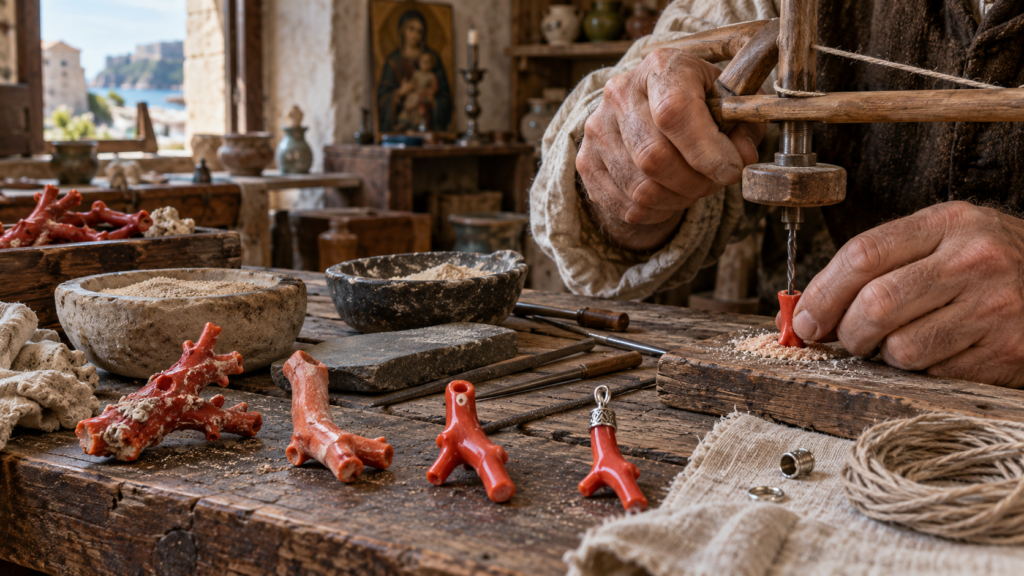
Humans harvested it.
Polished it.
Drilled it.
Carved it.
Hung it around necks.
Placed it on children.
Engraved it with sacred and magical imagery.
Combined it with silver, gold, bells, prayers and other amuletic materials.
Greek mythology explained coral through the blood of Medusa.
Roman magical traditions transformed it into engraved amulets.
Renaissance families placed it near vulnerable children.
Early modern craftspeople incorporated it into rattles that functioned simultaneously as toys, teethers and protective objects.
Islamic and North African traditions incorporated coral into still other forms of amuletic jewellery.
Across these contexts, coral’s meaning was never completely universal.
Different societies used the same material within different systems of belief.
That distinction matters.
Modern metaphysical traditions may continue to regard red coral as protective, grounding or energising.
Those beliefs can form part of contemporary spiritual practice.
They should not be confused with scientific evidence or presented as unchanged survivals from antiquity.
At Natural Gems Belgium, the most compelling approach is therefore neither to dismiss historical belief nor to convert it automatically into modern crystal healing.
Instead, we can ask what the object tells us about the people who trusted it.
A small coral branch hanging from a child’s neck centuries ago was not merely red jewellery.
It represented a parent’s attempt to place protection around something precious.
Science may not confirm the supernatural mechanism.
History confirms the human need behind it.
And that may be the most enduring meaning coral carries.
References & Further Reading
Gemmological and Historical Background
Gemological Institute of America (GIA) — Captivated by Coral
GIA overview of coral as a gem material, its colour range, long history of human use and historical lore, including the Greco-Roman tradition connecting red coral with Perseus, Medusa and the sea.
Late Roman Coral and Magical Practice
British Museum — Coral Magical Gem / Intaglio, Third Century CE
An unusually important eastern Mediterranean coral object classified by the British Museum as a magical gem. The oval coral intaglio carries an engraved standing hawk and hieroglyphic inscription and was acquired in Alexandria. It provides direct material evidence that coral could participate in late Roman magical practice.
British Museum — Coral Magical Gem with Hawk, Third Century CE
A second eastern Mediterranean coral magical gem dating to the third century, engraved with a hawk and inscription. Together with the related British Museum example, it demonstrates that coral could function within the complex magical and religious environment of Roman-period Egypt and the eastern Mediterranean.
Coral, Childhood and Protective Belief
The Metropolitan Museum of Art — Rattle, Whistle, and Bells, New York, 1735–45
Silver and coral children’s object made by Richard or Peter Van Dyck. The Met identifies it as simultaneously a toy, whistle, teething device and amulet and records the historical belief that coral could ward off enchantment and disease.
The Metropolitan Museum of Art — Child’s Rattle and Teether, Birmingham, 1835–36
British silver-and-coral children’s rattle illustrating the remarkable persistence of protective coral traditions into the nineteenth century. The museum notes both the physical use of coral for teething and its believed ability to protect against enchantment and disease.
Coral in Islamic Amuletic Traditions
The Metropolitan Museum of Art — Amulet Case, Samarkand, Nineteenth Century
Silver amulet case decorated with coral, turquoise and glass. The Met explains that such objects were designed to contain rolled papers bearing Qur’anic verses or other sacred words and were worn on the body for protection. This example demonstrates why coral in Islamic jewellery must be interpreted together with sacred text and amulet form rather than as an independent “crystal energy” object.
The Metropolitan Museum of Art — Companion Amulet Case, Samarkand, Nineteenth Century
The matching member of the pair, likewise decorated with turquoise, coral and glass and intended to hold protective sacred writing.
North African Coral and Protective Jewellery
The Metropolitan Museum of Art — Coral and Silver Necklace, Morocco
Nineteenth- to early twentieth-century necklace attributed to Morocco and associated with Amazigh jewellery traditions. The Met notes that the pendant resembles an amulet box and probably possessed a protective function.
The Metropolitan Museum of Art — Amulet Case, Kabylie, Algeria
Silver, enamel and coral amulet case attributed to Algeria’s Kabylie region. The museum identifies the object as a talismanic ornament intended to protect its wearer and discusses its relationship with North African jewellery traditions.
Longer-Distance Coral Traditions
British Museum — Coral Mesh Crown from the Kingdom of Benin
Important documentation of coral in the royal regalia of the Oba of Benin. The British Museum discusses coral’s protective and ritual dimensions within Benin court culture and notes that coral mesh regalia had become established by at least the sixteenth century. The museum record also explicitly documents that the object entered the collection following the British military expedition and looting of Benin City in 1897.
Comparative Amulet Traditions
The Metropolitan Museum of Art — Cypro-Phoenician Gold Amulet Case
Gold amulet container dating broadly from the seventh to second century BCE. The Met explains that such cases could contain protective spells written on gold or papyrus and traces the practice from Egypt through Phoenician networks to Cyprus and Carthage. Although not made from coral, it provides important comparative evidence for the broader Mediterranean tradition of wearable protective containers.
Historical Belief Versus Scientific Evidence
The surviving evidence securely demonstrates that coral participated in protective and magical traditions across several historical societies.
We can document:
Late Roman coral magical gems,
Mediterranean traditions connecting coral with Medusa,
European children’s coral amulets and teethers,
historical beliefs that coral could repel enchantment and disease,
coral incorporated into Islamic amulet cases containing sacred writing,
and protective coral jewellery in specific North African traditions.
These examples do not establish one universal “spiritual meaning of coral.”
They represent different cultural systems separated by geography, religion and historical period.
Nor do they demonstrate scientifically that coral emits protective energy, repels the evil eye, prevents disease or influences human physiology.
Modern associations involving grounding, vitality, energy fields or the Root Chakra belong primarily to contemporary metaphysical traditions.
The historically strongest interpretation therefore distinguishes:
documented historical belief
from
religious and cultural symbolism
from
modern metaphysical practice
from
scientifically established physical properties.
That distinction does not diminish coral’s spiritual history.
It reveals something considerably more interesting: for centuries, humans repeatedly selected this strange red substance from beneath the sea when confronting vulnerability, uncertainty and the desire to protect what they valued most.