Two gemstones can appear virtually identical to the unaided eye while having completely different origins.
One may have crystallised naturally within the Earth over geological time.
Another may have been grown inside a laboratory using a carefully controlled manufacturing process.
A third may not even be the same mineral. It may simply have been selected because its appearance resembles the gemstone it imitates.
These are the fundamental distinctions between natural gemstones, synthetic gemstones and simulants.
Understanding the differences between natural vs synthetic gemstones is crucial for making informed choices.
Understanding them is essential to modern gemmology because appearance alone does not establish identity.
Watch Episode 2 — Natural, Synthetic, Simulant: What’s the Difference?
In Episode 2 of the Natural Gems Belgium Gemmology Series, Marnick Elskens, Founder of Natural Gems Belgium, explains how natural gemstones differ from laboratory-grown equivalents and gemstone simulants—and why professional identification depends on evidence rather than visual assumptions.
The video introduces the three categories. Below, we examine their scientific basis and identification in greater depth.
What Is a Natural Gemstone?
A natural gemstone originates through geological processes without humans manufacturing the crystal itself.
The exact formation process depends on the mineral and geological environment.
Gem minerals can crystallise from magma, form during metamorphism, precipitate from hydrothermal fluids or develop through other geological processes.
Temperature, pressure, chemical composition, fluid activity and geological time all contribute to crystal formation.
This natural growth history can leave evidence inside the finished gemstone.
Examples include:
- mineral inclusions;
- fluid inclusions;
- healed fractures;
- growth zoning;
- twinning;
- trace-element variations;
- and other microscopic or chemical characteristics.
These features can become valuable evidence during gemstone identification.
However, natural origin does not imply perfection. In fact, many of the microscopic irregularities found inside natural gemstones are direct consequences of their geological formation.
Natural Does Not Mean Untreated
Natural origin and treatment status must be considered separately.
A sapphire that formed naturally and was subsequently heated remains a natural sapphire.
It is natural and treated.
Another naturally formed sapphire for which no evidence of heating is detected may be described as unheated within the limitations of the examination performed.
The distinction matters because the word natural describes origin, while terms such as heated, fracture-filled or untreated describe subsequent treatment history.
This is why a complete gemstone description often requires more information than simply stating that a gemstone is natural.
What Is a Synthetic Gemstone?
A synthetic gemstone is a material produced artificially that has essentially the same chemical composition, crystal structure and corresponding physical properties as its natural counterpart.
This definition is critical.
A synthetic ruby is not merely a red substance that resembles ruby.
Ruby is the red gem variety of corundum, aluminium oxide with the appropriate colour-producing trace chemistry.
A correctly identified synthetic ruby is also crystalline corundum.
The major distinction is its origin.
Natural ruby crystallised through geological processes.
Synthetic ruby crystallised through a human-controlled manufacturing process.
The same principle applies to synthetic sapphire, synthetic emerald, synthetic quartz and laboratory-grown diamond.
Synthetic therefore does not mean the same thing as imitation.
How Are Synthetic Gemstones Made?
Humans have developed several technologies capable of reproducing conditions under which gem crystals can grow.
Different techniques create different growth environments, and those environments can leave characteristic evidence in the finished material.
Flame Fusion — The Verneuil Process
The flame-fusion method, developed commercially around the beginning of the twentieth century, became one of the most important early techniques for manufacturing synthetic corundum.
Finely powdered chemical material passes through a high-temperature flame, melts and falls onto a support.
The molten droplets progressively solidify into a crystal mass known as a boule.
Synthetic ruby and sapphire have been produced extensively by this process.
Flame-fusion material may exhibit curved growth features that differ from the growth structures expected in natural corundum.
Gas bubbles and other manufacturing-related features may also occur.
Such observations can provide useful diagnostic evidence under magnification.
Flux Growth
Flux growth uses a molten chemical solvent in which the components required for crystal formation are dissolved.
As conditions change, crystals gradually grow from this solution.
The method can produce synthetic gemstones with internal appearances considerably more convincing than those produced by simpler manufacturing techniques.
Flux-grown synthetic ruby, sapphire, emerald and other materials have been produced.
Residues of flux may become trapped within a growing synthetic crystal and can sometimes provide diagnostic microscopic evidence.
However, identification should never depend solely on the presence or absence of one expected inclusion.
Hydrothermal Growth
Hydrothermal synthesis reproduces aspects of natural crystal growth from hot aqueous fluids.
Nutrients are dissolved in a water-rich solution under elevated temperature and pressure inside a sealed pressure vessel known as an autoclave.
Material is transported through the solution and deposited onto seed crystals.
Hydrothermal methods are particularly important for synthetic quartz and have also been used for materials such as synthetic emerald.
Because natural gemstones can themselves form in hydrothermal geological environments, synthetic hydrothermal crystals can present sophisticated identification challenges.
Growth structures, inclusions and advanced analytical properties may all become relevant.
Synthetic Diamond: HPHT and CVD
Modern laboratory-grown diamond provides one of the most important contemporary examples of gemstone synthesis.
A laboratory-grown diamond is not cubic zirconia and it is not simply a diamond imitation.
It is diamond.
Its crystal structure consists of carbon arranged in the diamond structure.
Two major manufacturing technologies dominate commercial production.
HPHT — High Pressure, High Temperature
HPHT synthesis creates diamond under extremely high pressures and temperatures.
A small diamond seed is used and carbon crystallises onto it under conditions designed to stabilise diamond growth.
The process can produce gem-quality synthetic diamonds.
Growth morphology, metallic inclusions, fluorescence patterns, defects and spectroscopic characteristics can provide evidence of HPHT growth.
CVD — Chemical Vapour Deposition
Chemical vapour deposition grows diamond at substantially lower pressures than HPHT.
A diamond seed is placed inside a chamber containing carbon-bearing gases.
The gases are activated, allowing carbon species to deposit progressively onto the diamond substrate.
Layer by layer, a diamond crystal develops.
Modern CVD diamonds can reach very high gem quality and may be difficult to distinguish from natural diamonds without appropriate equipment.
Post-growth treatment may also be applied to some laboratory-grown diamonds to modify their colour.
What Is a Gemstone Simulant?
A simulant is fundamentally different from a synthetic gemstone.
A gemstone simulant is a material used because it resembles another gem material in appearance.
It does not need to share the same chemical composition or crystal structure.
Cubic zirconia is a classic diamond simulant.
It can be transparent, colourless and highly brilliant, allowing it to resemble diamond visually.
But cubic zirconia is not diamond.
Diamond consists of carbon.
Cubic zirconia consists primarily of zirconium dioxide stabilised in a cubic crystal structure.
The two materials also differ in hardness, density, refractive index, dispersion, thermal conductivity and numerous other properties.
Glass provides another familiar example.
Coloured glass has historically been used to imitate ruby, sapphire, emerald and many other gemstones.
Visual resemblance therefore tells us very little about actual material identity.
Natural Diamond, Laboratory-Grown Diamond and Cubic Zirconia
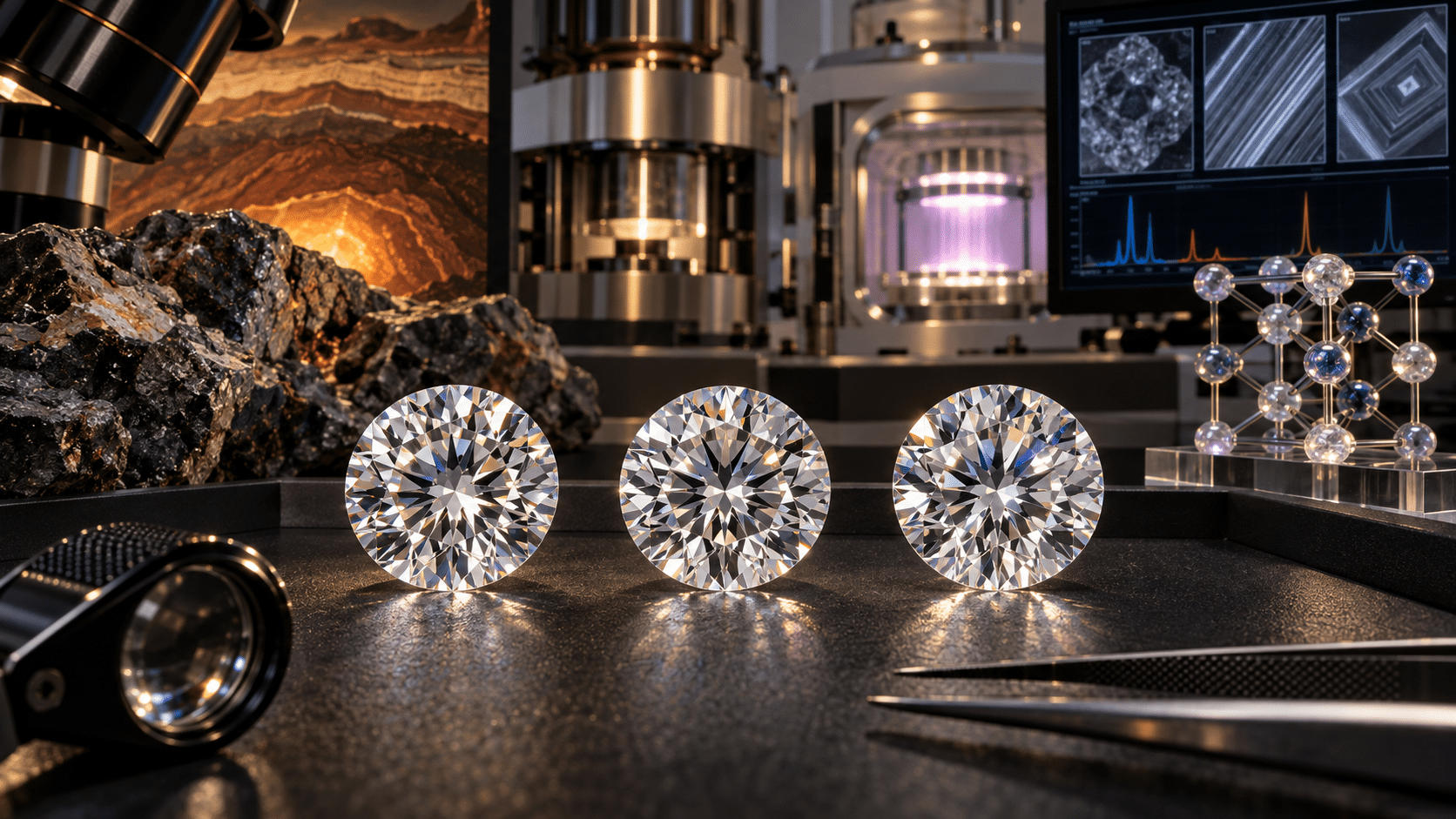
Diamond provides an excellent demonstration of the three categories.
Natural Diamond
A natural diamond formed through geological processes within the Earth.
Its material is crystalline carbon with the diamond structure.
Laboratory-Grown Diamond
A laboratory-grown diamond was produced artificially, commonly using HPHT or CVD technology.
Its material is also crystalline carbon with the diamond structure.
It is therefore a synthetic diamond, not a diamond simulant.
Cubic Zirconia
Cubic zirconia is a different chemical substance and crystal material.
It may imitate the appearance of diamond, but scientifically it is not diamond.
It is a simulant.
This distinction illustrates why the terms synthetic and simulant should never be treated as synonyms.
Can You Tell the Difference by Eye?
Sometimes there are visual clues.
But relying on appearance alone is not a reliable scientific identification method.
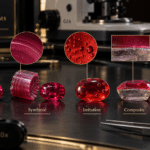
A well-cut synthetic ruby can appear extremely similar to natural ruby.
A high-quality laboratory-grown diamond may be visually indistinguishable from a natural diamond to an observer without specialised equipment.
Some simulants can also be remarkably convincing.
Conversely, assuming that an unusually clean gemstone must be synthetic is equally unreliable.
Natural gemstones can occasionally possess exceptional clarity.
Identification requires measurable evidence.
Microscopy: Reading the Growth History
The gemmological microscope is one of the most valuable instruments for investigating gemstone origin.
Internal characteristics can preserve evidence of how a crystal grew.
A natural gemstone may contain mineral inclusions that became trapped during geological crystallisation.
It may contain fluids associated with its formation environment.
Growth zoning may reflect changes in chemistry as the crystal developed.
A synthetic gemstone grows in a very different environment.
Flame-fusion corundum may display curved growth structures.
Flux-grown material may contain residues associated with the flux.
Hydrothermal synthetics may reveal characteristic growth structures related to seed plates and controlled crystallisation.
But interpretation requires experience.
No responsible gemmologist should conclude that a gemstone is natural or synthetic merely because one expected inclusion is present or absent.
Physical and Optical Properties
Gemstone identification does not rely solely on inclusions.
A gemmologist can examine properties such as:
- refractive index;
- birefringence;
- optic character;
- specific gravity;
- pleochroism;
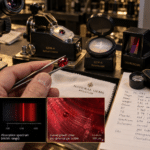
- absorption spectrum;
- fluorescence;
- dispersion;
- hardness-related observations where appropriate;
- and microscopic characteristics.
These properties help establish what material is being examined.
This is particularly useful for separating simulants.
For example, diamond and cubic zirconia differ substantially in several measurable physical and optical properties even though both can appear colourless and brilliant.
Separating a natural gemstone from its synthetic counterpart can be more challenging because both belong to essentially the same gem material and consequently share many fundamental properties.
The investigation then shifts increasingly toward growth history rather than basic mineral identity.
Why Laboratory-Grown Diamond Can Require Advanced Testing
Modern synthetic diamond technology demonstrates the limitations of traditional visual identification.
Because natural and laboratory-grown diamond share the same fundamental material identity, standard observations such as hardness or refractive index cannot simply separate them.
Professional laboratories can therefore use specialised techniques including:
- infrared spectroscopy;
- photoluminescence spectroscopy;
- ultraviolet fluorescence imaging;
- growth-pattern analysis;
- trace-element or defect analysis;
- and specialised diamond screening instruments.
These methods investigate structural defects and growth characteristics associated with natural geological formation, HPHT synthesis or CVD growth.
As manufacturing technology evolves, detection methods must evolve as well.
Synthetic Does Not Mean Fake
In everyday language, synthetic is sometimes incorrectly used as a synonym for fake.
Scientifically, that is misleading.
A synthetic gemstone can be a genuine example of a particular crystalline material while having an artificial origin.
Synthetic ruby is genuine corundum.
Laboratory-grown diamond is genuine diamond material.
What it is not is natural ruby or natural diamond.
Correct terminology should communicate that distinction clearly.
A simulant, meanwhile, is a different material being used to reproduce the visual appearance of another gemstone.
Accurate terminology therefore protects both scientific meaning and consumer expectations.
Why Disclosure Matters
Origin can have an enormous influence on rarity, market position and value.
A natural ruby formed through geological processes and a synthetic ruby produced commercially may share mineral identity, but they do not share rarity or origin.
The same principle applies to natural and laboratory-grown diamonds.
Consumers should therefore be able to distinguish clearly between:
Natural gemstone
Laboratory-grown or synthetic gemstone
Gemstone simulant
Descriptions should not deliberately obscure these distinctions.
Transparent terminology allows buyers to make decisions based on what a material actually is rather than what it merely resembles.
The Evidence-Based Approach
Modern gemmology works by combining evidence.
An inclusion may provide a clue.
A refractive-index measurement provides another.
Pleochroism, fluorescence, spectroscopy, chemical analysis and growth structures may add further information.
When independent observations agree, confidence in an identification increases.
When they conflict, further investigation is required.
And sometimes the correct professional decision is to submit the gemstone to an appropriately equipped gemmological laboratory.
That is not a failure of identification.
It is good scientific practice.
Look Beyond Appearance
Natural gemstones, synthetic gemstones and simulants can all be attractive materials.
But beauty and identity are different questions.
A gemstone’s appearance tells us what our eyes perceive.
Gemmology asks something deeper:
What is the material?
How did it form?
Was the crystal produced naturally or artificially?
Has another material been used to imitate it?
Answering those questions requires observation, measurement and evidence.
That distinction between appearance and identity is one of the foundations of professional gemmology.
References & Further Reading
Gemological Institute of America (GIA) — What Is a Synthetic Gemstone?
GIA educational information explaining synthetic gemstones and the distinction between natural and laboratory-grown materials.
https://www.gia.edu/gem-synthetic
Gemological Institute of America (GIA) — Laboratory-Grown Diamonds
Educational overview of laboratory-grown diamond, including HPHT and CVD production and identification.
https://www.gia.edu/gem-lab-grown-diamond
Gemological Institute of America (GIA) — HPHT and CVD Diamond Growth Processes
Technical introduction to the principal methods used to manufacture laboratory-grown diamonds.
https://www.gia.edu/hpht-and-cvd-diamond-growth-processes
Gemological Institute of America (GIA) — The Evolution of Synthetic Diamond Identification
Discussion of laboratory-grown diamond development and the analytical methods used to distinguish synthetic from natural diamond.
https://www.gia.edu/gems-gemology/summer-2017-synthetic-diamond-identification
Gemological Institute of America (GIA) — Synthetic Gem Materials and Their Identification
GIA’s Gems & Gemology resources provide technical research on synthetic gemstone growth, inclusions and identification.
https://www.gia.edu/gems-gemology
CIBJO — The World Jewellery Confederation — The Blue Books
International nomenclature and disclosure standards covering gemstones, synthetic materials, imitation products and responsible trade descriptions.
https://cibjo.org/the-blue-books/
CIBJO — Industry Standards & Resources
Current CIBJO resources for gemstone terminology, product integrity, laboratories and responsible industry practice.
https://cibjo.org/industry-standards-resources/
Federal Trade Commission — Jewelry Guides
Consumer-protection guidance concerning terminology and disclosure for natural, laboratory-created, simulated and imitation gem products.
https://www.ftc.gov/legal-library/browse/rules/guides-jewelry-precious-metals-pewter-industries
International Gem Society — An Introduction to Synthetic Gem Materials
Accessible supplementary reading on synthetic gemstone production methods and the differences between synthetics and simulants.
https://www.gemsociety.org/article/understanding-gem-synthetics-treatments-and-imitations/