Table of Contents
When Identifying the Mineral Is Only the Beginning
Four blue gemstones arrive on the gemmologist’s desk.
All four are transparent.
All four are faceted.
All four are attractive blue stones.
And standard gemmological testing produces an initially frustrating result:
all four are sapphire.
Their refractive indices fall within the corundum range.
Their specific gravities are compatible with corundum.
Their birefringence is compatible with corundum.
Their optical character is compatible with corundum.
Yet commercially and gemmologically, the four stones are profoundly different.
One is:
natural and unheated.
One is:
natural and heat treated.
One is:
laboratory-grown synthetic sapphire.
And one is:
natural sapphire whose colour has been modified by lattice diffusion.
The challenge is therefore no longer:
What mineral is this?
The challenge becomes:
How did this sapphire form, and what happened to it afterwards?
That distinction represents one of the most important transitions from elementary gemstone identification into professional gemmology.
Welcome to the next level of the Natural Gems Belgium Practical Gemmology workshops.
PART I — THE FOUR SAPPHIRES
1. Our Unknown Specimens
We will call the four stones:
Sapphire A
Sapphire B
Sapphire C
Sapphire D
Initially, their commercial histories are concealed.
All four appear to be blue sapphire.
Our task is to determine which is:
- natural unheated sapphire;
- natural heated sapphire;
- synthetic sapphire;
- diffusion-treated sapphire.
The investigation follows a modified NGB evidence workflow:
Confirm Species → Examine Growth → Examine Inclusions → Search for Treatment → Escalate if Necessary → Conclude
This differs deliberately from our previous identification workshops.
We are no longer trying primarily to eliminate different mineral species.
Instead we are reconstructing each gemstone’s:
history.
PART II — FIRST ESTABLISH THE SPECIES
2. What Is Sapphire?
Sapphire is corundum:
Al₂O₃
Corundum is trigonal and optically uniaxial.
Typical sapphire gemmological constants are approximately:
RI 1.762–1.770
Birefringence 0.008–0.010
SG approximately 4.00
Mohs hardness 9
These properties are extremely useful for establishing that an unknown stone is corundum.
But there is a complication.
3. Synthetic Sapphire Is Also Corundum
A laboratory-grown sapphire is not merely a blue imitation that resembles sapphire.
It is:
synthetic corundum.
Its essential crystal structure and chemical identity are the same mineralogical system as natural sapphire.
Consequently, synthetic sapphire can possess essentially the same:
- RI;
- birefringence;
- SG;
- hardness;
- optical character
as naturally formed sapphire.
This is the central problem of today’s workshop.
4. Standard Testing of Our Four Stones
The four stones produce results broadly compatible with:
corundum.
Refractometer readings fall approximately around:
1.76–1.77
Birefringence is approximately:
0.008–0.010
Hydrostatic SG is close to:
4.00
The polariscope confirms:
anisotropic, uniaxial behaviour.
The species-level conclusion is therefore straightforward:
All four stones are sapphire/corundum.
But our investigation has barely begun.
PART III — IDENTITY IS NOT HISTORY
5. Four Different Questions
Professional gemstone description requires several questions to remain separate.
Question 1 — What is the material?
Corundum / sapphire
Question 2 — Is it natural or laboratory-grown?
This concerns:
growth origin.
Question 3 — Has it been treated?
This concerns modification after formation or growth.
Question 4 — If treated, what treatment?
Examples include:
- conventional heating;
- lattice diffusion;
- fracture filling;
- other specialised processes.
A correct answer to Question 1 does not automatically answer Questions 2–4.
6. Why This Matters Commercially
Imagine two stones with virtually identical:
- weight;
- colour;
- cut;
- RI;
- SG.
One formed naturally underground and shows no evidence of heating.
The other was grown industrially.
Their fundamental corundum properties can be extremely similar.
Their market descriptions, rarity and commercial implications are not.
Therefore:
mineral identity is not the same as commercial identity.
PART IV — THE MICROSCOPE BECOMES CENTRAL
7. Return to Magnification
In our earlier workshops, the refractometer was often the decisive instrument.
Today the microscope becomes much more important.
We examine each sapphire using:
- darkfield illumination;
- brightfield illumination;
- fibre-optic lighting;
- diffused transmitted light;
- immersion where appropriate.
We search for evidence of:
- natural crystal growth;
- synthetic growth;
- mineral inclusions;
- rutile silk;
- colour zoning;
- healed fissures;
- altered inclusions;
- diffusion-related colour distribution.
The microscopic world may preserve events that occurred millions of years apart—or events created within a furnace.
PART V — SAPPHIRE A
8. First Microscopic Examination
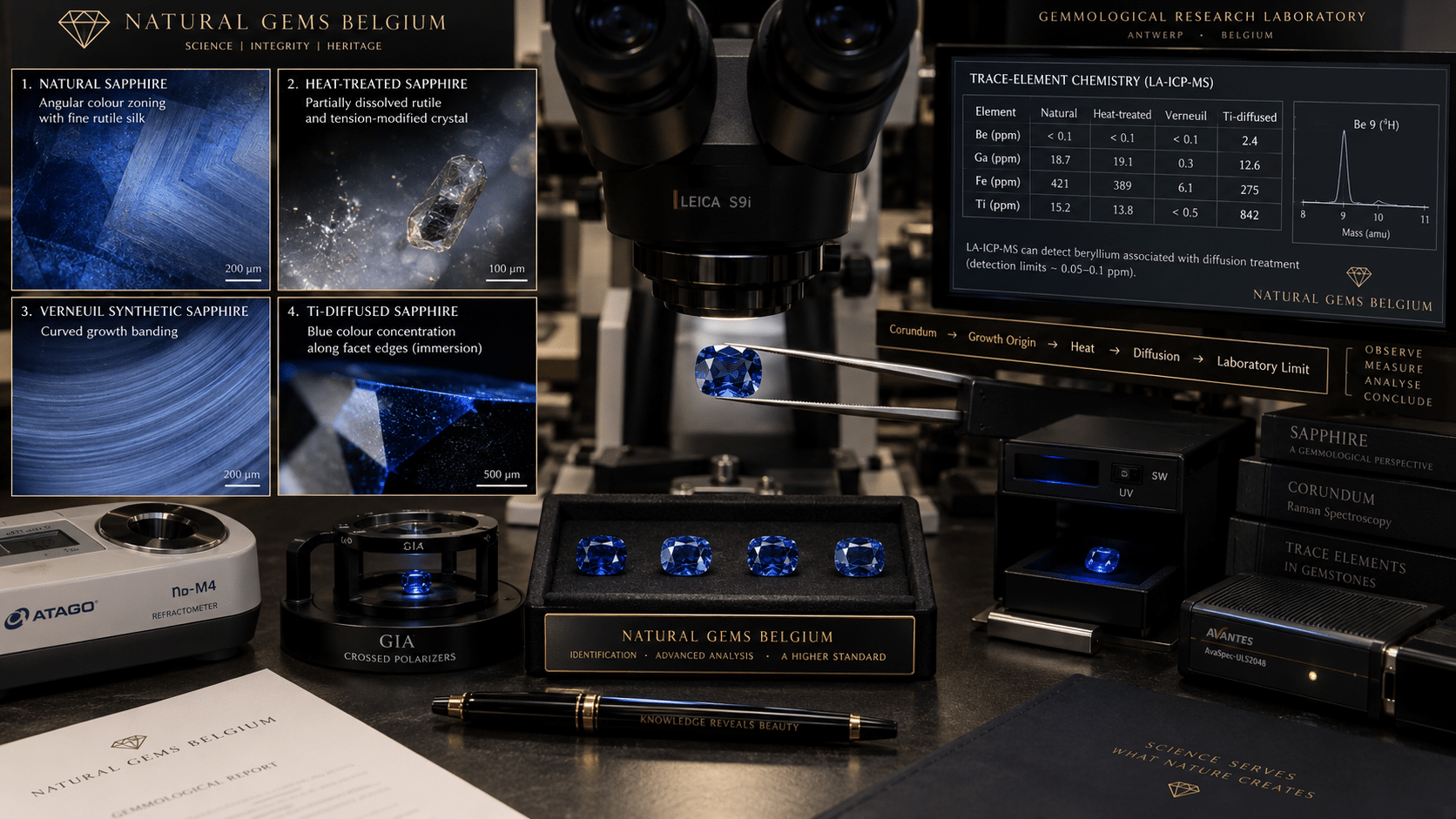
Sapphire A contains:
- fine straight rutile needles;
- angular growth zoning;
- small mineral crystals;
- natural-looking healed fissures.
The zoning follows crystallographic directions.
It is not curved.
The rutile needles remain relatively sharp and intact.
No obvious signs of thermal alteration are observed.
What can we conclude?
9. Angular Growth Zoning
Natural sapphire commonly grows through changing geological conditions.
Variations in trace-element incorporation can produce:
angular colour zoning.
These zones reflect the crystallographic structure of corundum.
They can form straight or angular patterns rather than the characteristic curved growth structures associated with Verneuil flame-fusion material.
Angular zoning therefore supports:
natural geological growth.
But it does not by itself prove that the sapphire is unheated.
10. Rutile Silk
Fine rutile needles are among the most familiar inclusions encountered in natural corundum.
When sufficiently abundant and appropriately oriented, they may produce:
silk.
Intact rutile can provide valuable evidence.
Heating can alter or dissolve rutile.
Therefore the condition of the silk may contribute to treatment assessment.
11. The Important Word: “May”
Do not make the rule:
intact rutile = definitely unheated.
Treatment interpretation requires the entire inclusion scene.
Heating conditions vary enormously.
Temperature, atmosphere and duration matter.
Not every heating event produces identical microscopic effects.
The correct conclusion is more cautious:
well-preserved heat-sensitive inclusions with no observed thermal alteration support an unheated interpretation.
12. Sapphire A — Provisional Conclusion
The evidence supports:
Natural sapphire — no indications of heating observed.
Notice the wording.
Professional gemmology does not say:
“This sapphire has never experienced heat anywhere in its geological history.”
Instead, the gemmologist evaluates whether there is evidence of:
artificial heat treatment.
PART VI — SAPPHIRE B
13. The Second Stone
Sapphire B also contains natural inclusions.
We observe:
- angular growth zoning;
- mineral crystals;
- remnants of rutile silk;
- altered internal features.
So natural geological origin appears likely.
But something has happened after formation.
14. Altered Rutile
Some former rutile needles appear:
- partially dissolved;
- broken;
- diffuse;
- transformed into altered structures.
GIA has documented internal diffusion produced when titanium from rutile silk dissolves into the corundum lattice during high-temperature heating.
That titanium can interact with iron and contribute to increased blue coloration.
The original inclusion has therefore become evidence of:
treatment.
15. Heating Can Change Both Colour and Clarity
Artificial heating of sapphire is not a single-purpose process.
Depending on material and conditions, heating may:
- intensify colour;
- lighten colour;
- alter hue;
- dissolve rutile;
- modify inclusions;
- improve apparent transparency;
- create or modify asterism.
The furnace is manipulating crystal chemistry and internal microstructure.
16. Heat-Affected Crystal Inclusions
Under sufficiently high temperatures, included minerals may react.
Possible observations include:
- rounded or melted-looking crystal surfaces;
- tension fractures;
- altered halos;
- partially decomposed inclusions;
- recrystallisation.
Zircon inclusions can be particularly informative because heating can substantially alter them.
But the interpretation depends on temperature.
17. Low-Temperature Heating Complicates the Problem
Not all heated sapphire has experienced extreme temperatures.
GIA experiments on Madagascar sapphire investigated treatment below approximately:
1350°C
used to lighten certain dark material.
Lower-temperature treatment may produce subtler changes than the dramatic inclusion destruction associated with very high-temperature heating.
Therefore:
absence of spectacular melting does not prove absence of heat treatment.
18. Sapphire B — Provisional Conclusion
The stone contains convincing evidence of:
natural growth
plus:
artificial heat treatment.
The appropriate conclusion is therefore:
Natural Sapphire — Heated
This is not synthetic sapphire.
The natural geological features remain.
The treatment occurred:
after natural formation.
PART VII — SAPPHIRE C
19. The Third Stone Looks Suspiciously Clean
Sapphire C contains few obvious natural mineral inclusions.
At first, that tells us very little.
Fine natural sapphire can be extremely clean.
Synthetic sapphire can also contain inclusions.
Clarity alone cannot determine growth origin.
Then, with careful illumination, we observe something more important.
20. Curved Growth Banding
Faint bands sweep through the sapphire in:
curved arcs.
Their geometry is fundamentally different from the angular crystallographic zoning observed in Sapphire A.
This is a classic clue to:
Verneuil flame-fusion synthetic sapphire.
21. Why Are the Bands Curved?
In the Verneuil process, powdered starting material is melted in a flame.
Molten droplets accumulate on a growing boule.
The synthetic crystal develops under a growth geometry very different from geological corundum.
This can produce characteristic:
curved striae or curved colour banding.
Natural sapphire growth zoning is normally related to crystal faces and therefore tends to be angular.
22. Curved Banding Is Powerful Evidence
GIA describes curved banding as a telltale feature of flame-fusion synthetic sapphire.
It can sometimes be observed using:
- darkfield illumination;
- brightfield illumination;
- immersion;
- short-wave UV examination.
But it may be extremely faint.
The absence of easily visible curved banding therefore does not automatically prove natural origin.
23. Gas Bubbles
Some Verneuil synthetic corundum can contain:
gas bubbles.
These may appear:
- round;
- elongated;
- associated with growth structures.
But again:
no bubbles ≠ natural sapphire.
A synthetic sapphire may be very clean.
Identification should never depend on requiring one inclusion to be present.
24. Plato Lines
When flame-fusion synthetic corundum is examined in appropriate orientation between crossed polarizers, characteristic:
Plato lines
may sometimes be visible.
These interference features can provide further evidence of Verneuil synthetic origin.
They are particularly useful when more obvious curved colour banding is difficult to see.
25. Synthetic Sapphire Is Not One Technology
Verneuil is only one method.
Synthetic sapphire has also been produced by methods including:
- flux growth;
- hydrothermal growth;
- Czochralski pulling;
- other melt-growth techniques.
Each can produce different growth structures and inclusion scenes.
Therefore the simplistic rule:
“No curved lines means natural”
is incorrect.
26. Flux-Grown Synthetic Sapphire
Flux-grown synthetic corundum may contain inclusions that appear more natural than the obvious curved striae of flame fusion.
Possible synthetic features can include:
- flux residues;
- metallic platelets;
- synthetic growth structures.
Distinguishing sophisticated synthetic material may therefore require considerable microscopy and, sometimes, advanced analysis.
27. Sapphire C — Conclusion
In our workshop specimen, the combination of:
- curved growth banding;
- compatible synthetic growth features;
- absence of convincing natural geological inclusions
supports:
Flame-Fusion Synthetic Sapphire
Its RI still says:
corundum.
Its SG still says:
corundum.
Its microscope reveals:
how the corundum grew.
PART VIII — SAPPHIRE D
28. The Fourth Stone
Sapphire D is natural corundum.
Natural inclusions are present.
It has also clearly experienced high-temperature treatment.
But immersion reveals something especially important.
The blue colour is not distributed normally through the gemstone.
Instead, blue becomes concentrated:
along facet edges and near the surface.
This immediately raises suspicion of:
surface-related lattice diffusion treatment.
29. What Is Lattice Diffusion?
During lattice diffusion treatment, sapphire is heated in the presence of selected chemical components.
At high temperatures, colouring elements can migrate into the corundum lattice.
The treatment can therefore alter colour from the outside inward.
This differs fundamentally from simply heating the stone’s pre-existing chemistry.
PART IX — TITANIUM DIFFUSION
30. Blue Diffusion-Treated Sapphire
Historically important blue diffusion treatment uses:
titanium.
GIA research documented blue diffusion-treated sapphire in which the colour-producing chemicals created a relatively shallow coloured layer near the surface.
When a faceted stone is examined in immersion, this may produce:
- colour concentrations along facet junctions;
- lighter or colourless areas at worn surfaces;
- colour patterns following the fashioned shape.
These observations can be highly diagnostic.
31. Why Immersion Helps
A faceted gemstone creates complicated reflections.
Those reflections can hide subtle colour distribution.
Immersion reduces surface reflections and makes internal colour zoning easier to evaluate.
In a diffusion-treated sapphire, the colour may appear to follow:
the exterior geometry of the cut stone
rather than natural crystal growth zoning.
That distinction is extremely important.
32. Recutting Can Matter
In shallow diffusion-treated sapphire, the colour resides principally near the surface.
Consequently:
repolishing or recutting can remove some or all of the treated colour.
This has practical consequences for:
- disclosure;
- repair;
- recutting;
- valuation.
A treatment is not merely an academic laboratory detail.
33. Sapphire D — First Conclusion
If the colour pattern shows the classic shallow surface-related distribution associated with titanium diffusion, the evidence can support:
Natural Sapphire — Heated, Titanium Lattice Diffusion Treated
But not every diffusion treatment is this easy.
That brings us to one of the most important limits in practical gemmology.
PART X — BERYLLIUM DIFFUSION
34. A More Difficult Treatment
In the early 2000s, unusual intensely coloured sapphires entered the market.
Many were attractive orange or pink-orange stones.
Investigation revealed a treatment involving:
beryllium diffusion.
The discovery became a major event in modern gemmology.
35. Why Beryllium Changed the Identification Problem
Beryllium is a very small ion.
At the extremely high temperatures used in the process, it can diffuse:
deeply into corundum.
This is fundamentally different from a very shallow surface-colour layer that is easily revealed by immersion.
Consequently, Be diffusion can be substantially harder to identify.
36. Temperatures Can Be Extreme
GIA’s landmark research documented beryllium diffusion at temperatures:
above 1800°C.
Such conditions can dramatically alter inclusions.
Microscopic evidence of extreme heating may include:
- heavily altered zircon;
- recrystallisation;
- internal diffusion around rutile;
- severely damaged crystals;
- synthetic overgrowth.
These features can prove that the sapphire experienced extreme heating.
But that still does not necessarily prove that beryllium was deliberately introduced.
PART XI — THE CRITICAL LABORATORY LIMIT
37. Heat Evidence Is Not the Same as Be Evidence
Suppose microscopy shows:
extreme high-temperature treatment.
Can we automatically conclude:
beryllium diffusion?
No.
A sapphire may have been subjected to extreme heat without intentional Be diffusion.
To prove beryllium treatment, the laboratory may need to determine whether Be concentrations and distribution are consistent with treatment.
38. Why Ordinary XRF Is Not Enough
Beryllium is a very light element.
Conventional X-ray fluorescence instrumentation used in gemmology cannot adequately detect the very low concentrations relevant to this problem.
Therefore laboratories had to adopt more sensitive analytical techniques.
39. LA-ICP-MS and SIMS
Important techniques used for this problem include:
LA-ICP-MS — Laser Ablation Inductively Coupled Plasma Mass Spectrometry
and:
SIMS — Secondary Ion Mass Spectrometry
These techniques can detect very low concentrations of light elements that standard gemmological instruments cannot.
This creates a critical boundary:
sometimes the correct gemmological decision is to stop testing and refer the gemstone to an appropriately equipped laboratory.
40. Knowing When You Cannot Conclude Is a Skill
A responsible gemmologist should never convert:
“I see evidence of very high heat”
into:
“therefore this is definitely Be diffused.”
The first statement may be supported by microscopy.
The second may require advanced chemistry.
Scientific discipline means respecting that boundary.
PART XII — FOUR STONES, SAME SPECIES
41. Evidence Table
| Property | Sapphire A | Sapphire B | Sapphire C | Sapphire D |
|---|---|---|---|---|
| Species | Corundum | Corundum | Corundum | Corundum |
| RI | Sapphire range | Sapphire range | Sapphire range | Sapphire range |
| SG | ~4.00 | ~4.00 | ~4.00 | ~4.00 |
| Optical character | Uniaxial DR | Uniaxial DR | Uniaxial DR | Uniaxial DR |
| Natural inclusions | Yes | Yes | No convincing natural suite | Yes |
| Angular natural zoning | Yes | Yes | No | May be present |
| Curved synthetic growth | No | No | Yes | No |
| Rutile silk | Preserved | Heat altered | Not natural suite | Heat affected |
| Heat evidence | Not observed | Yes | Growth-process dependent | Yes |
| Surface-related colour | No | No | No | Yes |
| Advanced chemistry needed? | Usually not for this exercise | Sometimes | Sometimes | May be essential depending on diffusion type |
PART XIII — IDENTIFY THE FOUR STONES
42. Sapphire A
Evidence:
- natural mineral inclusions;
- angular zoning;
- preserved rutile;
- no observed heat alteration.
Conclusion:
Natural Sapphire — No Indications of Heating
43. Sapphire B
Evidence:
- natural growth features;
- altered rutile;
- thermally modified inclusions;
- evidence of artificial heating.
Conclusion:
Natural Sapphire — Heated
44. Sapphire C
Evidence:
- curved growth banding;
- synthetic growth structure;
- no convincing natural geological inclusion suite.
Conclusion:
Synthetic Sapphire — Flame Fusion
45. Sapphire D
Evidence:
- natural sapphire;
- high-temperature treatment;
- surface-related blue colour concentration following facet geometry.
Conclusion:
Natural Sapphire — Heated, Titanium Lattice Diffusion Treated
If the suspected treatment were instead Be diffusion and standard evidence were insufficient:
refer for advanced chemical analysis.
PART XIV — A FIFTH STONE
46. Sapphire E
Now introduce one more specimen.
Sapphire E gives:
RI: corundum
SG: corundum
Optical character: corundum
Microscopy shows:
- natural inclusions;
- severe high-temperature alteration;
- recrystallisation;
- damaged zircon;
- synthetic overgrowth.
We know:
natural sapphire
and:
extreme heating.
But we cannot establish from standard testing whether beryllium was intentionally diffused.
What is the correct conclusion?
Not:
“Be diffused.”
Instead:
Natural sapphire showing evidence of high-temperature treatment; advanced analysis required to determine possible lattice diffusion.
That is the professional answer.
PART XV — HEAT TREATMENT IS NOT ONE THING
47. The Word “Heated” Covers Many Processes
A sapphire described simply as:
heated
may have experienced very different furnace conditions.
Variables include:
- temperature;
- duration;
- oxidising or reducing atmosphere;
- starting chemistry;
- presence of flux;
- presence or absence of externally supplied elements.
Therefore microscopic effects can vary considerably.
48. Low-Temperature Heating
Some sapphires are treated at comparatively lower temperatures.
The resulting microscopic modifications can be subtle.
This can make heat determination considerably harder.
49. High-Temperature Heating
At higher temperatures, gemmologists may encounter much more dramatic alteration:
- dissolved rutile;
- altered mineral inclusions;
- recrystallised fissures;
- melted-looking surfaces;
- tension features;
- internal diffusion.
These form a record of the furnace environment.
50. The Microscope as a Thermal History Recorder
A crystal trapped inside sapphire can effectively act as a miniature witness.
If it changes structurally at a known temperature range, its present condition may help reconstruct what the sapphire experienced.
This is one reason inclusion research is so important to modern gemmology.
PART XVI — SYNTHETIC SAPPHIRE METHODS
51. Verneuil Flame Fusion
The Verneuil process is historically one of the most important methods for producing synthetic corundum.
Characteristic clues may include:
- curved growth banding;
- curved striae;
- gas bubbles;
- Plato lines.
When clearly developed, these can be highly diagnostic.
52. Czochralski Growth
Czochralski-grown sapphire is pulled from a melt.
Its growth structures differ from Verneuil material.
A gemmologist should therefore never assume that every synthetic sapphire must display classic Verneuil curved banding.
53. Flux Growth
Flux-grown synthetic sapphire can be considerably more challenging.
Its inclusion scene may contain features that appear superficially geological.
Correct identification can require detailed interpretation.
54. Hydrothermal Growth
Hydrothermal techniques mimic aspects of natural crystallisation from hot aqueous solutions.
Synthetic growth structures can therefore become still more sophisticated.
The general lesson is:
synthetic sapphire is a category, not one microscopic appearance.
PART XVII — NATURAL DOES NOT MEAN UNTREATED
55. A Common Terminology Error
Consider:
Some consumers initially find this contradictory.
It is not.
“Natural” describes:
where the crystal formed.
“Heated” describes:
what humans subsequently did to it.
The two terms answer different questions.
56. Synthetic Does Not Mean Imitation
Another terminology error:
synthetic sapphire = fake blue stone.
Scientifically, synthetic sapphire is laboratory-grown:
corundum.
An imitation may instead be:
- glass;
- synthetic spinel;
- cubic zirconia;
- another material
used to resemble sapphire.
The distinction is fundamental.
57. Treated Does Not Mean Synthetic
A naturally formed sapphire can subsequently be:
- heated;
- diffusion treated;
- filled.
It remains natural corundum whose appearance has been modified.
Again:
origin and treatment are separate descriptors.
PART XVIII — DIFFUSION VERSUS CONVENTIONAL HEATING
58. Conventional Heating
In ordinary heating, the objective is generally to modify colour or clarity by manipulating components:
already present within the gemstone.
59. Lattice Diffusion
In diffusion treatment, selected elements from an external source enter the corundum lattice under high-temperature conditions.
This can create or modify colour.
That difference is commercially significant and should be disclosed appropriately.
60. Titanium and Beryllium Behave Differently
Titanium diffusion in blue sapphire historically tends to produce relatively shallow colour penetration.
Beryllium can penetrate much more deeply.
Therefore:
“Look for a surface colour layer”
is not a universal diffusion test.
The chemistry of the diffusing element matters.
PART XIX — COLOUR ZONING: NATURAL OR TREATMENT?
61. Natural Zoning
Natural sapphire can contain:
- straight zoning;
- angular zoning;
- hexagonal growth-related patterns.
These follow crystal growth.
62. Flame-Fusion Zoning
Verneuil sapphire may show:
curved banding.
The geometry reflects synthetic growth.
63. Diffusion-Related Zoning
A diffusion-treated faceted sapphire may show colour concentrations related to:
- facet edges;
- surface contours;
- shallow penetration.
This follows the:
fashioned exterior
rather than natural crystal growth.
The geometry itself therefore tells a story.
PART XX — A PRACTICAL DECISION TREE
64. Step 1 — Confirm Corundum
Use:
- RI;
- birefringence;
- SG;
- optical character.
If these do not support corundum, stop calling the stone sapphire.
65. Step 2 — Examine Growth Origin
Search for:
Natural evidence
- angular zoning;
- natural mineral inclusions;
- geological healed fissures.
Synthetic evidence
- curved growth banding;
- synthetic flux;
- characteristic growth structures;
- Plato lines.
66. Step 3 — Search for Heat
Evaluate:
- rutile condition;
- zircon condition;
- crystal alteration;
- recrystallisation;
- tension fractures;
- internal diffusion.
Do not depend on one feature.
67. Step 4 — Search for Diffusion
Use:
- immersion;
- diffused transmitted light;
- careful colour-distribution examination.
Look for colour associated with:
- facet edges;
- shallow surface layers;
- cut geometry.
68. Step 5 — Know the Laboratory Boundary
If treatment determination depends on chemistry inaccessible to standard equipment:
stop.
Refer the stone for advanced analysis.
Possible techniques include:
- FTIR;
- UV-Vis-NIR spectroscopy;
- Raman spectroscopy;
- photoluminescence;
- XRF;
- LA-ICP-MS;
- SIMS.
The exact analytical method depends on the question.
PART XXI — COMMON ERRORS
69. Error: “Correct Sapphire RI Means Natural Sapphire”
Incorrect.
Synthetic sapphire is corundum and can share essentially the same RI.
70. Error: “No Curved Striae Means Natural”
Incorrect.
Curved banding is strongly associated with Verneuil synthetic sapphire, but not every synthetic sapphire is Verneuil-grown.
71. Error: “A Clean Sapphire Is Synthetic”
Incorrect.
Fine natural sapphire can be exceptionally clean.
72. Error: “Inclusions Mean Natural”
Too simplistic.
Synthetic gemstones can contain inclusions created by their growth process.
The type and context of the inclusion matter.
73. Error: “Rutile Means Unheated”
Too absolute.
The condition, distribution and associated evidence must be evaluated.
74. Error: “Heat-Treated Means Synthetic”
Incorrect.
A sapphire can form naturally and later be heated.
75. Error: “Natural Means Untreated”
Incorrect.
Natural origin and treatment status are separate questions.
76. Error: “Diffusion Is Just Ordinary Heating”
Incorrect.
Lattice diffusion involves externally supplied elements entering the corundum lattice.
77. Error: “All Diffusion Is Surface Deep”
Incorrect.
Penetration depends strongly on the diffusing element and treatment conditions.
Beryllium can penetrate deeply.
78. Error: “Extreme Heat Proves Beryllium Diffusion”
Incorrect.
Extreme heating can provide suspicion or supporting context.
Proving Be diffusion may require chemical analysis.
79. Error: “Every Sapphire Can Be Fully Identified with a Loupe and Refractometer”
Incorrect.
Some of the most important modern treatment problems require advanced laboratory instrumentation.
PART XXII — EVIDENCE CLASSIFICATION
| Statement | Classification |
|---|---|
| Sapphire is corundum | Established mineralogical fact |
| Synthetic sapphire is synthetic corundum | Established mineralogical fact |
| Natural and synthetic sapphire can share the same basic RI and SG | Established gemmological fact |
| Angular growth zoning can support natural sapphire origin | Established microscopic evidence |
| Curved growth banding is characteristic of Verneuil synthetic sapphire | Established diagnostic evidence |
| Heating can dissolve rutile silk | Established treatment effect |
| Heat can modify sapphire colour and inclusions | Established treatment effect |
| Titanium diffusion can create shallow blue colour layers | Established treatment process |
| Beryllium can diffuse deeply into corundum | Established treatment behaviour |
| Be diffusion can require advanced chemical analysis | Established laboratory limitation |
| Intact rutile alone proves unheated status | Incorrect |
| Absence of curved zoning proves natural origin | Incorrect |
| High-temperature alteration alone proves Be diffusion | Incorrect |
| Natural sapphire automatically means untreated sapphire | Incorrect |
| Synthetic sapphire is merely a sapphire-coloured imitation | Incorrect |
PART XXIII — THE PROFESSIONAL REPORTING HIERARCHY
80. Stone A
Species: Natural Corundum
Variety: Blue Sapphire
Treatment: No indications of heating observed
81. Stone B
Species: Natural Corundum
Variety: Blue Sapphire
Treatment: Heated
82. Stone C
Species: Synthetic Corundum
Variety: Synthetic Blue Sapphire
Growth method: Flame fusion, where determinable from diagnostic evidence
83. Stone D
Species: Natural Corundum
Variety: Blue Sapphire
Treatment: Heated and titanium lattice diffusion treated
84. Stone E
Where microscopy establishes extreme heating but cannot establish suspected Be diffusion:
Do not over-report.
The correct action is:
advanced laboratory testing required.
PART XXIV — WHY ADVANCED LABORATORIES EXIST
85. Classical Gemmology Remains Powerful
The loupe, microscope, refractometer, polariscope, dichroscope, spectroscope and hydrostatic balance remain extraordinarily useful.
They can often establish:
- species;
- optical character;
- natural inclusion evidence;
- obvious synthetic growth;
- many treatment features.
But no instrument should be expected to answer questions outside its analytical capability.
86. Advanced Analysis Does Not Replace Microscopy
Modern laboratories may use sophisticated spectroscopy and chemical analysis.
Yet microscopy remains central.
Why?
Because the microscope can reveal:
- growth;
- treatment history;
- inclusion relationships;
- colour distribution;
- geological context.
Advanced chemistry and microscopy answer different questions.
The strongest laboratory conclusion often combines both.
87. The Best Gemmologist Knows When to Stop
Professional competence does not mean producing an answer to every question.
It means recognising the difference between:
evidence
and:
assumption.
If standard testing establishes only:
natural sapphire + high-temperature treatment
then that is the conclusion.
If determining Be diffusion requires LA-ICP-MS:
send it to the laboratory.
A restrained correct conclusion is scientifically stronger than a confident unsupported one.
PART XXV — FINAL WORKSHOP CHALLENGE
You are given four anonymous sapphires.
Unknown 1
RI: corundum range
SG: ~4.00
Angular zoning: present
Fine intact rutile: present
Natural mineral crystals: present
Thermal alteration: not observed
Best conclusion:
Natural Sapphire — No Indications of Heating
Unknown 2
RI: corundum range
SG: ~4.00
Natural inclusions: present
Rutile: partially dissolved
Crystal inclusions: heat altered
Recrystallisation: present
Best conclusion:
Natural Sapphire — Heated
Unknown 3
RI: corundum range
SG: ~4.00
Curved colour banding: present
Plato lines: present
Natural geological inclusions: absent
Best conclusion:
Flame-Fusion Synthetic Sapphire
Unknown 4
RI: corundum range
SG: ~4.00
Natural inclusions: present
Heat evidence: present
Blue colour concentrated along facet edges in immersion
Best conclusion:
Natural Sapphire — Titanium Diffusion Treated
Unknown 5
RI: corundum range
Natural inclusions: present
Extreme heat alteration: present
No conclusive shallow diffusion pattern: present
Possible Be diffusion: suspected
Best conclusion:
Natural Sapphire — High-Temperature Treatment Evident; Advanced Chemical Analysis Required for Possible Beryllium Diffusion
That final answer may feel less satisfying.
Scientifically, it is one of the best answers in the workshop.
Conclusion
In our previous identification workshops, the refractometer could rapidly separate gemstones belonging to different mineral species.
Today it could not solve the central problem.
Every principal specimen was:
corundum.
Their refractive indices overlapped.
Their specific gravities overlapped.
Their birefringence overlapped.
Their optical character overlapped.
Yet their histories were fundamentally different.
One sapphire crystallised naturally and retained microscopic evidence consistent with no artificial heating.
Another crystallised naturally and later entered a furnace.
Another never formed geologically at all—it grew as synthetic corundum under controlled laboratory conditions.
Another began as natural sapphire but subsequently acquired modified colour through lattice diffusion.
And a fifth demonstrated something still more important:
sometimes standard gemmology reaches its analytical limit.
The solution came not from asking:
“Is this sapphire?”
but from asking a sequence of increasingly sophisticated questions:
How did it grow?
What inclusions survived?
Have those inclusions been thermally altered?
Does the colour follow natural crystal growth or the fashioned surface?
Could externally supplied elements have entered the lattice?
Can my instruments actually prove that?
The microscope revealed angular natural zoning.
It revealed intact rutile.
It revealed heat-altered rutile.
It revealed synthetic curved growth.
Immersion exposed diffusion-related colour distribution.
Advanced chemical analysis became necessary where standard observations could no longer distinguish treatment mechanisms confidently.
This is an important threshold in gemmological education.
A beginner learns to identify:
sapphire.
A developing gemmologist learns to distinguish:
natural sapphire from synthetic sapphire.
A more advanced gemmologist asks:
heated or unheated?
diffusion treated or conventionally heated?
And the professional gemmologist eventually learns the hardest lesson:
when the available evidence is insufficient to answer the question.
That is not failure.
It is analytical discipline.
A gemstone report should never contain more certainty than the evidence can support.
The fundamental workflow therefore evolves from:
Observe → Measure → Eliminate → Identify
into:
Identify → Reconstruct → Test → Challenge → Escalate → Conclude
The mineral tells us what the stone is.
Its inclusions tell us how it grew.
Treatment features tell us what happened later.
Advanced analysis can reveal chemistry invisible to ordinary instruments.
Together, those layers allow gemmologists to move beyond identifying a gemstone and begin reconstructing its history.
That is where practical gemstone identification becomes:
forensic gemmology.
References & Further Reading
Renfro, N. D., Koivula, J. I., Muyal, J., McClure, S. F., Schumacher, K. & Shigley, J. E. — “Inclusions in Natural, Synthetic, and Treated Sapphire.” Gems & Gemology, Summer 2017.
One of the most useful visual references for distinguishing natural, synthetic and treated sapphire. It documents natural inclusions, heat-treatment features, internal diffusion, and synthetic sapphires produced by flux, flame-fusion, hydrothermal and other growth methods.
GIA — Inclusions in Natural, Synthetic, and Treated Sapphire
Hughes, E. B. — “Curved Banding in Flame-Fusion Synthetic Sapphires.” Gems & Gemology, Summer 2019.
Clear practical reference showing the characteristic curved growth banding of Verneuil flame-fusion synthetic sapphire and contrasting it with the angular zoning normally associated with natural corundum.
GIA — Curved Banding in Flame-Fusion Synthetic Sapphires
Palke, A. C. & Shigley, J. E. — “Laboratory Growth of Gem Materials and the Attempt to Replicate Nature.” Gems & Gemology, Summer 2024.
Modern overview of laboratory gemstone growth, including melt, flux and hydrothermal methods, and why differences between geological and artificial growth environments still allow many synthetic coloured gemstones to be identified.
GIA — Laboratory Growth of Gem Materials and the Attempt to Replicate Nature
Hughes, E. B. & Perkins, R. — “Madagascar Sapphire: Low-Temperature Heat Treatment Experiments.” Gems & Gemology, Summer 2019.
Important experimental research showing that sapphire treatment is not restricted to extreme temperatures. The study examines Madagascar sapphire heated below approximately 1350°C and documents changes relevant to distinguishing heated from unheated material.
GIA — Madagascar Sapphire: Low-Temperature Heat Treatment Experiments
Nassau, K. — “Heat Treating Ruby and Sapphire: Technical Aspects.” Gems & Gemology, Fall 1981.
Foundational technical discussion of the many effects heat treatment can have on corundum, including modification of colour, silk, asterism and internal imperfections. It remains valuable for understanding that “heated” does not describe one single treatment condition.
GIA — Heat Treating Ruby and Sapphire: Technical Aspects
Kane, R. E., Kammerling, R. C., Koivula, J. I., Shigley, J. E. & Fritsch, E. — “The Identification of Blue Diffusion-Treated Sapphires.” Gems & Gemology, Summer 1990.
Foundational study of titanium-related blue diffusion treatment. It documents shallow colour penetration, immersion features, colour concentration along facets and the possibility that repolishing or recutting can remove part or all of the diffusion-produced colour.
GIA — The Identification of Blue Diffusion-Treated Sapphires
Emmett, J. L. et al. — “Beryllium Diffusion of Ruby and Sapphire.” Gems & Gemology, Summer 2003.
Landmark research into beryllium lattice diffusion in corundum. The study documents treatment at temperatures above approximately 1800°C, deep penetration of beryllium and situations in which standard gemmological testing is insufficient and mass-spectrometric chemical analysis becomes necessary.
GIA — Beryllium Diffusion of Ruby and Sapphire
Lalous, G. — “Beryllium in Blue Sapphires, Both Natural and Diffusion-Treated.” Gems & Gemology, Spring 2014.
Useful discussion of the difficulties involved in detecting low concentrations of beryllium and why techniques such as SIMS and LA-ICP-MS may be necessary when microscopic evidence alone cannot establish Be diffusion conclusively.
GIA — Beryllium in Blue Sapphires, Both Natural and Diffusion-Treated
Sun, Z., Jollands, M. & Palke, A. C. — “Chemical Analysis in the Gemological Laboratory: XRF and LA-ICP-MS.” Gems & Gemology, Winter 2024.
Modern explanation of elemental analysis in professional gem laboratories. Particularly relevant to this article because conventional XRF has limitations for very light elements such as beryllium, while LA-ICP-MS can measure trace elements at concentrations useful for treatment and origin investigations.
GIA — Chemical Analysis in the Gemological Laboratory: XRF and LA-ICP-MS
Okada, T. — “‘Sugar Plum’ in Titanium-Diffused Blue Sapphire.” Gems & Gemology, Summer 2025.
Recent microscopic case study of titanium-diffused blue sapphire. The sapphire displayed severely heat-altered zircon and blue colour concentrations along pavilion facet edges—valuable practical evidence for diffusion treatment.
GIA — “Sugar Plum” in Titanium-Diffused Blue Sapphire
Katsurada, Y. — “Elements in Synthetic Overgrowth on Flux-Heated Ruby and Beryllium-Diffused Sapphire.” Gems & Gemology, Fall 2017.
Advanced example demonstrating synthetic overgrowth produced during high-temperature treatment and showing how LA-ICP-MS chemistry can distinguish treatment-related materials and detect unusually high beryllium concentrations.
GIA — Elements in Synthetic Overgrowth on Flux-Heated Ruby and Beryllium-Diffused Sapphire
Emmett, J. L., Atikarnsakul, U., Stone-Sundberg, J. & Sangsawong, S. — “Yellow Sapphire: Natural, Heat-Treated, Beryllium-Diffused, and Synthetic.” Gems & Gemology, Fall 2023.
Extensive modern study demonstrating how natural, heated, Be-diffused and synthetic sapphire can overlap in appearance and chemistry. It reinforces why multiple independent analytical methods are required for difficult corundum determinations.
GIA — Yellow Sapphire: Natural, Heat-Treated, Beryllium-Diffused, and Synthetic
Estrella, A. & Smith, T. — “Irreversible Photochromism in Synthetic Sapphire.” Gems & Gemology, Spring 2025.
Especially useful modern warning against relying only on standard constants or obvious synthetic inclusions. The studied laboratory-grown sapphire had RI 1.760–1.768 and SG 3.99—fully consistent with corundum—while lacking obvious curved colour banding and Plato lines during initial microscopic examination.
GIA — Irreversible Photochromism in Synthetic Sapphire