

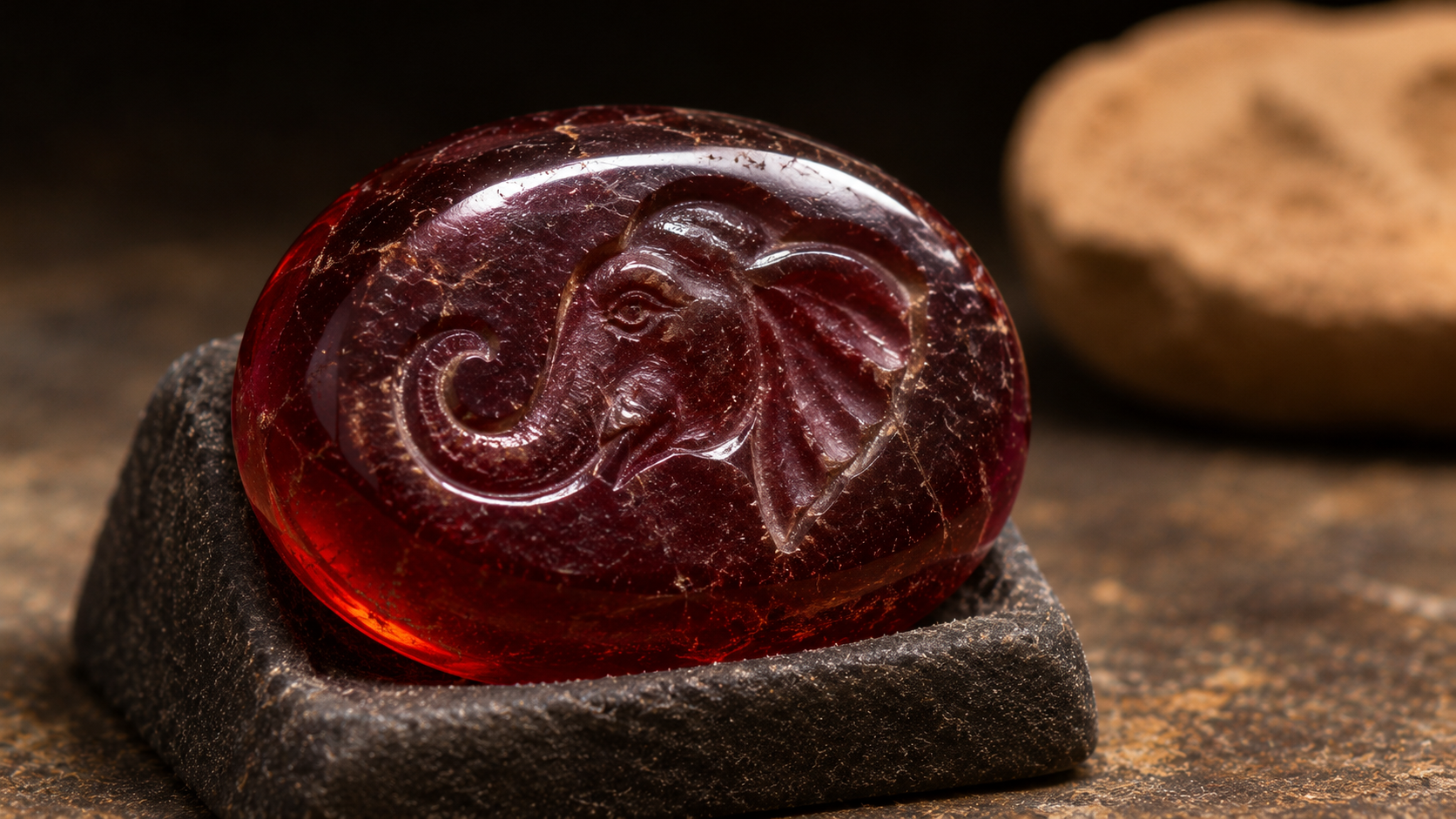
An engraved garnet seal was made to be appreciated in two different forms: as a polished stone held in the hand, and as an impression left in another material. Its deep red colour belonged to the gemstone, while the image it transferred could participate in an act of identification or authorisation. This relationship between a precious object and its reproducible mark makes Sasanian garnet seals particularly revealing examples of historical gemstone use.
During the Sasanian period, conventionally dated to 224–651 CE, stamp seals belonged to a wider culture of administration, ownership and personal representation. Garnet was one of several materials used, and surviving examples allow the subject to be approached through both gemmology and the study of ancient inscriptions and images, including Sasanian garnet seals.
Table of Contents
From Engraved Gemstone to Recognisable Mark
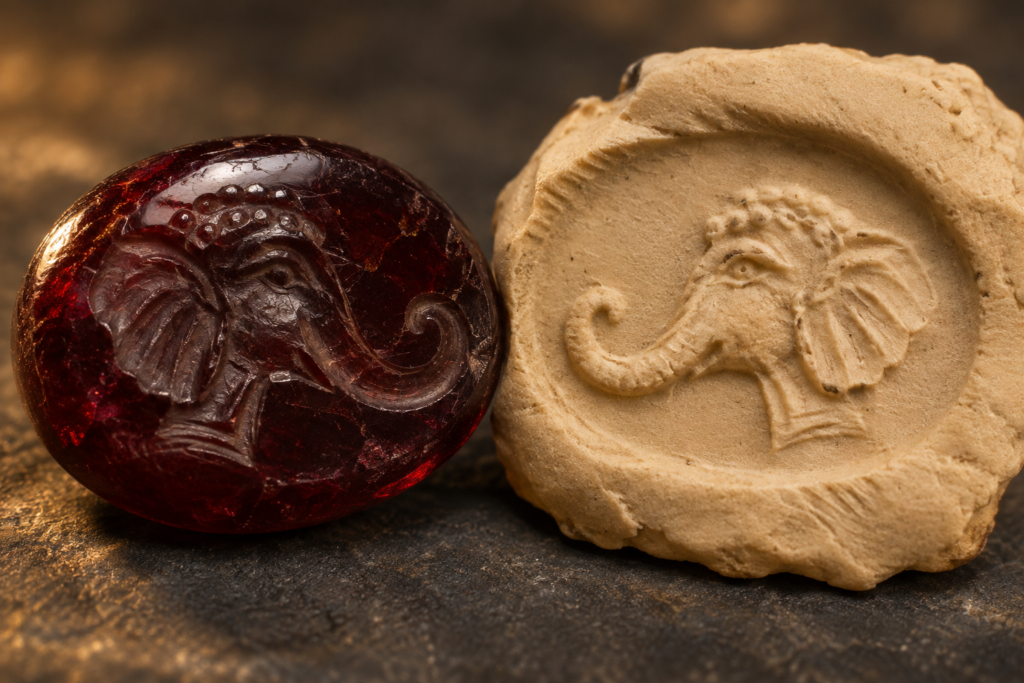
A stamp seal carries its design on a surface that can be pressed into a receptive material. Where the image is engraved below the surrounding surface—a technique known as intaglio—the resulting impression reproduces it in relief and reverses its orientation. The engraved stone and the impression therefore present complementary evidence: one preserves the working surface, while the other reveals the design as it appeared when transferred.
Sasanian sealing practices included impressions on clay bullae associated with documents. As discussed in the Smithsonian’s scholarly account of Sasanian seals, these marks could function in economic transactions, while legal traditions addressed the authority and authenticity of seals. Their importance consequently extended beyond ornament: the impression linked a material object to an action recognised within a social or legal setting.
What Surviving Garnet Seals Establish
Museum records provide direct evidence that garnet formed part of the Sasanian seal repertoire. The Metropolitan Museum of Art catalogues several examples as almandine garnet, including a stamp seal dated approximately to the late third century CE and another assigned to the fourth–fifth century.
A particularly informative object is its fourth-century “Inscribed stamp seal with elephant’s head,” accession number 81.6.278. Catalogued as almandine garnet and attributed to Iran, it measures approximately 1.5 centimetres across its longest recorded dimension. Within that small space, the maker combined an animal motif with an inscription.
These objects establish the use of garnet without implying that every Sasanian seal was made from it. They also show why individual records matter: material, date, dimensions and imagery must be assessed together rather than inferred from the general appearance of a red engraved stone.
The Mineralogy Behind the Red Stone
Garnet is a group of related silicate minerals rather than a single mineral with one fixed composition. Almandine is the iron-rich member with the ideal chemical formula Fe₃Al₂(SiO₄)₃, although natural garnets commonly contain components of more than one garnet end-member. An almandine-rich stone may therefore represent a mixed composition rather than a chemically pure ideal.
Geoscience Australia describes almandine colours ranging from deep red and brownish red to nearly black, with transparency varying from transparent to opaque. This range helps explain why a garnet can appear dark in reflected light while revealing red colour along a thinner, illuminated edge.
The Australian Museum places garnet in the cubic crystal system and gives a general hardness range of approximately 6.5–7.5 on the Mohs scale. Hardness measures resistance to scratching; it does not make a carved stone immune to fracture or damage. For an engraved object, the condition of the surface and the survival of fine details remain important alongside the mineral’s general durability.
Carving an Image That Had to Work
A seal engraver had to produce more than a pleasing miniature composition. The recessed design needed to generate a recognisable impression, which meant controlling the relationship between shallow details, deeper cuts and the surrounding polished surface. A feature that is difficult to read on a dark gemstone may become clearer in its impression, where the relief catches light differently.
Christopher J. Brunner’s catalogue of Sasanian seals in the Metropolitan Museum documents considerable variation in form and imagery, including relatively flat bezels and more rounded seal shapes. Its descriptions also distinguish particular cutting effects, such as drill-produced details in representations of hair. Such observations demonstrate how close examination can connect the visible image with aspects of its manufacture.
They do not, however, justify assigning an identical tool sequence to every object. A reconstruction of workshop practice should follow the marks on the particular seal rather than assume that all engravers worked in precisely the same way.
Images, Inscriptions and Personal Identity
Sasanian seal inscriptions can preserve names, religious expressions or official designations. Encyclopaedia Iranica distinguishes private seals carrying conventional figures or monograms from seals identifying officials and dignitaries, as well as seals of office whose inscriptions refer to an institution or administrative position rather than a named individual.
These differences are historically significant because an image alone may not reveal the capacity in which a seal was used. An inscription can connect the object to a person or office, although its reading may require specialist knowledge of Middle Persian writing and the conventions of seal engraving.
Portrait-like imagery also needs careful treatment. The Smithsonian notes that male busts were popular on Sasanian seals, but questions whether such representations necessarily conveyed an individual’s actual appearance, even when a name survives. A bust might have served as a conventional image of identity or status rather than a likeness in the modern sense.
Authority Was Expressed Through Use
The relationship between seals and power becomes clearest when attention shifts from the gemstone to the act of sealing. Negin Miri’s study of Sasanian administration emphasises the role of stamp seals and clay bullae in official documentation, including the activities of civil and military administrators.
This provides a framework for understanding how a small object could operate within a much larger administrative system. The significance lay partly in the recognised connection between the mark, its authorised user and the document or transaction concerned.
Nevertheless, participation in sealing practices was not confined to kings. Smithsonian collection scholarship identifies seal owners among officials, priests and wealthy property holders, while also noting ownership in lower social strata. A finely engraved garnet should therefore not automatically be described as royal, nor should its material alone be used to assign its owner a specific rank.
What Material Identification Cannot Tell Us Alone
Describing an object as almandine garnet answers a mineralogical question, but it does not by itself identify the ancient mine, workshop or owner. The distinction follows from the nature of the evidence: a mineral name describes the material, whereas provenance concerns its geographical and historical path.
Likewise, a museum attribution such as “Iran or Mesopotamia” should not be transformed into a statement about the geological source of the rough stone. The place where an object was made or used and the place where its raw material originated are separate questions.
A scientifically careful account therefore brings different kinds of evidence together while preserving their limits. Mineralogical description concerns the stone; tool marks concern manufacture; imagery and inscriptions concern representation; and archaeological context may connect the object with a particular setting of use.
A Gemstone With a Practical Voice
Sasanian garnet seals occupy a compelling intersection between material beauty and practical communication. Their red colour and polished surfaces made them distinctive possessions, while their engraved faces allowed an image to be repeated beyond the stone itself.
For Natural Gems Belgium, their importance lies in this combination of measurable material properties and historically documented use. A garnet could become more than a worked gemstone: through engraving and recognised sealing practices, it could help make identity and authority visible.
References & Further Reading
Brunner, C. J. (1978). Sasanian Stamp Seals in The Metropolitan Museum of Art. New York: The Metropolitan Museum of Art.
A scholarly museum catalogue documenting materials, forms, imagery and inscriptions. The complete publication is available online.
https://resources.metmuseum.org/resources/metpublications/pdf/Sasanian_Stamp_Seals_in_The_Metropolitan_Museum_of_Art.pdf
Daryaee, T., and Gholami, K. “Sasanian Seals and Bullae at the Freer Gallery of Art and Arthur M. Sackler Gallery.” Smithsonian Institution.
A scholarly museum essay discussing sealing practices, transactions and the historical and legal significance of seals.
https://publications.asia.si.edu/seals/sasanian-seals-bullae-at-fsg.php
Miri, N. (2013). “Sasanian Administration and Sealing Practices.” In The Oxford Handbook of Ancient Iran, pp. 909–919. Oxford University Press.
Academic discussion of seals, bullae and civil and military administration. The abstract is publicly accessible; full-text access may require an institution.
https://doi.org/10.1093/oxfordhb/9780199733309.013.0001
The Metropolitan Museum of Art. “Inscribed stamp seal with elephant’s head.” Sasanian, approximately fourth century CE. Accession 81.6.278.
An individually documented seal catalogued as almandine garnet.
https://www.metmuseum.org/art/collection/search/321574
The Metropolitan Museum of Art. “Stamp seal.” Sasanian, approximately late third century CE. Accession 74.51.4425.
Museum documentation of an almandine garnet seal attributed to Iran or Mesopotamia.
https://www.metmuseum.org/art/collection/search/321503
The Metropolitan Museum of Art. “Stamp seal.” Sasanian, approximately fourth–fifth century CE. Accession 81.6.272.
A further documented example of almandine garnet within the Sasanian seal tradition.
https://www.metmuseum.org/art/collection/search/321568
Smithsonian National Museum of Asian Art. “Stamp seal.” Accession F1993.15.3.
A comparative carnelian example with curatorial discussion of seal ownership and the interpretation of male busts. This object is not garnet.
https://asia.si.edu/explore-art-culture/collections/search/edanmdm:fsg_F1993.15.3/
Encyclopaedia Iranica. “Epigraphy i. Old Persian and Middle Iranian Epigraphy.”
Scholarly reference material discussing names, religious expressions, official titles and institutional inscriptions on Sasanian seals.
https://www.iranicaonline.org/articles/epigraphy-i/
Geoscience Australia. “Garnet.”
Government geoscience information covering garnet compositions, almandine chemistry, colour and physical properties.
https://www.ga.gov.au/education/minerals-energy/australian-mineral-facts/garnet
Australian Museum. “Garnet.”
Museum mineralogical information explaining garnet’s crystal system, physical properties and compositional relationships.
https://australian.museum/learn/minerals/gemstones/garnet/
[…] Metropolitan Museum of Art documents numerous Frankish brooches decorated with garnets during the sixth […]