Table of Contents
A Sacred Image Carved into a Small Stone
Imagine a person living in the Sasanian Empire approximately 1,600 years ago.
Suspended from a cord around the neck is a small, polished gemstone.
Its colour is a subdued reddish brown.
Its surface is smooth, with a gently rounded back and a carefully engraved design.
The carving is almost miniature in scale.
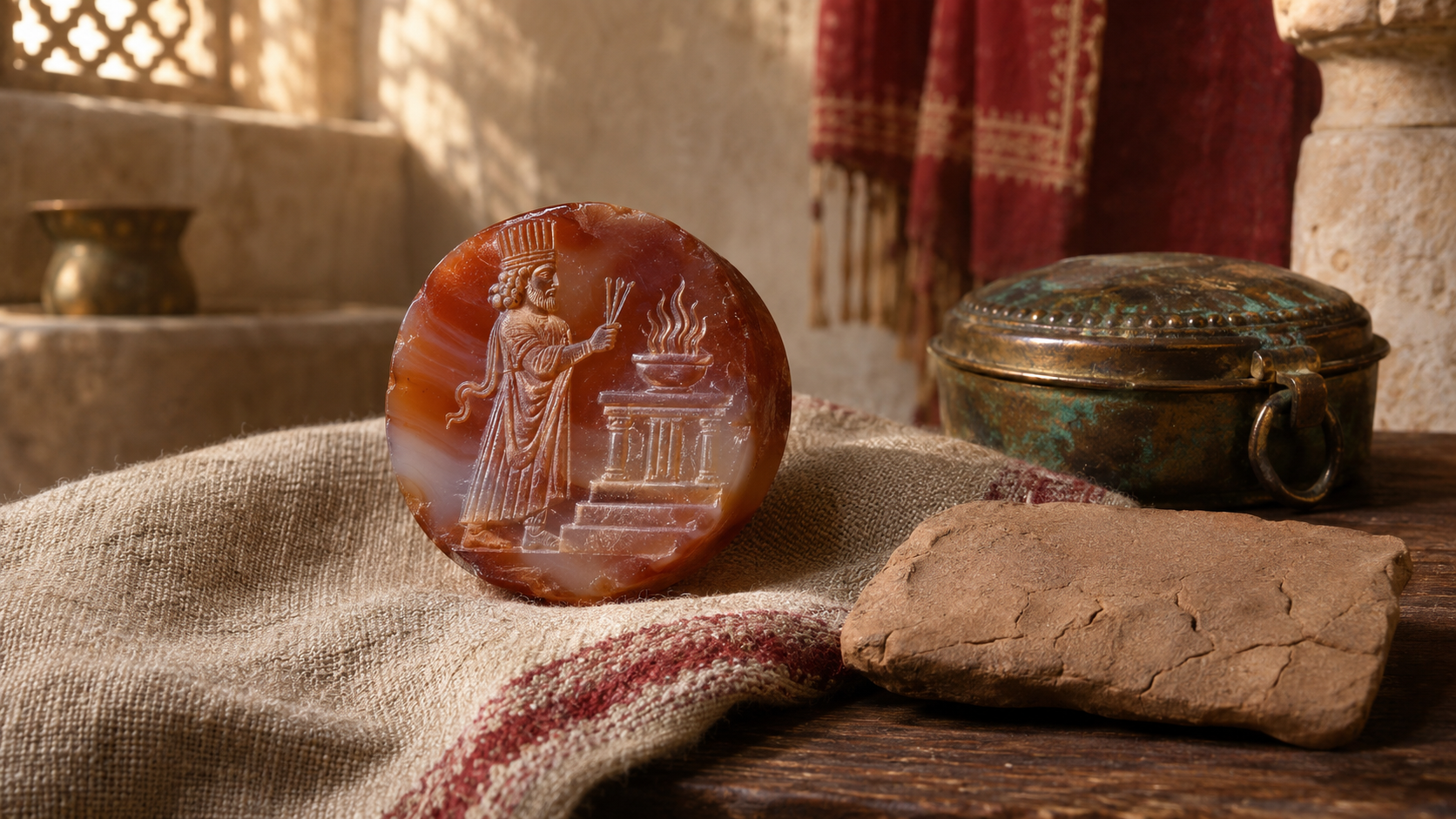
At its centre stands an altar associated with sacred fire.
Nearby are figures drawn from the natural world.
The stone can be worn, handled and pressed into a soft material to leave an impression.
It is both a practical object and a bearer of meaningful imagery.
Such a gemstone survives today in the Cleveland Museum of Art.
Dating to approximately 400 CE, the object is made from chalcedony and carries an engraving interpreted as a Zoroastrian fire altar.
Its design also incorporates a bird, fish and a star.
A perforation through the stone indicates that it could once have been suspended from a cord.
The object provides an extraordinary introduction to the world of Sasanian gemstone seals.
Sasanian agate seals were not only practical tools but also carried deep cultural and spiritual significance.
These small stones combined skilled craftsmanship, personal identification, social status and, in some cases, religious symbolism.
They also demonstrate why the history of gemstones cannot be understood solely through colour, rarity or commercial value.
In Sasanian Persia, a gemstone could function simultaneously as an administrative instrument, a personal possession and a surface upon which religious imagery was preserved, including iconic examples of Sasanian agate seals.
Understanding these objects requires us to examine the civilisation that produced them, the religious traditions represented in their engravings and the natural properties of the stones themselves.
The Sasanian Empire: Persia Before the Islamic Conquests
The Sasanian Empire ruled much of Iran and neighbouring territories from 224 to 651 CE.
It was one of the major political powers of late antiquity.
Its influence extended across regions of western and central Asia.
The empire maintained sophisticated administrative institutions, extensive commercial relationships and a highly developed artistic culture.
Its rulers competed with the Roman and later Byzantine empires.
Royal imagery appeared on coins, metalwork, textiles and monumental reliefs.
Precious and ornamental stones also formed part of this artistic environment.
Sasanian craftsmen produced numerous engraved seals using materials such as agate, chalcedony, sardonyx and other gemstones.
Some seals carried portraits.
Others displayed animals, inscriptions, religious figures or symbolic designs.
These objects belonged to a world in which political authority, religious identity and personal ownership could intersect.
However, Sasanian society was not religiously uniform.
Zoroastrianism held an important position in the empire, particularly in connection with royal institutions.
Christian, Jewish and other religious communities also existed within its territories.
Consequently, not every Sasanian seal should automatically be interpreted as Zoroastrian.
Its imagery and archaeological context must be examined individually.
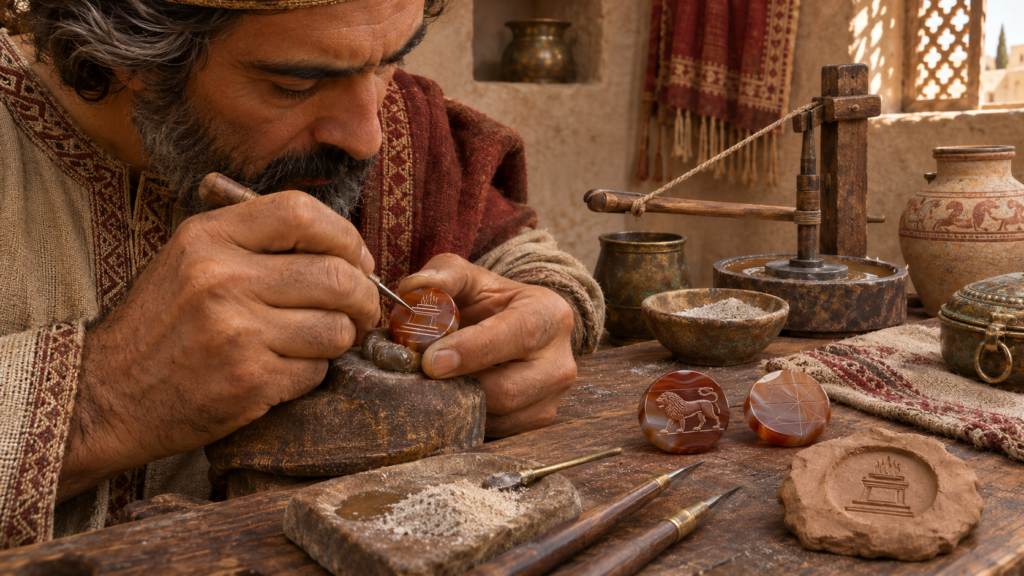
What Was a Sasanian Gemstone Seal?
A seal was an object used to create an identifying impression.
Many Sasanian examples were relatively small and possessed a rounded or domed back.
The engraved surface was usually flatter.
When pressed into suitable sealing material, the carved design produced an impression.
The resulting image could help identify an individual or authenticate an administrative action.
Seals were used in systems of ownership, correspondence and document management.
They could also communicate personal status.
The Metropolitan Museum of Art describes Sasanian stamp seals as marks of ownership and badges of status.
Some were pierced so that they could be suspended and worn.
This detail is especially important.
A seal could accompany its owner throughout daily life.
It was not necessarily stored permanently inside an administrative building.
The same object could be handled during practical transactions and worn as a personal possession.
When its engraving included religious imagery, the distinction between functional and symbolic significance became particularly interesting.
Agate: A Natural Material Suited to Fine Engraving
Agate belongs to the chalcedony family of quartz materials.
It consists predominantly of silica, with the chemical formula SiO₂.
Its internal structure is composed of extremely fine crystalline material.
Agate is especially associated with banding, although the appearance of individual specimens varies considerably.
Its colours may include white, grey, brown, reddish orange and numerous other shades.
Some specimens display sharply contrasting layers.
Others possess subtler variations.
The material has a hardness of approximately 6.5–7 on the Mohs scale.
It can take a fine polish and is suitable for detailed engraving.
These characteristics made it useful for historical seals.
A carefully carved surface could preserve small lines and recognisable forms.
The stone was also durable enough to survive repeated handling.
Its natural colour could contribute to the beauty of the finished object.
The Gemmological Association of Great Britain explains that agate forms through the deposition of very fine quartz material, frequently within cavities in volcanic rocks.
These processes are geological.
They do not involve supernatural forces.
Nevertheless, human societies could assign symbolic meaning to the finished gemstone.
Agate, Chalcedony and Sardonyx: Why the Names Matter
Historical gemstone terminology requires particular care.
Agate is a variety of chalcedony, but the terms are not always interchangeable in modern gemmological descriptions.
Agate is especially associated with banded material.
Chalcedony is the broader term for a family of very fine-grained silica materials.
Sardonyx is a banded variety containing contrasting brownish or reddish and lighter layers.
Carnelian is commonly orange to reddish-brown chalcedony.
These materials share related mineralogical characteristics.
However, their appearances and historical names differ.
Museum catalogues may identify individual Sasanian seals as agate, chalcedony or sardonyx.
Those distinctions should be preserved.
A chalcedony seal should not automatically be described as banded agate merely because both materials belong to the same broader family.
This article examines agate seals within the wider tradition of Sasanian chalcedony engraving.
The Fire Altar: A Powerful Religious Image
One of the most important religious motifs in Sasanian art is the fire altar.
The expression fire altar is widely used in historical scholarship.
However, it requires explanation.
In Zoroastrian contexts, the structure supported a sacred fire.
It was not necessarily an altar upon which an animal or other offering was burned.
Encyclopaedia Iranica notes that the term fire-holder can be more technically accurate.
The fire itself possessed profound religious importance.
Within Zoroastrian tradition, fire is associated with purity, illumination and divine truth.
It occupies a central position in important ritual practices.
Yet describing Zoroastrians simply as people who worship fire is misleading.
The religion is centred upon Ahura Mazda and a wider framework of ethical and religious teachings.
Fire is revered within this framework.
It is not adequately understood as an independent deity worshipped in isolation.
Why Fire Was So Important
Fire possesses several natural characteristics that help explain its symbolic potential.
It produces light.
It generates heat.
It transforms combustible material.
It can be sustained through careful attention.
These are measurable physical properties.
Religious traditions may interpret them through additional symbolic frameworks.
Within Zoroastrianism, fire has been associated with purity and the sacred order of creation.
Its maintenance became an important aspect of religious practice.
The significance of fire also appeared in royal imagery.
Sasanian coins frequently displayed fire-holders.
Their presence connected political authority with religious and dynastic representation.
The image was therefore recognisable far beyond the interior of a ritual space.
It could appear on objects used in commerce and administration.
Gemstone seals were one of the surfaces upon which this imagery was reproduced.
A Remarkable Chalcedony Seal in Cleveland
The Cleveland Museum of Art preserves a particularly informative example.
The object is catalogued as Fire Altar Intaglio.
It dates to approximately 400 CE and belongs to the Sasanian cultural sphere.
The gemstone measures approximately 2.4 × 2 × 1.7 centimetres.
Its material is identified as chalcedony.
The engraved design includes a Zoroastrian fire altar consisting of a pedestal, a pillar and a bowl associated with the sacred flame.
A bird appears above the altar.
Fish are positioned near its base.
A star is carved on the reverse.
The gemstone also possesses a perforation, suggesting that it could have been suspended from a cord.
These details are important because they are documented features of an actual surviving object.
They allow the relationship between gemstone, image and personal use to be examined without relying upon modern crystal folklore.
The Bird, the Fish and the Star
The combination of animals and celestial imagery on the Cleveland seal invites interpretation.
A bird occupies a prominent position.
Fish appear near the altar.
A star is present on the reverse.
It would be tempting to assign a fixed supernatural meaning to every figure.
The bird might be described as representing the soul.
The fish might be interpreted as symbols of fertility.
The star might be claimed to provide cosmic protection.
However, these explanations would go beyond what the object alone establishes.
The Cleveland Museum notes that birds and fish also occur in Christian iconography.
This observation is particularly valuable.
Similar motifs can appear in different religious traditions.
Their meanings are not necessarily identical.
The presence of a Zoroastrian fire altar supports a religious interpretation of the central design.
The precise significance of the accompanying animals remains less certain.
Could the Seal Have Been an Amulet?
The Cleveland gemstone contains a hole suggesting suspension.
This indicates that it could have been worn.
But an object worn around the neck is not automatically a magical amulet.
It may have served as a personal seal.
It may have displayed religious affiliation.
It may have been valued as an ornament.
Its owner could also have attributed protective significance to its imagery.
These possibilities are not mutually exclusive.
However, only some can be established directly from the surviving evidence.
The perforation demonstrates a practical method of carrying the object.
The engraving demonstrates the presence of religious imagery.
Neither feature independently proves that the stone was believed to emit protective energy.
The distinction between documented use and inferred belief is essential.
The Agate Seal with a Ritual Figure
Another important object survives in the Smithsonian’s National Museum of Asian Art.
The Freer Gallery of Art collection contains a Sasanian agate stamp seal catalogued under accession number F1993.18.22.
The seal originated in Iran and belongs to the Sasanian period, approximately 224–651 CE.
Its engraved design depicts a standing male figure.
He wears a long coat.
He holds a barsom, a ritual bundle of sticks.
The figure stands before a fire altar.
This object provides unusually direct evidence of religious imagery engraved onto agate.
Rather than displaying only an isolated symbol, it presents a human figure associated with a recognisable ritual implement.
The seal is therefore especially valuable for understanding the relationship between gemstone engraving and Zoroastrian religious practice.
What Is a Barsom?
The barsom is a traditional implement used in Zoroastrian ritual.
The term derives from an older Avestan expression, barəsman.
Historically, the barsom consisted of sacred twigs.
Later practices also employed metal wires.
Its preparation and use were governed by ritual conventions.
The number of elements could vary according to the ceremony.
Encyclopaedia Iranica documents its role in Zoroastrian liturgy, including the Yasna.
The barsom therefore provides a meaningful clue when it appears in historical art.
On the Smithsonian agate seal, the figure’s possession of the bundle supports an interpretation involving Zoroastrian religious practice.
However, the image should not be treated as a complete documentary record of a particular ceremony.
A miniature engraving simplifies reality.
It may present an idealised or conventional religious scene.
The Relationship Between Sacred Fire and the Gemstone
The Smithsonian seal brings together two different natural materials and their cultural uses.
Agate originates through geological processes.
Fire results from combustion.
Both possess scientifically explainable physical characteristics.
Yet the Sasanian artisan used one to represent the other.
A stone formed over geological time became the surface for an image of sacred fire.
The resulting object connected a durable material with a religious symbol.
This relationship is significant.
The gemstone did not need to possess supernatural properties for the engraving to have spiritual meaning.
The religious significance could reside primarily in the image.
The material made that image portable, durable and personally accessible.
This distinction is often overlooked in modern discussions of historical gemstone spirituality.
Gemstones as Personal Identity
Sasanian seals frequently contained more than religious images.
Some displayed inscriptions in Middle Persian written in Pahlavi script.
Others depicted animals, portraits or identifying symbols.
The Metropolitan Museum of Art preserves a banded agate stamp seal bearing a Pahlavi inscription.
The object is dated broadly to the third through seventh centuries CE.
It measures approximately two centimetres in height and 2.4 centimetres in diameter.
Its material is specifically identified as banded agate.
The presence of an inscription demonstrates that a gemstone could function as a medium for written identity.
A seal could identify an owner or communicate a meaningful formula.
However, the presence of writing does not automatically make the inscription religious.
Its content must be examined before its function can be interpreted.
A Signature That Could Be Carried
The practical role of seals helps explain their importance.
In an administrative system, the ability to identify or authenticate a document could be essential.
An engraved gemstone supplied a distinctive image.
The impression left in clay or another suitable material could associate an action with a particular person or authority.
The seal could also communicate social position.
Some individuals may have possessed more elaborate or valuable examples than others.
The Metropolitan Museum’s excavations at Qasr-i Abu Nasr, near Shiraz, recovered seals from a site with significant late Sasanian occupation.
The museum interprets such objects within the administrative and defensive activities of the settlement.
This archaeological context demonstrates that gemstone seals were part of functioning institutions.
They were not merely decorative objects or mysterious charms.
The Lion: Strength, Authority and Representation
Animals were prominent subjects in Sasanian seal engraving.
The Smithsonian preserves an agate stamp seal depicting a striding lion with a Pahlavi inscription above it.
Another seal in the same collection, made from chalcedony, depicts a reclining lion.
The museum notes that lions appear frequently on Sasanian seals.
The lion was a powerful image within Iranian artistic and literary traditions.
It could evoke strength and martial prowess.
However, animal symbolism should not be reduced to a universal list of spiritual properties.
A lion on one seal may communicate status or identity.
Another representation may participate in a particular religious or literary tradition.
The surviving image does not always reveal which interpretation its original owner intended.
The Lion and Later Persian Literature
The Smithsonian discusses lion imagery partly in relation to the Shahnameh, the Persian Book of Kings.
In that literary tradition, the lion can function as an image of a great warrior.
This comparison is informative.
But chronology matters.
The Shahnameh was composed in its celebrated form by Ferdowsi around the turn of the eleventh century, after the Sasanian Empire had ended.
It preserves and reworks older Iranian traditions.
It is therefore useful for understanding the long history of Iranian symbolic imagery.
It should not be treated as a direct contemporary explanation of every Sasanian seal.
The lion’s association with strength is plausible within the broader cultural setting.
Its precise meaning on an individual gemstone remains dependent upon context.
Were All Sasanian Seals Religious?
No.
The surviving objects display considerable variation.
Some contain recognisable religious imagery.
Others show animals, portraits, monograms or inscriptions.
Certain motifs may have had multiple meanings.
A fire altar can be strongly associated with Zoroastrian religious practice.
A portrait may identify an important individual.
An animal may communicate social identity or another symbolic association.
A monogram may serve an administrative function.
The presence of a precious material does not automatically transform every image into a spiritual symbol.
This diversity is one of the most important lessons of Sasanian glyptic art—the art of engraving gems and seals.
It demonstrates how gemstone use extended across different aspects of society.
Fire Altars on Coins and Seals
Sasanian fire imagery was not confined to gemstones.
Fire-holders appeared prominently on royal coinage.
Encyclopaedia Iranica documents the importance of these representations.
The structures commonly possess stepped bases and upper sections.
Flames may appear above the central support.
Royal figures or attendants sometimes accompany the altar.
These images connected sacred fire with royal representation.
The seal engravings belong to a broader artistic vocabulary.
Their imagery could be understood by people familiar with coins and other official objects.
This helps explain how a small gemstone could communicate a complex religious or political idea through a relatively simple design.
The Three Great Sacred Fires
Zoroastrian tradition preserves accounts of several especially important sacred fires.
Among the best known are Ādur Farnbāg, Ādur Gušnasp and Ādur Burzēn-Mihr.
These fires acquired major significance in Iranian religious history.
They were associated with particular regions and traditions.
However, their precise founding dates and early histories are not always securely established.
Encyclopaedia Iranica emphasises the complexity of the surviving evidence.
It would therefore be misleading to identify the fire depicted on an ordinary Sasanian seal as one specific sacred fire without supporting evidence.
The image may represent a general religious symbol.
It may relate to a particular cultic tradition.
Or it may participate in royal imagery.
The exact identification cannot always be recovered.
The Importance of Religious Diversity
The Sasanian Empire included communities with different religious identities.
Zoroastrianism was influential, particularly in royal and institutional contexts.
Christianity also developed significant communities within the empire.
Jewish communities had longstanding histories in Mesopotamia and neighbouring regions.
Other religious traditions were present as well.
The Cleveland Museum’s observation that birds and fish also occur in Christian imagery is a useful reminder of this diversity.
An image must be interpreted within its complete context.
One symbol cannot always be assigned exclusively to one religion.
The study of Sasanian gemstones therefore benefits from religious history as much as from gemmology.
Why Agate Was an Effective Material for Seals
The physical properties of agate made it particularly useful for engraving.
Its fine-grained structure allows detailed carving.
Its hardness helps preserve the engraved design.
Its ability to take a smooth polish enhances its visual appeal.
The stone can also be produced in relatively small, portable forms.
These characteristics suited the requirements of a personal seal.
The engraver needed a surface capable of preserving small lines.
The owner needed an object that could survive repeated use.
Agate provided a useful combination of durability and workability.
These properties can be explained through mineralogy and materials science.
They do not require a supernatural explanation.
The Art of Cutting a Miniature Image
Producing an engraved seal required specialised craftsmanship.
The artisan had to prepare the stone.
Its shape and polished surfaces were established before or during engraving.
A design was then cut into the material.
Because an intaglio produces a reversed impression, the engraver had to consider how the image would appear when stamped.
This could be particularly important for inscriptions.
A small error might affect the readability of the resulting impression.
The finest examples demonstrate considerable technical skill.
Human figures, animals and architectural forms could be rendered within an area only a few centimetres wide.
The craftsmanship itself contributed to the object’s value.
A Gemstone Between the Visible and the Invisible
The spiritual interest of these seals lies partly in the relationship between the object and the idea it represented.
The stone was visible and tangible.
Its engraving could be examined.
Its impression could be reproduced.
But the religious concepts associated with the image belonged to a different category.
Sacred fire, divine truth and ritual purity were understood within religious frameworks.
The gemstone supplied a physical medium for expressing those ideas.
This distinction allows us to appreciate the object without confusing religious symbolism with measurable mineral properties.
The stone did not need to possess a scientifically detectable spiritual energy field to become culturally meaningful.
Did Sasanian Agates Offer Protection?
Some historical gemstone traditions included protective or amuletic beliefs.
However, the surviving Sasanian seals discussed here should not automatically be classified as magical protection devices.
Their documented functions include identification, ownership and the representation of meaningful imagery.
Some could be worn.
Some displayed religious symbols.
It is possible that particular owners understood their seals as spiritually significant or protective.
But a specific claim of protection requires evidence from inscriptions, historical texts or archaeological context.
The existence of a fire altar engraving alone does not establish that the agate prevented illness, repelled evil or altered events through supernatural power.
The distinction is essential for responsible historical interpretation.
Modern Agate Spirituality and Ancient Persian Belief
Modern crystal-healing literature often associates agate with emotional stability, grounding, balance and protection.
These interpretations may be meaningful within contemporary spiritual practices.
However, they should not be presented as documented Sasanian teachings.
The historical evidence discussed here concerns engraved seals, personal identity, religious imagery and ritual representation.
Modern chakra systems and gemstone-energy descriptions belong to different historical developments.
It is therefore inaccurate to claim that Sasanian seal engravers selected agate because it balanced a particular chakra.
No such conclusion follows from the surviving objects.
The ancient material culture is sufficiently fascinating without importing unsupported modern explanations.
Does Agate Possess Scientifically Proven Spiritual Powers?
Agate has measurable physical properties.
Its chemical composition can be analysed.
Its hardness can be tested.
Its microstructure can be studied.
Its optical behaviour can be examined.
Its geological formation can be investigated.
These are scientifically established areas of inquiry.
By contrast, there is no established scientific evidence that agate independently produces supernatural protection, balances chakras, alters personal destiny or cures medical conditions through an invisible spiritual energy.
The historical use of agate in religiously meaningful objects does not demonstrate such effects.
A gemstone can carry symbolism without possessing a supernatural physical mechanism.
The Difference Between a Sacred Image and a Sacred Mineral
This distinction is particularly important in the study of Sasanian seals.
A fire altar engraving can represent a religious concept.
The material carrying that engraving can be ordinary chalcedony or agate.
The religious significance may belong primarily to the depicted subject.
The stone provides the physical support.
Of course, its beauty and durability may also contribute to the object’s prestige.
But the meaning of the image should not automatically be transferred into a claim about the mineral’s inherent powers.
The same material could carry a religious scene, an animal or a personal inscription.
Its function changed with the engraving and the circumstances of use.
What Surviving Objects Tell Us
The archaeological and museum evidence allows several conclusions.
Sasanian craftsmen produced engraved seals from agate, chalcedony and related gemstones.
These objects could function as personal identifiers and administrative instruments.
Some were perforated for suspension.
Religious imagery appeared on certain seals.
The Cleveland Museum preserves a chalcedony seal with a Zoroastrian fire altar, bird, fish and star.
The Smithsonian preserves an agate seal showing a figure holding a barsom before a fire altar.
Other agate seals contain Pahlavi inscriptions, animals and personal motifs.
Fire altar imagery also appeared on Sasanian coinage.
The use of agate was supported by its physical suitability for engraving.
The precise personal beliefs of individual seal owners cannot always be reconstructed.
No established scientific evidence demonstrates supernatural healing or protective effects from the mineral itself.
Why These Gemstones Matter Today
The Sasanian seals reveal a form of gemstone appreciation that differs from modern jewellery culture.
Their value was not determined only by size or brilliance.
The engraving mattered.
The owner’s identity mattered.
The ability to authenticate an action mattered.
The religious or cultural meaning of the image could matter.
A relatively small agate might therefore become an important personal possession.
It could accompany its owner and communicate information through repeated impressions.
When religious imagery was present, the object could also express a connection with a wider symbolic tradition.
The gemstone’s significance emerged from the relationship between natural material, craftsmanship and human society.
Conclusion: When Stone Became a Carrier of Sacred Meaning
The agate seals of Sasanian Persia provide a remarkable example of the relationship between gemstones and religious culture.
Their story begins with geological processes that produced durable silica materials.
Craftsmen transformed these stones into small, carefully shaped objects.
Engravers created images of people, animals, inscriptions and religious symbols.
Some seals depicted sacred fire.
Others showed ritual implements such as the barsom.
Their owners could use them to identify themselves or authenticate transactions.
Some were worn as personal possessions.
Together, these objects reveal a society in which artistic craftsmanship, administration, religious identity and personal expression could intersect.
The historical evidence does not establish that every seal was an amulet.
Nor does it demonstrate that agate possessed supernatural powers.
Its spiritual significance was often connected with the imagery engraved upon it and the cultural traditions in which it was used.
The importance of Sasanian agate seals lies not in scientifically proven gemstone energy, but in the extraordinary way a small natural stone could preserve personal identity, religious symbolism and the artistic achievements of an ancient civilisation.
For Natural Gems Belgium, these objects illustrate why gemstone education should include more than mineralogical classification.
The physical properties of a gemstone explain what it is.
Its historical context helps explain what people made of it.
And its symbolism reveals how human societies transformed natural materials into objects of lasting cultural significance.
References & Further Reading
1. Cleveland Museum of Art – Fire Altar Intaglio
https://www.clevelandart.org/art/1954.593
Source description: Official museum catalogue for a Sasanian chalcedony seal dating to approximately 400 CE. Documents the Zoroastrian fire altar, bird, fish, star and suspension hole. A principal archaeological object for this article.
2. Smithsonian National Museum of Asian Art – Sasanian Agate Seal with Ritual Figure
https://asia-archive.si.edu/object/F1993.18.22
Source description: Official Freer Gallery of Art collection record for an agate seal depicting a standing male figure holding a barsom before a fire altar. Provides direct evidence of Zoroastrian ritual imagery engraved into a gemstone.
3. Metropolitan Museum of Art – Banded Agate Stamp Seal with Pahlavi Inscription
https://www.metmuseum.org/art/collection/search/327722
Source description: Official collection record for a Sasanian banded agate seal bearing a Pahlavi inscription. Documents the object’s material, dimensions, date and cultural attribution.
4. Metropolitan Museum of Art – Sasanian Banded Agate Stamp Seal
https://www.metmuseum.org/art/collection/search/322150
Source description: Museum catalogue for another banded agate seal from Iran or Mesopotamia, dating to approximately the third through seventh centuries CE. Demonstrates the variety of agate objects used within Sasanian material culture.
5. Smithsonian National Museum of Asian Art – Agate Seal with Lion and Pahlavi Inscription
https://asia-archive.si.edu/object/F1993.15.8
Source description: Official Freer Gallery collection record documenting a Sasanian agate seal with a striding lion and Pahlavi inscription. Provides evidence of animal imagery and written identification on gemstone seals.
6. Smithsonian National Museum of Asian Art – Chalcedony Seal with Lion
https://asia-archive.si.edu/object/F1999.6.57
Source description: Detailed museum record for a Sasanian chalcedony seal depicting a lion. Includes historical discussion of lion imagery, archaeological sealings and the wider Iranian literary tradition.
7. Encyclopaedia Iranica – Fire Altars
Source description: Scholarly article by Mark B. Garrison examining the archaeological evidence, terminology, religious significance and representation of fire altars in ancient Iranian traditions, including Sasanian seals and coinage.
8. Encyclopaedia Iranica – Ātašdān: Fire-Holder
Source description: Academic reference explaining the construction and representation of Iranian fire-holders, particularly those appearing on Sasanian royal coins, seals and reliefs.
9. Encyclopaedia Iranica – Barsom
Source description: Scholarly study by Maneck Fardoonji Kanga explaining the barsom as a Zoroastrian ritual implement, including its historical forms, ceremonial use and religious importance.
10. Metropolitan Museum of Art – Sasanian Stamp Seal from Qasr-i Abu Nasr
https://www.metmuseum.org/art/collection/search/323224
Source description: Archaeologically contextualised museum record explaining how Sasanian seals functioned as marks of ownership and status. Discusses excavations at Qasr-i Abu Nasr near Shiraz and the settlement’s administrative activities. The specific seal is catalogued as possibly hematite, rather than agate.
11. Gemmological Association of Great Britain – Chalcedony: Agate, Quartz & Jasper
https://gem-a.com/gem-hub/different-types-of-chalcedony
Source description: Professional gemmological article by Pat Daly FGA DGA explaining chalcedony varieties, agate formation, banding, microcrystalline structure and the distinctions between agate, carnelian, sardonyx and other related materials.
12. Gemological Institute of America – Structures Behind the Spectacle: A Review of Optical Effects in Phenomenal Gemstones and Their Underlying Nanotextures
https://www.gia.edu/gems-gemology/summer-2025-phenomenal-gemstones
Source description: Peer-reviewed scientific review published in Gems & Gemology in 2025. Includes detailed mineralogical discussion of agate’s silica microstructure, quartz and moganite components, banding and optical characteristics.
Historical, Religious and Scientific Distinctions
Scientifically established: Agate is a variety of chalcedony composed predominantly of very fine-grained silica.
Scientifically established: Its physical properties, including hardness, microstructure and optical behaviour, can be measured.
Historically documented: Sasanian craftsmen produced engraved gemstone seals from agate, chalcedony and other materials.
Historically documented: Seals served administrative functions, including identification and marks of ownership.
Historically documented: Certain seals were pierced for suspension and could be worn.
Religiously documented: Fire held an important position in Zoroastrian ritual and symbolism.
Archaeologically documented: Sasanian gemstone seals include images of fire altars and figures holding ritual implements.
Historically documented: Some seals contain Pahlavi inscriptions, animal imagery and personal motifs.
Historical uncertainty: The precise spiritual intentions of individual seal owners cannot always be reconstructed.
Modern metaphysical belief: Contemporary crystal traditions may associate agate with grounding, emotional stability or protection.
Scientific limitation: There is no established scientific evidence that agate produces supernatural protection, balances chakras or independently cures medical conditions.
The Sasanian agate seal illustrates how a natural gemstone can become culturally and spiritually meaningful through human craftsmanship and symbolic imagery.
Its mineralogical properties belong to science.
Its historical use belongs to archaeology.
Its religious imagery belongs to the study of ancient Iranian traditions.
Its supposed supernatural powers remain matters of belief rather than scientifically demonstrated fact.