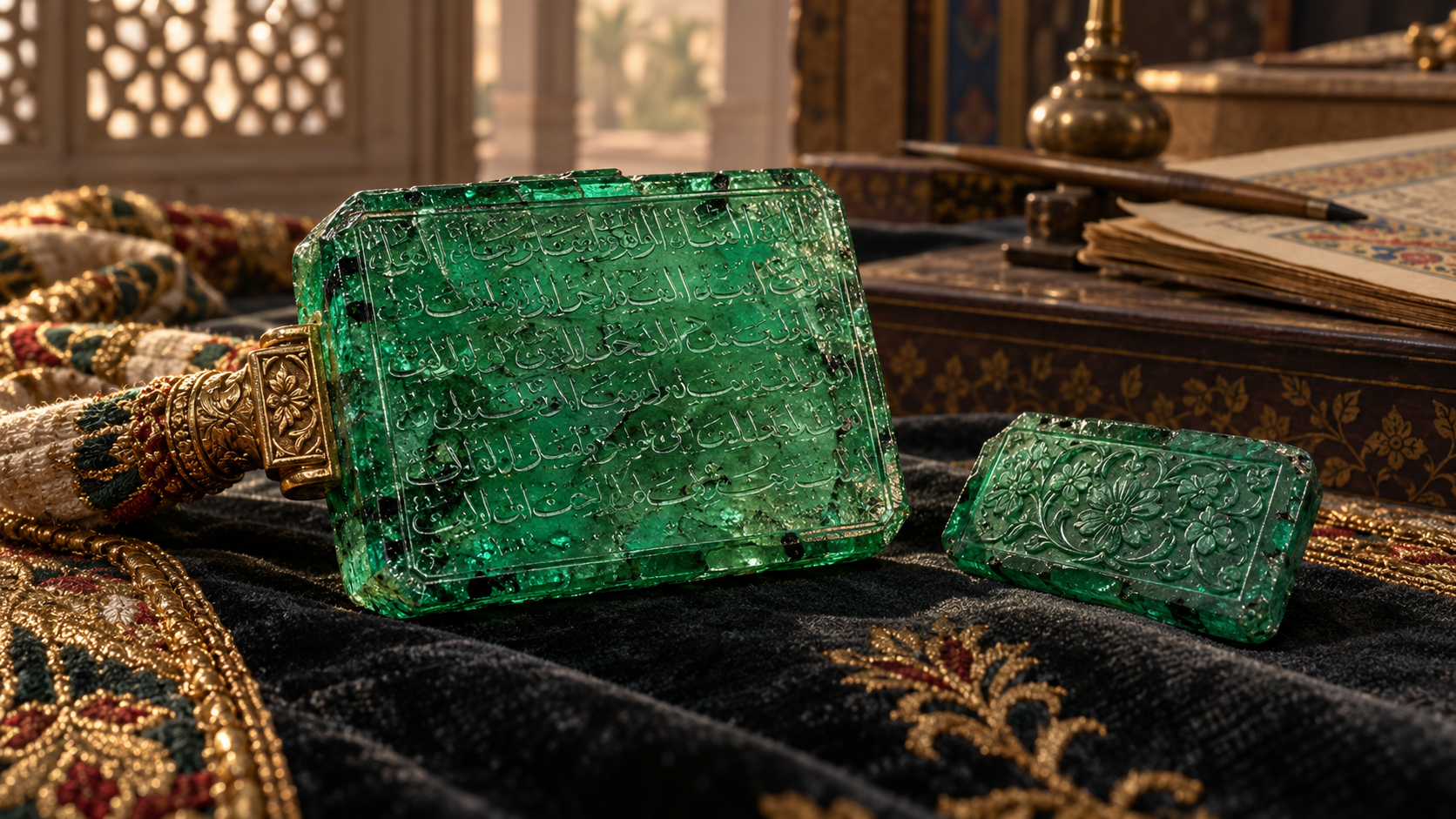
A deep green emerald rests in an imperial workshop in India.
The year is somewhere around the seventeenth century.
The stone itself, however, has already travelled farther than almost anyone who will ever touch it.
It formed millions of years earlier in the mountains of what is now Colombia.
It was extracted from the earth in South America.
European expansion opened new commercial routes across the Atlantic.
The emerald travelled through international trading networks.
Eventually it reached India, where Mughal patrons valued exceptional gems with extraordinary enthusiasm.
The story of these precious stones brings us to the intricate world of emeralds in Mughal India.
There, an artisan might polish it.
Carve a flower into it.
Pierce it for suspension.
Or cover one of its broad surfaces with minute Arabic calligraphy.
Some surviving Mughal emeralds carry Qur’anic passages, prayers or pious formulas.
Others carry flowers.
Some combine precious stones with gold, jade, rubies and diamonds.
A few were apparently intended to be worn on the body.
This is where gemstone history becomes particularly fascinating.
The emerald was simultaneously:
a geological object,
an international commodity,
an imperial luxury,
a surface for artistic carving,
and sometimes a carrier of sacred words.
Modern crystal traditions often describe emerald as a stone of love, emotional healing, prosperity or the Heart Chakra.
Mughal emerald culture offers something historically different.
Here, spiritual meaning could emerge not merely from the identity of the stone but from the relationship between material, inscription, prayer, craftsmanship and bodily use.
Understanding that distinction takes us into one of the most sophisticated gemstone cultures of the early modern world.
Table of Contents
First: What Is Emerald?
Emerald is the intensely green gem variety of the mineral beryl.
Beryl has the chemical formula:
Be₃Al₂Si₆O₁₈
Pure beryl is colourless.
Emerald acquires its characteristic green colour principally through trace amounts of chromium and/or vanadium substituting within its crystal structure.
Not every green beryl is necessarily classified as emerald; colour saturation and gemmological convention matter.
Emerald commonly contains inclusions.
Indeed, inclusions are so characteristic of many natural emeralds that gem dealers have long used the French term jardin, meaning “garden,” for their internal appearance.
These inclusions do not automatically indicate poor quality.
They can form part of the natural geological identity of the stone.
A Gemstone with a Geological Passport
Modern gemmology can sometimes use an emerald’s inclusions and chemical characteristics to investigate its geographic origin.
This is particularly important when studying historical emeralds.
Before the sixteenth century, important emerald sources were known in the Old World.
But after the Spanish conquest of territories in South America, exceptionally rich Colombian deposits entered global commercial networks on an unprecedented scale.
The consequences reached astonishingly far.
Colombian emeralds crossed the Atlantic.
Then crossed cultural and political boundaries.
Eventually, substantial quantities reached the courts of India.
The Mughal fascination with emerald was therefore partly made possible by the first age of truly global intercontinental commerce.
The Mughals
The Mughal dynasty established itself in northern India in the early sixteenth century.
Its rulers developed one of the most powerful and artistically productive imperial courts of the early modern world.
Under emperors such as:
Akbar,
Jahangir,
and Shah Jahan,
court culture combined influences from Central Asia, Persia and the Indian subcontinent while developing highly distinctive artistic languages of its own.
Painting flourished.
Architecture reached extraordinary levels of refinement.
Textiles, metalwork, jade carving and jewellery became vehicles for imperial display.
Gemstones occupied an especially important place within this world.
An Imperial Love of Gems
Mughal rulers accumulated precious stones on an enormous scale.
Diamonds.
Rubies.
Spinels.
Pearls.
Emeralds.
These materials were not merely decorative.
Precious stones could communicate wealth, legitimacy, rank, diplomatic connection and imperial magnificence.
Some were mounted in jewellery.
Some decorated weapons.
Some were carved into vessels.
Others were inscribed.
The imperial body itself became a surface on which political power could be displayed through gemstones.
Portraits of Mughal rulers frequently show elaborate necklaces, turban ornaments, armlets and weapons covered with precious materials.
A gem at court therefore existed within a political language.
The Emerald Arrives from Another World
The emeralds particularly admired by the Mughals often came from Colombia.
The Metropolitan Museum of Art notes that emeralds were favourite gemstones of Mughal emperors and that Colombian material entered India through Portuguese-controlled Goa.
This is one of the most remarkable geographical journeys in gemstone history.
Consider the route conceptually:
Colombia → Atlantic world → European maritime networks → Indian Ocean → Goa → Mughal India.
The precise route of an individual stone could vary.
But the broader historical movement is clear.
A green crystal formed in South America could become part of the visual culture of an Islamic imperial court in South Asia.
Gemstones Do Not Belong to One Culture
This movement illustrates something important.
A gemstone has no inherent nationality.
Geology creates materials without regard to human borders.
People then move them.
Trade changes their context.
Craftsmanship changes their appearance.
Religion can change their meaning.
A Colombian emerald could become profoundly Mughal without ceasing to be Colombian geologically.
This is why gemstones provide unusually powerful evidence for global history.
They are portable enough to travel enormous distances while durable enough to survive the journey.
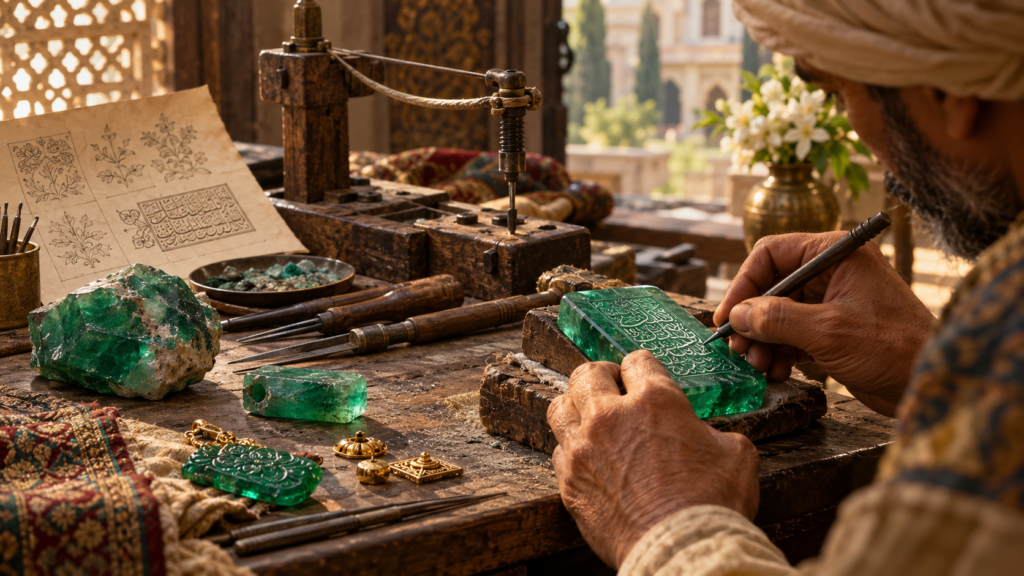
Carving the Emerald
Many Mughal emeralds were not faceted in the modern European sense.
Large stones could be polished into tablets or cabochons.
Some were carved with vegetal decoration.
Flowers became particularly important.
The Metropolitan Museum preserves a seventeenth-century Mughal emerald later mounted by Cartier, carved with a lotus-like rosette and leafy stalks.
The floral design is not accidental.
Mughal visual culture developed an extraordinary fascination with plants.
Flowers appear in painting.
Architecture.
Textiles.
Jade.
Metalwork.
And gemstones.
Shah Jahan and the Flowering of Mughal Naturalism
During the reign of Shah Jahan, the imperial court produced some of the most refined naturalistic floral ornament in Mughal art.
The Taj Mahal itself famously incorporates extensive floral imagery.
Precious objects from the same cultural world combine gems with scrolling vines, blossoms and leaves.
A mid-seventeenth-century rock-crystal flask in The Metropolitan Museum of Art, probably created during Shah Jahan’s reign, is covered with gold, enamel, rubies and emeralds arranged through elegant vegetal ornament.
The object demonstrates how precious materials and representations of nature could be fused into one artistic language.
But Some Emeralds Carried Words Instead of Flowers
Here the story moves directly into spiritual practice.
A small number of surviving Mughal-period emeralds are inscribed.
The inscriptions matter enormously.
According to the Museum of Islamic Art in Doha, Mughal emeralds bearing inscriptions were usually decorated with:
Qur’anic verses,
mystical sayings,
or pious formulas.
That immediately distinguishes them from ordinary decorative gems.
The surface of the gemstone had become a carrier of religious language.
The Jahangir Emerald
One particularly important emerald preserved by the Museum of Islamic Art dates to 1609–1610 CE.
The rectangular stone is inscribed:
“Jahangir Shah-i Akbar Shah”
along with its date.
The museum describes it as the only known inscribed and dated Mughal emerald from the reign of Emperor Jahangir.
This is unusual because Mughal emeralds more commonly carried religious texts than royal names.
Spinels, by contrast, were more frequently engraved with imperial titles and names.
The object therefore sits at the intersection of gemstone, kingship and inherited Timurid traditions of inscribing precious stones.
Emeralds and Protective Belief
The same museum documentation records that emeralds were historically believed to possess healing properties and were worn to repel illness and evil spirits.
This is significant historical evidence.
It demonstrates that at least within the cultural traditions surrounding these objects, emerald could possess an explicitly protective reputation.
But the distinction between historical evidence and scientific evidence is essential.
A museum can document that people believed emerald protected against illness.
That does not demonstrate that emerald actually prevents disease.
The belief is historically real.
The proposed medical mechanism is not scientifically established.
The Mogul Mughal Emerald
Few gemstones illustrate this world more dramatically than the extraordinary object commonly called the Mogul Mughal Emerald.
It is enormous.
The stone weighs approximately 217.8 carats.
It measures about 5.2 by 4 centimetres.
It dates to 1695–1696 CE.
Today it is preserved in the Museum of Islamic Art in Doha.
One face is covered with an inscription.
The other is carved with flowers.
Material.
Prayer.
Nature.
Craftsmanship.
All exist on the same gemstone.
What Is Written on It?
The inscription is a prayer invoking blessings upon Muhammad, Fatima and the Twelve Imams.
This is particularly interesting because the formula reflects a Shi’a devotional context.
The Mughal emperor ruling in 1695–96 was Aurangzeb, who belonged to the Sunni tradition.
Therefore, although the stone dates to his reign, it should not simply be described as “Aurangzeb’s emerald.”
Its exact original patron or owner is not securely known.
This is an important historical correction.
A gemstone can date from an emperor’s reign without having belonged personally to that emperor.
Why the Inscription Matters
If the emerald had simply been large and green, it would already have been valuable.
The inscription transformed it into something more.
Sacred language was physically engraved into the stone.
The Museum of Islamic Art notes that the occurrence of Qur’anic passages or prayers on several known Indian emeralds suggests that such objects were believed to possess talismanic properties.
This is stronger evidence than merely assuming that emerald was spiritual because green looks mystical.
The evidence is material.
The prayer survives.
The gemstone survives.
The holes through which the object could be mounted or attached survive.
We can study the system directly.
What Is a Talisman?
The terms amulet and talisman are sometimes used interchangeably, although historical specialists may distinguish them depending on context.
Broadly speaking, such an object is associated with protection, benefit or sacred efficacy.
But an Islamic talisman should not automatically be interpreted as a “crystal healing stone.”
Its perceived power could be associated with:
Qur’anic text,
the names of God,
prayers,
sacred formulas,
astrological correspondences,
material properties,
or combinations of these.
The inscription could be more important than the mineral.
Sacred Writing as Protection
Written sacred language has played important roles in many Islamic societies.
Qur’anic verses could appear on architecture, textiles, jewellery, weapons, seals and amulets.
One particularly famous passage is Ayat al-Kursi, the Throne Verse, Qur’an 2:255.
The verse emphasises God’s sovereignty, knowledge and protection over the heavens and earth.
It appears on numerous historical amulets.
The British Museum preserves an early Islamic limestone amulet from approximately the ninth or tenth century engraved with the Throne Verse.
The Ashmolean Museum preserves a Mughal-period bracelet amulet from northern India carrying the same verse.
Neither object is emerald.
That is precisely why they are useful comparisons.
They demonstrate that sacred text itself had an established protective role independent of any one gemstone.
The Stone Is Only Part of the System
This allows us to interpret inscribed Mughal emeralds more carefully.
Imagine an emerald carrying a Qur’anic verse.
What protects the wearer?
Is it:
the emerald?
the verse?
the act of writing?
the divine authority invoked by the text?
the person’s faith?
the object’s preparation?
Or some combination?
Historical traditions may answer differently.
The safest scholarly conclusion is that the complete object operated within a religious and cultural system.
Reducing it to “emerald energy” removes most of that system.
Wearing Sacred Words
The physical design of carved Mughal gems provides another clue.
Some stones were drilled so they could be attached to the body.
The Smithsonian’s National Museum of Natural History preserves a carved Mughal emerald now mounted in a later European necklace.
The museum explains that carved gemstones of this type were often worn on the arm as amulets, with cords threaded through small holes in the stone.
This means that a gemstone could place imagery or sacred language physically against—or immediately beside—the human body.
The relationship between body, stone and inscription was therefore intentional.
The Bazuband
The bazuband was an arm ornament worn in India.
The Metropolitan Museum of Art notes that such armbands were worn by both men and women and appear in Mughal paintings of courtly life.
Some incorporated emeralds, rubies and other gems.
A carved emerald later transformed into a twentieth-century Cartier brooch may originally have belonged to such an arm ornament.
The movement of these objects across time is itself fascinating.
A gemstone that once participated in Mughal bodily adornment could centuries later become European high jewellery.
Its meaning changed while the stone remained.
Gemstone Biography
Objects have biographies.
A Colombian emerald begins as geological material.
It becomes a mined commodity.
Then an imported Mughal luxury.
Perhaps an amulet.
Perhaps an arm ornament.
Perhaps a treasury object.
Later it enters a European collection.
A jeweller such as Cartier remounts it.
Eventually it enters a museum.
At every stage, the same physical stone acquires new social meaning.
This is why asking only:
“What does emerald mean?”
is too simple.
A better question is:
“What did this particular emerald mean at this particular moment in its history?”
Cartier and the Rediscovery of Mughal Gems
In the early twentieth century, Mughal gemstones entered another cultural chapter.
Jacques Cartier travelled to India in 1911.
European jewellery houses developed relationships with Indian rulers and acquired or remounted historical Indian gemstones.
By the 1920s and 1930s, carved Mughal emeralds appeared in spectacular Art Deco jewellery.
The Metropolitan Museum preserves a brooch incorporating a seventeenth-century Mughal emerald with floral carving.
The British Museum preserves Cartier jewellery incorporating eighteenth- or nineteenth-century Indian emeralds inlaid with ruby and diamond flowers.
The gemstones survived.
Their settings changed.
Their audience changed.
Their meaning changed again.
A Sacred Object Can Become Fashion
This transformation raises an important question.
What happens when an object created in one religious or cultural context becomes luxury fashion in another?
Sometimes the original meaning remains visible.
Sometimes it is misunderstood.
Sometimes it disappears entirely.
A carved emerald that once functioned as an amulet might later be appreciated principally for its colour and workmanship.
Museums now attempt to reconstruct those earlier layers.
This is one reason provenance and cultural context matter in gemstone history.
Beauty alone does not tell the whole story.
Emerald Green and Islam
Modern popular writing sometimes claims that emerald was important in Islamic cultures simply because “green is the sacred colour of Islam.”
That statement is too simplistic.
Green certainly acquired important religious, dynastic and cultural associations in many Islamic contexts.
It appears in descriptions of paradise and became associated with particular political and devotional traditions.
But Islamic civilisation spans more than fourteen centuries across enormous geographical and cultural diversity.
There is no single universal Islamic gemstone code in which every green stone automatically has one fixed meaning.
An inscribed Mughal emerald must be understood through its specific object history.
Paradise and Green
The Qur’an contains vivid descriptions of paradise in which green garments and luxuriant gardens appear.
Green therefore acquired powerful positive associations within Islamic visual and literary traditions.
But we should not reverse the logic automatically.
A green gemstone is not necessarily a direct symbol of paradise simply because it is green.
Historical interpretation requires evidence connecting a specific object with a specific symbolic intention.
Where an emerald carries sacred writing, the religious connection is demonstrable.
Where it carries only floral decoration, the interpretation requires greater caution.
Flowers on Mughal Emeralds
Floral carving nevertheless deserves attention.
Mughal artists repeatedly represented flowers with extraordinary precision and elegance.
Under Jahangir and Shah Jahan, close observation of the natural world became especially prominent in court art.
Flowers could decorate architecture, textiles, manuscripts and precious objects.
The reverse of the Mogul Mughal Emerald carries a central rosette surrounded by poppy-like flowers.
This side is not simply empty decoration surrounding the religious inscription.
It belongs to the broader Mughal fascination with ordered nature.
Nature, Garden and Empire
Gardens occupied an important place in Mughal court culture.
The Mughal garden inherited Persianate traditions while developing distinctive forms in South Asia.
Order imposed upon nature could communicate imperial authority.
Water channels.
Terraces.
Symmetry.
Flowers.
Fruit trees.
Architecture.
The garden could simultaneously be aesthetic, political and evocative of paradisiacal imagery.
It would nevertheless be too strong to claim that every flower carved into an emerald explicitly represents paradise.
The relationship is culturally suggestive rather than automatically provable.
Emerald and Healing in Historical Tradition
Emerald accumulated medical and protective reputations long before and beyond Mughal India.
Premodern lapidary traditions attributed various powers to gemstones.
Emerald was sometimes associated with eyesight, poison detection, protection and other effects.
Such claims travelled through Greek, Arabic, Persian, European and South Asian intellectual networks.
Texts were translated.
Ideas were modified.
Gemstone lore crossed linguistic boundaries just as gemstones themselves crossed geographical ones.
This makes it difficult to speak of one single “original emerald meaning.”
Historical Medicine Is Evidence of History, Not Proof of Treatment
This distinction cannot be overstated.
If a seventeenth-century text says emerald protects eyesight, historians learn something important.
They learn that people attributed that property to emerald.
They do not thereby demonstrate that emerald improves vision.
Historical medical literature should be studied within the scientific frameworks available to people at the time.
Modern clinical claims require modern evidence.
A gemstone’s cultural authority cannot replace controlled medical research.
Modern Emerald Spirituality
Contemporary metaphysical traditions commonly associate emerald with:
- love
- compassion
- emotional healing
- prosperity
- abundance
- loyalty
- renewal
- harmony
- the Heart Chakra
These associations belong primarily to modern crystal spirituality.
Some themes may echo much older associations with fertility, spring, love, wealth or protection.
But resemblance does not demonstrate continuous transmission.
The modern Heart Chakra association in particular should not be projected backwards into Mughal Islamic culture.
The Heart Chakra Is a Different Tradition
Chakra concepts developed within South Asian religious traditions, particularly Hindu and Buddhist tantric systems.
Those traditions are themselves historically diverse.
The familiar modern system assigning seven rainbow colours to seven chakras is substantially shaped by later reinterpretation.
Mughal India certainly existed in a South Asian environment where Hindu, Jain, Buddhist, Islamic and other traditions interacted.
But that does not mean a Muslim Mughal courtier wearing an emerald amulet was using it to “activate the Heart Chakra.”
Without evidence, that would be an anachronism.
Does Emerald Attract Prosperity?
Emerald has been associated with wealth partly because it has genuinely been an expensive prestige material.
Mughal rulers prized it.
European monarchs prized it.
Modern collectors prize it.
This can create a subtle circular argument:
Emerald is expensive.
Therefore wealthy people possess emeralds.
Therefore emerald becomes associated with wealth.
Then the association becomes:
Emerald causes wealth.
Historical evidence supports the first three steps.
It does not scientifically establish the last.
Wearing emerald has not been demonstrated to alter financial probability.
Does Emerald Protect Against Evil?
Historically, yes—in the sense that some people believed emerald could repel evil or harmful forces.
The Museum of Islamic Art explicitly records protective beliefs surrounding Mughal emeralds.
Some surviving stones carry sacred prayers or Qur’anic passages and appear to have been worn talismanically.
That is strong historical evidence for belief.
Scientifically, however, there is no established evidence that emerald emits a force capable of repelling supernatural entities or altering external events.
Both statements can be true simultaneously:
the belief is historically real;
the claimed supernatural mechanism is not scientifically established.
Does Emerald Heal?
Modern crystal sources sometimes attribute effects to emerald involving:
the heart,
vision,
circulation,
fertility,
the nervous system,
or emotional health.
Such medical claims are not established therapeutic properties of emerald.
Emerald is beryl coloured principally by trace elements.
Its measurable properties include refractive index, specific gravity, hardness, absorption characteristics and inclusion patterns.
Those physical properties do not demonstrate the medical claims commonly assigned to it.
Gemstones should not replace appropriate healthcare.
A Historically Inspired Emerald Reflection
Mughal emeralds offer an unusually rich basis for personal contemplation without requiring unsupported claims about gemstone energy.
Imagine holding a natural emerald.
First, look inside it.
Do not search only for perfection.
Observe fractures.
Growth structures.
Mineral or fluid inclusions.
Then consider the geography.
If the stone originated in Colombia, imagine the distance between the Andes and India.
An emerald arriving at a Mughal court had crossed oceans and political worlds.
Ask:
How many invisible journeys exist behind the objects I value?
Then consider an inscribed emerald.
A craftsperson deliberately cut sacred words into a precious stone.
The act was irreversible.
Ask:
Which words would I consider important enough to make permanent?
Finally consider the wearer.
The emerald might have rested against the arm or chest.
Ask:
Which ideas do I choose to keep physically close to me—and why?
The stone does not answer.
Its history provides the questions.
The Power May Have Been in the Words
This may be the most important insight offered by Mughal inscribed gemstones.
Modern crystal spirituality tends to begin with the material:
“What power does emerald have?”
An inscribed Mughal amulet invites another possibility.
Perhaps the stone’s preciousness made it a worthy surface.
Perhaps its traditional reputation contributed to its selection.
But the sacred words engraved upon it could have been central to its perceived protective significance.
The object therefore redirects attention from mineral energy toward meaning encoded in material.
That is a fundamentally different model of gemstone spirituality.
Preciousness as Devotion
Why engrave sacred words on something valuable?
One possible answer lies in the relationship between material value and reverence.
Human societies repeatedly devote costly materials to things considered sacred.
Gold covers reliquaries.
Precious stones decorate religious manuscripts.
Marble builds temples.
Silk carries sacred inscriptions.
The expense itself can communicate importance.
An emerald bearing prayer may therefore be significant not because green beryl possesses a measurable supernatural frequency, but because an extraordinary natural material was deliberately transformed into a worthy carrier of sacred language.
The Stone, the Text and the Body
An inscribed emerald worn as an amulet brings three domains together:
nature — the gemstone formed by geological processes;
language — the sacred inscription created by human hands;
body — the person who wears the object.
None is sufficient to explain the entire artefact.
Together they create something new.
That combination is one of the most sophisticated ways to understand historical gemstone spirituality.
The stone is neither merely decorative nor independently magical.
It participates in a network of belief.
Why the Mughal Emerald Story Matters Today
Modern consumers encounter gemstones largely through jewellery, investment and crystal spirituality.
Mughal emeralds challenge all three categories.
They show that a gemstone can simultaneously be:
financially valuable,
artistically important,
politically prestigious,
religiously meaningful,
and personally protective within a historical belief system.
No single label captures the object.
This complexity is precisely what makes historical gemstone traditions worth studying.
What Can We Say with Confidence?
Several conclusions are strongly supported.
Emerald is the green gem variety of beryl.
Exceptional Colombian emeralds entered Indian trade networks in substantial quantities following European expansion into the Americas.
Emeralds became highly prized at the Mughal court.
Mughal artisans polished, carved, drilled and mounted emeralds in sophisticated jewellery and luxury objects.
Floral carving became particularly characteristic of Mughal gem art.
Some Mughal emeralds were inscribed with Qur’anic verses, prayers, mystical sayings or pious formulas.
Museum scholarship indicates that such inscribed stones could possess talismanic functions.
Historical sources also document beliefs that emerald could protect against illness or evil spirits.
These beliefs are historically significant but do not establish medical or supernatural efficacy.
Modern Heart Chakra, crystal-energy and manifestation interpretations should not automatically be projected onto Mughal Islamic objects.
Conclusion
The history of emeralds in Mughal India is a history of worlds meeting.
The gemstone itself could begin in Colombia.
Spanish and Portuguese expansion connected it to new commercial networks.
Merchants carried it across oceans.
Indian craftspeople transformed it.
Mughal patrons valued it.
Artists carved flowers into it.
Calligraphers or gem engravers inscribed prayers upon it.
Wearers placed it against their bodies.
Centuries later, European jewellers remounted some of these stones into entirely new objects.
Today, museums preserve them as evidence of global trade, artistic achievement and religious belief.
The emerald therefore moved repeatedly between categories.
Geology became commodity.
Commodity became imperial treasure.
Treasure became art.
Art could become talisman.
Talisman could become jewellery again.
Modern metaphysical traditions add yet another layer, associating emerald with love, prosperity, healing and the Heart Chakra.
Those contemporary beliefs form part of emerald’s continuing cultural biography.
They should not be confused with Mughal religious practice or with scientifically established properties of beryl.
At Natural Gems Belgium, preserving those distinctions allows us to see something more extraordinary than a universal list of “emerald meanings.”
A Mughal emerald demonstrates how human beings can take a natural object formed on one continent and transform it, thousands of kilometres away, into a carrier of identity, artistry and prayer.
The stone crossed the world.
The inscription gave it words.
And the person who wore it gave those words meaning.
References & Further Reading
Mughal Emeralds and Sacred Inscriptions
Qatar Museums, Museum of Islamic Art — Emerald of Jahangir, 1609–1610
Exceptional inscribed Mughal emerald from the reign of Jahangir. The Museum of Islamic Art explains that Mughal emerald inscriptions more commonly carried Qur’anic verses, mystical sayings or pious formulas and records historical beliefs that emeralds could repel illness and evil spirits.
https://collections.qm.org.qa/en/objects/emerald-je18120041
Qatar Museums, Museum of Islamic Art — Carved Mughal Emerald, 1695–1696
Authoritative museum record for the celebrated 217.8-carat carved Mughal emerald. One face bears a prayer blessing Muhammad, Fatima and the Twelve Imams; the reverse carries elaborate floral carving. The museum specifically notes that prayers and Qur’anic inscriptions on related emeralds suggest talismanic use.
https://collections.qm.org.qa/en/objects/carved-mughal-emerald-je862002
Christie’s — A Magnificent Carved Emerald, Mughal or Deccani, 1695–1696
Detailed historical catalogue entry for the same 217.8-carat emerald, documenting its Shi’a invocation, naskh inscription, floral carving, dimensions and drilled attachment points.
https://www.christies.com/en/lot/lot-2729922
Shah Jahan and Inscribed Emeralds
Christie’s — The Shah Jahan Emerald
Detailed catalogue documentation of a 30.60-carat Colombian emerald engraved around 1621–1622 with the name of Shah Jahan. Christie’s notes that Mughal emeralds carrying inscriptions typically bore spiritual texts, making the royal inscription on this example especially unusual.
https://www.christies.com/en/lot/lot-6212077
Carved Emeralds and Mughal Jewellery
The Metropolitan Museum of Art — Brooch with Carved Mughal Emeralds and Sapphires
Seventeenth-century Mughal emerald later mounted by Cartier around 1920. The emerald carries a carved lotus-like rosette and leafy stalks and illustrates both Mughal floral gem carving and the later European reuse of historic Indian gemstones.
https://www.metmuseum.org/art/collection/search/458799
The Metropolitan Museum of Art — Ring with Emerald, Jaipur
Nineteenth-century Indian gold and enamel ring with a large emerald. The Met discusses the long-standing Mughal preference for emerald and specifically notes that emeralds entered India from the New World through Portuguese Goa.
https://www.metmuseum.org/art/collection/search/450397
The Metropolitan Museum of Art — Centerpiece of an Armband
Northern Indian bazuband incorporating emeralds, rubies and colourless sapphires. The Met explains that such arm ornaments were worn by both men and women and appear frequently in Mughal court painting.
https://www.metmuseum.org/art/collection/search/450396
Emerald Amulets and Bodily Use
Smithsonian National Museum of Natural History — Mogul Emerald Necklace
Carved Colombian emerald worked in the Mughal style and later incorporated into a European necklace. The Smithsonian explains that carved gemstones of this type were often worn on the arm as amulets, with threads passing through small drilled holes.
https://naturalhistory.si.edu/explore/collections/geogallery/10002769
Sacred Text and Mughal Amulets
Ashmolean Museum, Yousef Jameel Centre for Islamic and Asian Art — Mughal Amulet Inscribed with the Throne Verse
Northern Indian Mughal-period bracelet amulet inscribed with Qur’an 2:255, the famous Throne Verse. Although made from cornelian rather than emerald, it provides important comparative evidence for the protective use of Qur’anic inscription on gemstones in Mughal India.
British Museum — Early Islamic Amulet Inscribed with Qur’an 2:255
Ninth- to tenth-century limestone amulet engraved with the Throne Verse. This object provides broader historical context for the use of Qur’anic text on wearable protective objects in Islamic material culture.
https://islamicworld.britishmuseum.org/collection/RRM32365
Mughal Gemstone Art and Natural Forms
The Metropolitan Museum of Art — Mango-Shaped Flask, Mid-17th Century
Rock-crystal flask set with gold, enamel, rubies and emeralds, probably created during Shah Jahan’s reign. The Met identifies the object as an outstanding expression of Mughal interest in natural forms, precious materials and floral ornament.
https://www.metmuseum.org/art/collection/search/453341
Victoria and Albert Museum — The Great Mughals: Art, Architecture and Opulence
Overview of the V&A’s major exhibition devoted to the artistic and international culture of the Mughal court during the reigns of Akbar, Jahangir and Shah Jahan, including carved emeralds, bejewelled weapons and court luxury objects.
https://www.vam.ac.uk/exhibitions/great-mughals-art-architecture-opulence
Emeralds, Rubies and Imperial Weapons
British Museum — Mughal Dagger with Jade Hilt, Emeralds and Rubies
Seventeenth-century Indian dagger whose jade hilt is inlaid with emeralds and rubies in gold. The object demonstrates how emerald participated in Mughal elite weaponry and courtly display.
https://www.britishmuseum.org/collection/object/A_2001-0521-41
The Metropolitan Museum of Art — Mughal Dagger with Sheath
Indian Mughal dagger incorporating steel, gold, rubies, emeralds and diamonds, illustrating the integration of gemstones into prestigious arms and courtly material culture.
https://www.metmuseum.org/art/collection/search/31862
Historical Belief Versus Modern Crystal Spirituality
The surviving evidence securely demonstrates that emerald occupied an important position within Mughal material and devotional culture.
We can document:
Colombian emeralds transported into India through early modern global trade,
imperial Mughal appreciation of emerald,
floral carving on emerald tablets,
Qur’anic verses and pious formulas engraved on gemstones,
emeralds designed for bodily wear,
and historical beliefs attributing protective or healing properties to emerald.
The Museum of Islamic Art’s carved emeralds provide particularly strong evidence that some inscribed stones could have been understood talismanically.
This evidence does not establish that emerald emits scientifically measurable healing energy, alters prosperity, cures illness, activates the Heart Chakra or physically repels supernatural entities.
Modern metaphysical associations with love, abundance, emotional healing and the Heart Chakra belong primarily to contemporary crystal traditions.
The strongest historical interpretation therefore distinguishes:
the mineralogical properties of emerald
from
documented Mughal artistic and devotional practice
from
historical protective belief
from
modern metaphysical spirituality.
Those distinctions do not diminish the emerald’s spiritual history.
They reveal something more sophisticated: in Mughal India, a gemstone could become spiritually significant not simply because of what people believed the stone was, but because of what human beings deliberately carved, wrote and prayed upon it.