

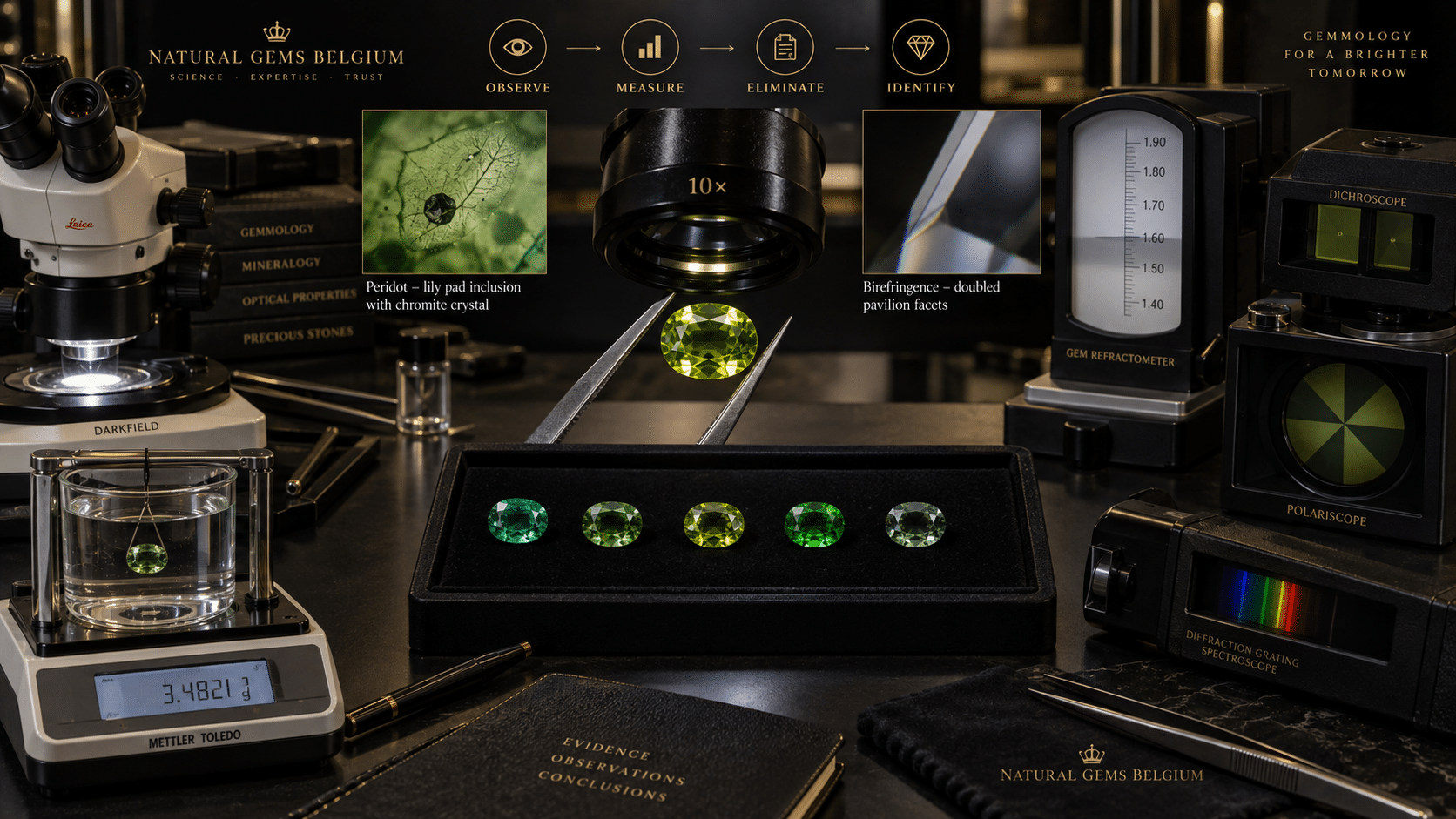
A Practical Evidence-Based Gemstone Identification Exercise
A transparent green gemstone is placed on the gemmologist’s desk.
There is no laboratory report.
No reliable seller description.
No known locality.
No treatment information.
At first glance, the obvious thought might be:
But green is one of the most dangerous colours from which to make an immediate gemstone identification.
Our unknown could instead be:
- green tourmaline;
- peridot;
- tsavorite garnet;
- manufactured green glass;
- or another green gemstone not included in today’s initial candidate list.
In this workshop we will deliberately work with five candidates:
Emerald
Green Tourmaline
Peridot
Tsavorite Garnet
Green Glass
The objective is not to decide which one “looks most likely.”
Instead we will follow the same NGB evidence-based procedure developed throughout the Practical Gemmology series:
Observe → Measure → Eliminate → Compare → Combine → Conclude
Every test will answer a specific question.
And, just as importantly, we will distinguish what each test cannot prove to identify a green gemstone.
Table of Contents
PART I — THE UNKNOWN GREEN STONE
1. Initial Observation
Our specimen is a:
transparent vivid yellowish-green oval mixed-cut gemstone.
Weight:
3.18 ct
Dimensions:
approximately 9.1 × 7.2 × 5.3 mm
Unaided examination shows:
- vitreous lustre;
- high transparency;
- lively brilliance;
- noticeable doubling of some internal pavilion facet junctions when viewed carefully through the crown;
- no obvious surface coating;
- no visible joining plane;
- no obvious gas bubbles without magnification.
The stone is attractive.
But none of these observations is yet enough to name it.
2. Establish the Candidate List
Candidate A — Emerald
Emerald is the green to bluish-green variety of:
beryl — Be₃Al₂Si₆O₁₈
Typical GIA reference properties include approximately:
RI 1.577–1.583
Birefringence 0.005–0.009
SG 2.72
Emerald is:
doubly refractive and uniaxial.
Its colour is principally associated with chromium and/or vanadium, with iron capable of modifying the appearance.
Candidate B — Green Tourmaline
Tourmaline is not one single chemically fixed mineral but a complex mineral group.
Gem tourmalines can show considerable chemical variation.
Studies of natural tourmaline populations have produced RI ranges approximately around:
1.62–1.65
with measurable birefringence and SG commonly close to:
3.0–3.2
depending on composition.
Tourmaline is:
doubly refractive and uniaxial.
Green tourmaline can also display strong pleochroism.
Candidate C — Peridot
Peridot is gem-quality olivine, generally rich in the:
forsterite component.
Its simplified composition lies in the:
(Mg,Fe)₂SiO₄
olivine system.
GIA gives approximately:
RI 1.65–1.69
Birefringence 0.035–0.038
SG 3.34
Peridot is:
orthorhombic and biaxial.
Its unusually high birefringence is one of its most valuable identification clues.
Candidate D — Tsavorite
Tsavorite is the vivid green variety of:
grossular garnet.
It belongs to the garnet group and is coloured principally by combinations involving:
- vanadium;
- chromium.
Published GIA studies of tsavorite show RI values commonly around:
1.74
and SG approximately:
3.6–3.66
depending on composition and locality.
Because garnet is cubic, tsavorite is fundamentally:
singly refractive.
It can sometimes show anomalous double refraction caused by strain, but this is not true structural birefringence.
Candidate E — Green Glass
Manufactured glass can be produced in almost any colour.
GIA specifically notes that glass has long been used as a common imitation for coloured gemstones, including green gems.
Glass is generally:
amorphous
and therefore normally:
singly refractive.
But its RI and SG vary greatly with composition.
This makes microscopy and the full property set particularly important.
PART II — WHY GREEN IS DECEPTIVE
3. “Emerald Green” Is Not a Scientific Identification
Commercial language frequently uses expressions such as:
emerald green.
That describes colour.
It does not establish mineral identity.
A tourmaline can be intensely green.
Tsavorite can rival fine emerald in saturation.
Peridot can show vivid pure green in exceptional specimens.
Manufactured glass can be made in virtually any shade required.
The eye sees colour.
The gemmologist must determine material.
4. Hue Provides Clues, Not Conclusions
There are broad tendencies.
Emerald commonly ranges from:
green to bluish green.
Peridot often ranges:
yellowish green to green.
Tourmaline can cover an extraordinary range of greens.
Tsavorite can show:
yellowish green through richly saturated green.
But natural populations overlap.
Never turn a colour tendency into an identification rule.
5. Path Length Changes Apparent Colour
The same gemstone may look:
- lighter through a shallow direction;
- darker through a longer optical path.
Pleochroism can modify colour further in anisotropic gems.
Cutting orientation and internal reflection add still more complexity.
That means apparent face-up colour cannot be treated as a simple chemical label.
PART III — LOUPE AND MICROSCOPE
6. Begin with the 10× Loupe
Inspect:
- crown;
- girdle;
- pavilion;
- facet junctions;
- surface-reaching fractures;
- internal structures.
Our unknown contains several interesting features.
At 10× we observe:
- rounded to disc-like reflective inclusions;
- tiny dark crystals;
- conspicuous doubling of some pavilion facet junctions;
- several small partially healed fractures.
No obvious large round gas bubbles are present.
7. The Facet Doubling Deserves Attention
When viewed through the crown, some pavilion facet edges appear:
doubled.
This immediately suggests significant:
birefringence.
But do not jump straight to peridot.
Other doubly refractive gemstones can also produce doubling.
The correct observation is:
strong apparent double refraction visible under magnification.
Now we test quantitatively.
8. Move to the Gemmological Microscope
Under darkfield illumination, the internal scene becomes clearer.
One of the most distinctive features is a round, flattened fracture surrounding a small dark crystal.
It resembles a floating leaf on water.
Gemologists commonly describe this appearance as a:
lily-pad inclusion.
GIA documents these reflective, disc-like inclusion structures as common features in peridot.
This strongly raises peridot on our candidate list.
But we still need physical measurements.
9. What Is a Peridot “Lily Pad”?
Despite its informal name, the feature is not a plant-like object inside the gemstone.
GIA studies describe lily-pad structures as circular or disc-like fractures or healing planes that can occur around:
- tiny crystals;
- negative crystals;
- fluid-related internal features.
Some studied peridots contain dark chromite crystals at or near the centre of these structures.
They can be highly characteristic.
But even a characteristic inclusion should support measurement rather than replace it.
10. Chromite Inclusions
Dark opaque crystals are also visible.
GIA studies of peridot from locations including Vietnam and Myanmar have documented:
chromite
among common mineral inclusions.
Chromite may occur with:
- tension halos;
- discoid fractures;
- lily-pad structures.
This is another compatible feature.
Still:
compatible ≠ proven.
PART IV — REFRACTIVE INDEX
11. The First Quantitative Test
Clean the gemstone.
Clean the refractometer.
Use the correct minimal contact liquid.
Take repeated readings through a suitable polished facet while rotating the stone.
The observed readings bracket approximately:
RI 1.652–1.688
with the extreme readings producing a difference of roughly:
0.036.
Now the candidate list changes dramatically.
12. Compare with Emerald
Typical emerald RI is approximately:
1.577–1.583
although natural populations can vary somewhat with chemistry.
Our readings are substantially higher.
Emerald is no longer compatible with the measured optical constants.
13. Compare with Green Tourmaline
Natural green tourmaline commonly occupies a region around:
1.62–1.65
with composition-dependent variation.
Our lowest reading approaches the upper tourmaline region, but the full spread to approximately:
1.688
and extremely large birefringence are inconsistent with ordinary green tourmaline.
Tourmaline becomes highly unlikely.
14. Compare with Peridot
GIA lists peridot approximately:
1.65–1.69
with birefringence approximately:
0.035–0.038.
Our unknown:
RI 1.652–1.688
Birefringence ~0.036
This is an excellent match.
Peridot now becomes the leading candidate.
15. Compare with Tsavorite
Tsavorite grossular is typically approximately:
RI ~1.74
and fundamentally singly refractive.
Our unknown has both:
- lower RI;
- very strong true birefringence.
This is inconsistent with tsavorite.
Tsavorite can be eliminated.
16. Compare with Glass
Glass can have a wide RI range because manufacturers can alter its composition.
Therefore one RI value alone is not enough to exclude every possible glass.
But ordinary glass should not produce this stable, crystallographically consistent birefringence.
The refractometer is therefore already strongly inconsistent with ordinary glass.
PART V — WHY PERIDOT’S BIREFRINGENCE IS SO USEFUL
17. The Difference Between the Two Extreme RIs
Our measurement gives approximately:
1.688 − 1.652 = 0.036
That is large for a transparent faceted coloured gemstone.
GIA’s reference range for peridot is approximately:
0.035–0.038.
This strong birefringence explains the doubled pavilion facets observed under magnification.
The microscope clue and refractometer measurement now tell the same story.
18. Facet Doubling
Light passing through an anisotropic crystal can separate into two permitted vibration directions.
When their refractive indices differ substantially, images seen through the gemstone can appear doubled.
In peridot, the effect may be strong enough for pavilion facet junctions to appear as:
two parallel edges.
This is one of the classic visual clues to peridot.
19. Strong Doubling Is Not Unique to Peridot
High zircon is another famous gemstone with strong birefringence and conspicuous facet doubling.
Therefore:
facet doubling alone ≠ peridot.
But high zircon has radically different RI and density.
Once again, multiple properties solve the ambiguity.
PART VI — POLARISCOPE
20. Test Optical Behaviour
Place the stone between crossed polarizers.
Rotate through:
360°.
The gemstone alternates clearly between illuminated and extinction positions.
This confirms:
doubly refractive / anisotropic behaviour.
21. What Does This Do to the Candidate List?
Emerald
DR — possible in principle.
Tourmaline
DR — possible in principle.
Peridot
DR — expected.
Tsavorite
Fundamentally SR — inconsistent.
Glass
Normally SR — inconsistent.
So the polariscope independently removes the two isotropic candidates.
22. Conoscopic Examination
With suitable orientation and a conoscope, the interference behaviour is consistent with a:
biaxial gemstone.
This matters.
Emerald and tourmaline are:
uniaxial.
Peridot is:
biaxial.
Our optical character therefore provides another strong independent separation.
23. Why Peridot Is Biaxial
Peridot belongs to the:
orthorhombic crystal system.
Orthorhombic crystals are optically biaxial.
They possess three principal refractive indices:
α, β and γ
with two optic-axis directions.
The refractometer and polariscope are therefore showing two consequences of the same crystal structure.
PART VII — DICHROSCOPE
24. Examine Pleochroism
View the gemstone through the dichroscope.
The colour difference is present but restrained:
green
and:
yellowish green.
GIA studies of Burmese peridot report:
weak to moderate green / yellowish-green pleochroism.
This is compatible with our unknown.
25. Compare with Tourmaline
Many green tourmalines display much stronger pleochroism.
GIA research on tourmaline from Luc Yen found pleochroism most intense in:
- green;
- brown;
- purple
specimens.
Therefore a strongly contrasting dichroscope reaction might have favoured tourmaline.
But pleochroism strength alone is not sufficiently diagnostic.
26. Compare with Emerald
Emerald can also display obvious pleochroism.
Some natural populations show:
- yellowish green or green in one direction;
- bluish green in another.
Thus colour-direction observations alone cannot reliably distinguish emerald, tourmaline and peridot.
The refractometer remains much stronger here.
27. Tsavorite and Pleochroism
Tsavorite is cubic grossular garnet.
A cubic crystal does not show true crystallographic pleochroism.
Therefore genuine directional colour separation would be inconsistent with tsavorite.
PART VIII — SPECIFIC GRAVITY
28. Add Density Evidence
The gemstone is loose and safe for immersion.
We perform hydrostatic weighing.
Repeated measurements give approximately:
SG 3.34.
Now compare the candidates.
29. Emerald
Typical emerald:
SG around 2.72.
Far too low.
Emerald remains excluded.
30. Tourmaline
Green tourmalines studied by GIA can range roughly around:
3.05–3.20
depending on composition.
Our result is higher.
Tourmaline becomes still less plausible.
31. Peridot
GIA’s standard peridot reference value is approximately:
SG 3.34.
Excellent agreement.
32. Tsavorite
Published GIA tsavorite examples commonly measure around:
3.6–3.66.
That is substantially denser than our stone.
33. Glass
Glass is compositionally variable.
Some glasses occupy SG values near natural gemstones.
Therefore density alone cannot eliminate every glass formulation.
But glass would also have to explain:
- strong true birefringence;
- biaxial optical character;
- peridot-range RI;
- lily-pad inclusion scene.
The combined explanation becomes untenable.
PART IX — SPECTROSCOPE
34. Examine the Visible Absorption
The handheld spectroscope reveals weak absorption features in the blue region.
Well-studied natural peridot from Vietnam displayed visible bands around:
455 nm
and:
484 nm
with strong absorption below approximately:
440 nm.
These features were attributed to:
Fe²⁺.
Our specimen displays a compatible iron-related spectrum.
35. Peridot Is an Iron-Coloured Gemstone
Many gemstones obtain colour from trace impurities present only in small amounts.
Peridot is different in an important way.
Iron is part of the olivine solid-solution chemistry itself.
The relative proportion of magnesium and iron affects:
- colour;
- optical properties;
- density.
This is why peridot is often described as an:
idiochromatic
gemstone—its colour-forming element is part of its essential chemical system.
36. Compare with Emerald Colour Chemistry
Emerald colour instead arises principally from small quantities of:
- chromium;
- vanadium
substituting within beryl.
Its absorption spectrum can therefore show chromium/vanadium-related features entirely different from peridot’s Fe²⁺-dominated spectrum.
Spectroscopy adds chemistry-related evidence to the optical measurements.
37. Compare with Tsavorite
Tsavorite’s green colour is associated particularly with:
- vanadium;
- chromium.
GIA studies of tsavorite document different visible absorption behaviour from peridot.
Thus two gems can both appear vivid green while deriving that colour from very different electronic processes.
PART X — THE EVIDENCE TABLE
38. Bring the Results Together
| Property | Unknown | Emerald | Green Tourmaline | Peridot | Tsavorite | Glass |
|---|---|---|---|---|---|---|
| Colour | Yellowish green | Possible | Possible | Strongly compatible | Possible | Possible |
| RI | 1.652–1.688 | Too high | Mostly too high / range inconsistent | Strong match | Too low | Variable |
| Birefringence | ~0.036 | Much lower | Usually lower | Strong match | None normally | None normally |
| Optical character | Biaxial DR | Uniaxial DR | Uniaxial DR | Biaxial DR | SR | SR |
| Pleochroism | Weak green / yellow-green | Can be stronger, often green/blue-green | Often strong | Compatible | None true | None true |
| SG | ~3.34 | Too low | Generally lower | Strong match | Too high | Variable |
| Facet doubling | Strong | Usually subtle | Moderate at most | Characteristic | None true | None true |
| Lily-pad inclusions | Present | Not characteristic | Not characteristic | Classic clue | Not characteristic | No |
| Fe²⁺-type spectrum | Compatible | Different chromophore system | Composition dependent | Compatible | Different dominant chromophores | Depends on colourant |
The answer does not depend on one matching number.
It comes from the fact that:
every major independent property converges on the same material.
PART XI — THE IDENTIFICATION
39. Evidence-Based Conclusion
The unknown gemstone is best identified as:
Natural Peridot — Olivine
The conclusion is supported by:
- RI in the peridot range;
- birefringence approximately 0.036;
- biaxial optical character;
- SG approximately 3.34;
- weak green/yellow-green pleochroism;
- strong facet doubling;
- lily-pad inclusions;
- dark chromite-type inclusions;
- compatible Fe²⁺ absorption.
Peridot is not simply the gemstone that looked most similar.
It is the candidate that survives the complete dataset.
PART XII — NATURAL OR LABORATORY-GROWN?
40. Species Identification and Origin of Growth Are Different Questions
Our standard tests establish:
olivine / peridot.
The internal inclusion scene strongly supports natural geological formation.
The lily-pad structures and natural mineral inclusions are consistent with documented natural peridot populations.
This permits a strong natural-origin interpretation for our hypothetical workshop specimen.
But the general principle remains:
species identification and natural-versus-manufactured determination are separate analytical steps.
41. Peridot and Natural Geological Environments
Natural peridot is strongly associated with Earth’s mantle.
Much gem peridot reaches the surface inside:
- basalt;
- mantle xenoliths;
- related volcanic material.
Peridot also occurs in unusual extraterrestrial material such as:
pallasite meteorites.
The same mineral family can therefore tell remarkable geological stories.
42. Inclusion Scenes Can Reflect Formation Environment
GIA studies of peridot document inclusions such as:
- chromite;
- spinel-group minerals;
- biotite/phlogopite;
- fluid inclusions;
- negative crystals;
- lily-pad fractures.
These do more than help identify the gemstone.
They preserve information about the environment through which the peridot travelled.
PART XIII — WHAT IF IT HAD BEEN EMERALD?
43. Alternative Dataset
Imagine instead that our unknown produced:
RI 1.577–1.583
Birefringence ~0.006–0.008
SG ~2.72
Uniaxial DR
green/bluish-green pleochroism
emerald-type internal inclusions
Then the evidence would converge strongly toward:
emerald / beryl.
44. Emerald Microscopy
Natural emerald may display:
- mineral crystals;
- fluid inclusions;
- multiphase inclusions;
- growth tubes;
- healed fissures;
- jardin-like internal structure.
But inclusion interpretation must remain careful.
Three-phase inclusions, for example, do not automatically prove Colombian origin.
Similar structures have been documented from several emerald-producing regions.
45. Emerald Treatment Adds Another Question
Many fashioned natural emeralds contain surface-reaching fractures whose visibility has been reduced with:
- oils;
- resins;
- other fillers.
Therefore after identifying:
emerald
the gemmologist must ask:
Is clarity enhancement present?
Identification and treatment determination are separate.
46. Filled Emerald Can Still Be Natural Emerald
Oil or resin treatment does not transform natural beryl into synthetic emerald.
The correct hierarchy is:
species → natural/laboratory-grown → treatment → degree/type of treatment → origin if required.
This same hierarchy applies throughout professional gemmology.
PART XIV — WHAT IF IT HAD BEEN GREEN TOURMALINE?
47. Alternative Dataset
Imagine:
RI approximately 1.620–1.645
Birefringence approximately 0.016–0.023
SG around 3.05–3.20
Uniaxial DR
strong pleochroism
Now:
green tourmaline
becomes a powerful candidate.
48. Natural Variation in Tourmaline
Tourmaline is chemically complex.
GIA studies show meaningful variations in:
- RI;
- SG;
- colour;
- pleochroism
between compositions and localities.
Therefore the term:
tourmaline
covers a much broader chemical family than a relatively simple single-species label might imply.
49. Pleochroism Is Especially Useful
Green tourmaline can display strong directional colour.
Depending on composition, one direction may appear:
- vivid green;
- bluish green;
- dark green;
- yellowish green.
This directional behaviour can become a major cutting consideration as well as an identification clue.
50. Inclusions in Tourmaline
Natural tourmaline may contain:
- two-phase inclusions;
- fluid inclusions;
- growth tubes;
- trichites;
- healed fractures.
Microscopy can therefore provide evidence complementary to the optical properties.
PART XV — WHAT IF IT HAD BEEN TSAVORITE?
51. Alternative Dataset
Imagine:
RI ~1.740–1.742
SG ~3.63–3.66
Polariscope: SR with possible weak ADR
No true pleochroism
green colour
The data would strongly support:
tsavorite grossular garnet.
52. Tsavorite Is Garnet, Not Beryl
This distinction is crucial.
Emerald and tsavorite can occupy similar green colour spaces.
But their mineralogy is completely different.
Emerald
Beryl.
Hexagonal.
Doubly refractive.
RI around the upper 1.57s to low 1.59s in many populations.
Tsavorite
Grossular garnet.
Cubic.
Fundamentally singly refractive.
RI around approximately 1.74.
A refractometer and polariscope can separate them rapidly.
53. Tsavorite Colour
GIA research identifies:
vanadium and chromium
as important colour-causing elements in green grossular.
The same broad elements involved in emerald colour can therefore occur in another entirely different mineral.
Chromophore identity alone does not determine gemstone species.
54. Anomalous Double Refraction
Some garnets can show:
anomalous double refraction — ADR.
Internal strain may cause light transmission between crossed polarizers even though the cubic gemstone is fundamentally isotropic.
Do not misinterpret this as ordinary structural birefringence.
The refractometer remains extremely useful.
A single RI near 1.74 plus cubic behaviour differs fundamentally from peridot’s wide RI spread.
PART XVI — WHAT IF IT HAD BEEN GLASS?
55. Glass Can Be Convincing
GIA notes that manufactured glass can imitate almost any coloured gemstone.
Its colour can be tailored.
It can be:
- transparent;
- translucent;
- vividly green;
- cut and polished like a gemstone.
Visual appearance therefore provides very weak protection against a sophisticated imitation.
56. Microscopic Glass Clues
GIA has documented green and blue-green glass imitations containing:
- round gas bubbles;
- elongated bubbles;
- flow structures;
- fused boundaries;
- surface dimples.
These features can be powerful clues.
But absence of bubbles does not prove that a material is natural.
High-quality glass may be very clean.
57. Glass Is Normally Singly Refractive
Because glass is amorphous, it has no ordered crystal lattice comparable with:
- beryl;
- tourmaline;
- olivine.
It is therefore normally:
singly refractive.
Internal strain may create anomalous effects between crossed polarizers, but not the normal large crystallographic birefringence of peridot.
58. Glass RI and SG Are Variable
There is no one universal:
glass RI
or:
glass SG.
Manufacturers can alter composition using different oxides.
Therefore:
“RI is 1.60, so it cannot be glass”
would be unsafe.
Instead identify the complete physical behaviour.
59. Assemblages Can Be More Difficult
GIA has documented green imitations combining:
- natural beryl;
- manufactured glass;
- cement layers.
Such assemblages can contain genuine natural inclusions in one section while still being manufactured composite objects.
Always inspect:
- girdle;
- facet junctions;
- internal boundaries.
Microscopy prevents bulk measurements from being interpreted too simplistically.
PART XVII — THE PERIDOT SPECTRUM AND COLOUR
60. Why Peridot Is Yellowish Green
Peridot’s characteristic green arises principally through:
Fe²⁺
within the olivine structure.
Changing iron content affects:
- hue;
- RI;
- SG.
Studies of Vietnamese peridot show that darker, more iron-rich samples can have somewhat higher RI and SG than lighter specimens.
This is another example of why published constants should be treated as:
ranges.
61. Darker Peridot Can Be Denser
A GIA study of Vietnamese peridot found SG values from approximately:
3.28 to 3.49.
The darker material generally had higher SG.
One unusually dense sample contained abundant chromite inclusions, which further raised the bulk density.
That illustrates two important effects:
host chemistry + inclusion chemistry.
Both can shift measured physical properties.
62. Published Values Are Not Magic Numbers
Our workshop uses:
SG 3.34
because that is a useful standard reference.
A natural peridot reading:
3.30
or:
3.36
should not be rejected automatically.
Interpret the result with:
- RI;
- chemistry;
- inclusions;
- measurement uncertainty.
Professional gemmology deals in populations and ranges, not exact passwords.
PART XVIII — PERIDOT AND FACETING
63. Strong Birefringence Matters to the Cutter
Peridot’s strong double refraction is not merely an identification property.
It affects appearance.
Poor orientation or unsuitable facet relationships can make internal facet junctions appear visually:
- doubled;
- blurred.
A cutter must understand the stone’s optical behaviour while planning the design.
64. Clarity Planning
Peridot rough can contain:
- lily-pad fractures;
- chromite;
- other crystals;
- healed fractures.
The cutter must decide whether to:
- remove an inclusion;
- retain it outside the face-up area;
- orient around fractures;
- sacrifice weight for durability or clarity.
This creates a direct bridge between Practical Gemmology and the NGB Gemstone Faceting guides.
PART XIX — WORKSHOP CHALLENGE
65. Unknown Green Stone A
RI: 1.579–1.586
Birefringence: ~0.007
SG: 2.73
Optical character: uniaxial DR
Pleochroism: green / bluish green
Microscopy: jardin-like fissures and fluid inclusions
Best identification?
Emerald / beryl
subject to confirmation of variety-level colour and natural/synthetic status.
66. Unknown Green Stone B
RI: 1.620–1.642
Birefringence: ~0.020
SG: 3.10
Optical character: uniaxial DR
Pleochroism: strong green / darker green
Best broad identification?
Green Tourmaline
with chemistry needed if precise tourmaline species matters.
67. Unknown Green Stone C
RI: 1.652–1.688
Birefringence: 0.036
SG: 3.34
Optical character: biaxial DR
Microscopy: lily pad and chromite
Facet doubling: strong
Best identification?
Peridot
68. Unknown Green Stone D
RI: 1.741
Polariscope: SR with slight ADR
SG: 3.64
Pleochroism: none
Colour: vivid green
Best identification?
Tsavorite Grossular Garnet
69. Unknown Green Stone E
RI: single reading around 1.50–1.60 depending on composition
Polariscope: SR / irregular strain
Microscopy: gas bubbles and flow structures
Pleochroism: none
Best interpretation?
Manufactured Green Glass
subject to confirmation of the specific material.
PART XX — WHICH TEST IS MOST POWERFUL?
70. Refractometer
For this candidate set, the refractometer is exceptionally useful.
The approximate regions progress broadly as:
Emerald ~1.58
Tourmaline ~1.62–1.65
Peridot ~1.65–1.69
Tsavorite ~1.74
Glass remains composition-dependent.
Importantly, peridot also produces an unusually large RI spread.
71. Polariscope
The polariscope separates:
tsavorite + ordinary glass
from the normally anisotropic crystal candidates.
With a conoscope it can further separate:
uniaxial emerald/tourmaline
from:
biaxial peridot.
That makes the instrument particularly useful here.
72. Dichroscope
The dichroscope is valuable for:
- emerald;
- tourmaline;
- peridot.
Tourmaline can show especially strong pleochroism.
But pleochroism should remain supporting evidence because strength varies.
73. Specific Gravity
SG produces another useful ladder:
Emerald ~2.72
Tourmaline commonly ~3.0–3.2
Peridot ~3.34
Tsavorite ~3.6+
Glass remains variable.
The independent mass-volume property strongly reinforces RI.
74. Microscope
Microscopy adds entirely different evidence:
Emerald: fluid inclusions, crystals, healed fissures, treatment evidence
Tourmaline: tubes, fluid inclusions, trichites, growth structures
Peridot: lily pads, chromite, negative crystals, mineral inclusions
Tsavorite: crystals, fingerprints, other natural inclusions
Glass: bubbles, flow structure, manufacturing features
The combination is far stronger than colour alone.
PART XXI — COMMON ERRORS
75. Error: “Deep Green Means Emerald”
Incorrect.
Tsavorite and tourmaline can be equally vivid.
76. Error: “Yellowish Green Means Peridot”
Too simplistic.
Tourmaline, garnet and glass can occupy similar colour spaces.
77. Error: “Lily Pad Automatically Means Peridot”
Lily pads are classic peridot clues.
But identification should still be confirmed through optical properties.
Characteristic does not always mean absolutely unique.
78. Error: “A Bright Stone Under Crossed Polars Cannot Be Garnet”
Incorrect.
Garnet may show anomalous double refraction due to strain.
The question is whether the reaction represents true structural birefringence.
79. Error: “Tsavorite and Emerald Are Basically the Same Green Gem”
Incorrect.
They differ fundamentally in:
- mineral species;
- crystal system;
- RI;
- SG;
- optical character.
Their similarity is primarily visual.
80. Error: “Gas Bubble Means the Whole Stone Is Glass”
Not always.
Foreign glass filler inside a genuine natural gemstone can also contain bubbles.
Determine where the bubble occurs and what surrounds it.
81. Error: “Correct RI Proves Natural Origin”
Incorrect.
Synthetic materials can reproduce the physical properties of the natural mineral species.
Natural versus laboratory-grown determination is a separate question.
82. Error: “Emerald Identification Proves No Treatment”
Incorrect.
Emerald clarity enhancement is common and must be evaluated separately.
PART XXII — EVIDENCE CLASSIFICATION
| Statement | Classification |
|---|---|
| Emerald is green to bluish-green beryl | Established mineralogical fact |
| Green tourmaline is doubly refractive and can be strongly pleochroic | Established gemmological observation |
| Peridot is gem-quality olivine | Established mineralogical fact |
| Peridot typically has unusually high birefringence | Established optical property |
| Lily-pad inclusions are common in peridot | Established microscopic observation |
| Tsavorite is green grossular garnet | Established mineralogical fact |
| Tsavorite is fundamentally singly refractive | Established crystallographic property |
| Garnet may show anomalous double refraction | Established gemmological phenomenon |
| Manufactured glass can imitate green gemstones convincingly | Established gem-trade fact |
| Gas bubbles and flow structures can support glass identification | Established microscopic evidence |
| Green colour alone proves emerald | Incorrect |
| Strong facet doubling alone uniquely proves peridot | Incorrect |
| Emerald and tsavorite have the same optical behaviour | Incorrect |
| RI alone always proves natural origin | Incorrect |
| Species identification automatically determines treatment status | Incorrect |
PART XXIII — THE PROFESSIONAL CONCLUSION
For our original unknown we obtained:
Yellowish-green transparent faceted gemstone
RI 1.652–1.688
Birefringence approximately 0.036
Biaxial doubly refractive optical behaviour
Weak green / yellowish-green pleochroism
SG approximately 3.34
Strong pavilion facet doubling
Lily-pad structures
Dark chromite-type inclusions
Fe²⁺-compatible visible absorption
These independent properties converge strongly on:
Natural Peridot — Olivine
The competing candidates are contradicted by multiple measurements.
That is the key point.
The result is not:
“It has lily pads, therefore peridot.”
It is:
“Every major independent physical, optical and microscopic property is consistent with peridot and inconsistent with the principal alternatives.”
That is evidence-based identification.
Conclusion
Five green materials began this workshop looking sufficiently similar to create uncertainty:
emerald
green tourmaline
peridot
tsavorite
green glass.
Colour did not solve the problem.
The microscope provided the first strong clue.
A rounded reflective structure resembling a lily pad surrounded a dark internal crystal.
Then the refractometer transformed suspicion into measurable evidence:
RI 1.652–1.688
with:
birefringence approximately 0.036.
Emerald fell away.
Ordinary green tourmaline became inconsistent.
Tsavorite was contradicted both by RI and by genuine double refraction.
Glass could no longer explain the crystallographic behaviour.
The polariscope confirmed:
anisotropy.
The optic figure supported:
biaxial character.
The dichroscope showed restrained:
green / yellowish-green pleochroism.
Specific gravity measured:
approximately 3.34.
The spectroscope added:
iron-related absorption compatible with peridot.
And the microscope tied everything together with:
lily-pad fractures and dark mineral inclusions.
The correct conclusion became:
natural peridot.
But the greater lesson is not the identity of this one stone.
It is the method.
Emerald, tourmaline, peridot and tsavorite can all be green.
Glass can be manufactured to resemble any of them.
One may imitate the colour of another while possessing completely different:
- crystal symmetry;
- refractive index;
- birefringence;
- density;
- pleochroism;
- inclusions;
- absorption behaviour.
That is why professional gemmology does not ask:
“Which gemstone does this remind me of?”
It asks:
“Which material satisfies all of the measured properties?”
Sometimes one test provides a powerful separation.
Often several are required.
And sometimes the standard instruments establish only the mineral species while leaving harder questions unresolved:
natural or laboratory-grown?
treated or untreated?
which filler?
which geographic source?
Those questions demand their own evidence.
Good gemmology therefore ends exactly where the data end.
No sooner.
No later.
The correct sequence remains:
observe → measure → eliminate → compare → combine → conclude.
And whenever the evidence stops short:
do not guess.
That principle is more important than memorising any gemstone constant.
References & Further Reading
Gemological Institute of America — Emerald.
Authoritative reference for emerald as beryl and its principal gemmological properties, including RI 1.577–1.583, birefringence 0.005–0.009 and SG 2.72.
GIA — Emerald
Gemological Institute of America — Peridot.
Authoritative reference for peridot, including composition (MgFe)₂SiO₄, RI 1.65–1.69, birefringence 0.035–0.038, SG 3.34 and the characteristic visibility of doubled pavilion facets caused by strong double refraction.
GIA — Peridot
Gemological Institute of America — Peridot Quality Factors.
Reference documenting peridot’s characteristic reflective disc-like “lily pad” inclusions and dark mineral crystals.
GIA — Peridot Quality Factors
Thuyet, N. T. M. et al. — “Peridot from the Central Highlands of Vietnam: Properties, Origin, and Formation.” Gems & Gemology, Fall 2016.
Detailed study documenting RI, birefringence and SG variation with composition, Fe²⁺-related absorption bands, lily pads, chromite crystals, tension halos and other natural peridot inclusions.
GIA — Peridot from Vietnam
Seneewong-Na-Ayutthaya, M. et al. — “Gemological Characterization of Peridot from Pyaung-Gaung in Mogok, Myanmar.” Gems & Gemology, Winter 2021.
Modern study documenting RI 1.648–1.689, birefringence 0.030–0.041, SG 3.24–3.36, green/yellow-green pleochroism and characteristic lily-pad, chromite and fluid-related inclusions.
GIA — Peridot from Mogok, Myanmar
Koivula, J. I. — “San Carlos Peridot.” Gems & Gemology, Winter 1981.
Classic inclusion and geological study documenting chromite, chromian spinel, negative crystals, lily-pad cleavages, glass blebs and other features in Arizona peridot.
GIA — San Carlos Peridot
Huong, L. T.-T. et al. — “An Update on Tourmaline from Luc Yen, Vietnam.” Gems & Gemology, Summer 2017.
Detailed natural-tourmaline reference documenting RI 1.618–1.645, birefringence 0.016–0.023, SG approximately 3.05–3.20 and particularly strong pleochroism in green tourmaline.
GIA — Tourmaline from Luc Yen, Vietnam
Adamo, I., Diella, V. & Pezzotta, F. — “Tsavorite and Other Grossulars from Itrafo, Madagascar.” Gems & Gemology, Fall 2012.
Scientific study of tsavorite/grossular chemistry and chromophores, demonstrating the near-grossular composition and importance of iron and vanadium in the studied green stones.
GIA — Tsavorite and Grossular from Madagascar
Gemological Institute of America — Winter 1999 Gem News: Tsavorite from Madagascar.
Useful classical property reference documenting green tsavorite with RI 1.740–1.742, no true birefringence, hydrostatic SG 3.63–3.66 and singly refractive behaviour with weak anomalous double refraction.
GIA — Winter 1999 Gems & Gemology
Gemological Institute of America — Garnet.
Authoritative overview of the garnet group identifying tsavorite as green grossular and explaining the broad colour range of gem garnets.
GIA — Garnet
Gemological Institute of America — “An Introduction to Imitation Diamonds & Other Gems.”
General authoritative reference explaining that manufactured glass can be made in virtually any colour and remains a common gemstone imitation.
GIA — Gemstone Imitations
Renfro, N. D. — “Artificial Glass Imitating a Paraíba Tourmaline.” Gems & Gemology, Winter 2020.
Excellent practical glass-identification example in which RI ruled out tourmaline and microscopy revealed gas bubbles, flow structure and fused glass boundaries; FTIR confirmed manufactured glass.
GIA — Glass Imitating Tourmaline
Ye, M. et al. — “Greenish Blue Glass Imitating Gem Silica.” Gems & Gemology, Summer 2020.
Useful comparison showing how greenish glass can convincingly imitate natural gem material while gas bubbles, RI and SG reveal incompatible physical properties.
GIA — Greenish Blue Glass Imitation
Smith, T. & Castillo, A. — “Beryl and Glass Assemblage Imitating Emerald.” Gems & Gemology, Summer 2018.
Important reminder that composite green imitations can contain genuine natural beryl inclusions alongside manufactured glass and cement, making microscopic examination of boundaries essential.
GIA — Beryl and Glass Assemblage Imitating Emerald
Gemological Institute of America — Emerald Care and Cleaning Guide.
Authoritative treatment and durability reference explaining the widespread occurrence of filled surface-reaching fissures in fashioned emeralds and the use of oils, resins and polymers.
GIA — Emerald Care and Cleaning
[…] modern association between August and peridot is a recognised convention rather than a relationship established by astronomy or mineral […]