
A Practical Guide to Dichroism, Trichroism and Directional Colour
A blue gemstone looks deep blue through the table.
Rotate it.
From another direction, its colour becomes slightly greenish blue.
Turn another gemstone and it changes much more dramatically—from violet-blue to pale yellowish grey.
A third reveals blue, violet and another colour component depending on the direction in which it is examined.
The gemstones themselves have not changed.
The illumination has not necessarily changed.
What changed is:
the direction in which light travelled through the crystal.
This phenomenon is called:
pleochroism.
It arises because some crystalline gemstones absorb polarized light differently in different crystallographic directions.
To the unaided eye, those directional colours can become mixed together.
A simple gemmological instrument can separate them.
That instrument is the:
dichroscope.
A gemstone dichroscope allows a gemmologist to compare two polarized colour components simultaneously.
Used systematically, it can help:
- confirm that a coloured gemstone is anisotropic;
- recognise strong dichroism;
- investigate biaxial trichroism;
- distinguish some visually similar gemstones;
- understand cutting orientation;
- separate genuine pleochroism from colour zoning or simple differences in light path.
But the dichroscope has important limitations.
Not every doubly refractive gemstone shows visible pleochroism.
A singly refractive gemstone cannot display true crystallographic pleochroism.
A weak reaction does not automatically identify a species.
Two colours do not prove natural origin.
Synthetic ruby and sapphire can show the same fundamental pleochroism as natural corundum.
And viewing a gemstone in the wrong crystallographic direction can make strong pleochroism almost disappear.
The dichroscope is therefore best used as part of the broader NGB practical identification sequence:
loupe → microscope → refractometer → polariscope → dichroscope.
Each instrument asks a different question.
Table of Contents
1. What Is Pleochroism?
The term:
describes a variation in colour with crystallographic direction in a doubly refractive coloured gemstone.
The word derives from Greek roots associated with:
many colours.
Scientifically, the effect occurs because differently polarized light components travel through different optical directions within an anisotropic crystal and can be absorbed by different amounts.
If those absorption differences are strong enough, each polarization direction can display a noticeably different colour.
GIA describes pleochroism as directional colour variation produced by differential absorption of polarized light in doubly refractive gemstones.
2. Pleochroism Begins with Crystal Structure
Gemstone colour is not controlled only by:
- trace elements;
- defects;
- chromophores.
Crystal structure also determines how light interacts with those colour-causing mechanisms.
In an anisotropic crystal, optical behaviour changes with direction.
Two light waves travelling through different vibration directions can therefore experience different amounts of absorption.
One may emerge:
deep blue
while another emerges:
greenish blue.
The crystal has separated colour according to direction.
3. Why the Unaided Eye Often Mixes the Colours
When you look at a faceted doubly refractive gemstone normally, light can travel through several directions.
It may also:
- refract;
- reflect from pavilion facets;
- travel different path lengths;
- exit through different facets.
The final face-up colour is therefore often a mixture of several optical components.
The gemstone dichroscope simplifies the observation by separating two polarized components into adjacent viewing fields.
4. What Is a Gemstone Dichroscope?
A dichroscope is a small optical instrument designed to display two polarized colour components from a gemstone simultaneously.
A traditional professional version contains:
calcite.
Calcite is strongly doubly refractive.
The internal calcite crystal separates the incoming light into two images with perpendicular polarization directions.
The observer therefore sees two adjacent windows.
Each can display a different pleochroic colour.
5. What You See Through the Instrument
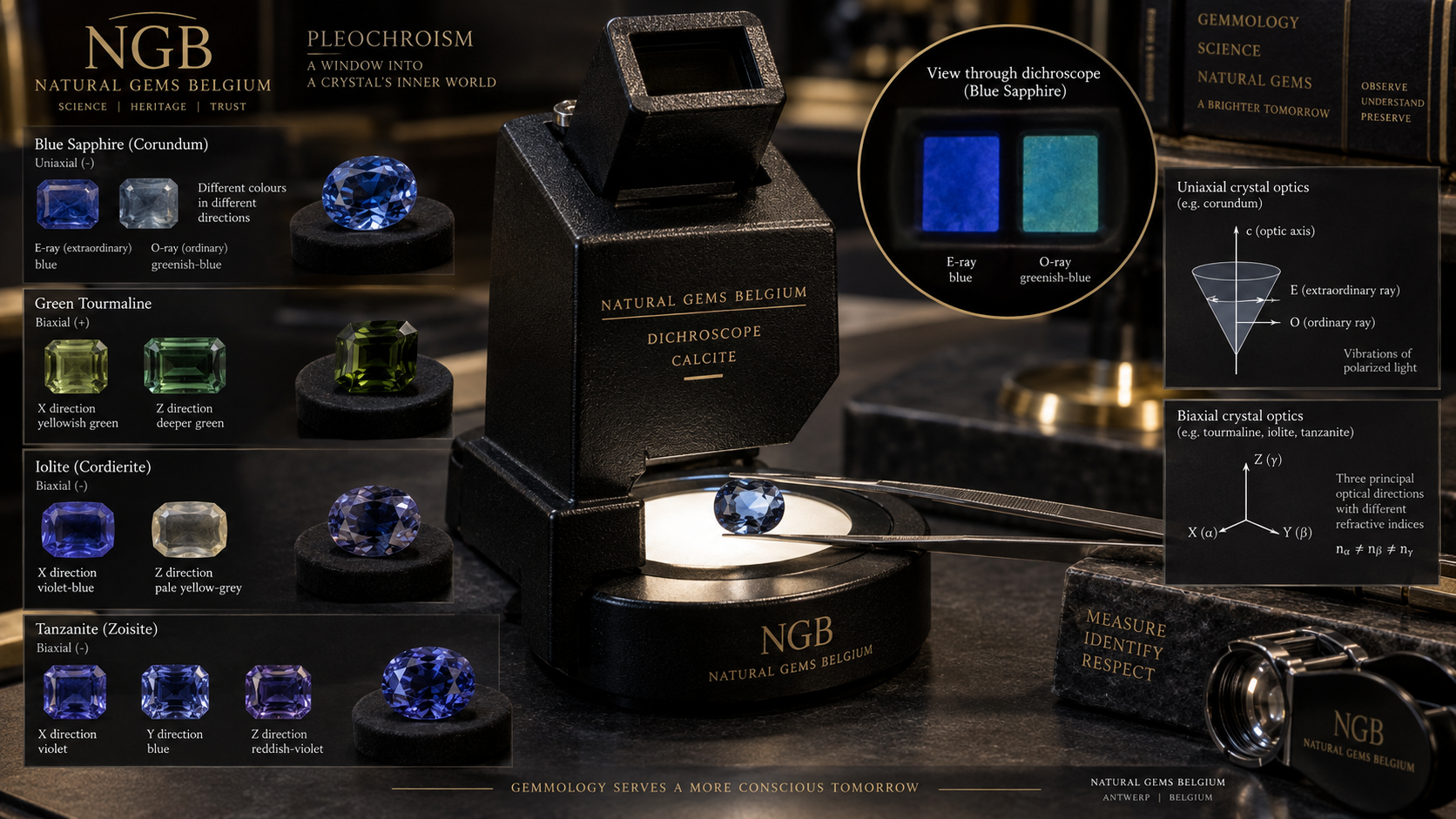
Look through a calcite dichroscope at a suitable pleochroic gemstone and you may see:
[ blue ] [ greenish blue ]
or:
[ violet-blue ] [ pale yellow-grey ]
The two windows correspond to two differently polarized light components.
Their simultaneous display makes subtle colour differences much easier to recognise than simply rotating the gemstone with the naked eye.
GIA’s current calcite dichroscope is specifically designed to display pleochroic colours simultaneously in sharp contrast.
6. Calcite Versus Polarizing Dichroscopes
Not every dichroscope uses calcite.
Another design uses:
polarizing filters.
GIA’s detailed discussion of pleochroism notes that calcite-type instruments are often preferable because calcite itself is colourless, while some polarizing filters may have a slight:
- green;
- grey
cast that can influence the colour impression.
Both types remain useful.
7. The London Dichroscope
Gem-A also produces the:
London Dichroscope.
It is designed for straightforward observation of dichroic and trichroic colours in both:
- rough;
- fashioned gemstones.
Gem-A includes dichroscopes in portable gemmological instrument kits because the instrument is small, inexpensive and useful in field identification.
8. Dichroism
If a gemstone can show two different directional colours, the effect is called:
dichroism.
This commonly applies to:
uniaxial gemstones.
Uniaxial gemstones have two principal optical vibration directions.
They can therefore potentially produce two different absorption colours.
9. Uniaxial Gemstones
Gemstones in the:
- tetragonal;
- trigonal;
- hexagonal
crystal systems are optically:
uniaxial.
Examples include:
- ruby;
- sapphire;
- tourmaline;
- emerald;
- aquamarine;
- quartz;
- zircon.
They possess two principal refractive indices and may display two pleochroic colours.
10. Ordinary and Extraordinary Rays
In a uniaxial gemstone, the two principal polarized light components are traditionally described as:
ordinary — o
and:
extraordinary — e.
Their vibration directions interact differently with the crystal structure.
If the gemstone absorbs the two components differently, they emerge with different colours.
That is dichroism.
11. Uniaxial Does Not Automatically Mean Visibly Dichroic
This is important.
Every coloured uniaxial anisotropic crystal has the underlying optical framework that can produce directional absorption.
But the difference may be too small to see.
Therefore:
uniaxial ≠ automatically strong visible dichroism.
GIA specifically notes that some uniaxial gemstones display only one readily visible colour even though their optical structure is anisotropic.
12. Strong Dichroism
Some gemstones show especially obvious dichroism.
Important examples include:
- blue sapphire;
- many tourmalines.
GIA identifies both as classic strongly dichroic uniaxial gemstones.
Their directional colour difference can sometimes be seen without an instrument.
The dichroscope makes it easier to isolate.
13. Trichroism
Biaxial gemstones have three principal vibration directions.
They can therefore potentially display:
three different directional colours.
This is:
trichroism.
The three optical vibration directions are commonly labelled:
X, Y and Z
or associated with:
α, β and γ.
14. Biaxial Gemstones
Gemstones in the:
- orthorhombic;
- monoclinic;
- triclinic
crystal systems are optically:
biaxial.
Examples include:
- iolite;
- tanzanite;
- topaz;
- chrysoberyl;
- andalusite;
- kunzite.
Some can show spectacular trichroism.
15. Why a Dichroscope Shows Only Two Colours at Once
A trichroic gemstone can possess three principal directional colours.
Yet a conventional dichroscope displays only:
two at a time.
Why?
Because when light travels through the crystal in one direction, the two permitted vibration directions lie perpendicular to the direction of travel.
The third principal direction is not simultaneously represented in that same view.
To find all three colours, the gemstone must be examined from several directions.
16. Tanzanite
Tanzanite is one of the best-known examples of strong pleochroism.
It belongs to the mineral:
zoisite
and is optically biaxial.
GIA describes tanzanite as showing different colours in three crystal directions.
Historically documented pleochroic components include combinations of:
- blue;
- violet;
- yellow-green or brownish colour.
Most commercial tanzanite is heated, reducing much of the yellow-green or brown component and emphasising blue and violet.
17. Heating Does Not Remove Tanzanite’s Optical Anisotropy
Heating tanzanite changes its colour balance.
It does not convert zoisite into an isotropic crystal.
The gemstone remains:
- biaxial;
- anisotropic.
After heating, the pleochroic colours may become less diverse visually, with blue and violet dominating.
The underlying optical structure remains.
18. Iolite
Iolite is another spectacular pleochroic gemstone.
It is the gem variety of:
cordierite.
GIA describes iolite as strongly pleochroic, with directional colours that can include:
- violet-blue;
- blue;
- pale yellow to colourless.
This effect is so strong that the orientation of an iolite crystal can dramatically change its apparent colour.
19. Why Iolite Is an Excellent Training Stone
For someone learning to use a dichroscope, iolite is particularly useful because its directional colours can be striking.
A single specimen may produce very different impressions as it is rotated.
This helps demonstrate immediately that pleochroism is:
directional absorption
rather than simple colour zoning.
20. Sapphire
Blue sapphire is another classic dichroscope specimen.
Sapphire is:
- corundum;
- trigonal;
- uniaxial.
Many blue sapphires display two directional blue components.
Depending on chemistry and orientation, these may appear as combinations such as:
- blue;
- greenish blue;
- violetish blue.
The exact colours vary between specimens.
21. Ruby
Ruby is also corundum.
It therefore shares sapphire’s:
- trigonal structure;
- uniaxial optical character.
Ruby can show directional differences in its red colour.
The dichroscope can contribute evidence separating ruby from some singly refractive red gemstones.
22. Ruby Versus Red Spinel
This is one of the classic practical uses of the dichroscope.
Ruby
Doubly refractive corundum.
Can show dichroism.
Spinel
Cubic.
Singly refractive.
Does not show true crystallographic pleochroism.
GIA specifically describes its calcite dichroscope as useful for quickly separating doubly refractive ruby from singly refractive materials such as red spinel and garnet.
23. But Never Use the Dichroscope Alone
Suppose you see a red gemstone and find two colours.
That supports:
anisotropic coloured material.
It does not automatically prove:
natural ruby.
Synthetic ruby is also corundum.
Other doubly refractive red gemstones exist.
Always combine the result with:
- RI;
- microscopy;
- spectrum;
- other observations.
24. Tourmaline
Tourmaline is famous for strong pleochroism.
GIA explicitly lists pleochroism among the group’s notable optical effects.
Depending on variety, different orientations may display substantial differences in:
- tone;
- hue;
- saturation.
This effect is highly important to gemstone cutters.
25. Tourmaline Cutting Orientation
Imagine a tourmaline crystal with:
- a very dark colour along one direction;
- a much brighter attractive colour along another.
A cutter must decide how to orient the table.
The goal may be to:
- maximise attractive hue;
- prevent excessive darkness;
- preserve weight.
Pleochroism therefore affects commercial cutting decisions, not merely identification.
26. Pleochroism Can Make a Stone Too Dark
Strong directional absorption is not always beneficial.
Some tourmaline rough can be so strongly absorbing along one crystallographic direction that the stone appears nearly:
black
when cut incorrectly.
Understanding pleochroism before faceting can therefore prevent a valuable piece of rough from becoming an unattractive finished stone.
27. Emerald
Emerald is beryl:
- hexagonal;
- uniaxial;
- doubly refractive.
It can show directional green colour differences.
These may range between:
- green;
- bluish green;
- yellowish green
depending on chemistry and individual stone.
Pleochroism can support the broader identification of anisotropic green material.
28. But Emerald Pleochroism Does Not Prove Geographic Origin
A Colombian emerald and a Zambian emerald remain the same mineral species:
beryl.
Both retain the same underlying uniaxial optical architecture.
The dichroscope cannot normally tell you:
- Colombia;
- Zambia;
- Afghanistan.
Geographic origin requires very different evidence.
29. Alexandrite
Alexandrite is the colour-change variety of:
chrysoberyl.
It is:
- orthorhombic;
- biaxial;
- trichroic.
Its colour behaviour is especially complex because two different phenomena can operate simultaneously:
pleochroism
and:
colour change.
30. Pleochroism Is Not Colour Change
These terms must not be confused.
Pleochroism
Colour changes when:
crystal orientation changes.
The illumination can remain the same.
Colour Change
Colour changes when:
the spectral composition of the light source changes.
The gemstone may remain in the same orientation.
Alexandrite can display both effects.
31. Why Alexandrite Is Complicated
Alexandrite has three principal pleochroic directions.
It also absorbs light in a way that causes different overall colour impressions under:
- daylight-type illumination;
- incandescent-type illumination.
Its face-up appearance therefore results from an interaction between:
- pleochroism;
- cut;
- orientation;
- light source;
- internal reflections.
GIA research confirms that cut and multiple reflections can strongly mix the three directional colours in fashioned alexandrite.
32. Pleochroism Is Not Colour Zoning
Colour zoning occurs when different physical regions of a gemstone contain different:
- trace-element concentrations;
- defects;
- colour intensity.
Pleochroism occurs because the same region of crystal absorbs polarized light differently according to direction.
These are fundamentally different phenomena.
33. How to Separate Zoning from Pleochroism
Suppose a sapphire looks darker on one side.
Possible explanations include:
- colour zoning;
- pleochroism;
- cut-related path-length differences;
- reflections.
Use the dichroscope.
If the colour difference is caused by pleochroism, the two adjacent polarized windows should show different directional colours from the same illuminated area.
Colour zoning will remain spatially associated with a particular region of the stone.
34. Path Length Can Imitate Pleochroism
A gemstone can appear darker where light travels through more material.
This follows basic absorption behaviour.
GIA provides the example of tsavorite garnet: its ends can look darker than the centre because the light travels a longer path, despite garnet being singly refractive and incapable of true crystallographic pleochroism.
This is why visible colour variation alone is not proof of pleochroism.
35. Prepare a Suitable Light Source
Pleochroism is easiest to observe with:
- strong;
- neutral;
- diffused
transmitted light.
A daylight-equivalent gemmological lamp is useful.
Avoid strongly coloured surroundings.
The light source should be bright enough to pass through the stone without overwhelming subtle colour differences.
36. White Background
A neutral white background helps prevent surrounding colours from influencing perception.
Gemstone colour observation is surprisingly susceptible to:
- coloured walls;
- clothing;
- warm light;
- reflected surroundings.
Keep the observation environment as neutral as practical.
37. Hold the Dichroscope Close to the Stone
Place the gemstone in front of the light.
Bring the dichroscope close to the gemstone.
Look through the eyepiece.
You should see the instrument’s two comparison windows.
Move the stone until the same region appears clearly in both fields.
38. Focus on One Region
Do not compare two completely different parts of a zoned gemstone.
The dichroscope should ideally compare two polarization components passing through approximately the:
same area.
Otherwise colour zoning may contaminate the comparison.
39. Rotate the Dichroscope
Rotate the dichroscope around its long viewing axis.
This changes the orientation of the separated polarization components relative to the gemstone.
The colour contrast between the two windows can:
- strengthen;
- weaken;
- reverse.
Search for the orientation showing the clearest difference.
40. Rotate the Gemstone Too
Do not examine only one orientation.
Rotate and tilt the gemstone.
For uniaxial stones, pleochroism can change strongly depending on the angle between the viewing direction and the optic axis.
For biaxial gemstones, several directions may be necessary to find all important colours.
41. Uniaxial Orientation Matters
In a uniaxial gemstone, GIA explains that:
- viewing parallel to the c-axis produces essentially one principal colour;
- viewing at right angles to the c-axis produces the strongest dichroic separation.
Therefore a strongly dichroic stone can appear almost non-pleochroic from one direction.
42. Never Conclude “No Pleochroism” from One View
This follows directly.
If two windows look identical:
- rotate the dichroscope;
- rotate the gemstone;
- tilt the gemstone;
- try another facet.
Only after several orientations should you record:
no visible pleochroism detected.
Even then, the gemstone may still be doubly refractive but weakly pleochroic.
43. Biaxial Stones Need More Directions
A biaxial crystal can possess three principal colours.
To find them, examine several mutually different directions.
GIA explains that different viewing directions combine the X, Y and Z vibration components differently.
A single dichroscope view can show only two of the three possible principal components.
44. Strong Versus Weak Pleochroism
Pleochroism can be described qualitatively as:
- weak;
- moderate;
- strong.
The classification is observational.
It describes how distinct the directional colours appear.
Do not confuse pleochroic strength with:
- colour quality;
- saturation grade;
- gemstone value.
45. A Strong Reaction Is Not Automatically Better
Iolite’s strong pleochroism is scientifically fascinating.
But the pale directional component can create cutting challenges.
Tourmaline’s strong absorption may make one direction unattractively dark.
Pleochroism is a property.
Whether it improves beauty depends on how the gemstone is oriented and cut.
46. Record the Actual Colours
Instead of writing only:
Strong dichroism
record something such as:
Strong dichroism: violetish blue / greenish blue
or:
Moderate dichroism: red / purplish red
This creates a much more useful gemmological record.
47. Use Neutral Colour Language
Avoid decorative descriptions such as:
ocean blue
or:
royal flame red
during technical examination.
Use controlled terms such as:
- blue;
- greenish blue;
- violetish blue;
- purplish red;
- yellowish green.
Observation should remain repeatable.
48. Pleochroism Can Support Species Identification
Suppose an unknown red gemstone has:
- RI consistent with corundum;
- DR reaction in the polariscope;
- visible red/purplish-red dichroism.
The evidence converges toward:
ruby.
If instead it has:
- RI near spinel;
- SR polariscope reaction;
- no true pleochroism,
spinel becomes more likely.
This is how classical gem instruments work together.
49. Pleochroism Alone Rarely Identifies a Stone
Many different species can show:
- green/green pleochroism;
- blue/blue pleochroism;
- red/purple pleochroism.
Directional colour therefore narrows possibilities.
It rarely determines identity alone.
Always compare with measurable physical properties.
50. Synthetic Gemstones
A synthetic gemstone generally retains the crystal structure of its natural counterpart.
Therefore:
synthetic ruby can be dichroic.
synthetic sapphire can be dichroic.
A dichroscope cannot simply distinguish:
natural versus synthetic corundum.
Microscopy and other laboratory evidence remain necessary.
51. An Interesting Corundum Orientation Clue
GIA’s detailed pleochroism research describes an interesting historical observation.
Natural ruby and sapphire are often fashioned with the table approximately perpendicular to the c-axis.
Viewed through the table in this orientation, little pleochroism may be visible.
Verneuil synthetic corundum is often cut from boule material with a different typical orientation and may display stronger table-view dichroism.
This can provide supporting evidence in suitable cases—but it is not a standalone natural/synthetic test.
52. Why It Is Only Supporting Evidence
Cutters can orient stones differently.
A natural sapphire can be cut unusually.
A synthetic sapphire can be oriented deliberately.
Therefore orientation-dependent pleochroism should never replace:
- microscopy;
- growth-structure analysis;
- spectroscopy;
- laboratory confirmation.
53. Singly Refractive Stones
Ideal singly refractive materials cannot show true crystallographic pleochroism.
Examples include:
- spinel;
- garnet;
- diamond;
- glass.
If colour appears to change directionally in one of these materials, investigate other causes.
54. Other Causes of Apparent Colour Difference
Possible alternatives include:
- colour zoning;
- path-length difference;
- coloured inclusions;
- facet reflections;
- strain-related optical effects;
- illumination changes.
Do not rename every colour variation:
pleochroism.
55. Pleochroism Versus Dispersion
Dispersion separates white light into spectral colours because refractive index varies with wavelength.
Pleochroism involves:
different absorption of polarized components.
They are unrelated optical mechanisms.
A diamond can show strong dispersion while lacking true pleochroism.
56. Pleochroism Versus Fluorescence
Fluorescence is light emitted after excitation—commonly by ultraviolet radiation.
Pleochroism concerns directional absorption of transmitted polarized light.
A ruby may show both:
- red fluorescence;
- directional pleochroism.
Again, different optical phenomena can coexist in one gemstone.
57. Pleochroism and Colour Grading
A faceted gemstone’s visible face-up colour is not simply one of its dichroscope colours.
Internal reflections mix several optical components.
GIA emphasizes that the apparent colour of faceted pleochroic gemstones results from a synthesis of:
- directional absorption;
- cut;
- light paths;
- orientation;
- reflections.
The dichroscope isolates components.
It does not replace face-up colour evaluation.
58. Pleochroism and Faceting
For a cutter, pleochroism can be commercially important.
The orientation chosen before cutting can determine:
- final hue;
- final tone;
- saturation;
- yield.
The cutter may deliberately orient the table to favour a particular pleochroic component.
59. Tanzanite Cutting
Tanzanite demonstrates this beautifully.
GIA notes that cutters can orient tanzanite to favour different combinations of:
- blue;
- violet.
The final face-up colour therefore depends partly on rough orientation before cutting.
60. Weight Versus Colour
The ideal colour orientation may require cutting away more rough.
A cutter therefore faces a trade-off:
maximum weight
versus:
maximum colour quality.
Pleochroism can directly influence this economic decision.
61. Rough Gemstones
The dichroscope can be extremely useful before faceting.
Rough crystals may provide access to:
- c-axis direction;
- perpendicular directions;
- multiple natural crystal faces.
Examining pleochroism can help determine the best cutting orientation.
62. Cabochons
Transparent and translucent cabochons can also show pleochroism.
The curved surface means many optical directions may be encountered simultaneously.
The reaction can therefore be less geometrically straightforward than in well-oriented rough.
Nevertheless, useful directional colour information can often be obtained.
63. Mounted Gemstones
A mounted gemstone can sometimes be examined with a dichroscope if sufficient transmitted light passes through it.
The setting may block:
- pavilion light;
- side views;
- rotation.
Loose stones generally permit a more complete examination.
64. Dark Stones
Very dark gemstones can be difficult.
If too little light passes through the material, both dichroscope windows may look nearly black.
Use:
- stronger transmitted illumination;
- thinner edge areas;
- lighter zones
where appropriate.
Do not mistake darkness for absence of pleochroism.
65. Very Pale Stones
The opposite problem occurs in very pale gemstones.
The absorption difference may be so weak that both windows appear nearly colourless.
This does not prove the stone is singly refractive.
Use the:
refractometer and polariscope
to establish optical character.
66. Colourless Gemstones
A completely colourless anisotropic gemstone can be doubly refractive yet show:
no colour pleochroism
because there is essentially no colour absorption to separate.
Pleochroism is therefore not synonymous with birefringence.
67. Birefringence Versus Pleochroism
This distinction is fundamental.
Birefringence
Difference between refractive indices in an anisotropic crystal.
Pleochroism
Difference in colour produced by differential absorption along optical directions.
A gemstone can be birefringent without showing obvious visible pleochroism.
68. Polariscope Versus Dichroscope
The previous NGB guide introduced the polariscope.
The two instruments answer different questions.
Polariscope
Does optical behaviour change with direction?
Useful for:
- SR/DR;
- aggregate;
- ADR;
- optic figures.
Dichroscope
Does colour absorption change with direction?
Useful for:
- dichroism;
- trichroism;
- orientation.
Together they describe different consequences of optical anisotropy.
69. Refractometer Versus Dichroscope
The refractometer measures:
refractive index.
The dichroscope observes:
directional colour absorption.
For example, corundum can show:
- RI around 1.762–1.770;
- birefringence around 0.008–0.010;
- uniaxial DR behaviour;
- dichroism.
Different instruments reveal different parts of one crystal structure.
70. Microscope Versus Dichroscope
The microscope can show:
- inclusions;
- growth structures;
- zoning;
- treatment features.
The dichroscope can help determine whether visible colour differences are truly pleochroic.
If a sapphire contains strong blue zoning, microscopy can map the physical zone while dichroscopic examination investigates directional absorption.
71. The Handheld Nature Is Valuable
A dichroscope requires:
- no electricity;
- no contact liquid;
- almost no setup.
This makes it valuable:
- at gem fairs;
- during rough examination;
- in field work;
- beside a microscope.
It is one of the simplest professional gem instruments.
72. But Simple Does Not Mean Foolproof
The instrument is mechanically simple.
The interpretation is not always simple.
Errors often come from:
- wrong orientation;
- weak lighting;
- colour zoning;
- path-length differences;
- very dark material;
- assumptions based on expected identity.
Good technique matters more than instrument complexity.
73. Common Beginner Mistakes
Looking in Only One Direction
Pleochroism may disappear along particular axes.
Using Weak Light
Subtle colour differences become impossible to see.
Comparing Different Parts of a Zoned Stone
This confuses zoning with pleochroism.
Naming the Stone from Two Colours Alone
Many species overlap.
Assuming Every DR Stone Shows Strong Pleochroism
Some show very weak colour differences.
Assuming No Pleochroism Means SR
Orientation or low saturation can hide it.
Confusing Colour Change with Pleochroism
They depend on different variables.
Ignoring Cut Orientation
Faceted stones can mix pleochroic components strongly.
74. Common Interpretation Errors
“Two colours mean ruby.”
Incorrect.
Many anisotropic gemstones are pleochroic.
“No two colours means spinel.”
Incorrect.
You may be looking along the optic axis of an anisotropic stone.
“This tanzanite shows three colours at once in the dichroscope.”
Not in one conventional view.
A dichroscope displays two components at a time; the third is found through another orientation.
“A darker end facet proves pleochroism.”
Not necessarily.
Longer optical path length can produce darker areas even in singly refractive stones.
“Strong table-view dichroism proves synthetic sapphire.”
Incorrect.
Orientation can provide supporting clues but is not conclusive.
75. Evidence Classification
| Statement | Classification |
|---|---|
| Pleochroism is directional colour variation in anisotropic coloured gemstones | Established optical principle |
| Pleochroism arises from differential absorption of polarized vibration directions | Established optical principle |
| Uniaxial gems can potentially show two principal pleochroic colours | Established optical crystallography |
| Biaxial gems can potentially show three principal pleochroic colours | Established optical crystallography |
| A dichroscope normally shows two polarized colours simultaneously | Established instrument principle |
| Sapphire and tourmaline can show strong dichroism | Established gemmological observation |
| Tanzanite and iolite can show strong trichroism | Established gemmological observation |
| Every doubly refractive coloured stone shows obvious pleochroism | Incorrect |
| Singly refractive materials show true crystallographic pleochroism | Incorrect |
| Colour zoning is the same phenomenon as pleochroism | Incorrect |
| Pleochroism alone proves natural gemstone origin | Incorrect |
| A synthetic gemstone can display the same fundamental pleochroism as its natural counterpart | Established crystallographic principle |
| Pleochroism can influence cutting orientation and face-up colour | Established lapidary principle |
76. A Repeatable Dichroscope Routine
Use the same sequence for every suitable coloured gemstone.
Step 1 — Establish Good Illumination
Use strong neutral transmitted light.
Step 2 — Choose One Area
Avoid obvious colour zoning where possible.
Step 3 — Hold the Dichroscope Close
Bring the instrument close to the stone.
Step 4 — Observe Both Windows
Check whether their colours differ.
Step 5 — Rotate the Dichroscope
Search for maximum colour separation.
Step 6 — Rotate the Gemstone
Try several directions.
Step 7 — Tilt the Stone
Especially important with uniaxial material.
Step 8 — Record the Colours
Example:
blue / greenish blue
not simply:
positive pleochroism.
Step 9 — Estimate Strength
Weak, moderate or strong.
Step 10 — Compare with Other Results
Use:
- RI;
- birefringence;
- polariscope;
- microscope;
- spectrum.
Step 11 — Conclude Conservatively
Pleochroism supports identification.
It rarely completes the identification by itself.
77. A Practical Blue-Stone Example
Suppose an unknown blue gemstone has:
- RI 1.762–1.770;
- DR uniaxial polariscope reaction;
- blue/greenish-blue dichroism;
- corundum-type inclusions.
The evidence converges strongly toward:
blue sapphire.
But additional questions remain:
- natural or synthetic?
- heated or unheated?
- geographic origin?
The dichroscope cannot answer those by itself.
78. A Practical Red-Stone Example
An unknown red stone gives:
- RI approximately 1.718;
- SR polariscope reaction;
- no true pleochroism.
This is consistent with:
spinel.
A ruby would normally show:
- higher RI;
- DR reaction;
- potential dichroism.
The instruments reinforce one another.
79. A Practical Blue-Violet Example
An unknown blue-violet gemstone shows:
- strong directional blue and violet components;
- biaxial optical behaviour;
- RI around the zoisite range.
Tanzanite becomes a strong possibility.
Its pleochroism then contributes to the overall identification rather than functioning alone.
80. A Practical Iolite Example
An unknown violet-blue stone gives:
- relatively low RI around the cordierite range;
- biaxial behaviour;
- exceptionally strong blue/violet versus pale yellowish directional colours.
This combination strongly supports:
iolite.
Few common blue gemstones display directional colour contrast as dramatically.
81. Recording Good Data
A useful gemmological note might read:
Dichroscope: strong dichroism; deep blue and greenish blue. Maximum separation observed through pavilion direction.
For a biaxial stone:
Dichroscope: strong pleochroism; violet-blue, blue and pale yellow-grey observed through multiple orientations.
This is much more informative than:
“dichroscope positive.”
82. What the Dichroscope Is Excellent At
The dichroscope is particularly effective for:
- confirming visible pleochroism;
- distinguishing some SR and DR coloured materials;
- supporting ruby versus spinel investigation;
- recognising strongly pleochroic tourmaline;
- studying iolite and tanzanite;
- determining rough orientation before faceting;
- separating pleochroism from some apparent colour variations.
It accomplishes this with remarkably little equipment.
83. What the Dichroscope Cannot Tell You
A dichroscope generally cannot determine by itself:
natural versus synthetic
heated versus unheated
fissure filled versus untreated
geographic origin
exact trace-element chemistry
overall gemstone quality
Those questions require other tests.
84. Why It Still Matters in Modern Gemmology
Modern laboratories use sophisticated instruments including:
- Raman spectroscopy;
- FTIR;
- UV-Vis-NIR;
- photoluminescence;
- trace-element analysis.
Yet GIA’s current Gem Identification curriculum still requires students to use a:
dichroscope
alongside:
- refractometer;
- polariscope;
- microscope;
- spectroscope.
The reason is simple.
The instrument reveals a fundamental property of the gemstone directly and quickly.
85. The Most Important Habit
Do not begin by asking:
“What gemstone has these two colours?”
Begin with:
“What directional colour behaviour do I actually observe?”
Then record:
- colours;
- strength;
- viewing direction;
- repeatability.
Only after that should the result be compared with possible species.
This prevents expectation from controlling observation.
Conclusion
The dichroscope is one of the simplest instruments in classical gemmology.
But the optical science behind it is remarkably rich.
A coloured anisotropic gemstone does not necessarily absorb light equally in every crystallographic direction.
Different polarized vibration components can interact with different arrangements of atoms and colour-causing elements.
One direction may transmit:
blue.
Another:
greenish blue.
A biaxial gemstone may possess three distinct directional colour components.
The dichroscope separates two of those polarized components so the observer can compare them side by side.
This makes invisible crystal orientation visible through:
colour.
Ruby and sapphire can show dichroism.
Tourmaline can display dramatic directional absorption.
Iolite can transform from deep violet-blue to almost colourless or yellowish-grey depending on direction.
Tanzanite can preserve several directional colours within a single crystal.
But pleochroism must be interpreted correctly.
A doubly refractive gemstone may show only weak visible colour separation.
Looking along an optic axis can hide the effect.
Colour zoning can imitate directional variation.
Longer light paths can create darker facets even in singly refractive materials.
Synthetic gemstones can preserve exactly the same fundamental pleochroism as natural gemstones of the same mineral species.
And a dichroscope cannot reveal geographic origin or treatment history by itself.
So the professional sequence remains:
observe → rotate → compare → record → confirm.
The refractometer measures how strongly the stone refracts light.
The polariscope reveals whether that behaviour changes with direction.
The dichroscope asks the next question:
Does the colour change with those directions too?
That progression turns gemstone examination from visual guesswork into structured optical evidence.
And that is precisely why such a small instrument remains useful in modern gemmology.
References & Further Reading
Hughes, R. W. — “Pleochroism in Faceted Gems: An Introduction.” Gems & Gemology, Fall 2014, Gemological Institute of America.
The principal scientific reference for this guide. It explains the optical basis of pleochroism, dichroism and trichroism; the X, Y and Z vibration directions of biaxial gems; correct dichroscope orientation; the effects of faceting and light path; and the distinction between genuine pleochroism and colour zoning or path-length effects. GIA — Pleochroism in Faceted Gems
Shen, C., Palke, A., Sun, Z. & Fairchild, M. D. — “How to Calculate Color from Spectra of Uniaxial Gemstones.” Gems & Gemology, Spring 2021.
Modern scientific treatment of directional absorption in uniaxial crystals, explaining how ordinary and extraordinary polarized vibration directions can produce different absorption spectra and therefore different pleochroic colours. GIA — Color from Spectra of Uniaxial Gemstones
Gemological Institute of America — Calcite Dichroscope.
Current GIA instrument reference describing simultaneous observation of pleochroic colours and the practical separation of doubly refractive ruby from singly refractive red spinel and garnet. GIA Calcite Dichroscope
Gemological Institute of America — Gem Identification Course.
Current GIA professional training reference listing a dichroscope—calcite preferred—alongside the microscope, refractometer, polariscope and spectroscope as required equipment for systematic gemstone identification. GIA Gem Identification
Gemological Institute of America — Gem Identification Student Package.
Current professional equipment reference demonstrating the continuing role of the calcite dichroscope within a complete classical gemstone-testing workstation. GIA Gem Identification Instrument Package
Gem-A — Wide View Calcite Dichroscope.
Current Gem-A professional instrument designed with enlarged observation fields for easier recognition of weak dichroism and trichroism, including in small gemstones. Gem-A Wide View Calcite Dichroscope
Gem-A — London Dichroscope.
Current Gem-A reference for its portable dichroscope designed for simple observation of dichroic and trichroic colours in rough and fashioned gemstones. Gem-A London Dichroscope
Gemological Institute of America — Iolite.
Useful practical reference for one of gemmology’s most strongly pleochroic gemstones. GIA describes iolite’s violet-blue appearance together with pale yellow to colourless directional components. GIA Iolite
Gemological Institute of America — Tanzanite Description.
Authoritative reference describing the role of pleochroism in tanzanite colour and explaining how heating removes or reduces much of the yellow-green or brownish component while emphasising blue and violet. GIA Tanzanite Description
Gemological Institute of America — Tanzanite.
Concise reference identifying tanzanite as pleochroic zoisite capable of showing distinct directional colours and providing its standard gemmological properties. GIA Tanzanite
Gemological Institute of America — Gübelin Gem Project: Tourmaline.
Reference documenting pleochroism as an important optical characteristic of the highly variable tourmaline group. GIA Gübelin Gem Project — Tourmaline
Schmetzer, K. — “Pleochroism and Color Change in Faceted Alexandrite: Influence of Cut and Sample Orientation.” Gems & Gemology, Spring 2019.
Advanced study clearly separating pleochroism from colour change in alexandrite and demonstrating how crystal orientation, faceting and multiple internal reflections combine the three pleochroic colour components in finished stones. GIA — Pleochroism and Color Change in Alexandrite
Gemological Institute of America — Sapphire.
Reference for corundum’s standard RI and birefringence values, useful when dichroism is combined with refractometer and polariscope evidence in sapphire identification. GIA Sapphire
Gemological Institute of America — Spinel.
Reference confirming spinel’s cubic, non-birefringent optical behaviour, making red spinel an important comparison material when learning ruby dichroism. GIA Spinel