
Introduction
A fine faceted sapphire is not created by choosing a beautiful design and imposing it on a piece of rough.
The process begins in the opposite direction.
The rough must be understood first.
Evaluating sapphire rough for faceting therefore begins with understanding the crystal before any cutting decision is made
Natural sapphire can contain uneven colour, crystallographically controlled zoning, pleochroism, fractures, mineral inclusions, rutile silk and irregular surfaces. Its external shape may preserve substantial weight in one design and force excessive loss in another. A dark crystal may require an orientation that reduces apparent colour concentration, while pale material may benefit from an orientation that concentrates colour through a longer optical path.
This is why sapphire rough evaluation is fundamentally a problem of optimisation.
The faceter is balancing:
- colour;
- orientation;
- clarity;
- structural integrity;
- optical performance;
- finished dimensions;
- shape;
- weight retention;
- and cutting risk.
GIA notes that cutters orient sapphire rough by considering its crystal shape, colour zoning, pleochroism and overall lightness or darkness in order to achieve a desirable balance of colour, proportions and retained weight.
For valuable natural sapphire, the most important cutting decision may therefore occur before the stone ever touches a lap.
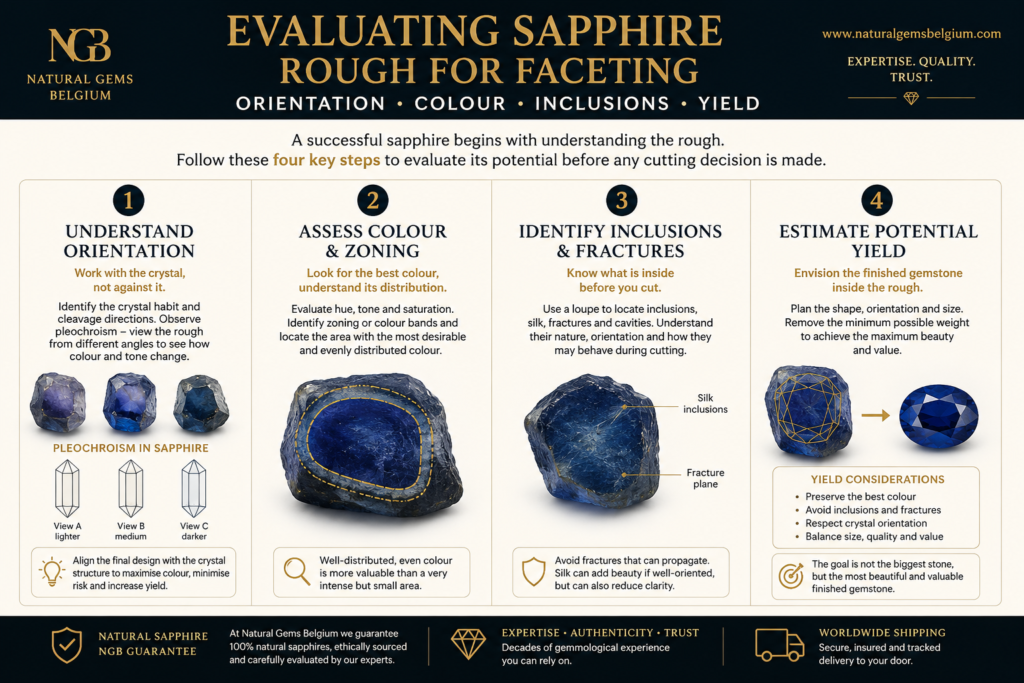
Table of Contents
1. Know the Material Before Planning the Cut
Sapphire is gem-quality corundum with the ideal chemical formula Al₂O₃.
Its principal properties relevant to the faceter include:
| Property | Sapphire / Corundum | Practical relevance |
|---|---|---|
| Mohs hardness | 9 | Slow material removal; requires suitable abrasives |
| Refractive index | approx. 1.762–1.770 | Allows strong brilliance when proportions are appropriate |
| Birefringence | approx. 0.008–0.010 | Related to its anisotropic optical behaviour |
| Optic character | Uniaxial | Orientation affects pleochroic colour |
| Cleavage | None | Advantageous for faceting |
| Toughness | Excellent | Generally durable, although fractures and parting still matter |
| Common rough issues | Zoning, silk, mineral inclusions, healed/open fractures | Can control orientation and usable yield |
| Common treatment | Heat | Treatment history may affect inclusions and commercial assessment |
Corundum has excellent toughness and no cleavage, an important advantage compared with strongly cleavable faceting materials.
But “no cleavage” must not be interpreted as “cannot break.”
Corundum can contain fractures and structural weaknesses, and parting has been documented in some natural corundum.
The first rule is therefore:
Hardness is not the same as structural security.
2. Evaluating Sapphire Rough for Faceting : Confirm What the Rough Actually Is
Before valuable cutting time is invested, the identity of rough sold as sapphire should be reasonably established.
Depending on context and value, this can range from basic gemmological examination to laboratory testing.
Useful observations can include:
- crystal morphology;
- refractive index where a suitable polished surface exists;
- specific gravity;
- dichroism;
- spectroscopy;
- fluorescence;
- microscopic inclusions.
For high-value rough, questions of natural versus synthetic origin and treatment can materially affect commercial decisions.
A faceter should not assume that transparency, colour or visible inclusions prove natural origin.
Synthetic sapphire is corundum and can therefore share sapphire’s fundamental physical and optical properties.
The practical question before cutting is not merely:
“Can I facet this?”
It is also:
“Do I understand what I am committing to the cut?”
3. Clean the Rough Before Evaluating It
Surface contamination can disguise important information.
Clay, iron staining, oil, residue from mining or handling, and weathered surfaces may obscure:
- fractures;
- colour zoning;
- transparent windows;
- surface-reaching inclusions;
- crystal boundaries.
Clean the rough appropriately for corundum and inspect it dry and, when useful, with a suitable immersion method.
Do not grind away significant material merely to discover what is inside unless there is a clear reason.
Every exploratory window has a yield cost.
For expensive rough, planning should precede aggressive preforming.
4. Map the Rough in Three Dimensions
A faceter should mentally — or physically — map the stone before choosing a table orientation.
Examine it from multiple directions.
Record:
- maximum length;
- maximum width;
- maximum depth;
- irregular projections;
- broken surfaces;
- natural crystal faces;
- pits;
- fractures;
- transparent regions;
- inclusions;
- colour concentrations.
A useful question is:
What is the largest clean, optically useful volume inside this rough?
That volume may not align with the rough’s apparent external shape.
A large crystal can contain only a small facetable core.
Conversely, irregular rough that looks unpromising externally may contain an excellent stone if its internal structure and colour are favourable.
5. Identify the Crystal Orientation
Orientation is particularly important in corundum because sapphire is optically anisotropic and commonly pleochroic.
The rough may retain recognizable crystal morphology, although alluvial material can be rounded by transport and lose obvious external crystallographic faces.
When morphology is unclear, optical observations can help establish useful orientation information.
For faceting, the goal is not crystallography for its own sake.
The goal is understanding how orientation will influence the finished gemstone’s:
- colour;
- pleochroism;
- zoning;
- face-up appearance;
- dimensions;
- yield.
6. Pleochroism: Do Not Judge Colour from One Direction
Pleochroism occurs when an anisotropic coloured gemstone displays different colours or colour intensities according to crystallographic viewing direction.
Blue sapphire commonly shows different blue components, which can include violetish blue and greenish blue.
Cutters generally seek an orientation that presents the more desirable violetish-blue component face-up rather than emphasizing a less attractive greenish-blue direction.
This means a piece of rough does not have one simple colour.
It has an orientation-dependent colour behaviour.
Practical Assessment
View the rough through multiple directions under consistent illumination.
Where useful, use a dichroscope to compare pleochroic components.
Ask:
- Which direction produces the most attractive hue?
- Which produces excessive green, grey or darkness?
- Does the preferred orientation permit an acceptable pavilion depth?
- What weight penalty would that orientation impose?
- Can the design mix the pleochroic colours attractively?
Do not automatically sacrifice major yield for a theoretically “perfect” crystallographic orientation.
Faceting involves optimisation, not a single universal rule.
7. Colour Zoning Can Control the Entire Cut
Natural sapphire commonly displays colour zoning.
Blue sapphire may show angular bands or zones ranging from strongly coloured blue to much paler material.
Zoning should be mapped before preforming.
Rotate the rough and determine:
- where the strongest colour lies;
- its thickness;
- whether it crosses the full stone;
- whether it is near one surface;
- whether zones are angular or patchy;
- whether unwanted colour components are present.
Why a Thin Colour Zone Can Be Valuable
A sapphire does not necessarily need uniform blue colour throughout its entire volume to face up as an attractive blue gemstone.
In some Sri Lankan sapphire rough, colour can be concentrated close to the crystal surface. A skilled cutter may orient the culet into that concentrated region so that internal light paths distribute the colour through the face-up appearance.
That is an important practical principle:
Do not remove a colour zone simply because it occupies only a small part of the rough.
It may be the most valuable optical feature in the stone.
8. Pale Sapphire and Dark Sapphire Require Different Strategies
Orientation should respond to tone.
Pale Rough
Pale sapphire may benefit from:
- greater optical path length;
- strategic placement of stronger colour zones;
- designs that avoid excessive windowing;
- sufficient pavilion depth to encourage internal reflection.
Dark Rough
Dark sapphire may require the opposite approach:
- avoiding excessive depth;
- reducing concentration of already-dark colour;
- selecting an orientation that prevents extinction;
- considering a broader face-up spread rather than maximum weight.
A technically perfect meet-point design can still produce an unattractive stone if its colour becomes too dark.
For coloured gemstones, optical performance and colour management cannot be separated.
9. Inspect Inclusions Before Deciding What to Remove
Natural sapphire inclusions can include:
- rutile silk;
- zircon;
- other mineral crystals;
- healed fissures;
- open fractures;
- particulate clouds;
- negative crystals;
- growth structures.
Not every inclusion should be removed.
That would often destroy yield unnecessarily.
Instead classify each feature by its effect.
Category A — Visually Acceptable Inclusion
An inclusion may remain if it does not seriously compromise:
- beauty;
- transparency;
- structural integrity;
- durability.
Category B — Optically Disruptive Inclusion
A cloud or large crystal may substantially reduce transparency or brilliance.
The decision becomes economic:
Is the improvement worth the weight loss required to remove it?
Category C — Structural Risk
Open fractures and inclusions associated with significant stress require greater caution.
These can determine:
- preform boundaries;
- girdle placement;
- facet placement;
- whether the rough should be divided.
10. Rutile Silk Requires Special Attention
Fine rutile needles are among sapphire’s most characteristic inclusions.
Their presence is not automatically undesirable.
Fine silk can contribute to the soft or velvety appearance admired in some sapphires.
Dense oriented rutile can also produce asterism when corundum is cut appropriately as a cabochon.
Star corundum must be oriented and fashioned as a cabochon to display the phenomenon effectively.
Therefore, before deciding to facet transparent sapphire containing oriented silk, ask:
Is this material actually more valuable or beautiful as phenomenal corundum?
Faceting is not automatically the correct manufacturing choice.
A piece capable of producing a strong star sapphire may lose its most distinctive optical phenomenon if fashioned as a conventional faceted stone.
11. Examine Fractures Under Several Lighting Conditions
Fractures are among the highest-risk features in expensive rough.
Use:
- transmitted light;
- reflected light;
- fibre-optic illumination where available;
- magnification;
- immersion where appropriate.
Determine whether a fracture is:
- internal;
- surface-reaching;
- healed;
- open;
- isolated;
- connected to another inclusion;
- positioned where the girdle or culet would fall.
A fracture near the centre of a planned stone can be far more consequential than one that can be removed during preforming.
Never assume that corundum’s Mohs hardness protects it from fracture propagation.
12. Treatment History Can Affect What You See
Heat treatment can alter sapphire’s internal features.
Research on heated sapphire has documented:
- partial dissolution of rutile;
- altered inclusions;
- internal diffusion associated with dissolved titanium;
- modified fluorescence;
- changes detectable through spectroscopy.
This matters to the faceter for two reasons.
First, inclusion scenes in treated sapphire may differ from those in untreated material.
Second, if treatment status is commercially important, major recutting can remove useful surface evidence or change the practical ability to document a stone’s pre-cut condition.
For significant natural rough, record its appearance before cutting.
Photography and weight records are good professional practice.
13. Decide Whether the Rough Should Be One Stone or Several
Weight retention does not mean preserving the entire piece at all costs.
A single irregular sapphire crystal might produce:
- one large stone with poor colour and inclusions;
or:
- two smaller stones with much better colour and clarity.
The second option can be preferable.
Before sawing or splitting, map:
- colour;
- fractures;
- clean regions;
- dimensional constraints;
- likely finished outlines.
Then compare alternative yield plans.
For valuable rough, a photograph or drawing with proposed cutting planes is worthwhile before material is removed.
14. Estimate Usable Yield — Not Just Weight Yield
Suppose a piece of rough weighs 10 ct.
A plan that produces a 5 ct finished stone gives 50% weight yield.
But yield alone tells us little about success.
If another orientation produces a 4 ct sapphire with dramatically superior colour and optical performance, the lower-yield result may be far better.
A more useful concept is:
usable yield = retained material that contributes positively to the finished gemstone
Material below the girdle that adds weight but causes excessive depth, darkness or poor proportions is not necessarily valuable yield.
Cut quality involves proportions, symmetry, polish and how facets interact with light — not merely finished carat weight.
15. Choose the Outline from the Rough
Do not begin with:
“I want to cut an oval.”
Begin with:
“What outline does this rough support?”
Common sapphire shapes include:
- oval;
- cushion;
- round;
- pear;
- emerald/step-cut variations;
- radiant or mixed cuts;
- freeform precision designs.
Oval and cushion-type shapes are common in corundum partly because they can work efficiently with typical sapphire rough morphology.
A long narrow crystal may favour one outline.
A broad shallow piece may favour another.
Forcing a round into elongated rough can destroy substantial material before optical design has even begun.
16. Pavilion Depth Must Serve Optics, Not Weight Alone
Corundum’s refractive index is approximately 1.76–1.77. Its critical angle is roughly 34.4°, although actual design choice must account for the specific optical properties and geometry rather than treating one number as a universal pavilion instruction.
The practical objective is to avoid a pavilion so shallow that light leaks through the bottom and produces a window.
But simply cutting every pavilion very deep is not the solution.
Excessive depth can:
- reduce face-up size;
- retain unproductive weight;
- darken strongly saturated material;
- complicate mounting.
The best design balances internal light return with the rough’s colour and dimensions.
17. Extinction and Windowing Are Different Problems
Two common optical failures should not be confused.
Windowing
A window occurs when substantial light passes through the pavilion rather than returning toward the viewer.
The observer may appear to see through the centre of the gemstone.
Extinction
Extinction refers to areas that appear excessively dark because little useful light returns toward the viewer.
Dark sapphire can suffer from extinction even when pavilion angles are technically above the critical angle.
This is why sapphire design cannot be reduced to a critical-angle calculation.
Colour concentration, pleochroism, facet arrangement, pavilion depth and lighting all interact.
18. Preforming: Remove Material with a Reason
Once the plan is established, preforming converts rough into a manageable approximation of the intended finished stone.
Every significant removal should have a purpose:
- eliminate a dangerous fracture;
- improve outline;
- establish girdle position;
- remove unusable matrix;
- position a colour zone;
- create workable proportions.
Avoid “cleaning up” rough indiscriminately.
Material cannot be restored once removed.
With valuable sapphire, conservative preforming allows the plan to be reassessed as new internal information becomes visible.
19. Sapphire’s Hardness Changes the Cutting Process
At Mohs 9, corundum is exceptionally hard.
Diamond abrasives are widely used for sapphire cutting and polishing because efficient material removal requires an abrasive harder than corundum.
Hardness has practical consequences:
- cutting is slower than with many softer gemstones;
- coarse damage must be removed completely before later stages;
- laps must remain flat and effective;
- excessive pressure should not substitute for appropriate abrasive action.
Sapphire rewards patience.
Trying to force a hard material through a cutting sequence can create more work rather than less.
20. Pre-Polish Is Not an Optional Cosmetic Stage
A polish does not reliably repair a badly prepared facet.
Before final polishing, the facet should have:
- correct geometry;
- accurate meets;
- no deep cutting scratches;
- minimal subsurface damage;
- a consistent pre-polished surface.
If deep scratches remain, polishing them out directly can:
- take excessive time;
- round facet edges;
- move meet points;
- distort symmetry.
A professional workflow therefore treats pre-polish as the final geometry stage, not merely a rough version of polishing.
21. Polishing Sapphire
There is no single polishing recipe that every faceter uses successfully for every sapphire.
This should be stated explicitly.
Diamond is a widely used polishing abrasive for corundum, and professional lap manufacturers offer several metal and composite laps intended for sapphire with diamond or suitable oxide systems.
Experienced cutters use combinations including:
- diamond on tin-based laps;
- diamond on copper;
- diamond on ceramic;
- diamond on composite laps;
- other established corundum polishing systems.
Professional practice shows multiple successful combinations rather than one universal system.
Variables include:
- lap material;
- diamond particle size;
- lubricant;
- lap condition;
- rotational speed;
- pressure;
- crystallographic orientation of the facet.
Therefore, a serious faceter should develop a controlled polishing protocol rather than switching variables randomly whenever a problem appears.
22. Directional Behaviour Can Complicate Polishing
Although sapphire has no cleavage, its crystalline structure can produce direction-dependent cutting and polishing behaviour.
A facet that polishes easily may sit beside another that behaves differently.
This is one reason troubleshooting should be systematic.
If a facet develops persistent roughness, do not immediately assume contamination.
Check:
- Was the pre-polish genuinely complete?
- Is the lap properly conditioned?
- Is the polishing compound appropriate?
- Is excessive pressure being used?
- Is heat building?
- Does changing sweep direction alter the behaviour?
- Is the problem limited to facets of a particular orientation?
This is an area where practical lapidary experience remains important; not every polishing behaviour can be predicted solely from a gemmological property table.
23. Heat Management and Cleanliness
Faceting generates friction.
The stone and lap should not be allowed to become unnecessarily hot.
Excessive heat can:
- weaken some adhesives used for dopping;
- cause the stone to shift;
- complicate polishing;
- create avoidable risk.
Cleanliness is equally important.
Coarse abrasive contamination on a fine pre-polish or polishing lap can produce scratches that are disproportionately difficult to remove.
Professional practice should include:
- separate storage for clean polishing laps;
- clean hands and work surfaces;
- careful lap cleaning;
- controlled abrasive application;
- inspection before polishing valuable material.
24. Stop and Reassess When the Rough Reveals New Information
Natural rough is not completely predictable.
Preforming may reveal:
- a previously hidden fracture;
- stronger colour zoning;
- an unexpected inclusion;
- a cleaner region;
- a change in transparency.
Do not continue mechanically because the original plan exists.
Reassess.
A professional faceting plan is a working model, not a contract.
Changing the design early may preserve value.
Continuing a failing orientation simply because cutting has started may destroy it.
25. A Professional Sapphire Rough Evaluation Workflow
Stage 1 — Identity and Documentation
Record:
- rough weight;
- dimensions;
- photographs;
- stated origin if supplied;
- stated treatment status;
- laboratory documentation if applicable.
Stage 2 — Cleaning and Initial Observation
Examine:
- external morphology;
- surface condition;
- transparency;
- apparent colour;
- fractures.
Stage 3 — Optical Orientation
Assess:
- pleochroism;
- strongest and weakest colour directions;
- lightness/darkness;
- optic/crystal orientation where determinable.
Stage 4 — Colour Mapping
Map:
- angular zoning;
- concentrated colour bands;
- pale areas;
- undesirable secondary hues.
Stage 5 — Inclusion Mapping
Classify features as:
- acceptable;
- optically disruptive;
- structurally dangerous.
Stage 6 — Yield Planning
Compare:
- one-stone versus multi-stone options;
- possible outlines;
- expected dimensions;
- estimated finished weights;
- colour consequences.
Stage 7 — Optical Design
Select a design that respects:
- RI;
- rough depth;
- desired face-up spread;
- tone;
- colour zoning;
- pleochroism.
Stage 8 — Conservative Preforming
Remove only material justified by the plan.
Stage 9 — Cutting and Reassessment
Reinspect the stone as new surfaces expose additional information.
Stage 10 — Pre-Polish and Polish
Protect:
- facet geometry;
- meet points;
- symmetry;
- surface quality.
Stage 11 — Final Documentation
Record:
- finished weight;
- dimensions;
- cut;
- observations;
- before-and-after yield.
This creates useful professional data for future rough purchasing and cutting decisions.
26. A Rough Evaluation Scorecard
A faceter can formalise the initial assessment before cutting.
| Factor | Question |
|---|---|
| Identity confidence | Is the material reliably identified as sapphire/corundum? |
| Transparency | How much usable transparent material exists? |
| Colour quality | What are the hue, tone and saturation? |
| Pleochroism | Which orientation gives the best face-up colour? |
| Colour zoning | Can zoning be used rather than removed? |
| Inclusion burden | Which inclusions affect beauty? |
| Structural integrity | Are fractures or parting a risk? |
| Rough geometry | Which outline preserves useful material? |
| Optical depth | Is there enough depth for a sound pavilion? |
| Yield | What finished volume is realistically usable? |
| Phenomenon potential | Would cabochon cutting better preserve a star or other effect? |
| Cutting risk | How much uncertainty remains? |
The purpose is not to reduce faceting to a numerical formula.
It is to force the cutter to examine the variables before irreversible material removal begins.
27. Common Sapphire-Rough Planning Errors
Error 1 — Choosing the Design Before Studying the Rough
Better approach: Let rough geometry, colour and inclusions constrain the design.
Error 2 — Maximising Carat Weight at Any Cost
Better approach: Maximise useful optical and commercial yield.
Error 3 — Ignoring Pleochroism
Better approach: Examine multiple orientations before choosing the table direction.
Error 4 — Removing Colour Zoning Automatically
Better approach: Determine whether the zone can improve face-up colour.
Error 5 — Assuming Hardness Means the Rough Is Structurally Safe
Better approach: Inspect fractures, parting and surface-reaching inclusions.
Error 6 — Cutting Star Material as an Ordinary Faceted Stone
Better approach: Evaluate oriented silk and phenomenon potential first.
Error 7 — Trying to Polish Away Poor Pre-Polish
Better approach: Correct the surface at the appropriate abrasive stage.
Error 8 — Treating Every Sapphire with One Fixed Recipe
Better approach: Adapt to the actual rough.
28. Evidence and Professional-Practice Classification
| Statement | Classification |
|---|---|
| Sapphire is corundum with Mohs hardness 9 | Established gemmological fact |
| Corundum has no cleavage and generally excellent toughness | Established gemmological fact |
| Sapphire can show pleochroism and colour zoning | Established gemmological fact |
| Orientation can materially influence finished sapphire colour | Established gemmological and lapidary principle |
| Concentrated colour zones can sometimes be positioned to improve face-up colour | Established professional cutting practice documented by GIA |
| Rutile silk can contribute to asterism | Established gemmological fact |
| Every included sapphire should be cut to remove all inclusions | Incorrect |
| Maximum carat retention always produces the most valuable result | Incorrect |
| One polishing lap/abrasive combination is universally optimal for all sapphire | Not established; professional practice varies |
| A specific pavilion angle is ideal for every sapphire | Incorrect oversimplification |
| Visual examination of rough alone can always establish natural origin and treatment | Incorrect |
Conclusion
Faceting sapphire begins with restraint.
The first objective is not to remove material. It is to understand the material well enough to know which material should not be removed.
Natural sapphire asks the cutter to reconcile crystallography, colour, pleochroism, zoning, inclusions, structural integrity and optical design with the economic reality that every grinding operation permanently reduces the rough.
The highest weight yield is not necessarily the best yield.
The cleanest stone is not necessarily the most beautiful.
The strongest colour zone is not necessarily something to remove.
And the most elaborate faceting design is not necessarily the design the rough requires.
A successful sapphire cut emerges when the faceter recognises the internal architecture of the rough and designs around it.
That is the central transition from mechanical gemstone cutting to professional faceting.
References & Further Reading
Gemological Institute of America — Sapphire Quality Factors
Authoritative reference for the relationship between sapphire rough morphology, colour zoning, pleochroism, orientation, finished colour and weight retention.
https://www.gia.edu/sapphire-quality-factor
Gemological Institute of America — Sapphire Care and Cleaning Guide
Reference for corundum hardness, toughness, absence of cleavage and general stability.
https://www.gia.edu/sapphire-care-cleaning
Gemological Institute of America — Colored Gemstone Value Factors: Cut
Detailed professional discussion of coloured-stone cut quality, rough limitations, orientation, pleochroism, proportions, symmetry and optical performance.
https://www.gia.edu/gems-gemology/spring-2016-colored-stone-value-factors-cut
Gemological Institute of America — Inclusions in Natural, Synthetic, and Treated Sapphire
Professional visual reference for natural sapphire inclusions, heat-treatment features and synthetic corundum characteristics.
https://www.gia.edu/gems-gemology/inclusions-natural-synthetic-treated-sapphire
Gemological Institute of America — Madagascar Sapphire: Low-Temperature Heat Treatment Experiments
Detailed experimental research documenting changes to sapphire colour, rutile and diagnostic features during heating.
https://www.gia.edu/gems-gemology/summer-2023-low-temperature-heat-treatment-pink-sapphires-madagascar
Gemological Institute of America — Useful Visual Clue Indicating Corundum Heat Treatment
Practical gemmological research on inclusion alteration as evidence of corundum heating.
https://www.gia.edu/gems-gemology/spring-2018-microworld-useful-visual-clue-indicating-corundum-heat-treatment
Gemological Institute of America — Rubies and Sapphires from Snezhnoe, Tajikistan
Scientific documentation of natural corundum properties, pleochroism, twinning, inclusions and documented parting in some material.
https://www.gia.edu/gems-gemology/winter-2015-rubies-sapphires-snezhnoe-tajikistan
Ultra Tec — Polishing Laps
Professional faceting-equipment reference illustrating lap materials and polishing systems used for coloured stones including sapphire.
https://www.ultratec-facet.com/product-category/laps/polishing-laps/
International Gem Society — Corundum Polishing Survey Results
Useful practitioner reference showing that multiple successful polishing systems are used for corundum rather than one universal recipe.
https://www.gemsociety.org/article/corundum-polishing-survey/