

Introduction
Few gemstones are as immediately recognisable as emerald.
Its intense green colour has defined one of the great gemstone categories for centuries.
Yet from a gemmological perspective, emerald presents a remarkable combination of beauty and complexity.
Emerald is not an independent mineral species.
It is a variety of:
beryl
with the general chemical formula:
Be₃Al₂Si₆O₁₈
The same mineral family also produces aquamarine, morganite, heliodor and colourless goshenite.
What transforms beryl into emerald is principally the presence of trace amounts of:
- chromium;
- vanadium;
combined with sufficient green colour and saturation for the material to fall within the emerald variety.
That may sound simple.
In practice, emerald gemology and identification can involve some of the most fascinating problems in coloured-stone gemmology.
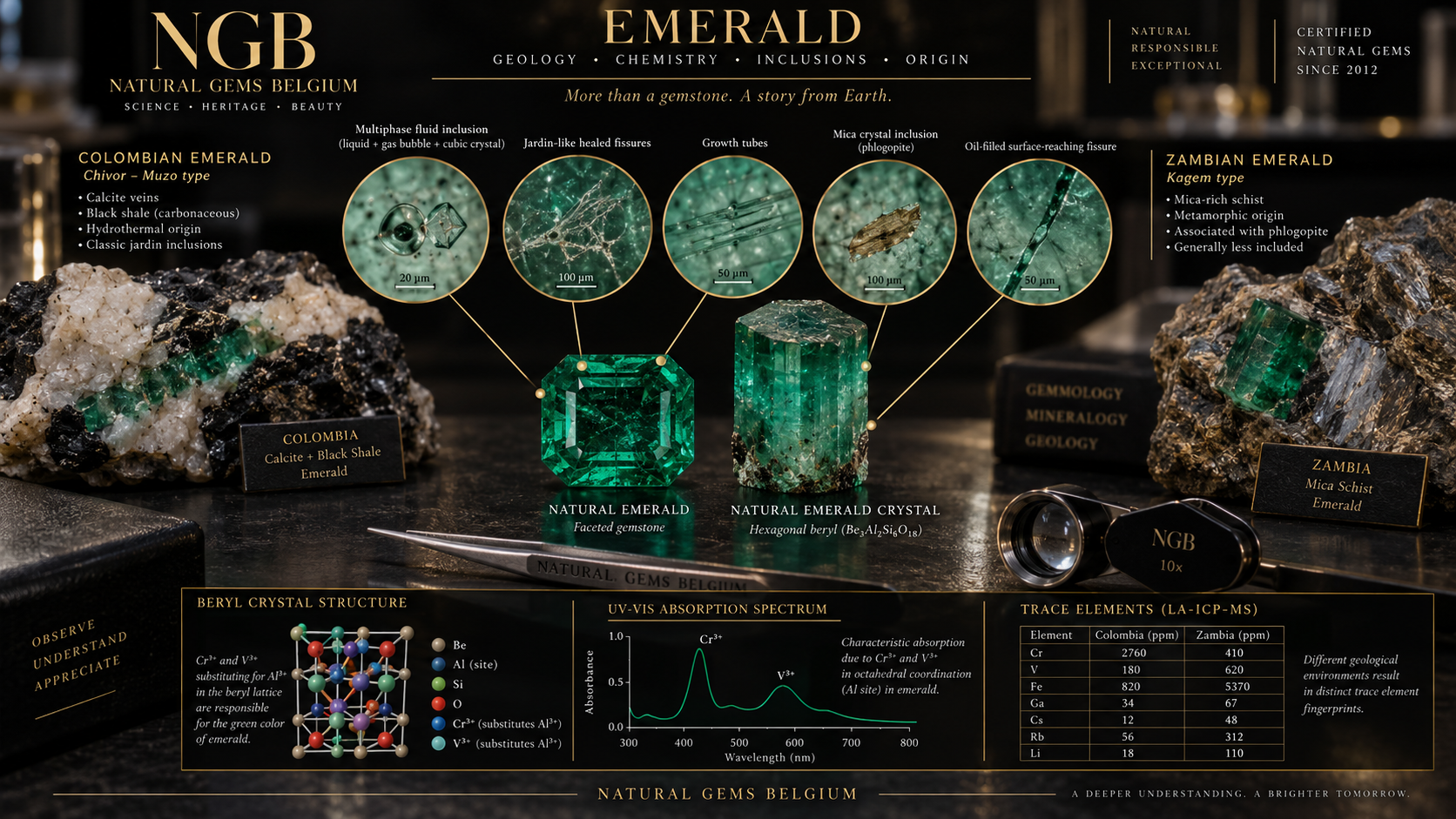
Natural emerald commonly contains an intricate internal world of:
- fluid inclusions;
- mineral crystals;
- growth tubes;
- partially healed fissures;
- colour zoning.
These internal characteristics are often collectively described by the French word:
jardin — “garden.”
Many emeralds also contain surface-reaching fissures that have been filled with oils, resins or other substances to reduce their visibility.
Synthetic emerald can reproduce essentially the same fundamental beryl chemistry and green colour while preserving microscopic evidence of an entirely different growth environment.
And geographic origin—from Colombia, Zambia, Afghanistan, Brazil or another locality—cannot safely be determined from colour or one famous inclusion alone.
Modern emerald gemmology therefore combines:
mineralogy + optics + microscopy + spectroscopy + chemistry + treatment analysis + geological comparison.
This guide develops that framework step by step.
Table of Contents
1. Emerald Is Beryl
Emerald belongs to the mineral species:
beryl.
Its idealised chemical formula is:
Be₃Al₂Si₆O₁₈
Beryl crystallises in the:
hexagonal crystal system.
Well-formed natural crystals commonly develop as six-sided prisms.
This characteristic morphology can be clearly visible in high-quality emerald rough.
2. The Beryl Family
Emerald is only one variety of beryl.
The family also includes:
Emerald
Green to bluish-green beryl.
Aquamarine
Blue to greenish-blue beryl.
Morganite
Pink to orangy-pink beryl.
Heliodor / Golden Beryl
Yellow to golden beryl.
Goshenite
Colourless beryl.
These gemstones share the same fundamental mineral species.
Their colour differences arise mainly from trace chemistry and related electronic mechanisms.
3. Basic Gemmological Properties
Typical gemmological properties of emerald include approximately:
Chemical composition: Be₃Al₂Si₆O₁₈
Crystal system: Hexagonal
Mohs hardness: 7.5–8
Specific gravity: commonly around 2.72, but variable
Refractive index: commonly around 1.577–1.583
Birefringence: approximately 0.005–0.009
Optical character: Uniaxial negative
Actual refractive-index and specific-gravity values can vary somewhat according to chemical composition and geographic population.
This variability itself can sometimes provide useful supporting evidence.
4. Emerald Is Hard—but More Fragile Than Ruby
Emerald’s Mohs hardness of approximately 7.5–8 gives it good resistance to scratching.
But hardness must not be confused with toughness.
Emeralds are commonly fractured.
Those fissures can make them significantly more vulnerable to:
- impact;
- pressure;
- cutting damage;
- setting damage.
This is why emerald requires more careful handling than ruby or sapphire despite having relatively high hardness.
5. Why the Emerald Cut Exists
The famous rectangular step cut with truncated corners is known as the:
emerald cut.
Its association with emerald is not accidental.
Natural emerald crystals often have an elongated hexagonal form, making rectangular cuts efficient for retaining rough.
The truncated corners also reduce vulnerability at sharp corners during:
- cutting;
- setting;
- wear.
A cutting style therefore became associated with the gemstone partly because of its physical behaviour.
6. Why Emerald Is Green
Chemically pure beryl is colourless.
Emerald’s green colour is principally associated with trace quantities of:
chromium — Cr³⁺
and/or
vanadium — V³⁺
substituting for aluminium in appropriate positions within the beryl crystal structure.
Iron can also modify the final appearance.
The balance between these elements influences:
- hue;
- tone;
- saturation;
- fluorescence;
- spectroscopy.
7. Chromium Does Not Have One Universal Colour
Chromium demonstrates one of the most important principles of gemstone colour science.
In ruby:
Cr³⁺ contributes red.
In emerald:
Cr³⁺ contributes green.
The element did not change.
The host mineral did.
Chromium’s electronic energy levels are influenced by the surrounding crystal field.
Corundum and beryl provide different atomic environments.
Different visible wavelengths are therefore absorbed.
8. Vanadium Can Also Produce Emerald Green
Emerald colour is not restricted to chromium-bearing beryl.
Vanadium can produce the necessary green colour as well.
Modern laboratories therefore recognise emeralds whose colour is predominantly vanadium-related.
This is why the simplistic definition:
“Emerald is chromium-coloured beryl”
is incomplete.
A more scientifically accurate statement is:
Emerald is sufficiently saturated green to bluish-green beryl whose colour is principally associated with chromium and/or vanadium.
9. The Emerald Versus Green Beryl Boundary
Not every green beryl is necessarily classified as emerald.
If the colour is too:
- pale;
- weakly saturated;
some laboratories and traders classify the material as:
green beryl.
There is no universally accepted single chemical concentration defining the boundary.
GIA uses master comparison stones to judge whether the colour is sufficiently dark and saturated to receive the emerald variety designation.
This means the mineral species is objective.
The variety boundary includes controlled visual classification.
10. Iron Modifies Emerald Colour
Iron can influence emerald appearance substantially.
Higher iron concentrations may contribute:
- blue-green components;
- darker tone;
- reduced chromium fluorescence.
This becomes particularly useful when comparing geological populations.
Some Zambian emeralds, for example, tend to contain substantially more iron than many Colombian emeralds.
But iron content alone does not determine origin.
11. Pleochroism
Emerald is optically anisotropic.
It can therefore show:
pleochroism.
Depending on viewing direction, the stone may display variations between:
- yellowish green;
- green;
- bluish green.
The strength depends on the individual stone.
Cutting orientation can influence the apparent face-up colour.
The cutter therefore works not only with shape and inclusions, but also with crystallographic optics.
12. Colour Is Usually the Most Important Quality Factor
For fine emerald, colour is generally the dominant value factor.
Highly desired colours are commonly:
bluish green to pure green
with:
- strong saturation;
- attractive tone;
- good transparency.
Too much darkness can suppress brightness.
Too little saturation can move the appearance toward ordinary green beryl.
The final judgement remains visual.
13. Emerald Clarity Is Different
Expectations for emerald clarity differ substantially from those for diamond or aquamarine.
Eye-visible inclusions are common.
Eye-clean natural emeralds are comparatively rare.
The trade consequently accepts a greater degree of inclusion than it would in many other transparent gemstones.
This does not mean clarity is irrelevant.
It means emerald must be judged according to the realities of emerald formation.
14. The “Jardin”
Emerald’s internal world is traditionally called:
jardin
—the French word for garden.
Under magnification, the stone may contain a landscape of:
- fractures;
- fluid inclusions;
- crystals;
- growth tubes;
- partially healed fissures.
The term is descriptive rather than scientific.
A jardin is not one particular type of inclusion.
It describes the overall garden-like visual character produced by many internal features.
15. Inclusions Are Not Automatically Defects
An inclusion can have several different meanings.
It may affect:
Appearance
Does it reduce transparency or brilliance?
Durability
Does a fracture reach the surface?
Identification
Does it support natural beryl?
Origin
Is it consistent with a particular geological population?
Treatment
Does it contain filler?
Scientific interest
What does it reveal about the gemstone’s formation?
These questions should remain separate.
16. Fluid Inclusions
Fluid inclusions are especially important in emerald gemmology.
They represent small quantities of fluid trapped during or after crystal growth.
A fluid inclusion can contain:
- liquid;
- gas;
- solid daughter minerals.
Different phase combinations provide information about geological conditions.
They can also become important clues in geographic-origin research.
17. Two-Phase Inclusions
A two-phase fluid inclusion might contain:
liquid + gas
A gas bubble may move as the gemstone is tilted.
The inclusion cavity itself can have:
- irregular;
- rectangular;
- elongated;
- blocky
morphology depending on the host and geological conditions.
Two-phase inclusions occur in many emerald populations.
18. Three-Phase Inclusions
The classic emerald three-phase inclusion contains:
liquid + gas + solid crystal
The solid component may be a daughter mineral that crystallised from the trapped fluid during cooling.
Some Colombian emeralds contain famous jagged cavities containing:
- liquid;
- gas bubble;
- cubic crystal.
The cubic solid is commonly associated with salts such as halite or sylvite.
19. The Old Colombian Shortcut
For many years, gemmologists often treated classic three-phase inclusions as strong evidence of:
Colombian origin.
That historical rule became deeply embedded in gem education.
Modern research has shown that it is too simplistic.
Emeralds from:
- Afghanistan;
- China;
- Zambia
can also contain multiphase inclusions that superficially resemble Colombian examples.
Origin identification therefore had to become more sophisticated.
20. Three Phases Do Not Automatically Mean Colombia
This is one of the most important modern emerald lessons.
If you see:
- liquid;
- gas bubble;
- cubic crystal
inside an emerald, do not automatically conclude:
Colombia.
Instead examine:
- cavity shape;
- size;
- daughter-mineral population;
- growth structure;
- chemistry;
- spectroscopy.
GIA research demonstrated that multiphase inclusions overlap substantially across several geographic sources.
21. Large Classic Colombian Fluid Inclusions
Some Colombian emeralds contain especially large jagged fluid inclusions.
GIA’s geographic-origin research indicates that very large examples—particularly those above roughly half a millimetre—can provide unusually strong evidence for Colombian provenance.
Smaller inclusions require more caution because similar structures occur elsewhere.
This illustrates how:
size + morphology + context
can matter more than simply counting phases.
22. Gota de Aceite
Some fine Colombian emeralds display the famous optical effect known as:
gota de aceite
Spanish for:
drop of oil.
The gemstone appears slightly roiled or softly textured.
The phenomenon results from growth structures aligned within the emerald.
It can create a highly prized soft visual appearance.
Gota de aceite strongly supports Colombian origin when properly identified, although superficially related growth textures can occur elsewhere.
23. Solid Mineral Inclusions
Emerald can contain many different mineral inclusions.
Depending on source, these may include:
- calcite;
- mica;
- pyrite;
- quartz;
- feldspar;
- amphibole;
- apatite;
- spinel;
- chlorite;
- talc.
These minerals can preserve evidence of the geological environment in which the emerald formed.
24. Mica in Schist-Hosted Emeralds
Mica is particularly common in several schist-related emerald deposits.
It may appear as:
- thin plates;
- brown or colourless crystals;
- reflective inclusions.
Zambian emeralds from Kafubu frequently contain minerals associated with mica-rich reaction zones.
Mica can therefore contribute to a geographic-origin interpretation when combined with other evidence.
It is not uniquely Zambian.
25. Growth Tubes
Emerald can contain elongated hollow or partially filled structures oriented along crystallographic directions.
These:
growth tubes
may run parallel to the crystal’s long c-axis.
Under the microscope they can appear as:
- straight channels;
- parallel tubes;
- elongated cavities.
Their appearance and associated material can contribute to identification.
26. Partially Healed Fissures
Fractures can partially heal during geological history.
They may leave networks of:
- small cavities;
- fluid inclusions;
- irregular reflective features.
These patterns can resemble fingerprints.
They contribute strongly to the characteristic jardin of many emeralds.
27. Colombia: A Geological Exception
Colombian emerald geology is unusual.
Many important global emerald deposits involve interactions between:
- beryllium-rich granitic or pegmatitic fluids;
- chromium- or vanadium-bearing mafic or ultramafic rocks.
Colombian emeralds instead occur primarily in sedimentary black-shale environments where hydrothermal fluids moved through fractures and carbonate veins.
This distinct geological setting contributes to their unusual chemistry and inclusion characteristics.
28. Colombian Emerald
Major Colombian mining districts include:
- Muzo;
- Chivor;
- Coscuez;
- La Pita.
Fine Colombian emerald is famous for:
- vivid green colour;
- often relatively low iron;
- strong chromium/vanadium signatures;
- characteristic fluid inclusions.
But Colombia produces a wide range of quality.
A country name is not automatically a quality grade.
29. Zambia: A Different Emerald Environment
Zambia represents one of the world’s most important emerald sources.
The famous Kafubu district occurs within geological systems involving:
- chromium-bearing metamafic rocks;
- beryllium-bearing fluids;
- quartz-tourmaline veins;
- mica-rich reaction zones.
These geological conditions are fundamentally different from Colombia’s black-shale deposits.
30. Zambian Emerald Chemistry
Zambian emeralds commonly contain higher iron concentrations than classic Colombian material.
This can produce:
- somewhat darker tone;
- bluish-green character;
- weaker red fluorescence.
Many fine Zambian stones nevertheless display exceptional:
- saturation;
- transparency;
- size.
Modern gem quality must be evaluated individually rather than through historical source hierarchy.
31. Afghanistan
The Panjshir Valley of Afghanistan produces important emeralds capable of exceptionally fine colour.
Their appearance can sometimes overlap strongly with Colombian emeralds.
Panjshir emeralds frequently contain:
- elongated multiphase inclusions;
- multiple daughter crystals;
- fluid inclusions.
This overlap is one reason microscope evidence alone can be insufficient for geographic origin.
32. Brazil, Russia, Ethiopia and Other Sources
Commercial emerald also comes from regions including:
- Brazil;
- Russia;
- Ethiopia;
- Zimbabwe;
- Pakistan;
- Madagascar;
- China.
Each deposit reflects a particular combination of:
- geology;
- trace chemistry;
- inclusion assemblages.
As new deposits enter the market, laboratory reference databases must continually expand.
Geographic-origin science is therefore an evolving discipline.
33. Origin Is Determined by Convergence
Modern emerald-origin analysis uses several evidence categories.
Microscopy
Researchers examine:
- fluid inclusions;
- mineral crystals;
- growth structures;
- fissures.
UV-Vis-NIR Spectroscopy
Absorption related to:
- chromium;
- vanadium;
- iron
can provide useful population information.
FTIR
Infrared spectra can provide information related to:
- water;
- channel constituents;
- treatment.
Trace-Element Chemistry
LA-ICP-MS can measure tiny concentrations of elements that help differentiate geological populations.
No single dataset should automatically dominate.
34. Why Reference Collections Matter
A laboratory cannot determine origin simply by memorising textbook photographs.
It requires comparison with stones whose origin is genuinely known.
Major laboratories maintain reference collections containing samples acquired:
- directly from mines;
- through field expeditions;
- from carefully documented sources.
Unknown emeralds are compared against these datasets.
Origin determination is therefore a statistical and comparative exercise as well as a visual one.
35. Origin Can Be Inconclusive
Not every emerald can be assigned confidently to one country.
Some geological populations overlap strongly in:
- inclusions;
- chemistry;
- spectra.
Treatment can also obscure microscopic evidence.
If the available observations do not converge sufficiently, a responsible laboratory may issue an:
inconclusive
origin result.
Scientific uncertainty is preferable to a commercially attractive guess.
36. Natural Emerald Often Contains Fissures
Emerald crystals commonly experience substantial geological stress.
Surface-reaching fissures are therefore extremely common in fashioned stones.
A fracture can scatter and reflect light strongly.
This reduces apparent:
- transparency;
- clarity.
For centuries, humans have discovered that introducing transparent substances into these fissures can make them less visible.
37. Emerald Clarity Enhancement
The principal treatment associated with emerald is:
fissure filling
or
clarity enhancement.
A transparent substance is introduced into a surface-reaching fissure.
Traditional filling materials include natural oils.
Modern filling substances can also include:
- resins;
- polymers;
- proprietary formulations.
The purpose is primarily optical.
38. Why Filling a Fissure Works
An empty fissure contains air.
Air has a very different refractive index from emerald.
The boundary therefore reflects light strongly.
If a transparent substance with an optical behaviour closer to emerald enters the crack, the boundary becomes less conspicuous.
The fracture has not necessarily disappeared.
Its visibility has been reduced.
That distinction matters.
39. Oil Does Not “Heal” the Emerald
This terminology should remain precise.
A fissure filled with oil has not necessarily physically healed.
The structural crack still exists.
The filler reduces its optical visibility.
Therefore:
clarity enhanced
is more accurate than implying geological repair.
This is different from actual recrystallisation processes discussed in flux-healed ruby.
40. Cedarwood Oil
Cedarwood oil is historically one of the most familiar emerald filling materials.
It has been widely used because transparent oil can enter fine fissures and improve their appearance.
Other oils and filling substances are also used.
A laboratory should therefore avoid assuming filler identity purely from tradition.
Analytical methods may be required where the exact substance matters.
41. Resins and Polymers
More durable synthetic fillers have also been developed.
Resins may:
- harden within fissures;
- provide more persistent filling;
- create different microscopic or spectroscopic evidence.
This has complicated treatment analysis because the term:
oiled emerald
does not accurately describe every clarity-enhanced stone.
A more general description such as:
clarity enhanced
or
fissure filled
may therefore be technically appropriate.
42. How Filling Is Detected
Under magnification, filled fissures may reveal:
- flattened gas bubbles;
- flow structures;
- flash effects;
- partially filled regions;
- differences in lustre.
Directional fibre-optic illumination can be particularly effective.
Rotating the gemstone while moving the light can make treatment evidence appear suddenly.
43. The Flash Effect
A filled fissure can sometimes produce coloured flashes when viewed from particular directions.
These may appear:
- blue;
- orange;
- violet;
- yellowish.
The colours result from optical interaction at boundaries between:
- emerald;
- filler;
- air.
A flash effect is useful evidence but must be interpreted in context.
44. Enhancement Degree Matters
Treatment is not simply:
yes / no.
The amount of clarity enhancement can differ dramatically.
GIA classifies the degree of emerald clarity enhancement as:
- Minor
- Moderate
- Significant
The classification evaluates how strongly filled fissures affect the gemstone’s face-up appearance.
It is not an overall clarity grade.
45. Minor Enhancement
A minor degree of filling indicates relatively limited effect on appearance.
The emerald may contain only a small number or extent of visibly filled surface-reaching fissures.
For fine emerald, minor enhancement is often commercially preferred to more extensive filling.
But value still depends strongly on:
- colour;
- transparency;
- cut;
- size;
- origin where relevant.
46. Significant Enhancement
A significantly enhanced emerald contains enough filled fissuring for treatment to have an obvious effect on face-up appearance.
This is materially different from a stone with only minor filling.
Consequently:
“oiled emerald”
without describing the extent can conceal important commercial information.
47. Filling Can Change With Time
Some fillers are not permanent.
Oil can:
- migrate;
- dry;
- leak;
- alter.
Resins and polymers can also change depending on:
- chemistry;
- light;
- heat;
- cleaning.
An emerald’s appearance can therefore change if its fissure filler deteriorates or is removed.
48. Re-oiling
Emeralds can sometimes be re-treated after filler has dried or been removed.
This means treatment history may involve more than one intervention.
Laboratory evaluation describes the treatment state observed when the gemstone is examined.
It cannot necessarily reconstruct every previous filling event.
49. Cleaning Emerald Safely
Because many emeralds are fractured and clarity enhanced, cleaning should be conservative.
The safest general method is:
warm water + mild soap + gentle cleaning.
Avoid routine use of:
- ultrasonic cleaners;
- steam cleaners.
Ultrasonic vibration can affect fractured stones.
Steam and heat can disturb fillers.
50. Heat Is Particularly Important
Heat can extend existing emerald fractures.
It can also affect:
- oils;
- resins;
- polymers
inside fissures.
A jeweller should therefore know that a jewellery piece contains emerald before performing high-temperature repair work nearby.
Treatment knowledge is part of practical gemstone care.
51. Natural Versus Synthetic Emerald
Synthetic emerald is genuine emerald material grown artificially.
It can possess essentially the same fundamental:
- beryl structure;
- chemical composition;
- optical properties;
- chromium/vanadium green colour
as natural emerald.
Synthetic does not mean green glass.
The distinction is:
geological growth versus artificial growth.
52. Major Synthetic Growth Methods
Commercial synthetic emerald has principally been produced by:
Flux Growth
Emerald crystallises from a high-temperature molten flux.
Hydrothermal Growth
Emerald grows from a hot pressurised aqueous solution within an autoclave.
Each method can leave characteristic internal evidence.
53. Flux-Grown Synthetic Emerald
Flux-grown emerald may contain:
- residual flux;
- veil-like inclusions;
- growth features;
- seed-related structures.
Some trapped flux can resemble natural fingerprint-like structures.
Therefore one must examine the entire internal environment.
A simple “fingerprint = natural” rule is unsafe.
54. Hydrothermal Synthetic Emerald
Hydrothermal growth attempts to reproduce some aspects of geological crystal growth using:
- water;
- dissolved chemical components;
- high temperature;
- high pressure.
Hydrothermal synthetics can show features such as:
- growth zoning;
- colour zoning;
- nailhead spicules;
- seed plates;
- tube-like inclusions.
Different manufacturers produce different characteristic features.
55. Nailhead Spicules
One classic inclusion associated with some hydrothermal synthetic emerald is the:
nailhead spicule.
It can resemble:
- a thin stem;
- terminating in a broader cone or head.
These structures are useful identification clues.
But no single synthetic process should be reduced to one inclusion photograph.
Manufacturing techniques evolve.
56. Spectroscopy Helps Separate Synthetic and Natural
Microscopy is usually the first line of investigation.
But some synthetic emeralds require additional testing.
Possible methods include:
- UV-Vis-NIR spectroscopy;
- FTIR;
- Raman;
- chemical analysis.
Hydrothermal growth environments can leave distinctive:
- water-related spectra;
- chemical residues;
- trace elements.
Modern identification relies on multiple tests when necessary.
57. Refractive Index Is Useful—but Not Enough
A refractometer can establish optical properties consistent with beryl.
That can help separate emerald from many green imitations.
But synthetic emerald is also beryl.
Its refractive index can overlap natural emerald.
Therefore RI can establish:
what mineral family the material resembles
without necessarily establishing:
natural or synthetic origin.
58. Emerald Imitations
Materials used to imitate emerald can include:
- green glass;
- synthetic spinel;
- other green gemstones;
- assembled stones.
A visually convincing green colour is not enough.
Standard gemmological tests may examine:
- refractive index;
- birefringence;
- inclusions;
- spectrum;
- specific gravity.
Again:
colour is evidence, not identity.
59. Glass Imitations
Green glass can resemble emerald surprisingly well to an inexperienced observer.
Under magnification, clues may include:
- gas bubbles;
- flow lines;
- absence of natural crystal inclusions.
Its refractive index and other properties generally differ from beryl.
A professional identification should combine observations rather than rely only on bubbles.
60. Doublets and Assembled Stones
Some emerald imitations consist of multiple layers joined together.
Examples can include:
- colourless material joined with green cement;
- natural beryl combined with coloured components.
The joining plane may be visible around:
- girdle;
- pavilion;
- edge.
Reflected and transmitted microscopy are useful for identifying assembled construction.
61. Trapiche Emerald
Some natural emeralds display extraordinary radial structures known as:
trapiche.
They may show:
- central core;
- six radial arms;
- sector-like emerald growth.
The appearance reflects crystal growth interacting with inclusions and growth sectors.
Trapiche emerald is a natural growth phenomenon, not a star produced by ordinary reflected-light asterism.
62. Trapiche Is Not the Same as Asterism
A star ruby shows asterism because oriented microscopic inclusions reflect light.
A trapiche emerald displays a fixed radial structural pattern.
The rays do not behave like a moving reflected star.
This distinction illustrates how visually similar patterns can arise from fundamentally different physical mechanisms.
63. Emerald Fluorescence
Emerald fluorescence varies substantially.
Chromium can produce red fluorescence.
Iron can suppress it.
Consequently:
- some low-iron emeralds may show visible red reaction;
- higher-iron emeralds may be weak or inert.
Fluorescence is useful supporting evidence.
It should not be used alone for geographic origin.
64. The Chelsea Filter
Historically, the Chelsea filter was used as a rapid test for emerald.
Some chromium-rich emeralds appear:
- red;
- pinkish
through the filter.
But other materials can produce similar reactions, while some genuine emeralds may respond weakly.
The Chelsea filter is therefore a screening tool rather than a definitive emerald test.
Modern gemmology has far more reliable methods available.
65. Emerald Spectroscopy
Visible-light spectroscopy can reveal absorptions associated with:
- chromium;
- vanadium;
- iron.
Characteristic chromium-related features commonly occur in red-region wavelengths.
UV-Vis-NIR spectroscopy provides much more detailed absorption data.
These spectra help investigate:
- colour mechanism;
- geographic population;
- sometimes synthetic origin.
66. Trace-Element Chemistry
Modern laboratories can analyse emerald chemistry at parts-per-million levels.
Elements commonly examined include combinations of:
- Cr;
- V;
- Fe;
- Cs;
- Li;
- Na;
- Mg;
- Ga.
The exact relationships can differ between geological deposits.
These chemical fingerprints are compared with known reference material.
67. Chemistry Does Not Replace Microscopy
Trace-element analysis can strongly narrow possible origin.
But two deposits may overlap chemically.
Microscopic evidence can then become decisive.
Likewise, a visually convincing inclusion scene may point toward one locality while chemistry argues against it.
The strongest conclusion comes when:
microscopy + spectroscopy + chemistry
agree.
68. Origin and Quality Must Remain Separate
A Colombian emerald is not automatically fine.
A Zambian emerald is not automatically darker.
An Afghan emerald is not automatically comparable to Colombia.
Every mine produces variation.
Quality depends on the individual gemstone’s:
- colour;
- transparency;
- clarity;
- cut;
- treatment;
- size.
Geographic origin is an additional characteristic.
69. Treatment and Origin Are Separate Too
A gemstone can be:
Colombian + moderately clarity enhanced
or:
Zambian + minor enhancement
or:
Afghan + no clarity enhancement detected.
Country does not tell you treatment.
Treatment does not tell you country.
A professional laboratory addresses these questions independently.
70. Why Laboratory Reports Matter
For commercially important emerald, a reputable laboratory report can help determine:
- identity;
- natural versus synthetic origin;
- clarity enhancement;
- degree of enhancement;
- geographic origin where requested and determinable.
The report provides scientific evidence about the stone’s identity and history.
It does not automatically grade its overall beauty.
71. An Emerald Report Is Not a Quality Grade
Suppose two emeralds both receive:
Natural Emerald — Colombia — Minor Clarity Enhancement
They can still differ dramatically in:
- colour;
- transparency;
- cut;
- carat weight;
- visual appeal.
Laboratory classification and commercial quality evaluation remain different tasks.
72. Common Misconceptions
Myth 1 — “Emerald is its own mineral.”
Incorrect.
Emerald is a green to bluish-green variety of beryl.
Myth 2 — “Only chromium creates emerald.”
Incorrect.
Vanadium can also be an important chromophore.
Myth 3 — “Every green beryl is emerald.”
Incorrect.
Very pale material may be classified as green beryl.
Myth 4 — “Three-phase inclusions prove Colombian origin.”
Incorrect.
Similar multiphase inclusions occur in emeralds from Afghanistan, Zambia, China and other sources.
Myth 5 — “All Colombian emeralds are better than Zambian emeralds.”
Incorrect.
Origin and individual quality are different.
Myth 6 — “Jardin means poor-quality emerald.”
Incorrect.
Jardin describes emerald’s characteristic internal inclusion landscape. Its value impact depends on transparency, visibility and durability.
Myth 7 — “Oiling heals emerald fractures.”
Incorrect.
Filling mainly reduces their optical visibility.
Myth 8 — “All clarity-enhanced emeralds contain cedarwood oil.”
Incorrect.
Oils, resins, polymers and other fillers may be used.
Myth 9 — “Synthetic emerald is glass.”
Incorrect.
Synthetic emerald is artificially grown beryl with essentially the same fundamental mineral structure as natural emerald.
Myth 10 — “Hardness 8 means emerald is extremely tough.”
Incorrect.
Emerald’s common fractures make it more vulnerable than ruby or sapphire.
73. Evidence Classification
| Statement | Classification |
|---|---|
| Emerald is green to bluish-green beryl | Established mineralogical fact |
| Beryl has ideal composition Be₃Al₂Si₆O₁₈ | Established mineralogical fact |
| Chromium and/or vanadium are major emerald chromophores | Established spectroscopic fact |
| Iron can modify colour and suppress fluorescence | Established gemmological fact |
| Emerald commonly contains eye-visible inclusions | Established gemmological observation |
| Multiphase fluid inclusions occur in multiple geographic sources | Established modern origin research |
| Three-phase inclusions alone prove Colombia | Incorrect |
| Colombian and schist-hosted emeralds form in different geological settings | Established geological fact |
| Oils and resins can reduce the visibility of surface-reaching fissures | Established treatment fact |
| GIA classifies clarity enhancement as minor, moderate or significant | Established laboratory practice |
| Fissure filling physically converts a fracture into pristine beryl | Incorrect |
| Synthetic emerald can have essentially the same mineral identity as natural emerald | Established gemmological fact |
| Flux and hydrothermal methods can produce synthetic emerald | Established synthetic-growth fact |
| Microscopy can help distinguish natural and synthetic emerald | Established laboratory practice |
| Geographic origin requires comparison with reference populations | Established laboratory methodology |
| One inclusion or one colour proves geographic origin | Incorrect |
74. A Practical Emerald Examination Framework
A systematic emerald investigation can proceed as follows.
Step 1 — Observe Without Magnification
Record:
- colour;
- tone;
- saturation;
- transparency;
- cut;
- obvious fractures.
Step 2 — Establish Basic Identity
Use appropriate gemmological properties to determine whether the stone is consistent with beryl.
Step 3 — Examine the Surface
Look for:
- surface-reaching fissures;
- cavities;
- filled openings;
- damage.
Step 4 — Darkfield Microscopy
Search for:
- crystals;
- jardin;
- fissures;
- growth structures.
Step 5 — Brightfield / Transmitted Light
Examine:
- fluid inclusions;
- colour zoning;
- growth structure.
Step 6 — Fibre-Optic Illumination
Investigate:
- filler;
- gas bubbles;
- flash effects;
- reflective fissures.
Step 7 — Natural Versus Synthetic
Evaluate the complete internal growth environment.
Step 8 — Treatment
Determine whether clarity enhancement is present and, where laboratory methodology permits, estimate its extent.
Step 9 — Origin
Only interpret geography after comparing:
- inclusions;
- spectroscopy;
- trace chemistry;
- reference data.
Step 10 — Conclude Conservatively
Report only what the evidence actually demonstrates.
Conclusion
Emerald may be defined simply as green to bluish-green beryl.
But its gemmology is anything but simple.
Its colour can arise from chromium, vanadium or both.
Iron modifies that colour and can suppress fluorescence.
The same beryl structure that produces emerald can also produce aquamarine, morganite and colourless goshenite when trace chemistry changes.
Inside natural emerald lies an extraordinarily rich microscopic world.
Fluid inclusions preserve remnants of geological fluids.
Mineral crystals record the rocks surrounding the growing emerald.
Growth tubes reveal crystallographic direction.
Partially healed fractures create the jardin that has become one of emerald’s most recognisable internal characteristics.
But those inclusions must be interpreted carefully.
A three-phase inclusion is no longer an automatic passport to Colombia.
Afghanistan, Zambia and China can produce remarkably similar structures.
Modern geographic-origin determination therefore combines microscopy with:
UV-Vis-NIR spectroscopy + FTIR + trace-element chemistry + documented reference collections.
Then there is treatment.
Natural emerald is commonly fissured.
Introducing transparent oil, resin or another filler into surface-reaching cracks can dramatically reduce their visibility.
The fracture does not vanish.
Its optical contrast changes.
The amount of filling matters enough that laboratories can classify clarity enhancement as:
minor, moderate or significant.
Synthetic emerald adds another level of complexity.
Flux-grown and hydrothermal emerald can reproduce the essential chemistry, structure and green appearance of natural beryl.
The difference lies in the growth environment—and therefore in the microscopic, spectroscopic and chemical evidence preserved within the crystal.
This leads to the central lesson of emerald gemology:
never allow one attractive clue to become the entire conclusion.
Green colour does not prove emerald.
Three phases do not prove Colombia.
A fingerprint does not automatically prove natural origin.
A famous country does not prove quality.
And a beautiful face-up appearance does not reveal how extensively fissures may have been filled.
Professional identification works through convergence:
optical properties + microscopy + treatment analysis + spectroscopy + chemistry + geological comparison.
When those independent lines of evidence agree, emerald’s internal garden becomes more than beautiful.
It becomes readable.
References & Further Reading
Gemological Institute of America — “Emerald Description.”
Authoritative introductory reference defining emerald as the green to bluish-green variety of beryl and discussing the practical boundary between emerald and lighter green beryl.
https://www.gia.edu/emerald-description
Gemological Institute of America — “Emerald.”
Reference for beryl chemistry, refractive index, birefringence, specific gravity, hardness and major emerald quality factors.
https://www.gia.edu/gia-website/emerald
Gemological Institute of America — “Emerald Quality Factors.”
Detailed discussion of emerald colour, jardin-like inclusions, cutting considerations and GIA’s minor/moderate/significant clarity-enhancement classification.
https://www.gia.edu/emerald-quality-factor
Gemological Institute of America — “Emerald Care and Cleaning Guide.”
Practical reference explaining emerald hardness and toughness, the prevalence of filled fractures, risks associated with heat, ultrasonic and steam cleaning, and conservative care recommendations.
https://www.gia.edu/emerald-care-cleaning
Palke, A. C. et al. — “Geographic Origin Determination of Emerald.” Gems & Gemology, Winter 2019, Gemological Institute of America.
Major modern reference explaining emerald geographic-origin methodology through microscopy, spectroscopy, trace-element chemistry and documented reference samples. Particularly important for Colombia, Afghanistan, Zambia, Brazil, Russia, Ethiopia and other sources.
https://www.gia.edu/gems-gemology/winter-2019-emerald-geographic-origin-determination
Saeseaw, S., Pardieu, V. & Sangsawong, S. — “Three-Phase Inclusions in Emerald and Their Impact on Origin Determination.” Gems & Gemology, Summer 2014, Gemological Institute of America.
Essential study demonstrating that three-phase and multiphase inclusions resembling Colombian examples also occur in emeralds from Afghanistan, China and Zambia. The research explains why inclusion morphology must be combined with UV-Vis-NIR, FTIR and LA-ICP-MS data.
https://www.gia.edu/gems-gemology/summer-2014-saeseaw-three-phase-inclusions-emerald
Renfro, N. D. et al. — “Chart: Inclusions in Natural, Synthetic, and Treated Emerald.” Gems & Gemology, Winter 2016, Gemological Institute of America.
Comprehensive photomicrographic reference comparing natural emerald inclusions with hydrothermal and flux synthetic features and clarity-enhancement evidence such as flattened gas bubbles and flash effects.
https://www.gia.edu/gems-gemology/winter-2016-inclusions-natural-synthetic-treated-emerald
Zwaan, J. C. et al. — “Emeralds from the Kafubu Area, Zambia.” Gems & Gemology, Summer 2005, Gemological Institute of America.
Detailed geological and gemmological study of one of the world’s most important emerald deposits, including mica-rich reaction zones, trace chemistry, physical properties and characteristic inclusions.
https://www.gia.edu/gems-gemology/summer-2005-emeralds-kafubu-zambia-zwaan
Schmetzer, K., Kiefert, L., Bernhardt, H.-J. & Zhang, B. — “Characterization of Chinese Hydrothermal Synthetic Emerald.” Gems & Gemology, Winter 1997, Gemological Institute of America.
Important reference on hydrothermal synthetic emerald and its diagnostic growth zoning, tubes, nailhead-type spicules, chemical characteristics and infrared spectroscopy.
https://www.gia.edu/gems-gemology/winter-1997-chinese-hydrothermal-synthetic-emerald-schmetzer
Schmetzer, K. et al. — “Synthetic Emeralds Grown by Richard Nacken in the Mid-1920s.” Gems & Gemology, Winter 2016, Gemological Institute of America.
Historical and analytical study of early flux-grown synthetic emeralds, illustrating characteristic trapped flux and growth-related inclusions.
https://www.gia.edu/gems-gemology/winter-2016-synthetic-emeralds-richard-nacken-1920s
GIA — “A Review of Analytical Methods Used in Geographic Origin Determination of Gemstones.” Gems & Gemology, Winter 2019.
Broad methodological reference explaining the combination of microscopy, trace-element chemistry and spectroscopy used in modern gemstone-origin determination, with a detailed emerald section.
https://www.gia.edu/gems-gemology/winter-2019-analytical-methods-geographic-origin-determination-gemstones
Gemological Institute of America — “On a Laboratory Report for a Treated Emerald, What Does F1, F2 and F3 Mean?”
Concise reference defining GIA’s emerald clarity-enhancement categories: minor (F1), moderate (F2) and significant (F3).
https://www.gia.edu/FAQ/gia-faq-analysis-grading-treated-emerald-f1-f2-f3
CIBJO — The World Jewellery Confederation, The Blue Books.
International industry standards and nomenclature resource for coloured gemstones, treatments, synthetic materials and laboratory terminology. CIBJO describes the Blue Books as living standards reviewed regularly.
https://cibjo.org/the-blue-books/
CIBJO — Emerald Guide.
Material-specific industry guidance covering emerald colour, clarity, cut, carat weight, modifications and commercial disclosure.
https://cibjo.org/the-gemstone-guides/
