A Practical Guide to Measuring One of Gemmology’s Most Useful Physical Properties
Two transparent gemstones sit on the table.
They are approximately the same size.
One feels noticeably heavier.
That difference is not simply about carat weight.
Different gemstone materials pack different amounts of mass into the same volume.
Aquamarine is relatively light.
Corundum is considerably denser.
Some garnets are denser still.
This physical property can be expressed through:
specific gravity — SG.
Specific gravity adds something especially useful to practical gemstone identification.
It is not an optical property.
The refractometer measures interaction with light.
The polariscope examines optical anisotropy.
The dichroscope reveals directional colour.
The spectroscope reveals selective absorption.
Gemstone Specific gravity asks a completely different question:
How much mass does this gemstone contain for its volume compared with water?
That makes it a valuable independent test.
It can help distinguish gemstones that:
- look alike;
- overlap in colour;
- cannot easily be measured with a refractometer;
- are rough rather than faceted.
But specific gravity is not a magical identification number.
Different gem species can overlap.
Chemical composition can shift SG.
Inclusions can influence results.
Air bubbles can create significant errors.
Fracture filling and composite construction can make the measurement misleading.
And hydrostatic weighing requires a loose stone that can safely be immersed in water.
The correct approach is therefore:
measure → calculate → compare → combine with other evidence.
Table of Contents
1. What Is Gemstone Specific Gravity?
Specific gravity compares the density of a material with the density of water.
In simplified gemmological terms:
Specific Gravity = density of gemstone / density of water
Because it is a ratio between two densities, specific gravity has:
no unit.
A gemstone with SG 4.00 is approximately four times as dense as an equal volume of water under the relevant reference conditions.
2. Specific Gravity Is Closely Related to Density
Density describes:
mass per unit volume.
Specific gravity expresses that density relative to a reference substance.
For ordinary gemmological work, the reference is:
water.
This makes SG especially convenient because water can also provide the buoyancy needed for hydrostatic measurement.
3. Why Equal-Sized Gemstones Can Weigh Differently
Imagine two gemstones occupying exactly the same volume.
One has SG:
2.65
and another:
4.00.
The second contains substantially more mass within the same physical volume.
That is why gemstones of similar dimensions can have noticeably different carat weights.
Specific gravity is therefore linked directly to:
- chemistry;
- crystal structure;
- atomic mass.
4. Atomic Composition Matters
A gemstone containing heavier elements or a more densely packed crystal structure can have higher density.
But there is no simple rule such as:
“darker gemstones are denser.”
Colour and density are separate physical properties.
A transparent colourless gemstone can be denser than a dark coloured one.
5. Gemstone SG Values Form Characteristic Ranges
Many gem species occupy recognisable SG ranges.
Approximate examples include:
Quartz: around 2.65
Beryl: around 2.70–2.80, with aquamarine commonly around 2.72
Tourmaline: commonly around 3.0–3.2 depending on composition
Spinel: commonly around 3.58–3.61
Chrysoberyl: around 3.73
Corundum: approximately 4.00
The exact value may vary with composition and inclusions.
GIA lists aquamarine at SG 2.72 and alexandrite/chrysoberyl around 3.73, illustrating how different gemstone species occupy distinct density ranges.
6. Why SG Is Useful in Identification
Suppose an unknown blue gemstone could be:
- aquamarine;
- spinel;
- sapphire.
Their colours might overlap visually.
But their SG values differ substantially.
If an accurately measured stone has SG around:
2.72
that strongly supports beryl over corundum.
If it approaches:
4.00
corundum becomes far more plausible.
SG eliminates possibilities very efficiently.
7. But SG Is Not Unique to Every Gemstone
Different species can overlap.
For example, some garnets can approach the SG range of ruby and sapphire.
Gem-A specifically warns that red almandine garnet can overlap corundum in specific gravity.
Therefore:
SG alone is not a diagnostic identification test.
It becomes much stronger when combined with refractive index and optical character.
8. The Historical Principle: Archimedes
Hydrostatic weighing is based on the principle associated with the ancient Greek scientist:
Archimedes.
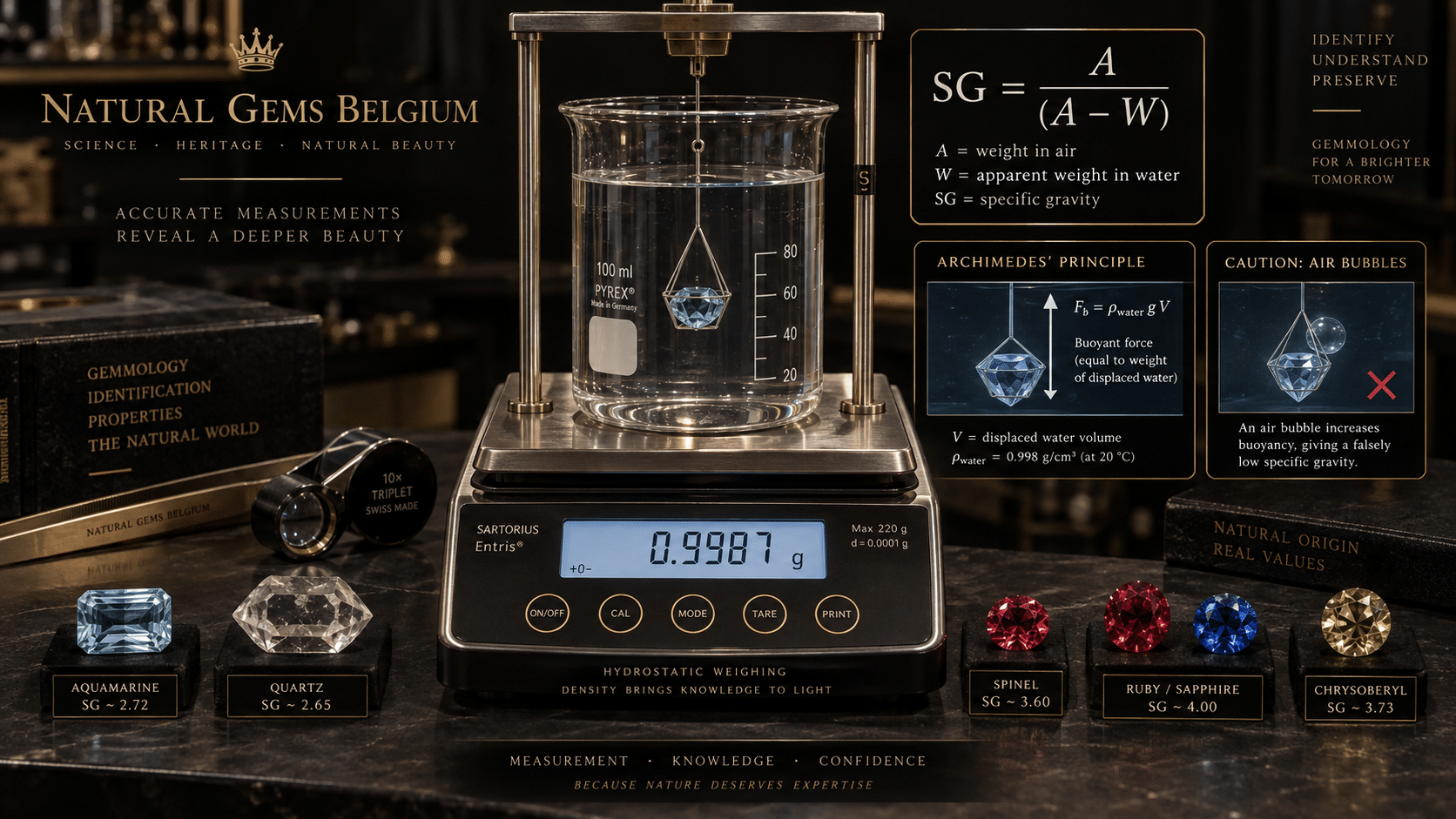
The principle states that an object immersed in a fluid experiences an upward buoyant force equal to the weight of the fluid displaced.
This means an object appears to weigh less when submerged in water.
That apparent loss of weight allows us to calculate its volume indirectly.
9. The Famous Crown Story
According to the traditional historical account, Archimedes was asked to determine whether a crown supposedly made of pure gold had been adulterated with another metal.
The key insight was that materials of different density displace different amounts of water for the same mass.
Whether every detail of the famous bath story happened exactly as later retold is historically debated.
But the physical principle became fundamental to hydrostatic density measurement.
10. Galileo and Hydrostatic Measurement
Centuries later, Galileo described a hydrostatic balance in his early work:
La Bilancetta — “The Little Balance.”
Gem-A notes Galileo’s historical role in developing hydrostatic weighing methodology based on Archimedean principles.
Modern digital gem balances make the same underlying method far easier to perform accurately.
11. The Hydrostatic Principle
First weigh the gemstone in:
air.
Then weigh it while:
fully suspended in water.
The submerged stone appears lighter.
The difference between these two weights corresponds to the weight of the displaced water.
That gives us the information needed to calculate specific gravity.
12. The Standard Formula
The standard hydrostatic equation is:
SG = A / (A − W)
where:
A = weight in air
and:
W = apparent weight while suspended in water
Therefore:
A − W = apparent loss of weight in water
which corresponds to the weight of the displaced water under the test conditions. Gem-A teaches this same formula for gemmological hydrostatic weighing.
13. A Simple Example
Suppose a gemstone weighs:
4.00 ct in air
and:
3.00 ct while suspended in water.
The apparent loss of weight is:
4.00 − 3.00 = 1.00 ct
Then:
SG = 4.00 / 1.00
So:
SG = 4.00
That result would immediately make relatively low-density materials such as quartz or beryl unlikely.
14. The Weight Unit Cancels Out
The gemstone can theoretically be weighed in:
- grams;
- carats;
- another consistent mass unit.
Because the same unit appears in both parts of the ratio, it cancels.
Specific gravity therefore remains:
unitless.
In professional gemmology, carat balances are convenient because they are already standard equipment.
15. Equipment Required
A practical hydrostatic setup generally requires:
- precise digital gem scale;
- hydrostatic bridge or support;
- beaker;
- water;
- fine suspension wire or basket;
- tweezers;
- gemstone.
The apparatus allows the gemstone to be weighed underwater without the basket touching:
- bottom;
- sides
of the container.
16. Scale Precision Matters
Specific gravity depends on a relatively small difference between two measurements.
If the scale is insufficiently precise, calculation error can become significant.
This is especially problematic for:
small gemstones.
A tiny absolute weighing error becomes a larger proportion of the total measurement.
17. Larger Stones Usually Give Better SG Results
Imagine an error of 0.01 ct.
On a:
20 ct gemstone
that error may be comparatively small.
On a:
0.25 ct gemstone
it can be proportionally enormous.
Hydrostatic weighing is therefore generally more reliable on sufficiently large specimens.
18. Stability Matters
The balance must sit on a stable surface.
Avoid:
- touching the table;
- vibration;
- drafts;
- people bumping the setup.
Gem-A specifically warns that movement around a sensitive hydrostatic balance can alter the reading.
Wait until the display stabilises before recording.
19. Prepare the Water
The water should be:
- clean;
- free from visible contamination;
- suitable for precise weighing.
Distilled or appropriately prepared water reduces variability.
Water density changes slightly with temperature.
For routine gemmology this effect may be small, but precise SG work should control measurement conditions.
20. Water Temperature Matters
Water reaches maximum density at approximately:
4°C.
Traditional SG tables and procedures may specify controlled conditions.
For ordinary identification work, the crucial point is consistency.
If high precision matters, account for water temperature according to the laboratory method being used.
21. Clean the Gemstone
Before weighing, clean the stone.
Remove:
- grease;
- fingerprints;
- dirt.
Surface contamination can change wetting behaviour and encourage air bubbles.
A clean surface makes immersion more reliable.
22. First Measure Weight in Air
Remove the hydrostatic load from consideration according to the balance setup.
Place the gemstone on the balance normally.
Allow the reading to stabilise.
Record:
A = weight in air
with all digits justified by the instrument’s precision.
Do not round prematurely.
23. Prepare the Underwater Basket
Position the water container beneath the suspended wire or basket.
The basket must:
- remain fully submerged;
- not touch the glass;
- hang freely.
Tare the apparatus according to the balance manufacturer’s procedure.
Only then introduce the gemstone.
24. Fully Submerge the Stone
Place the gemstone carefully in the submerged basket.
The entire stone must be underwater.
It must not:
- touch the beaker;
- rest on the bottom;
- protrude above the water.
Any contact can transfer force away from the balance and invalidate the reading.
25. Record the Underwater Weight
Allow motion to stop.
Record:
W = apparent weight in water.
This value will be lower than the weight in air because buoyancy supports part of the gemstone’s weight.
Now the SG can be calculated.
26. The Difference Is the Key
Calculate:
A − W
This is the gemstone’s apparent loss of weight in water.
If the stone weighs:
5.00 ct in air
and:
3.75 ct underwater,
the loss is:
1.25 ct.
Then:
SG = 5.00 / 1.25 = 4.00.
The calculation is simple.
Getting accurate measurements is the difficult part.
27. Air Bubbles Are a Major Error Source
One of the most common practical problems is:
air attached to the gemstone.
A small bubble adds buoyancy.
The gemstone then appears artificially lighter underwater.
The measured SG becomes inaccurate.
Gem-A specifically warns that bubbles attached to the surface, fractures or drill holes can interfere with hydrostatic measurement.
28. Check Every Surface
After immersion, inspect the gemstone carefully.
Look especially at:
- pavilion facets;
- drill holes;
- concave surfaces;
- cavities;
- rough texture.
A tiny bubble can hide easily.
If a bubble is present, gently dislodge it before recording the weight.
29. Rough Stones Can Trap Bubbles Easily
Hydrostatic weighing is especially valuable for rough material.
But rough surfaces also create more sites where bubbles can adhere.
This is an important practical trade-off.
Observe rough specimens carefully during immersion.
30. Drill Holes Are Particularly Problematic
Beads can trap air inside drilled channels.
The trapped air behaves like added buoyancy.
A drilled gemstone can therefore produce a falsely low apparent density if the channel is not completely flooded.
This makes hydrostatic measurement of beads more difficult than it first appears.
31. Surface-Reaching Fractures Can Trap Air
Open fractures and cavities may also retain bubbles.
Repeated wetting or careful immersion can sometimes remove them.
But heavily fissured gemstones may remain difficult to measure accurately.
Record the limitation rather than pretending the number is exact.
32. Inclusions Can Shift SG
A gemstone is not always chemically or physically homogeneous.
It may contain inclusions with densities different from the host.
Large or abundant inclusions can shift the measured SG.
Gem-A specifically identifies inclusions and impurities as sources of variation.
This helps explain why published gemstone values are commonly given as ranges.
33. Solid Solution Also Creates SG Ranges
Many gemstone species allow chemical substitution.
For example, garnet forms extensive solid solutions.
Spinel composition can also vary.
Replacing lighter elements with heavier ones can alter density.
Therefore a species often has:
an SG range
rather than one universal value.
34. Spinel Is a Useful Example
Gem-A gives natural spinel approximately:
3.58–3.61
while noting that some Verneuil synthetic spinel can be somewhat higher.
Composition matters.
GIA laboratory studies likewise demonstrate spinel-group materials with noticeably higher SG where heavier elements such as zinc become significant.
35. Gahnospinel Shows Composition Effects Clearly
GIA examined a cobalt-blue gahnospinel with:
SG 3.96
and RI 1.742.
Its chemistry contained substantial zinc.
This is much denser than ordinary Mg-rich spinel.
The example illustrates why gem data must be interpreted chemically rather than memorised as immutable constants.
36. Corundum
Ruby and sapphire—both corundum—generally have SG close to:
4.00.
Gemological measurements commonly span a small range around this value.
Research on Vietnamese corundum, for example, produced hydrostatic values roughly around:
3.9–4.05
with some unusual sapphires extending slightly higher.
This makes corundum noticeably denser than beryl or quartz.
37. Aquamarine and Emerald
Aquamarine and emerald are both:
beryl.
GIA gives aquamarine SG around:
2.72.
Emerald values can vary somewhat with composition.
The key practical point is that beryl is substantially less dense than corundum.
This can be extremely useful in separating similarly coloured stones.
38. Chrysoberyl
GIA gives alexandrite/chrysoberyl SG around:
3.73.
That places it:
- considerably above beryl;
- below typical corundum.
Combined with its RI around 1.746–1.755 and biaxial optical behaviour, SG provides another strong independent identification property.
39. SG Can Help with Refractometer OTL Stones
Some gemstones lie above the ordinary refractometer limit.
Specific gravity can then become especially useful.
GIA examined cat’s-eye demantoid and brown andradite whose RI values were:
over the refractometer limit
but whose hydrostatic SG measured:
3.84.
Raman spectroscopy then confirmed andradite.
This is an excellent demonstration of multi-method identification.
40. Rare Materials Benefit from SG Too
A GIA laboratory identification of rare titanoholtite used:
- RI 1.720–1.740;
- hydrostatic SG 3.65;
- advanced chemical testing.
The physical constants helped demonstrate that the submitted identity did not fit before advanced analysis completed the determination.
SG can therefore be valuable even when the final identification requires sophisticated instrumentation.
41. Specific Gravity and Refractive Index Together
This is one of the most useful combinations in classical gemmology.
Imagine two possibilities with overlapping appearance.
RI gives one constraint.
SG gives an independent density constraint.
A candidate has to satisfy:
both.
The probability of a false identification decreases substantially when independent properties agree.
42. Example: Aquamarine Versus Blue Sapphire
Suppose a transparent pale blue gemstone has:
SG approximately 2.72.
That supports:
beryl / aquamarine.
Blue sapphire should be much closer to:
4.00.
Now measure RI.
If RI is around:
1.577–1.583
the evidence strongly converges toward aquamarine.
43. Example: Red Spinel Versus Ruby
A transparent red gemstone gives SG around:
3.60.
That favours spinel over ruby.
Now add:
- RI around 1.718;
- singly refractive behaviour.
The identification becomes much stronger.
A ruby should generally have higher SG and corundum-like DR behaviour.
44. Example: Ruby Versus Garnet
Here SG demonstrates its limitation.
Some garnets overlap corundum around:
3.8–4.1 or higher.
Therefore an SG near:
4.00
cannot by itself distinguish ruby from certain garnets.
The refractometer and polariscope become essential.
Gem-A specifically uses ruby/almandine overlap as an example of why SG is not diagnostic by itself.
45. Example: Rare Transparent Sodalite
GIA examined a transparent orange-yellow sodalite with:
- RI 1.484;
- hydrostatic SG 2.28;
- singly refractive behaviour.
Raman spectroscopy later confirmed sodalite.
Again, SG became one piece of a converging dataset.
46. Rough Gemstones
Hydrostatic SG is particularly useful for:
rough.
A rough stone may lack:
- polished table;
- flat facet;
- refractometer-quality surface.
But if it can safely be immersed, hydrostatic weighing can still provide useful density information.
Gem-A specifically highlights hydrostatic testing for rough material for this reason.
47. This Makes SG Valuable for Faceting Rough
Before cutting an unknown rough gemstone, the gemmologist may be able to collect:
- visual morphology;
- microscope observations;
- SG;
- spectrum;
- polariscope reaction.
That can substantially narrow identification before any facet is polished.
48. Mounted Gemstones Cannot Normally Be Tested Hydrostaticly
A gemstone set in jewellery cannot simply be weighed underwater independently from:
- metal;
- solder;
- setting components.
The measured density would represent the combined object.
Hydrostatic SG testing is therefore fundamentally a:
loose-stone procedure.
Gem-A explicitly lists this as a limitation.
49. Composite Gemstones Are Problematic
A doublet or triplet contains multiple materials.
Examples can include:
- opal doublets;
- garnet-topped doublets;
- assembled coloured stones.
The measured SG becomes an average influenced by all components.
It no longer represents one mineral species.
Therefore composite gemstones should not be interpreted through a simple single-species SG table.
50. Fracture-Filled Stones Can Be Misleading
A fracture-filled gemstone contains:
- host gemstone;
- foreign filler.
The filler may have a very different density.
If enough filling material is present, the measured result can shift.
Gem-A warns that fracture-filled and coated or otherwise treated materials may not yield straightforward SG results.
51. Glass-Filled Ruby Is a Good Example
A heavily glass-filled ruby does not consist only of corundum.
Foreign glass may occupy extensive fissures and cavities.
The bulk density becomes a combined property.
Therefore hydrostatic SG should not be interpreted as though the specimen were homogeneous untreated corundum.
Treatment information matters before numerical interpretation.
52. Porous Gem Materials
Porous materials present another problem.
Water may:
- enter pores;
- enter cavities;
- change the effective displaced volume.
The result may become unstable or misleading.
Some porous gemstones can also be harmed by immersion.
Never assume hydrostatic testing is appropriate simply because SG would be useful.
53. Water-Sensitive Gemstones
Before immersing an unknown material, consider whether water can:
- dissolve it;
- alter coatings;
- enter glued joins;
- affect fillers;
- damage porous structure.
Safety comes before obtaining one measurement.
Choose another test if immersion is inappropriate.
54. Organic Gem Materials
Materials such as:
- amber;
- pearl;
- coral
require different handling considerations from durable crystalline gems.
Some may tolerate brief water exposure.
Others may be treated, porous or delicate.
Follow material-specific procedures rather than applying the gemstone hydrostatic routine automatically.
55. Temperature-Corrected Precision
At advanced laboratory precision, SG calculations can account for:
- water density at the test temperature;
- air buoyancy;
- balance calibration.
Routine gemmological identification usually does not require extreme metrological precision.
But this explains why a laboratory result may differ slightly from a simplified classroom calculation.
56. Surface Tension
Small stones and fine suspension wires can also be affected by:
surface tension.
Where wire passes through the air-water boundary, forces can influence the reading.
Professional hydrostatic apparatus is designed to minimise such effects.
Consistent setup improves repeatability.
57. The Basket Has Buoyancy Too
The hydrostatic basket or wire is itself immersed.
That is why the balance must be:
tared correctly.
You are interested in the change caused by the gemstone, not the total buoyancy of the supporting apparatus.
Follow the balance’s hydrostatic procedure precisely.
58. Never Hold the Stone with Tweezers During the Measurement
If tweezers support any of the gemstone’s weight, the scale no longer measures the correct underwater force.
Tweezers are useful for:
- placing;
- removing;
- dislodging bubbles.
During the actual reading, the gemstone must be supported only by the calibrated suspension arrangement.
59. Repetition Is Essential
A good practice is to repeat the underwater measurement.
Remove the stone.
Reposition it.
Check for bubbles.
Measure again.
If the result changes substantially, investigate the setup.
Repeatability is one of the easiest ways to detect practical errors.
60. Do Not Average Bad Measurements
If one reading is obviously affected by:
- bubble;
- touching basket;
- vibration;
do not average it with good measurements.
Discard invalid data.
Repeat the experiment correctly.
Statistical averaging cannot repair a fundamentally flawed observation.
61. Round Only at the End
Keep the scale’s justified precision during the calculation.
Round the final SG value appropriately.
Premature rounding can create unnecessary error, particularly with small gemstones.
62. Do Not Report False Precision
If your setup can only support SG to approximately:
two decimal places,
do not report:
3.987416.
That implies accuracy you did not measure.
A result such as:
SG ≈ 3.99
is scientifically more honest.
63. Measurement Uncertainty Should Influence Interpretation
Suppose your result is:
3.60 ± practical uncertainty.
Do not reject a species whose accepted range includes:
3.58–3.61
because your single reading differs by a few hundredths.
Gem data are ranges.
Measurements have uncertainty.
Interpretation should reflect both.
64. Synthetic Gems Can Have Similar SG
A synthetic gemstone usually reproduces the same basic mineral composition and structure as its natural counterpart.
Therefore natural and synthetic versions can have:
- overlapping SG;
- overlapping RI;
- the same optical character.
Specific gravity does not generally prove geological origin.
65. Sometimes Synthetic Composition Differs
Certain synthetic materials may contain compositional differences sufficient to shift physical constants slightly.
Gem-A notes, for example, somewhat higher SG ranges in some Verneuil synthetic spinel compared with typical natural spinel.
This can provide supporting evidence.
It should not be treated as a universal natural-versus-synthetic rule.
66. Geographic Origin Cannot Be Determined from SG Alone
Rubies from:
- Myanmar;
- Mozambique;
- Vietnam
are all corundum.
Their SG values may vary slightly.
But SG is not a reliable country fingerprint.
Origin laboratories require:
- microscopy;
- chemistry;
- spectroscopy;
- reference populations.
67. Treatment Usually Cannot Be Determined from SG Alone
Heating often leaves the bulk mineral structure fundamentally unchanged.
Therefore a heated sapphire may retain an SG essentially within normal corundum range.
Some treatments involving foreign material can shift bulk density.
But SG is not normally a primary treatment-detection test.
68. GIA Still Uses Hydrostatic SG
Modern gem laboratories have access to advanced spectroscopy, imaging and chemical analysis.
Yet GIA still uses specific gravity as part of its physical-characterisation workflow.
Its current laboratory methodology notes that SG may be calculated from accurately measured volume where possible, with:
hydrostatic measurement used when needed for loose gemstones.
This shows that classical physical properties remain relevant even in advanced laboratories.
69. Modern Volume Measurement
Modern optical measuring equipment can reconstruct the dimensions and volume of some faceted stones.
If:
- mass;
- volume
are known accurately, density can be calculated directly.
This avoids immersion.
GIA now uses such volume-based calculations where suitable, while retaining hydrostatic weighing when necessary.
70. Why Hydrostatic Weighing Still Matters
Most independent gemmologists do not have advanced non-contact 3D volumetric scanners.
A digital balance and hydrostatic kit are far more accessible.
The Archimedean method therefore remains practical, inexpensive and scientifically sound when performed correctly.
71. Specific Gravity and Weight Estimation
Density also helps estimate gemstone weight from dimensions.
If the same cut geometry is made from two materials with different SG values, the denser gemstone will weigh more.
This principle is useful in jewellery where direct weighing of a mounted stone is impossible.
Gem-A teaches gemstone-weight estimation alongside hydrostatic SG in practical training.
72. Diamond as a Standard Example
Diamond has SG around:
3.52.
GIA notes that a stone with physical density consistent with approximately 3.52 can be provisionally treated as a diamond candidate before further testing confirms whether it is:
- natural;
- laboratory-grown;
- another material.
Physical constants narrow the problem; they do not finish it.
73. Why SG Tables Are Ranges
Published tables often show a range because real gems vary through:
- chemical substitutions;
- inclusions;
- structural state;
- treatment;
- measurement uncertainty.
Do not treat one tabulated value as an immutable universal constant.
74. Learn Families Before Exact Numbers
A practical beginner does not need to memorise hundreds of SG values immediately.
Start by understanding broad density groups.
Relatively Light
Amber and some low-density organic materials.
Around 2.6–2.8
Quartz and many beryls.
Around 3.0–3.3
Many tourmalines and other silicates.
Around 3.5–3.8
Spinel, diamond, chrysoberyl and several other gems.
Around 4.0+
Corundum and several denser minerals.
Then learn species-specific ranges.
75. Combine SG with RI as a Two-Dimensional Filter
Imagine identification candidates plotted by:
- refractive index;
- specific gravity.
Two gemstones that overlap in one property may separate clearly in the other.
This makes RI + SG one of the most useful classical property combinations.
Add optical character and microscopy, and the candidate list can shrink dramatically.
76. Practical Identification Workflow
For an unknown loose gemstone:
Step 1 — Observe
Record:
- colour;
- transparency;
- cut;
- lustre.
Step 2 — Microscope
Look for:
- inclusions;
- treatment evidence;
- assembled construction.
Step 3 — Refractometer
Measure RI if possible.
Step 4 — Polariscope
Determine optical behaviour.
Step 5 — Dichroscope
Observe pleochroism if relevant.
Step 6 — Spectroscope
Record absorption features.
Step 7 — Hydrostatic SG
Measure density if useful and safe.
Step 8 — Compare
Find species consistent with the complete physical dataset.
Step 9 — Escalate
Use professional laboratory analysis when natural/synthetic status, treatment or origin remains commercially important.
77. Common Beginner Mistakes
Forgetting to Tare the Hydrostatic Apparatus
The basket and suspension system must be accounted for.
Allowing the Stone to Touch the Beaker
This transfers weight and invalidates the measurement.
Leaving Air Bubbles Attached
A major source of falsely low results.
Using an Unstable Table
Vibration changes readings.
Rounding Too Soon
Keep valid precision until the final calculation.
Measuring Tiny Stones Beyond Practical Accuracy
Relative weighing error becomes too large.
Testing Composite Stones as Single Minerals
The result represents combined materials.
Assuming One SG Equals One Gem Species
Overlap exists.
Immersing Porous or Sensitive Material Without Considering Safety
The test should never damage the specimen.
78. Common Interpretation Errors
“SG 4.00 means ruby.”
Incorrect.
Sapphire is also corundum, and some other gems can overlap.
“SG 3.60 means natural spinel.”
Not necessarily.
Synthetic and compositionally unusual spinels can overlap or shift.
“The result differs from the textbook by 0.03, so the stone cannot be that species.”
Too absolute.
Consider composition and measurement uncertainty.
“Mounted gemstones can be hydrostatically weighed normally.”
Incorrect.
The metal contributes mass and volume.
“A fracture-filled ruby should still read exactly like pure corundum.”
Not necessarily.
Foreign filler contributes to the bulk specimen.
“SG proves geographic origin.”
Incorrect.
79. Evidence Classification
| Statement | Classification |
|---|---|
| Specific gravity compares material density with water | Established physical principle |
| SG is unitless | Established mathematical consequence |
| Hydrostatic weighing uses apparent weight loss in water | Established Archimedean principle |
| SG can be calculated as A / (A − W) | Established gemmological method |
| Air bubbles can distort underwater measurements | Established practical limitation |
| Chemical composition and inclusions can shift SG | Established material-science fact |
| Hydrostatic SG can be useful for rough stones lacking polished facets | Established gemmological practice |
| Composite and heavily filled gemstones can give misleading bulk SG values | Established practical limitation |
| One SG value uniquely identifies a gemstone | Incorrect |
| Natural and synthetic equivalents always have completely different SG | Incorrect |
| SG normally proves geographic origin | Incorrect |
| Hydrostatic weighing remains in modern professional gemmology | Established current laboratory practice |
80. A Repeatable Hydrostatic Routine
Use the same sequence every time.
Step 1 — Confirm the Stone Is Suitable
Loose?
Water-safe?
Not a composite?
Step 2 — Stabilise the Balance
Use a firm, draft-free surface.
Step 3 — Prepare the Water and Apparatus
Ensure the basket hangs freely.
Step 4 — Clean the Gemstone
Reduce contamination and bubble formation.
Step 5 — Weigh in Air
Record:
A
Step 6 — Tare the Hydrostatic Setup
Follow the balance procedure.
Step 7 — Immerse Fully
The gemstone must not touch the vessel.
Step 8 — Remove Air Bubbles
Inspect carefully.
Step 9 — Record Underwater Weight
Record:
W
Step 10 — Calculate
SG = A / (A − W)
Step 11 — Repeat
Check reproducibility.
Step 12 — Compare with Reference Data
Use accepted SG ranges.
Step 13 — Combine with Other Tests
Never identify from SG alone.
81. How to Record the Result
A useful technical note could read:
Hydrostatic SG: 3.59. Two repeat readings consistent within practical scale tolerance. No visible attached air bubbles.
This is far better than writing only:
SG = spinel.
Again:
measurement first;
interpretation second.
82. Why the Method Is So Elegant
Hydrostatic weighing does not need to measure the gemstone’s dimensions directly.
A complicated faceted stone may have:
- dozens of facets;
- irregular proportions;
- curved surfaces.
Yet water automatically responds to its:
entire displaced volume.
That is the elegance of Archimedes’ principle.
83. What SG Is Excellent At
Specific gravity is particularly useful for:
- rough gemstones;
- stones without flat polished facets;
- separating candidates with different density;
- confirming RI-based identifications;
- investigating over-the-limit materials;
- building a complete physical-property dataset.
It is inexpensive and fundamentally non-destructive for suitable water-safe loose stones.
84. What SG Cannot Usually Tell You
Specific gravity generally cannot by itself determine:
natural versus synthetic
heated versus unheated
filler identity
geographic origin
exact chemical composition
overall gemstone quality
Those require other observations and often advanced laboratory testing.
85. The Broader Lesson
Practical gemmology becomes much stronger when independent physical properties converge.
Colour alone is weak evidence.
RI is stronger.
Optical character adds another layer.
Absorption spectrum contributes chemistry-related evidence.
Specific gravity contributes:
mass-volume evidence.
When all of these agree, an identification becomes far more defensible than one based on appearance alone.
Conclusion
Specific gravity takes gemstone identification away from colour and optics and into another fundamental property of matter:
density.
Every gemstone occupies volume.
Every gemstone has mass.
The relationship between those two quantities reflects:
- chemical composition;
- atomic mass;
- crystal structure.
Hydrostatic weighing provides an elegant method for measuring that relationship.
First weigh the gemstone in air.
Then suspend it completely in water.
The apparent loss of weight corresponds to the water displaced by the stone.
From these two measurements:
SG = A / (A − W)
A gemstone around SG 2.72 belongs to a very different physical density region from corundum near 4.00.
Spinel, chrysoberyl, garnets and other minerals occupy still other ranges.
This can rapidly eliminate identification possibilities.
But the method demands discipline.
An attached air bubble can alter the result.
A drilled hole can trap air.
An inclusion can shift bulk density.
Chemical substitution creates natural ranges.
A filled or composite gemstone does not behave like one homogeneous mineral.
A very small stone may simply be beyond the practical precision of the balance.
And overlapping SG ranges mean that no responsible gemmologist should convert one number directly into one gemstone name.
So the correct sequence remains:
measure → repeat → calculate → compare → combine.
Use SG alongside:
- refractive index;
- polariscope reaction;
- pleochroism;
- absorption spectrum;
- microscopy.
The refractometer tells you how the gemstone interacts with light.
The spectroscope reveals which wavelengths it absorbs.
Specific gravity tells you something altogether different:
how much material is packed into its volume.
That independent physical evidence is precisely what makes specific gravity so valuable.
More than two thousand years after Archimedean buoyancy was first described, the principle remains useful in modern gemstone laboratories.
Sometimes the most elegant gemmological instrument is simply:
a precise balance, a gemstone and water.
References & Further Reading
The Gemmological Association of Great Britain — “Understanding Specific Gravity and Why It Is Vital to Gemmologists.”
Primary practical reference for this guide. Gem-A explains the Archimedean principle, Galileo’s hydrostatic balance, the formula SG = A/(A−W), equipment, step-by-step measurement, bubble-related errors, inclusions, composite stones and the importance of combining SG with other tests.
https://gem-a.com/gem-hub/specific-gravity-gemstones-gemmology/
Gemological Institute of America — “Analysis of Gemstones at GIA Laboratories.” Gems & Gemology, Winter 2024.
Current laboratory-methodology reference confirming that GIA calculates SG from precise volume measurements where appropriate and uses hydrostatic measurement when necessary, based on weight in air and suspended weight in water.
https://www.gia.edu/gems-gemology/winter-2024-gemstone-analysis
The Gemmological Association of Great Britain — Gemmology Laboratory Classes.
Current Gem-A training reference confirming that practical students learn hydrostatic specific-gravity methodology as part of a broader classical gemmological workflow together with the refractometer, spectroscope, polariscope and other instruments.
https://gem-a.com/education/lab-classes/
Gemological Institute of America — Aquamarine.
Reference for beryl properties, including RI 1.577–1.583, birefringence 0.005–0.009 and specific gravity around 2.72.
https://www.gia.edu/aquamarine
Gemological Institute of America — Alexandrite.
Reference for chrysoberyl/alexandrite properties, including RI approximately 1.746–1.755 and specific gravity around 3.73.
https://www.gia.edu/alexandrite
Jaisanit, N. — “A Remarkable 16.71 ct Transparent Orange-Yellow Sodalite.” Gems & Gemology, Winter 2023.
Useful laboratory example showing the practical combination of RI, hydrostatic SG, fluorescence, microscopy and Raman spectroscopy in identifying an unusual transparent sodalite.
https://www.gia.edu/gems-gemology/winter-2023-lab-notes-remarkable-sodalite
Ahline, N. — “Pink Pyrope Garnet.” Gems & Gemology, Spring 2023.
Modern example in which hydrostatic SG 3.77, RI 1.741 and microscopic observations supported identification of an unusual faceted pink pyrope garnet.
https://archive.gia.edu/gems-gemology/spring-2023-lab-notes-pink-pyrope-garnet
Okada, T. — “Cat’s-Eye Demantoid and Brown Andradite with Horsetail Inclusions.” Gems & Gemology, Spring 2018.
Excellent example of SG supporting identification where refractive index was above the conventional refractometer limit. The stones gave hydrostatic SG 3.84, with Raman spectroscopy providing confirmation.
https://www.gia.edu/gems-gemology/spring-2018-labnotes-cats-eye-demantoid-and-brown-andradite-with-horsetail-inclusions
Jaisanit, N. — “A ‘Cobalt Blue’ Gahnospinel.” Gems & Gemology, Winter 2022.
Useful demonstration of how chemistry influences physical constants. The Zn-bearing gahnospinel had RI 1.742 and unusually high SG 3.96, substantially above ordinary spinel values.
https://www.gia.edu/gems-gemology/winter-2022-lab-notes-cobalt-blue-gahnospinel0
Cooper, A. & Renfro, N. — “Rare Faceted Hexagonite.” Gems & Gemology, Spring 2021.
Laboratory example using refractive index, hydrostatic SG and pleochroism in the investigation of a rare faceted gem material.
https://www.gia.edu/gems-gemology/spring-2021-labnotes-rare-faceted-hexagonite
LeCroy, B. & Palke, A. — “Exceptionally Rare Titanoholtite.” Gems & Gemology, Spring 2024.
Recent example demonstrating how physical constants—including hydrostatic SG 3.65—can reveal that a submitted identification is inconsistent before advanced chemical analysis establishes the correct rare mineral species.
https://www.gia.edu/gems-gemology/spring-2024-lab-notes-exceptionally-rare-titanoholtite
Wu, J., Ma, H. & Li, H. — “Forsterite in a Purple Tanzanian Spinel.” Gems & Gemology, Spring 2023.
Modern spinel example using RI 1.714 and hydrostatic SG 3.59 together with spectroscopy and microscopic analysis.
https://my.gia.edu/gems-gemology/spring-2023-gemnews-forsterite-in-purple-tanzanian-spinel
Schwarz, D. et al. — “Rubies and Sapphires from Vietnam.” The Journal of Gemmology.
Detailed study containing hydrostatic specific-gravity data for Vietnamese ruby and sapphire, illustrating the natural SG variation possible within corundum populations.
https://gem-a.com/images/Documents/JoG/Archive/JoG2004_29_3.pdf