Table of Contents
Introduction: Gemstones Formed Without Melting the Rock
Many gemstones are associated with magma, volcanic activity or mineral-rich fluids. Others form through a different geological process: metamorphism.
Deep within the Earth’s crust, existing rocks may experience changes in temperature, pressure, stress and fluid chemistry.
Their minerals may become unstable under the new conditions.
Chemical reactions can reorganise the elements already present, producing new mineral assemblages.
Some of these newly formed minerals may develop into attractive crystals suitable for gemstone cutting or mineral collecting.
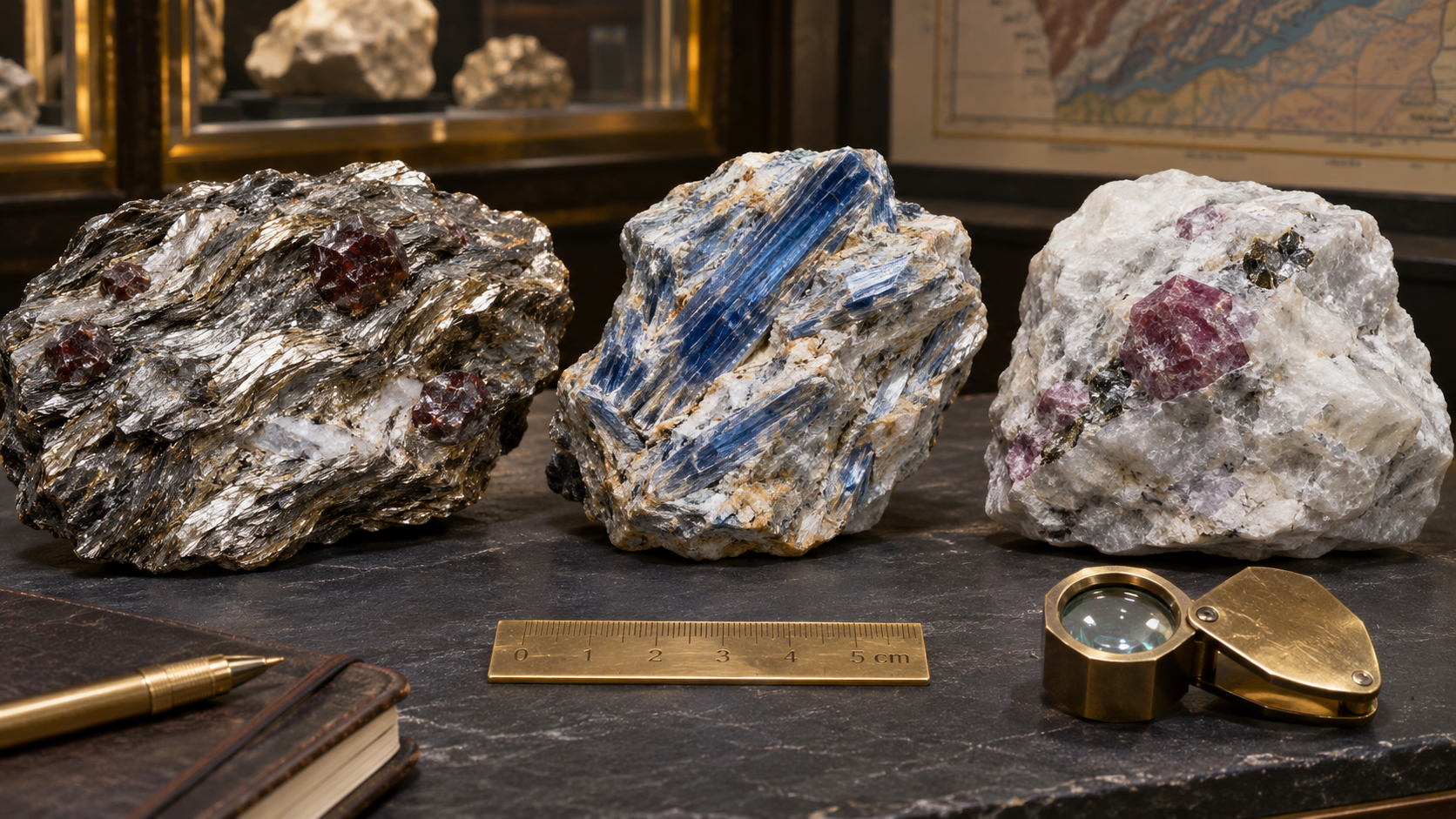
Garnet, kyanite and certain deposits of ruby and sapphire provide important examples.
Metamorphism is especially fascinating because a gemstone can grow within a rock that remains predominantly solid throughout the process.
The rock does not necessarily need to melt.
Instead, mineral reactions, recrystallisation and chemical transport allow new crystals to develop.
Understanding metamorphic gemstone formation connects gemmology with the geological history of mountain belts, continental collisions and deep crustal processes.
It also explains why the presence of a particular gemstone can provide information about the environment in which its host rock formed.
However, no single mineral reveals a complete geological history by itself.
1. What Is Metamorphism?
Metamorphism is the transformation of an existing rock through changes in physical and chemical conditions.
The original rock is known as the protolith.
A sedimentary rock, igneous rock or older metamorphic rock can undergo metamorphism.
The transformation may involve mineral reactions, recrystallisation, changes in texture and deformation.
Temperature and pressure are major influences.
Fluids and the original chemical composition of the rock are also important.
In conventional geological usage, metamorphism generally refers to changes occurring predominantly in the solid state, although limited partial melting can occur at the high-temperature boundary between metamorphic and igneous processes.
The US Geological Survey and British Geological Survey describe metamorphism as an important mechanism through which rocks acquire new mineral assemblages and textures.
A metamorphic rock is therefore not necessarily a completely new chemical material.
It may contain many of the same major elements as its protolith, reorganised into different minerals.
2. Why Rocks Change Without Melting
Minerals are stable only within particular ranges of temperature, pressure and chemical conditions.
When those conditions change, an existing mineral assemblage may no longer be the most stable arrangement.
New reactions can become favourable.
For example, clay-rich sedimentary rocks may undergo progressive metamorphism.
At relatively low metamorphic grades, fine-grained minerals may recrystallise.
At higher grades, minerals such as garnet, staurolite, kyanite or sillimanite may develop, depending on bulk composition and pressure-temperature conditions.
These reactions involve the redistribution of chemical components within the rock.
Atoms do not need to move through a fully molten liquid.
Chemical transport can occur through crystal boundaries, defects and fluid-assisted processes.
The resulting minerals may grow slowly or rapidly depending on reaction kinetics and environmental conditions.
3. The Importance of Temperature
Temperature influences mineral stability and reaction rates.
As rocks are buried or heated by nearby igneous bodies, their temperatures may increase.
Higher temperatures can promote recrystallisation and mineral reactions.
However, the temperature required for a particular mineral to form depends on pressure and chemical composition.
There is no single temperature at which all garnets, for example, begin to crystallise.
Different garnet compositions occur in different geological environments.
Similarly, kyanite formation depends on more than temperature alone.
A scientifically meaningful interpretation must consider temperature together with pressure and the chemistry of the rock.
4. The Importance of Pressure
Pressure influences which mineral structures are stable.
At depth, rocks experience lithostatic pressure from the overlying geological material.
They may also experience differential stress associated with tectonic deformation.
These are related but distinct concepts.
Confining pressure influences mineral stability and phase relationships.
Differential stress can influence deformation, foliation and mineral orientation.
Some minerals are especially useful because their stability is sensitive to pressure-temperature conditions.
Kyanite is an important example.
However, a crystal’s external shape does not independently reveal the exact pressure at which it formed.
Detailed geological interpretation requires mineral assemblages, composition and appropriate thermodynamic models.
5. Regional Metamorphism and Mountain Building
Regional metamorphism affects large volumes of rock.
It commonly occurs in tectonic settings involving crustal thickening, burial and deformation.
Continental collision zones are particularly important.
As crustal rocks become buried, they may experience increasing temperature and pressure.
New minerals develop as the rocks adjust to these conditions.
Garnet-bearing schists and gneisses are common examples of regional metamorphic rocks.
Kyanite can also occur in suitable aluminium-rich metamorphic rocks.
However, not every metamorphic gemstone originates in a continental collision zone.
Different tectonic settings can produce metamorphism.
The geological history of each deposit must be evaluated individually.
6. Contact Metamorphism
Contact metamorphism occurs when surrounding rocks are heated by an igneous intrusion.
The heated region around the intrusion is called a contact aureole.
Temperature may increase substantially while pressure changes are comparatively limited.
The resulting mineral assemblage depends on the original rock composition and the intensity of heating.
Contact metamorphism can produce distinctive minerals in carbonate-rich and other reactive rocks.
Some garnets form in contact-metamorphic or metasomatic environments.
However, contact metamorphism should not be confused with crystallisation directly from magma.
The surrounding rock can undergo mineral reactions without becoming completely molten.
7. Metasomatism and Fluid-Assisted Reactions
Fluids can play an important role in metamorphic mineral formation.
They may transport chemical components, facilitate reactions and influence mineral growth.
Metasomatism involves chemical alteration associated with the addition or removal of material.
Some gemstone-forming environments combine metamorphic conditions with substantial fluid-rock interaction.
For example, certain ruby deposits occur in metamorphosed carbonate rocks.
The development of corundum in such environments depends on appropriate aluminium availability and low silica activity.
However, fluid involvement varies between deposits.
Not every metamorphic gemstone forms through extensive metasomatism.
The distinction between metamorphism, hydrothermal alteration and metasomatism can be complex because these processes may overlap.
8. Metamorphic Grade: How Intensely Has a Rock Changed?
Metamorphic grade describes the relative intensity of metamorphic conditions, especially temperature and pressure.
Low-grade metamorphism may preserve much of the original rock’s fine-grained character.
Higher-grade metamorphism commonly produces more extensive recrystallisation and different mineral assemblages.
However, metamorphic grade is not a single universal scale that applies identically to every rock composition.
The minerals that form depend strongly on the protolith.
A clay-rich rock may develop garnet or kyanite under suitable conditions.
A limestone or dolostone subjected to similar conditions may develop an entirely different mineral assemblage.
Therefore, metamorphic grade must be interpreted in relation to the chemistry of the rock.
9. What Are Index Minerals?
Index minerals are minerals whose occurrence can help constrain metamorphic conditions in particular rock compositions.
In aluminium-rich metamorphic rocks, a commonly taught sequence includes chlorite, biotite, garnet, staurolite, kyanite and sillimanite.
However, this sequence is a simplified educational model.
It is not a universal progression followed by every metamorphic rock.
The appearance of a mineral depends on pressure, temperature, bulk composition and reaction history.
Kyanite, for example, is particularly associated with certain pressure-temperature conditions.
Sillimanite occupies a different stability field.
Andalusite is another important aluminium silicate polymorph.
These minerals can help geologists interpret metamorphic environments when considered together with the surrounding mineral assemblage.
10. Garnet: A Major Metamorphic Gemstone Group
Garnet is not one mineral species but a group of related silicate minerals.
Common members include almandine, pyrope, spessartine, grossular and andradite.
Many garnets crystallise in the cubic crystal system.
Metamorphic garnets frequently grow within schists and gneisses.
Their formation depends on the chemical composition of the rock and the prevailing metamorphic conditions.
Almandine is particularly common in iron-rich metamorphic rocks.
Pyrope-rich garnet can occur in high-grade metamorphic and mantle-derived environments.
Grossular may form in calcium-rich metamorphic or metasomatic settings.
However, not all garnets are metamorphic.
Some occur in igneous rocks and other geological environments.
The garnet group therefore provides an excellent example of why mineral identity alone does not establish geological origin.
11. How Garnet Crystals Grow Inside Solid Rock
Garnet crystals may grow as porphyroblasts within metamorphic rocks.
A porphyroblast is a relatively large crystal that develops within a finer-grained metamorphic matrix.
As garnet grows, it may incorporate minerals already present in the surrounding rock.
These become inclusions.
Some inclusions preserve internal patterns that reflect aspects of the rock’s deformation or growth history.
Garnet may also develop chemical zoning from core to rim.
Changes in iron, magnesium, manganese and calcium concentrations can record aspects of mineral growth and reaction progress.
However, these patterns do not automatically reveal a unique pressure-temperature path.
Later diffusion, resorption and deformation can modify the original record.
Professional geological interpretation requires mineral chemistry, textures and appropriate models.
12. Why Garnet Can Preserve Geological Information
Garnet is particularly valuable in metamorphic petrology because it can preserve compositional differences formed during growth.
Under suitable conditions, chemical diffusion within garnet may be relatively limited.
This can allow earlier growth zoning to remain recognisable.
Geologists may analyse garnet cores and rims to investigate changes in metamorphic conditions.
However, the preservation of zoning depends on temperature, duration and the elements involved.
At sufficiently high temperatures or over long timescales, diffusion can modify compositional profiles.
Therefore, garnet is not a perfect geological recorder.
Its chemical history must be interpreted critically.
For gemstone collectors, garnet’s internal geological record is scientifically interesting even when it has no direct effect on visible beauty.
13. Kyanite: A Mineral Linked to Metamorphic Conditions
Kyanite has the chemical formula Al₂SiO₅.
It belongs to the triclinic crystal system.
Kyanite is one of three important polymorphs of aluminium silicate.
The others are andalusite and sillimanite.
All three have the same ideal chemical composition but different crystal structures.
Their relative stability depends on pressure and temperature.
Kyanite is commonly associated with comparatively higher-pressure metamorphic conditions within the aluminium silicate system.
It frequently occurs in aluminium-rich schists and gneisses.
However, kyanite’s presence alone does not provide an exact pressure measurement.
The surrounding mineral assemblage and geological context are necessary for a meaningful interpretation.
14. Why Kyanite Often Forms Bladed Crystals
Kyanite commonly develops elongated, bladed crystals.
Its habit reflects its crystal structure and growth conditions.
Kyanite also displays strongly directional hardness.
Its hardness differs depending on the crystallographic direction in which it is measured.
This is an example of anisotropy in a mineral’s mechanical properties.
For gemstone cutting, kyanite’s cleavage and directional hardness require attention.
A visually attractive crystal may be challenging to cut or polish.
Some kyanite is transparent enough for faceting.
Other material is better suited to mineral collecting or decorative use.
The external crystal habit alone does not establish gem quality.
15. Andalusite, Kyanite and Sillimanite: Three Structures, One Composition
Andalusite, kyanite and sillimanite share the ideal formula Al₂SiO₅.
They are polymorphs.
Their different crystal structures are stable under different pressure-temperature conditions.
This relationship is fundamental to metamorphic geology.
Geologists use the aluminium silicate system to understand mineral stability and metamorphic reactions.
However, the exact stability boundaries depend on thermodynamic models and geological conditions.
Natural rocks may also preserve minerals outside their expected equilibrium stability fields because reactions can be incomplete.
Therefore, a single observed mineral does not always represent the final equilibrium state of the rock.
This is an important distinction when interpreting metamorphic gemstone formation.
16. Corundum: The Mineral Behind Ruby and Sapphire
Corundum is aluminium oxide, Al₂O₃.
It belongs to the trigonal crystal system.
Ruby is the red variety of corundum, with chromium playing a major role in its colour.
Sapphire includes other gem varieties of corundum.
Blue sapphire commonly owes its colour to iron-titanium-related electronic interactions.
Corundum can form in several geological environments.
Some important ruby and sapphire deposits are associated with metamorphic rocks.
Others are related to igneous or metasomatic processes.
Therefore, the presence of corundum does not automatically establish one particular geological origin.
Its formation depends on the availability of aluminium and suitable chemical conditions.
17. Why Silica Activity Matters for Corundum Formation
Corundum is an aluminium oxide mineral.
In many geological environments, aluminium combines with silica to form aluminosilicate minerals.
For corundum to form and remain stable, the chemical environment must be appropriate.
Low silica activity can be important.
This helps explain why corundum may occur in certain metamorphosed carbonate rocks and other silica-poor environments.
However, the detailed formation process differs between deposits.
Temperature, pressure, fluid composition and the availability of trace elements all influence mineral formation.
The statement that ruby forms simply because limestone is heated is therefore incomplete.
Specific chemical and geological conditions are required.
18. Ruby in Metamorphosed Marble
Some famous ruby deposits occur in marble-hosted geological environments.
Marble forms through metamorphism of carbonate-rich rocks.
Under suitable conditions, corundum may crystallise within these rocks.
GIA’s research on ruby and sapphire geology identifies marble-hosted ruby deposits as an important geological category.
Such deposits can produce high-quality ruby.
However, not every marble contains ruby.
Aluminium must be available, and the chemical environment must favour corundum formation.
Trace-element chemistry also influences colour.
The surrounding mineral assemblage can provide valuable information about the deposit.
Nevertheless, the visual appearance of a ruby alone cannot prove that it originated from marble.
19. Ruby in Amphibole-Rich Metamorphic Rocks
Ruby also occurs in metamorphic environments involving amphibole-rich rocks.
These deposits can differ significantly from marble-hosted systems.
Their mineral assemblages, trace-element chemistry and inclusion characteristics may reflect different geological conditions.
GIA distinguishes major geological categories of ruby deposits and explains their significance for origin studies.
However, geological categories are not equivalent to countries.
A ruby from one country may occur in a geological environment similar to deposits elsewhere.
Professional origin determination therefore requires more than assigning a broad rock type.
20. Metamorphic Sapphire
Some sapphires form in metamorphic environments.
Their formation can involve aluminium-rich rocks subjected to suitable temperature-pressure and chemical conditions.
The resulting corundum may contain trace elements that produce blue, yellow, pink or other colours.
However, sapphires also occur in non-metamorphic geological settings.
Basalt-related sapphire deposits are particularly important in some regions.
This distinction matters because gemstones recovered from secondary gravels may have lost their original host-rock context.
A sapphire found in river sediment does not necessarily reveal whether it formed in metamorphic or igneous rock.
Detailed investigation may require inclusions, trace-element chemistry and geological reference data.
21. Why Metamorphic Gemstones May Contain Inclusions
Gemstones growing within solid rocks may incorporate surrounding minerals.
Garnet can trap small crystals from the metamorphic matrix.
Corundum may contain mineral inclusions associated with its formation environment.
Kyanite may contain inclusions or internal features related to growth and deformation.
However, inclusions are not exclusive to metamorphic gemstones.
Igneous and hydrothermal gemstones can also contain solid, liquid or gas-bearing inclusions.
The identity and arrangement of inclusions may provide geological clues.
But no single inclusion should automatically be treated as proof of a specific geographical origin.
Reliable interpretation depends on the complete assemblage and other evidence.
22. Deformation and Crystal Growth
Metamorphism frequently occurs alongside tectonic deformation.
Rocks may develop foliation as minerals become aligned or segregated.
Some crystals grow before deformation.
Others grow during deformation.
Still others develop after the principal deformation event.
The relationship between crystals and surrounding rock textures can help geologists reconstruct the sequence of events.
Garnet porphyroblasts are especially useful in structural geology because they may preserve inclusion patterns.
However, interpreting these patterns can be complicated.
A curved inclusion trail does not automatically establish one simple rotation history.
Different growth and deformation processes may produce similar appearances.
The geological interpretation must therefore consider the complete rock texture.
23. Metamorphic Gemstones and Geological Time
Metamorphism can occur over a wide range of geological timescales.
Some metamorphic events are associated with prolonged mountain-building processes.
Others involve comparatively short heating events.
Crystal growth may occur during only part of the overall metamorphic history.
Therefore, the age of a host rock is not necessarily the same as the age of the gemstone crystal within it.
Likewise, the age of a metamorphic event is not automatically the age of every mineral present.
Geochronological methods may be required to establish specific formation ages.
Crystal size, colour and habit alone cannot provide an absolute age.
24. From Metamorphic Rock to Alluvial Gemstone Deposits
Metamorphic gemstones may eventually be released from their original host rocks.
Uplift and erosion expose the rocks at the surface.
Weathering breaks down the surrounding material.
Durable minerals may survive transport into streams and sedimentary deposits.
Garnet, ruby and sapphire can occur in secondary deposits.
However, their presence in river gravel does not mean they originally formed in sediment.
Their primary geological environment may have been metamorphic or igneous.
This distinction between primary formation and secondary concentration is fundamental to gemstone geology.
25. Metamorphic Origin Versus Geographical Origin
A gemstone’s geological origin describes the processes and environment in which it formed.
Its geographical origin identifies a location.
These are different types of information.
A ruby may be associated with a marble-hosted metamorphic environment.
That does not, by itself, establish whether it came from Myanmar, Vietnam, Afghanistan or another locality.
Similarly, garnet from a metamorphic rock cannot be assigned to one country based solely on its crystal habit.
Professional origin determination may combine mineral inclusions, trace-element chemistry, spectroscopy and reference collections.
Even then, some stones remain difficult to assign confidently.
Scientific transparency requires distinguishing geological interpretation from geographical provenance.
26. Metamorphic Gemstones and NGB Evaluation
Metamorphic gemstones must be evaluated according to their actual mineralogical and gemmological properties.
For faceted garnet, colour, clarity, cut quality and optical performance are important.
For ruby and sapphire, treatment status, colour, inclusions and cut quality require attention.
For kyanite, cleavage, directional hardness and cutting quality are particularly relevant.
For rough specimens, crystal form, natural characteristics, transparency and fractures influence the intended use.
However, metamorphic origin is not itself a universal quality grade.
A gemstone formed in a metamorphic environment is not automatically superior to one formed in an igneous environment.
Quality must be assessed individually.
27. Common Misconceptions About Metamorphic Gemstones
Metamorphic gemstones form only when rocks melt.
Incorrect. Many form through solid-state reactions and recrystallisation.
All garnets are metamorphic.
Incorrect. Garnets also occur in igneous and other geological environments.
Kyanite forms at one exact pressure and temperature.
Incorrect. Its stability depends on a range of conditions and the surrounding chemical system.
All ruby forms in marble.
Incorrect. Ruby occurs in several geological environments.
All sapphire forms in metamorphic rocks.
Incorrect. Important sapphire deposits also have igneous associations.
A gemstone’s inclusions always identify its country of origin.
Incorrect. Similar inclusions may occur in different deposits.
A large garnet crystal must have grown slowly.
Not necessarily. Growth rate depends on reaction and transport conditions.
The age of the host rock equals the age of the gemstone.
Not necessarily. Mineral growth may occur during later geological events.
Metamorphic origin guarantees gemstone quality.
Incorrect. Quality depends on the individual material and its characteristics.
28. Practical Workshop: Examining Metamorphic Gemstone Specimens
This workshop is intended for collectors, students and gemstone enthusiasts.
It is non-destructive and focuses on careful observation.
Step 1 – Identify the mineral
Record the gemstone species or variety as reliably as possible.
Avoid assigning a specific mineral based only on colour.
Step 2 – Examine the host rock
If the specimen retains matrix, observe whether the surrounding rock is foliated, massive or visibly recrystallised.
Step 3 – Look for mineral associations
Record visible mica, quartz, feldspar, amphibole or other associated minerals.
Do not assume that every association proves a particular metamorphic grade.
Step 4 – Observe crystal habit
Describe whether the crystal is equant, prismatic, bladed or irregular.
Step 5 – Examine visible inclusions
Document observable internal features without attempting to assign exact geological conditions.
Step 6 – Record fractures and cleavage
These may influence specimen preservation and cutting suitability.
Step 7 – Photograph the specimen
Use consistent lighting and a scale reference.
Step 8 – Record provenance
Preserve reliable locality and collection information.
Do not infer a country from appearance alone.
Step 9 – Avoid destructive testing
Do not scratch, break, heat or chemically treat valuable specimens merely to investigate their formation.
Step 10 – Seek professional identification where appropriate
Unusual or scientifically significant specimens may require mineralogical analysis.
The purpose is accurate observation and documentation, not definitive reconstruction of geological history.
29. Why Metamorphic Gemstones Matter to Gemmology
Metamorphic gemstones illustrate the relationship between mineral stability, geological processes and gemstone formation.
Garnet demonstrates how crystals can grow within solid rocks and preserve chemical zoning.
Kyanite illustrates the importance of pressure-sensitive mineral stability.
Ruby and sapphire show how corundum can develop in specialised chemical environments.
These examples reveal that gemstone formation cannot be explained through temperature or pressure alone.
The original rock composition, available chemical components, fluids and geological history all matter.
For gemmologists, this understanding helps place gemstone characteristics within a scientific context.
For collectors, it adds meaning to mineral associations and natural crystal forms.
For responsible gemstone descriptions, it encourages clear distinctions between observation, interpretation and verified provenance.
Conclusion: Gemstones Created Through Geological Transformation
Metamorphism is one of the major geological processes responsible for gemstone formation.
Existing rocks can undergo substantial mineralogical transformation without becoming fully molten.
Changes in temperature, pressure and chemical conditions can produce new mineral assemblages.
Garnet may grow within schists and gneisses.
Kyanite may develop in aluminium-rich rocks under suitable pressure-temperature conditions.
Ruby and sapphire may crystallise in specialised metamorphic environments.
However, these minerals do not each belong to one exclusive geological setting.
Their formation depends on the interaction between rock composition and geological conditions.
The central scientific principle is:
Metamorphic gemstones form when existing rocks undergo mineral reactions and recrystallisation under changing physical and chemical conditions, often while remaining predominantly solid.
Understanding these processes connects gemstone beauty with the dynamic history of the Earth’s crust.
It also reinforces the importance of evidence-based mineral identification, geological interpretation and transparent gemstone descriptions.
References & Further Reading
The following references are authoritative geological and gemmological resources from the US Geological Survey, British Geological Survey, Gemological Institute of America and established scientific publications. They address metamorphic processes, mineral stability, garnet, kyanite, corundum and gemstone formation.
1. British Geological Survey – Metamorphic Rocks
An educational introduction to metamorphic rock formation, mineral recrystallisation, geological conditions and the transformation of existing rocks.
https://www.bgs.ac.uk/discovering-geology/rocks-and-minerals/metamorphic-rocks
2. US Geological Survey – Metamorphic Rocks
A government geological reference explaining how existing rocks are transformed through heat, pressure and geological processes.
3. Encyclopaedia Britannica – Metamorphism
A scientific overview of metamorphic processes, mineral reactions, temperature-pressure conditions and geological environments.
https://www.britannica.com/science/metamorphism
4. Encyclopaedia Britannica – Garnet
Explains garnet mineralogy, crystal structure, chemical diversity and occurrence in metamorphic and other geological environments.
https://www.britannica.com/science/garnet
5. Encyclopaedia Britannica – Kyanite
Provides mineralogical information on kyanite, its crystal structure, metamorphic occurrence and relationship with aluminium silicate polymorphs.
https://www.britannica.com/science/kyanite
6. Encyclopaedia Britannica – Corundum
Describes the mineralogy of corundum, its crystal structure and the relationship between ruby, sapphire and geological formation.
https://www.britannica.com/science/corundum
7. Gemological Institute of America – Ruby Gemstone
An institutional gemmological reference covering ruby mineralogy, formation environments, colour and natural characteristics.
8. Gemological Institute of America – Sapphire Gemstone
Provides information on sapphire mineralogy, colour, geological occurrence and gemmological characteristics.
9. Gemological Institute of America – Garnet Gemstone
An educational reference describing the garnet mineral group, gem varieties and their geological diversity.
10. Gemological Institute of America – Gem Encyclopedia
An institutional reference for gemstone mineralogy, natural characteristics, identification and geological context.
https://www.gia.edu/gem-encyclopedia
Scientific Interpretation and Limitations
Metamorphic mineral formation depends on temperature, pressure, rock composition, fluid activity and geological history.
Metamorphic grade cannot be determined reliably from one mineral without considering the surrounding assemblage and bulk composition.
Garnet, corundum and other gemstone minerals may occur in more than one geological environment.
The presence of kyanite does not independently establish an exact formation pressure or temperature.
Mineral inclusions and chemical zoning can provide geological information but require appropriate interpretation.
A metamorphic geological origin is not equivalent to a verified geographical origin.
The age of a gemstone crystal is not necessarily identical to the age of its host rock.
The practical workshop is intended for non-destructive observation and does not replace professional geological or gemmological analysis.