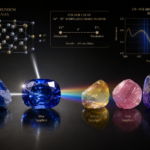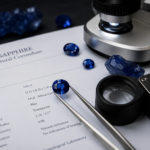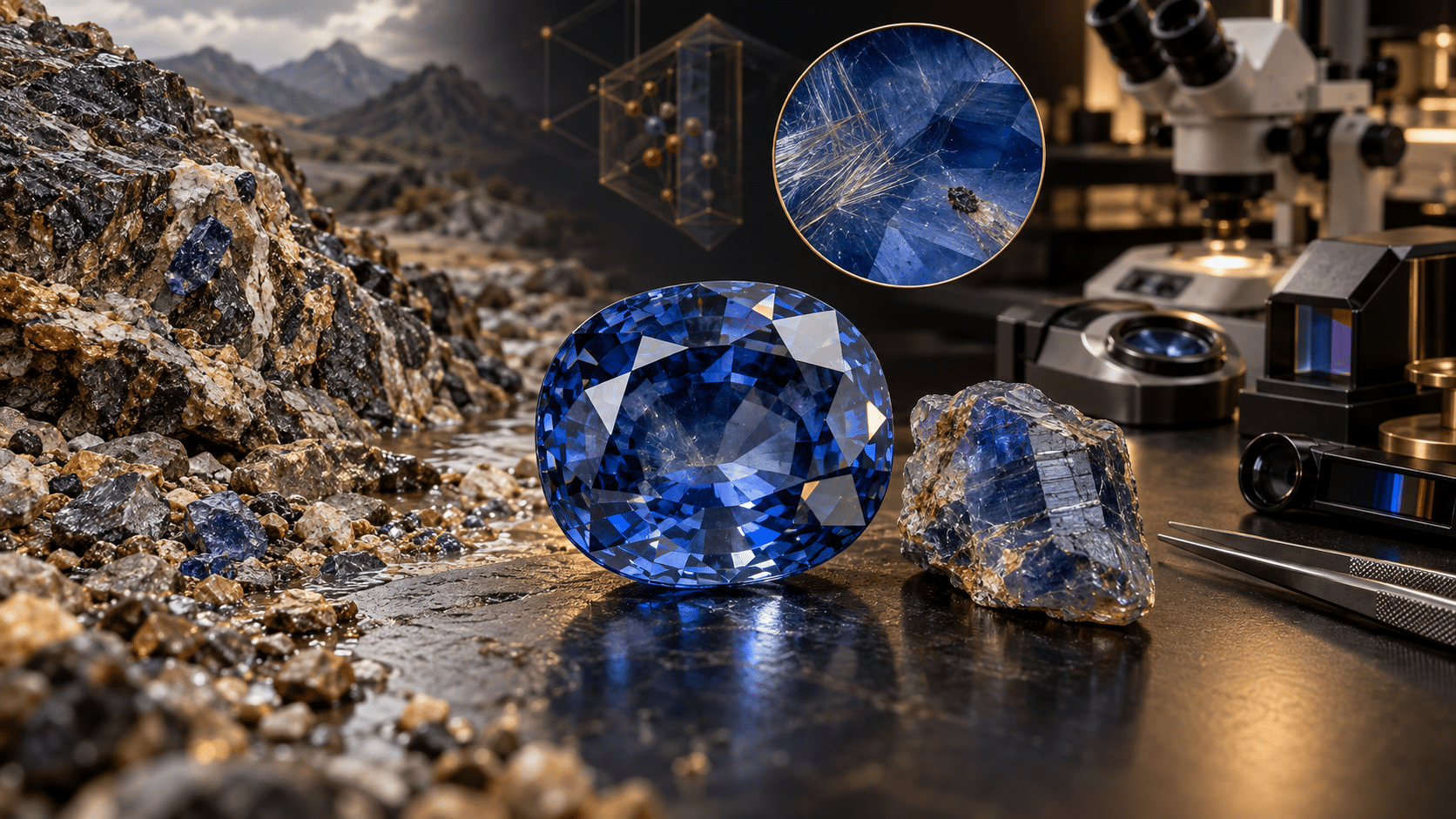
Blue sapphire is the blue gem variety of corundum, the aluminium oxide mineral Al₂O₃. Although its mineral chemistry appears simple, blue sapphire provides an exceptionally rich subject for gemmological study. Trace quantities of iron and titanium can transform essentially colourless corundum into blue material, while the geological environment in which a sapphire formed can leave measurable chemical, spectroscopic and microscopic evidence within the crystal.
For the gemmologist, colour alone is never sufficient for identification. Refractive index, birefringence, optic character, specific gravity, pleochroism, absorption spectroscopy, growth structures and microscopic inclusions together establish a far more reliable picture. Further examination may be required to determine whether the sapphire is natural or synthetic, heated or unheated, diffusion treated, and—under appropriate laboratory conditions—whether its properties are consistent with a particular geographic origin.
Blue sapphire is therefore much more than a familiar blue gemstone. It is a record of crystal growth, geological processes and trace-element chemistry that can be investigated from the hand lens to advanced spectroscopy.
Table of Contents
BLUE SAPPHIRE — TECHNICAL GEMMOLOGICAL DATA
CLASSIFICATION
Mineral Species: Corundum
Gem Variety: Sapphire
Colour Variety Discussed: Blue Sapphire
Mineral Class: Oxide
Chemical Formula: Al₂O₃
Principal Blue Colour Mechanism: Predominantly Fe²⁺–Ti⁴⁺ intervalence charge transfer; Fe-related absorptions also contribute to the spectrum
CRYSTALLOGRAPHY
Crystal System: Trigonal
Optical Character: Uniaxial negative
Common Crystal Habits: Barrel-shaped, bipyramidal, tabular and related corundum habits
PHYSICAL PROPERTIES
Mohs Hardness: 9
Specific Gravity:
Approximately 4.00.
Measured natural stones commonly fall around 3.98–4.02.
Cleavage: None
Parting:
Basal and rhombohedral parting may occur.
Fracture:
Uneven to conchoidal
Tenacity:
Brittle
Lustre:
Vitreous to subadamantine
Transparency:
Transparent to translucent; lower-grade material may be opaque.
Streak:
White
OPTICAL PROPERTIES
Typical Refractive Index:
1.762–1.770
Typical Birefringence:
0.008–0.010
Optic Sign:
Negative
Dispersion:
Low, approximately 0.018
Pleochroism:
Dichroic.
Commonly differing blue, violet-blue and/or greenish-blue components depending upon chemistry and crystallographic orientation.
Colour Zoning:
Common.
Natural sapphire typically shows angular or straight crystallographic zoning rather than the curved banding characteristic of many flame-fusion synthetics.
COLOUR CHEMISTRY
Pure Corundum:
Colourless
Principal Blue Chromophore Mechanism:
Fe²⁺–Ti⁴⁺ intervalence charge transfer.
Fe³⁺ can additionally contribute characteristic absorption features.
Trace-element concentrations, valence state and defect chemistry influence hue, tone and saturation.
VISIBLE / UV-VIS SPECTROSCOPY
Fe³⁺-related absorption may occur near:
~377 nm
~388 nm
~450 nm
A broad Fe²⁺–Ti⁴⁺ intervalence charge-transfer absorption is an important cause of blue colour.
Certain basalt-related sapphires may show additional broad iron-related absorption in the near-infrared region.
Interpretation requires laboratory context.
FLUORESCENCE
Blue sapphire is frequently inert or weak under long-wave and short-wave ultraviolet radiation.
Iron tends to suppress fluorescence.
Response varies according to trace-element chemistry, geological origin, treatment and colour zoning.
UV response alone is not diagnostic.
COMMON NATURAL MICROSCOPIC FEATURES
Rutile needles / silk
Angular growth zoning
Colour zoning
Zircon crystals
Apatite
Feldspar
Spinel
Mica-group minerals
Ilmenite and other opaque minerals
Fluid inclusions
Negative crystals
Healed fissures / fingerprints
Twinning
Parting
Particulate clouds
Source-dependent mineral assemblages
PHENOMENA
Asterism:
Possible when appropriately oriented inclusions, commonly rutile, produce a star effect in cabochon-cut material.
Colour Change:
Occurs in specialised sapphire varieties but should be treated separately from ordinary blue sapphire.
MAJOR GEOLOGICAL FAMILIES
Metamorphic
Metamorphic-metasomatic
Magmatic / basalt-associated
Secondary placer deposits derived from weathering and erosion
IMPORTANT HISTORIC AND MODERN SOURCES
Sri Lanka
Kashmir
Myanmar
Madagascar
Montana, USA
Australia
Thailand
Cambodia
Vietnam
Tanzania
Other occurrences worldwide
TREATMENTS
Conventional heat treatment
High-temperature heat treatment
Titanium lattice diffusion
Beryllium diffusion
Specialised diffusion processes
POSSIBLE EFFECTS OF HEATING
Modification of colour
Improved apparent transparency
Partial or extensive dissolution of rutile silk
Alteration of mineral inclusions
Modification or healing of fractures
Changes in spectroscopic features
SYNTHETIC SAPPHIRE
Flame-fusion / Verneuil
Flux-grown
Hydrothermal
Czochralski / pulled growth
Other melt-growth techniques
POSSIBLE SYNTHETIC INDICATORS
Curved colour banding in flame-fusion material
Curved striae
Gas bubbles in some flame-fusion products
Plato lines
Flux residues in flux-grown material
Laboratory-specific growth structures
An unusually clean stone alone is NOT proof of synthetic origin.
IMPORTANT BLUE LOOK-ALIKES
Blue spinel
Tanzanite
Iolite
Blue tourmaline
Blue zircon
Kyanite
Benitoite
Blue glass
Synthetic simulants
CLASSICAL IDENTIFICATION SUITE
Refractive index
Birefringence
Optic character
Specific gravity
Pleochroism
Spectroscope
Polariscope
Microscopic examination
ADVANCED ANALYSIS WHEN REQUIRED
UV-Vis-NIR spectroscopy
FTIR spectroscopy
Raman spectroscopy
EDXRF
LA-ICP-MS trace-element analysis
Advanced fluorescence imaging
High-resolution microscopy
GEOGRAPHIC ORIGIN
Origin cannot be reliably assigned from colour alone.
Professional geographic-origin determination compares microscopic inclusions, trace-element chemistry and spectroscopic data with reference samples of known provenance.
DURABILITY
Excellent resistance to scratching due to Mohs hardness 9.
No true cleavage.
Nevertheless susceptible to chipping, fracture-related damage and thermal shock.
Treatment status should be established before aggressive cleaning, jewellery repair or exposure to substantial heat.
Blue Sapphire: A Gemmological Reference Guide
Definition and Classification
Blue sapphire belongs to the mineral species corundum, crystalline aluminium oxide with the chemical formula Al₂O₃.
The terminology deserves precision. Corundum is the mineral species. Sapphire is the gem-variety designation generally applied to gem corundum other than ruby, with colour descriptors added where necessary. Blue sapphire therefore identifies blue gem-quality corundum rather than a separate mineral species.
This distinction is important because ruby and blue sapphire share the same fundamental crystal structure and most physical constants. Their dramatic visual difference results principally from trace elements and crystal-lattice defects rather than a different major-element composition.
Why Sapphire Is Blue
Ideally pure corundum is colourless.
The blue of most natural sapphire is predominantly associated with iron and titanium incorporated in very small concentrations into the corundum lattice.
A central colour mechanism is intervalence charge transfer involving Fe²⁺ and Ti⁴⁺.
Rather than functioning as a simple blue pigment, neighbouring iron and titanium ions interact electronically. This produces broad absorption within the visible spectrum, removing certain wavelengths and allowing the remaining transmitted and reflected light to be perceived as blue.
Iron also contributes characteristic absorption bands independently.
Typical Fe³⁺-related features may occur around 377, 388 and 450 nanometres.
The precise appearance of sapphire depends on more than simply the presence of iron and titanium. Their concentration, oxidation state, distribution, crystallographic orientation and interaction with lattice defects all influence the final colour.
This helps explain why natural blue sapphire may range from pale blue through strongly saturated royal or cornflower-type blues to extremely dark material.
Geological Formation
Blue sapphire does not have a single geological origin.
Modern geological classification recognises important sapphire deposits in metamorphic, metasomatic and magmatic settings, together with secondary deposits produced by weathering and erosion.
The fundamental requirement is an environment sufficiently rich in aluminium for corundum to crystallise while silica activity remains low enough to prevent that aluminium from being incorporated predominantly into silicate minerals.
Trace elements, including iron and titanium, must also be available if blue colour is to develop.
Metamorphic and Metasomatic Sapphire
Important sapphires can develop where aluminium-rich rocks undergo metamorphism under pressure and temperature conditions in which corundum becomes stable.
Fluid-rock interaction may be especially important.
Metasomatism describes chemical modification of rock through interaction with circulating fluids. Such fluids can transport chemical components and establish local conditions suitable for sapphire growth.
Several famous sapphire-producing regions are associated with metamorphic terrains.
Sri Lanka, Madagascar, Kashmir and parts of Myanmar provide important examples of sapphire linked to complex metamorphic geological histories.
Kashmir Sapphire
Kashmir represents one of the classic geological examples.
The celebrated deposits are associated with desilicified pegmatitic rocks, commonly referred to as plumasites, within a metamorphic geological environment.
Interaction between pegmatitic material, surrounding rocks and fluids produced conditions in which corundum could crystallise.
Kashmir sapphire is famous historically for richly saturated blue stones with characteristic microscopic textures, but appearance alone is never sufficient for scientifically assigning Kashmir origin.
Basalt-Associated Sapphire
A second important geological family is associated with alkali basalt volcanism.
The expression “basalt-related sapphire” must be interpreted carefully.
A sapphire recovered from basaltic terrain did not necessarily crystallise directly from the basaltic lava.
Corundum crystals may originate at greater depth and later be transported upward by ascending magma as xenocrysts or megacrysts.
The volcanic system effectively acts as a geological transport mechanism.
Basalt-associated sapphire deposits occur in several regions of Southeast Asia, Australia, China, Madagascar and elsewhere.
These stones may show trace-element and spectroscopic characteristics that differ systematically from many metamorphic sapphires.
Secondary Deposits
Corundum is extremely resistant to weathering.
Its hardness, lack of easy cleavage and chemical durability allow crystals to survive long after their original host rocks have begun to decompose.
Weathering releases sapphire from primary deposits.
Gravity, water and sedimentary processes subsequently transport and concentrate the dense crystals into eluvial, colluvial or alluvial gravels.
Many economically important sapphire mines therefore work secondary deposits rather than the original bedrock source.
A sapphire recovered from river gravel may have travelled a considerable distance from the geological environment in which it initially crystallised.
Sri Lanka
Sri Lanka is one of the world’s most historically significant sapphire-producing regions.
Much production comes from secondary gem gravels formed through prolonged erosion of ancient metamorphic rocks.
The country produces blue sapphire alongside numerous other corundum colours.
Sri Lankan sapphires have also played an important role in scientific research concerning inclusions, trace-element chemistry, heat treatment and spectroscopy.
Kashmir
Kashmir sapphire became legendary following discoveries in the late nineteenth century.
The historic deposit produced material prized for its intense blue colour and characteristic visual appearance.
In gemmology, however, terms such as “Kashmir appearance” or “velvety blue” cannot establish provenance.
Laboratory origin determination requires a much broader body of evidence.
Myanmar
Myanmar is famous primarily for ruby but also produces important sapphire.
Mogok blue sapphire has been studied extensively using microscopy, chemistry, FTIR spectroscopy and UV-Vis-NIR spectroscopy.
The same district can therefore produce both ruby and sapphire while the chemical and geological conditions responsible for their colour differ.
Madagascar
Madagascar has become one of the world’s major modern sapphire sources.
The island contains multiple sapphire-producing environments.
Ilakaka is particularly associated with extensive secondary deposits that have yielded large quantities of sapphire in many colours.
The diversity of Madagascar’s geology also makes the country an important subject for gemmological origin research.
Montana, United States
Montana contains several well-known sapphire localities, including Yogo Gulch, Rock Creek, Missouri River deposits and Dry Cottonwood Creek.
Montana sapphires are especially valuable scientifically because detailed research has compared their chemistry, inclusions and spectra.
Yogo sapphire, for example, is associated with an igneous geological setting and has characteristic chemistry and inclusion suites.
Other Important Sources
Additional historically or commercially significant blue sapphire sources include:
Australia
Thailand
Cambodia
Vietnam
Tanzania
China
Nigeria
Ethiopia
Laos
and other regions worldwide.
The occurrence of the same mineral species in many geological environments is one reason geographic-origin determination is so technically demanding.
Physical Properties
Blue sapphire inherits the physical properties of corundum.
Its Mohs hardness is 9.
This places corundum immediately below diamond in the traditional Mohs reference scale and gives sapphire excellent resistance to scratching.
Hardness, however, should not be confused with toughness.
A sapphire can still chip or fracture when subjected to strong impact, particularly at thin facet junctions or where significant fractures are present.
Corundum has no true cleavage.
Crystallographic parting may nevertheless occur along specific structural directions.
Fracture is generally uneven to conchoidal.
Lustre is typically vitreous to subadamantine.
Specific Gravity
The specific gravity of corundum is approximately 4.00.
Measured natural sapphire values commonly lie near approximately 3.98 to 4.02.
Minor variation can result from inclusions, fractures, composition and measurement uncertainty.
Specific gravity remains useful when distinguishing sapphire from many blue gemstones with substantially lower or higher density.
Refractive Index
Typical refractive indices of sapphire are approximately:
1.762–1.770
Typical birefringence is approximately:
0.008–0.010
Corundum belongs to the trigonal crystal system and is optically uniaxial negative.
This combination of optical properties is highly useful during classical gemmological identification.
Pleochroism
Blue sapphire is dichroic.
Light travelling through the crystal in different crystallographic directions may be absorbed differently.
A dichroscope can consequently reveal two colour components.
Depending upon chemistry, orientation and colour intensity, these may appear as combinations of:
blue
violet-blue
greenish blue
Pleochroism is important not only for identification but also for cutting.
A cutter must consider orientation carefully when positioning strongly pleochroic sapphire rough if the most desirable face-up colour is to be achieved.
Absorption Spectroscopy
Spectroscopy provides a direct connection between visible colour and trace-element chemistry.
Iron can produce characteristic absorptions in the violet and blue portions of the visible spectrum.
Fe³⁺-related bands may occur near approximately:
377 nm
388 nm
450 nm
A broad Fe²⁺–Ti⁴⁺ intervalence charge-transfer absorption contributes strongly to blue colour.
Advanced UV-Vis-NIR spectroscopy can reveal additional information useful for investigating geological type, treatment and geographic-origin relationships.
Nevertheless, no isolated absorption feature should automatically be treated as proof of origin.
Fluorescence
Many blue sapphires are inert or weak under ultraviolet radiation.
Iron tends to suppress fluorescence.
This contrasts with chromium-rich, low-iron ruby, which can display strong red fluorescence.
However, blue sapphire fluorescence is not universally absent.
Trace chromium, colour zoning, crystal defects, heat treatment and geological environment can all modify UV response.
Fluorescence should therefore be interpreted as one observation within a broader dataset.
Microscopic Features
Microscopy is one of the most powerful tools in sapphire examination.
Natural blue sapphire may contain:
- rutile needles
- rutile silk
- zircon crystals
- apatite crystals
- feldspar
- spinel
- mica-group minerals
- ilmenite
- negative crystals
- fluid inclusions
- healed fissures
- particulate clouds
- angular growth zoning
- colour zoning
- twinning structures
The specific inclusion assemblage depends strongly on the geological environment.
Some inclusions may be strongly associated with particular deposit types, while others occur in many geographic regions.
No single inclusion should be treated casually as conclusive proof of geographic origin.
Rutile Silk
Fine oriented rutile needles are among the best-known internal characteristics of corundum.
Dense silk can scatter light and create a soft appearance.
When sufficiently abundant and crystallographically oriented, rutile needles may reflect light in intersecting directions.
If such material is correctly cut as a cabochon, the result may be asterism.
This produces star sapphire.
Heat Treatment
Heat treatment is extremely important in the sapphire trade.
Heating can modify colour, clarity and microscopic features.
One important process involves rutile.
At sufficiently high temperature, titanium contained within rutile can dissolve into the corundum lattice.
Under appropriate chemical conditions, titanium can then interact with iron, increasing the Fe²⁺–Ti⁴⁺ intervalence charge-transfer mechanism responsible for blue colour.
Heat may therefore strengthen or alter blue colour.
Heating can also:
partially dissolve rutile silk
modify zircon inclusions
alter other mineral inclusions
change fracture appearance
modify colour zoning
alter spectroscopic features
The cooling regime after heating can also influence the result.
Titanium can remain in solid solution under some conditions, while slower cooling may allow titanium to exsolve again as rutile.
Treatment determination therefore involves interpreting multiple pieces of evidence rather than simply looking for one altered inclusion.
Titanium Diffusion
Titanium lattice diffusion differs fundamentally from conventional heating.
During diffusion treatment, titanium is deliberately introduced from an external source at high temperature.
The titanium diffuses into the surface region of the corundum.
When sufficient iron is present, this can create or intensify blue colour.
The resulting colour layer may be relatively shallow.
Characteristic colour concentration along facet junctions or within surface-related regions can therefore be important diagnostic evidence.
Because repolishing may remove or alter portions of this layer, diffusion treatment has important implications for disclosure and durability of appearance.
Beryllium Diffusion
Beryllium diffusion became another important development in corundum treatment.
Beryllium ions are very small and can diffuse much deeper into corundum than titanium under appropriate high-temperature conditions.
The process can alter several corundum colours.
Detection may require advanced analytical techniques because beryllium is a light element present at low concentrations.
Laboratory techniques such as LA-ICP-MS and SIMS have been used for this purpose.
The mere presence of beryllium is not automatically proof of treatment because naturally occurring Be has been detected in some sapphires.
Interpretation therefore requires concentration profiles, associated chemistry and other analytical evidence.
Synthetic Sapphire
Synthetic sapphire possesses essentially the same chemical composition and crystal structure as natural sapphire.
For this reason, standard corundum properties such as RI and SG establish that the material is corundum but cannot by themselves prove natural origin.
Synthetic sapphire has been produced using several methods.
These include:
flame fusion
flux growth
hydrothermal growth
Czochralski or pulled growth
other melt-growth techniques
Flame-Fusion Sapphire
The Verneuil flame-fusion method is historically one of the most important synthetic-growth processes.
A classic diagnostic feature is curved growth banding.
Natural sapphire more commonly displays straight or angular crystallographic growth zoning.
Flame-fusion sapphire may instead show curved striae produced by the artificial growth process.
Gas bubbles and Plato lines may provide additional evidence.
However, not every synthetic sapphire displays obvious textbook features.
Flux-Grown and Other Synthetics
Flux-grown sapphire can contain flux residues, metallic particles and growth structures characteristic of laboratory crystallisation.
Some of these features can superficially resemble natural healed fissures.
Hydrothermal and other advanced synthetic-growth techniques can create further challenges.
When classical microscopy is inconclusive, advanced spectroscopy and chemical analysis may be required.
Imitations and Look-Alikes
Several blue gemstones can visually resemble sapphire.
Important possibilities include:
blue spinel
tanzanite
iolite
blue tourmaline
blue zircon
kyanite
benitoite
blue glass
synthetic simulants
Classical gemmological testing usually distinguishes them effectively.
Refractive index, birefringence, optic character, specific gravity, pleochroism and spectroscopy provide far more diagnostic information than colour alone.
For example, spinel is singly refractive, whereas sapphire is doubly refractive and optically uniaxial.
Iolite possesses distinctly different RI and SG values and often displays very strong pleochroism.
Geographic Origin Determination
Determining that a gemstone is natural blue sapphire and determining where it formed are fundamentally different analytical problems.
Colour alone cannot establish origin.
Professional laboratories maintain large reference collections containing stones obtained from known mining localities.
Unknown sapphires are compared against these reference datasets.
Evidence may include:
microscopic inclusion assemblages
growth structures
trace-element chemistry
UV-Vis-NIR spectroscopy
FTIR spectroscopy
fluorescence characteristics
advanced elemental analysis
Even sophisticated analytical results may overlap between different deposits.
A geographic-origin statement is therefore a laboratory opinion based on the combined weight of evidence.
Descriptions such as “Kashmir colour”, “Ceylon appearance” or “basaltic-looking” are not scientifically sufficient to prove provenance.
Durability and Care
Blue sapphire is among the most durable major coloured gemstones.
Its Mohs hardness of 9 provides excellent resistance to scratching.
The absence of true cleavage is another advantage for jewellery use.
Nevertheless, sapphire is not indestructible.
Sharp impact can chip facet junctions.
Large fractures can reduce structural integrity.
Treatment history may also influence care recommendations.
Warm water, mild detergent and a soft brush are generally conservative cleaning methods.
Before ultrasonic cleaning, steam cleaning, jewellery repair or high-temperature work, the stone should be examined for fractures, fillings and unusual treatments.
Why Blue Sapphire Matters to Gemmology
Blue sapphire demonstrates how several branches of science converge within a single gemstone.
Mineralogy establishes that it is corundum.
Crystallography explains its trigonal structure and uniaxial optical behaviour.
Solid-state physics helps explain Fe²⁺–Ti⁴⁺ intervalence charge transfer.
Geology explains the environments in which corundum crystallises and how tectonics, metamorphism, magmatism, weathering and erosion create gemstone deposits.
Microscopy reveals internal growth history.
Spectroscopy investigates chromophores and lattice defects.
Analytical chemistry contributes to treatment detection and geographic-origin determination.
The blue colour visible to the eye is therefore only the beginning.
For the gemmologist, every sapphire is a small geological archive whose chemistry, optical behaviour and microscopic inclusions preserve evidence of how the crystal formed and what happened to it afterwards.
References & Further Reading
Gemological Institute of America — Sapphire Gem Encyclopedia
https://www.gia.edu/sapphire
Gemological Institute of America — Sapphire Description
https://www.gia.edu/sapphire-description
Giuliani, G. & Groat, L.A. — Geology of Corundum and Emerald Gem Deposits, Gems & Gemology
https://www.gia.edu/gems-gemology/winter-2019-geology-of-corundum-and-emerald-gem-deposits
Gemological Institute of America — Gems Formed in Metamorphic Rocks
https://www.gia.edu/gems-gemology/summer-2023-colored-stones-unearthed0
Gemological Institute of America — Inclusions in Natural, Synthetic and Treated Sapphire
https://www.gia.edu/gems-gemology/summer-2017-inclusions-sapphire
Gemological Institute of America — Gemological Characterization of Sapphires from Yogo Gulch, Montana
https://www.gia.edu/gems-gemology/summer-2018-gemological-characterization-of-sapphires-from-yogo-gulch-montana
Gemological Institute of America — Beryllium Diffusion of Ruby and Sapphire
https://www.gia.edu/gems-gemology/summer-2003-beryllium-diffusion-ruby-sapphire-emmett
Gemological Institute of America — Laboratory Growth of Gem Materials and the Attempt to Replicate Nature
https://www.gia.edu/gems-gemology/summer-2024-colored-stones-unearthed