

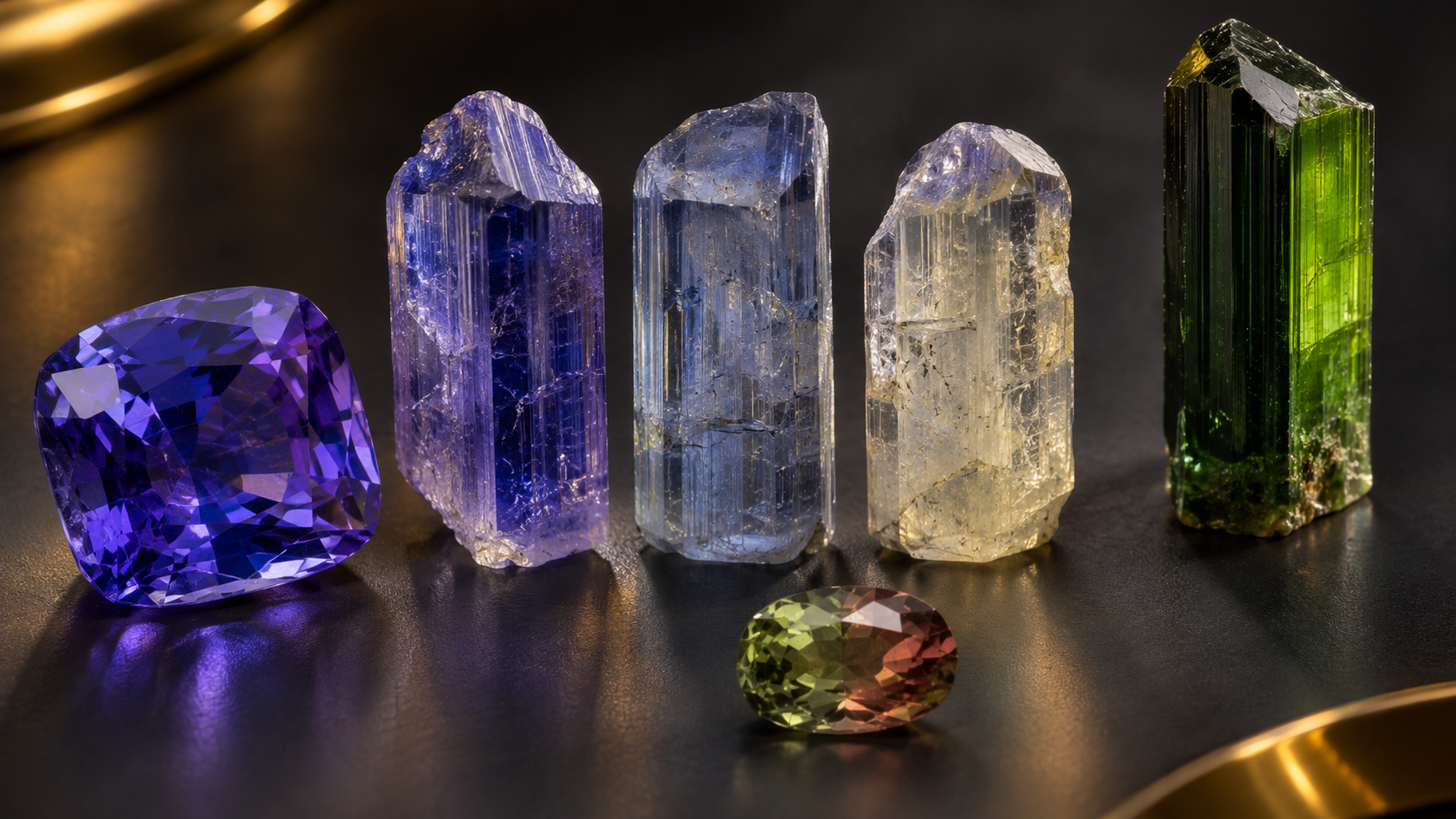
Table of Contents
Introduction: One Crystal, Several Colours
Imagine examining a transparent gemstone that appears deep violet-blue when viewed through one direction. Rotate it slightly, and the colour becomes noticeably lighter. Turn it again, and the same crystal may reveal a yellowish or greyish component.
The gemstone has not changed its chemical composition. The lighting has not necessarily changed either. Instead, the observer is seeing a fundamental property of certain crystalline materials: pleochroism.
Pleochroism is the variation in colour observed when light travels through a gemstone along different crystallographic directions. It results from differences in how the crystal absorbs light according to the orientation of the light’s electric field relative to its structure.
This phenomenon is especially important in iolite, tanzanite, tourmaline, andalusite and corundum.
It is more than an interesting optical curiosity. Pleochroism can influence the colour visible through a finished gemstone, the orientation selected by a lapidary and, ultimately, the aesthetic and commercial value of the cut stone.
To understand it properly, we must examine the relationship between crystal structure, polarised light and selective absorption.
1. What Is Gemstone Pleochroism?
The term pleochroism derives from Greek roots referring to multiple colours.
In mineralogy and gemmology, it describes the phenomenon in which an optically anisotropic crystal exhibits different absorption colours associated with different vibration directions of light.
A strongly pleochroic crystal may show clearly different hues. A weakly pleochroic crystal may exhibit only subtle changes in tone or saturation.
Some minerals show little or no visible pleochroism, even though they are optically anisotropic.
The effect depends on the crystal structure, the colour-producing components and the magnitude of directional absorption.
Pleochroism should not be confused with colour zoning. Colour zoning involves spatial variations in colour within a crystal, whereas pleochroism involves the directional optical behaviour of the material.
2. Why Crystal Structure Determines Optical Behaviour
A crystalline gemstone contains atoms arranged in an ordered, repeating structure.
In some crystals, optical properties vary with direction. These materials are described as optically anisotropic.
The interaction between light and the crystal can depend on the orientation of the electric field relative to the crystallographic structure.
If absorption differs for different polarisation directions, the corresponding light components can emerge with different spectral distributions.
The observer may consequently perceive different colours.
This is particularly important in gemstones containing transition-metal ions, whose absorption characteristics are influenced by their local crystallographic environment.
However, optical anisotropy alone does not guarantee visible pleochroism.
The directional differences in absorption must be sufficiently pronounced within the visible spectrum.
3. Isotropic and Anisotropic Gemstones
Gemstones can be broadly distinguished according to their optical behaviour.
Optically isotropic materials have the same refractive index in every direction under ordinary conditions. Garnet and spinel are familiar examples.
Optically anisotropic materials possess direction-dependent refractive indices. Corundum, tourmaline, iolite and tanzanite belong to this category.
An ideal homogeneous isotropic crystal does not exhibit true crystallographic pleochroism.
However, apparent colour variations in an isotropic gemstone may arise from inclusions, colour zoning, reflections or other effects.
Anisotropic gemstones can exhibit pleochroism, but not all do so visibly.
The distinction between optical anisotropy and observable pleochroism is therefore essential.
4. Dichroism and Trichroism
Pleochroism is commonly divided into two principal categories.
Dichroism describes the two characteristic absorption colours associated with the two principal vibration directions in a uniaxial crystal.
Trichroism describes the three principal absorption colours associated with the three principal vibration directions in a biaxial crystal.
Uniaxial gemstones include corundum and tourmaline.
Biaxial gemstones include iolite, tanzanite and andalusite.
However, the terminology requires care.
A biaxial gemstone may have three principal absorption colours, but an observer looking along one particular direction does not simultaneously isolate all three.
A dichroscope typically separates two orthogonally polarised components in a given viewing direction.
The third characteristic colour may require examining the crystal from another orientation.
Likewise, a uniaxial gemstone does not necessarily display two visibly different hues.
The absorption differences may be too weak to distinguish.
5. Why Light Polarisation Matters
Ordinary daylight contains light with electric-field vibrations in many directions perpendicular to the direction of propagation.
When this light enters an anisotropic crystal, its behaviour depends on the crystal’s optical properties.
Different polarisation components may experience different refractive indices and absorption.
In a pleochroic gemstone, this selective absorption changes the relative proportions of transmitted wavelengths.
A dichroscope makes these differences easier to observe by separating two orthogonally polarised components into adjacent images.
However, a dichroscope does not create pleochroism.
It reveals a property already present in the crystal.
Strong pleochroism may be visible simply by rotating a transparent crystal and observing it under consistent illumination.
6. Iolite: One of the Clearest Examples
Iolite is the gem variety of cordierite, a magnesium-iron-aluminium cyclosilicate.
It is one of the most instructive gemstones for studying pleochroism.
Depending on its body colour and orientation, iolite may display violet-blue, blue-grey, yellowish or nearly colourless appearances.
GIA describes violet iolite as exhibiting light violet, dark violet and yellow-brown pleochroic colours.
Bluish specimens may show colourless-to-yellow, blue-grey and dark-violet components.
This explains why a piece of iolite rough may appear intensely blue from one direction yet relatively pale from another.
The difference can be striking even without sophisticated equipment.
For gemstone cutters, this property presents both an opportunity and a challenge.
The stone must be oriented to achieve an attractive face-up colour without sacrificing excessive weight.
A poorly chosen orientation may produce a finished gemstone that looks washed out despite possessing richly coloured material in another direction.
7. Why Iolite Cutting Requires Careful Orientation
Before cutting iolite, a lapidary must evaluate the colour from different directions.
The strongest blue or violet component may not correspond to the direction that produces the greatest finished weight.
This creates a trade-off between colour and yield.
If the cutter prioritises weight retention, the gemstone may appear lighter or less saturated than the rough initially suggested.
If the cutter prioritises the most desirable face-up colour, more material may need to be removed.
Iolite also possesses distinct cleavage, making mechanical orientation and handling important.
The final cutting decision must consider colour, inclusions, shape, cleavage and potential yield together.
GIA’s iolite guidance emphasises that strong pleochroism and cleavage both influence cutting decisions.
8. Tanzanite: Blue, Violet and Yellow-Green Directions
Tanzanite is the blue-to-violet variety of zoisite.
It is strongly pleochroic and provides an especially valuable example of the relationship between colour, crystal orientation and treatment.
In suitable untreated material, three characteristic colour directions may include blue, violet-to-reddish-violet and yellowish-green or brownish components.
The exact appearance depends on the specimen and its chemical characteristics.
Gem-A explains that heating commonly reduces the yellowish or brownish component and enhances the blue-violet appearance.
This is one reason much commercial tanzanite is heat-treated.
Importantly, heating does not change tanzanite into an optically uniaxial mineral.
Its biaxial crystal structure remains.
The observed pleochroic colours may become less distinct after treatment, but the underlying optical classification does not change.
9. How Tanzanite Cutters Balance Colour and Weight
Tanzanite cutters must consider the direction in which the strongest blue or violet colour appears.
Different orientations may produce different face-up appearances.
Some stones are cut to emphasise blue.
Others retain a more violet appearance.
In certain orientations, multiple pleochroic components contribute to the colour observed through the crown.
The final appearance also depends on pavilion geometry, optical path length and internal reflections.
A gemstone that appears predominantly blue when viewed through one rough crystal face may look more violet after faceting.
This does not necessarily indicate poor cutting.
The desired result depends on the available rough, colour distribution, weight retention and aesthetic preference.
The key principle is that orientation is an intentional component of coloured gemstone design.
10. Andalusite: Pleochroism as a Design Feature
Andalusite is an aluminium silicate mineral with the formula Al₂SiO₅.
Gem-quality andalusite can display strong directional colours, commonly involving greenish, yellowish and reddish-brown components.
Its pleochroism can produce a distinctive appearance in faceted gemstones.
Unlike materials where cutters may try to minimise an undesirable colour direction, andalusite is sometimes fashioned to showcase a combination of contrasting colours.
The effect can create a visually complex gemstone with different colours appearing in adjacent facets.
However, the appearance depends on crystal orientation and cut design.
Not every andalusite gemstone will display an equally dramatic multicoloured effect.
Pleochroism must also be distinguished from ordinary colour zoning and reflection patterns.
11. Tourmaline: Strong Dichroism and Dark Optical Directions
Tourmaline is a complex group of borosilicate minerals.
Many coloured tourmalines show strong dichroism.
The absorption difference between ordinary and extraordinary vibration directions can be substantial.
Richard W. Hughes, writing in Gems & Gemology, explains that the ordinary-ray component in tourmaline is the darker of the two.
This is particularly important for dark green tourmaline.
Some crystals show an extremely dark direction parallel to the crystallographic c-axis, often described in the trade as a closed c-axis.
A cutter who orients the stone poorly may produce a gemstone that appears excessively dark face-up.
The result may be a loss of visible brilliance and colour separation.
Conversely, carefully selected orientation can reduce the influence of the darkest absorption direction.
Tourmaline demonstrates why the most strongly coloured direction is not always the most desirable viewing direction.
12. Sapphire and Ruby: Pleochroism in Corundum
Ruby and sapphire are varieties of corundum, Al₂O₃.
Corundum is optically uniaxial and can exhibit dichroism.
Blue sapphire may show different blue or blue-green absorption components depending on crystal orientation.
Ruby may show red and purplish-red or orangy-red components.
The exact colours depend on the chromophores present.
GIA’s quantitative research on corundum colour explains how chromium, iron, titanium and vanadium-related absorption mechanisms contribute to its appearance.
These mechanisms may exhibit directional differences.
For cutters, the relationship between the crystallographic c-axis and the table facet is important.
However, there is no universal cutting orientation that produces the best result in every sapphire or ruby.
Colour zoning, crystal shape, transparency and internal features must also be considered.
13. The Optical Axis and the c-Axis
The optical axis is a direction in an anisotropic crystal along which light does not undergo the usual separation into two distinct refractive rays.
In uniaxial corundum, the optical axis coincides with the crystallographic c-axis.
In biaxial minerals, two optic axes exist, and their relationship to the crystallographic axes is different.
This distinction matters when describing cutting orientation.
For example, a statement about the c-axis in tourmaline cannot automatically be applied to tanzanite or iolite.
The optical geometry of each mineral must be considered independently.
Scientific descriptions should avoid treating all pleochroic gemstones as though they possess the same crystallographic symmetry.
14. Can Pleochroism Be Seen in a Faceted Gemstone?
Yes.
Pleochroism is often introduced as a property of rough crystals examined with a dichroscope.
However, it can also influence the visible appearance of a finished gemstone.
Different facets redirect light through different internal paths.
Some of these paths favour particular absorption components.
As a result, the crown may display variations in hue or saturation.
GIA’s 2014 study, Pleochroism in Faceted Gems: An Introduction, demonstrates that directional colour effects can remain visible even in stones cut with the optic axis approximately parallel to the viewing direction.
The appearance can include distinct facet-related colour patterns.
Therefore, pleochroism is relevant not only to mineral identification but also to finished gemstone design.
15. Pleochroic Bow-Tie Patterns
A bow-tie pattern is a familiar term in gemmology, but it can describe more than one optical phenomenon.
In some faceted gemstones, dark bow-tie areas result from cutting geometry and light obstruction.
However, strongly pleochroic gemstones can also display bow-tie-like colour patterns caused by directional absorption.
GIA documents examples in corundum and zircon where pleochroism contributes to characteristic colour differences across the gemstone.
These effects should not be confused with ordinary dark extinction.
A pleochroic colour pattern may contain differently coloured or differently saturated regions rather than simply dark areas.
Correct interpretation requires examining the relationship between orientation, polarisation and light paths.
16. Pleochroism Versus Colour Zoning
Colour zoning occurs when different regions of a crystal contain different concentrations or configurations of colour-producing components.
Pleochroism results from directional absorption within an anisotropic crystal.
Both effects can occur in the same gemstone.
A sapphire may contain growth-related colour bands while also displaying dichroism.
A tanzanite crystal may exhibit directional colours together with uneven colour distribution.
The distinction can be investigated by observing whether colour changes correspond primarily to viewing direction or to fixed regions within the crystal.
However, complex faceted stones can make this distinction difficult.
Laboratory examination may be necessary.
17. Pleochroism Versus Colour Change
Pleochroism and colour change are different optical phenomena.
Pleochroism depends on crystal orientation and directional absorption.
A colour-change effect depends on the spectral composition of the illumination and the gemstone’s absorption characteristics.
For example, a colour-change gemstone may appear different under daylight-equivalent illumination and incandescent illumination.
The observer may see this change without rotating the stone.
By contrast, a strongly pleochroic gemstone can display different colours when rotated under the same light source.
Some gemstones, including certain diaspore specimens, can exhibit both properties.
GIA’s 2018 study of gem diaspore examines the interaction between chromophores, trichroism and colour-change behaviour.
These properties must be evaluated separately.
18. Pleochroism Versus Fluorescence
Fluorescence involves light emission following excitation.
Pleochroism involves differences in absorption associated with crystal orientation.
A gemstone can be strongly pleochroic without showing visible fluorescence.
It can also fluoresce without exhibiting visible pleochroism.
Ruby provides an example of a material in which both phenomena may occur.
Its chromium-related absorption contributes to body colour and dichroism, while chromium-related luminescence may produce red fluorescence under suitable excitation.
The underlying physical processes are related to electronic structure but are not identical.
19. Does Strong Pleochroism Mean Better Quality?
Not necessarily.
Strong pleochroism can be aesthetically desirable in certain gemstones.
Andalusite and some tanzanites may benefit from visible directional colour complexity.
In other cases, strong pleochroism creates cutting challenges.
A dark tourmaline may appear almost opaque in one direction.
An iolite may appear pale or yellowish when viewed along an unfavourable orientation.
Therefore, pleochroism should not automatically increase or decrease a gemstone’s quality grade.
Its importance depends on how it affects the finished appearance.
Colour balance, transparency, cut and optical performance remain central to gemstone evaluation.
20. Why Pleochroism Matters for Rough Gemstone Buying
When evaluating rough material intended for faceting, the colour seen through one crystal face may not represent the colour achievable in the finished stone.
A rough iolite crystal may show an intense blue direction but require substantial weight loss to orient the table favourably.
A dark green tourmaline may contain a nearly closed optical direction.
A tanzanite crystal may present different blue and violet components that influence cutting choices.
Therefore, a buyer should assess the rough from several directions under consistent illumination.
This does not replace professional cutting analysis, but it can reveal important risks.
The most attractive-looking face of a rough crystal is not necessarily the direction that will produce the most valuable finished gemstone.
21. Pleochroism and Faceting Yield
Faceting yield describes the proportion of rough material retained in the finished gemstone.
Yield is influenced by shape, inclusions, fractures, desired proportions and cutting orientation.
Strong pleochroism adds another constraint.
The cutter may need to rotate the planned gemstone within the rough to achieve a desirable face-up colour.
That decision can reduce the maximum available size.
However, a smaller gemstone with superior colour may be more attractive and commercially desirable than a larger stone with weak or excessively dark appearance.
The optimum cutting solution therefore balances multiple factors.
Weight retention alone is not a sufficient measure of cutting quality.
22. Can Pleochroism Help Identify a Gemstone?
Pleochroism can provide useful supporting evidence.
A strongly trichroic blue-violet specimen may suggest iolite or tanzanite among other possibilities.
A strongly dichroic green gemstone may be consistent with tourmaline.
However, different minerals can exhibit overlapping pleochroic colours.
Some specimens also show weak responses that are difficult to interpret.
Pleochroism cannot independently establish mineral identity.
Refractive index, optic character, specific gravity, inclusions and other observations may be required.
Likewise, pleochroism does not prove natural origin or establish whether a gemstone has been treated.
23. Practical Observation: Examining Directional Colour
A basic educational observation can be performed without heating, irradiation or destructive testing.
Select a transparent, documented gemstone with known strong pleochroism, such as iolite.
Examine it under a stable white-light source.
Rotate the specimen slowly while maintaining consistent illumination.
Observe whether the apparent hue, tone or saturation changes with viewing direction.
If available, compare the observation with a second specimen of the same mineral species.
Record the differences.
A dichroscope may help separate polarisation components, but it is not essential for appreciating strong directional colour in some rough crystals.
Care should be taken not to confuse reflections, colour zoning or changes in background illumination with pleochroism.
For accurate comparison, maintain consistent lighting and viewing conditions.
24. Suggested Pleochroism Observation Record
| Observation | Description |
|---|---|
| Mineral species | Confirmed identification |
| Crystal or cut shape | Rough, cabochon or faceted |
| Primary visible colour | Hue and tone |
| Directional colour variation | Colours observed when rotated |
| Strength | Weak, moderate or strong, if assessable |
| Illumination | Consistent white-light source |
| Instrument used | None or dichroscope |
| Colour zoning | Present, absent or uncertain |
| Treatment information | Documented or unknown |
| Interpretation | Observed facts separated from conclusions |
The record is intended for education and collection documentation.
It is not a substitute for professional gemmological identification.
25. Common Misconceptions About Pleochroism
Every coloured gemstone exhibits pleochroism.
Incorrect. True crystallographic pleochroism requires appropriate optical anisotropy and directional absorption.
Every biaxial gemstone visibly shows three colours.
Incorrect. Some show only subtle differences or no clearly distinguishable colour variation.
A dichroscope creates two colours inside a gemstone.
Incorrect. It separates polarisation components already affected differently by the crystal.
Pleochroism is the same as colour zoning.
Incorrect. One is directional; the other concerns spatial variation.
Pleochroism is the same as colour change.
Incorrect. Colour change depends on illumination spectra, whereas pleochroism depends on crystal orientation.
Strong pleochroism always increases value.
Incorrect. It may enhance appearance or create cutting difficulties.
The strongest colour direction is always the best cutting direction.
Incorrect. Excessive absorption can make a gemstone too dark.
A pleochroic gemstone must be natural.
Incorrect. Synthetic anisotropic crystals can also exhibit pleochroism.
Pleochroism proves geographical origin.
Incorrect. It is not a unique geographical fingerprint.
26. Why Pleochroism Matters to Scientific Gemmology
Pleochroism connects crystal structure, chemical absorption and practical gemstone appearance.
It demonstrates that colour is not always an intrinsic scalar property that can be described without reference to direction.
For certain gemstones, orientation is fundamental.
A crystal can contain the same chromophores throughout yet display different colours along different viewing directions.
This has important consequences for scientific measurement.
Absorption spectra may need to be recorded using controlled polarisation orientations.
GIA’s 2020 quantitative study of corundum chromophores explains how directional absorption is incorporated into rigorous colour analysis.
The same principle is important in lapidary design.
The cutter must consider how the internal optical properties will interact with the finished facet geometry.
Conclusion: Crystal Orientation Is Part of Gemstone Colour
Pleochroism reveals one of the most fascinating relationships between mineral structure and visible appearance.
Iolite may show blue, violet and yellowish directions.
Tanzanite can display different blue, violet and yellow-green components.
Andalusite may combine contrasting colours within a single faceted gemstone.
Tourmaline can exhibit strong dichroism that makes some directions considerably darker than others.
Ruby and sapphire demonstrate how directional absorption operates within the uniaxial corundum structure.
These effects arise from the interaction between polarised light and anisotropic crystal structures.
They are not equivalent to fluorescence, colour zoning or illumination-dependent colour change.
For gemstone cutters, pleochroism influences orientation, colour balance and cutting yield.
For collectors, it provides an additional dimension of mineral appreciation.
For gemmologists, it offers important supporting evidence about optical behaviour.
The central scientific principle is that gemstone colour can depend not only on chemical composition and illumination, but also on the direction in which light travels through the crystal and the polarisation components involved.
Understanding this principle helps explain why the same gemstone may reveal several different appearances—and why skilled cutting is essential to presenting its colour effectively.
References & Further Reading
The following references are scientific and educational publications from the Gemological Institute of America and Gem-A. They focus on optical crystallography, pleochroism, directional absorption, gemstone cutting and the interpretation of colour.
1. Hughes, R. W. (2014) – Pleochroism in Faceted Gems: An Introduction
Gems & Gemology, Fall 2014, Volume 50, Number 3.
A detailed gemmological study explaining dichroism, trichroism, crystallographic orientation and the appearance of pleochroism in faceted gemstones, including sapphire, tourmaline and tanzanite.
https://www.gia.edu/gems-gemology/fall-2014-introduction-pleochroism-faceted-gems
2. Dubinsky, E. V., Stone-Sundberg, J., and Emmett, J. L. (2020) – A Quantitative Description of the Causes of Color in Corundum
Gems & Gemology, Spring 2020, Volume 56, Number 1.
A peer-reviewed investigation of corundum chromophores, polarised absorption and the relationship between chemical composition and colour.
https://www.gia.edu/gems-gemology/spring-2020-corundum-chromophores
3. Gemological Institute of America – Iolite Description
An institutional gemstone reference explaining iolite’s strong pleochroism, directional colours, cleavage and cutting considerations.
https://www.gia.edu/iolite-description
4. Gem-A – Understanding Tanzanite
An educational explanation of tanzanite’s crystal structure, pleochroism, heating and the resulting changes in colour appearance.
https://gem-a.com/gem-hub/tanzanite-gemstone-facts
5. Shen, C., and Lu, R. (2018) – The Color Origin of Gem Diaspore: Correlation to Corundum
Gems & Gemology, Winter 2018, Volume 54, Number 4.
A scientific investigation of colour-change diaspore, trichroism, polarised spectroscopy and chromophore behaviour.
https://www.gia.edu/gems-gemology/winter-2018-color-origin-of-gem-diaspore-correlation-to-corundum
6. Gem-A – December Birthstone: Tanzanite
An educational reference discussing the appearance of tanzanite’s directional colours, heating and gemstone durability.
https://gem-a.com/gem-hub/birthstone-gemstone-month-december-tanzanite
Scientific Interpretation and Limitations
Pleochroism results from direction-dependent absorption associated with optically anisotropic crystals.
Uniaxial and biaxial gemstones may possess two and three principal absorption colours respectively, but these are not necessarily all visibly distinguishable.
A dichroscope separates two polarisation components for a given viewing direction; it does not display all three principal colours of a biaxial mineral simultaneously.
Crystal orientation, optical path length, facet geometry and illumination influence the observed appearance.
Pleochroism is distinct from colour zoning, fluorescence and illumination-dependent colour change.
Strong pleochroism is not universally beneficial or detrimental to gemstone quality.
Heat treatment may modify the visible pleochroic colours of tanzanite without changing its biaxial optical classification.
Pleochroism alone cannot establish mineral identity, treatment status, natural origin or geographical provenance.
[…] his account. Their survival establishes that Roman-period craftspeople made drinking vessels from fluorite. Whether Pliny’s word always referred to that single mineral is a more difficult […]
[…] effects are examples of double refraction, a consequence of the direction-dependent optical behaviour of certain crystalline […]