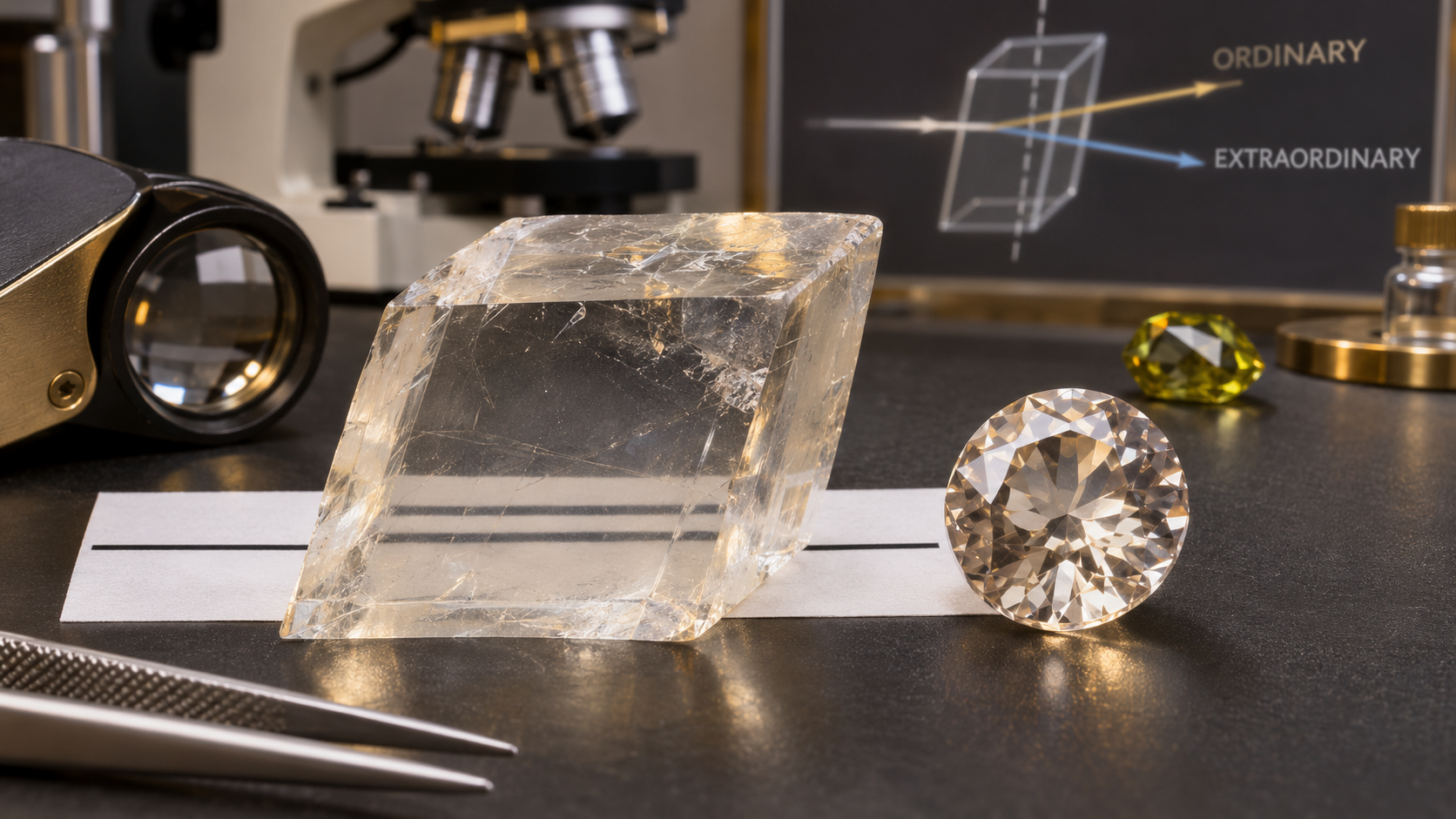
A transparent crystal of calcite placed over a printed line can produce a remarkable optical effect: one line appears as two. Under magnification, a faceted natural zircon may show a related phenomenon, with rear facet junctions appearing doubled.
These effects are examples of double refraction, a consequence of the direction-dependent optical behaviour of certain crystalline materials.
The underlying material property is known as birefringence.
Birefringence, specifically gemstone birefringence, is one of the fundamental optical characteristics used in mineralogy and professional gemmology. It helps explain how light interacts with crystal structure, why some gemstones display doubled images, and how optical measurements can contribute to gemstone identification.
However, the relationship between birefringence and visible doubling is more complex than it initially appears.
The study of gemstone birefringence reveals the complexities of light behavior in crystals.
A gemstone may possess measurable birefringence without showing obvious doubled facet junctions. Conversely, a strongly birefringent mineral may display very different optical effects depending on the direction from which it is examined.
Understanding these distinctions requires examining the physical nature of light, the optical properties of crystals and the geometry of the finished gemstone.
In Episode 11 of the Natural Gems Belgium Gemmology Series, we investigate the science of birefringence and double refraction, using calcite, zircon, titanite, peridot and other gemstones as practical examples.
Watch the Natural Gems Belgium Gemmology Series – Episode 11
Birefringence & Double Refraction: Why Some Gemstones Show Two Images
Presented by Marnick Elskens, Founder of Natural Gems Belgium.
Table of Contents
1. What Is Birefringence?
Birefringence is an optical property of anisotropic materials in which light can propagate with different refractive indices depending on its polarisation and direction of travel.
In a transparent isotropic material, the refractive index is independent of propagation direction and polarisation under ordinary conditions.
In an anisotropic crystal, the optical response is direction-dependent.
Consequently, light travelling through the crystal can be described by two characteristic polarisation modes, generally associated with different refractive indices.
The difference between the maximum and minimum principal refractive indices is called the material’s maximum birefringence.
It is commonly represented as:
Δn = n(max) − n(min)
Where:
- Δn represents maximum birefringence.
- n(max) is the highest principal refractive index.
- n(min) is the lowest principal refractive index.
This numerical value is a characteristic optical property of the mineral under specified conditions.
However, birefringence is not itself a measurement of the visible distance between two images.
The apparent separation also depends on the thickness of the gemstone, its orientation and the direction in which light travels through it.
2. The Physical Origin: Light and Crystal Structure
Light is an electromagnetic wave.
Its electric field interacts with the electronic structure of the material through which it propagates.
The resulting optical response determines properties such as refractive index, absorption and polarisation behaviour.
In crystals, atoms occupy ordered positions within a three-dimensional lattice.
The symmetry of this arrangement influences how the material responds to light.
In certain crystal systems, the optical response is equivalent in every direction.
In others, the response varies with crystallographic direction.
This distinction leads to two fundamental optical categories.
Isotropic Materials
An isotropic material has the same refractive index for all propagation directions and polarisations under ordinary conditions.
Gemstone examples include ideal, unstressed crystals of:
- Diamond.
- Spinel.
- Garnet.
These minerals belong to the cubic crystal system.
Noncrystalline materials such as ordinary glass are also generally optically isotropic when free of significant internal stress.
Anisotropic Materials
An anisotropic crystal possesses direction-dependent optical properties.
Examples include:
- Quartz.
- Corundum.
- Beryl.
- Tourmaline.
- Zircon.
- Peridot.
- Topaz.
- Titanite.
- Calcite.
These minerals belong to noncubic crystal systems.
Their optical behaviour is described using more than one principal refractive index.
This difference is fundamental to professional gemstone identification.
3. What Is Double Refraction?
Double refraction is the phenomenon in which light entering an anisotropic crystal can propagate as two differently polarised components.
Under suitable conditions, these components travel along different energy-propagation paths.
They may emerge from the crystal at different positions or directions, producing two distinguishable images.
A classic demonstration involves a transparent calcite rhombohedron placed over a printed line.
Instead of seeing one line, the observer may see two.
The effect is not caused by two physical objects.
It arises because light from the original object is transmitted through the crystal in two different optical modes.
The observer receives two spatially separated contributions from the same object.
The amount of separation depends on the crystal’s optical properties and the geometry of the experiment.
Double refraction is therefore a consequence of birefringence, but the two terms describe different aspects of the phenomenon.
Birefringence is the refractive-index difference. Double refraction is the associated optical propagation effect.
4. Ordinary and Extraordinary Waves
Uniaxial crystals provide a useful introduction to the physical mechanism.
Such crystals possess two principal refractive indices:
- The ordinary refractive index, nω.
- The extraordinary refractive index, nε.
The ordinary wave has a phase refractive index that is independent of propagation direction.
The extraordinary wave has an effective phase refractive index that depends on the direction of propagation relative to the optic axis.
These characteristic waves are associated with different polarisation states.
Under suitable conditions, their energy-propagation directions differ, allowing the two transmitted contributions to become spatially separated.
It is important to distinguish between the direction of the wave normal and the direction of energy flow.
In anisotropic media, these directions do not necessarily coincide for the extraordinary wave.
This distinction helps explain the ray displacement observed in calcite.
The Optic Axis
A uniaxial crystal possesses one optic-axis direction.
For propagation along this direction, the two characteristic phase refractive indices become equal.
Consequently, the usual double-refraction effect is not observed in the same way.
This explains why the visibility of doubled images depends strongly on crystal orientation.
A gemstone can be anisotropic even when its visible doubling is weak or absent from a particular viewing direction.
5. Uniaxial and Biaxial Gemstones
Anisotropic minerals are divided into two principal optical categories.
Uniaxial Minerals
Uniaxial minerals have one optic-axis direction.
They occur in the tetragonal, trigonal and hexagonal crystal systems.
Examples include:
- Quartz.
- Corundum.
- Beryl.
- Tourmaline.
- Zircon.
- Calcite.
Their principal refractive indices are designated nω and nε.
The maximum birefringence is:
Δn = |nε − nω|
Uniaxial minerals may be optically positive or negative, depending on which principal refractive index is greater.
Biaxial Minerals
Biaxial minerals possess two optic-axis directions.
They occur in the orthorhombic, monoclinic and triclinic crystal systems.
Examples include:
- Peridot.
- Topaz.
- Titanite.
- Tanzanite.
- Chrysoberyl.
- Iolite.
Their three principal refractive indices are designated:
nα ≤ nβ ≤ nγ
The maximum birefringence is:
Δn = nγ − nα
The actual refractive-index difference experienced by light travelling through the crystal depends on propagation direction.
Thus, maximum birefringence and observed birefringence are not always identical.
6. Calcite: The Classic Demonstration
Calcite is one of the most important minerals in the history of optical crystallography.
Its chemical formula is:
CaCO₃
Transparent calcite has a particularly large birefringence.
At approximately the sodium D reference wavelength, its principal refractive indices are commonly quoted near:
- nω = 1.658.
- nε = 1.486.
The resulting maximum birefringence is approximately:
Δn = 0.172
This is exceptionally large compared with many familiar faceted gemstones.
A transparent calcite rhombohedron placed over printed text can produce two visibly separated images.
Rotating the crystal changes the orientation of the observed doubling.
Why Thickness Matters
The amount of visible separation is influenced by the distance that light travels through the crystal.
A thicker crystal can produce greater spatial displacement under otherwise comparable conditions.
However, the relationship also depends on the angle of propagation and the optical geometry.
Two calcite crystals with the same intrinsic birefringence may therefore display different apparent separations.
This illustrates an important principle:
Visible doubling cannot be predicted from the birefringence number alone.
7. Natural Zircon: Double Refraction in a Faceted Gemstone
Natural zircon is a zirconium silicate mineral with the chemical formula:
ZrSiO₄
It crystallises in the tetragonal system and is optically uniaxial.
Transparent high-type zircon is particularly well known for its strong birefringence.
Representative principal refractive indices are approximately:
- nω = 1.925.
- nε = 1.984.
The corresponding maximum birefringence is approximately:
Δn = 0.059
These values are characteristic of high-type zircon; individual specimens may differ.
Doubled Facet Junctions
When a suitably oriented faceted zircon is examined through its crown, the junctions between pavilion facets may appear doubled.
The effect can be particularly noticeable under a gemmological loupe or microscope.
Instead of one sharp facet boundary, the observer may see two closely separated lines.
This is a practical manifestation of double refraction.
Why Zircon Properties Vary
Zircon can undergo structural damage caused by natural radioactive decay over geological time.
This process is associated with metamictisation.
The resulting structural changes can affect refractive index, birefringence, density and other properties.
Consequently, not all zircon specimens possess the same optical characteristics.
Natural Zircon Versus Cubic Zirconia
Natural zircon must not be confused with cubic zirconia.
Natural zircon is zirconium silicate.
Cubic zirconia is based on zirconium dioxide and is commonly manufactured as a diamond simulant.
Cubic zirconia is generally optically isotropic in its usual cubic form.
The distinction between these materials is fundamental.
8. Titanite: Strong Birefringence and Strong Dispersion
Titanite, traditionally called sphene in the gemstone trade, has the chemical formula:
CaTiSiO₅
It crystallises in the monoclinic system and is optically biaxial.
Titanite is notable for both strong birefringence and strong optical dispersion.
These properties must not be confused.
Birefringence
Titanite possesses a substantial difference between its principal refractive indices.
This can produce conspicuous doubling of rear facet junctions.
Dispersion
Titanite also displays strong wavelength-dependent changes in refractive index.
When appropriately cut and illuminated, this can contribute to vivid spectral flashes.
The two phenomena have different physical meanings.
Birefringence concerns polarisation-dependent optical propagation.
Dispersion concerns wavelength-dependent refractive index.
A gemstone may exhibit both simultaneously.
Cutting Considerations
Titanite’s strong optical anisotropy influences how the cutter evaluates facet orientation and appearance.
Its relatively modest hardness and cleavage also require consideration.
A visually spectacular gemstone is not necessarily equally durable for every jewellery application.
Optical performance and mechanical durability must be assessed separately.
9. Peridot: A Practical Gemmological Example
Peridot is the gem variety of olivine.
It crystallises in the orthorhombic system and is optically biaxial.
Representative refractive indices for gem-quality peridot are approximately:
- nα = 1.654.
- nβ = 1.670.
- nγ = 1.690.
These values vary with composition.
The maximum birefringence is commonly around:
Δn = 0.036
This is sufficiently high that doubled rear facet junctions may be visible under suitable conditions.
The effect can be useful during gemmological examination.
However, its visibility depends on the orientation and thickness of the finished stone.
Not every faceted peridot will display equally obvious doubling.
Professional identification should therefore combine the observation with additional gemmological properties.
10. Why Sapphire and Quartz Usually Show Less Obvious Doubling
Corundum, the mineral species that includes ruby and sapphire, is optically uniaxial.
Its representative principal refractive indices are approximately:
- nω = 1.768.
- nε = 1.760.
Maximum birefringence is therefore approximately:
Δn = 0.008
Quartz has representative principal indices near:
- nω = 1.544.
- nε = 1.553.
Its maximum birefringence is approximately:
Δn = 0.009
These values are much smaller than those of calcite or high-type zircon.
Consequently, visible doubling of facet junctions is usually less conspicuous.
Nevertheless, the minerals remain optically anisotropic.
Their birefringence can be detected and measured using appropriate gemmological techniques.
The absence of obvious facet doubling is therefore not sufficient evidence that a gemstone is isotropic.
11. Does Greater Birefringence Always Produce Greater Visible Doubling?
Not necessarily.
A larger birefringence generally increases the potential for spatial separation under comparable optical conditions.
However, the visible effect depends on several additional variables.
Crystal Orientation
The direction of observation relative to the optic axes influences the effective refractive-index difference and ray geometry.
Gemstone Thickness
The optical path through the material affects the displacement accumulated by the transmitted components.
Facet Geometry
A faceted gemstone presents multiple surfaces that redirect light.
The orientation of these surfaces influences which internal features or rear facet junctions are visible.
Refractive Index
The relationship between birefringence and angular ray separation also depends on the absolute refractive indices.
Research published in The Journal of Gemmology demonstrates that two materials with different birefringence values do not necessarily exhibit visible doubling in the same simple proportion.
Observation Conditions
Magnification, illumination, focus and the sharpness of the observed facet boundaries affect the examiner’s ability to detect doubling.
For these reasons, the visible effect must be interpreted as a combination of material properties and optical geometry.
12. How Gemmologists Measure Birefringence
The gemmological refractometer is one of the principal instruments used to investigate refractive index and birefringence.
A suitable polished gemstone facet is placed in optical contact with the refractometer prism using an appropriate contact liquid.
The instrument allows the examiner to observe refractive-index-related shadow boundaries.
In anisotropic gemstones, two shadow edges may be visible.
As the gemstone is rotated, their positions can change.
By collecting appropriate readings, the gemmologist can determine the highest and lowest observed refractive indices.
Their difference provides the measured birefringence.
Important Limitations
Not every gemstone can be measured using a conventional refractometer.
Some materials possess refractive indices beyond the instrument’s operating range.
Other specimens may lack a suitable polished facet or have insufficient optical contact.
In addition, measurements obtained from limited orientations may not reveal the maximum birefringence.
The examiner must understand the instrument’s limitations and apply the appropriate technique.
A refractometer measurement is more rigorous than simply estimating birefringence from the apparent doubling of facets.
13. The Polariscope and Optical Character
A polariscope is another important instrument in gemmology.
It uses polarised light to investigate optical behaviour.
Under appropriate conditions, it can help distinguish isotropic from anisotropic materials.
It can also contribute to determining optical character when used with suitable techniques and accessories.
However, interpreting polariscope observations requires care.
Internal strain, inclusions and aggregate structures can produce complex responses.
A polariscope result should therefore be considered alongside other optical measurements.
The distinction between uniaxial and biaxial optical character is particularly important for mineral identification.
For more advanced work, optical interference figures can provide information about optic axes and optical symmetry.
These techniques connect practical gemmology with the broader discipline of optical mineralogy.
14. Birefringence Versus Dispersion
Birefringence and dispersion are often confused because both involve refractive index.
However, they describe different physical properties.
Birefringence
Birefringence is associated with differences in optical propagation between characteristic polarisation modes in anisotropic materials.
It can produce double refraction and visible image doubling.
Dispersion
Dispersion describes the variation of refractive index with wavelength.
It contributes to the spectral colour separation known as gemstone fire.
A colourless diamond can display strong fire even though an ideal diamond is optically isotropic.
Conversely, a strongly birefringent gemstone does not necessarily display exceptional fire.
Titanite is particularly interesting because it possesses both strong birefringence and strong dispersion.
These phenomena can occur together, but they remain physically distinct.
15. Birefringence Versus Pleochroism
Pleochroism is another optical phenomenon associated with anisotropic crystals.
It occurs when light with different polarisation directions experiences different absorption.
As a result, a coloured gemstone may display different colours or colour intensities when examined in different orientations.
Birefringence and pleochroism both arise from direction-dependent optical behaviour.
However, their mechanisms are different.
Birefringence concerns refractive-index differences.
Pleochroism concerns absorption differences.
A gemstone can be birefringent without displaying visually strong pleochroism.
Likewise, strong pleochroism does not necessarily imply that doubled facet junctions will be obvious.
Understanding these distinctions is essential for correct optical interpretation.
16. Anomalous Double Refraction in Isotropic Gemstones
An important complication occurs in some materials that are normally optically isotropic.
Diamond, spinel and garnet belong to the cubic crystal system.
In ideal, unstressed conditions, their intrinsic optical response is isotropic.
However, internal strain and structural disturbances can create local optical anisotropy.
Under polarised light, such specimens may display anomalous optical effects.
These observations are sometimes described as anomalous double refraction.
The presence of strain-related optical effects does not change the fundamental crystallographic classification of the mineral.
A cubic gemstone remains cubic.
Therefore, an anomalous optical response should not automatically be interpreted as evidence that the material belongs to a noncubic crystal system.
Professional interpretation requires distinguishing intrinsic birefringence from strain-related behaviour.
17. Can Birefringence Identify a Gemstone?
Birefringence is a valuable diagnostic property.
For example, a strongly doubly refractive gemstone may be distinguished from a visually similar isotropic material.
The combination of refractive index, birefringence and optic character can significantly narrow the range of possible mineral identities.
However, birefringence alone is rarely sufficient for definitive identification.
Different gemstone species may possess overlapping values.
Compositional variation can also influence refractive indices.
The examiner may therefore need additional observations, including:
- Microscopic characteristics.
- Refractive-index measurements.
- Optical character.
- Specific gravity.
- Absorption spectra.
- Pleochroism.
- Appropriate advanced laboratory analyses.
The strongest identification is based on a consistent combination of independent evidence.
18. Can Birefringence Prove Natural Origin?
No.
Natural and laboratory-grown specimens of the same mineral species can possess essentially the same fundamental optical properties.
A laboratory-grown ruby is still corundum.
A laboratory-grown sapphire is also corundum.
Their intrinsic birefringence can therefore overlap closely with that of natural material.
Birefringence does not independently establish whether a gemstone formed naturally or was manufactured.
It also cannot reliably determine geographic origin.
Nor does a birefringence value alone establish treatment status.
These questions require examination of other characteristics, such as growth structures, inclusions, chemical composition and spectroscopic evidence.
The distinction between material identification and origin determination is fundamental to responsible gemmology.
19. Why Birefringence Matters to Collectors and Gemstone Buyers
Understanding birefringence helps collectors appreciate an important aspect of gemstone optical behaviour.
It also prevents several common misconceptions.
A gemstone showing doubled facet junctions is not necessarily damaged.
Visible doubling is not automatically a cutting defect.
A gemstone without obvious doubling is not necessarily isotropic.
And the presence of birefringence does not prove that a gemstone is natural.
For gem cutters, optical orientation can influence how a gemstone’s internal features and facet junctions appear.
For gemmologists, birefringence is a measurable property that contributes to identification.
For collectors, it provides a fascinating example of the relationship between crystal structure and visible beauty.
Conclusion: When Crystal Structure Creates Two Images
Birefringence demonstrates how profoundly crystal structure can influence the behaviour of light.
In anisotropic materials, different characteristic polarisation modes can experience different refractive indices.
Under suitable conditions, this produces double refraction and the appearance of two images.
Calcite provides a dramatic demonstration.
Natural zircon, titanite and peridot show how the same underlying principles become relevant to faceted gemstones.
Quartz and corundum demonstrate that measurable birefringence does not always produce obvious visual doubling.
And isotropic materials such as diamond, spinel and garnet illustrate why crystal symmetry matters.
The central lesson is that visible optical effects must be interpreted within their complete physical context.
At Natural Gems Belgium, we believe that understanding these scientific principles makes gemstone appreciation more meaningful.
A doubled facet junction is not merely an unusual visual detail.
It is evidence of how light interacts with the ordered internal structure of a crystal.
References & Further Reading
The following sources are scientific and educational publications rather than gemstone product pages. They provide additional information about birefringence, optical crystallography, double refraction and gemmological interpretation.
1. Gem-A – The Journal of Gemmology (2002)
Doubling of Images in Gemstones.
A technical study of visible image doubling in gem materials, including the influence of optical orientation and gemstone thickness.
https://gem-a.com/wp-content/uploads/2023/11/JoG2002_28_4.pdf
2. Gem-A – The Journal of Gemmology (1993), Volume 23, Issue 7
Technical discussion of birefringence, refractive indices and the relationship between intrinsic birefringence and observed doubling strength.
https://gem-a.com/wp-content/uploads/2023/11/JoG1993_23_7.pdf
3. Gemological Institute of America – Gems & Gemology, Fall 2014
Scientific discussion of optical crystallography, polarisation, uniaxial and biaxial materials, and double refraction.
https://www.gia.edu/doc/FA14.pdf
4. Mineralogical Society of America – Guide to Thin Section Microscopy
A technical educational reference covering optical mineralogy, refractive index, anisotropy, birefringence and polarised-light observations.
https://msaweb.org/wp-content/uploads/2022/06/Thin_Sctn_Mcrscpy_2_rdcd_eng.pdf
5. Gem-A – The Journal of Gemmology
Scientific and technical research on gemstone identification, optical properties and laboratory methods.
6. Gemological Institute of America – Gems & Gemology
Peer-reviewed research on gemstone optical properties, identification and laboratory examination.
https://www.gia.edu/gems-gemology
Natural Gems Belgium – Gemmology Series
Presented by Marnick Elskens, Founder of Natural Gems Belgium.
Natural Gemstones • Expertly Selected • Every Piece Unique