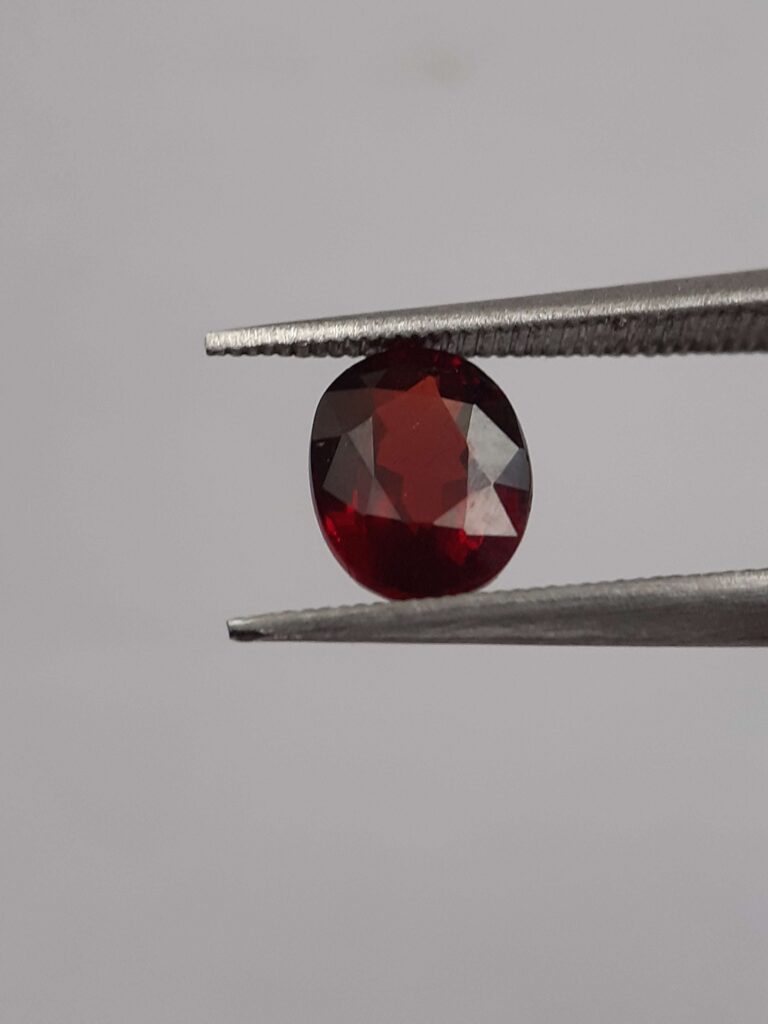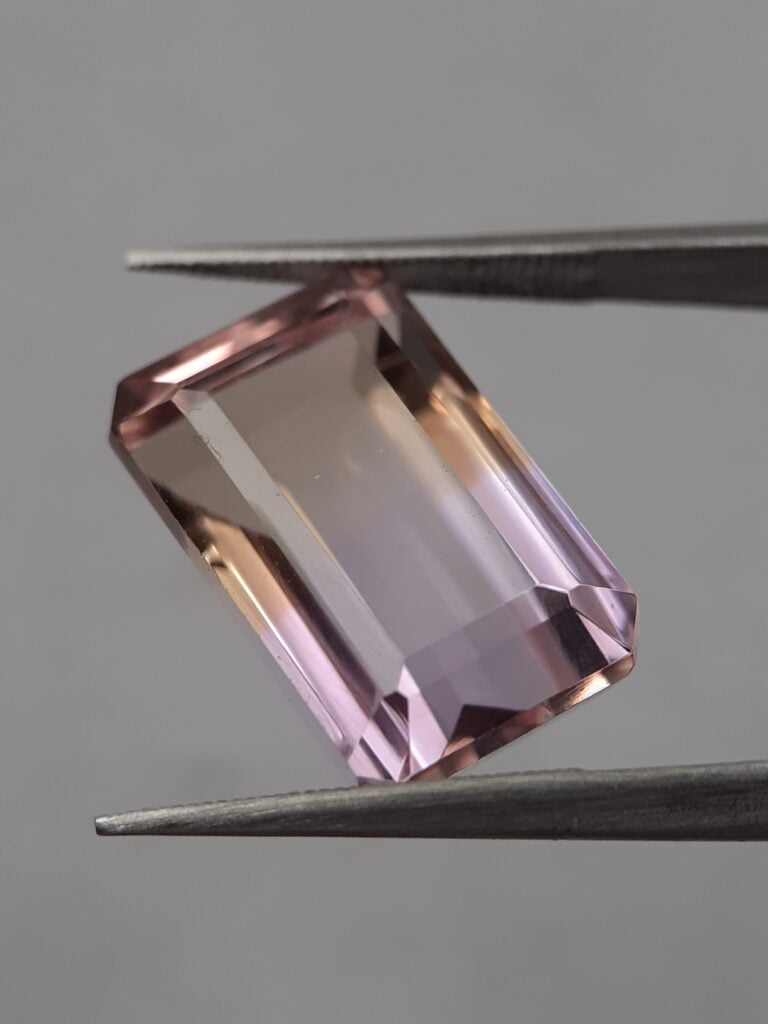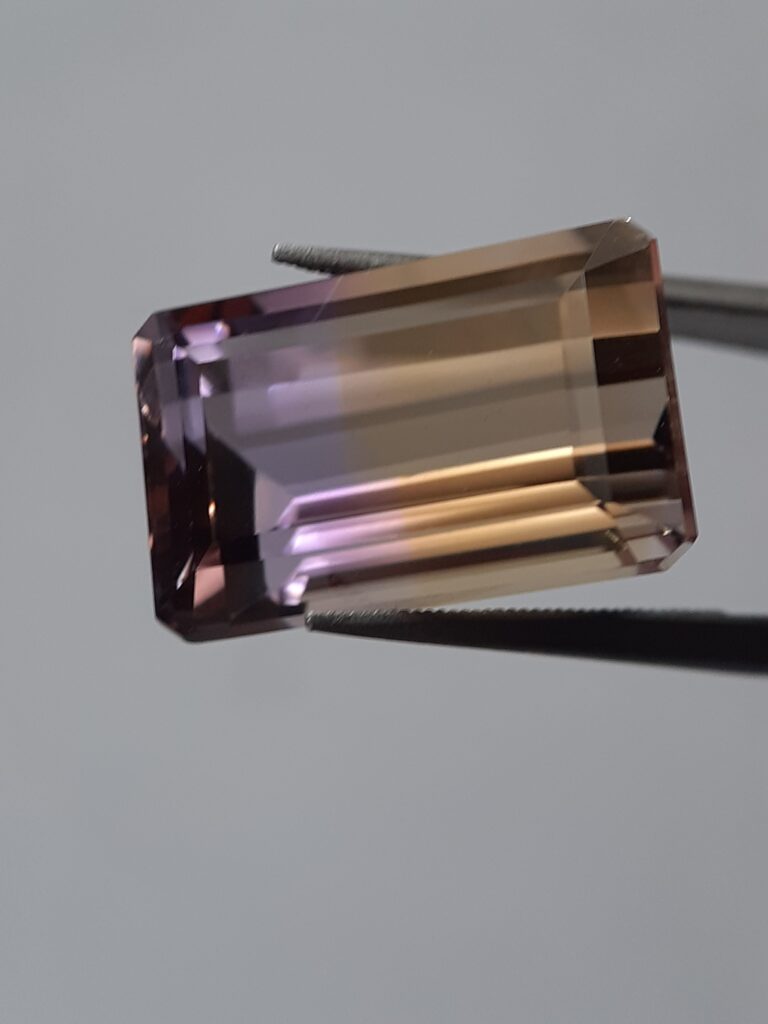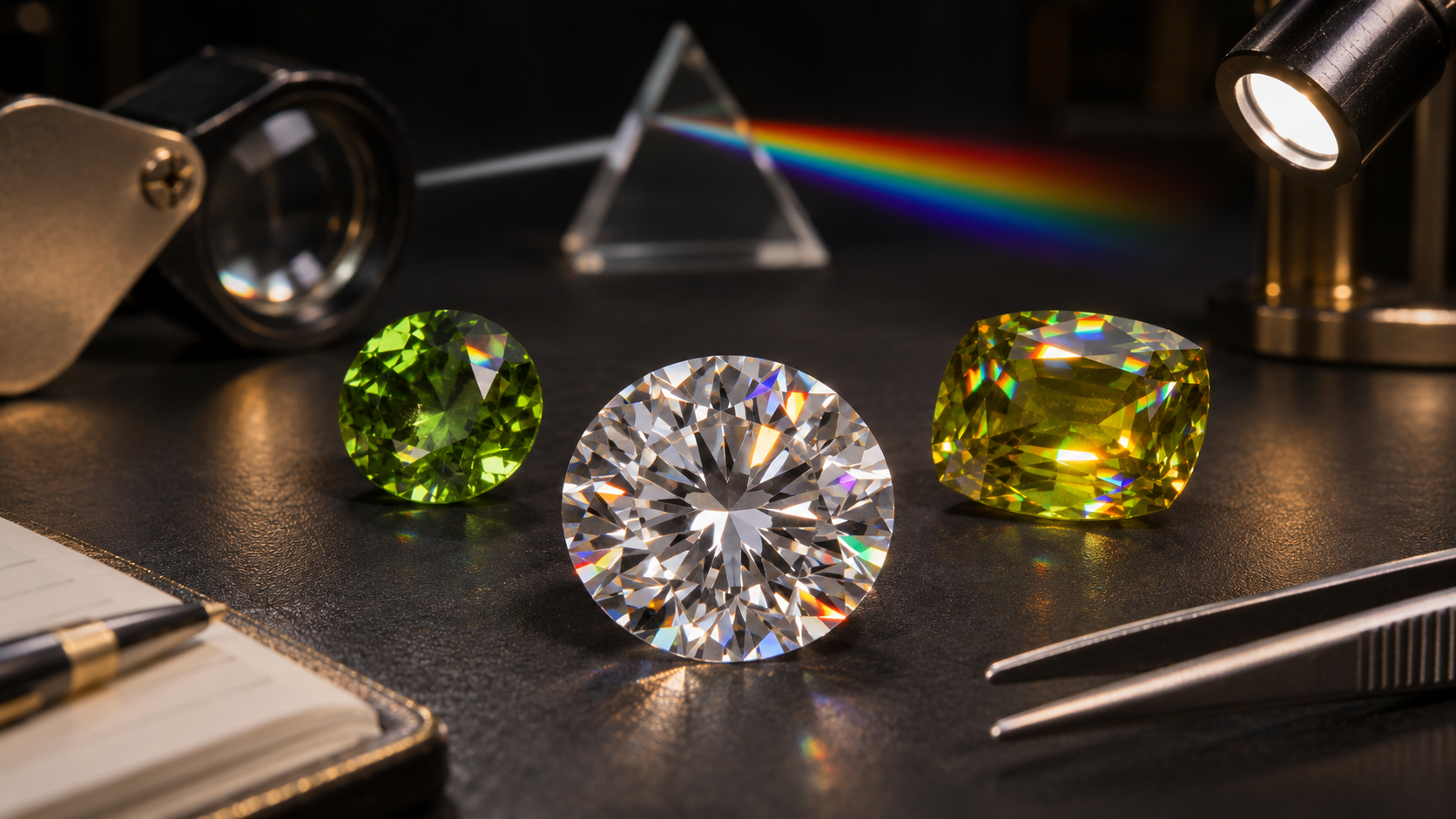
A beautifully cut gemstone can produce a remarkable display of light. As the stone moves, flashes of red, blue, green, yellow and violet may appear and disappear across its facets.
These colourful flashes are commonly described in gemmology as fire.
Although diamond is particularly famous for this phenomenon, it is far from the only gemstone capable of displaying it. Demantoid garnet, titanite (sphene), zircon and several other gem materials can produce exceptional spectral flashes under suitable conditions.
The scientific explanation begins with optical dispersion: the variation of refractive index with the wavelength of light.
Yet dispersion alone does not determine how much fire a gemstone displays. Cutting geometry, body colour, transparency, illumination and the observer’s position all influence the final appearance.
Understanding these relationships provides valuable insight into gemstone optics and helps distinguish the measurable properties of a mineral from the visual performance of a finished gemstone.
Understanding Gemstone Dispersion and Fire provides valuable insight into gemstone optics and helps distinguish the measurable properties of a mineral from the visual performance of a finished gemstone.
In Episode 10 of the Natural Gems Belgium Gemmology Series, we examine how dispersion works, why some gemstones display more fire than others, and how gemmologists interpret these effects.
Watch the Natural Gems Belgium Gemmology Series – Episode 10
Dispersion & Fire: Why Gemstones Flash Rainbow Colours
Presented by Marnick Elskens, Founder of Natural Gems Belgium.
This educational episode explores the physics of dispersion, the optical performance of faceted gemstones and the influence of cutting proportions and illumination on visible fire.
Table of Contents
1. What Is Optical Dispersion?
Optical dispersion describes the variation of a material’s refractive index with the wavelength of light.
Refractive index, represented by the symbol n, relates the phase velocity of light in a material to its speed in a vacuum.
In its simplest form:
n = c / v
Where:
- n is refractive index.
- c is the speed of light in a vacuum.
- v is the phase velocity of light in the material.
However, the phase velocity is generally not identical for all wavelengths.
In many transparent materials across the visible spectrum, shorter wavelengths have a higher refractive index than longer wavelengths.
This behaviour is known as normal dispersion.
Consequently, violet and blue light are often refracted more strongly than red light under comparable optical conditions.
When white light encounters appropriately arranged refracting surfaces, these wavelength-dependent differences can produce visible colour separation.
This is the physical foundation of gemstone fire.
2. Why White Light Contains Different Colours
White light is not a single visible wavelength.
It contains a distribution of wavelengths that collectively produce the perception of white.
The visible spectrum extends approximately from violet at the shorter-wavelength end to red at the longer-wavelength end.
The boundaries are approximate because human visual sensitivity changes gradually across the spectrum.
A transparent prism demonstrates how white light can be separated into its constituent spectral colours.
When light enters and exits the prism, refraction changes its direction.
Because the refractive index varies with wavelength, different colours emerge at slightly different angles.
The resulting separation produces a spectrum.
A faceted gemstone can generate related effects through a much more complex arrangement of optical interfaces.
Light may enter through one facet, undergo internal reflections and emerge through another facet.
The wavelength-dependent refraction at these interfaces can produce distinct coloured flashes.
3. Dispersion and Fire Are Not the Same Thing
One of the most important distinctions in gemstone optics is the difference between dispersion as a material property and fire as a visible optical effect.
Dispersion describes how the refractive index of a material changes with wavelength.
Fire describes the visible spectral colours produced by a fashioned gemstone.
Two diamonds with different cutting proportions possess essentially the same intrinsic dispersion when measured at the same reference wavelengths.
Yet they may display substantially different amounts of visible fire.
This occurs because the geometry of the finished gemstones determines how light travels through them and how much separated light reaches the observer.
A gemstone with high intrinsic dispersion may display limited fire if its cutting geometry is unsuitable.
Conversely, an appropriately fashioned gemstone with more moderate dispersion may display attractive spectral flashes.
Dispersion provides the physical potential for fire.
The gemstone’s optical design and viewing conditions determine how that potential is expressed.
4. How Is Gemstone Dispersion Measured?
Dispersion can be quantified by comparing refractive indices measured at two specified wavelengths.
In traditional gemmological reference data, a commonly quoted dispersion value is the difference between the refractive indices at the Fraunhofer B and G spectral lines.
These correspond approximately to:
- B line: 687 nanometres, in the red region.
- G line: 431 nanometres, in the violet-blue region.
The conventional dispersion value can therefore be expressed as:
Dispersion = n(G) − n(B)
This is a numerical measure of how much the refractive index changes between the two selected wavelengths.
It is not a direct measurement of the amount of fire visible in a finished gemstone.
Other optical disciplines may use different wavelength pairs or dispersion parameters.
Therefore, dispersion values should only be compared when they use compatible definitions and measurement conventions.
In anisotropic gemstones, dispersion can be more complex because different optical directions and polarisation states may have different wavelength-dependent refractive indices.
5. Why Diamonds Display Fire
Diamond is particularly well known for its optical performance.
It combines a high refractive index with appreciable dispersion.
Its refractive index is approximately 2.42 at the conventional sodium D reference wavelength.
Its commonly quoted B–G dispersion value is approximately:
0.044
This provides the potential for clearly visible spectral flashes.
However, the visible fire of a diamond is strongly influenced by its cut.
The Role of Facet Geometry
A faceted diamond contains numerous polished surfaces that control the direction of light.
Light entering the stone may undergo refraction, internal reflection and additional refraction as it exits.
The crown and pavilion angles, facet arrangement and overall proportions influence which light rays return towards the observer.
These factors affect both white-light return and spectral colour separation.
GIA research has demonstrated that diamond cutting proportions can produce different combinations of brightness and fire.
There is no universal rule that maximising one optical component automatically maximises every other component.
The most attractive optical appearance generally requires a balanced design.
Why a Diamond Can Look Different Under Different Lighting
A diamond may appear bright and relatively white under diffuse illumination.
Under concentrated directional lighting, distinct coloured flashes can become more noticeable.
This does not mean its intrinsic dispersion has changed.
The lighting environment has changed the way separated light reaches the observer.
The distinction is essential when evaluating gemstone photographs and videos.
6. Brightness, Fire and Scintillation
Three terms are particularly important when discussing diamond optical performance.
Brightness
Brightness describes the appearance of white light returned to the observer through internal and external reflections.
A bright gemstone returns a substantial amount of visible light towards the observer.
However, brightness does not necessarily imply strong fire.
Fire
Fire describes the appearance of dispersed spectral colours.
It may appear as small points or larger flashes of red, blue, yellow, green and other colours.
The strength of visible fire depends on dispersion, cutting geometry, lighting and viewing conditions.
Scintillation
Scintillation describes the flashes of light and changing patterns of bright and dark areas produced as the gemstone, observer or light source moves.
It contributes to the dynamic appearance often described as sparkle.
A gemstone can display white flashes without producing equally prominent spectral colours.
Likewise, a gemstone may show attractive fire while having a less balanced overall brightness pattern.
These three properties are related but should not be confused.
7. Demantoid Garnet: Exceptional Fire in a Green Gemstone
Demantoid is a green variety of andradite garnet.
It is especially admired for its strong dispersion.
The commonly quoted B–G dispersion value for demantoid is approximately:
0.057
This is higher than the conventional value for diamond.
As a result, transparent, well-cut demantoid can display exceptionally attractive fire.
However, demantoid is also a coloured gemstone.
Its green body colour results from selective absorption of visible light.
This absorption can affect which spectral colours are transmitted and how prominently they appear.
A dark or strongly saturated specimen may display less obvious fire than a lighter, highly transparent specimen, even when both possess similar intrinsic dispersion.
The visible result depends on the interaction between dispersion, absorption, cutting geometry and illumination.
This illustrates why a numerical dispersion value cannot be used as a complete assessment of gemstone optical quality.
8. Titanite or Sphene: One of the Most Spectacular Examples
Titanite, traditionally called sphene in the gemstone trade, is another material known for very strong dispersion.
It is a calcium titanium silicate mineral with the formula:
CaTiSiO₅
Transparent gem-quality titanite may display vivid spectral flashes, especially in yellow, green and related body colours.
Its commonly cited dispersion values are substantially higher than those of diamond, although reference figures depend on the measurement convention and optical direction.
Titanite is also strongly birefringent.
Its optical behaviour is therefore more complicated than that of isotropic diamond.
Why Titanite Is Not Simply a More Brilliant Diamond
Strong dispersion does not make titanite equivalent to diamond.
The two materials differ significantly in hardness, cleavage, crystal structure, optical anisotropy and durability.
Titanite has a Mohs hardness of approximately 5–5.5 and possesses cleavage that requires consideration during cutting and handling.
It is therefore generally less resistant to everyday wear than diamond.
A well-cut titanite can be visually spectacular, but it should be evaluated according to its own mineralogical properties and intended use.
This is a clear example of why optical performance and durability must be assessed separately.
9. Zircon: Natural Fire and Optical Complexity
Natural zircon is a zirconium silicate mineral with the formula:
ZrSiO₄
Certain transparent high-type zircon specimens combine relatively high refractive indices with appreciable dispersion.
Well-cut colourless zircon can display noticeable fire.
Blue and other coloured zircons may also show attractive spectral flashes under appropriate conditions.
However, zircon presents additional complexity.
Natural radiation damage can affect its crystal structure over geological time.
This process, known as metamictisation, may change optical and physical properties.
Consequently, the optical behaviour of zircon is not identical across every specimen.
Zircon Is Not Cubic Zirconia
Natural zircon must not be confused with cubic zirconia.
Cubic zirconia is a different material, commonly manufactured as a diamond simulant.
It is based on zirconium dioxide rather than zirconium silicate.
Cubic zirconia can display strong fire, with a commonly quoted dispersion value near 0.060.
Its ability to produce colourful flashes does not establish that it is diamond.
The distinction between natural zircon and cubic zirconia is fundamental to accurate gemstone identification.
10. Other Materials with Notable Dispersion
Several other natural gemstones and manufactured materials can display significant spectral colour separation.
Examples include certain garnets, high-type zircon and various diamond simulants.
Some materials possess dispersion values higher than diamond.
Others possess lower intrinsic dispersion but can still display attractive fire when appropriately cut.
The optical appearance of each material must be considered in context.
For coloured gemstones, selective absorption is particularly important.
For highly birefringent gemstones, optical direction and facet orientation may influence the observed result.
For strongly included or translucent specimens, scattering and reduced transparency can limit the visibility of distinct spectral flashes.
The scientific question is not simply which gemstone has the largest dispersion number.
It is how the complete material and optical system behave together.
11. How Cutting Proportions Influence Fire
A gemstone’s cut determines how its facets redirect light.
The geometry of the crown and pavilion influences light entry, internal reflections and light exit.
These relationships affect both brightness and fire.
Crown Geometry
The crown facets influence how light enters and leaves the gemstone.
Their angles and arrangement affect the angular separation and distribution of emerging light.
Pavilion Geometry
The pavilion plays an important role in determining whether light returns towards the observer or escapes through other directions.
Inappropriate pavilion proportions may create excessive light leakage.
Facet Arrangement
The number, size and orientation of facets influence the apparent distribution of flashes.
However, simply adding more facets does not guarantee superior fire.
The overall design must work with the material’s refractive index, dispersion and other optical properties.
Brilliant Cuts and Step Cuts
Brilliant-style cuts are often designed to produce lively patterns of light return and scintillation.
Step cuts generally create broader, more orderly reflections.
Both styles can be attractive, but they emphasise different aspects of gemstone appearance.
The optimal choice depends on the material, its colour, transparency and the cutter’s intended visual result.
12. Why Lighting Is Essential to Fire
The appearance of fire changes significantly with illumination.
A gemstone examined under broad diffuse lighting may display substantial white-light return while producing relatively subdued spectral flashes.
Under a small directional light source, separated colours may become more distinct.
This is because concentrated illumination can create stronger angular and visual contrast between emerging spectral components.
Spot Lighting
Small directional sources can make individual spectral flashes more visible.
This is particularly effective against relatively dark surroundings.
Diffuse Lighting
Diffuse lighting can produce a more uniform overall appearance.
It is useful for evaluating certain aspects of brightness, but may make distinct fire less prominent.
Multiple Light Sources
Several directional lights can produce complex patterns of reflections and spectral flashes.
These conditions may create visually dramatic results, but they can make it harder to evaluate the contribution of a single optical effect.
Photography and Video
Gemstone photography can strongly influence the perceived amount of fire.
Light-source size, camera position, exposure, focus and movement all affect the recorded result.
A gemstone displaying spectacular fire in a carefully controlled studio may look different under ordinary daylight or indoor illumination.
Accurate presentation should avoid suggesting that a gemstone will display identical optical effects under every condition.
13. Why Body Colour Can Suppress Fire
A transparent colourless gemstone can transmit a broad range of visible wavelengths.
In a coloured gemstone, selective absorption modifies the light that passes through the material.
For example, a strongly green gemstone may absorb substantial portions of the red and blue regions of the spectrum.
Even if the material has high dispersion, the spectral components available to produce visible flashes may be reduced.
This can suppress or alter the appearance of fire.
The relationship is not always simple.
A gemstone’s thickness, transparency, absorption spectrum and cutting geometry all influence the result.
Strong body colour may enhance the overall attractiveness of a gemstone while simultaneously reducing the visibility of certain dispersed colours.
This is one reason why the evaluation of coloured gemstones differs from the evaluation of colourless diamonds.
14. Can Fire Be Used to Identify a Gemstone?
Fire can provide useful observational information, but it is not a definitive identification method.
Several natural gemstones and manufactured materials can display strong dispersion.
Some diamond simulants produce more visible spectral colour separation than diamond under suitable conditions.
Therefore, strong rainbow flashes do not prove that a gemstone is diamond.
Likewise, weak visible fire does not prove that a gemstone is not diamond.
Cutting geometry and illumination may explain the difference.
A professional gemmologist may combine visual observations with:
- Refractive-index measurements.
- Optical-character determination.
- Birefringence observations.
- Specific-gravity measurements.
- Microscopic examination.
- Spectroscopic analysis.
- Other appropriate laboratory techniques.
The choice of tests depends on the material and the identification question.
A consistent body of evidence is more reliable than any single visual characteristic.
15. Does Fire Prove Natural Origin?
No.
Natural and laboratory-grown gemstones of the same mineral species can possess very similar fundamental optical properties.
Their refractive indices and dispersion characteristics may overlap closely.
The presence of fire therefore cannot establish whether a gemstone formed naturally or was produced in a laboratory.
Fire also cannot reliably establish geographic origin.
Nor can it determine every treatment applied to a gemstone.
For these questions, gemmologists investigate other characteristics, such as internal growth structures, inclusions, spectroscopy and chemical composition.
The distinction between material identification and origin determination is essential.
16. Dispersion Versus Other Optical Phenomena
Gemstone dispersion should not be confused with several other optical effects.
Dispersion and Pleochroism
Pleochroism occurs in certain optically anisotropic materials when different polarisation directions experience different absorption.
It can cause a gemstone to display different body colours or colour intensities when viewed in different directions.
This is not the same mechanism as fire.
Dispersion and Colour Change
Colour-change gemstones can appear different under different illumination spectra.
The effect is primarily associated with selective absorption and the spectral composition of the light source.
It should not be confused with the separation of white light into spectral flashes.
Dispersion and Fluorescence
Fluorescence is the emission of light following excitation by suitable radiation.
Fire does not require the gemstone to emit new light through fluorescence.
Dispersion and Asterism
Asterism is associated with organised internal structures that redirect light into intersecting bands forming a star.
It is not produced by the same optical mechanism as ordinary gemstone fire.
These distinctions demonstrate the importance of precise scientific terminology.
17. How Gemmologists Evaluate Optical Performance
Optical performance involves several interacting characteristics.
For a colourless faceted gemstone, brightness, fire and scintillation are especially important.
For a coloured gemstone, body colour, tone, saturation, transparency and cutting quality also strongly influence appearance.
A complete evaluation may consider:
Light return: How effectively the gemstone directs light towards the observer.
Fire: The visibility and distribution of spectral colour flashes.
Scintillation: The dynamic pattern of bright and dark areas.
Contrast: The balance between illuminated and darker regions.
Transparency: The extent to which the material transmits light.
Cutting quality: Proportions, symmetry, polish and facet arrangement.
Body colour: The colour and absorption characteristics of the gemstone.
No single numerical measurement captures all of these factors.
A gemstone’s visual quality must be assessed as a complete optical system.
18. Why Dispersion Matters to Collectors and Buyers
Understanding dispersion helps gemstone collectors appreciate why different materials can produce such distinctive visual effects.
It also prevents several common misconceptions.
A gemstone with stronger fire is not necessarily more valuable.
A gemstone with higher dispersion is not necessarily better cut.
A gemstone displaying rainbow flashes is not necessarily diamond.
And a photograph showing exceptional fire does not guarantee that the same appearance will be visible under every lighting condition.
The most informative approach is to consider the material’s identity, optical properties, cutting quality, colour, transparency and intended use together.
For collectors, dispersion is one of the most fascinating connections between mineral physics and gemstone beauty.
For gemmologists, it is an optical property that must be interpreted within a broader scientific framework.
Conclusion: The Science Behind Gemstone Fire
The colourful flashes observed in diamonds and other gemstones are the visible result of wavelength-dependent optical behaviour.
Dispersion describes how refractive index changes with wavelength.
Fire describes the spectral colours that become visible when a fashioned gemstone separates and returns light towards the observer.
The relationship between these concepts is fundamental, but it is not sufficient on its own to predict gemstone appearance.
Cutting proportions, facet geometry, transparency, body colour and illumination all influence the final result.
Diamond demonstrates how a combination of high refractive index, dispersion and sophisticated cutting can produce exceptional optical performance.
Demantoid garnet, titanite and zircon reveal that other minerals can display equally fascinating, and sometimes stronger, dispersion.
At Natural Gems Belgium, we believe that understanding the science behind gemstone beauty makes every specimen more interesting.
A brilliant flash of colour is not merely a decorative effect.
It is a visible expression of light interacting with matter.
References & Further Reading
The following references are authoritative, non-commercial scientific and educational publications. They support the discussion of optical dispersion, gemstone fire, cutting geometry, illumination and professional gemmological interpretation.
1. Gemological Institute of America – Modeling the Appearance of the Round Brilliant Cut Diamond: An Analysis of Fire, and More about Brilliance
Reinitz, I. M., Johnson, M. L., Hemphill, T. S., Gilbertson, A. M., Geurts, R. H., Green, B. D., and Shigley, J. E.
Gems & Gemology, Fall 2001.
An important scientific study investigating the relationship between diamond cutting proportions, spectral light return and visible fire.
https://www.gia.edu/gems-gemology/fall-2001-modeling-appearance-round-brilliant-cut-diamond-reinitz
2. Gemological Institute of America – A Foundation for Grading the Overall Cut Quality of Round Brilliant Cut Diamonds
Moses, T. M., et al.
Gems & Gemology, Fall 2004.
A foundational study establishing precise terminology for brightness, fire and scintillation and explaining their importance in diamond cut evaluation.
https://www.gia.edu/gems-gemology/fall-2004-grading-cut-quality-brilliant-diamond-moses
3. Gemological Institute of America – Optimizing Face-Up Appearance in Colored Gemstone Faceting
Gems & Gemology.
A technical discussion of gemstone cutting geometry, light return, contrast and optical performance in coloured gemstones.
https://www.gia.edu/gems-gemology/optimizing-face-up-appearance-in-colored-gemstone-faceting
4. Gemological Institute of America – How Light Affects a Diamond’s Appearance
GIA 4Cs educational publication.
Explains how facet arrangement, illumination and movement influence brightness, fire and scintillation.
https://4cs.gia.edu/en-us/blog/light-affects-diamond-cut-appearance
5. Gemological Institute of America – Garnet Gemstone Reference
GIA educational mineral and gemstone reference.
Includes information about demantoid garnet and its characteristic high dispersion and fire.
6. Gemological Institute of America — Cutting Diffraction Gratings to Improve Dispersion (“Fire”) in Diamonds
Gems & Gemology, Winter 2009.
A specialised scientific investigation into diffraction-based surface modifications and their influence on visible fire, including the importance of directional and diffuse illumination. This research concerns an additional optical mechanism and should not be confused with ordinary bulk material dispersion.
https://www.gia.edu/doc/Cutting-Diffraction-Gratings-to-Improve-Dispersion-Fire-in-Diamonds.pdf
7. Gemological Institute of America – How to Tell if a Diamond Is Real
GIA 4Cs educational publication.
Discusses the limitations of visual sparkle as an identification method and explains why diamond simulants can also display strong optical effects.
https://4cs.gia.edu/en-us/blog/how-to-tell-if-diamond-is-real
8. Gemological Institute of America – Why Cut Matters, Part 2
GIA 4Cs educational publication.
Explains the relationship between cutting proportions, brightness, fire and scintillation in round brilliant diamonds.
https://4cs.gia.edu/en-us/blog/why-cut-matters-part-2
Natural Gems Belgium — Gemmology Series
Presented by Marnick Elskens, Founder of Natural Gems Belgium.
Natural Gemstones • Expertly Selected • Every Piece Unique