

Two gemstones can look remarkably similar. They may share the same colour, transparency, size and cutting style, yet belong to completely different mineral species.
A red spinel can resemble a ruby. A green garnet can resemble an emerald. Colourless quartz, topaz and other transparent materials may also be difficult to distinguish by appearance alone.
Professional gemmology therefore relies on measurable physical and optical properties rather than visual impressions.
Among the most important of these properties is refractive index, commonly abbreviated as RI.
The Gemstone Refractive Index is a critical factor in gemmology as it helps in identifying various gemstones.
Refractive index describes how light propagates through a material. Because gemstones differ in chemical composition, atomic bonding and crystal structure, they frequently possess characteristic refractive-index values.
By measuring these values, gemmologists can narrow down possible identities, determine aspects of optical character and distinguish between materials that otherwise appear similar.
In Episode 9 of the Natural Gems Belgium Gemmology Series, we examine the science of refraction, the operating principle of the gemmological refractometer, the interpretation of measurements and the limitations that every examiner must understand.
Watch the Natural Gems Belgium Gemmology Series – Episode 9
Refractive Index: How Gemmologists Measure the Bending of Light
Presented by Marnick Elskens, Founder of Natural Gems Belgium.
Understanding the Gemstone Refractive Index is essential for accurate gemstone assessment.
This episode explains how light interacts with gemstones and how refractive-index measurements contribute to reliable mineral identification.
The concept of Gemstone Refractive Index is foundational in the field of gemmology.
Table of Contents
1. What Is Refractive Index?
Refractive index is an optical property describing the relationship between the speed of light in a vacuum and its phase velocity in a material.
It is represented by the symbol n.
For a transparent, isotropic medium at a specified wavelength, the relationship can be written as:
n = c / v
Where:
- n is the refractive index.
- c is the speed of light in a vacuum.
- v is the phase velocity of light in the material.
For most transparent gemstones in the visible spectrum, the refractive index is greater than one.
This means that the phase velocity of light in the material is lower than its speed in a vacuum.
However, the refractive index is not necessarily a single universal value for every direction and wavelength.
In anisotropic crystals, optical properties depend on direction and polarisation. Refractive index also varies with wavelength, a property known as dispersion.
Consequently, precise refractive-index values must be interpreted within their optical and measurement context.
2. Why Does Light Bend When Entering a Gemstone?
When a light wave crosses the boundary between two materials with different optical properties, its direction may change.
This phenomenon is called refraction.
Imagine a light ray travelling through air and entering a transparent gemstone at an oblique angle.
Because the phase velocity changes at the boundary, the transmitted wave generally changes direction.
When light passes from a lower-index isotropic medium into a higher-index one, it bends towards the normal to the surface.
The normal is an imaginary line perpendicular to the interface.
When light travels from a higher-index medium into a lower-index one, the transmitted ray bends away from the normal, provided transmission is possible.
This principle helps explain why objects viewed through water appear displaced and why transparent gemstones alter the paths of incoming light.
In gemstones, refraction contributes to the optical behaviour of facets, internal reflections and the distribution of light emerging from the finished stone.
3. Snell’s Law: The Mathematics of Refraction
The relationship between the angles of incidence and refraction is expressed by Snell’s law.
For two isotropic optical media:
n₁ sin θ₁ = n₂ sin θ₂
Where:
- n₁ is the refractive index of the first medium.
- n₂ is the refractive index of the second medium.
- θ₁ is the angle of incidence.
- θ₂ is the angle of refraction.
Both angles are measured relative to the normal.
Consider light travelling from air, with an approximate refractive index of 1.00, into quartz with a refractive index near 1.54.
At an oblique incidence, the transmitted ray bends towards the normal.
The exact angle depends on the incident angle and the optical properties involved.
Snell’s law provides the foundation for understanding refraction in elementary optical systems.
For anisotropic gemstones, a complete description can be more complicated because optical behaviour depends on crystal orientation and polarisation.
Nevertheless, the principles of refraction remain fundamental to gemmological optics.
4. Reflection and Refraction Are Different Phenomena
When light encounters a polished gemstone surface, several processes may occur.
Part of the incident light can be reflected.
Another portion may enter the gemstone and undergo refraction.
Some wavelengths may subsequently be absorbed or scattered within the material.
Reflection and refraction must therefore be distinguished.
Reflection describes light redirected at an interface.
Refraction describes the change in propagation direction associated with transmission between media having different optical properties.
Both processes influence the appearance of faceted gemstones.
For example, a well-designed faceted gemstone can redirect light through internal reflections before allowing it to emerge towards the observer.
However, refractive index alone does not determine brilliance.
Cut proportions, facet arrangement, transparency, absorption and illumination also influence the final appearance.
A high refractive index does not automatically guarantee an attractive or well-cut gemstone.
5. Critical Angle and Total Internal Reflection
A particularly important optical phenomenon occurs when light travels from a higher-index medium towards a lower-index medium.
As the angle of incidence increases, the transmitted ray bends progressively farther from the normal.
At a specific angle, known as the critical angle, the refracted ray approaches a direction parallel to the interface.
Beyond this angle, total internal reflection occurs in an ideal optical system.
For two isotropic media where n₁ is greater than n₂, the critical angle is described by:
sin θc = n₂ / n₁
This relationship is central to several optical applications.
It contributes to the behaviour of faceted gemstones and forms the physical basis of traditional critical-angle gemmological refractometers.
In a refractometer, the position of the boundary between different illumination regions can be used to determine the refractive index of the specimen.
6. How Does a Gemmological Refractometer Work?
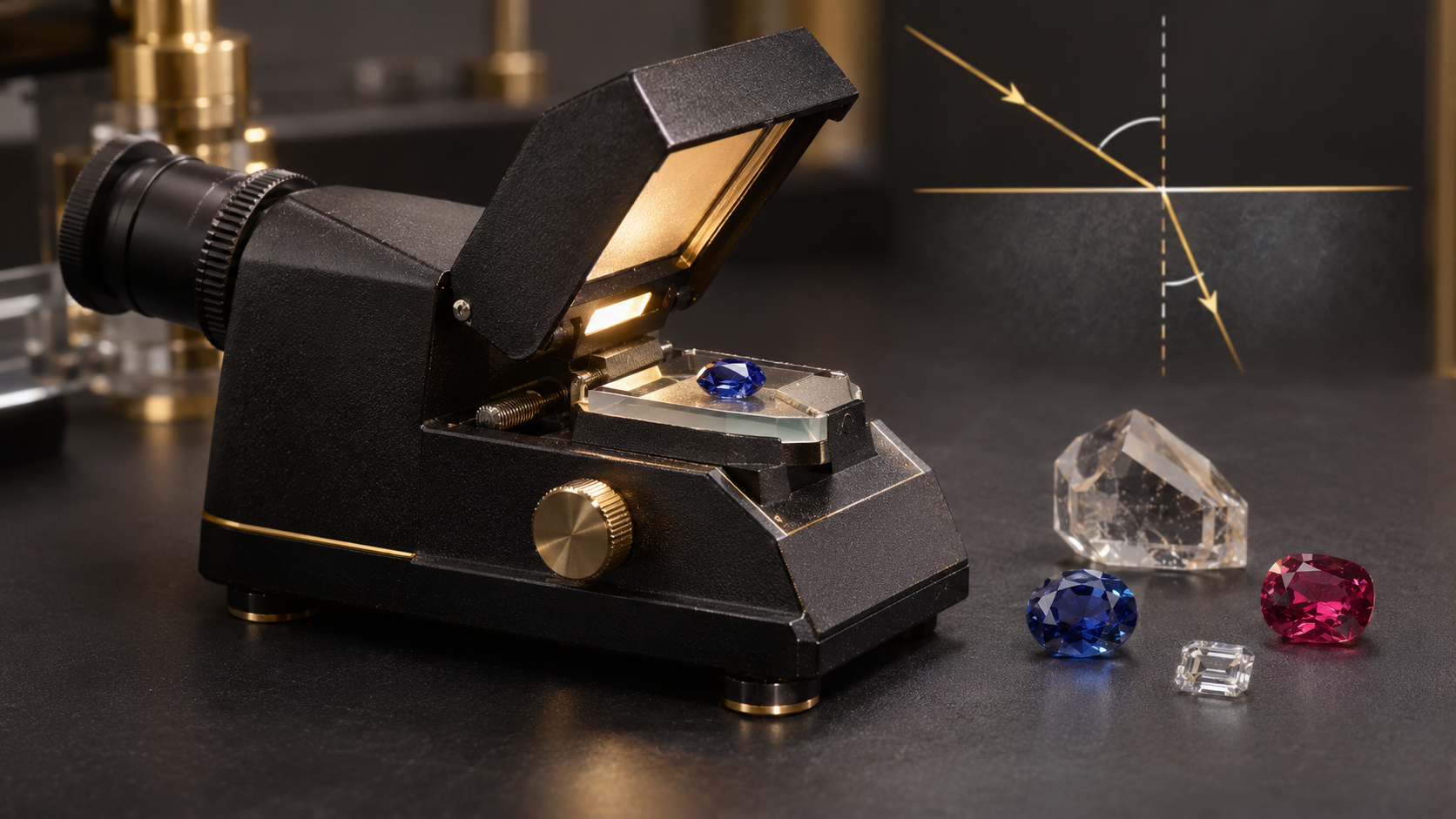
A traditional gemmological refractometer is an optical instrument designed to measure the refractive index of suitable gemstones.
Its principal components include a high-refractive-index measuring prism, an illumination system, a viewing system and a calibrated scale.
The gemstone is placed in optical contact with the measuring prism, usually using a small amount of appropriate refractive-index contact liquid.
The instrument uses the relationship between critical angle and refractive index.
When viewed through the eyepiece, the examiner observes a boundary between illuminated and dark regions.
This is commonly called the shadow edge.
The position of this boundary on the scale corresponds to a refractive-index reading.
A clear shadow edge is important because a poorly defined boundary makes precise measurement difficult.
The instrument must be properly maintained and used according to its manufacturer’s instructions.
7. Why Is Refractive-Index Contact Liquid Necessary?
A polished gemstone facet and the refractometer prism do not automatically form perfect optical contact.
Even apparently smooth surfaces contain microscopic irregularities.
Air gaps between the surfaces can interfere with reliable measurement.
A suitable contact liquid helps establish optical contact between the gemstone and the prism.
Its refractive index must be appropriate for the instrument and measurement range.
Only a very small amount is normally required.
Excessive liquid may make the examination unnecessarily difficult and increase cleaning requirements.
Some refractive-index liquids contain chemicals requiring careful handling.
They should be used according to the manufacturer’s safety instructions, with appropriate attention to ventilation, skin contact and instrument compatibility.
The contact liquid is an important component of the measurement system, not merely a convenient accessory.
8. How Is a Refractive-Index Measurement Taken?
For a conventional faceted gemstone, the examiner normally selects a clean, sufficiently polished flat facet.
The instrument’s measuring prism must also be clean and free from damage.
A small amount of suitable contact liquid is applied according to the manufacturer’s procedure.
The gemstone is then placed carefully against the prism.
The examiner looks through the eyepiece and observes the shadow edge.
Its position is read from the calibrated scale.
For optically anisotropic gemstones, the stone may be rotated through several positions while readings are recorded.
Depending on the material, facet orientation and measurement conditions, one or two boundaries may be observed.
These readings can provide information about the gemstone’s refractive indices and optical character.
However, a single reading does not always reveal the full range of optical behaviour.
Careful rotation, repeated observation and correct interpretation are essential.
9. Single Refraction and Double Refraction
Gemstones are commonly classified as optically isotropic or anisotropic.
Isotropic Gemstones
In an ideal isotropic material, refractive index is independent of the direction of light propagation.
Examples include:
- Diamond.
- Spinel.
- Garnet.
- Many types of glass.
These materials are described as singly refractive in conventional gemmology.
An isotropic gemstone normally produces one refractive-index boundary under suitable measurement conditions.
However, internal strain or anomalous optical effects may complicate observations in some specimens.
Anisotropic Gemstones
Anisotropic gemstones possess direction-dependent optical properties.
Examples include:
- Quartz.
- Corundum.
- Beryl.
- Tourmaline.
- Topaz.
- Peridot.
These materials can display double refraction.
In general, two differently polarised light waves can propagate through an anisotropic crystal with different phase velocities.
A refractometer may reveal two corresponding boundaries.
The readings depend on crystal orientation.
In uniaxial minerals, the principal refractive indices are commonly designated as ordinary and extraordinary.
Biaxial minerals have three principal refractive indices.
This distinction is fundamental to optical mineralogy and professional gemmology.
10. What Is Birefringence?
Birefringence describes the difference between appropriate refractive indices in an anisotropic material.
In gemmology, maximum birefringence is generally calculated as the difference between the highest and lowest principal refractive indices.
For example, quartz has approximate principal refractive indices of 1.544 and 1.553.
Its maximum birefringence is therefore approximately:
1.553 − 1.544 = 0.009
Birefringence can provide valuable information about mineral identity.
However, the difference between two readings obtained in one arbitrary orientation does not necessarily represent the maximum birefringence.
The gemstone’s optical orientation must be considered.
Some materials possess sufficiently strong birefringence to produce visible doubling of internal features or facet junctions.
Other anisotropic materials have much smaller differences between their refractive indices.
Birefringence is therefore an important extension of refractive-index measurement.
11. Refractive-Index Values of Common Gemstones
Different gemstone species have characteristic RI ranges.
The following values are approximate and should be understood as reference ranges rather than absolute identification criteria.
| Gemstone | Approximate refractive index |
|---|---|
| Quartz | 1.544–1.553 |
| Beryl | 1.57–1.60 |
| Spinel | 1.71–1.74 |
| Corundum — ruby and sapphire | 1.762–1.778 |
| Topaz | 1.609–1.643 |
| Peridot | 1.65–1.69 |
| Diamond | 2.417–2.419 |
These ranges can vary according to chemical composition, measurement wavelength and other material characteristics.
Some gemstone groups have substantial compositional variation.
Garnet and tourmaline, for example, encompass materials with differing refractive indices.
A refractive-index measurement should therefore be compared with reliable reference data appropriate to the specific mineral or gemstone variety.
Why RI Is Useful
Consider a transparent blue gemstone.
Its appearance might suggest sapphire, spinel, aquamarine or another blue material.
A reliable RI measurement can immediately narrow the possibilities.
However, overlapping RI ranges mean that further testing may still be necessary.
Colour should never be treated as a substitute for physical measurement.
12. Why Diamond Cannot Normally Be Measured with a Standard Refractometer
Diamond has an exceptionally high refractive index of approximately 2.42 at the conventional yellow reference wavelength.
Traditional gemmological refractometers commonly have an upper measuring limit near 1.81, depending on their optical design.
This limit is associated with the refractive indices of the measuring prism and contact system.
Consequently, diamond’s refractive index lies beyond the range of most standard gemmological refractometers.
The examiner cannot simply place a diamond on a conventional refractometer and expect a direct numerical reading of 2.42.
Instead, other appropriate instruments and methods must be used.
Some specialised optical instruments can measure or estimate higher refractive indices through alternative techniques.
These are not equivalent to obtaining a conventional critical-angle reading on a standard gemmological refractometer.
Recognising an instrument’s limitations is an essential part of professional practice.
13. Refractive Index, Birefringence and Dispersion
Three related optical properties are often confused.
Refractive Index
Refractive index describes the propagation of light through a material at a specified wavelength and optical direction.
Birefringence
Birefringence describes the difference between refractive indices associated with the optical anisotropy of a material.
Dispersion
Dispersion describes how refractive index changes with wavelength.
These properties are related but distinct.
A material can have a high refractive index without displaying birefringence.
Diamond provides a familiar example.
It is optically isotropic, despite its very high refractive index.
Dispersion, meanwhile, contributes to the separation of different wavelengths of light.
In faceted gemstones, dispersion can contribute to the appearance of coloured flashes known as fire.
However, visible fire also depends on the gemstone’s cut and illumination.
Precise use of these terms prevents misunderstandings about gemstone optics.
14. Can Refractive Index Prove That a Gemstone Is Natural?
No.
Refractive index is primarily useful for characterising and identifying materials.
It does not, by itself, establish whether a gemstone formed naturally or was grown in a laboratory.
Natural ruby and laboratory-grown ruby both belong to the mineral species corundum.
Their principal optical properties are therefore broadly comparable.
Likewise, natural and laboratory-grown spinel may have overlapping refractive-index values.
The examiner must use other appropriate observations to investigate natural or synthetic origin.
These may include growth structures, inclusions, spectroscopy and advanced laboratory techniques.
Refractive index alone also cannot establish geographic origin.
It cannot reliably determine every treatment.
A professional identification must distinguish between determining the mineral species and establishing additional claims about the specimen.
15. Common Sources of Refractometer Error
Even a high-quality instrument can produce misleading observations when used incorrectly.
Poor Optical Contact
Insufficient or uneven contact between the gemstone and prism may weaken the shadow edge.
Dirty Surfaces
Dust, grease or contact-liquid residue can interfere with the examination.
Inappropriate Facet Selection
A poorly polished, damaged or excessively small facet may make accurate measurement difficult.
Incorrect Illumination
Unsuitable lighting can reduce boundary contrast or complicate interpretation.
Failure to Rotate the Gemstone
Anisotropic gemstones may require observations in multiple orientations.
A single reading may not reveal the complete range of optical behaviour.
Instrument Range Limitations
Materials with refractive indices above the instrument’s measuring range cannot be measured conventionally.
Excessive Pressure
Pressing the gemstone against the prism can risk damage to the instrument, gemstone or both.
Reliable refractometer work requires careful handling, repeated observation and accurate documentation.
16. What About Cabochons and Rough Gemstones?
Conventional refractometer measurements are most straightforward when a suitable polished flat surface is available.
Cabochons and rough gemstones may present additional difficulties.
Some instruments and techniques permit approximate spot readings on curved surfaces.
However, these readings may have lower precision and should not automatically be treated as equivalent to measurements from an appropriately polished flat facet.
Rough specimens with irregular surfaces can be particularly challenging.
In such cases, other identification methods may be more appropriate.
These can include microscopy, specific gravity, Raman spectroscopy and other suitable techniques.
The choice of method depends on the specimen’s characteristics and the required level of certainty.
Professional gemmology involves selecting the correct method for the material, not forcing every specimen into the same testing procedure.
17. Refractive Index in Modern Gemmological Laboratories
Refractometers remain important because they provide useful optical information without requiring the complex instrumentation associated with many advanced analytical techniques.
In modern laboratories, standard gemmological observations are often combined with additional methods.
These may include:
- Polarised-light examination.
- Microscopic inclusion analysis.
- Specific-gravity measurement.
- Ultraviolet-visible-near-infrared spectroscopy.
- Raman spectroscopy.
- Infrared spectroscopy.
- Chemical analysis.
Not every gemstone requires every technique.
The examination should be proportional to the identification problem.
For many common gemstones, conventional gemmological measurements provide enough information for reliable species identification.
For unusual materials, treatments or origin investigations, additional analysis may be necessary.
Refractive index remains a foundational measurement within this broader scientific workflow.
18. Why Refractive Index Matters to Gemstone Buyers and Collectors
A gemstone’s appearance does not always reveal its mineral identity.
Different materials may possess similar colours and cutting styles.
Reliable identification therefore benefits from objective measurements.
Refractive index is one of the most useful of these measurements because it connects the gemstone’s observable optical behaviour with its underlying material properties.
For buyers and collectors, understanding RI also helps explain why two apparently similar gemstones can behave differently under light.
However, a refractive-index value should not be confused with a quality grade.
It does not measure clarity, cutting precision, rarity or commercial value.
Nor does it guarantee that a gemstone is natural or untreated.
Its value lies in contributing reliable evidence to a professional gemmological assessment.
Conclusion: Measuring Light to Understand Gemstones
Refractive index demonstrates how fundamental optical physics can become a practical identification method.
Light changes its propagation behaviour when it enters a gemstone.
That behaviour depends on the material’s optical properties, crystal structure and the wavelength of illumination.
Through the critical-angle method, a gemmological refractometer converts these properties into measurable values.
The resulting information can help distinguish gemstone species, reveal optical anisotropy and support further testing.
Yet the measurement must always be interpreted correctly.
Instrument limitations, specimen orientation, optical contact and overlapping reference ranges can all influence the examination.
At Natural Gems Belgium, our approach to gemmology is based on scientific transparency and the responsible interpretation of evidence.
A gemstone’s colour may attract attention.
Its refractive index helps us understand what the material actually is.
References & Further Reading
The following sources are authoritative scientific and educational publications. They are provided for further study of refractive index, gemmological instrumentation and professional identification.
1. Gemological Institute of America – Analysis of Gemstones at GIA Laboratories
Gems & Gemology, Winter 2024.
An overview of modern laboratory workflows, including standard gemstone identification methods and the role of refractometers alongside advanced analytical techniques.
https://www.gia.edu/gems-gemology/winter-2024-gemstone-analysis
2. Gemological Institute of America – A Review of Analytical Methods Used in Geographic Origin Determination of Gemstones
Gems & Gemology, Winter 2019.
A technical review explaining how refractive index, specific gravity, microscopy, spectroscopy and chemical analysis contribute to gemstone identification and origin investigation.
3. Gemological Institute of America – How GIA Analyzes Colored Stones from Start to Finish
An educational explanation of gemstone testing procedures and the use of standard gemmological instruments.
https://www.gia.edu/gia-news-research/guide-how-gia-analyzes-colored-stones
4. Gemological Institute of America – A Case of Mistaken Identity?
An educational discussion of the importance of optical character and other gemmological properties when separating visually similar gemstones.
https://origin.prod.gia.edu/gia-news-research/case-mistaken-identity
5. Gem-A – The Air-Boundary Refractometer
R. M. Yu and D. Healey.
The Journal of Gemmology, 1979, Volume XVI, Number 8.
A technical publication examining refractive-index measurement and the limitations of conventional critical-angle refractometers.
https://gem-a.com/wp-content/uploads/2023/11/JoG1979_16_8.pdf
6. Gem-A – The Variation of RI with Rotation of a Doubly Refractive Gemstone on the Refractometer Hemicylinder
Xinhua Song, Ruihua Wu and Weizheng Wu.
The Journal of Gemmology, 2004.
A technical investigation of how refractive-index readings vary with gemstone orientation and how such measurements relate to optical character.
https://gem-a.com/wp-content/uploads/2023/11/JoG2004_29_5-6.pdf
7. Gem-A – The Role of Reflectivity in Gemmology, Part I: Fresnel Refractometers
W. William Hanneman.
The Journal of Gemmology, 1978, Volume XVI, Number 2.
A discussion of refractive-index measurement, optical reflectivity and the significance of measurement wavelength.
https://gem-a.com/wp-content/uploads/2023/11/JoG1978_16_2.pdf
8. Gemological Institute of America – Raman Spectroscopy and X-Ray Diffraction: Phase Identification of Gem Minerals and Other Species
Gems & Gemology, Winter 2024.
An advanced review explaining how modern laboratories identify gemstone materials when conventional properties such as refractive index are insufficient.
https://www.gia.edu/gems-gemology/winter-2024-raman-spectroscopy-and-xrd
9. Gemological Institute of America – Scientific Instruments Help Researchers Tell Gem Stories
An educational overview of analytical instruments used in gemstone research and identification.
https://www.gia.edu/research-instruments
Natural Gems Belgium – Gemmology Series
Presented by Marnick Elskens, Founder of Natural Gems Belgium.
Natural Gemstones • Expertly Selected • Every Piece Unique
[…] scientific explanation begins with optical dispersion: the variation of refractive index with the wavelength of […]