

Three Colourless Stones. One Looks Like Diamond. So Do the Other Two.
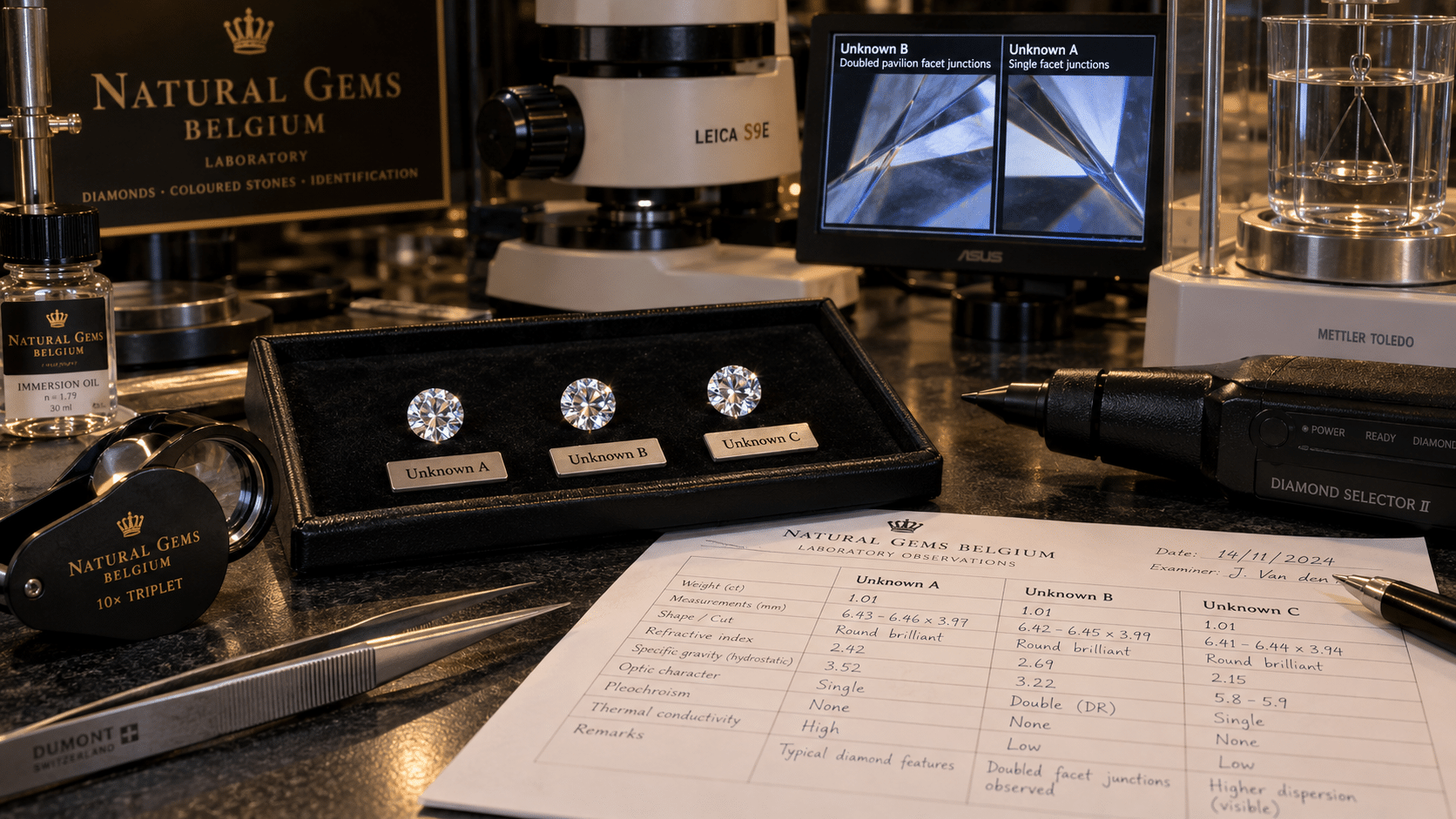
Three colourless round brilliant-cut stones lie on the gemmological workbench.
They are almost identical in diameter.
All three are transparent.
All three are brilliant.
All three produce flashes of spectral colour.
One is:
diamond.
One is:
One is:
Can you identify them?
Perhaps.
But today’s investigation contains a second problem that is more important than the first.
Even after we establish which stone is diamond, we still have to ask:
Is that diamond natural or laboratory-grown?
That distinction changes the entire identification strategy.
Welcome to:
Table of Contents
NGB UNKNOWN STONE WORKSHOP 2
Today we will investigate:
In this article, we will explore the differences and similarities between diamond vs moissanite vs cubic zirconia.
diamond
versus:
versus:
cubic zirconia
and then discover why:
DIAMOND IDENTIFIED
does not necessarily mean:
NATURAL DIAMOND IDENTIFIED.
PART I — FIRST, FIX THE TERMINOLOGY
Before touching an instrument, we need four terms.
Diamond
Diamond is crystalline carbon.
A diamond may be:
natural
or:
laboratory-grown.
Both are diamond.
Synthetic Moissanite
Moissanite is silicon carbide:
SiC.
Jewellery-quality moissanite is generally laboratory-grown.
It is therefore correctly described as:
synthetic moissanite.
When used as an alternative to diamond, it functions as a:
It is not synthetic diamond.
Cubic Zirconia
Cubic zirconia—commonly abbreviated:
CZ
—is crystalline zirconium dioxide:
ZrO₂
stabilised in the cubic structure.
It is manufactured and widely used as a:
diamond simulant.
It is not diamond.
It is not zircon.
And it is not moissanite.
PART II — THE FIRST TRAP
1. “It Looks Like Diamond”
That statement has very little identification value.
A successful diamond simulant is specifically intended to resemble diamond.
Colourless materials that can imitate diamond have included:
- cubic zirconia;
- synthetic moissanite;
- colourless sapphire;
- colourless spinel;
- zircon;
- glass;
- synthetic rutile;
- strontium titanate;
- YAG;
- GGG.
Some are largely historical as commercial diamond simulants.
Others remain very important.
Today the two major examples are:
cubic zirconia
and:
synthetic moissanite.
PART III — OUR THREE UNKNOWNS
Label the stones:
Unknown A
Unknown B
Unknown C
Do not decide which is diamond yet.
Our first observations:
Unknown A
Colourless.
Strong brilliance.
Noticeable spectral fire.
Sharp facet junctions.
Unknown B
Colourless.
Very strong brilliance.
Extremely conspicuous spectral fire.
Unknown C
Colourless.
Strong brilliance.
Broad colourful flashes.
All three look convincing.
So we continue.
PART IV — WHY BRILLIANCE DOES NOT PROVE DIAMOND
2. Brilliance Is an Optical Effect
Diamond’s visual appearance results from a combination of properties including:
- high refractive index;
- strong dispersion;
- cutting proportions;
- polish;
- internal reflection.
But other transparent materials can also have high refractive indices and strong dispersion.
Therefore:
sparkle is not an identity test.
PART V — DISPERSION
3. What Is “Fire”?
White light contains many wavelengths.
When those wavelengths separate as they travel through a material, we observe:
dispersion.
In a faceted gemstone this can produce flashes of spectral colour commonly called:
fire.
Diamond has strong dispersion.
But synthetic moissanite has even stronger dispersion.
Cubic zirconia also produces substantial fire.
4. More Fire Does Not Automatically Mean Better Diamond
This is an interesting visual paradox.
A stone displaying unusually intense rainbow flashes might initially appear:
more diamond-like.
But excessive fire can actually suggest a simulant.
Synthetic moissanite is especially well known for its strong dispersion.
In larger stones, this can become visually conspicuous.
But visual appearance alone remains insufficient.
PART VI — THE 10× LOUPE
5. Begin as Before
Take a properly corrected:
Examine all three stones.
Look at:
- facet junctions;
- girdle;
- polish;
- abrasions;
- inclusions;
- pavilion facets;
- doubling;
- surface characteristics.
6. Unknown A
Facet junctions appear:
sharp and single.
A tiny internal inclusion is visible.
The girdle shows no obvious moulding or assembly.
Interesting.
But not conclusive.
7. Unknown B
The stone appears very clean.
However, when we look through the crown toward the pavilion and focus carefully on the rear facet junctions, something unusual appears.
Some facet junctions look:
doubled.
This is important.
PART VII — DOUBLE REFRACTION
8. Diamond Is Singly Refractive
Diamond crystallises in the cubic crystal system.
Optically it is:
singly refractive.
Light entering an ideal diamond does not split into two differently refracted rays in the way it does in an anisotropic doubly refractive gemstone.
9. Moissanite Is Different
Synthetic moissanite used in jewellery is:
doubly refractive.
When viewed in appropriate directions through the stone, this can produce visible doubling of rear facet junctions.
The effect can make the interior appear slightly blurred or doubled.
GIA specifically identifies this doubling as an important way of separating synthetic moissanite from diamond.
Our Unknown B has therefore become highly interesting.
10. But Orientation Matters
A warning.
Double refraction is directional.
Depending on how a moissanite is oriented and cut, doubling may be easier or harder to observe from particular directions.
Therefore:
failure to see doubling once does not prove diamond.
Rotate the stone.
Change viewing direction.
Refocus.
PART VIII — UNKNOWN C
11. The Third Stone
Unknown C shows:
no obvious doubling.
Does that make it diamond?
No.
Cubic zirconia is also:
singly refractive.
So the absence of doubling cannot separate:
diamond
from:
CZ.
This is exactly why gemstone identification requires multiple tests.
PART IX — HEFT
12. Pick Up the Stones
Suppose the three stones have approximately the same dimensions.
Unknown C feels surprisingly heavy.
Why?
Because density differs substantially among these materials.
Approximate specific gravities are:
Diamond: ~3.52
Synthetic moissanite: ~3.22
Cubic zirconia: commonly around 5.6–6.0
CZ is therefore dramatically denser than diamond.
13. Same Size Does Not Mean Same Weight
Two round brilliant stones of equal diameter can have very different weights if their densities differ.
A CZ fashioned to diamond-like proportions will normally weigh substantially more than a diamond of comparable dimensions.
This is a powerful identification clue.
14. But Do Not Guess by Hand
“Heavy” is subjective.
Professional work uses measurement.
If the stone is loose, hydrostatic weighing can determine:
specific gravity.
This provides quantitative evidence.
PART X — SPECIFIC GRAVITY
15. Hydrostatic Principle
Specific gravity can be determined by comparing a gemstone’s weight:
in air
with its apparent weight:
when suspended in water.
The difference relates to the volume of water displaced.
A simplified expression is:
SG = weight in air ÷ (weight in air − weight in water)
16. Our Results
Suppose the measurements produce:
Unknown A
SG ≈ 3.52
Unknown B
SG ≈ 3.22
Unknown C
SG ≈ 5.8
Now the possibilities separate dramatically.
Unknown C is strongly compatible with:
cubic zirconia.
Unknown B is strongly compatible with:
synthetic moissanite.
Unknown A is compatible with:
diamond.
But we continue.
PART XI — THE DIAMOND TESTER
17. Enter the Familiar Instrument
A handheld diamond tester is placed on the bench.
For many people this seems like the decisive moment.
Touch the probe to the stone.
Machine says diamond.
Case closed.
Except:
it is not that simple.
PART XII — THERMAL CONDUCTIVITY
18. Why Traditional Diamond Testers Work
Diamond has exceptionally high:
thermal conductivity.
Heat moves through it extremely efficiently.
Many common diamond simulants conduct heat much less effectively.
A thermal probe can exploit this difference.
19. Test Unknown C
The probe touches Unknown C.
It does not respond as diamond.
Combined with:
- high specific gravity;
- lack of doubling;
- visual properties
the evidence strongly supports:
CUBIC ZIRCONIA
Unknown C is solved.
PART XIII — TEST UNKNOWN A
The thermal probe touches Unknown A.
Result:
DIAMOND.
Excellent.
Have we solved it?
Partly.
The stone is compatible with diamond.
But we still have another stone.
PART XIV — TEST UNKNOWN B
The probe touches Unknown B.
And then something surprising happens.
The conventional thermal tester may also respond:
DIAMOND.
But Unknown B already showed:
- doubled facet junctions;
- SG around 3.22;
- exceptionally strong dispersion.
Those properties contradict diamond.
What happened?
PART XV — WHY MOISSANITE CHANGED DIAMOND TESTING
20. Thermal Conductivity Was Once Extremely Convenient
Before synthetic moissanite became a major jewellery material, thermal conductivity testing provided a very useful way to separate diamond from many common simulants.
Then synthetic moissanite entered the jewellery market.
Its thermal properties are sufficiently close to diamond that traditional thermal probes can react to it as though it were diamond.
This became an important identification problem.
21. One Instrument Has Been Defeated
This does not mean the thermal tester is useless.
It means:
the tester answers a narrower question than many users assume.
A positive thermal response does not necessarily mean:
natural diamond.
It may not even, with a basic thermal-only instrument, establish:
diamond rather than moissanite.
Context matters.
PART XVI — ELECTRICAL CONDUCTIVITY
22. Combined Testers
Later instruments combined:
thermal conductivity
with:
electrical conductivity
to improve separation between diamond and synthetic moissanite.
These instruments can be extremely useful screening tools.
But the larger principle remains:
understand exactly what your instrument measures.
Never treat a screening result as more powerful than it actually is.
PART XVII — THE RESULTS SO FAR
Our evidence now looks like this:
| Property | Unknown A | Unknown B | Unknown C |
|---|---|---|---|
| Appearance | Diamond-like | Diamond-like | Diamond-like |
| Facet doubling | No | Yes | No |
| SG | ~3.52 | ~3.22 | ~5.8 |
| Thermal response | Diamond | May respond diamond | Non-diamond |
| Working identity | Diamond | Synthetic moissanite | Cubic zirconia |
Two simulants are now separated.
But our hardest problem has only just begun.
PART XVIII — UNKNOWN A IS DIAMOND
23. What Have We Actually Proved?
Unknown A behaves as:
diamond.
Its physical and optical characteristics support diamond.
Now ask:
Natural diamond or laboratory-grown diamond?
This is not the same problem as:
diamond or simulant?
PART XIX — LABORATORY-GROWN DIAMOND IS DIAMOND
24. Chemistry
Natural diamond consists principally of:
carbon.
Laboratory-grown diamond also consists principally of:
carbon.
25. Crystal Structure
Natural diamond has the diamond crystal structure.
Laboratory-grown diamond has the:
same fundamental diamond crystal structure.
26. Physical Properties
Laboratory-grown diamond possesses essentially the same defining:
- hardness;
- refractive behaviour;
- thermal conductivity;
- crystal structure
as natural diamond.
Therefore a conventional diamond tester can correctly tell you:
this is diamond
while telling you nothing about whether Earth or a reactor grew it.
PART XX — THIS IS THE CRITICAL LESSON
A conventional tester may help distinguish:
DIAMOND
from:
CZ.
A suitable combined tester may help distinguish:
DIAMOND
from:
MOISSANITE.
But once the material is established as diamond, a new identification problem begins:
NATURAL OR LABORATORY-GROWN?
That requires different evidence.
PART XXI — HOW LABORATORY-GROWN DIAMONDS ARE PRODUCED
Two principal technologies dominate gem-quality laboratory-grown diamond production:
HPHT
and:
CVD.
PART XXII — HPHT
27. High Pressure High Temperature
HPHT stands for:
High Pressure High Temperature.
The method grows diamond under extremely high pressure and temperature.
A diamond seed is used.
Carbon dissolves in a metallic flux or catalyst and crystallises onto the seed.
28. Growth Environment Leaves Evidence
HPHT growth can produce characteristics including:
- distinctive growth sectors;
- characteristic fluorescence patterns;
- metallic flux inclusions;
- particular impurity distributions;
- phosphorescence in some stones.
Not every HPHT diamond shows every feature.
PART XXIII — CVD
29. Chemical Vapour Deposition
CVD stands for:
Chemical Vapour Deposition.
Instead of growing diamond under the extreme pressure used in HPHT synthesis, CVD uses activated carbon-bearing gases at much lower pressure.
Carbon is deposited onto:
diamond seed plates.
The diamond grows layer by layer.
30. Different Growth, Different Evidence
CVD diamonds may show characteristics including:
- layered growth;
- banded strain patterns;
- characteristic fluorescence patterns;
- dark pinpoint inclusions;
- spectroscopic defect features.
Again:
no single visual feature occurs in every stone.
PART XXIV — CAN WE USE THE LOUPE?
31. Sometimes We Find Clues
Certain laboratory-grown diamonds may contain diagnostic or suggestive inclusions.
HPHT diamonds can sometimes contain:
metallic flux inclusions.
Some may even respond to a strong magnet when sufficient metallic material is present.
CVD diamonds may contain:
dark pinpoint inclusions.
But many modern laboratory-grown diamonds are very clean.
32. Clean Does Not Mean Synthetic
Natural diamonds can be extremely clean.
Laboratory-grown diamonds can be extremely clean.
Therefore:
clarity is not origin.
PART XXV — CAN WE USE FLUORESCENCE?
33. Useful but More Complex
Natural and laboratory-grown diamonds can respond differently under ultraviolet excitation.
Their growth structures can produce distinctive fluorescence patterns.
Specialised fluorescence imaging is therefore extremely useful in diamond identification.
But simple observation under a standard UV lamp should not be treated as a universal natural-versus-laboratory-grown test.
PART XXVI — GROWTH PATTERNS
34. Crystals Preserve Their Growth History
This repeats one of the most important ideas from our first Unknown Stone Workshop.
Crystals preserve evidence of:
how they grew.
Natural diamonds grew within Earth.
HPHT diamonds grew in high-pressure laboratory systems.
CVD diamonds grew from activated carbon-bearing gases.
Their growth geometries differ.
35. Fluorescence Imaging
Specialised instruments can reveal those growth structures.
GIA has documented characteristic patterns associated with:
- natural diamond growth;
- HPHT synthetic growth;
- CVD synthetic growth.
These patterns can provide extremely powerful origin evidence.
PART XXVII — SPECTROSCOPY
36. Looking at Atomic Defects
Advanced diamond identification often examines:
- nitrogen-related defects;
- boron;
- vacancies;
- silicon-related defects;
- hydrogen-related features;
- lattice imperfections.
These features can be studied using techniques including:
FTIR spectroscopy
and:
photoluminescence spectroscopy.
37. Why Defects Matter
A perfect diamond lattice would contain only carbon atoms in an ideal arrangement.
Real diamonds contain:
- impurities;
- vacancies;
- defect complexes.
The way these defects form and aggregate depends partly on:
growth environment
and:
thermal history.
Natural diamonds and laboratory-grown diamonds therefore often contain different defect populations.
PART XXVIII — GEOLOGICAL TIME MATTERS
38. Natural Diamonds Have Long Histories
Many natural diamonds resided deep within Earth for immense geological periods.
During that history, impurities such as nitrogen can change configuration within the lattice.
Laboratory-grown diamonds form over vastly shorter timescales under controlled conditions.
This difference contributes to useful spectroscopic signatures.
PART XXIX — TYPE I AND TYPE II DIAMONDS
39. Diamond Type
Diamond scientists classify diamonds partly according to impurities, especially:
nitrogen
and:
boron.
Broadly:
Type I diamonds contain measurable nitrogen.
Type II diamonds contain little or no measurable nitrogen in the relevant classification sense.
Further subdivisions exist.
40. Useful but Not a Verdict
Diamond type can be extremely useful in screening.
But:
diamond type alone does not establish natural or laboratory-grown origin.
Natural type II diamonds exist.
Laboratory-grown type II diamonds exist.
Again:
one property rarely solves the entire problem.
PART XXX — WHY ADVANCED SCREENING EXISTS
41. Modern Laboratory-Grown Diamonds Can Be Extremely Convincing
Modern HPHT and CVD diamonds can be:
- colourless;
- high clarity;
- well cut;
- substantial in size.
Some cannot be reliably separated from natural diamond by ordinary visual examination.
GIA research has documented near-colourless HPHT synthetic diamonds whose synthetic origin was difficult to establish using standard gemmological techniques alone.
Advanced analysis provided the conclusion.
PART XXXI — THE SCREENING CONCEPT
42. Pass or Refer
Many modern diamond-screening instruments do not attempt to provide a complete laboratory identification.
Instead they may divide stones into categories such as:
PASS
or:
REFER.
A “pass” result means the stone meets the instrument’s criteria for the category it is designed to recognise.
A “refer” result means:
further testing is required.
It does not automatically mean:
laboratory-grown.
43. Why This Is Good Science
Suppose an instrument cannot confidently classify a stone.
The correct response is not to guess.
It is to:
refer the specimen for additional analysis.
This is the same evidence discipline introduced in Workshop 1.
PART XXXII — MELEE MAKES THE PROBLEM HARDER
44. Tiny Diamonds
Very small diamonds used in jewellery are called:
melee.
A single jewellery item may contain dozens or hundreds.
Commercial parcels can contain thousands.
Testing every tiny stone manually with advanced laboratory methods would be impractical.
Therefore automated screening has become extremely important.
45. Mixed Parcels
Laboratories have documented parcels containing mixtures of:
- natural diamonds;
- HPHT laboratory-grown diamonds;
- CVD laboratory-grown diamonds;
- treated diamonds;
- simulants.
A parcel that appears visually uniform can therefore contain fundamentally different materials.
PART XXXIII — A REAL LABORATORY EXAMPLE
GIA documented a parcel containing:
3,005 melee diamonds
submitted for screening.
Automated screening passed the great majority as natural.
A smaller group was referred for additional investigation.
Advanced testing ultimately identified:
three HPHT-grown synthetic diamonds
among the parcel.
The important lesson is not the percentage.
It is that:
visual similarity does not establish common origin.
PART XXXIV — THE LASER INSCRIPTION TRAP
46. Read the Girdle
A laboratory report number or inscription on the girdle can be useful.
But should an inscription alone determine identification?
No.
Why?
Because fraudulent inscriptions exist.
GIA has documented synthetic moissanite carrying a fraudulent GIA inscription.
More recently, laboratories have also encountered laboratory-grown and treated diamonds bearing inscriptions corresponding to other stones.
47. Verification Must Match the Stone
A report number should be checked against:
- laboratory database;
- carat weight;
- measurements;
- shape;
- colour;
- clarity characteristics;
- inscription;
- other identifying information.
An inscription is:
evidence
not:
proof by itself.
PART XXXV — RETURN TO OUR THREE STONES
We can now classify them.
UNKNOWN C
Observations:
- singly refractive;
- very high density;
- non-diamond thermal response;
- strong dispersion.
Conclusion:
CUBIC ZIRCONIA
A:
diamond simulant.
UNKNOWN B
Observations:
- obvious doubling of rear facet junctions;
- strong dispersion;
- SG around 3.22;
- thermal response potentially overlapping diamond.
Conclusion:
SYNTHETIC MOISSANITE
Also a:
diamond simulant.
UNKNOWN A
Observations:
- properties compatible with diamond;
- SG around 3.52;
- singly refractive;
- diamond-like thermal response.
Conclusion:
DIAMOND
But:
natural versus laboratory-grown remains unresolved by these tests alone.
That final sentence is the most important result of the workshop.
PART XXXVI — THE WRONG CONCLUSION
Suppose someone tests Unknown A with a thermal probe.
The tester indicates:
DIAMOND.
They write:
Natural diamond.
What is wrong?
The instrument has answered:
material identity
but the user has claimed:
growth origin.
Those are different questions.
This is precisely the same conceptual mistake we examined in our article:
Natural, Synthetic, Imitation and Composite Gemstones: The Essential Differences.
PART XXXVII — A BETTER REPORT
A responsible preliminary observation might read:
Tests are consistent with diamond. Natural versus laboratory-grown origin requires appropriate diamond screening or laboratory analysis.
That wording respects the limits of the evidence.
PART XXXVIII — DIAMOND VERSUS SIMULANT WORKFLOW
For an unknown colourless brilliant-cut stone:
VISUAL OBSERVATION
↓
10× MAGNIFICATION
Look for doubling, inclusions, wear and facet characteristics
↓
OPTICAL BEHAVIOUR
Singly or doubly refractive?
↓
PHYSICAL PROPERTIES
Density / specific gravity where practical
↓
THERMAL / ELECTRICAL SCREENING
Understand exactly what the instrument measures
↓
MATERIAL IDENTIFICATION
Diamond?
Moissanite?
CZ?
Other simulant?
Then, if diamond:
↓
DO NOT STOP
↓
NATURAL / LABORATORY-GROWN SCREENING
↓
if referred or uncertain:
ADVANCED LABORATORY ANALYSIS
PART XXXIX — WORKSHOP CHALLENGE 1
A colourless brilliant-cut stone shows:
strong thermal conductivity
visible doubling of pavilion facet junctions
very strong dispersion
SG approximately 3.22
What is it?
Answer:
SYNTHETIC MOISSANITE
The thermal result alone could mislead you.
The combined evidence does not.
PART XL — WORKSHOP CHALLENGE 2
A colourless brilliant-cut stone shows:
no facet doubling
SG approximately 5.8
strong fire
negative response on a conventional diamond thermal tester
Answer:
CUBIC ZIRCONIA
PART XLI — WORKSHOP CHALLENGE 3
A colourless brilliant-cut stone shows:
no doubling
SG approximately 3.52
diamond thermal response
physical properties consistent with diamond
Can you call it:
natural diamond?
Answer:
NO
You can establish:
diamond.
Natural versus laboratory-grown origin remains a separate question.
PART XLII — WORKSHOP CHALLENGE 4
A screening instrument refers a diamond for additional testing.
Does “refer” mean:
laboratory-grown diamond?
No.
It means:
the screening instrument cannot place the stone confidently in its pass category and further investigation is required.
Never convert uncertainty into a diagnosis.
PART XLIII — WORKSHOP CHALLENGE 5
A stone carries a laser inscription matching a natural-diamond report number.
Can you stop testing?
No.
Fraudulent inscriptions have been documented.
Verify that the physical stone corresponds with the report.
PART XLIV — WHY HARDNESS IS NOT OUR TEST
48. “Diamond Scratches Glass”
Yes.
But so do many materials harder than glass.
And deliberately scratching either the gemstone or another object is unnecessary and potentially destructive.
Modern gemmology has better methods.
Never identify a valuable gemstone by performing an avoidable destructive scratch test.
PART XLV — WHY THE FOG TEST IS NOT OUR TEST
49. Breath on the Diamond?
Popular advice sometimes recommends breathing onto a stone and watching how quickly condensation disappears.
Diamond’s thermal conductivity can influence this behaviour.
But environmental conditions, contamination, mounting and interpretation make this unsuitable as a professional identification method.
Use instruments.
Not internet tricks.
PART XLVI — WHY WE DO NOT DROP IT INTO WATER AND GUESS
Differences in optical appearance under water do not replace:
measured specific gravity
or:
proper optical testing.
Professional gemmology replaces subjective tricks with reproducible observations.
PART XLVII — THE FOUR QUESTIONS
When a colourless stone arrives, separate four questions.
Question 1
Is this diamond or another material?
Question 2
If another material:
What material?
Moissanite?
CZ?
Something else?
Question 3
If diamond:
Natural or laboratory-grown?
Question 4
If diamond:
Has it undergone post-growth or other treatment?
These are separate analytical stages.
PART XLVIII — TREATMENT RETURNS
50. Laboratory-Grown Does Not Mean Untreated
Laboratory-grown diamonds may undergo post-growth treatment to modify colour.
Natural diamonds may also be treated.
Therefore even after growth origin is determined, treatment can remain a separate question.
Again:
identity
≠
growth origin
≠
treatment status.
PART XLIX — THE OBSERVATION SHEET
For an unknown colourless diamond-like gemstone, record:
BASIC OBSERVATION
Colour:
Transparency:
Cut:
Weight:
Dimensions:
Lustre:
Dispersion appearance:
MAGNIFICATION
Facet doubling:
Inclusions:
Girdle characteristics:
Laser inscription:
Wear / abrasion:
PHYSICAL / OPTICAL TESTS
Optical character:
Specific gravity:
Thermal response:
Electrical response if appropriate:
MATERIAL CONCLUSION
Diamond:
Moissanite:
CZ:
Other:
IF DIAMOND
Natural/laboratory-grown screening:
Screening result:
Advanced analysis required:
Treatment investigation:
FINAL CONCLUSION
Identity:
Growth origin:
Treatment:
Confidence:
PART L — THE EVIDENCE MATRIX
| Property | Diamond | Synthetic Moissanite | Cubic Zirconia |
|---|---|---|---|
| Composition | C | SiC | ZrO₂ |
| Crystal system | Cubic | Hexagonal/polytypic | Cubic |
| Optical character | Singly refractive | Doubly refractive | Singly refractive |
| Approx. SG | 3.52 | 3.22 | ~5.6–6.0 |
| Dispersion | Strong | Very strong | Strong |
| Rear-facet doubling | No | Often visible | No |
| Conventional thermal probe | Diamond response | May respond as diamond | Usually non-diamond |
| Natural counterpart relevant to jewellery product | Yes | Natural moissanite exists but gem-size jewellery material is synthetic | Jewellery CZ is manufactured |
| Diamond simulant | No | Yes when used to imitate diamond | Yes |
The table is useful.
But remember:
a table does not replace testing.
PART LI — THE MOST IMPORTANT LINE IN THE TABLE
Diamond:
Natural counterpart? Yes.
Moissanite:
Different material.
CZ:
Different material.
That creates two completely different identification problems.
For moissanite and CZ we ask:
Is this material actually diamond?
For laboratory-grown diamond we ask:
How was this diamond formed?
That is a fundamentally more difficult question.
PART LII — WHY THE DIAMOND PROBLEM IS SPECIAL
A cubic zirconia manufacturer is trying to produce:
something that resembles diamond.
A synthetic moissanite manufacturer produces:
moissanite that may be used as a diamond alternative.
A laboratory-grown diamond producer is creating:
diamond itself.
That is why laboratory-grown diamond cannot be identified merely by testing whether the stone possesses diamond’s basic properties.
It does.
PART LIII — WHEN TO ESCALATE
Escalate a diamond to specialised screening or a recognised gemmological laboratory when:
- natural versus laboratory-grown origin matters;
- screening produces a referral result;
- observations contradict one another;
- valuable provenance claims are involved;
- unusual fluorescence or inclusions are observed;
- treatment status matters;
- an inscription or report appears inconsistent;
- commercial value makes uncertainty unacceptable.
The principle is simple:
the importance of the claim determines the level of evidence required.
PART LIV — THE GEMMOLOGIST’S DISCIPLINE
Yesterday’s workshop introduced three separate stages:
Observation
Interpretation
Conclusion
Apply them here.
Bad observation:
“Moissanite-looking fire.”
Better observation:
“Unusually strong spectral dispersion observed face-up.”
Bad conclusion:
“Tester says diamond, therefore natural diamond.”
Better conclusion:
“Thermal response consistent with diamond or another high-thermal-conductivity material; additional tests required.”
Good gemmology begins with good language.
PART LV — WHAT EACH TOOL ACTUALLY TELLS US
A loupe may reveal:
doubling, inclusions, wear and inscriptions.
A hydrostatic balance can provide:
specific gravity.
A thermal tester investigates:
thermal conductivity.
A combined tester may investigate:
thermal and electrical behaviour.
Specialised screening instruments examine properties associated with:
diamond growth and defects.
Advanced spectroscopy investigates:
impurities and lattice defects.
Fluorescence imaging can reveal:
growth structures.
Each instrument has a specific job.
Problems begin when we ask it to answer a question it was not designed to answer.
PART LVI — THE FINAL REVEAL
Place the three stones back beside each other.
To the unaided eye:
three brilliant colourless gemstones.
Scientifically:
UNKNOWN A
Diamond
Natural versus laboratory-grown:
requires appropriate screening / analysis.
UNKNOWN B
Synthetic moissanite
When represented as an alternative to diamond:
diamond simulant.
UNKNOWN C
Cubic zirconia
diamond simulant.
The visual resemblance is real.
The materials are not the same.
Conclusion
Three colourless brilliant-cut stones began today’s workshop looking remarkably similar.
One was diamond.
One was synthetic moissanite.
One was cubic zirconia.
Visual appearance alone could not reliably separate them.
So we followed the evidence.
Cubic zirconia revealed itself through a combination of properties, particularly its much greater density and its different thermal behaviour.
Synthetic moissanite presented a more sophisticated problem.
Its strong dispersion, lower density and—most importantly in appropriate viewing directions—double refraction helped distinguish it from diamond.
Yet its thermal conductivity exposed a weakness in traditional diamond testers.
A conventional thermal probe can react to synthetic moissanite as though it were diamond.
That lesson is larger than moissanite itself:
an instrument result is only meaningful when we understand what the instrument actually measures.
Then we reached Unknown A.
The evidence supported:
diamond.
And that was where the most difficult question began.
Because modern gemmology distinguishes between:
identifying diamond
and:
determining diamond growth origin.
Natural diamond is diamond.
HPHT laboratory-grown diamond is diamond.
CVD laboratory-grown diamond is diamond.
A thermal probe therefore cannot solve natural versus laboratory-grown origin merely by confirming diamond’s thermal conductivity.
The question has changed from:
“What material is this?”
to:
“How did this diamond grow?”
Answering that question may require specialised screening, fluorescence imaging, spectroscopy and analysis of growth-related defects.
That is why professional laboratories study:
- growth patterns;
- fluorescence;
- phosphorescence;
- inclusions;
- strain;
- nitrogen;
- boron;
- vacancies;
- silicon-related defects;
- spectroscopic signatures.
The crystal itself contains evidence of its history.
But extracting that evidence requires the correct tools.
Today’s workshop therefore gives us a hierarchy:
APPEARANCE
is not identity.
IDENTITY
is not growth origin.
GROWTH ORIGIN
is not treatment status.
And:
A TESTER RESULT
is not automatically a complete gemmological conclusion.
This is particularly important with diamond because modern laboratory growth has become extraordinarily sophisticated.
A colourless, high-clarity, beautifully cut diamond can be natural.
It can also be HPHT-grown.
It can also be CVD-grown.
And without appropriate testing, appearance may not tell you which.
Professional gemmology therefore replaces the question:
“Does the tester say diamond?”
with a better sequence:
Is it diamond?
↓
If not, what is it?
↓
If it is diamond, natural or laboratory-grown?
↓
Has it been treated?
↓
Does the available evidence justify the conclusion?
And if the answer to that last question is no:
refer the stone for further analysis.
That is not hesitation.
It is professional discipline.
Because the purpose of gemmology is not to produce an answer as quickly as possible.
It is to produce an answer that the evidence can support.
References & Further Reading
Nassau, K., McClure, S. F., Elen, S. & Shigley, J. E. — “Synthetic Moissanite: A New Diamond Substitute.” Gems & Gemology, Winter 1997.
Foundational GIA investigation of jewellery-quality synthetic moissanite. Reports refractive indices of 2.648 and 2.691, specific gravity of 3.22 and strong dispersion, and importantly demonstrates that conventional thermal diamond probes can respond to synthetic moissanite as though it were diamond. The paper also discusses double refraction and facet-junction doubling as important separation criteria.
https://www.gia.edu/gems-gemology/winter-1997-synthetic-moissanite-nassau0
GIA — “An Introduction to Imitation Diamonds & Other Gems.”
Accessible authoritative overview of diamond simulants including cubic zirconia and synthetic moissanite. Particularly useful for the distinction between imitation materials and laboratory-grown counterparts and for the visual characteristics of moissanite, including intense dispersion and doubled rear facets.
https://www.gia.edu/UK-EN/gem-imitation
GIA — “HPHT and CVD Diamond Growth Processes.”
Comprehensive overview of the two principal methods used to produce laboratory-grown diamond. GIA describes characteristic differences involving growth patterns, fluorescence, inclusions, graining, strain and phosphorescence and shows how specialised fluorescence imaging can reveal natural, HPHT and CVD growth structures.
https://www.gia.edu/hpht-and-cvd-diamond-growth-processes
GIA — “Simulants, Moissanite and Lab-Grown Diamonds.”
Consumer-oriented but technically valuable explanation of the difference between diamond simulants and laboratory-grown diamond, together with an overview of modern screening. GIA notes that specialised instrumentation and advanced laboratory testing exploit growth-related differences to separate natural and laboratory-grown diamonds.
https://4cs.gia.edu/en-us/simulants-moissanite-and-lab-grown-diamonds/
GIA — Laboratory-Grown Diamond Report: How GIA Identifies Laboratory-Grown Diamonds.
Explains that laboratory-grown diamonds are investigated through inclusions, graining, ultraviolet reactions and other growth-related characteristics, and distinguishes HPHT growth from CVD growth.
https://discover.gia.edu/gialgdr
Martineau, P. M., Lawson, S. C., Taylor, A. J., Quinn, S. J., Evans, D. J. F. & Crowder, M. J. — “Identification of Synthetic Diamond Grown Using Chemical Vapor Deposition (CVD).” Gems & Gemology, Spring 2004.
Major technical study of more than one thousand experimental CVD synthetic diamonds. Absorption spectroscopy, photoluminescence, cathodoluminescence and imaging revealed impurity and growth-related characteristics useful for separating CVD synthetic diamonds from natural diamonds.
https://www.gia.edu/gems-gemology/spring-2004-identification-cvd-synthetic-diamond-martineau
D’Haenens-Johansson, U. F. S. et al. — “Near-Colorless HPHT Synthetic Diamonds from AOTC Group.” Gems & Gemology, Spring 2014.
Important study demonstrating the increasing sophistication of gem-quality HPHT synthetic diamond. The authors found that synthetic origin could be difficult to establish using standard gemmological methods alone, while photoluminescence, FTIR spectroscopy and fluorescence imaging conclusively identified the specimens.
https://www.gia.edu/gems-gemology/spring-2014-ulrika-hpht-synthetic-diamonds
Balov, I. P. & Johnson, P. — “Screening of HPHT Synthetic Melee With Natural Diamonds.” Gems & Gemology, Fall 2016.
Real-world GIA screening study involving a parcel of 3,005 melee. Automated screening and subsequent FTIR, photoluminescence and fluorescence-imaging analysis ultimately detected HPHT-grown synthetic diamonds among the submitted stones. Excellent evidence for the importance of systematic melee screening.
https://www.gia.edu/gems-gemology/fall-2016-labnotes-screening-hpht-synthetic-melee-natural-diamonds
Hlatshwayo, S. & Eaton-Magaña, S. — “Synthetic Moissanite with Fraudulent GIA Inscription.” Gems & Gemology, Fall 2020.
A particularly valuable practical case study. GIA identified a synthetic moissanite carrying a fraudulent GIA inscription. Infrared and Raman spectroscopy confirmed the material as synthetic moissanite, demonstrating why an inscription should be verified rather than accepted as proof of identity.
https://www.gia.edu/gems-gemology/fall-2020-labnotes-synthetic-moissanite-fraudulent-gia-inscription
GIA — “HPHT-Processed Natural and Laboratory-Grown Diamonds with Counterfeit Inscriptions.” Gems & Gemology, Summer 2025.
Recent laboratory case demonstrating the continuing sophistication of diamond-related fraud. Detailed spectroscopic and fluorescence-imaging examination showed that stones bearing misleading inscriptions included both laboratory-grown diamonds and HPHT-processed natural diamonds. Particularly relevant to the principle that inscriptions must be matched scientifically to the actual stone.
https://origin.prod.gia.edu/gems-gemology/summer-2025-lab-notes-hpht-processed-diamonds-with-counterfeit-inscriptions
Gem-A — Diamond Diploma Practical Lab Classes.
Gem-A’s professional diamond practical training includes direct examination of natural and synthetic diamonds as well as simulants including synthetic moissanite, glass and cubic zirconia, together with diamond treatments and grading procedures.
https://gem-a.com/education/lab-classes/
[…] Diamond is the hardest natural mineral on the Mohs scale. […]