Turn a polished fluorite cup towards a window and the stone changes character. Pale bands that look subdued under reflected light become more apparent as light passes through the wall. A thicker section may stay dark while a thin one reveals colour that was barely visible a moment earlier. In an ancient dining room, the shape of the cup and the way it was held would have mattered almost as much as the stone selected to make it.
Pliny the Elder describes a Roman luxury with some of those qualities. The vessels he calls myrrhina, often written murrhina in modern discussions, were admired for their purple and white tones, varied markings and subdued sheen. Two Roman murrhine vessels in the British Museum, the Crawford Cup and the Barber Cup, give historians something unusually concrete to compare with his account. Their survival establishes that Roman-period craftspeople made drinking vessels from fluorite. Whether Pliny’s word always referred to that single mineral is a more difficult question.
Table of Contents
What Did Pliny Mean by Murrhine?
Writing in the first century CE, Pliny devoted part of Book 37 of his Natural History to murrhine vessels. He associated the material with eastern territories, particularly the Parthian realm, and singled out Carmania for especially fine examples. He also linked the arrival of murrhine vessels in Rome to Pompey’s eastern campaigns. His account places these objects in a Roman tradition of acquiring and displaying costly materials from beyond Italy.
The most revealing part of the description concerns what people saw. Pliny distinguishes a restrained sheen from more intense brilliance. He describes purple and pale areas meeting or changing in appearance, and records a preference among some admirers for colour effects at the edges. Others preferred denser-looking material and regarded paleness or translucency as faults. Roman buyers evidently valued different effects even within the same class of object.
Pliny’s explanation of the substance itself is less secure. He reports a belief that a liquid solidified underground through heat. That is evidence for an ancient explanation of formation. His observations of colour and appearance can be compared with surviving objects, but neither the formation story nor the vocabulary gives us a modern mineralogical identification.
The Crawford Cup: When the Bands Carry the Design
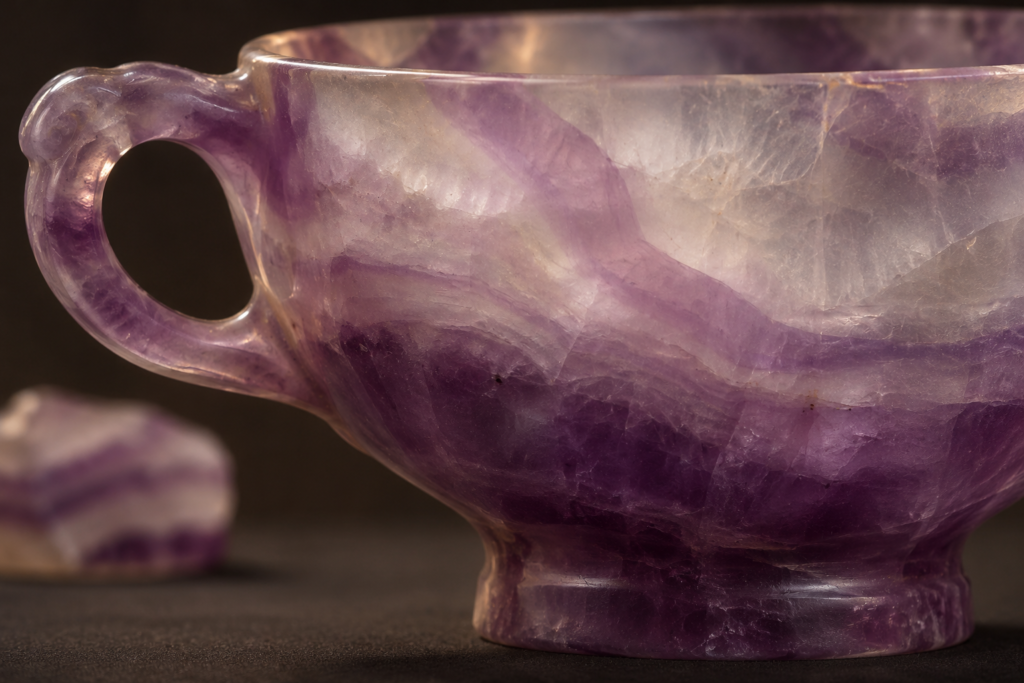
The British Museum catalogues the Crawford Cup as a Roman fluorite vessel dated approximately 50–100 CE. It is about 9.7 centimetres high and has two handles. Its broad purple and pale bands follow the form of the bowl, making it an especially clear example of decoration produced by the stone’s own colour distribution.
The relatively plain body gives those bands room to read across the vessel. Seen from one angle, a dark zone can dominate the profile. From another, light passing through the wall can make the pale areas much more prominent. The cup’s polish contributes surface reflections while its thickness affects the light seen through the stone.
This is one of the closest visual parallels with Pliny’s account. His discussion of purples, whites and changing edge effects makes sense alongside a vessel in which the material supplies much of the ornament. The resemblance supports the identification of Roman fluorite cups with murrhina, while the museum’s material identification provides independent evidence about this particular object.
The Barber Cup: When Relief Meets Colour
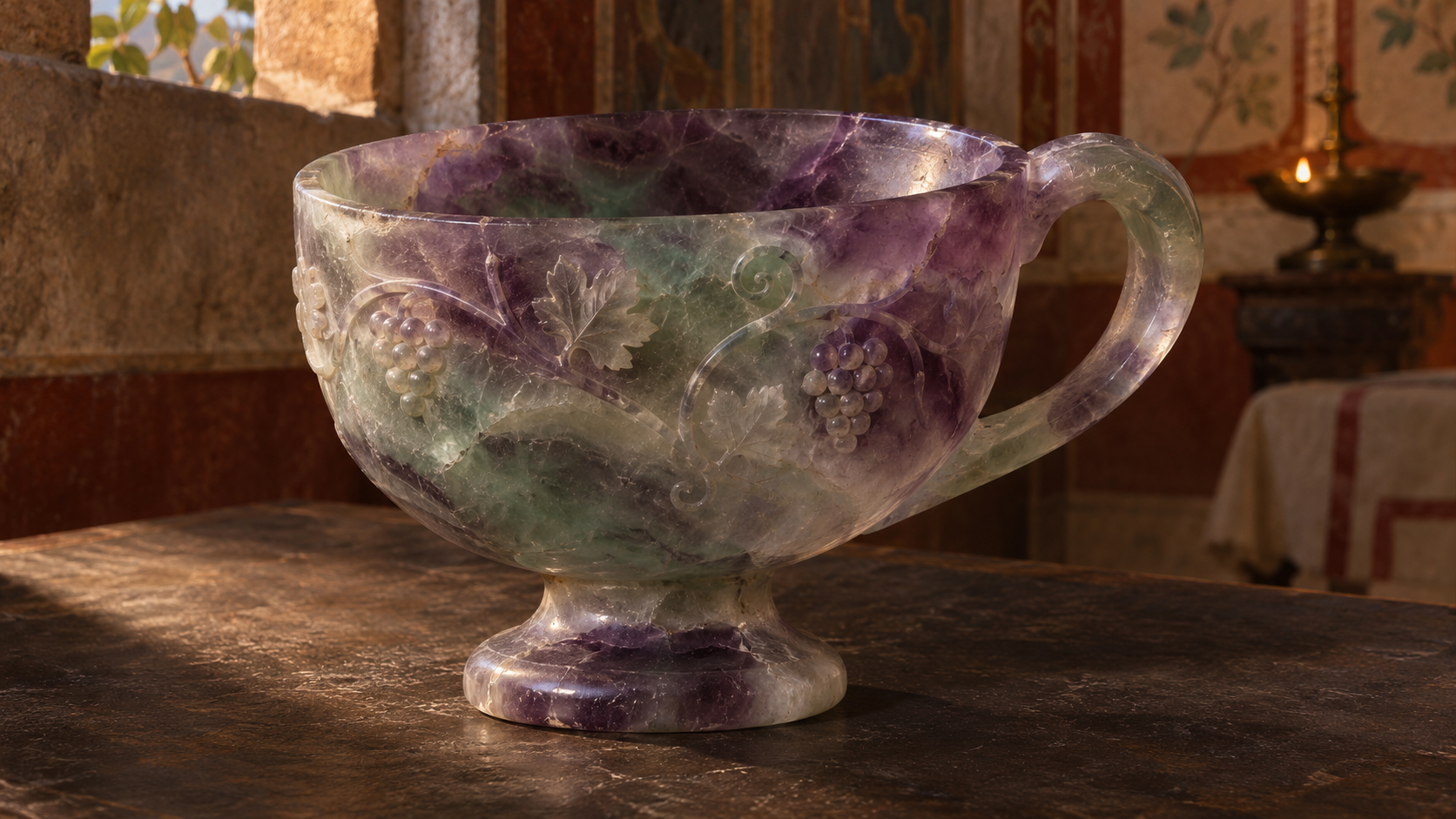
The Barber Cup, also catalogued as Roman fluorite from approximately 50–100 CE, presents a different solution. It has one handle, a low pedestal foot and an oval body. Grapevines, leaves and tendrils appear in low relief, while a bearded head beneath the handle is interpreted as Dionysus, or one of his companions. The decoration suits a drinking vessel, and the attribution of the face remains a curatorial interpretation.
Its purple, green, yellow and pale zones cross the carved form. As a result, the viewer reads two patterns at once. There is the continuous banding of the stone, and there are the contours of leaves, grapes and tendrils picked out by shadows and reflections. The colour boundaries need not follow the outlines of the relief for the two to work together.
The cup’s oval profile may reflect the shape or usable volume of the original block, as Catherine Johns suggested in her account of the acquisition. That is a plausible workshop interpretation. The surviving shape alone cannot recover the carver’s original plan, including whether a different handle arrangement was ever intended.
Why Fluorite Can Be Soft and Difficult to Carve
Fluorite is calcium fluoride, CaF₂. It belongs to the cubic crystal system, has a Mohs hardness of 4 and commonly shows colour zoning. For a lapidary, its most consequential property is perfect octahedral cleavage, which allows it to split readily along four families of equivalent planes.
Hardness and cleavage describe different behaviours. A Mohs value tells us how readily a surface can be scratched. Cleavage tells us whether the crystal has preferred directions of splitting. Fluorite can therefore abrade more readily than quartz while remaining vulnerable to a break that follows a cleavage plane.
That matters throughout the geometry of a vessel. Hollowing reduces the material behind the rim, and carving around a handle creates narrow transitions where a break could spoil the whole object. On the Barber Cup, cutting a relief into the exterior also changed the amount of stone remaining between the outer surface and the hollow interior. The carver had to manage that relationship throughout the design. These are constraints implied by the material and the finished form, rather than a record of the exact workshop sequence.
A comparison with Shah Jahan’s nephrite cup makes the distinction tangible. Nephrite’s interlocking amphibole fibres contribute to high fracture resistance. Fluorite presents the carver with easy splitting along crystallographic planes. A similar ambition, hollowing a block of coloured stone into a vessel, poses very different problems in those two materials.
Colour Zoning and the Effect of Wall Thickness
The bands seen in a fluorite object can reflect changes during crystal growth. Their appearance in the finished vessel depends on how the carver’s surfaces intersect those zones and on how much material light passes through.
There are two effects to watch for. When the wall is viewed mainly in reflected light, polish and relief can dominate. When light passes through it, a thicker stretch of the same absorbing material can appear darker or more saturated than a thinner stretch. Uneven translucency across an entire cup is therefore compatible with differences in wall thickness as well as differences between natural colour zones.
A curved wall complicates the picture further. As the cup turns, the angle of illumination, position of highlights and length of the light path through the stone all change. A historical description of colours shifting around an edge gives us a clue about the viewing experience. It does not require us to diagnose mineralogical colour change or fluorescence from the text.
Would the Cups Have Changed the Taste of Wine?
Pliny records that smell contributed to the appeal of murrhine vessels. Modern discussions have connected that observation with resin. Johns points to the use of resin in later Derbyshire Blue John working and raises the possibility that a comparable treatment in antiquity could have influenced the taste of wine.
The proposal is an analogy between workshops separated by many centuries. To establish it for a particular Roman cup, researchers would need evidence of a residue and a way to distinguish an ancient application from deposits acquired during use, burial, handling or later conservation. Pliny’s account does not provide that evidence, and the publications cited here do not document a residue analysis proving the proposed treatment on either cup.
The claim therefore remains historically interesting as a testable explanation. It also leaves room for the simpler distinction between what a Roman author reported about prized vessels and what can be demonstrated about the surfaces of two surviving examples.
A Shared Find History and an Unknown Geological Source
The cups are reported to have been found in a Roman tomb in the vicinity of the modern Türkiye–Syria border during the First World War. They subsequently passed into different collections. The Crawford Cup entered the British Museum in 1971. The Barber Cup, which had passed through a collection in Brussels, joined it decades later. The published museum acquisition account describes the evidence for their having been found together as circumstantial.
That qualification matters because the reported findspot, workshop location and source of the raw mineral are three separate things. Even a securely excavated burial would tell us where the finished cups were deposited. Matching bands or a shared find story would still leave open where the fluorite was quarried and where it was carved.
Pliny’s references to Parthia and Carmania contribute evidence about Roman ideas of supply and quality. The modern association of banded fluorite with Derbyshire Blue John contributes a comparison in appearance and working practice. Neither comparison assigns these two cups to a named deposit.
How Strong Is the Fluorite Identification?
The evidence has two levels. At the object level, the Crawford and Barber Cups are catalogued as fluorite. Their existence establishes that the mineral could be worked at vessel scale despite its cleavage. At the historical level, their period, form and natural colour bands make them strong candidates for the kind of luxury Pliny describes.
The scope of the ancient word remains the open issue. A Roman category could have brought together objects by appearance, perceived origin and use. To establish that every recorded murrhine vessel was fluorite would require identifying the material of objects that survive only in written accounts.
The two cups nonetheless give the ancient description a physical scale. One lets broad bands define an almost unadorned vessel. The other sets those same kinds of colour variation against carved grapevines and a sculpted handle. Together they show what a Roman craftsman could achieve with a stone soft enough to abrade and prone enough to split that every part of the form demanded care.
References & Further Reading
- Pliny the Elder. Natural History, Book 37, §§18–22. The ancient account of murrhine vessels, their reported origins and the visual qualities Roman collectors valued. Latin text hosted by the University of Chicago
- British Museum. “The Crawford Cup,” registration no. 1971,0419.1. Museum collection entry with the vessel’s dimensions, dating and material. British Museum collection entry on Google Arts & Culture
- British Museum. “The Barber Cup,” registration no. 2003,1202.1. Museum collection entry documenting the single handle, grapevine relief, bearded head and fluorite colour bands. British Museum collection entry on Google Arts & Culture
- Johns, C. (2004). “The Barber Cup: A New Acquisition for the British Museum.” Gem & Jewellery News, March 2004, p. 17. The museum acquisition account explains the carving, the circumstantial evidence for a shared find and the proposed comparison with later resin use. Gem-A journal archive, PDF
- “What Was Murrhine?” (1952). Antiquity, 26(102), 65–70. Historical research on the debate over identifying the material named in ancient texts. Cambridge University Press
- Mineralogical Society of America. “Fluorite.” Handbook of Mineralogy. Reference data for composition, cubic symmetry, hardness, perfect cleavage and colour zoning. Mineral data sheet, PDF
- Art Institute of Chicago. “Cat. 71: Dish, mid-2nd/early 1st century B.C.” Roman Art at the Art Institute of Chicago. Scholarly catalogue entry with comparative images of the Crawford and Barber Cups. Art Institute of Chicago
- Government of South Australia, Department for Energy and Mining. “Nephrite Jade.” Geological reference for the comparison between nephrite’s interlocking texture and the fracture behaviour of other lapidary materials. South Australian Government