

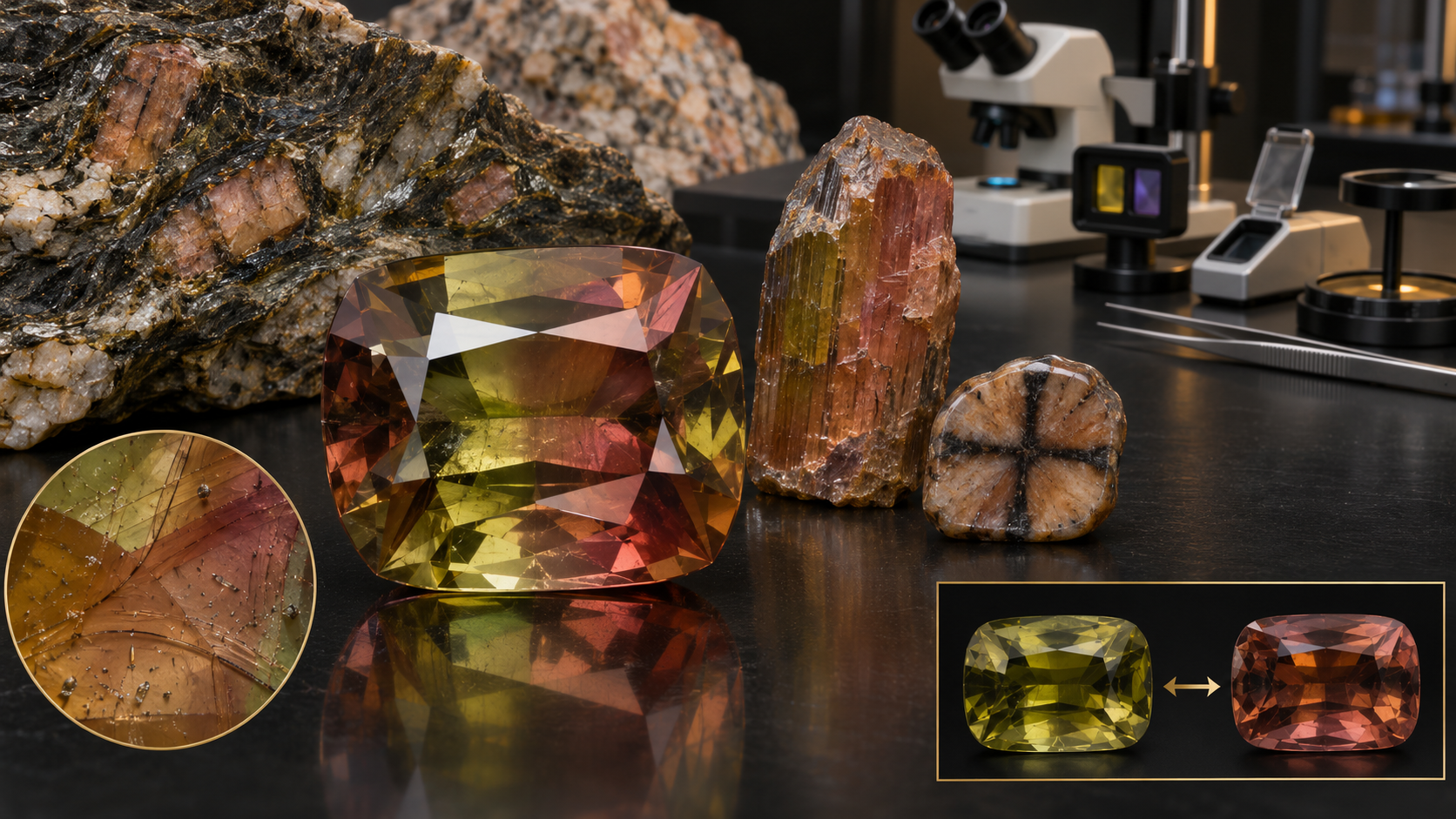
Few gemstones demonstrate the relationship between crystallography and colour as dramatically as andalusite.
Andalusite is an orthorhombic aluminium silicate with the chemical formula Al₂SiO₅. It is a recognised mineral species and one of three important polymorphs sharing this composition, alongside kyanite and sillimanite. Although chemically identical in their ideal formulas, these minerals possess different crystal structures and are stable under different geological conditions. The andalusite gemstone is well-known for its unique properties.
Gem-quality andalusite is particularly remarkable for its strong pleochroism. A single transparent crystal can display green, yellowish green, brownish pink and reddish-brown components depending on crystallographic orientation and the direction of observation. Because andalusite is biaxial, three principal optical directions exist, making it capable of trichroism.
This property gives gem cutters an unusual challenge. Rather than merely maximising brilliance, they must decide how to orient the crystal to reveal, balance or deliberately contrast its directional colours. Some faceted stones display striking combinations of green and warm reddish-brown across different facets.
Andalusite also has considerable geological significance. It commonly develops during metamorphism of aluminium-rich sedimentary rocks, especially under relatively low-pressure conditions. Its presence can help geologists reconstruct the pressure-temperature history of metamorphic terrains.
The andalusite gemstone has significant industrial applications due to its heat resistance and unique optical properties.
One particularly distinctive variety is chiastolite, in which dark carbonaceous inclusions form cross-shaped patterns within the crystal. These patterns record the relationship between crystal growth and the redistribution or incorporation of surrounding material.
Professional gemmological investigation adds further depth. Refractive-index measurements, optic character, pleochroism, absorption spectroscopy and microscopic growth structures distinguish andalusite from superficially similar gemstones.
Research into Brazilian gem-quality andalusite has documented curved mineral inclusions, growth-sector boundaries, fingerprint-like features, unusual fluorescence and experimental fracture filling.
In this episode of the Nadia Gemstone Academy, we examine andalusite from metamorphic mineralogy to practical laboratory identification, including its optical behaviour, internal features, treatments, imitations and durability.
Andalusite demonstrates how the physical structure of a mineral can transform light into a complex display of colour—and how that same structure preserves evidence of the geological environment in which the andalusite gemstone formed.
Table of Contents
Andalusite: A Complete Gemmological Reference Guide
Introduction
Andalusite is a naturally occurring aluminium silicate mineral with the ideal chemical composition Al₂SiO₅. Although relatively common as a constituent of metamorphic rocks, transparent crystals suitable for faceting are considerably less common.
Its most distinctive gemmological feature is strong pleochroism, often sufficiently pronounced to create visibly contrasting colours within a single faceted gemstone.
Andalusite may display yellowish-green, brownish-green, pinkish-brown and reddish-brown colour components. The exact appearance depends on composition, crystal orientation, light path and cutting design.
Beyond its optical interest, andalusite is an important geological indicator mineral. Its occurrence can provide evidence of metamorphic conditions, especially the pressure-temperature evolution of aluminium-rich rocks.
Mineralogical Classification
Andalusite is a recognised mineral species belonging to the nesosilicate class.
Its chemical formula is:
Al₂SiO₅
It shares this ideal formula with two other mineral species:
Kyanite
and
Sillimanite
The three minerals are polymorphs.
This means that they possess essentially the same ideal chemical composition but different atomic arrangements.
These structural differences produce different crystal systems, optical properties, cleavage characteristics and geological stability fields.
Andalusite is orthorhombic.
Kyanite is triclinic.
Sillimanite is also orthorhombic but possesses a different crystal structure.
The three must therefore not be described as varieties of one mineral species.
Crystal Structure and Morphology
Andalusite frequently forms elongated prismatic crystals.
Its cross-section can appear approximately square or rhombic.
However, this apparent geometry must not be mistaken for tetragonal symmetry.
Andalusite is orthorhombic.
Natural crystals may display:
prism-face striations
surface etching
growth steps
cleavage-related features
overgrowth structures
In detailed research on Brazilian material, strongly etched surfaces and multiple orientations of striations were documented.
Such features can reflect the history of crystal growth, metamorphism and later geological alteration.
Metamorphic Formation
Andalusite is principally associated with metamorphism of aluminium-rich rocks.
These rocks often originate as clay-rich sediments, mudstones or shales.
During metamorphism, heat and pressure cause the original minerals to react and recrystallise.
Andalusite is particularly characteristic of comparatively low-pressure metamorphic conditions.
It commonly develops in contact-metamorphic aureoles around igneous intrusions.
Heat from the intrusion transforms the surrounding sedimentary rock.
Andalusite crystals may develop as porphyroblasts within the metamorphic matrix.
Regional metamorphism can also produce andalusite under suitable conditions.
Geological Significance
The relationship between andalusite, kyanite and sillimanite is fundamental to metamorphic petrology.
The three Al₂SiO₅ polymorphs have different pressure-temperature stability fields.
Andalusite is generally favoured at relatively low pressures.
Kyanite becomes stable at higher pressures.
Sillimanite becomes favoured at sufficiently high temperatures.
Actual mineral assemblages depend on more than temperature and pressure.
They are also influenced by:
bulk-rock chemistry
fluid composition
reaction kinetics
deformation
metamorphic history
Consequently, the presence of andalusite provides important geological evidence but cannot alone establish one exact formation depth or temperature.
History and Nomenclature
The name andalusite was introduced during the development of systematic mineralogy in the late eighteenth century.
It refers to Andalusia in Spain.
Historical research has raised questions about whether the earliest described material actually originated from the region implied by the name.
Such historical ambiguities are not unusual in mineral nomenclature.
From a scientific perspective, andalusite became particularly important through recognition of its relationship to kyanite and sillimanite.
Gem-Quality Andalusite
Transparent material suitable for faceting is considerably less common than ordinary metamorphic andalusite.
Gem-quality specimens require:
sufficient transparency
attractive colour
limited fracturing
adequate size
favourable orientation
The strong pleochroism creates additional cutting considerations.
A cutter can orient the rough to emphasise one colour component or deliberately create contrasting colours within the face-up gemstone.
This makes the visual appearance of faceted andalusite highly dependent on cutting orientation.
Brazilian Andalusite
Brazil is one of the important sources of transparent gem-quality material.
A major GIA study published in 2009 examined rough and faceted andalusite attributed to Brazil.
The researchers documented:
green material
yellowish-green material
brownish-pink material
bicoloured stones
The study measured optical properties, specific gravity, fluorescence and internal features and also investigated heat treatment and fracture filling.
The exact mine source of the studied parcel was not established.
This point matters because “Brazilian” does not automatically mean one precisely defined deposit population.
Pleochroism and Trichroism
Andalusite is one of the classic examples of strong pleochroism.
Pleochroism occurs when an anisotropic crystal absorbs light differently along different crystallographic directions.
Because andalusite is biaxial, three principal optical directions exist.
Transparent material can therefore display trichroism.
Directional colours can include:
yellowish green
brownish green
brownish pink
reddish brown
In Brazilian material studied by GIA, some crystals appeared brownish pink along the c-axis and yellowish or brownish green in other directions.
When faceted, these colours can appear simultaneously because light follows multiple paths through the gemstone.
Trichroism Versus Colour Change
Pleochroism must not be confused with the alexandrite effect.
In pleochroism, the colour differences depend principally on the direction of light through an anisotropic crystal.
In alexandrite-type colour change, the observed colour changes according to the spectral composition of the illumination source.
Andalusite may appear multicoloured in a single lighting condition because different facets direct light through different crystallographic orientations.
That is fundamentally different from true colour change.
Colour Chemistry
Transition metals contribute to andalusite colour.
Iron is important in many ordinary gem-quality stones.
Manganese can become significant in green, manganese-rich material known as viridine.
The visible colour depends on:
element concentration
oxidation state
crystallographic site
optical direction
absorption behaviour
Consequently, colour alone cannot establish composition or geographic origin.
Viridine
Viridine is a manganese-rich green variety of andalusite.
It remains the same mineral species.
Its increased manganese content can produce differences in colour and optical properties.
Published data for some viridine compositions show refractive indices and birefringence outside the most commonly quoted ordinary-andalusite ranges.
These values must not be treated as standard constants for all andalusite.
Refractive Index
Typical gem andalusite has refractive indices around:
1.63–1.65
In the Brazilian GIA study, measured values included approximately:
nα: 1.637–1.649
nγ: 1.646–1.654
Individual measurements depend on composition and orientation.
The values obtained from one deposit population should therefore not be treated as absolute limits for the mineral species.
Birefringence
Typical birefringence is around:
0.008–0.011
The Brazilian study recorded approximately:
0.008–0.010
This degree of double refraction is moderate.
The visible colour effects of andalusite are therefore dominated more strongly by pleochroism than by conspicuous facet doubling.
Optical Character
Andalusite is biaxial.
Ordinary gem material is generally described as biaxial negative.
Its biaxial nature distinguishes it from many visually similar uniaxial gemstones.
Polariscope and conoscopic examination can therefore provide useful supporting evidence.
Specific Gravity
Typical specific gravity is approximately:
3.13–3.17
The Brazilian study measured approximately:
3.11–3.16
Small differences can result from composition, inclusions and measurement uncertainty.
Specific gravity is useful when separating andalusite from superficially similar materials.
Hardness and Mechanical Properties
Andalusite has Mohs hardness approximately:
6.5–7.5
Its hardness provides reasonable resistance to scratching.
However, it remains brittle.
Cleavage is also present.
These properties make the mineral less impact-resistant than gemstones such as chrysoberyl or corundum.
Hardness must therefore not be interpreted as complete durability.
Microscopic Features
Transparent andalusite can display a complex internal environment.
Documented features include:
curved inclusions
growth tubes
small films
crystalline inclusions
pinpoint clouds
fingerprint-like structures
colour zoning
growth-sector boundaries
Some mineral inclusions may suggest sillimanite or other phases.
However, visual appearance alone is not always sufficient to identify an inclusion.
Raman spectroscopy can provide more reliable confirmation.
Growth Structures
Growth structures can provide valuable evidence about crystallisation.
Sharp boundaries may separate differently coloured sectors.
Fine mineral inclusions may accumulate along particular growth planes.
Other crystals may display:
wavy growth structures
parallel particle arrangements
complex zoning
overgrowth features
These structures are also important for cutters because they may influence colour distribution and clarity.
Chiastolite
Chiastolite is a distinctive variety of andalusite.
It contains dark cross-shaped or X-shaped internal patterns.
These structures commonly consist of carbonaceous material, including graphite-bearing matter, concentrated during crystal growth.
The pattern is most clearly visible in cross-sections cut perpendicular to the crystal’s elongation.
Chiastolite is commonly opaque or translucent.
The cross is an internal geological structure.
It is not carved, painted or engraved.
Fluorescence
Fluorescence is variable.
Some reference tables describe andalusite as inert or weakly fluorescent.
However, Brazilian material studied by GIA behaved differently.
The stones were inert under long-wave UV but displayed moderate to strong yellowish-green fluorescence under short-wave UV.
This demonstrates why fluorescence tables should never be treated as absolute rules.
A fluorescence reaction can provide useful supporting information, but it is not independently diagnostic.
Visible Spectroscopy
Visible absorption spectroscopy can contribute to colour investigation.
Some Brazilian specimens showed a diffuse absorption feature around approximately 455 nm.
Others did not produce a clearly identifiable handheld spectrum under the same general study conditions.
This variability reinforces an important principle:
One absorption line should not be presented as a universal identification criterion.
Raman Spectroscopy
Raman spectroscopy is particularly useful for distinguishing the three Al₂SiO₅ polymorphs.
Andalusite, kyanite and sillimanite share the same ideal chemical composition but have different crystal structures.
These structural differences produce different Raman spectra.
Raman microscopy can also assist in identifying inclusions.
This makes it a valuable advanced gemmological method when classical testing is insufficient.
FTIR Spectroscopy
Fourier Transform Infrared Spectroscopy provides complementary structural information.
The method can detect infrared absorption associated with lattice vibrations and certain impurities.
Infrared spectra can also vary according to measurement orientation.
FTIR is therefore useful primarily as part of a broader analytical dataset rather than as one isolated identification test.
Treatments
Andalusite is not associated with a major commercial treatment industry comparable to corundum.
Nevertheless, treatments have been studied.
In the 2009 GIA investigation, selected Brazilian samples were heated under controlled conditions.
The resulting colour changes were generally limited.
This suggests that routine heating does not offer the same dramatic commercial benefits seen in some other gemstone species.
Fracture Filling
The same study investigated clarity enhancement.
Surface-reaching fractures were filled with colourless materials including epoxy resin.
The filling reduced the visibility of fractures and improved apparent clarity.
This demonstrates that treatment assessment remains relevant even in gemstones generally considered to be seldom treated.
Any detected filler should be disclosed.
Synthetic Andalusite
Synthetic andalusite is not a major routine commercial jewellery product.
Laboratory synthesis of Al₂SiO₅-related material is scientifically possible.
However, the market situation differs greatly from widespread synthetic corundum, emerald, spinel or alexandrite.
An unusually transparent or clean stone should not automatically be assumed to be synthetic.
Natural versus synthetic origin should be established through evidence.
Andalusite Versus Tourmaline
Certain andalusites can resemble green or bicoloured tourmaline.
The two minerals differ significantly.
Andalusite is:
orthorhombic
biaxial
potentially strongly trichroic
Tourmaline is:
trigonal
uniaxial
dichroic
Refractive indices, birefringence and specific gravity provide additional diagnostic information.
Andalusite Versus Kyanite
Kyanite has the same ideal chemical formula as andalusite.
However, it crystallises in the triclinic system.
Kyanite is also famous for direction-dependent hardness.
Its optical properties differ sufficiently from those of andalusite to permit gemmological separation.
Raman spectroscopy provides definitive structural confirmation when required.
Andalusite Versus Sillimanite
Sillimanite is another Al₂SiO₅ polymorph.
It is orthorhombic but has a different crystal structure from andalusite.
Sillimanite frequently occurs in prismatic or fibrous forms.
Gem-quality fibrolite is one familiar gemstone expression.
Its optical constants, microscopic textures and Raman spectrum distinguish it from andalusite.
Geographic-Origin Determination
Strong pleochroism cannot establish geographic origin.
Likewise, one particular inclusion should not automatically be interpreted as proof of Brazil, Sri Lanka, Madagascar or another source.
Origin assessment should combine:
inclusion assemblages
growth structures
spectroscopy
trace-element chemistry
comparison with authenticated reference material
For many andalusites, a precise laboratory origin conclusion may not be possible.
In that situation, the scientifically correct result is to leave origin undetermined.
Cutting Considerations
Cutting andalusite is unusual because orientation determines much of the visible colour.
A cutter may orient the gemstone to maximise green tones.
Alternatively, the cut can deliberately mix green and reddish-brown components.
Some stones are fashioned to produce a visually complex patchwork of directional colours.
Yield must also be considered.
Natural fractures, growth zoning and the shape of the rough may limit orientation options.
Jewellery Durability
Andalusite can be used successfully in jewellery.
However, its mechanical properties warrant more caution than those of sapphire or chrysoberyl.
Impact can produce chips or cleavage-related damage.
Rings worn daily face greater risk than earrings or pendants.
Protective settings can therefore be useful.
Fracture-filled stones require additional care.
Cleaning
A conservative cleaning procedure is recommended:
lukewarm water
mild soap
soft brush or cloth
Steam cleaning should be avoided.
Ultrasonic cleaning is also best avoided, especially if fractures or filling materials are present.
Strong heat and sudden temperature changes can increase the risk of damage.
Why Andalusite Matters to Gemmology
Andalusite brings several scientific disciplines together within one gemstone.
Mineralogy identifies it as Al₂SiO₅.
Crystallography explains its orthorhombic and biaxial structure.
Metamorphic petrology explains its relationship with kyanite and sillimanite.
Optical physics explains its striking trichroism.
Microscopy reveals its growth structures and inclusions.
Chiastolite shows how crystal growth can organise surrounding carbonaceous material into distinctive geometric patterns.
Spectroscopy separates structural polymorphs and investigates colour.
Treatment studies demonstrate why even relatively untreated gemstones require analytical caution.
Andalusite is therefore far more than an unusual green-and-brown gemstone.
It is an exceptionally clear example of how geological environment, crystal structure and interaction with light combine to produce a gemstone’s observable properties.
References & Further Reading
1. Fernandes, S. & Choudhary, G. – Gem-Quality Andalusite from Brazil
Gems & Gemology, Summer 2009.
Primary gemmological investigation of Brazilian andalusite, including refractive indices, specific gravity, pleochroism, fluorescence, inclusions, spectroscopy and experimental treatments.
https://www.gia.edu/doc/SU09.pdf
The andalusite study begins on page 120.
2. Gemological Institute of America – Gübelin Gem Project: Various Gems
Institutional reference collection containing documented andalusite specimens from Brazil and Sri Lanka.
https://www.gia.edu/gia-gem-project-various-gems-a
3. Gemological Institute of America – Pleochroism in Faceted Gems: An Introduction
Gems & Gemology, Fall 2014.
Reference explaining uniaxial and biaxial optical behaviour, directional colour absorption and the distinction between dichroism and trichroism.
https://my.gia.edu/gems-gemology/fall-2014-introduction-pleochroism-faceted-gems
4. Gemological Institute of America – Inclusions in Gemstones
Gems & Gemology, Summer 2022.
Scientific discussion of inclusions, crystallisation environments, healed fractures, growth structures and geological interpretation.
https://www.gia.edu/gems-gemology/summer-2022-colored-stones-unearthed
5. Gemological Institute of America – A Review of Analytical Methods Used in Geographic Origin Determination of Gemstones
Gems & Gemology, Winter 2019.
Discussion of microscopy, chemistry, spectroscopy and the limitations of gemstone geographic-origin determination.
6. Gemological Institute of America – Insights from Inclusions
Educational resource concerning the role of inclusions in natural, synthetic and geological interpretation.
https://www.gia.edu/gem-inclusion-insight
7. Mineralogist.org – Andalusite Mineral Data
Supplementary mineralogical reference for Al₂SiO₅ chemistry, orthorhombic crystallography, cleavage and physical properties.
[…] 4. Dichroism and Trichroism […]