

Table of Contents
Introduction: Before a Gemstone Reaches the Market
Every natural gemstone begins with a geological story.
Long before a sapphire is faceted, an emerald is polished or a tourmaline crystal is placed in a collector’s cabinet, the material must first be discovered.
Some gemstones are found within solid rock.
Others are recovered from river gravels after millions of years of weathering and erosion.
Certain crystals develop in cavities within coarse-grained igneous rocks.
Others form through metamorphism, hydrothermal activity or complex interactions between geological fluids and surrounding rocks.
Finding these materials is rarely a matter of simply searching the ground for beautiful stones.
Professional gemstone exploration involves geological interpretation, field observation, sampling, mineral identification and economic evaluation.
Geologists must understand which environments are capable of producing particular gemstones.
They must recognise the rock formations, mineral associations and structural features that may indicate a deposit.
They must also distinguish between an isolated occurrence and a concentration of material that could support sustained extraction.
A single spectacular crystal can be scientifically important without indicating a commercially viable gemstone deposit.
Conversely, a deposit containing many small or moderately coloured gemstones may support substantial production if the material can be recovered efficiently.
This distinction is central to understanding how gemstone discoveries develop.
The discovery of a gemstone is not the same as the discovery of a mine.
Between those two events lies a process of geological investigation, practical evaluation and considerable uncertainty.
1. What Is a Gemstone Deposit?
A gemstone deposit is a natural concentration of gem material within a geological environment.
The material may occur in its original host rock or within sediments produced by weathering and erosion.
A deposit may contain transparent crystals suitable for faceting.
It may produce translucent or opaque material appropriate for cabochons, carvings or decorative objects.
It may also contain mineral specimens valued primarily for their crystal form, colour or scientific interest.
Not every gemstone-bearing rock contains economically valuable material.
For example, garnet is relatively common in many metamorphic rocks.
However, only a portion of naturally occurring garnet possesses the colour, transparency, size and structural quality desired for particular gem uses.
Similarly, a pegmatite may contain abundant tourmaline crystals while producing very little transparent faceting material.
Geologists therefore distinguish between the presence of a mineral and the presence of material with commercial gem potential.
The United States Geological Survey identifies several important geological environments in which gemstones occur, including igneous rocks, metamorphic rocks and alluvial gravels.
Each environment presents different exploration challenges.
2. Primary and Secondary Gemstone Deposits
One of the most important distinctions in gemstone geology concerns primary and secondary deposits.
Primary deposits
A primary deposit contains gemstones associated with the geological environment in which they formed, or with rock that transported them from their original crystallisation environment to the Earth’s surface.
For example, tourmaline may occur within a granitic pegmatite.
Ruby may occur within marble or other metamorphic rocks.
Sapphire may be associated with certain igneous rocks.
Emerald may form in reaction zones or hydrothermal veins.
Primary deposits can provide valuable information about the geological processes responsible for gemstone formation.
The relationship between the gemstone and surrounding minerals may help researchers understand the conditions under which it developed.
Secondary deposits
Secondary deposits form when gemstones are released from earlier rocks and subsequently concentrated by natural processes.
Weathering breaks down the original rock.
Erosion transports the liberated material.
Gravity and moving water may concentrate relatively resistant minerals in particular locations.
These accumulations are commonly described as placer deposits.
Alluvial deposits are a major category of placer deposits associated with rivers and streams.
Many commercially important sapphires and other gemstones are recovered from secondary deposits.
The distinction matters because exploration methods differ substantially.
Searching for crystals inside a pegmatite requires a different geological approach from investigating ancient river gravels.
3. The First Question: What Geological Environment Should Be Investigated?
Gemstone exploration begins with geological knowledge.
Different minerals require different conditions to form.
The presence of a particular rock type may therefore increase the likelihood of finding certain gem materials.
However, geological suitability does not guarantee a deposit.
A region may contain the correct broad rock type without possessing the necessary chemical composition, structural conditions or mineralisation history.
For example, not every granitic pegmatite contains gem-quality tourmaline.
Not every marble deposit contains ruby.
Not every river gravel contains sapphire.
The exploration process therefore begins with identifying environments where the necessary geological conditions may have occurred.
Researchers study geological maps, existing mineral records, regional structures and the distribution of known deposits.
Historical mining records can also be valuable.
A former mine may indicate that the surrounding geological region possesses favourable conditions.
However, an old mine does not prove that substantial undiscovered material remains.
The objective is to identify promising areas for further investigation rather than assume that every favourable rock formation contains gemstones.
4. Geological Mapping: Reading the Landscape
Geological maps are fundamental tools in mineral exploration.
They show the distribution of rock formations, geological structures and other features relevant to mineral deposits.
A geologist examining a potential gemstone region may investigate the age and composition of the rocks.
The relationships between intrusive igneous bodies and surrounding formations can be important.
Faults, fractures and shear zones may influence the movement of mineralising fluids.
Contacts between different rock types can create favourable environments for certain mineral reactions.
In some areas, satellite imagery and aerial photography can assist regional interpretation.
Remote sensing may reveal geological structures, surface alteration patterns or terrain features that warrant closer investigation.
However, satellite images do not normally identify individual buried gemstones.
They provide geological context and help select locations for fieldwork.
The USGS describes mineral resource assessment as a process that combines geological, geochemical, geophysical and spatial information.
For gemstone exploration, the usefulness of each method depends on the deposit type.
A large geological structure may be detectable through regional surveys.
A small gem-bearing cavity inside a pegmatite may be far more difficult to locate.
5. Pegmatites: Important Sources of Large Gem Crystals
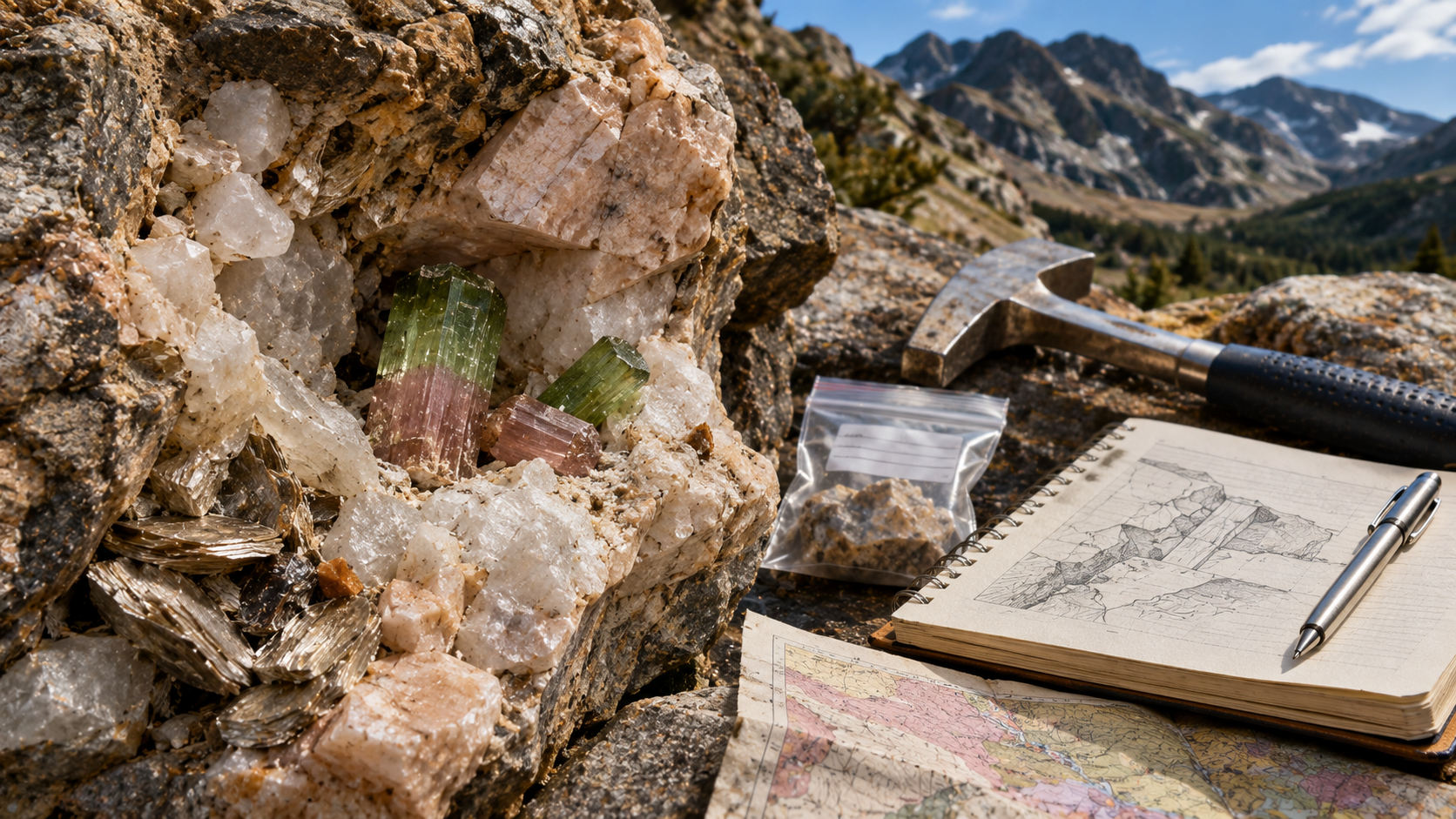
Granitic pegmatites are among the most important geological environments for gem-quality crystals.
A pegmatite is an igneous rock distinguished by its often exceptionally coarse crystal texture.
Many granitic pegmatites consist principally of quartz, feldspar and mica.
Some also contain minerals incorporating elements that are relatively uncommon in ordinary rock-forming mineral assemblages.
Gem-bearing pegmatites may produce tourmaline, beryl, topaz, spodumene, garnet and other minerals.
The gem varieties can include aquamarine, morganite, kunzite and several forms of tourmaline.
GIA’s 2025 scientific review, Gem Granitic Pegmatites, describes their mineralogy, geological formation and economic importance.
Pegmatites can occur as dikes, veins, lenses and other intrusive bodies.
Their internal structure may be complex.
Different mineral zones can develop within the same pegmatite.
Certain zones may contain large crystals.
Others may contain fine-grained minerals or unusual chemical compositions.
However, the presence of a pegmatite does not automatically indicate that valuable gemstone crystals are present.
Only particular pegmatites develop conditions favourable for significant gem mineralisation.
6. Gem Pockets: Where Exceptional Crystals May Develop
Some of the most impressive gemstone crystals are recovered from cavities within pegmatites.
These cavities are commonly called pockets.
A pocket may contain crystals that developed into open space.
Because the growing crystals were not completely surrounded by solid rock, they may possess well-developed external crystal faces.
In favourable circumstances, a pocket can contain transparent crystals of exceptional size or appearance.
However, pockets are not evenly distributed throughout a pegmatite.
They may be concentrated in particular internal zones.
Their locations can be irregular and difficult to predict.
GIA’s 2025 pegmatite review explains that miners sometimes use changes in mineral assemblages and rock textures as indicators of potentially favourable pocket zones.
Certain mica minerals, feldspar textures and variations in pegmatite geometry may provide useful clues.
Yet these are indicators rather than guarantees.
A promising-looking section of pegmatite may contain no valuable crystals.
Another section may produce an unexpected pocket.
Exploration therefore involves geological interpretation combined with uncertainty.
Careful extraction is also important.
Aggressive drilling or blasting can damage valuable crystals before they are recovered.
For high-value mineral specimens, preserving crystal form may be as important as recovering the material itself.
7. Tourmaline and Beryl: What Explorers Look For
Tourmaline and beryl illustrate how mineral associations can guide exploration.
Both occur in certain granitic pegmatites, although their distribution depends on local chemistry and geological evolution.
A geologist may examine the pegmatite’s internal zoning, mineral composition and relationship to surrounding rocks.
Minerals associated with chemically evolved pegmatites can provide useful information.
However, an indicator mineral does not independently prove that gem-quality material is present.
A pegmatite containing black tourmaline does not necessarily contain transparent green, pink or blue tourmaline.
Likewise, the presence of ordinary beryl does not guarantee gem-quality aquamarine or morganite.
Transparency, colour and crystal integrity must be evaluated separately.
GIA’s research on gem-bearing pegmatites demonstrates that valuable crystals may be restricted to relatively small portions of much larger rock bodies.
Consequently, the volume of a pegmatite is not a reliable measure of its potential gem value.
A small productive pocket may be more commercially significant than a large volume of unremarkable mineralised rock.
8. Metamorphic Deposits: Where Ruby and Other Gems Form
Metamorphism occurs when existing rocks undergo changes caused by temperature, pressure, deformation and, in some cases, chemically active fluids.
These processes can create new minerals or modify existing mineral assemblages.
Ruby is one of the important gemstones associated with certain metamorphic environments.
Some ruby deposits occur in marble.
Others are associated with mafic or ultramafic rocks and complex metamorphic or metasomatic processes.
GIA’s 2019 review of corundum and emerald deposits describes the geological diversity of these environments.
Ruby formation requires appropriate aluminium-rich conditions and the availability of chromium, which contributes to its red colour.
However, the presence of chromium-bearing rocks does not automatically produce ruby.
The complete geological environment must be suitable.
Exploration may focus on favourable metamorphic units, rock contacts, deformation zones and mineral associations.
The mineralogical context is essential.
A red crystal in metamorphic rock is not automatically ruby.
Correct identification requires appropriate gemmological or mineralogical examination.
9. Emerald Deposits: When Different Geological Components Interact
Emerald formation provides a particularly interesting geological challenge.
Emerald is the green variety of beryl.
Beryl contains beryllium, aluminium and silica.
Its green colour is associated principally with chromium and/or vanadium.
In many geological environments, the necessary components are not naturally concentrated together.
Emerald formation may therefore require processes that bring suitable chemical elements into contact.
Some deposits develop through interactions involving pegmatites, hydrothermal fluids and surrounding rocks.
Others form in different geological settings.
The emerald deposits of Zambia provide examples of mineralisation associated with reactions between beryllium-bearing fluids or rocks and chromium-bearing host rocks.
Colombian emerald deposits represent a different geological model.
GIA’s research describes emerald formation within black shale–limestone successions through the circulation of hydrothermal fluids associated with tectonic activity.
This distinction is important.
Emerald exploration cannot be reduced to a universal instruction to search for pegmatites.
Different geological models apply to different regions.
Successful exploration depends on understanding the particular formation process.
10. Alluvial Deposits: Gemstones Concentrated by Rivers
Alluvial gemstone deposits are formed through the action of moving water.
Weathering releases minerals from their original host rocks.
Streams and rivers transport the liberated particles and crystals.
The ability of water to move a mineral depends on several factors, including particle size, density, shape and water velocity.
When transport conditions change, some minerals accumulate in particular sedimentary environments.
Relatively dense and durable gemstones may become concentrated in gravel layers.
These deposits can contain sapphire, ruby, spinel, garnet, zircon and other gem minerals.
GIA’s 2023 review, Gems Recovered from Sedimentary Rocks, explains the geological processes responsible for placer formation.
Potential concentrations may occur in river gravels, sedimentary traps and older buried drainage systems.
However, the presence of heavy minerals does not guarantee valuable gemstones.
A gravel layer may contain numerous mineral grains but little material suitable for faceting.
The size, quality and distribution of recovered stones must be assessed.
11. Ancient River Channels: Gem Deposits Beneath the Present Landscape
One of the most interesting aspects of alluvial exploration is that productive gravels are not always associated with modern rivers.
Rivers change their courses over geological time.
Sediments can accumulate in former channels.
Later geological processes may bury these deposits beneath younger material.
Such ancient river channels are commonly described as paleochannels.
They can preserve concentrations of gemstones transported by earlier drainage systems.
The Ilakaka sapphire region of Madagascar provides an important example.
GIA’s field investigations document sapphire-rich gravels associated with ancient river systems.
The region became internationally significant after major discoveries in the late 1990s.
Gem-bearing layers can occur beneath substantial overburden.
This means that the surface appearance of a landscape may not reveal the position of the productive gravels.
Geological mapping, sedimentary interpretation and controlled sampling are therefore essential.
The objective is not simply to find a river.
It is to understand where the relevant sedimentary processes concentrated gemstone material.
12. How Geologists Investigate a Possible Placer Deposit
A placer exploration programme may begin by examining drainage patterns and sedimentary geology.
Researchers investigate the relationship between potential source rocks and downstream sediment accumulations.
They may identify areas where natural processes could have concentrated relatively dense minerals.
Sampling is then used to investigate whether the sediments contain gemstones.
The material is examined, sorted and recorded.
Different samples may contain different proportions of useful gem material.
This variability is important.
A single rich sample does not establish that an entire gravel deposit is equally productive.
Conversely, one unproductive sample does not necessarily eliminate a large geological area from consideration.
Sampling must be sufficiently representative to support meaningful conclusions.
In gemstone deposits, this can be particularly difficult because valuable stones may be unevenly distributed.
A small number of exceptional crystals can strongly influence the apparent value of a sample.
Professional evaluation therefore considers the distribution of material across multiple locations and geological units.
13. Why Gemstone Sampling Is Different From Ordinary Ore Evaluation
Many industrial mineral deposits are evaluated through the concentration of a particular chemical component.
For example, the grade of a metal-bearing ore may be expressed as a percentage or mass concentration of the desired metal.
Gemstone deposits are different.
The commercial value of gem material depends heavily on individual characteristics.
Two deposits may contain similar total weights of sapphire but produce very different commercial results.
One may yield mostly opaque or heavily fractured crystals.
The other may produce a smaller quantity of transparent, attractively coloured material.
A gemstone deposit therefore requires evaluation of both quantity and quality.
Relevant factors include colour, transparency, crystal size, fractures, inclusions and suitability for cutting.
The proportions of faceting-grade, cabochon-grade and specimen-grade material may also matter.
An assessment based only on the total weight of recovered mineral can be misleading.
The objective is to understand the likely distribution of saleable material and its realistic uses.
14. Geological Sampling and Documentation
Accurate sample documentation is essential during exploration.
A sample should be associated with reliable information about where and how it was collected.
Relevant records may include location coordinates, geological context, collection date, sample type and observed mineral associations.
Photographs and field notes can help preserve this information.
The importance of documentation extends beyond exploration.
GIA’s field gemology programme collects known-origin samples for research into geographical origin determination.
Its published field procedures describe the importance of recording sample provenance and distinguishing directly collected material from material acquired through less certain commercial channels.
This principle applies equally to exploration.
A gemstone without reliable collection information may still be valuable as a specimen.
However, it provides less reliable evidence for reconstructing the geological distribution of a deposit.
Careful documentation supports both scientific research and future commercial transparency.
15. Remote Sensing, Geochemistry and Geophysics
Modern mineral exploration can employ several scientific methods.
Remote sensing uses satellite or aerial observations to investigate surface features.
Geochemical surveys analyse rocks, soils or sediments to identify patterns in elemental composition.
Geophysical surveys investigate physical properties of the ground, such as magnetic, electrical or gravitational characteristics.
These methods can help identify geological structures or environments associated with mineralisation.
However, their usefulness depends on the deposit type.
A geophysical survey may help map a large rock body or structural boundary.
It may not reliably detect an individual small gemstone pocket.
Geochemical anomalies can suggest unusual mineral compositions without proving that transparent gem crystals exist.
Remote sensing can help identify geological features but does not directly reveal the quality of buried gemstones.
The USGS emphasises the integration of geological, geochemical, geophysical and spatial information in mineral resource assessment.
For gemstone exploration, these methods are best understood as ways to reduce uncertainty and guide field investigation.
They are not substitutes for examining actual material.
16. Drilling and Subsurface Investigation
Where promising gemstone-bearing layers are buried, subsurface investigation may be necessary.
Drilling can provide information about rock types, sediment thickness and geological structures.
In some deposit types, it can help locate potentially productive horizons.
However, drilling is not equally effective for every gemstone occurrence.
A narrow pegmatite pocket may be missed by a borehole.
A small sample from a gravel deposit may not adequately represent the distribution of rare valuable stones.
The method must therefore match the geological problem.
In sedimentary opal fields, subsurface exploration can be particularly relevant.
GIA’s research on Australian opal deposits documents the relationship between opal mineralisation and particular sedimentary layers.
At Lightning Ridge, for example, opal is associated with specific claystone and sandstone units.
Understanding the stratigraphy helps explorers focus on potentially favourable horizons.
Yet locating the correct geological layer does not guarantee that precious opal will be present.
17. Opal: Exploration in Sedimentary and Volcanic Environments
Opal illustrates why gemstone exploration requires different geological models.
Opal is hydrated silica.
Unlike crystalline quartz, it lacks a conventional long-range crystalline structure.
Precious opal can display play-of-colour caused by the interaction of light with suitably ordered microscopic silica structures.
Important Australian opal deposits occur in sedimentary environments.
GIA’s field research describes opal-bearing formations associated with the Great Artesian Basin.
Other opal deposits occur in volcanic or volcanically influenced environments.
Ethiopian opal provides an instructive example.
GIA’s field investigations document opal occurrences associated with volcanic sequences, while also discussing evidence for processes involving weathering and soil-related environments.
Consequently, it is inaccurate to assume that all opal forms through one identical geological process.
Exploration must consider the local rock formations, fluid history and geological conditions.
A successful model for one opal district may not apply to another.
18. A Discovery Is Not Yet a Commercial Mine
Finding gem-quality crystals can be exciting.
However, a successful discovery does not automatically justify mining.
The next question concerns the quantity, quality and accessibility of the material.
A deposit may contain beautiful gemstones but be too small to support sustained production.
It may lie beneath thick overburden.
The material may be distributed irregularly.
Extraction may be technically difficult or costly.
The location may lack suitable transport infrastructure.
Legal access to the land may be restricted.
Environmental conditions may require substantial mitigation measures.
The market may also be unable to absorb the expected production at prices sufficient to support the operation.
These factors are separate from the geological existence of gemstones.
A deposit can be scientifically significant without being economically viable.
The USGS describes mineral development as a process extending from discovery and exploration through extraction, processing and eventual reclamation.
For gemstone projects, the same broad distinction between geological discovery and practical development applies.
19. Gemstone Yield: Why Rough Weight Is Not Finished Gemstone Weight
A recovered rough gemstone may lose a substantial portion of its weight during cutting.
The amount retained depends on its shape, internal characteristics, intended cut and the location of defects.
Fractures may require removal.
Inclusions can limit the usable portion of a crystal.
Uneven colour zoning may influence cutting orientation.
Certain shapes may produce a relatively low yield when fashioned into conventional faceted gemstones.
Other specimens may be more valuable as mineral crystals or decorative rough.
This means that the weight of rough material recovered from a deposit is not equivalent to the weight of finished gemstones that can be sold.
A productive exploration programme must consider the likely uses of the recovered material.
A deposit producing large quantities of opaque sapphire may be commercially different from one producing a smaller quantity of transparent faceting-grade sapphire.
Likewise, a pegmatite containing exceptional mineral specimens may possess value that is not captured by faceting yield alone.
Commercial assessment must reflect the characteristics of the actual material.
20. The Economic Importance of Consistency
Gemstone deposits can be highly variable.
One productive pocket may contain exceptional crystals.
The surrounding rock may contain little of commercial interest.
One section of alluvial gravel may yield valuable stones.
A nearby section may be almost barren.
This variability creates challenges for mine planning.
A business cannot assume that the results of one exceptional discovery will continue indefinitely.
Exploration must investigate whether productive material occurs across a sufficiently extensive area.
It must also evaluate how reliably that material can be recovered.
The commercial value of the gemstone output depends on market conditions, quality distribution, operating costs and many other factors.
Unlike standardised bulk commodities, gemstone pricing can vary dramatically between individual stones.
A deposit containing valuable gemstones is therefore not necessarily a predictable source of revenue.
Responsible project evaluation recognises this uncertainty.
21. Environmental and Social Considerations
Gemstone extraction can affect the surrounding environment.
Potential impacts depend on the mining method, location and scale of activity.
Alluvial operations may disturb sediment and water systems.
Open excavations may alter landforms.
Underground workings can introduce stability and safety concerns.
Waste rock and sediment must be managed appropriately.
Access roads and other infrastructure can affect surrounding landscapes.
Mining also involves questions of worker safety, land rights, local communities and legal compliance.
The USGS considers environmental conditions and potential impacts as part of modern mineral resource assessment.
Responsible gemstone exploration should therefore address these issues before extraction begins.
The discovery of a valuable gemstone deposit does not override environmental protection or the rights of local communities.
A technically promising deposit may still be unsuitable for development under particular legal, social or environmental conditions.
22. Four Real-World Examples of Gemstone Exploration
Madagascar: Sapphire in Ancient River Gravels
The Ilakaka region demonstrates the importance of sedimentary geology.
Gemstones are recovered from gravel layers associated with ancient drainage systems.
The geological challenge involves locating productive sedimentary horizons and understanding their distribution.
The presence of sapphire in one location does not mean that every nearby gravel layer is equally productive.
Maine, United States: Tourmaline in Pegmatites
Maine’s pegmatite districts demonstrate a different geological model.
Gem-quality tourmaline and other minerals may occur in particular zones or pockets within pegmatite bodies.
GIA’s field reporting describes the importance of pegmatite mineralogy, structural relationships and careful pocket extraction.
Zambia: Emerald in Reaction Zones
The emerald deposits of central Zambia illustrate the importance of geological interactions.
Beryllium-bearing geological components and chromium-bearing host rocks can contribute to favourable conditions for emerald formation.
The productive zones are associated with specific geological relationships rather than simply the presence of green minerals.
Australia: Opal in Sedimentary Formations
Australian opal exploration demonstrates the importance of stratigraphy.
Certain sedimentary units are more favourable for opal occurrence.
However, even within suitable formations, gem-quality material can be highly irregularly distributed.
These examples show why gemstone exploration cannot be reduced to one universal technique.
The correct approach depends on the geological origin and subsequent history of the material.
23. Common Misconceptions About Gemstone Discovery
Gemstones can be found anywhere if someone searches long enough.
Incorrect. Their occurrence depends on suitable geological conditions.
Every pegmatite contains valuable gemstones.
Incorrect. Many pegmatites contain no commercially significant gem material.
A river containing heavy minerals must contain sapphires.
Incorrect. Heavy-mineral concentrations can contain many different minerals.
A spectacular crystal proves that a large deposit exists.
Incorrect. An isolated crystal may have little relationship to the volume of recoverable material.
Gemstone deposits are always found where the crystals originally formed.
Incorrect. Many gemstones are recovered from secondary deposits.
Satellite imagery can directly identify buried gem crystals.
Incorrect. Remote sensing primarily provides geological and environmental information.
All emerald deposits form through the same process.
Incorrect. Emerald deposits occur in several geological environments.
The largest rough crystal is always the most valuable.
Incorrect. Colour, transparency, fractures, shape and other characteristics influence value.
The discovery of gemstones automatically makes mining profitable.
Incorrect. Economic viability depends on many additional factors.
A gemstone’s mining location is always identical to its geological formation location.
Incorrect. Weathering and erosion may transport material into secondary deposits.
24. What Gemstone Exploration Teaches Us About Natural Rarity
Gemstone rarity is not simply a matter of whether a mineral exists in the Earth’s crust.
Several conditions must align.
The geological environment must permit the mineral to form.
The mineral must develop characteristics desirable for gem use.
The material must survive subsequent geological processes.
It must occur in a location where it can be discovered.
It must be recoverable without excessive damage.
Finally, the quality and quantity of the material must be considered in relation to demand and extraction costs.
A mineral may be widespread but rarely occur as transparent, attractive crystals.
Another mineral may be geologically uncommon but occur in a deposit capable of producing substantial quantities of gem material.
A third may be present in promising rocks but remain inaccessible.
These differences help explain why gemstone availability can change after major discoveries.
New deposits can introduce previously scarce colours or varieties into the market.
However, an increase in supply does not change the geological history or intrinsic characteristics of an individual specimen.
Rarity, quality and commercial availability are related but distinct concepts.
25. From the First Crystal to the Finished Gemstone
The journey from geological discovery to a finished gemstone involves several stages.
First, geologists identify potentially favourable terrain.
Fieldwork and sampling investigate whether gemstone material is present.
Further exploration attempts to establish the distribution and characteristics of the deposit.
If development is legally, environmentally and commercially feasible, extraction may begin.
Recovered rough material is then examined and sorted.
Some crystals are selected for faceting.
Others may be suitable for cabochons, carvings or decorative use.
Exceptional mineral specimens may be preserved in their natural form.
The material may then pass through cutting workshops, laboratories, trading centres and retailers.
At each stage, additional information may become available.
Measurements, photographs, treatment investigations and gemmological descriptions can help document the individual specimen.
However, the scientific quality of this documentation depends on the evidence supporting it.
The original geological discovery is only the beginning of a much longer process.
Conclusion: Finding Gemstones Means Understanding the Earth
Gemstone discovery is a scientific process shaped by geology, observation and uncertainty.
Pegmatites may contain remarkable crystals of tourmaline, beryl and other minerals.
Metamorphic rocks can host ruby and other valuable gemstones.
Hydrothermal systems can create emerald deposits under particular chemical and structural conditions.
Rivers can concentrate resistant gemstones in alluvial gravels.
Sedimentary formations may preserve valuable opal.
Each environment requires a different approach to exploration.
Geological mapping helps identify promising terrain.
Field observations reveal relationships between rocks and mineralisation.
Sampling provides evidence of actual gemstone occurrence.
Further investigation evaluates the distribution, quality and accessibility of the material.
Yet finding gemstones does not automatically establish a productive mine.
A commercially viable deposit must satisfy geological, technical, economic, legal and environmental requirements.
The most important lesson is that gemstone discovery involves far more than finding an attractive crystal.
A natural gemstone represents the successful intersection of geological formation, preservation, discovery and recovery.
Understanding this process gives gemstone buyers and collectors a deeper appreciation of the material they hold.
Before a gemstone can be graded, cut, polished or admired, the Earth must first create it—and someone must learn where to look.
References & Further Reading
The following references were selected from the United States Geological Survey and the Gemological Institute of America, including scientific research published in Gems & Gemology.
They provide authoritative information about geological environments, gemstone formation, exploration, pegmatites, primary and secondary deposits, field sampling and mining development.
All links lead to educational, scientific or institutional information rather than gemstone product listings.
1. United States Geological Survey – Natural Gemstones: Geologic Environment
Institution: United States Geological Survey
An educational geological reference explaining the occurrence of gemstones in pegmatites, metamorphic rocks and placer deposits.
https://pubs.usgs.gov/gip/gemstones/environment.html
2. Palke, Aaron C., and Shigley, James E. – Gem Granitic Pegmatites
Publication: Gems & Gemology, Summer 2025, Volume 61, Number 2
Institution: Gemological Institute of America
A comprehensive scientific review of granitic pegmatites, their formation, mineralogy, internal zoning, gemstone pockets and economic significance.
https://www.gia.edu/gems-gemology/summer-2025-colored-stones-unearthed
3. Shigley, James E., and Kamp, Anthony R. – Gem-Bearing Pegmatites: A Review
Publication: Gems & Gemology, Summer 1984, Volume 20, Number 2
Institution: Gemological Institute of America
A foundational scientific review of gem-bearing pegmatites and the geological conditions associated with large crystals of tourmaline, beryl, topaz and other minerals.
https://www.gia.edu/gems-gemology/summer-1984-pegmatite-shigley
4. Shigley, James E., Bassoo, Roy, and Palke, Aaron C. – Gems Recovered from Sedimentary Rocks
Publication: Gems & Gemology, Winter 2023, Volume 59, Number 4
Institution: Gemological Institute of America
A detailed scientific review of gemstone occurrences in sedimentary environments, including placer formation, alluvial deposits, weathering, transport and exploration.
https://www.gia.edu/gems-gemology/winter-2023-colored-stones-unearthed
5. Giuliani, Gaston, and Groat, Lee A. – Geology of Corundum and Emerald Gem Deposits: A Review
Publication: Gems & Gemology, Winter 2019, Volume 55, Number 4
Institution: Gemological Institute of America
An extensive scientific examination of ruby, sapphire and emerald formation, including primary and secondary deposits, metamorphic environments, magmatic associations and hydrothermal mineralisation.
https://www.gia.edu/gems-gemology/winter-2019-geology-of-corundum-and-emerald-gem-deposits
6. United States Geological Survey – Assessing Mineral Resources
Institution: USGS Mineral Resources Program
Published: 2 April 2026
Explains modern mineral resource assessment, including geological mapping, geochemical analysis, geophysical surveys, remote sensing, drilling data and environmental considerations.
https://www.usgs.gov/programs/mineral-resources-program/science/assessing-mineral-resources
7. Frank, Dave, Galloway, John, and Assmus, Ken – The Life Cycle of a Mineral Deposit
Publication: USGS General Information Product 17, 2005
Institution: United States Geological Survey
An educational guide describing the progression from mineral discovery and exploration through extraction, processing and land reclamation.
https://pubs.usgs.gov/gip/2005/17
8. Vertriest, Wim, Palke, Aaron C., and Renfro, Nathan D. – Field Gemology: Building a Research Collection and Understanding the Development of Gem Deposits
Publication: Gems & Gemology, Winter 2019
Institution: Gemological Institute of America
Explains professional field gemology, known-origin sample collection, documentation protocols and the importance of understanding geological deposits.
9. Gemological Institute of America – GIA Field Gemology Team Explores Sapphire Mines at Ilakaka, Madagascar
Published: 28 August 2015
Institution: Gemological Institute of America
A documented field investigation of Madagascar’s Ilakaka sapphire region, including paleochannels, alluvial deposits, mining conditions and scientific sample collection.
https://www.gia.edu/gia-news-research/sapphire-mines-ilakaka-madagascar-field-expedition
10. Hsu, Tao, Lucas, Andrew, Kane, Robert E., McClure, Shane, and Renfro, Nathan – Big Sky Country Sapphire: Visiting Montana’s Alluvial Deposits
Publication: Gems & Gemology, Summer 2017
Institution: Gemological Institute of America
A field report examining Montana sapphire deposits, including the geology and commercial development of alluvial sapphire-producing areas.
https://www.gia.edu/gems-gemology/summer-2017-montana-alluvial-deposits
11. Hsu, Tao, Lucas, Andrew, and Pardieu, Vincent – Splendor in the Outback: A Visit to Australia’s Opal Fields
Publication: Gems & Gemology, Winter 2015
Institution: Gemological Institute of America
A detailed field investigation of Australian opal geology, sedimentary formations, exploration methods and mining environments.
https://www.gia.edu/gems-gemology/winter-2015-splendor-outback-australia-opal-fields
12. Vertriest, Wim, et al. – Land of Origins: A Gemological Expedition to Ethiopia
Publication: Gems & Gemology, Spring 2019
Institution: Gemological Institute of America
A scientific field report investigating Ethiopian sapphire, opal and emerald deposits, their geological settings and the development of gemstone mining activities.
https://www.gia.edu/gems-gemology/spring-2019-land-of-origins-gemological-expedition-ethiopia
Scientific and Geological Limitations
The geological examples in this article describe established deposit types and documented field observations.
Individual deposits can vary significantly in mineral composition, formation history, gemstone quality and economic potential.
The presence of favourable rock formations or indicator minerals does not guarantee commercially valuable gemstones.
Remote sensing, geochemical surveys and geophysical investigations provide supporting geological information but do not independently establish the presence or quality of individual gem crystals.
Exploration results require representative sampling and appropriate geological interpretation.
A mineral occurrence is not equivalent to a commercially viable mineral resource or mining operation.
Gemstone extraction is subject to applicable legal, environmental, safety and land-access requirements.
The information in this article is intended for geological and gemmological education and should not be treated as site-specific exploration, engineering or mining advice.

[…] mineral deposit does not necessarily remain unchanged after its original […]