Table of Contents
Introduction: The Landscape Behind a Natural Gemstone
A natural sapphire may have formed deep within the Earth’s crust millions of years before being transported into a river deposit.
An emerald may have crystallised through geological processes involving the interaction of mineral-bearing fluids and suitable host rocks.
A garnet may have developed under the elevated temperatures and pressures associated with metamorphism.
Each gemstone has a geological history that begins long before human involvement.
But once a gemstone is discovered and extracted, another history begins.
The process of mining can disturb soil, vegetation, rock formations and waterways.
The gemstone mining environmental impact is significant and requires careful consideration.
Depending on the extraction method, it may create excavations, alter drainage patterns, produce waste material or affect nearby habitats.
These changes do not necessarily end when the last gemstone is recovered.
A mining site may require extensive rehabilitation before the land can support a stable and productive future.
In some circumstances, environmental management continues for years after mining has stopped.
In others, abandoned excavations remain as evidence of inadequate planning or insufficient resources.
Addressing the gemstone mining environmental impact is essential for sustainable practices.
The environmental consequences of gemstone mining therefore extend beyond the moment of extraction.
Understanding those consequences requires examining the complete life cycle of a mining operation.
From geological exploration and excavation to mine closure, land rehabilitation and long-term environmental monitoring.
The central question is not simply whether gemstone mining changes the environment.
It is how those changes are managed, whether preventable damage is avoided and what happens to the landscape after extraction ends.
1. Why Gemstone Mining Disturbs the Environment
Gemstones occur in geological environments that are not necessarily accessible from the Earth’s surface.
Some remain within their original host rocks.
Others are released through weathering and transported into secondary deposits.
Recovering these materials requires access to the geological formations containing them.
The necessary activities depend on the deposit.
A mining operation may remove vegetation, excavate soil, break rock, pump groundwater or process large quantities of sediment.
Each activity can influence the surrounding environment.
The principal areas of concern include land disturbance, soil degradation, water quality, sediment movement, biodiversity and the stability of excavated ground.
The extent of these impacts depends on several factors.
These include the geological setting, mining method, operational scale, surrounding ecosystem, local climate and quality of environmental management.
Two mines producing the same gemstone may have very different environmental impacts.
Similarly, two operations in the same country may perform very differently.
This is why broad claims about the environmental sustainability of gemstones based solely on their country of origin are scientifically unreliable.
2. Primary and Secondary Gemstone Deposits
Understanding the environmental effects of gemstone mining begins with understanding gemstone geology.
Gemstones are recovered from different types of deposits.
Primary deposits
A primary deposit contains gemstones within, or closely associated with, the geological environment in which they formed.
Examples include gemstones occurring in pegmatites, metamorphic rocks and certain hydrothermal deposits.
Extraction may require excavation of weathered rock, removal of overburden or underground mining.
The environmental disturbance depends on the depth, geometry and accessibility of the deposit.
Secondary deposits
Secondary deposits contain gemstones that have been transported away from their original geological environment.
Weathering can release resistant minerals from their host rocks.
Water and gravity may then transport the material.
Gemstones can accumulate in river gravels, floodplains, terraces and other sedimentary environments.
These deposits are particularly important for gemstones such as sapphire, ruby, spinel, garnet and zircon.
Alluvial gemstone mining often involves excavation and washing of sediment.
Although this may avoid some of the rock-breaking activities associated with primary deposits, it can still disturb soils, waterways and habitats.
The environmental implications of primary and secondary deposits must therefore be evaluated separately.
3. Alluvial Gemstone Mining and Its Environmental Challenges
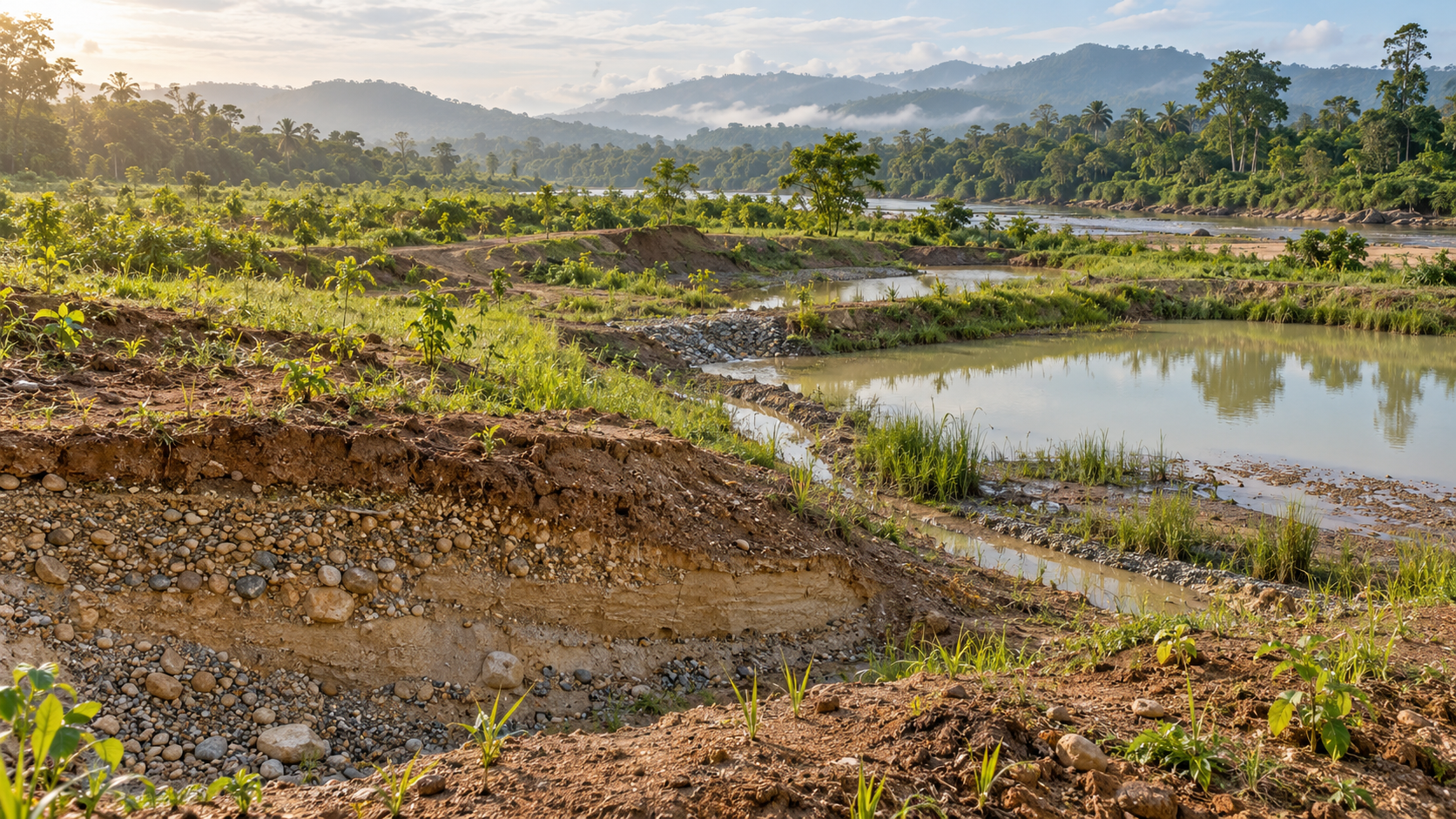
Alluvial gemstone mining involves recovering gemstones from unconsolidated sediments.
These may include gravel, sand, clay and other materials deposited by flowing water.
Mining methods range from small manually excavated pits to mechanised operations.
The environmental effects depend strongly on the location and excavation technique.
Soil disturbance
Excavation removes or redistributes soil layers.
If fertile surface soil is mixed with deeper material, the land may become less suitable for agriculture or natural vegetation.
Sediment movement
Washing gemstone-bearing gravel can produce water containing suspended particles.
If this water is discharged without adequate treatment, it may increase sediment concentrations in nearby waterways.
Riverbank erosion
Mining near rivers can destabilise banks or alter sediment transport.
Poorly controlled excavation may contribute to changes in channel shape and local erosion.
Habitat disturbance
Removing vegetation and excavating land can affect habitats used by plants and animals.
Open excavations
Abandoned pits may create safety hazards and interfere with subsequent land use.
These effects are not inevitable to the same degree at every site.
Appropriate planning, water management and rehabilitation can reduce environmental disturbance.
However, alluvial mining should not automatically be described as environmentally harmless simply because the gemstones occur in loose sediment.
4. Gemstone Mining in Sri Lanka: A Documented Example
Sri Lanka provides an important example because gemstone extraction has a long history and remains economically significant.
The country is especially well known for sapphire and other gemstones recovered from secondary deposits.
The National Gem and Jewellery Authority of Sri Lanka identifies several methods used in the country’s gemstone industry.
These include pit mining, tunnelling, surface placer mining and riverbed dredging.
The authority also describes environmental management practices associated with licensed operations.
These include environmental assessments, sedimentation ponds, water reuse and rehabilitation requirements.
Excavated overburden may need to be stored separately.
The authority recommends beginning rehabilitation during mining rather than postponing it until extraction has ended.
This is an important principle.
However, the existence of official guidelines does not establish that every mining operation follows them successfully.
Academic research has documented environmental problems associated with gemstone extraction in Sri Lanka.
A study published in 2025 by researchers at the University of Sri Jayewardenepura examined environmental changes associated with illegal gemstone mining in the Ratnapura region.
The researchers identified concerns involving vegetation removal, soil disturbance, altered land use, water contamination and damage associated with poorly controlled excavation.
The findings demonstrate why regulation and practical enforcement matter.
They also illustrate the need to distinguish between recognised environmental management practices and the conditions observed at individual mining sites.
5. What Happens When a Gemstone Mine Closes?
Mine closure is the process through which a mining operation is brought to an end and the site is prepared for its intended future condition.
It involves more than stopping extraction.
Depending on the operation, closure may include removing equipment, stabilising excavations, managing waste, reshaping disturbed land and addressing water-related risks.
The site may also require revegetation and continued environmental monitoring.
A properly planned closure process considers these activities before mining begins.
This allows environmental management to be incorporated into the operational design.
The International Finance Corporation’s Environmental, Health and Safety Guidelines for Mining provide technical guidance covering several mining methods, including underground mining, open-pit mining, alluvial extraction and dredging.
The guidelines address environmental risks associated with mining operations and the need for appropriate management measures.
Mine closure objectives should reflect the characteristics of the particular site.
A former alluvial gemstone pit may require a different rehabilitation approach from a deep underground mine.
Likewise, a site located beside a river requires different considerations from one situated on a dry hillside.
There is no single restoration method suitable for every gemstone deposit.
6. Mine Rehabilitation Versus Ecological Restoration
The terms rehabilitation and ecological restoration are sometimes used interchangeably.
However, they do not necessarily describe identical objectives.
Mine rehabilitation
Mine rehabilitation generally involves making disturbed land safe, stable and suitable for an agreed future use.
This may include stabilising slopes, managing water, replacing soil and establishing vegetation.
The final land use may be agricultural, ecological, recreational or another appropriate purpose.
Ecological restoration
Ecological restoration focuses on assisting the recovery of a degraded ecosystem.
Its objectives may include restoring native vegetation, ecological processes, habitat structure and biodiversity.
The Society for Ecological Restoration distinguishes ecological restoration from other forms of environmental repair.
Its international standards emphasise the importance of reference ecosystems, measurable objectives and long-term monitoring.
A rehabilitated mine site is not necessarily a fully restored ecosystem.
For example, an excavated area may be reshaped and covered with grass.
This could reduce erosion and make the land safer.
However, it does not automatically recreate the biodiversity or ecological functions of the original landscape.
This distinction is essential when evaluating environmental claims.
7. Why Mine Restoration Should Begin Before Closure
One of the most important principles of responsible mining is progressive rehabilitation.
This means that restoration activities begin while mining continues.
Instead of leaving every disturbed area untreated until the operation ends, sections that are no longer required can be rehabilitated progressively.
For example, a small alluvial gemstone operation may excavate one section of a deposit while rehabilitating an earlier section.
Suitable excavated material can be returned to completed areas.
Surface soil can be replaced where appropriate.
Drainage can be stabilised.
Vegetation can then be re-established.
Progressive rehabilitation offers several potential advantages.
It can reduce the total area of exposed ground.
It may limit erosion and sediment movement.
It can also reduce the amount of unfinished rehabilitation work remaining when extraction stops.
However, the effectiveness of progressive rehabilitation depends on site conditions and implementation.
A poorly designed rehabilitation programme may still produce unsatisfactory environmental results.
The Intergovernmental Forum on Mining, Minerals, Metals and Sustainable Development identifies mine closure and post-mining transition as important components of responsible mineral governance.
Its Mining Policy Framework also addresses the importance of financial mechanisms that support rehabilitation obligations.
8. The Importance of Topsoil
Topsoil plays a major role in successful land rehabilitation.
It often contains organic matter, nutrients, microorganisms and seeds.
These components support vegetation and soil biological processes.
During excavation, topsoil may be removed to access the underlying gemstone-bearing material.
If it is mixed indiscriminately with deeper geological material, some of its useful characteristics may be lost.
Consequently, rehabilitation planning often includes separating and preserving suitable surface soil.
However, topsoil management is more complex than simply storing a pile of earth.
Storage conditions can influence soil structure, biological activity and seed viability.
The suitability of replacement soil also depends on its physical and chemical characteristics.
For example, some excavated materials may have unsuitable acidity, salinity or other properties for plant growth.
Successful rehabilitation therefore requires understanding the local soil environment.
The United States Geological Survey has identified surface soil, overburden characteristics, climate and landform design as important factors influencing revegetation success at reclaimed mining sites.
Although much of this research concerns coal mining rather than gemstones, the underlying principles of soil management and vegetation establishment are relevant to disturbed-land rehabilitation more broadly.
9. Why Refilling a Mining Pit Is Not Always Enough
Refilling an excavation is often an important part of mine rehabilitation.
However, backfilling alone does not guarantee that the land has been restored successfully.
Several factors must be considered.
The returned material should be suitable for its intended position.
The final surface should be stable.
Drainage should not create excessive erosion.
The land should not contain dangerous voids or unstable excavations.
The soil should be capable of supporting the intended vegetation or land use.
If unsuitable material is returned without proper management, the site may experience settlement, poor drainage or reduced soil productivity.
The original soil layers may also have been permanently altered.
In some circumstances, restoring the exact original landform is neither technically feasible nor the agreed rehabilitation objective.
The appropriate outcome must therefore be determined through site-specific planning.
A successfully filled pit may be an important step toward rehabilitation.
It should not automatically be described as complete ecological restoration.
10. Water Management During and After Gemstone Mining
Water is an important part of many gemstone mining operations.
It may be used to wash gravel, separate minerals or control dust.
Groundwater may also enter excavations.
The environmental challenges depend on the local hydrology and the composition of the excavated material.
Suspended sediment
Water used for washing gemstone-bearing gravel may contain fine particles.
If released directly into rivers, these particles can increase turbidity and sediment deposition.
Sedimentation ponds
Settling ponds allow suspended particles to separate from water through gravity.
They can form part of a system for reducing sediment discharge.
Water reuse
Water can sometimes be circulated through several stages of washing and sediment removal.
This may reduce the demand for additional water.
Groundwater disturbance
Excavations may intersect groundwater.
Pumping or altered drainage can affect local water levels.
Long-term water quality
Some mining environments contain minerals capable of releasing potentially harmful substances under certain conditions.
Water management may therefore remain important after mining has ended.
The National Gem and Jewellery Authority of Sri Lanka describes sedimentation tanks, silt traps and water reuse as practices promoted for gemstone gravel washing.
These measures illustrate how relatively straightforward engineering techniques can help manage sediment-related impacts.
However, their effectiveness depends on appropriate design, maintenance and actual operating conditions.
11. Acid Mine Drainage: An Important Scientific Distinction
Acid mine drainage is frequently discussed in relation to mining pollution.
However, it should not be assumed that every gemstone mine produces acidic drainage.
Acid mine drainage develops when certain sulphide-bearing minerals are exposed to oxygen and water.
Oxidation reactions can generate acidity.
Under suitable conditions, this acidity may increase the mobility of some metals.
The United States Environmental Protection Agency identifies acid mine drainage as a significant problem at certain abandoned mining sites.
However, the risk depends on the mineralogical composition of the excavated material.
A gemstone deposit consisting mainly of relatively stable silicate minerals does not automatically present the same acid-generation risk as a sulphide-rich ore deposit.
Conversely, a gemstone-bearing geological environment containing reactive sulphide minerals may require additional assessment.
The correct approach is to investigate the actual geology and geochemistry of the site.
This distinction is important because the environmental characteristics of metal mining should not be applied indiscriminately to all gemstone operations.
12. Restoring Vegetation After Mining
Vegetation can help stabilise rehabilitated land.
Plant roots may reduce erosion.
Vegetation can contribute organic matter to developing soils.
It may also support the recovery of habitats and ecological processes.
However, planting vegetation is not the same as restoring an ecosystem.
The selection of plant species matters.
Introducing unsuitable species may create additional ecological problems.
In some environments, native vegetation may be the most appropriate choice.
In others, a carefully planned transitional approach may be necessary.
Successful revegetation depends on several conditions.
These include soil quality, water availability, climate, slope stability and the ecological characteristics of the surrounding landscape.
A site may initially appear successful because vegetation grows rapidly.
However, long-term ecological recovery requires more than temporary green cover.
The vegetation should remain viable under local conditions.
Where ecological restoration is the objective, the developing plant community should also contribute to the recovery of native ecosystem functions.
The Society for Ecological Restoration’s international standards emphasise the importance of using suitable ecological reference conditions and measurable recovery objectives.
13. Biodiversity Recovery Takes Time
Mining can affect biodiversity through several mechanisms.
Vegetation removal may reduce available habitat.
Excavation may disturb soil organisms.
Changes in water flow can influence aquatic environments.
Noise, traffic and other operational activities may also affect wildlife.
Restoration aims to address these disturbances where feasible.
However, biodiversity recovery may take considerably longer than the physical reshaping of a mining site.
For example, a restored landscape may develop vegetation relatively quickly.
But the return of specialised plant communities, soil organisms and wildlife may require much more time.
Some ecological relationships may not recover completely.
The International Union for Conservation of Nature has published guidance addressing biodiversity management throughout the mining life cycle.
The guidance emphasises the importance of considering biodiversity during planning, operation and closure.
This approach recognises that restoration is more effective when ecological concerns are addressed before extensive damage occurs.
Avoiding unnecessary disturbance is generally preferable to relying entirely on restoration after the fact.
14. River Restoration After Gemstone Extraction
Gemstone extraction from river environments presents particular challenges.
Rivers are dynamic systems.
Their channels, sediment deposits and banks change naturally through erosion and deposition.
Mining can interfere with these processes.
Removing sediment may change local channel geometry.
Excavation near riverbanks can influence stability.
Sediment discharged during washing may affect downstream conditions.
A study conducted through the University of Peradeniya examined the effects of riverbed dredging in tributaries of Sri Lanka’s Kalu Ganga basin.
The research investigated how gemstone extraction can affect riverbed conditions and sediment movement.
These findings illustrate why river-based mining requires careful environmental assessment.
Restoring a disturbed river environment is not simply a matter of returning excavated sediment.
The relationship between water flow, sediment transport, channel stability and surrounding habitats must be considered.
In some circumstances, natural processes can contribute to recovery.
In others, active intervention may be required.
The appropriate approach depends on the extent of disturbance and the characteristics of the river system.
15. Abandoned Mines and Their Long-Term Consequences
Not every mining operation ends with successful rehabilitation.
Some sites are abandoned without adequate closure measures.
The reasons may include financial difficulties, inadequate regulation, unexpected geological conditions or the absence of an effective closure plan.
Abandoned sites can create several problems.
Open excavations may present safety hazards.
Unstable ground can threaten nearby infrastructure.
Waste material may remain exposed.
Water quality problems may continue.
Vegetation may struggle to re-establish.
The United States Environmental Protection Agency maintains programmes addressing abandoned mine lands.
Its guidance recognises that former mining sites may require investigation, risk assessment and remediation.
The environmental conditions vary considerably between sites.
Some abandoned excavations may present relatively limited contamination risks but substantial physical hazards.
Others may require complex water treatment or waste management.
The existence of an abandoned mine does not automatically mean that severe chemical pollution is present.
However, it does demonstrate why mine closure planning and adequate financial resources are important.
16. Who Pays for Mine Restoration?
Environmental rehabilitation requires resources.
Excavations may need to be filled.
Landforms may require stabilisation.
Water-management infrastructure may need maintenance.
Soils and vegetation may need to be restored.
Monitoring may continue after extraction ends.
These activities involve financial costs.
If a mining operator closes without completing its obligations, responsibility may become difficult to resolve.
In some circumstances, public authorities may be required to address abandoned-site risks.
This is one reason why mine closure financial assurance is an important element of mineral governance.
Financial assurance mechanisms can include bonds or other approved forms of security.
Their purpose is to help ensure that funds are available for rehabilitation obligations if the operator fails to complete them.
The Intergovernmental Forum on Mining addresses these issues in its Mining Policy Framework and accompanying guidance.
However, requirements vary between jurisdictions.
The existence of financial assurance does not automatically prove that the available amount is sufficient.
Nor does it establish that rehabilitation has been completed successfully.
The adequacy of funding and the quality of implementation must be assessed separately.
17. Small-Scale Mining: Lower Impact or Different Risks?
Many natural gemstones are recovered through artisanal and small-scale mining.
Such operations can provide important income opportunities for local communities.
They may involve relatively simple equipment and labour-intensive extraction methods.
However, small-scale mining is not automatically environmentally responsible.
An individual operation may disturb a relatively limited area.
Yet numerous small excavations concentrated within one watershed can create cumulative environmental effects.
Poorly managed pits may remain open.
Water discharge may be uncontrolled.
Vegetation removal may affect sensitive habitats.
Conversely, a small operation using appropriate excavation, sediment management and rehabilitation techniques may limit certain environmental impacts.
The environmental outcome depends on actual practices.
The World Bank recognises artisanal and small-scale mining as an important source of livelihoods.
Its programmes have addressed challenges involving market access, capacity development and the resilience of mining communities.
Responsible sourcing must therefore consider environmental management alongside economic and social realities.
A simplistic distinction between small-scale mining as good and industrial mining as bad does not provide an adequate scientific assessment.
18. Environmental Impact Is Not the Same as Carbon Footprint
The environmental performance of gemstone production cannot be described accurately using a single indicator.
Carbon emissions are one important consideration.
However, they do not represent every environmental effect.
A mining operation may have relatively low fuel consumption while still causing significant local sediment pollution.
Another operation may require substantial energy but implement effective water treatment and land rehabilitation.
Environmental assessment should therefore consider several dimensions.
These may include:
- Land disturbance
- Water consumption
- Water quality
- Soil degradation
- Biodiversity
- Energy consumption
- Greenhouse gas emissions
- Waste management
- Mine closure performance
These indicators describe different environmental processes.
They should not be treated as interchangeable.
A claim that a gemstone has a low carbon footprint does not establish that its extraction caused no damage to local waterways.
Similarly, evidence of successful revegetation does not by itself establish that the mining operation had low greenhouse gas emissions.
Responsible environmental communication requires clearly identifying what has actually been measured.
19. Can a Gemstone Be Called Sustainable?
The word sustainable is frequently used in gemstone marketing.
However, it can be difficult to evaluate without a clear definition and supporting evidence.
A gemstone may be natural.
It may have been mined by hand.
It may come from a country with established environmental regulations.
None of these characteristics independently establishes that its extraction was environmentally sustainable.
A meaningful sustainability claim should identify the specific practices or outcomes being described.
For example, a mining operation might document the use of sedimentation ponds.
Another might provide records of completed rehabilitation.
A third might demonstrate compliance with environmental monitoring requirements.
These are specific, potentially verifiable claims.
They are more informative than a general statement that a gemstone is environmentally friendly.
Even documented compliance with a particular standard does not necessarily establish that all environmental impacts have been eliminated.
The strongest claims are limited to the evidence available.
20. The Difference Between Traceability and Sustainability
Traceability and sustainability are related but distinct concepts.
Traceability
Traceability concerns the ability to follow a gemstone through stages of its supply chain.
Depending on the available records, this may include information about the mining location, trading intermediaries, cutting workshop and subsequent ownership.
Sustainability
Sustainability concerns environmental, social and economic performance.
A traceable gemstone is not automatically sustainable.
Knowing the location of a mine does not prove that the operation followed responsible environmental practices.
Likewise, a gemstone may have been extracted using relatively careful methods without complete commercial traceability.
Both forms of information are valuable.
However, they answer different questions.
A responsible gemstone description should distinguish between documented geographical origin, supply-chain information and verified environmental performance.
21. What Can Gemstone Buyers Ask About Responsible Sourcing?
Consumers cannot normally conduct environmental inspections of gemstone mines.
However, they can ask informed questions.
The following considerations provide a useful framework.
Is the geographical origin documented?
Origin information can help establish where the gemstone was recovered.
However, it does not independently establish environmental performance.
Is the mining method known?
Information about alluvial, underground or surface extraction can provide useful context.
The environmental implications still depend on local conditions.
Are environmental management practices documented?
Relevant examples may include water management, waste handling and rehabilitation planning.
Is there independent verification?
Where environmental claims are important, independent evidence can provide stronger support than general marketing statements.
Are claims appropriately limited?
Statements such as natural, untreated, traceable and responsibly sourced describe different characteristics.
They should not be used interchangeably.
Is uncertainty acknowledged?
A supplier may not possess complete information about every stage of a gemstone’s history.
Acknowledging those limitations is more credible than making unsupported claims.
These questions encourage informed purchasing without implying that every gemstone must have identical documentation.
22. The Role of Scientific Monitoring
Mine rehabilitation should be evaluated through measurable outcomes.
Visual appearance alone may be misleading.
A site covered with vegetation may still experience soil instability or water-quality problems.
Conversely, a recently rehabilitated area may appear relatively bare while undergoing an appropriate recovery process.
Monitoring can provide more reliable information.
Relevant indicators may include soil stability, vegetation establishment, water quality, erosion rates and habitat recovery.
The selection of indicators depends on the site’s rehabilitation objectives.
The Society for Ecological Restoration’s 2026 international standards emphasise measurable performance indicators and the importance of evaluating ecological recovery over time.
Monitoring also supports adaptive management.
If a restoration measure does not produce the expected result, the approach can be revised.
For example, unsuccessful vegetation establishment may indicate problems involving soil quality, drainage or species selection.
Monitoring should therefore be understood as part of restoration rather than merely an administrative requirement.
23. When Can a Former Mine Be Considered Successfully Rehabilitated?
There is no universal visual test that proves successful mine rehabilitation.
The assessment depends on the agreed closure objectives and applicable regulatory requirements.
A site intended for agricultural use may be evaluated differently from one intended for native habitat recovery.
However, several broad principles are relevant.
The land should be physically stable.
Significant safety hazards should be addressed.
Water-related risks should be managed.
The soil should be suitable for the intended future use.
Vegetation should be established where required.
Any necessary long-term management obligations should be identified.
For ecological restoration projects, additional objectives may concern native biodiversity and ecosystem function.
Successful rehabilitation therefore requires more than completing a list of physical activities.
It requires demonstrating that the intended outcomes have been achieved.
The distinction between completing rehabilitation work and verifying its success is important.
24. What Mine Restoration Cannot Always Achieve
Environmental restoration has limitations.
Some geological and ecological changes may be difficult or impossible to reverse completely.
A removed geological formation cannot simply be recreated.
Original soil horizons may take long periods to develop.
Complex ecosystems may not return to their previous condition.
Some hydrological changes may persist.
This does not mean that rehabilitation is ineffective.
It means that environmental management should prioritise avoiding unnecessary damage wherever possible.
Restoration is an important response to disturbance.
It should not be used as a justification for assuming that every environmental impact can be reversed.
The Society for Ecological Restoration’s standards recognise different levels of ecological recovery.
This provides a more realistic framework than treating restoration as a simple choice between complete success and complete failure.
25. The Natural Gems Belgium Perspective
Natural gemstones are geological materials formed through natural processes.
Their mineral identity, physical properties and geological origin can be studied scientifically.
However, the fact that a gemstone is natural does not establish that its extraction was environmentally harmless.
Similarly, an untreated gemstone is not automatically an environmentally sustainable gemstone.
These are different characteristics.
At Natural Gems Belgium, accurate gemstone education requires distinguishing between what is known, what can be verified and what remains uncertain.
A gemstone’s natural origin concerns its formation.
Its treatment status concerns modifications made to the material.
Its geographical provenance concerns where it originated or was recovered.
Its environmental history concerns the circumstances of extraction and subsequent land management.
These categories should remain separate.
A gemstone can possess excellent gemmological quality without complete information about the environmental performance of its mine.
Likewise, environmental documentation does not replace accurate mineral identification or treatment disclosure.
Responsible communication should present each form of information according to the evidence available.
26. Common Misconceptions About Gemstone Mining
Misconception 1: Natural gemstones are automatically environmentally friendly.
Incorrect.
Natural formation does not establish the environmental impact of extraction.
Misconception 2: Small-scale gemstone mining never causes serious environmental damage.
Incorrect.
Small operations can cause significant local disturbance, particularly when numerous excavations affect the same area.
Misconception 3: Alluvial mining has no environmental impact.
Incorrect.
Alluvial extraction can disturb soils, waterways, riverbanks and habitats.
Misconception 4: Every gemstone mine produces acid mine drainage.
Incorrect.
Acid generation depends on the geological and geochemical characteristics of the excavated material.
Misconception 5: Refilling a mining pit completely restores the ecosystem.
Incorrect.
Backfilling may improve safety and stability, but ecological recovery involves additional processes.
Misconception 6: Planting trees proves successful ecological restoration.
Incorrect.
Restoration requires considering ecosystem suitability, native biodiversity and measurable recovery.
Misconception 7: Knowing a gemstone’s country of origin proves responsible sourcing.
Incorrect.
Geographical origin and environmental performance are different forms of information.
Misconception 8: Mine restoration begins only after extraction ends.
Incorrect.
Progressive rehabilitation can begin during mining operations.
Misconception 9: A low carbon footprint means that mining caused no environmental damage.
Incorrect.
Carbon emissions represent only one aspect of environmental impact.
Misconception 10: Environmental restoration can always recreate the original landscape.
Incorrect.
Some geological and ecological changes may be irreversible or require exceptionally long recovery periods.
27. A Practical Framework for Understanding Gemstone Mining Impacts
The following comparison summarises several important environmental considerations.
| Mining environment | Potential environmental concern | Relevant management approach |
|---|---|---|
| Alluvial gravel deposits | Soil disturbance and sediment release | Controlled excavation, sediment management and rehabilitation |
| Riverbed deposits | Channel disturbance and bank erosion | Hydrological assessment and appropriate river protection |
| Surface excavations | Vegetation removal and unstable slopes | Landform stabilisation and revegetation |
| Underground workings | Ground stability and water-management risks | Engineering assessment and appropriate closure measures |
| Gravel washing operations | Suspended sediment in wastewater | Sedimentation systems and water reuse |
| Abandoned excavations | Safety hazards and unfinished rehabilitation | Site assessment, stabilisation and remediation |
| Disturbed natural habitats | Loss of vegetation and ecological function | Biodiversity planning and ecological restoration |
| Sulphide-bearing geological environments | Potential acid generation and metal mobilisation | Geochemical assessment and suitable water management |
These examples describe possible risks and management approaches.
They do not imply that every gemstone mine experiences every listed problem.
Actual environmental performance must be assessed at the individual site.
Conclusion: Responsible Gemstone Mining Extends Beyond Extraction
A natural gemstone begins its history through geological processes.
Its extraction connects that geological history with human activity.
Mining can create economic opportunities and provide materials valued for their beauty, rarity and scientific interest.
However, it can also disturb landscapes, waterways and ecosystems.
The environmental consequences depend on the mining method, geological conditions, operational practices and effectiveness of rehabilitation.
Mine closure is therefore an important part of responsible mineral extraction.
A well-planned operation should consider the future condition of the land before extraction begins.
Progressive rehabilitation can reduce the amount of disturbed land remaining at closure.
Water management can help limit sediment-related impacts.
Appropriate soil handling and vegetation establishment can support land recovery.
Long-term monitoring can provide evidence of whether rehabilitation objectives are being achieved.
Yet restoration also has limitations.
Not every ecological change can be reversed completely.
For this reason, preventing unnecessary environmental disturbance remains essential.
For gemstone buyers and collectors, the most important lesson is that environmental responsibility cannot be determined from appearance, mineral species or country of origin alone.
It requires evidence about actual practices and outcomes.
The story of a natural gemstone does not end when it leaves the Earth.
The environmental responsibility associated with its extraction continues long after the gemstone has entered the market.
Understanding that responsibility is an important part of modern gemstone education.
References & Further Reading
The following references have been selected from governmental institutions, international environmental organisations, official mining authorities and academic research.
They provide scientific and regulatory context for gemstone mining, environmental disturbance, mine closure, rehabilitation and ecological restoration.
All references lead to informational, institutional or research publications rather than commercial gemstone product pages.
1. International Finance Corporation – Environmental, Health and Safety Guidelines for Mining
Institution: International Finance Corporation, World Bank Group
Publication: 2007
The IFC’s mining guidelines provide internationally recognised technical guidance on environmental, occupational and community risks associated with mining.
They cover underground mining, open-pit extraction, alluvial mining and dredging.
The publication provides a useful foundation for understanding environmental management throughout the mining life cycle.
2. National Gem and Jewellery Authority of Sri Lanka – Gemstone Mining Industry
Institution: National Gem and Jewellery Authority, Sri Lanka
An official overview of gemstone mining methods and environmental management practices in Sri Lanka.
The publication discusses pit mining, tunnelling, placer mining, riverbed dredging, environmental assessments, sedimentation ponds, water reuse and rehabilitation programmes.
It is particularly relevant because it concerns gemstone extraction directly rather than mining in general.
3. Withana, W. B. A., et al. – Environmental Changes Caused by Illegal Gem Mining in Sri Lanka
Institution: University of Sri Jayewardenepura, Sri Lanka
Publication: Proceedings of the 29th Forestry and Environment Symposium
Published: 22 April 2025
An academic investigation of environmental changes associated with illegal gemstone mining in the Ratnapura region.
The research examines vegetation removal, soil disturbance, altered land use, water contamination and infrastructure-related concerns.
It provides direct evidence of environmental problems associated with poorly controlled gemstone extraction.
https://journals.sjp.ac.lk/index.php/fesympo/article/view/8227
4. University of Peradeniya – Impact of Gem Mining by River Bed Dredging in the Upper Catchment Tributaries of Kalu Ganga, Sri Lanka
Institution: Postgraduate Institute of Science, University of Peradeniya
Published: 29 October 2021
A research investigation examining the effects of gemstone-related riverbed dredging on river morphology and sediment movement.
The study provides useful context for understanding why alluvial gemstone mining requires attention to river dynamics and hydrological conditions.
https://ir.lib.pdn.ac.lk/items/7eb1311f-2868-40f3-944b-1a07bf5b3688
5. United States Environmental Protection Agency – Abandoned Mine Lands
Institution: United States Environmental Protection Agency
An official resource explaining the environmental and public-health concerns associated with abandoned mining sites.
The EPA discusses site investigation, cleanup, environmental risk reduction and the challenges associated with historical mining operations.
https://www.epa.gov/superfund/abandoned-mine-lands
6. United States Environmental Protection Agency – Abandoned Mine Drainage
Institution: United States Environmental Protection Agency
An educational resource explaining the chemical processes responsible for acid mine drainage.
The publication describes how sulphide-bearing geological materials can react with oxygen and water, potentially generating acidic drainage and mobilising metals.
It is useful for distinguishing genuine geochemical risks from unsupported generalisations about gemstone mining.
https://www.epa.gov/nps/abandoned-mine-drainage
7. Intergovernmental Forum on Mining, Minerals, Metals and Sustainable Development – Mining Policy Framework
Institution: Intergovernmental Forum on Mining, Minerals, Metals and Sustainable Development
Framework updated: 2023
An international policy framework addressing environmental management, mine closure, post-mining transition and artisanal and small-scale mining.
The accompanying guidance discusses rehabilitation obligations, financial assurance and responsible mineral governance.
8. International Union for Conservation of Nature – Good Practice Guidance for Mining and Biodiversity
Institution: International Union for Conservation of Nature
Developed with: International Council on Mining and Metals
An international guidance publication examining biodiversity management throughout the mining life cycle.
The resource addresses the relationship between mining operations, ecosystem protection, rehabilitation and mine closure planning.
https://iucn.org/resources/grey-literature/good-practice-guidance-mining-and-biodiversity
9. Society for Ecological Restoration – International Principles and Standards for the Practice of Ecological Restoration
Institution: Society for Ecological Restoration
Third edition: June 2026
An internationally recognised framework for ecological restoration.
The standards explain the importance of reference ecosystems, measurable restoration objectives, monitoring, adaptive management and the distinction between ecological restoration and other forms of environmental repair.
https://www.ser.org/page/serstandards
10. United States Geological Survey – Reclamation of Mined Lands in the Western Coal Region
Authors: Narten, P. F., et al.
Institution: United States Geological Survey
Publication: Circular 872
Year: 1983
A scientific investigation of mine reclamation and the factors influencing revegetation success.
Although focused on coal mining rather than gemstone extraction, the research provides relevant principles concerning soil characteristics, landform design, climate and vegetation establishment.
https://www.usgs.gov/publications/reclamation-mined-lands-western-coal-region
11. World Bank – Enabling Small-Scale Miners to Weather the Impacts of COVID-19
Institution: World Bank
Published: 22 September 2022
A World Bank publication examining the economic and social importance of artisanal and small-scale mining.
The report discusses mining livelihoods, access to gemstone markets and the challenges facing small mining communities.
It provides useful context for understanding why responsible gemstone sourcing must consider social and economic conditions alongside environmental management.
12. United States Forest Service – International Principles and Standards for the Practice of Ecological Restoration
Authors: Gann, G. D., et al.
Publication: Restoration Ecology
Year: 2019
DOI: 10.1111/rec.13035
A peer-reviewed scientific publication establishing principles for ecological restoration.
The paper discusses reference ecosystems, measurable recovery objectives, stakeholder involvement, monitoring and the importance of ecological processes.
It provides a scientific foundation for distinguishing land rehabilitation from more comprehensive ecological restoration.
https://research.fs.usda.gov/treesearch/60367
Scientific Interpretation and Limitations
The environmental effects of gemstone mining vary according to geological conditions, extraction methods, operational scale and local environmental management.
The scientific findings discussed in this article should not be interpreted as evidence that all gemstone mines produce identical environmental impacts.
Likewise, the existence of official environmental regulations or recognised rehabilitation guidelines does not establish that every mining operation complies with them.
Environmental performance should be evaluated using site-specific evidence whenever possible.
The distinction between geological origin, commercial traceability and verified environmental performance is essential.
A natural gemstone’s mineral identity does not establish the environmental conditions under which it was extracted.
Responsible scientific communication should therefore distinguish documented observations from general assumptions and acknowledge uncertainty where reliable information is unavailable.